





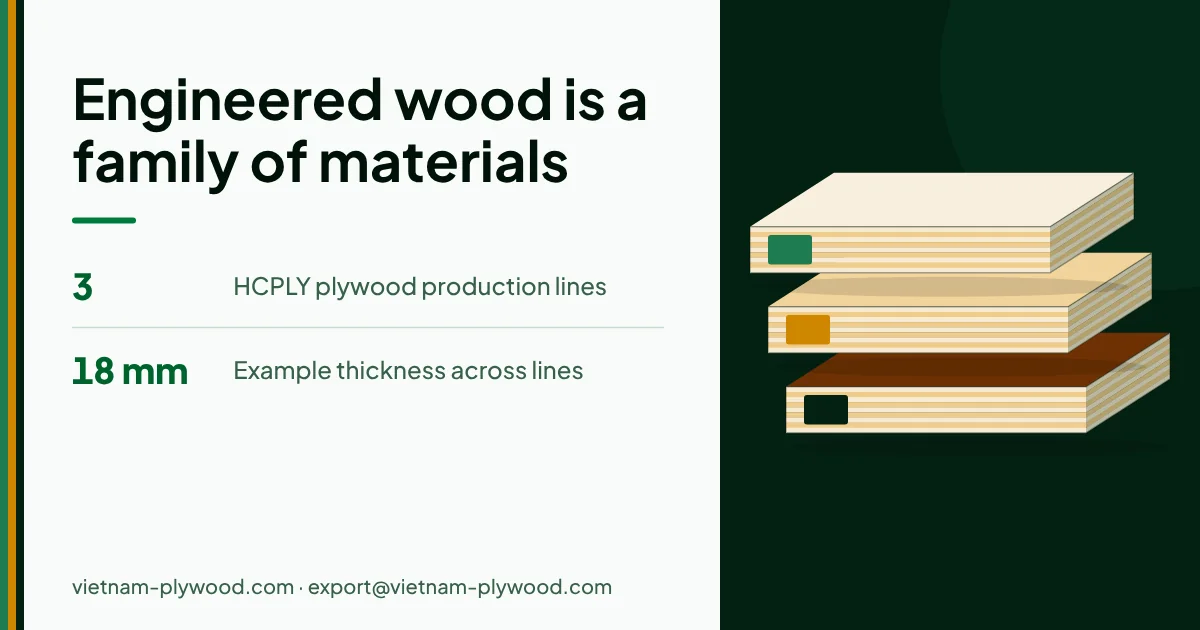
Engineered wood covers plywood, LVL, fiberboards and particle-based boards; plywood is one member of this wider family. Choosing the wrong member can mean rejected panels, extra machining costs or delayed cabinet production. At HCPLY, the useful first decision is whether a specification calls for veneer plywood and which producing line should press it.
What is engineered wood?
Engineered wood is a family of manufactured wood products assembled from veneers, strands, fibers, particles or timber pieces using adhesives or other bonding methods. Plywood, laminated veneer lumber (LVL), medium-density fiberboard (MDF), particleboard and oriented strand board (OSB) belong to that family, although their internal construction and applications differ. “Engineered wood” alone cannot identify a purchasable panel specification.
A manufactured board can have a visible wood veneer, a smooth fiber surface or a film overlay. The surface name does not reveal the internal structure. Start with the plywood types overview when comparing veneer-based panels.
Is plywood engineered wood?
Yes. Plywood is engineered wood made by bonding thin wood veneers into a panel, normally with neighboring grain directions crossed. The alternating grain directions help control movement across the sheet and provide useful panel stiffness in both directions.
LVL also uses bonded veneers, but its grain usually runs mainly in the same direction to serve lengthwise loads. An LVL beam and a cabinet plywood sheet are therefore different purchases even though both start with veneer. HCPLY’s specified production lines below make plywood; LVL is a category explained here, not a product offered by these lines.
How do plywood, MDF, particleboard, HDF and OSB compare?
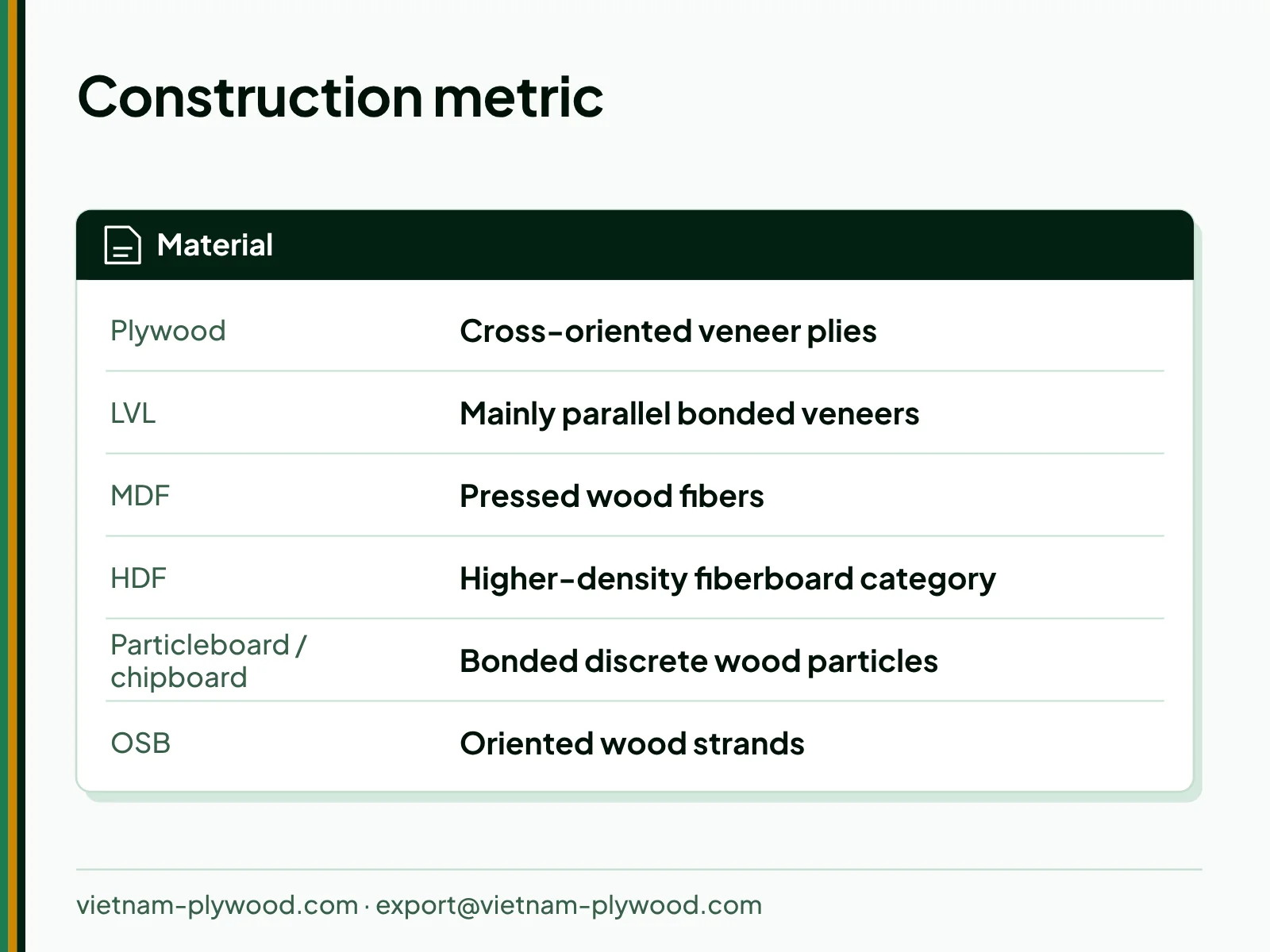
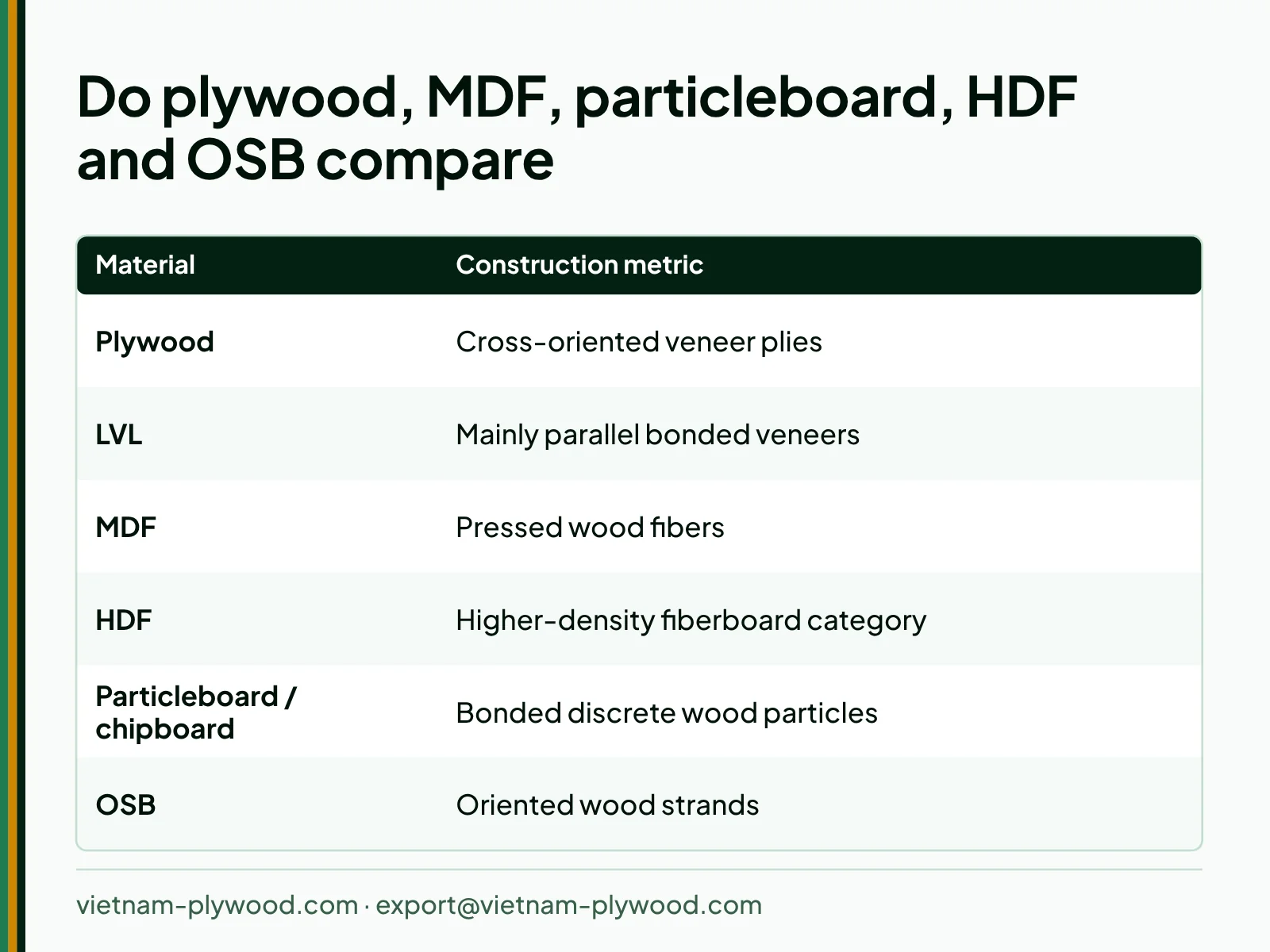
The measurable choice starts with construction and intended use, rather than a universal strength ranking. A dense fiberboard can produce a smooth paint surface while a veneer panel can provide better fastener performance for a particular cabinet joint. Test results and the actual grade govern demanding loads.
| Material | Construction metric | Surface and fastening implication | Verdict by use |
|---|---|---|---|
| Plywood | Cross-oriented veneer plies | Visible ply edges; screw performance depends on core and edge detail | Cabinet carcasses, export packing and formwork when built for the application |
| LVL | Mainly parallel bonded veneers | Directional member; specify load design and grade | Engineered beams and long members, sourced separately |
| MDF | Pressed wood fibers | Uniform machining and paint substrate; edges need suitable fixing | Painted routed components |
| HDF | Higher-density fiberboard category | Dense smooth surface; verify actual grade | Thin high-density substrates |
| Particleboard / chipboard | Bonded discrete wood particles | Edge fixing and moisture exposure need special attention | Dry, cost-sensitive cabinet components |
| OSB | Oriented wood strands | Distinct strand texture and graded structural applications | Sheathing where an accepted grade is specified |
Particleboard is itself engineered wood, so “engineered wood versus particleboard” compares a category with one member. For focused purchase decisions, see plywood versus chipboard, MDF or plywood and HDF plywood versus MDF panels.
Is engineered wood the same as MDF or particleboard?
No. MDF and particleboard are two members of the wider engineered-wood category. MDF is formed from fibers, while particleboard is formed from discrete particles. Plywood instead uses veneer layers, so specifying “engineered wood” without naming the construction leaves three very different material possibilities.
The US Environmental Protection Agency, in its formaldehyde-rule stakeholder guidance, identifies hardwood plywood, MDF and particleboard as three regulated composite-wood product groups under Toxic Substances Control Act Title VI. The EPA guidance distinguishes those groups from OSB and structural composite lumber, which are excluded from that particular rule; exclusion from this rule does not make them non-engineered wood. Read the EPA’s product definitions.
What is the difference between plywood and laminated wood?
Plywood describes a panel’s layered veneer construction. Laminated wood is a broader expression that can describe bonded timber laminations, laminated veneer lumber or a decorative surface bonded onto a board. A laminate face does not identify the core.
For a cabinet order, distinguish a decorative veneer face, a melamine-faced chipboard, a high-pressure laminate surface and a film-faced plywood panel. They have different core constructions and finishing routes. HCPLY does not press melamine-faced chipboard, MDF, OSB, HPL-faced or laminate-faced product lines. Compare the terms in melamine-faced chipboard and UV-coated plywood.
Which engineered wood panels do our factories press?
Our three factories press veneer plywood for different orders. HCPLY assigns each specification to the producing factory: our furniture line handles sanded furniture plywood, our commercial and packing line handles commercial and packing plywood, and our construction line handles film-faced formwork plywood. We do not press LVL, MDF, OSB, chipboard, blockboard, bamboo panels, MDO, HDO, 3-ply spruce panels or birch-core plywood.
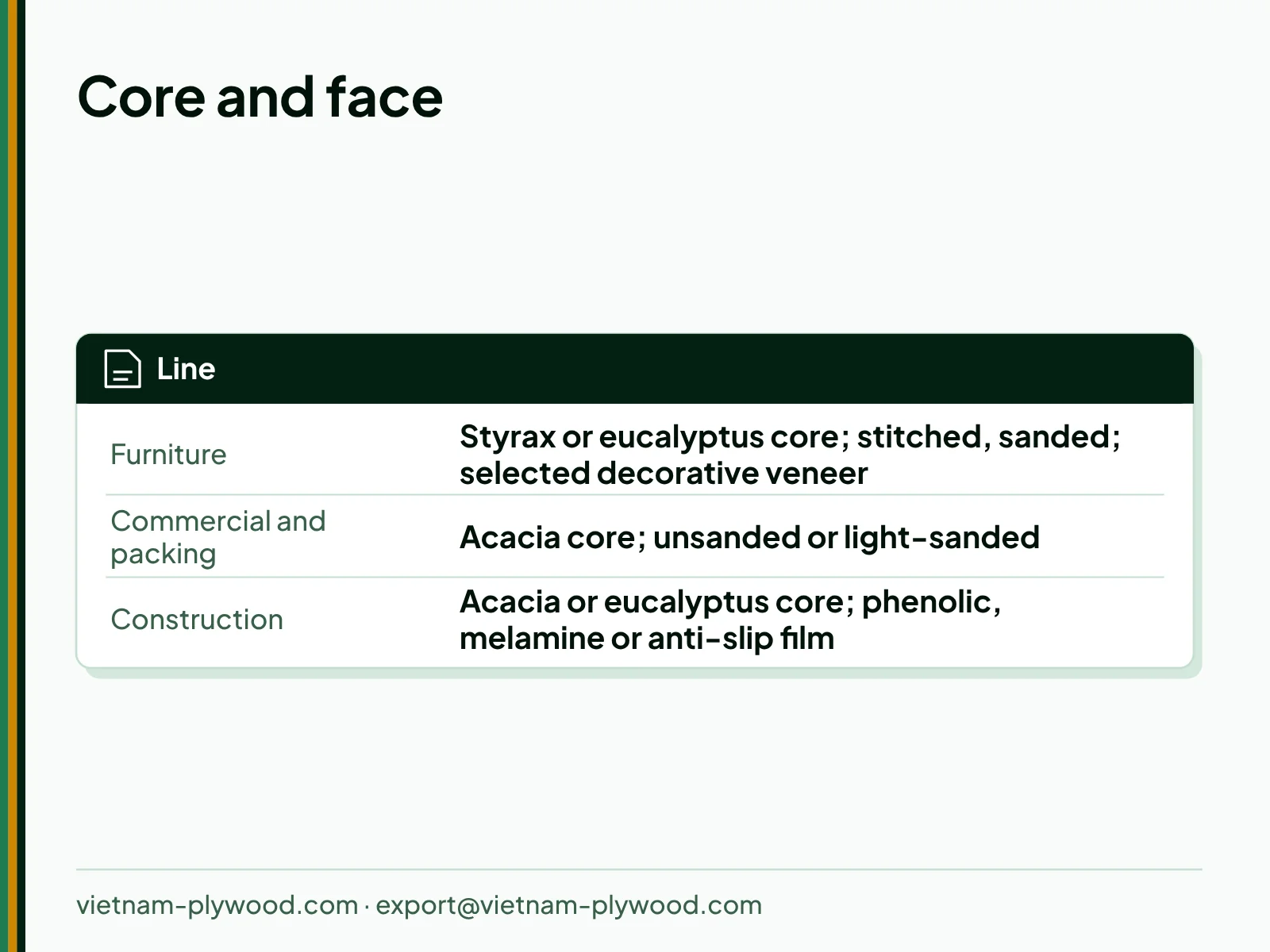
| Line | Core and face | 18 mm thickness tolerance | Appropriate request |
|---|---|---|---|
| Furniture | Styrax or eucalyptus core; stitched, sanded; selected decorative veneer | ±0.2 or ±0.3 mm as ordered | Cabinet and furniture components |
| Commercial and packing | Acacia core; unsanded or light-sanded | ±0.5 mm commercial; ±0.5–1.0 mm packing | Commercial sheets or export packaging |
| Construction | Acacia or eucalyptus core; phenolic, melamine or anti-slip film | ±0.5 mm | Concrete formwork |
The same nominal 18 mm dimension therefore represents three different builds. The face names the product, while density follows the core. For detailed furniture choices, see the hardwood plywood guide and commercial plywood export specification.
Which specification fields distinguish one plywood build from another?
A workable purchase specification names the application, veneer or film face, core species, core construction, adhesive, emission class, dimensions and inspection criteria. “Furniture engineered wood 18 mm” leaves the core, finish and tolerance unresolved.
HCPLY furniture cores use styrax or eucalyptus with full stitched construction, sanding and E0 or E1 emission classes. Commercial and packing plywood uses acacia with moisture-resistant (MR) glue; construction panels use phenolic or melamine film and acacia or eucalyptus cores. Glue and emissions are separate fields: melamine MR is described by a 12-hour boil, phenolic weather-and-boil-proof (WBP) by a 72-hour boil; E0, E1 and E2 describe emission classes. An American CARB P2 / TSCA Title VI requirement calls for the applicable third-party certification evidence, rather than a glue nickname.
Common face veneer thickness is 0.2–0.4 mm. Available plywood thickness spans 3–40 mm; standard sizes include 1220 × 2440 mm and 1250 × 2500 mm. Write the required tolerance and face grade into the order, including whether the panel is sanded.
Can different plywood builds travel in one container?
Yes. Specifications can be mixed in a 40-foot high-cube container within its 28.5-tonne payload limit, provided the loading plan accounts for the core density and pallet arrangement. At 18 mm and 1220 × 2440 mm, the reference full-container loads are 990 styrax sheets at 26.52 tonnes, 880 acacia sheets at 27.35 tonnes and 795 eucalyptus sheets at 27.69 tonnes, excluding film weight.
Those full loads are alternatives, not quantities to add together. A mixed load needs a new pallet-by-pallet weight and space check against the limit. See container packing calculations for the loading topic and several plywood types in one order for the ordering approach.
What can a buyer inspect at the producing factory?
A buyer can witness the face, cut edge, panel thickness, sanding and pallet marking against the agreed specification at the producing factory. An exposed edge reveals whether the core is stitched, edge-joined or loosely laid; measuring across several sheets tests the agreed thickness tolerance.
Ask the inspector to sample panels from identified bundles and record measurements against the approved order. Inspect visible veneer joints, core gaps, film continuity and edge sealing according to the intended application. A visual check cannot replace a laboratory emission result or a structural test report.
Factory certificates, including FSC, CARB P2, ISO 9001 and CE where relevant, are shown with factory details masked, on request. The applicable certificate or test report must match the producing factory and the agreed build.
What should I ask for when a specification only says engineered wood?
Ask the project designer to name the panel family first: plywood, MDF, particleboard, OSB or LVL. Then obtain the service environment, load or fastening requirement, finish and acceptance test before choosing a grade. If the answer is plywood, specify core, glue, emission class, face, thickness, tolerance and size in writing.
For a plywood quotation, HCPLY can allocate the agreed build to its relevant line. The minimum order is one 40HC; mixed specifications are possible within the payload limit. Furniture plywood starts from US$350/m³ FOB Hai Phong (October 2026) and commercial plywood from US$250/m³ FOB Hai Phong (October 2026). Core selection, face grade, sanding, construction and quantity affect the final quotation; other builds require a written specification rather than a generic price.
A shipment’s commercial invoice, packing list and bill of lading identify the ordered goods and their movement; the order’s emission certificate or test reports address agreed compliance requirements. For EU lots, the documentation includes the relevant EUTR/EUDR file set. After loading, the draft shipping documents come to you for approval.
How do I turn the definition into a factory-ready request?
Send a single specification with the exact panel family and intended application. If the design actually requires MDF, particleboard, OSB or LVL, request that material from a producer of that category instead of substituting a plywood description. For plywood, use the fields below and contact our export team with the drawings or acceptance requirements.
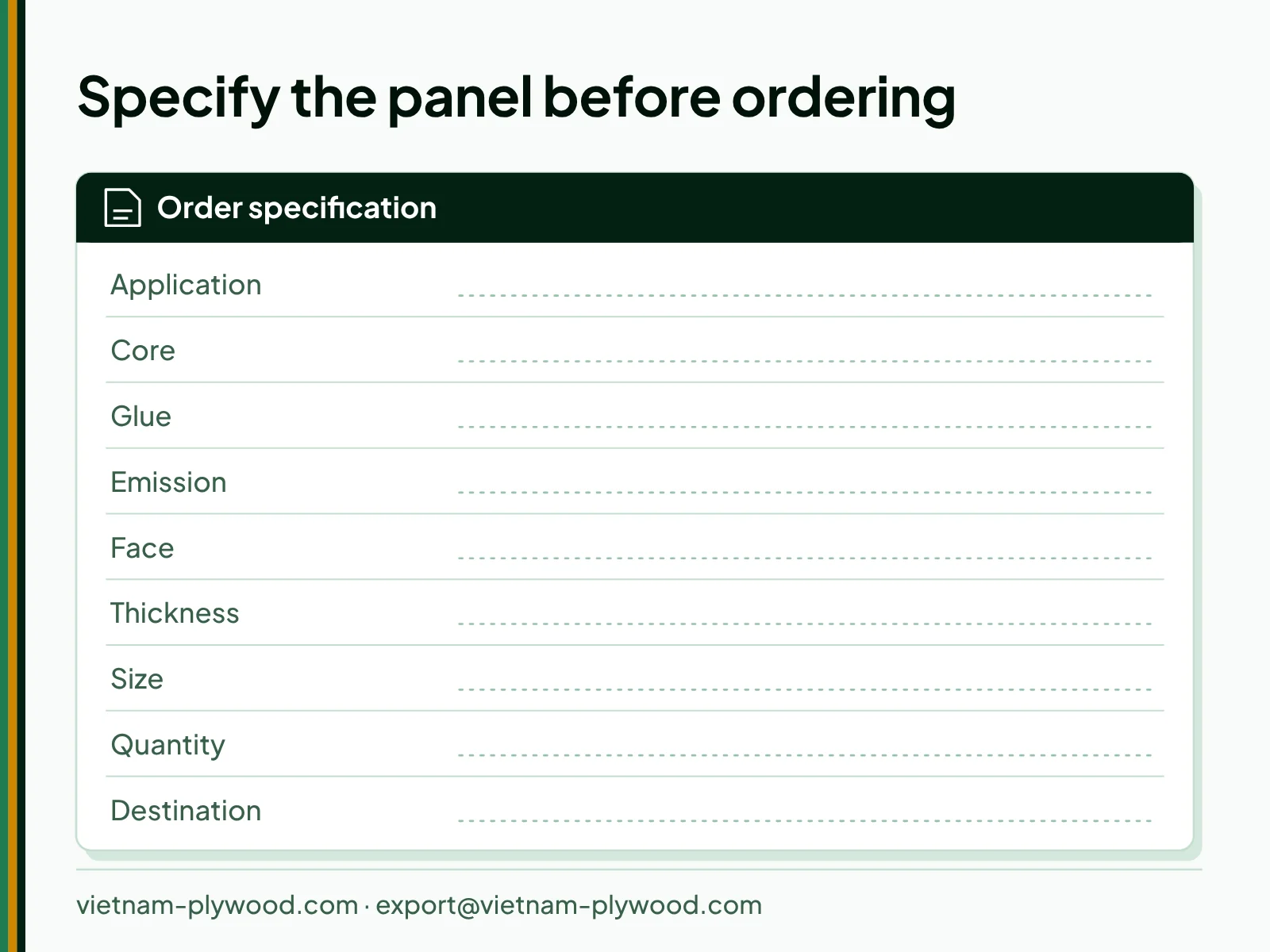
Application: cabinet carcass / commercial packing / concrete formwork
Line or core: furniture—styrax or eucalyptus / commercial—acacia / construction—acacia or eucalyptus
Glue: MR melamine / WBP phenolic, as specified
Emission: E0 / E1 / E2 / applicable market certification requirement
Face and grade: veneer species and A/B grade, or film type and weight
Thickness and tolerance: ___ mm; ±___ mm
Size: ___ × ___ mm
Quantity: ___ sheets / ___ 40HC
Destination port: ___
Next step: book a factory visit with Lucy at export@vietnam-plywood.com to inspect the producing factory and review the intended build.