





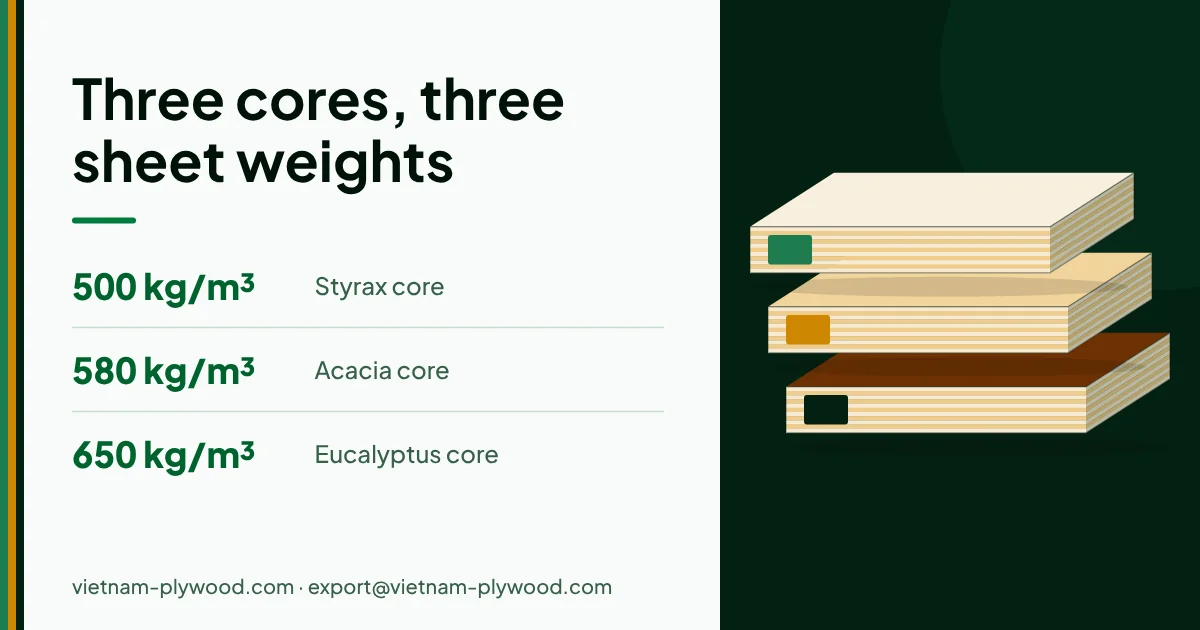
HCPLY’s lightweight plywood option is a 500 kg/m³ styrax-core furniture build, lighter than its acacia and eucalyptus alternatives at equal dimensions. Choosing by weight alone can cost money through failed fixings, damaged edges or rejected assemblies. The right purchase specification pairs a measured sheet mass with a joint test and an approved finish.
What is the lightest lightweight plywood available from Vietnam?
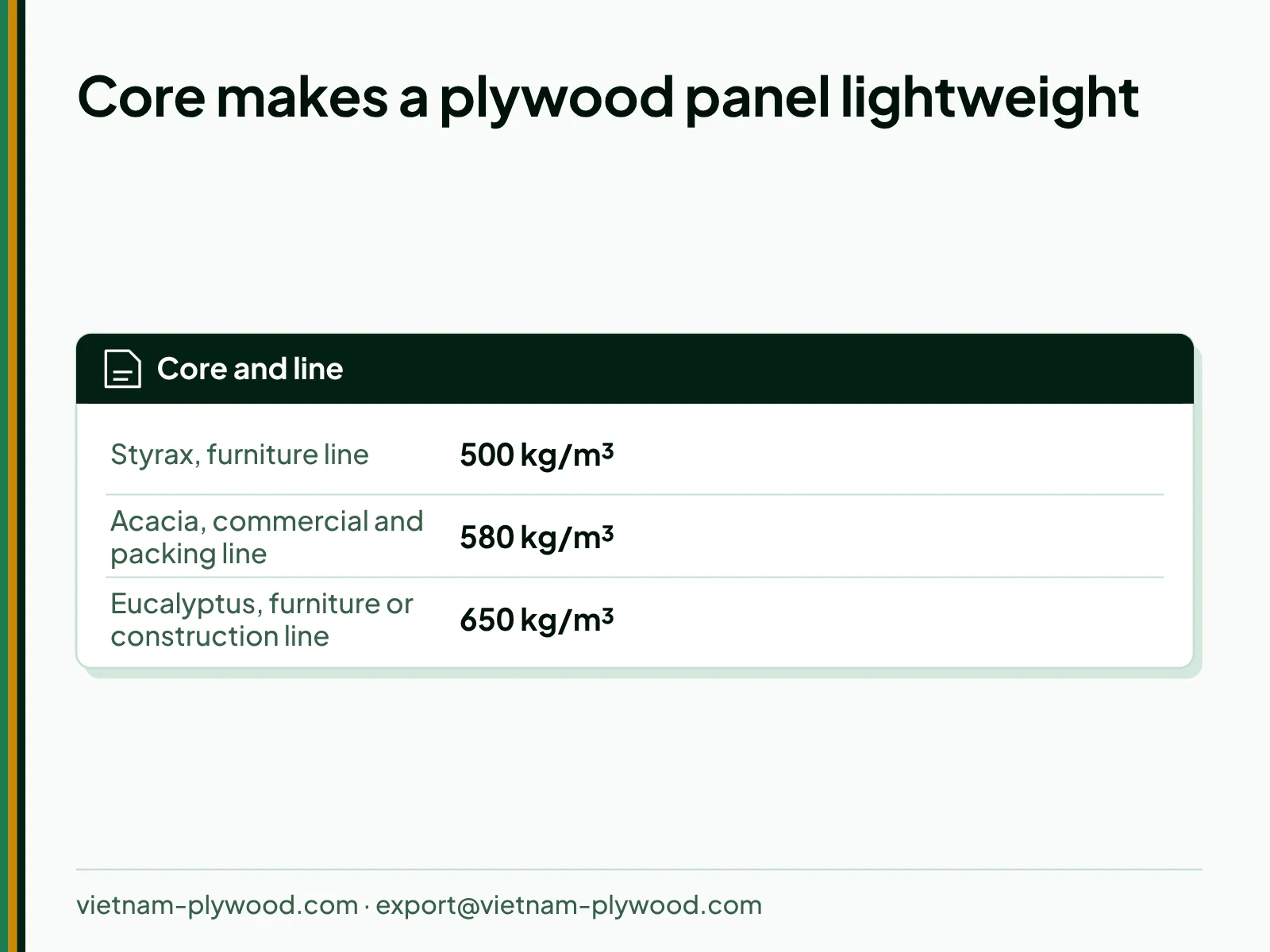
For these orders, styrax-core plywood at 500 kg/m³ is the lightest specified core. That is lighter than our acacia at 580 kg/m³ and eucalyptus at 650 kg/m³, when sheet dimensions match. It is not a claim that styrax is the lightest species sold anywhere in Vietnam: specialty paulownia and falcata products require separate supplier evidence and sample testing.
The meaningful purchasing question is whether the lighter panel still holds the intended hardware and survives machining. A lighter core saves handling and transport mass, but a rejected cabinet component can erase that benefit. Our furniture line supplies a furniture build with a full-stitched, sanded styrax core and a selected decorative face. The face names the product; the core sets the reference density. A birch face, for example, does not make the core birch.
For an adjacent product comparison, see poplar plywood from Vietnam. Poplar is a face option in our specification, not a fourth core species. Ask for the actual core construction and density rather than inferring them from the product name.
Which core makes a plywood panel lightweight?
Styrax is the lightest of our three specified cores: 500 kg/m³ versus acacia at 580 kg/m³ and eucalyptus at 650 kg/m³. For a 1220 × 2440 × 18 mm panel, the corresponding reference weights are approximately 26.79, 31.08 and 34.83 kg. These are nominal sheet weights; weigh the finished samples for purchase acceptance.
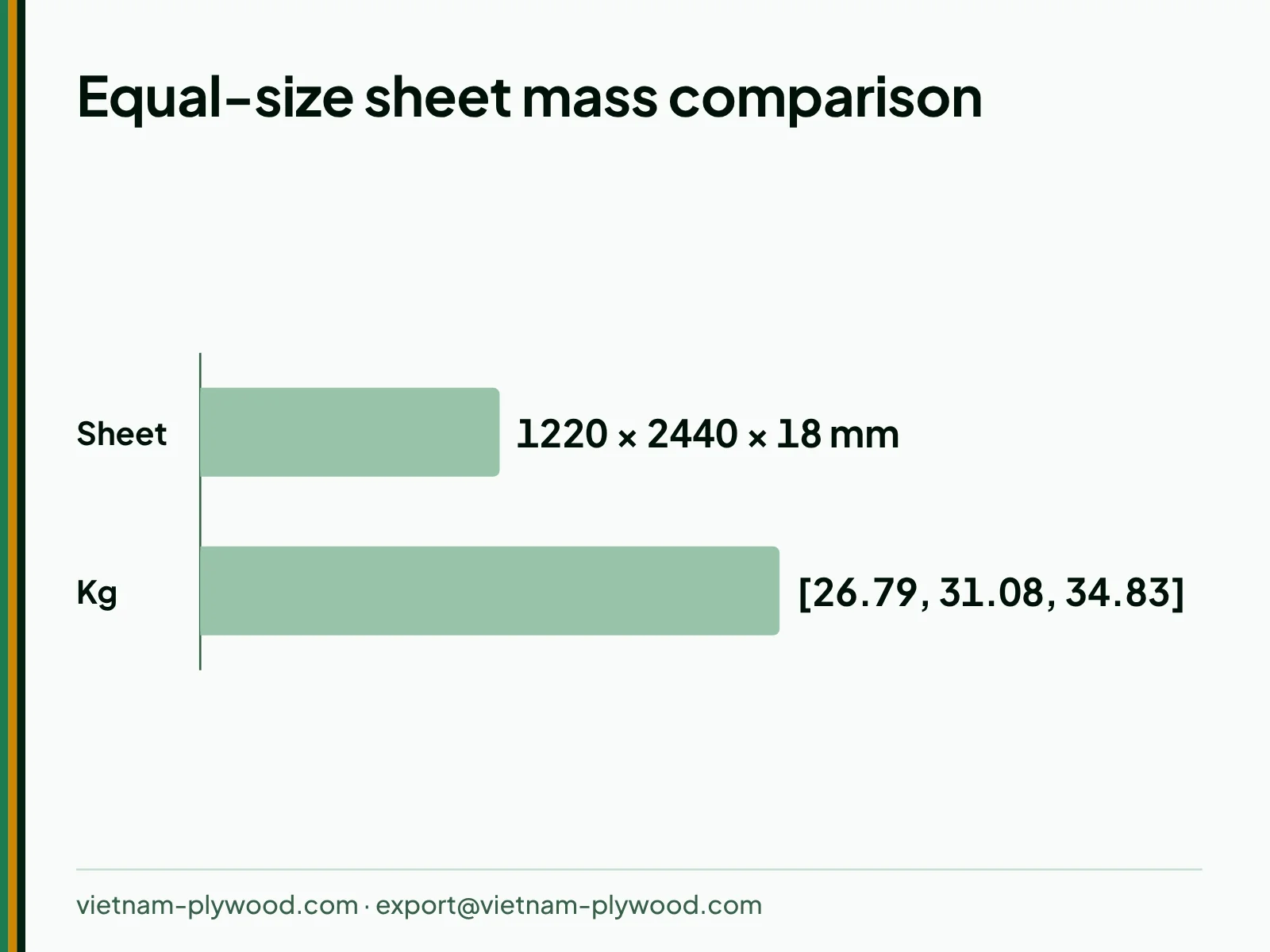
| Core and line | Reference density | 18 mm sheet mass | Relative mass | Verdict by use |
|---|---|---|---|---|
| Styrax, furniture line | 500 kg/m³ | 26.79 kg | Lightest of these cores | Weight-sensitive faced furniture and vehicle interiors |
| Acacia, commercial and packing line | 580 kg/m³ | 31.08 kg | Heavier than styrax | Packing panels where an MR, unsanded build fits |
| Eucalyptus, furniture or construction line | 650 kg/m³ | 34.83 kg | Heaviest of these cores | Compare when fastening and service demands outweigh mass |
The table is a controlled comparison at identical nominal dimensions. Actual panel weight needs a sample weighing because moisture, veneer selection and manufacturing details affect finished mass. Our furniture line accepts styrax or eucalyptus cores, full-stitched construction, sanding and E0/E1 emission specifications. Our commercial and packing line specifies acacia core with moisture-resistant (MR) glue and an unsanded or light-sanded finish. Our construction line uses acacia or eucalyptus under phenolic, melamine or anti-slip film; it is not the route for a decorative light furniture panel.
A buyer asking for a styrax-core crate panel should distinguish the desired engineering concept from the stated commercial-line specification. We can discuss a weight-sensitive packing requirement, but must not present styrax as a standard commercial-line build. The factory-line grade comparison explains why a shared thickness does not imply an interchangeable build.
What does a lighter styrax core give up in screw-holding and edge strength?
A lighter styrax core can give up screw withdrawal resistance, edge crushing resistance and local bearing performance relative to a denser core. The size of the difference is unverified until the intended joint is tested. Density alone cannot supply a safe fastener load for a particular panel.
The US Department of Agriculture Forest Service’s 2021 Wood Handbook, Chapter 8, covers fastenings and joint design. Its official Chapter 8 publication page explains that fastening design must account for wood strength along and across the grain and moisture-related dimensional changes. This supports testing the assembly rather than assigning a universal screw-holding rating to lightweight ply.
For cabinet hinges, drawer runners and vehicle furniture fixings, test the exact screw diameter, pilot hole, embedment, edge distance and number of fastening cycles. Compare withdrawal from the face with withdrawal from the edge; they are different failure modes. Test after the panel has been cut, edged and conditioned as it will be in service. A decorative veneer can improve appearance without solving weak core-edge anchorage.
A practical specification can move heavily loaded joints into rails, inserts or a verified reinforcement detail. Do not assume a thicker face veneer repairs a weak core joint. When fastening loads dominate, a denser eucalyptus-core furniture build deserves a parallel prototype, even though its reference sheet mass is higher.
How does styrax compare with falcata and paulownia?
Styrax is the known 500 kg/m³ core; falcata and paulownia are outside our three specified cores. They are relevant imported alternatives, but their actual panel density, construction, screw performance and quote must come from the supplying mill’s documents and representative samples.
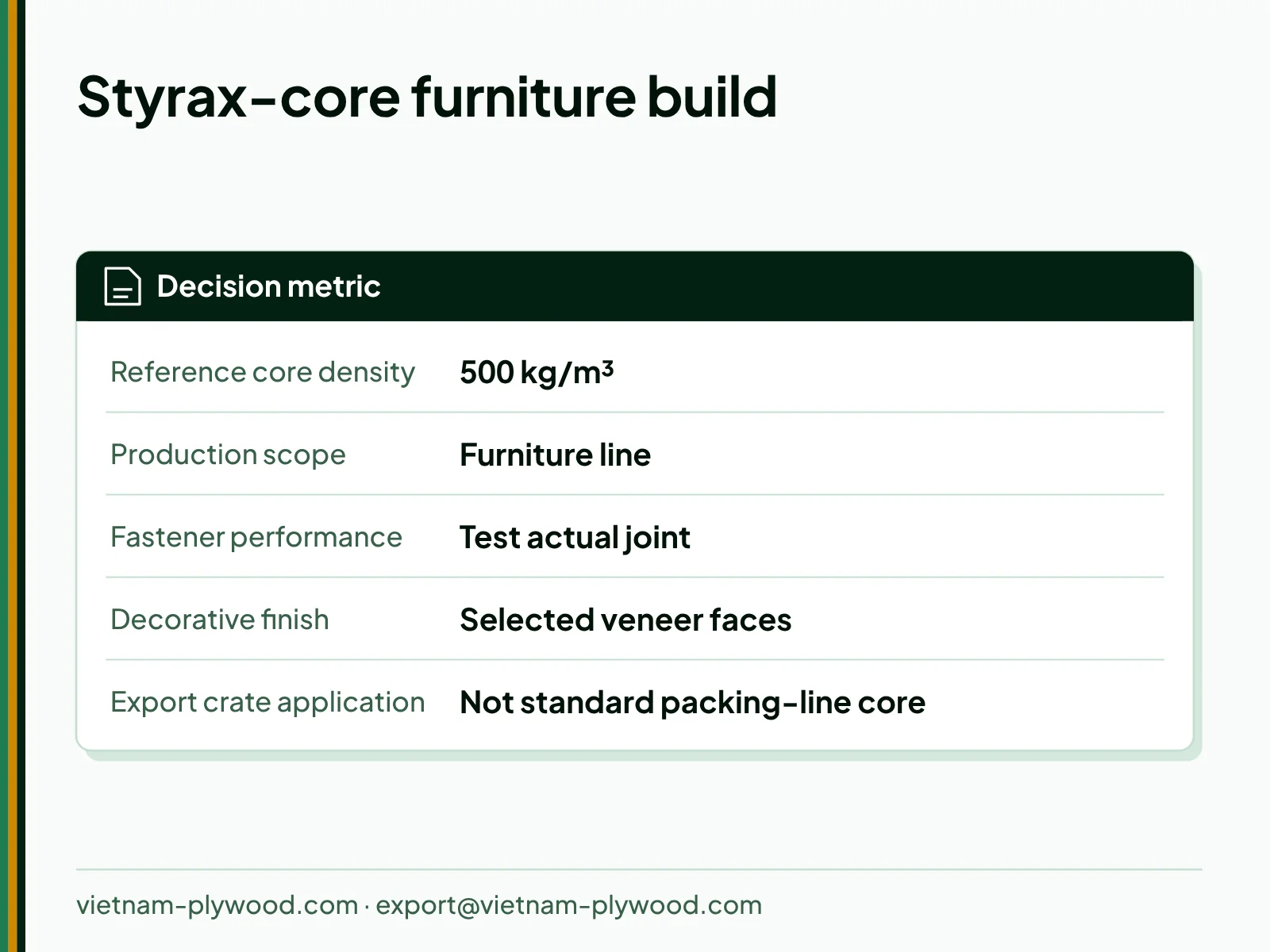
| Decision metric | Styrax-core furniture build | Falcata alternative | Paulownia alternative | Buying verdict |
|---|---|---|---|---|
| Reference core density | 500 kg/m³ | Request measured panel value | Request measured panel value | Compare equal sizes and moisture conditions |
| Production scope | Furniture line | Not an offered core | Not an offered core | Do not substitute names on an order |
| Fastener performance | Test actual joint | Test actual joint | Test actual joint | Choose by pass/fail assembly test |
| Decorative finish | Selected veneer faces | Supplier-specific | Supplier-specific | Approve physical samples |
| Export crate application | Not standard packing-line core | Supplier-specific | Supplier-specific | Validate crate design and shipment mass |
The independent 2026 Vinawood lightweight panel overview discusses paulownia, poplar, okoume and composite cores. Its product-category figures are comparative market descriptions, not verified properties of our output or a universal acceptance specification. Morland’s lightweight ply catalogue also shows how finish, size and substrate are sold as separate choices. We do not press foam-core or honeycomb panels, medium-density fibreboard (MDF), oriented strand board (OSB), chipboard, blockboard, bamboo or birch-core plywood.
The Woodexy paulownia listing supplied as a benchmark did not expose readable product specifications during this review. Its precise density, grade and availability therefore remain unverified. Do not turn an inaccessible listing into an engineering comparison.
Is lightweight plywood suitable for vehicle interiors and furniture?
Styrax-core furniture plywood is a candidate for non-structural vehicle interior fittings and furniture when the finished assembly passes the buyer’s requirements. It is not a structural vehicle approval, crash-performance claim or fire-rating claim. The responsible choice separates mass reduction from the service tests the finished product must pass.
Use full-stitched core construction for visible furniture panels where internal gaps could disrupt machining or edge treatment. Select a face from bintangor, okoume, engineered veneer (EV), gurjan, pine, poplar, eucalyptus, birch or sapele, then specify the face grade. Our ordinary face grades are A/B; birch face grades are D/E/F. A matt specification means an unfaced raw core, not a special lightweight species.
For cabinet makers, start with shelf span, load, fixing pattern and edge finishing method. For vehicle fit-out manufacturers, add vibration, repeated door movement and attachment to the vehicle structure. We do not assign a permitted load or service-life figure without tests of the assembly. When panels sit near moisture or temperature cycles, define the exposure and glue requirement separately from the emissions class.
Our furniture line is full-stitched and sanded with E0/E1 emissions specifications. A sanded thickness tolerance of ±0.2 or ±0.3 mm is available as ordered. Commercial and film-faced builds use ±0.5 mm; packing panels use ±0.5–1.0 mm. Length and width tolerance is ±2 mm. For appearance decisions, compare white-faced plywood options before selecting the face.
Can a lighter plywood core reduce export-crate freight weight?
Yes, a lighter core reduces calculated crate-panel mass at the same dimensions and panel count. Whether it reduces freight charges depends on the shipment’s rating basis, packaging design and payload constraint. Our standard packing-line core is acacia, so the styrax calculation below is a comparison scenario, not an offer of a styrax packing-line product.
At 1220 × 2440 × 18 mm, the core-density formula gives 26.79 kg for styrax and 31.08 kg for acacia. Compare the packed gross weights of crate prototypes built to the same dimensions before deciding whether a lighter design changes freight charges. A crate design must still pass stacking, impact and fastening checks.
For a 40-foot high-cube (40HC) shipment, the payload limit is 28.5 tonnes. At 18 mm and 1220 × 2440 mm, the reference loading patterns are 990 styrax sheets on 18 pallets, 880 acacia sheets on 16 pallets and 795 eucalyptus sheets on 15 pallets. These are different pallet configurations, so their total counts must not be read as a controlled core-only comparison. The container loading explanation owns the full loading calculation.
If a mixed shipment is planned, total each component’s cubic metres and mass before booking. A lighter sheet can create payload room, but it cannot make an untested export crate safe. Buyers should approve a finished packing prototype and check the gross packed mass rather than relying solely on the plywood density.
Which glue and emission specification belongs on the order?
Glue type and emissions class are separate order fields. Our furniture line offers E0/E1 emissions specifications, while the glue selection needs to match the intended moisture exposure. Melamine glue is described as MR with a 12-hour boil; phenolic glue as water-and-boil-proof (WBP) with a 72-hour boil for these plywood specifications. These descriptions are not automatic evidence of any independent test result.
E0, E1 and E2 refer to emission classes. CARB Phase 2 and TSCA Title VI relate to United States emission limits and third-party certification; neither is a synonym for a glue recipe. For regulated orders, ask which producing member factory’s documents and tested build apply. FSC, CARB P2, ISO 9001, CE and EUTR/EUDR documents associated with member factories are shown with factory details masked, on request.
A change from MR to WBP should be evaluated for its service requirement and manufacturing implications. Do not label a panel marine-grade or BS 1088 compliant unless a test report accepted by the buyer covers that build. Lightweight furniture plywood is not automatically suitable for wet structural service.
What specification should an importer send for light ply?
An actionable lightweight ply specification states the application, target mass and fastening requirements before it names a decorative face. A request for the lightest plywood without joint or finish criteria can select a panel that fails the intended assembly.
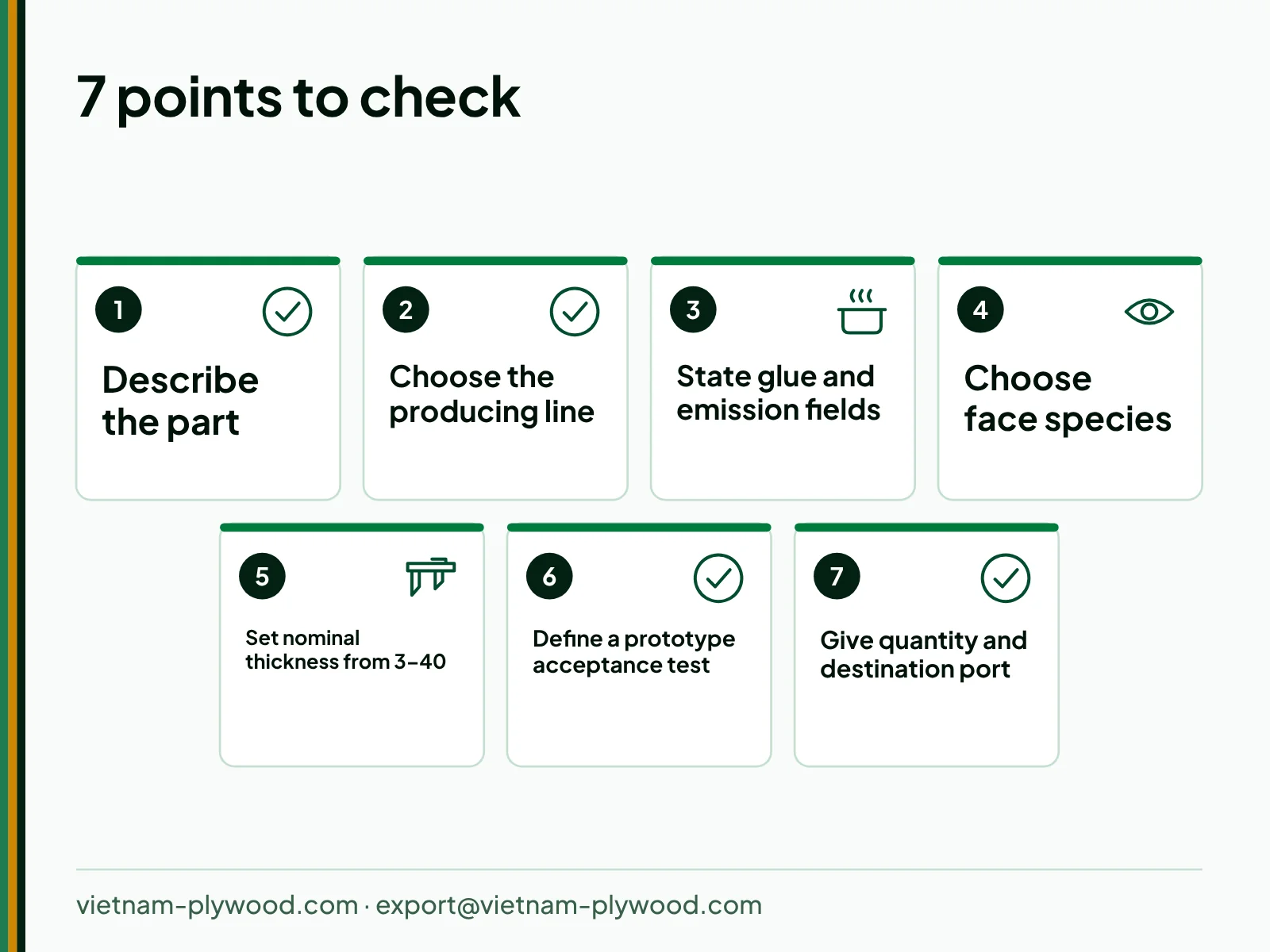
- Describe the part: cabinet carcass, vehicle interior lining, furniture door or packing component, with its support and load conditions.
- Choose the producing line and core; for our standard lightweight furniture option, specify full-stitched styrax.
- State glue and emission fields independently, with any accepted test-report requirement.
- Choose face species, grade and finish; specify 0.2–0.4 mm veneer only when that range fits the approved sample.
- Set nominal thickness from 3–40 mm, the ordered tolerance and one of the available sheet formats or custom cut dimensions.
- Define a prototype acceptance test for screw withdrawal, edge integrity, flatness and measured sheet mass.
- Give quantity and destination port so loading, documentation and commercial terms can be evaluated.
Common thicknesses are 3, 5, 9, 12, 15, 18, 21 and 25 mm. Standard formats include 1220 × 2440, 1250 × 2500, 1220 × 2135, 1220 × 1830, 915 × 2440, 915 × 2135 and 915 × 1830 mm. For 18 mm material, 11–13 plies is a reference range because core veneer thickness runs 1.4–2.0 mm. A ply count without the construction type is an incomplete quality description.
What can the buyer inspect at the producing factory?
The buyer can witness thickness checks, sample weighing, core-edge inspection and agreed fastening trials at the producing factory. These observations connect a light-core promise to the actual production batch rather than to a catalogue label.
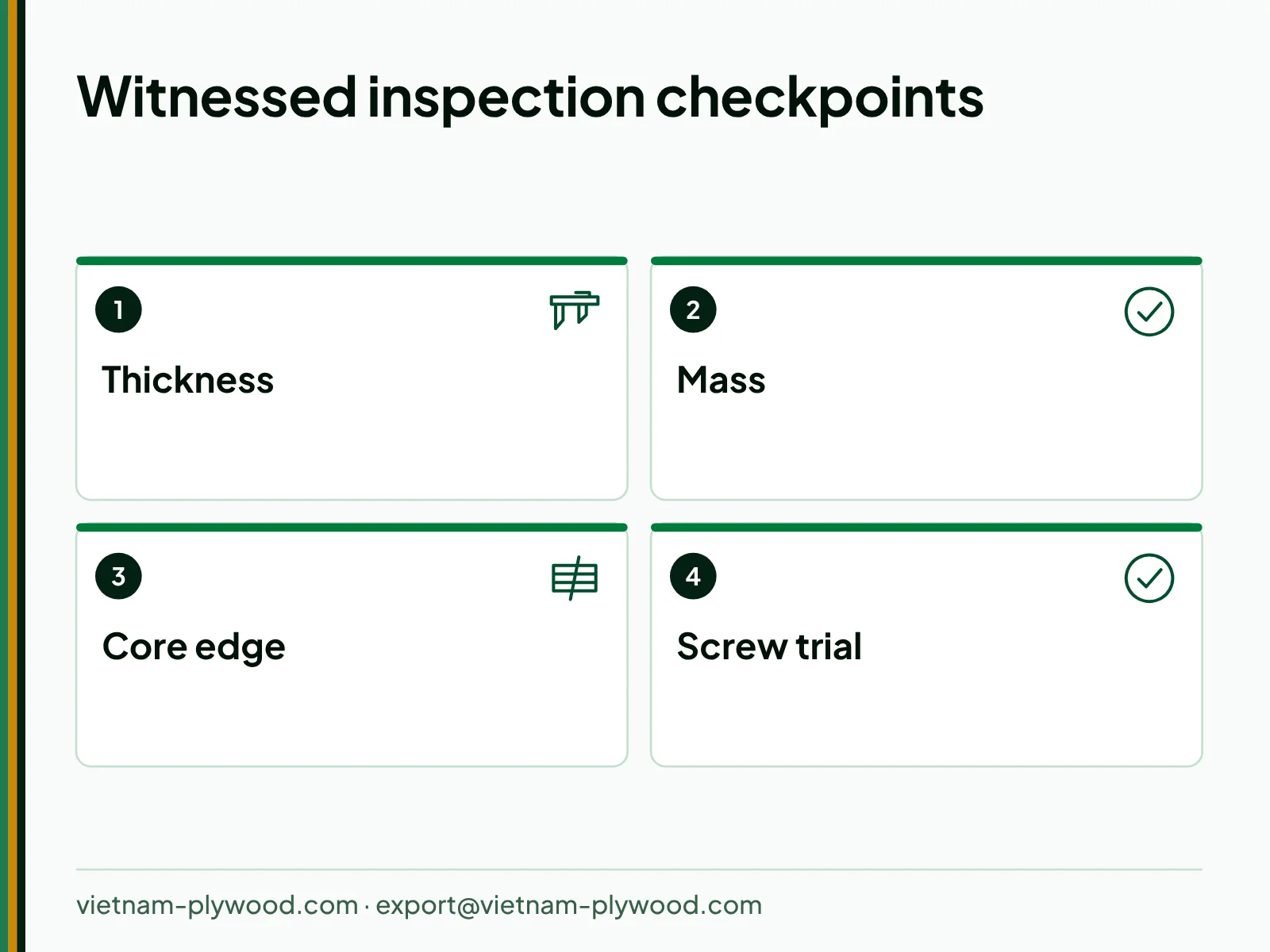
Start by identifying the batch and the approved reference sample. Measure thickness at agreed points, then weigh full-size sheets with the measurement conditions recorded. Inspect a freshly cut edge for core gaps, overlaps, poorly joined strips and visible bond defects. Full-stitched construction should be checked as an actual build feature, not inferred from the sanded face.
Next, run a repeatable hardware trial with the buyer’s screw and pilot-hole method. Record failure mode, not just whether the screw initially tightens. Inspect edge machining and banding on the finished part. Compare a styrax prototype against a denser-core alternative where joint performance is uncertain.
HCPLY coordinates specification, on-site quality control, export documents and loading. Buyers visit the factory office and inspect goods at the producing factory. A witnessed inspection is valuable evidence for that sampled batch; it is not a blanket strength certification for every application.
How should lightweight plywood be priced and shipped?
For a weight-sensitive furniture order, core selection, stitching, sanding, face species, grade, tolerance and required tests drive the quote. A full-stitched, sanded decorative furniture build costs more to prepare than a simpler unsanded packing construction because it adds core assembly, surface preparation and face selection. Request a quotation for the exact styrax-core construction and agreed tests.
The styrax-core furniture price needs a build-specific quotation. The standard acacia MR commercial construction is different from the sanded, full-stitched furniture specification. Ask for a written specification quote rather than treating unlike builds as interchangeable offers.
Minimum order is one 40HC; one container can carry several specifications as long as the payload limit holds. Factory lead time runs 15–45 days from receipt of the 30% deposit; the exact figure depends on order size, line loading and what the contract fixes. Balance is 70% against the scanned bill of lading (B/L), by telegraphic transfer (T/T) or irrevocable letter of credit (L/C) at sight. We ship FOB Hai Phong, or CFR (CNF) or CIF to your port.
Samples cost nothing: a first-time buyer pays the courier, and that charge comes off the first confirmed order. See production lead time for scheduling context. These terms do not establish an exact delivery date for a particular build.
Which shipping document records the agreed lightweight build?
The commercial invoice and packing list identify the ordered goods and shipped quantities; the agreed specification and relevant test reports substantiate the lightweight build. A density target should be written into the purchase specification and checked against the approved sample, rather than inferred from a face name on the invoice.
The shipment document set includes commercial invoice, packing list, B/L, certificate of origin, phytosanitary and fumigation papers, plus order-specific certificate documents and test reports for the agreed build. European Union lots use EUR.1 where applicable and the EUTR/EUDR file set; CIF shipments include insurance documents. After loading, the draft shipping documents come to you for approval.
For a mixed shipment, identify each panel specification on the packing list so a light furniture panel is not confused with an acacia packing board. The bill of lading establishes transport particulars; it is not a screw-withdrawal test report. Factory documents should be checked against the producing member factory and the actual ordered construction.
What should decide the final lightweight plywood choice?
Choose styrax-core furniture plywood when the calculated mass benefit is valuable and the finished part passes the specified fastening, machining and service tests. Choose a denser alternative when edge loading, repeated fixings or impact resistance dominate. The lowest panel mass alone is not an acceptance criterion.
A buyer comparing ultralight plywood, ultra lightweight plywood or a lightweight furniture board should request the same sheet dimensions and the same test method from every supplier. Falcata, paulownia and composite panels need their own evidence; they cannot inherit a styrax-core result. Ask for measured finished-sheet mass alongside the nominal core-density calculation.
For broader face and market naming differences, see Italian versus Vietnamese poplar plywood. The next action for a qualified import order is to book a factory visit with Lucy at export@vietnam-plywood.com and review the producing line and prototype together.
Application: [vehicle interior / furniture component / packing component]
Line or core: [furniture line, full-stitched styrax / other agreed build]
Glue: [MR melamine / WBP phenolic as specified]
Emission: [E0 / E1 / agreed class and evidence]
Face and grade: [species, A/B or birch D/E/F, finish]
Thickness and tolerance: [mm, ±0.2 or ±0.3 mm if furniture sanded]
Size: [L × W mm]
Quantity: [sheets / m³ / 40HC allocation]
Destination port: [port, country]