





What is white plywood?
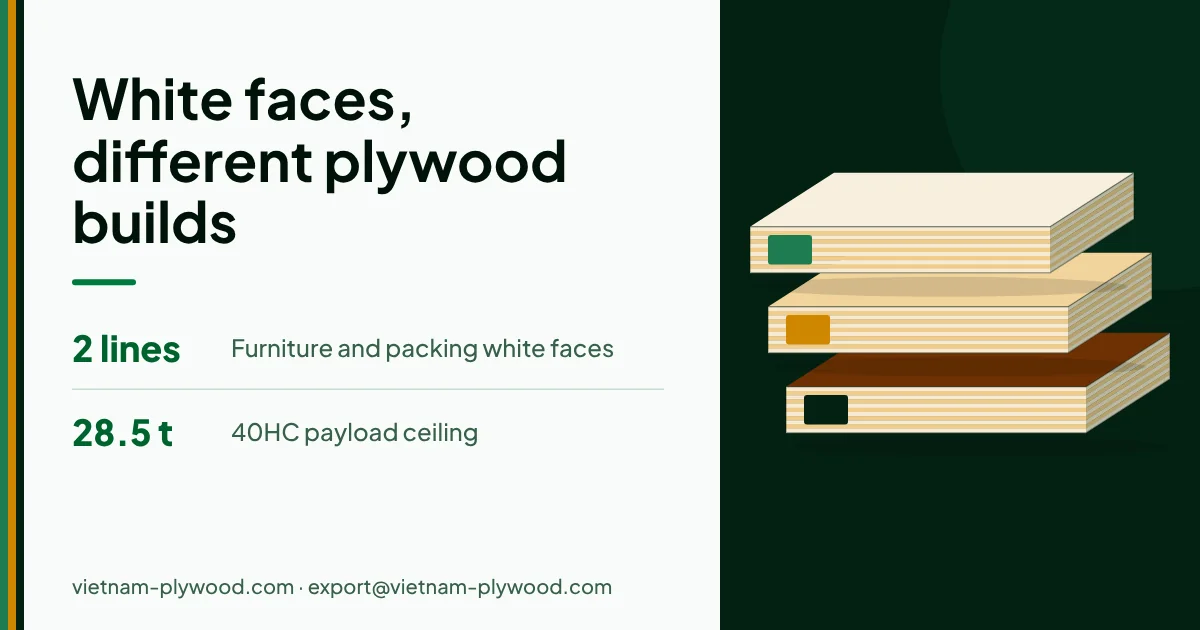
White plywood is veneer-core plywood selected for a pale natural face, a deliberately light decorative veneer, or a white surface added after panel manufacture. HCPLY makes pale-faced furniture panels and white-faced packing panels on different production lines. A wrong surface specification can mean paying for unnecessary finishing, losing production days, or receiving a load unsuitable for its intended finish.
A pale poplar veneer still shows wood grain. A bleached veneer has been treated to lighten its appearance. A white melamine overlay is a separate decorative layer applied to a suitable substrate by a laminator. Those distinctions affect the acceptable surface, edge appearance, thickness, and inspection method.
For cabinet purchasing, start with the finished appearance: visible natural grain, an even pale face for later coating, or a fully opaque white overlay. The written order should identify all three independently.
Which faces make a white panel: poplar, bleached veneer or EV?
Poplar gives a naturally pale wood appearance; bleaching and engineered veneer (EV) offer different ways to control the visual result. A buyer specifying white plywood should approve a physical face sample under the lighting used to judge the finished furniture or packing. White describes appearance, while the face species and grade describe what is actually purchased.
Poplar is a face option for our furniture line, alongside other decorative veneers. The core remains styrax or eucalyptus; a poplar face does not turn the internal plies into poplar. Our poplar plywood specification explains the face-versus-core distinction in more detail. A white poplar plywood for cabinets order should state whether the face stays visible, receives paint, or goes to a separate laminator.
Bleached birch plywood describes the treatment and appearance of a birch face. Birch is a permitted face, but its available face grades are D, E and F; do not substitute an A/B designation from another veneer species. A request for bleached material needs a sample and a written appearance target before production. Bleaching is a surface-treatment question, not evidence of a birch core; we do not press birch-core plywood.
EV can deliver a more repeated visual pattern than naturally varying veneer. It still needs an agreed sample, face grade, and finishing plan. If the purchase description says only “white ply wood,” the inspector cannot decide whether visible grain, small natural color differences, or an opaque finish is acceptable. For alternatives where low panel weight matters, compare lightweight plywood options before choosing the core.
Which of our lines presses white-faced panels?
Our furniture line presses pale decorative faces on full-stitched, sanded styrax or eucalyptus cores; our commercial and packing line makes white-faced packing builds on acacia cores. Our construction line presses film-faced formwork panels instead. The surface request therefore determines the producing factory and the inspection plan.
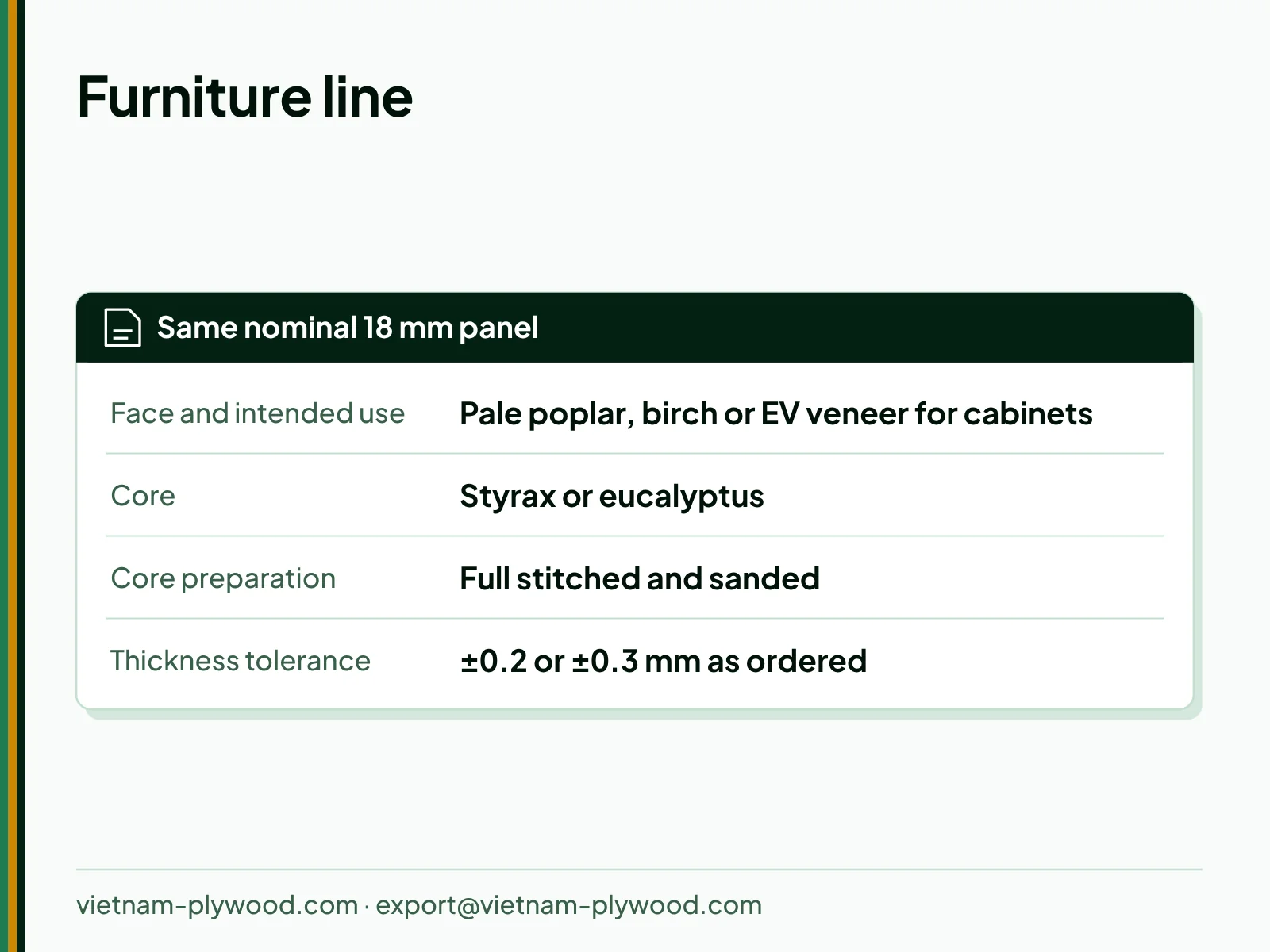
| Same nominal 18 mm panel | Furniture line | Commercial and packing line | Construction line |
|---|---|---|---|
| Face and intended use | Pale poplar, birch or EV veneer for cabinets | White-faced packing presentation | Phenolic or melamine film for formwork |
| Core | Styrax or eucalyptus | Acacia | Acacia or eucalyptus |
| Core preparation | Full stitched and sanded | Unsanded or light-sanded | Unsanded |
| Thickness tolerance | ±0.2 or ±0.3 mm as ordered | ±0.5 mm commercial; ±0.5–1.0 mm packing | ±0.5 mm |
| Typical surface decision | Visible furniture face or calibrated base | Packing appearance and handling | Film surface and formwork duty |
| Verdict | Select for cabinets and laminator substrates | Select for packing panels | Select for formwork, not white cabinetry |
This comparison is about the build under the face, rather than a promise that identical surfaces come from every line. For an 18 mm panel, the core veneer thickness of 1.4–2.0 mm gives 11–13 plies. These construction details matter more than a broad label such as white plywood board.
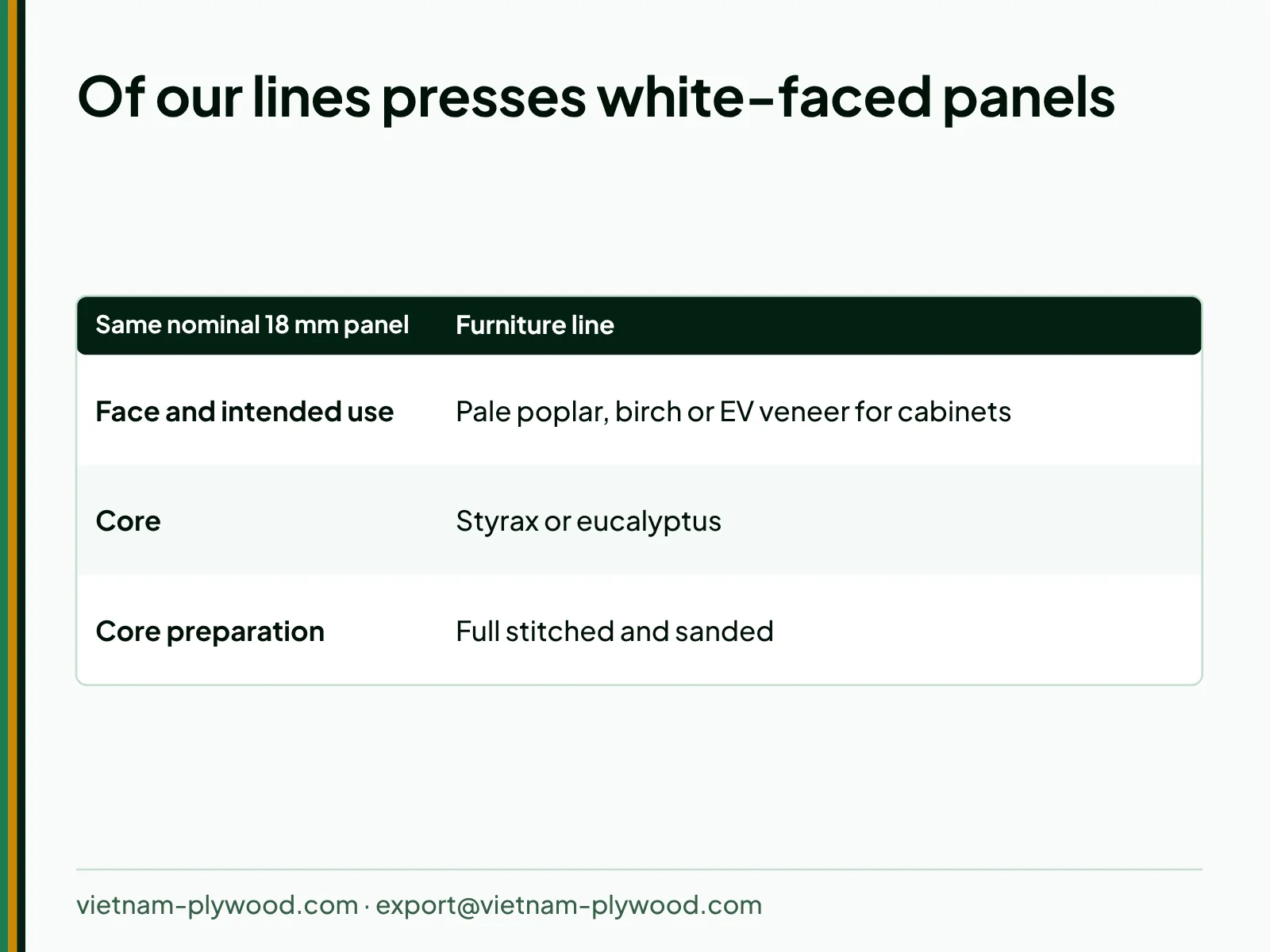
The three factories are in Phu Tho and Hai Phong. Each order is produced at the factory matching the agreed build and ships directly from it. HCPLY manages specification, on-site quality control, shipping documents, and loading; buyers can inspect goods at the producing factory.
Do you press white melamine plywood or white laminated plywood?
We do not press white melamine plywood, high-pressure laminate (HPL), or other decorative laminate-faced panels. A buyer’s laminator can apply those overlays to an appropriate calibrated plywood substrate from our furniture line. The order from us is for the plywood base, with the overlay specification handled by the downstream laminator.
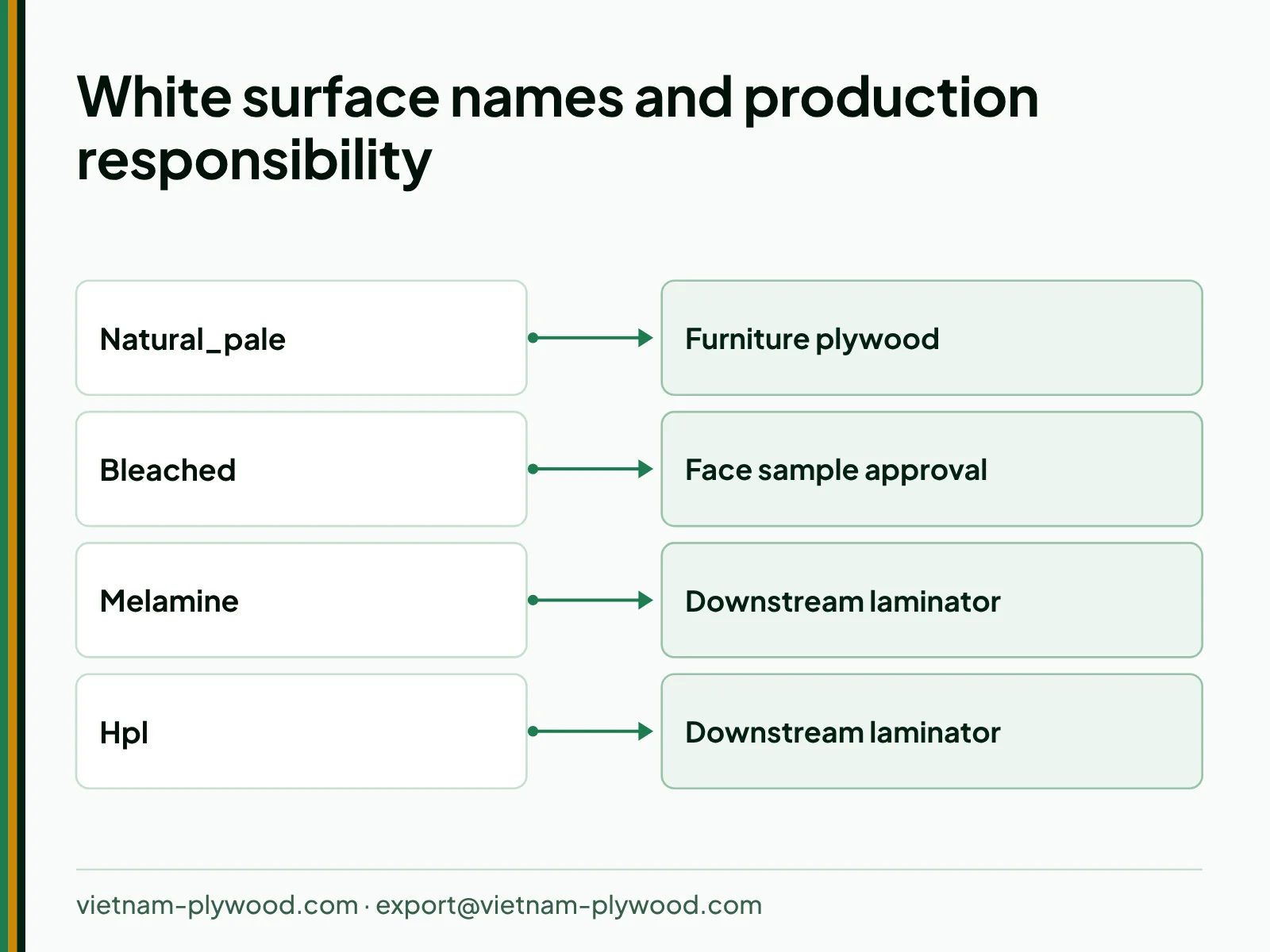
“White melamine plywood” commonly means a plywood base surfaced with melamine-impregnated decorative paper. “White laminated ply” can mean several different materials, including HPL and other decorative sheets. White laminated plywood sheets and white laminated carcass panels therefore need a description of the actual overlay, its adhesive, and its processing route. A glossy surface, matte finish, and natural pale veneer are different purchase outcomes.
A retailer’s white glossy two-face melamine board illustrates how a finished panel can be described by gloss, color, and sheet dimensions. Those retail attributes do not establish the substrate construction. Likewise, the phrase “white melamine plywood 4x8” indicates a nominal format, not a calibrated base or finished-overlay thickness. The phrase “white melamine plywood 1220x2280” needs a dimensional check: 1220 × 2280 mm is not among our listed standard sizes, so request custom cutting against a drawing.
White melamine faced plywood 18mm requires another distinction: is 18 mm the plywood before lamination or the final faced panel? Write the required finished thickness and the laminator’s overlay build separately, then choose the plywood tolerance that supports that target. We do not press medium-density fiberboard (MDF), oriented strand board (OSB), chipboard, blockboard, bamboo, or 3-ply spruce panels.
What plywood core should a white-overlay laminator specify?
A laminator should start with a sanded, full-stitched furniture plywood core and a written thickness tolerance. Our furniture line uses styrax or eucalyptus cores, with E0 or E1 emission classes specified separately from the glue. The laminator must approve the base against its own adhesive, press, and surface-finish requirements.
The first check is the surface: sanding quality, flatness, open joints, and telegraphing risks under an opaque overlay. The next check is the core: gaps, repairs, and edge construction can show after machining. Request a cut sample when the finished furniture will show machined edges.
Our furniture sanded tolerance is ±0.2 or ±0.3 mm as ordered, while length and width tolerance is ±2 mm. Specify the thickness of the substrate and the overlay separately; do not assume a finished 18 mm carcass panel begins with an 18 mm base. Our standard dimensions include 1220 × 2440 and 1250 × 2500 mm, with custom cutting available.
Melamine (MR, 12-hour boil) and phenolic (WBP, 72-hour boil) describe glue systems and their stated boil conditions; E0 and E1 describe emission classes. These are separate fields on the purchase order. For United States-bound regulated hardwood plywood, the U.S. Environmental Protection Agency’s 2025 edition of 40 CFR Part 770 sets third-party certification and other obligations under Toxic Substances Control Act Title VI. A buyer should identify the applicable product and documentary requirements before the substrate is produced.
The regulation also distinguishes certain veneer-laminated products from other decorative overlays. A melamine or HPL surface description should not be treated as a blanket certification statement. Factory-held CARB Phase 2 and other certificate material is shown with factory details masked, on request; the certificate and test report must match the producing factory and agreed build.
Is white poplar plywood suitable for cabinets?
White poplar plywood can suit cabinet faces when the approved pale veneer, core quality, and finishing process match the cabinet design. The furniture line is the appropriate starting point because it offers full-stitched, sanded cores and tighter ordered thickness tolerances. For painted or overlaid carcasses, specify the substrate as carefully as the visible face.
A visible cabinet door places greater emphasis on face uniformity, veneer joins, and color. All should be specified by application rather than assuming one white plywood sheet serves every cabinet part.
A natural pale poplar face can accept a finishing process chosen by the cabinet maker, but no untreated veneer is equivalent to a factory-applied opaque melamine surface. A bleached birch face changes the visual brief and grade discussion. An EV face offers a different pattern-control route. Choose from actual face samples and inspect the order against those samples.
For comparison of poplar naming across markets, read Italian versus Vietnamese poplar plywood. The country label alone does not identify the core or face construction. The purchasing specification should name the species in each role. For furniture projects, our line can use a styrax core at 500 kg/m³ or a eucalyptus core at 650 kg/m³; the face does not set either density.
Can white panels from two lines share one container?
Yes. Specifications from the furniture and commercial lines can be mixed in one 40HC container within its 28.5 t payload limit. The loading plan must use each core’s weight, the selected thickness, pallet configuration, and the final allocation of space. White appearance alone tells the freight planner nothing about weight.
At 18 mm and 1220 × 2440 mm, a styrax-core sheet weighs 26.79 kg; an acacia-core sheet weighs 31.08 kg; a eucalyptus-core sheet weighs 34.83 kg. For a full single-core 40HC reference, the corresponding loads are 990, 880 and 795 sheets. These figures exclude any film weight. The full-container figures are reference loads, not quantities to add together in a mixed shipment.
Consider a planning example using 10 pallets of 18 mm styrax-core furniture plywood and 6 pallets of 18 mm acacia-core packing plywood. The styrax allocation is 10 × 55 = 550 sheets, or 550 × 26.79 kg = 14,734.5 kg. The acacia allocation is 6 × 55 = 330 sheets, or 330 × 31.08 kg = 10,256.4 kg. Combined panel weight is 24,990.9 kg, below the 28,500 kg payload limit before pallets and other loading materials. Pallet dimensions, gross weight and loading geometry still need a checked stowage plan.
The furniture and packing lines can thus serve different parts of the same purchase program. Do not infer that a white packing face has the surface preparation of a furniture substrate. The final packing list identifies the actual quantity and construction for each item. Read the mixed-container loading arrangements and the container packing reference for the loading workflow.
What should an inspector check at the producing factory?
An inspector should compare the actual face, core, dimensions, and packing marks with the signed sample and written specification. HCPLY arranges inspection at the producing factory, where the order is pressed and prepared for loading. The checks differ between a visible cabinet face and a white packing panel.
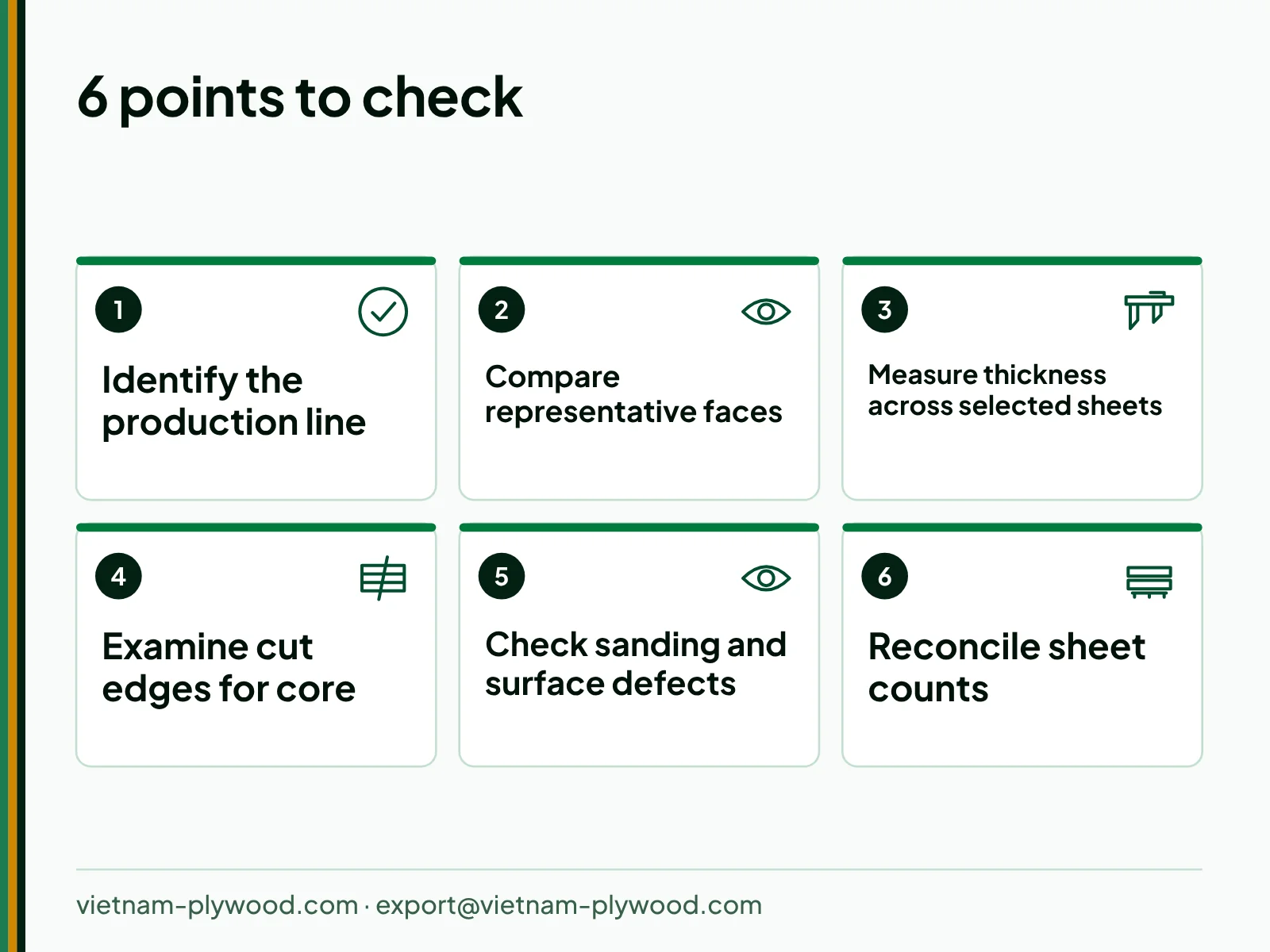
- Identify the production line and verify that pallet labels match the ordered face, core and thickness.
- Compare representative faces with the approved poplar, bleached or EV sample under consistent lighting; record grain and color observations.
- Measure thickness across selected sheets against the ordered furniture or packing tolerance, then measure length and width against ±2 mm.
- Examine cut edges for core gaps, joint construction and the requested full-stitched furniture build.
- Check sanding and surface defects on furniture bases intended for downstream lamination; separate that assessment from packing-grade appearance.
- Reconcile sheet counts, pallet counts and the packing list before loading, then retain the agreed inspection record.
That is why a face photograph is insufficient evidence for a lamination-grade substrate. If a buyer intends to press a decorative overlay later, the laminator’s sample approval and machining trial should happen before the full order. No unprovided adhesion or flatness test result should be assumed.
How do dimensions, glue and emissions enter the order?
Write the face and core as different fields, followed by glue, emission class, thickness tolerance and size. HCPLY supplies thicknesses from 3–40 mm, with common options of 3, 5, 9, 12, 15, 18, 21 and 25 mm. The purchase description should identify whether the material is a finished pale-faced sheet or a base for downstream finishing.
A white plywood furniture order can request a poplar face with an A/B face grade, a full-stitched styrax core, a sanded surface and an E1 emission class. A bleached birch face uses the D/E/F grading convention instead. A packing order can request an agreed white face on an acacia core, MR glue and the packing tolerance. Do not substitute an emission designation for a glue type.
If the buyer needs a downstream lamination trial, state its acceptance criteria and sample quantity in the order correspondence. A color reference, grade and thickness alone cannot specify an adhesive interface.
What documents and delivery terms accompany the panels?
The shipment’s packing list identifies the separate white-faced furniture and packing items, while the commercial invoice and bill of lading cover the export transaction. The documentation also includes a certificate of origin, phytosanitary and fumigation papers, and the order’s applicable certificate documents. EU lots include EUR.1 and the EUTR/EUDR file set; insurance is included under CIF.
Certificates such as FSC, CARB P2, ISO 9001 and CE belong to the member factories and are shown with factory details masked, on request. A certificate claim on sales documents, emission certificate or test report belongs in the order’s agreed document requirements. After loading, the draft shipping documents come to you for approval.
Minimum order is one 40HC; one container can carry several specifications as long as the payload limit holds. Factory lead time runs 15–45 days from receipt of the 30% deposit; the exact figure depends on order size, line loading and what the contract fixes. The remaining 70% is paid on the scan of the bill of lading, by T/T, or by irrevocable sight L/C. We ship FOB Hai Phong, or CFR (CNF) or CIF to your port. For scheduling factors, see plywood production lead time.
Furniture plywood starts from US$350/m³ FOB Hai Phong (October 2026); commercial plywood starts from US$250/m³ FOB Hai Phong (October 2026). These are different starting categories, not quotations for a specified white face. Face treatment and grading have the strongest direct influence on the white appearance requirement, followed by core construction, sanding tolerance, thickness and quantity. A full-stitched, tightly calibrated furniture base costs more to prepare than a light-sanded packing build because its veneer selection, stitching and surface preparation are different. Ask for a quotation against the written build rather than applying a generic white-panel price.
What should a buyer settle before ordering?
Settle the final visible surface, the core build and the party responsible for any overlay before approving the order. A natural pale veneer, a bleached face and an opaque laminated finish can all be called white plywood, yet they require different production and inspection decisions.
If the cabinet maker will laminate, send the substrate specification and the laminator’s trial requirements. If the order is for packing, specify the required white-face appearance and the handling conditions. If the purchase mixes both, list the items separately so pallet marks and shipping paperwork match the actual builds.
For samples, we provide them free; a first-time buyer pays the courier, and that charge comes off the first confirmed order. The sample request should identify the face, grade, core and intended finish. Keep a signed reference for color and surface acceptance. A white sample with an unknown core cannot settle a production purchase.
Send the specification to Lucy at export@vietnam-plywood.com or through contact. The next step is to book a factory visit and inspect the proposed build at the producing factory.
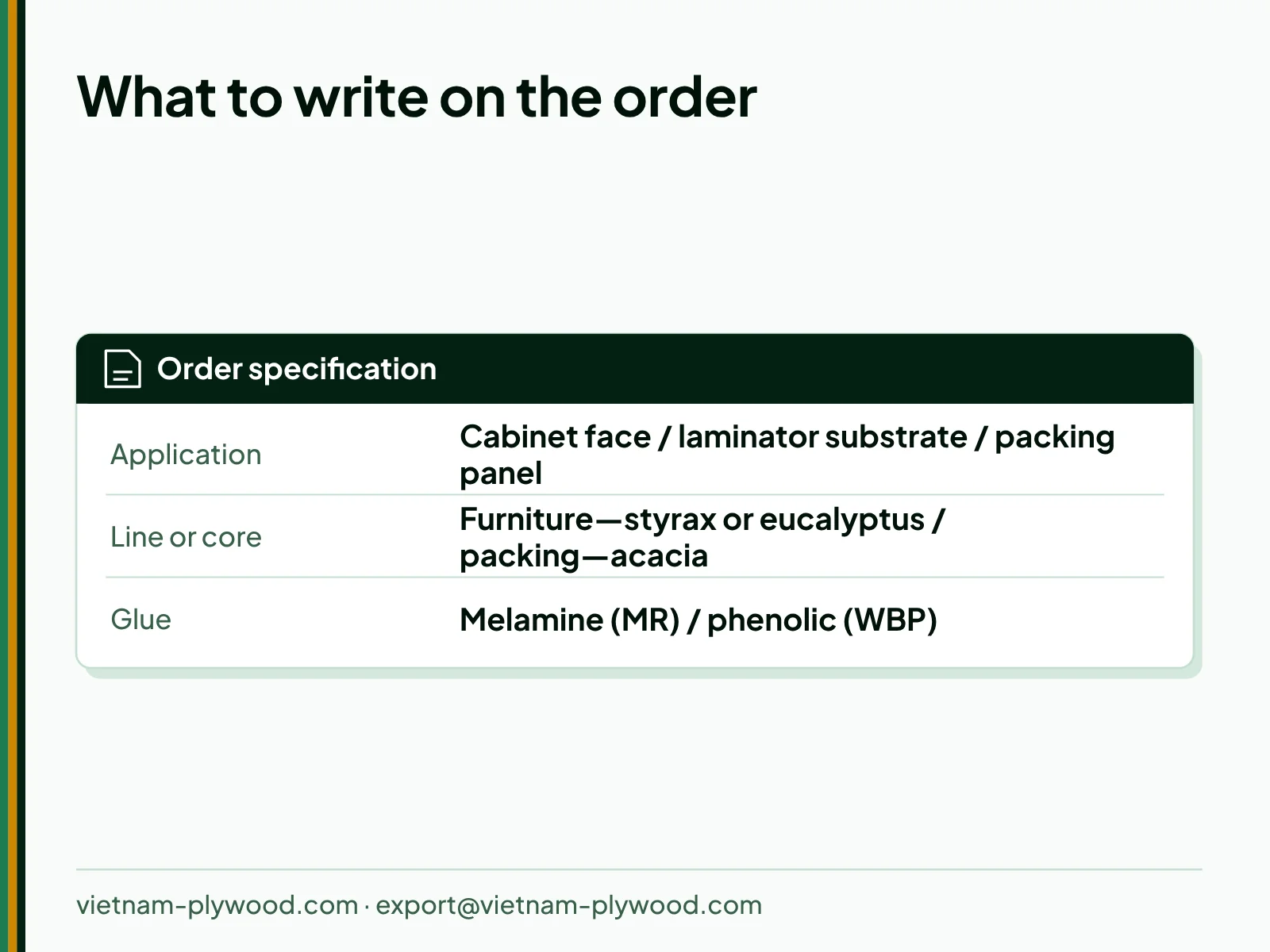
Application: cabinet face / laminator substrate / packing panel
Line or core: furniture—styrax or eucalyptus / packing—acacia
Glue: melamine (MR) / phenolic (WBP)
Emission: E0 / E1 / E2 or agreed destination requirement
Face and grade: poplar A/B / birch D/E/F / EV / agreed white packing face
Thickness and tolerance: ___ mm; ±___ mm
Size: ___ × ___ mm
Quantity: ___ sheets and ___ pallets per specification
Destination port: ___
Book a factory visit through contact to review the approved samples and producing line.