





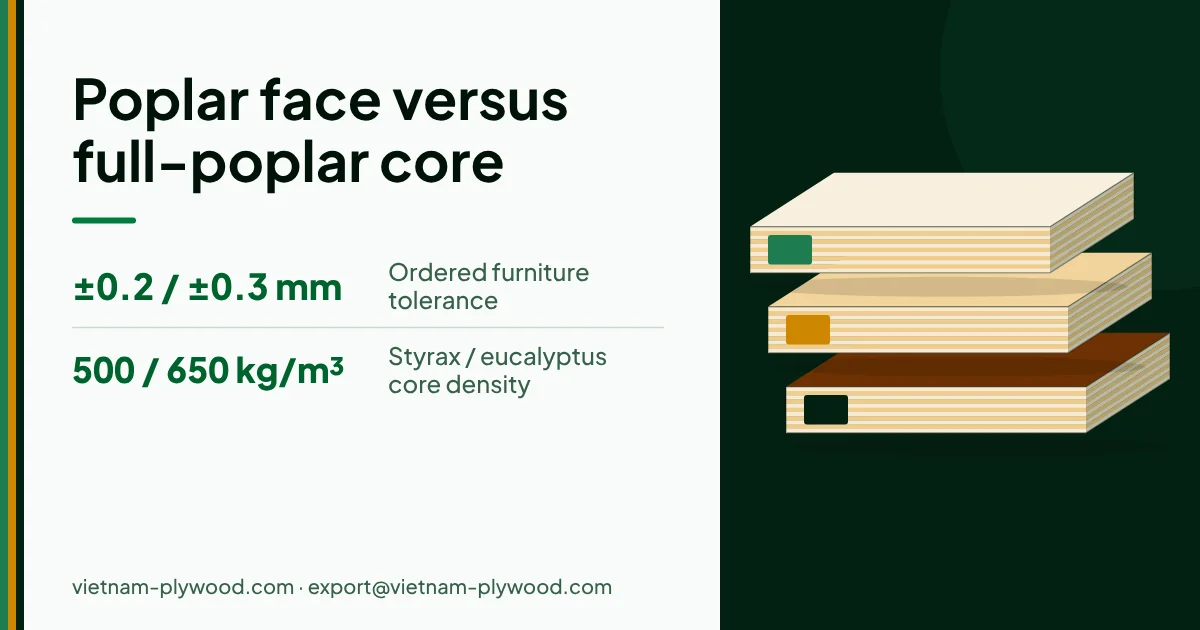
Italian poplar plywood and our poplar-face furniture plywood are different constructions: the latter uses styrax or eucalyptus core rather than full poplar. Choosing by face name alone can cause rejected furniture parts, machining delays and wasted material. HCPLY compares the actual layup, calibrated thickness and approved use before proposing a substitution for European furniture buyers.
What is Italian poplar plywood?
Italian poplar plywood is a veneer panel commonly specified for lightweight interior furniture, cabinetry and fit-out components, often with poplar throughout the layup. The term describes a commercial product family, not a universal grade or a promise that every sheet has identical construction. A buyer must identify the actual core, faces, bond, emission evidence and thickness calibration before approving substitution.
HCPLY offers poplar face veneer over Vietnamese cores; it does not press a full-poplar core.
European poplar plywood appears in the market as flat furniture panels and, separately, specialized bending stock. Capitol City Lumber describes a thin Italian poplar bending panel with three plies and directional bending options. That bending product should not become the reference specification for a rigid cabinet carcass. Its construction and intended movement are different.
See poplar plywood from Vietnam for our face options.
How does Italian poplar plywood compare with a Vietnamese poplar-face panel?
The comparison turns on the bill of materials and the approved end use. A poplar-faced Vietnamese panel can meet a visual face requirement while retaining a different core. It cannot truthfully be sold as the same full-poplar construction. Compare approved samples under identical machining and finishing conditions.
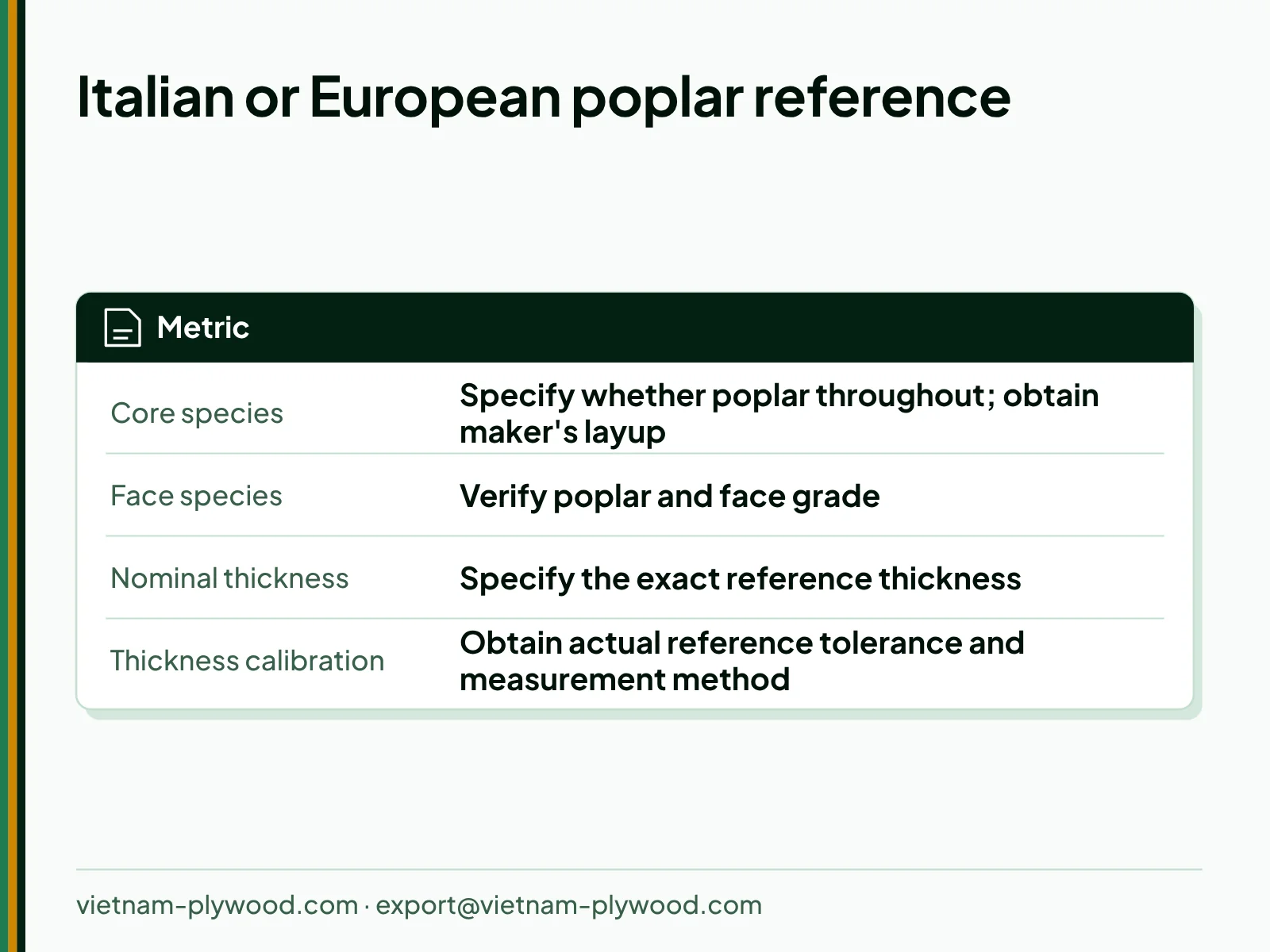
| Metric | Italian or European poplar reference | HCPLY poplar-face furniture build | Verdict by use |
|---|---|---|---|
| Core species | Specify whether poplar throughout; obtain maker’s layup | Styrax or eucalyptus; no poplar core | Not equivalent when a full-poplar core is mandatory |
| Face species | Verify poplar and face grade | Poplar veneer; A/B face grades | Candidate for visible poplar-face work after sample approval |
| Nominal thickness | Specify the exact reference thickness | 3–40 mm available | Candidate only within agreed range |
| Thickness calibration | Obtain actual reference tolerance and measurement method | Sanded furniture ±0.2 or ±0.3 mm as ordered | Candidate after matched-point measurement |
| Surface preparation | Check sanding and finish acceptance | Full-stitched, sanded furniture line | Candidate for paint or veneer finishing trials |
| Core density | Request a measured value for the named Italian product | Styrax 500 kg/m³; eucalyptus 650 kg/m³ | Different mass and machining behavior expected |
| Adhesive and emissions | Require independent declarations for the exact reference | Glue and E0/E1 emission specification are separate | Compare documents, not marketing labels |
| Curved fabrication | Check bending direction and bend radius | No bending-grade product claim | Not equivalent for bending stock |
| Exposed plywood edge | Full-poplar appearance if the reference truly uses poplar plies | Styrax/eucalyptus veneer edges | Not equivalent where exposed matching poplar edges are required |
The table is a specification crosswalk, not a laboratory ranking. Stiffness, screw holding and machining yield need agreed tests.
What are the characteristics of European poplar plywood?
European poplar plywood is commonly chosen for its pale appearance, relatively light handling and suitability for interior joinery. Those are category descriptions rather than measured properties of every producer’s sheet. The purchaser still needs a declared core layup, face quality, bond classification and calibrated thickness.
A full-poplar panel can provide a light-colored exposed edge. A face-only alternative cannot reproduce poplar throughout the section.
Some Italian poplar sheets are manufactured for tight curves rather than flat components. Capitol City Lumber distinguishes barrel-bend and column-bend orientation for its bending stock. For a flat shelf, evaluate span and loading separately; for a curved display, request the bend direction and tested minimum radius from the original supplier. We make no claim that our furniture build duplicates either bending format.
What are the characteristics of Vietnamese poplar plywood?
In this HCPLY offer, “Vietnamese poplar plywood” means a poplar face over a Vietnamese styrax or eucalyptus veneer core on our furniture line. The face gives the visible species name. Density follows the core, not the poplar face; therefore a poplar-faced panel is not automatically a lightweight full-poplar panel.
Our furniture line uses full-stitched cores, sanding and an E0 or E1 emission specification. Its common face veneer thickness is 0.2–0.4 mm. The ordered face grade is A/B, with thickness tolerance written as ±0.2 or ±0.3 mm. Agree on sampling points and measurement methods.
Our commercial and packing line instead uses acacia core, moisture-resistant (MR) glue and an unsanded or light-sanded surface. Our construction line makes film-faced panels with acacia or eucalyptus cores. These are different builds for different applications, even when nominal thickness matches. The cross-line plywood grade comparison sets out that distinction.
We do not press full-poplar-core plywood, birch-core plywood, medium-density fiberboard (MDF), oriented strand board (OSB), chipboard or blockboard. A buyer seeking those exact substrates should keep them in the purchase specification rather than assume a poplar-faced alternative is identical.
How do face, core and calibration differ?
Face, core and calibration answer three separate acceptance questions. Face controls the visible veneer and finishing substrate. Core controls most of the panel’s mass and its internal construction. Calibration controls whether panels fit a machining program without excessive adjustment.
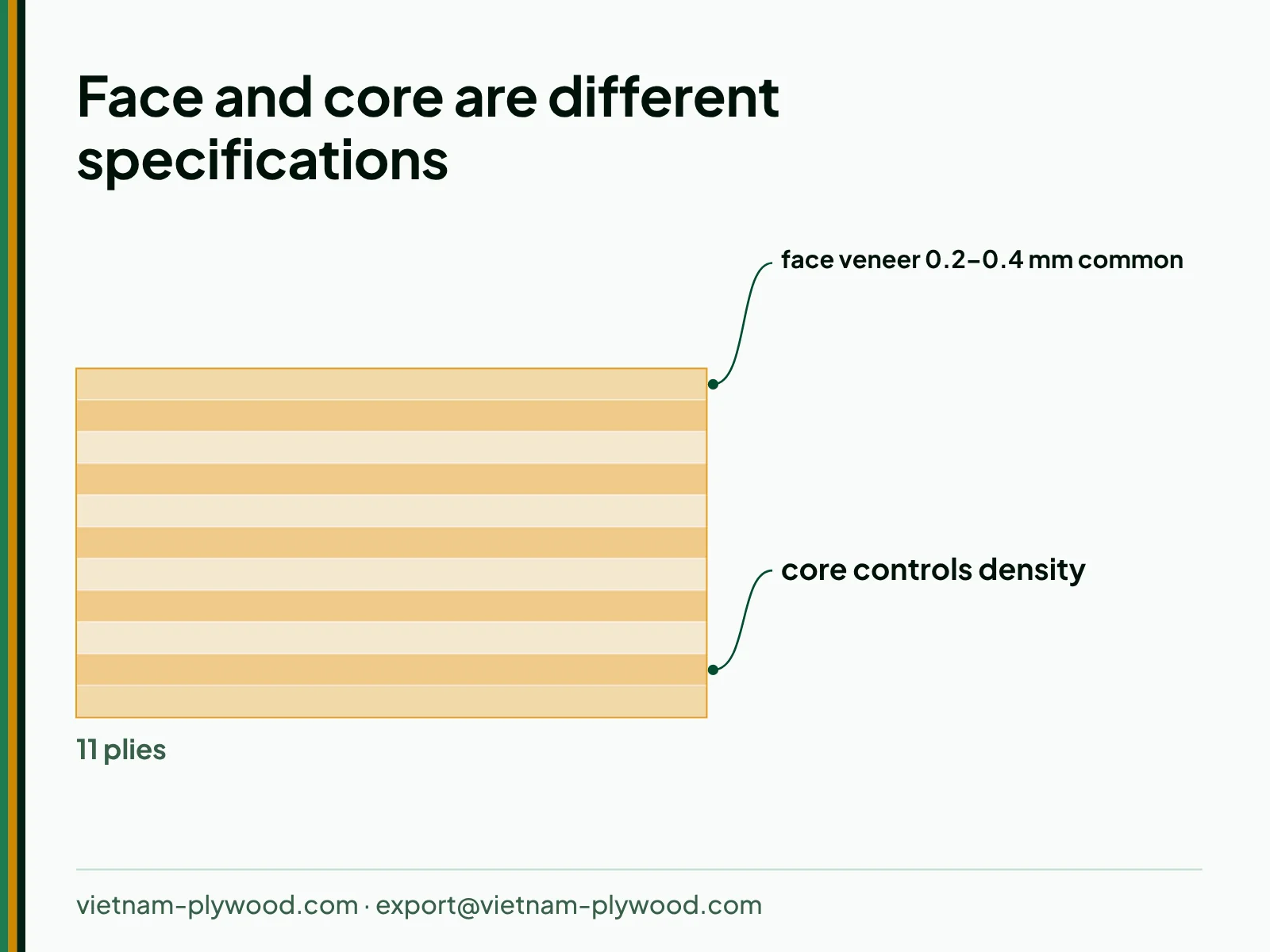
For a poplar-face order, write the face species and A/B grade explicitly. A common veneer range is 0.2–0.4 mm, but the ordered specification must settle the required face. A pale face can still reveal joint lines, glue bleed or sanding defects after a transparent finish. Make a production-representative finish sample before approving a transparent coating.
Our furniture cores are styrax at 500 kg/m³ or eucalyptus at 650 kg/m³. At 18 mm and 1220 × 2440 mm, calculated weights are about 26.8 kg and 34.8 kg. These are estimates, not weighed-lot results.
For calibration, specify the nominal thickness and either ±0.2 mm or ±0.3 mm for sanded furniture sheets. State the sampling locations, measurement tool and rejection rule in the purchase agreement. Sanding can improve consistency without changing the underlying species. If a reference panel has a tighter tolerance than the ordered Vietnamese build, it is not an acceptable drop-in replacement for a fixed machining setup.
At 18 mm our specified construction uses 11–13 plies because core veneer thickness is 1.4–2.0 mm. Ply count alone does not prove a defect-free core. The buyer’s inspection should also record edge gaps, overlap, joints and face-through sanding. See white-faced plywood options when finish uniformity matters more than a named poplar face.
Can Vietnamese poplar plywood replace Italian poplar plywood in furniture?
Yes, for some interior furniture applications when the buyer accepts a poplar face over a different core and approves the finished component. No, when the drawing, customer declaration or tested assembly requires full-poplar plies, a matching exposed edge or a specific bending product.
For painted cabinet sides, begin with a machining and finish trial using the exact ordered core. Inspect cut edges, fastener locations, surface flatness and paint build. A satisfactory face appearance alone does not answer whether the component holds fasteners or stays flat under the intended environment.
For veneered or upholstered interior components, compare handling weight and assembly behavior. The heavier eucalyptus option might change packaging and lifting arrangements. The styrax option has a lower stated density, but no stiffness or strength comparison can be inferred from density alone. Specify the actual mechanical acceptance tests where they affect the design.
For visible shelving or a collection advertised as full-poplar, retain the original construction requirement. The cut edge and product description change.
For curved fixtures, our flat furniture sample cannot establish a safe bend radius. Record any approved substitution against a control sample.
What would the same thickness look like across our three lines?
An 18 mm nominal sheet can be built for three different jobs, but it is not the same product on each line. The line choice determines core construction, surface preparation and acceptance criteria. Use the table to prevent a packing-grade or film-faced sheet from being ordered as furniture plywood.
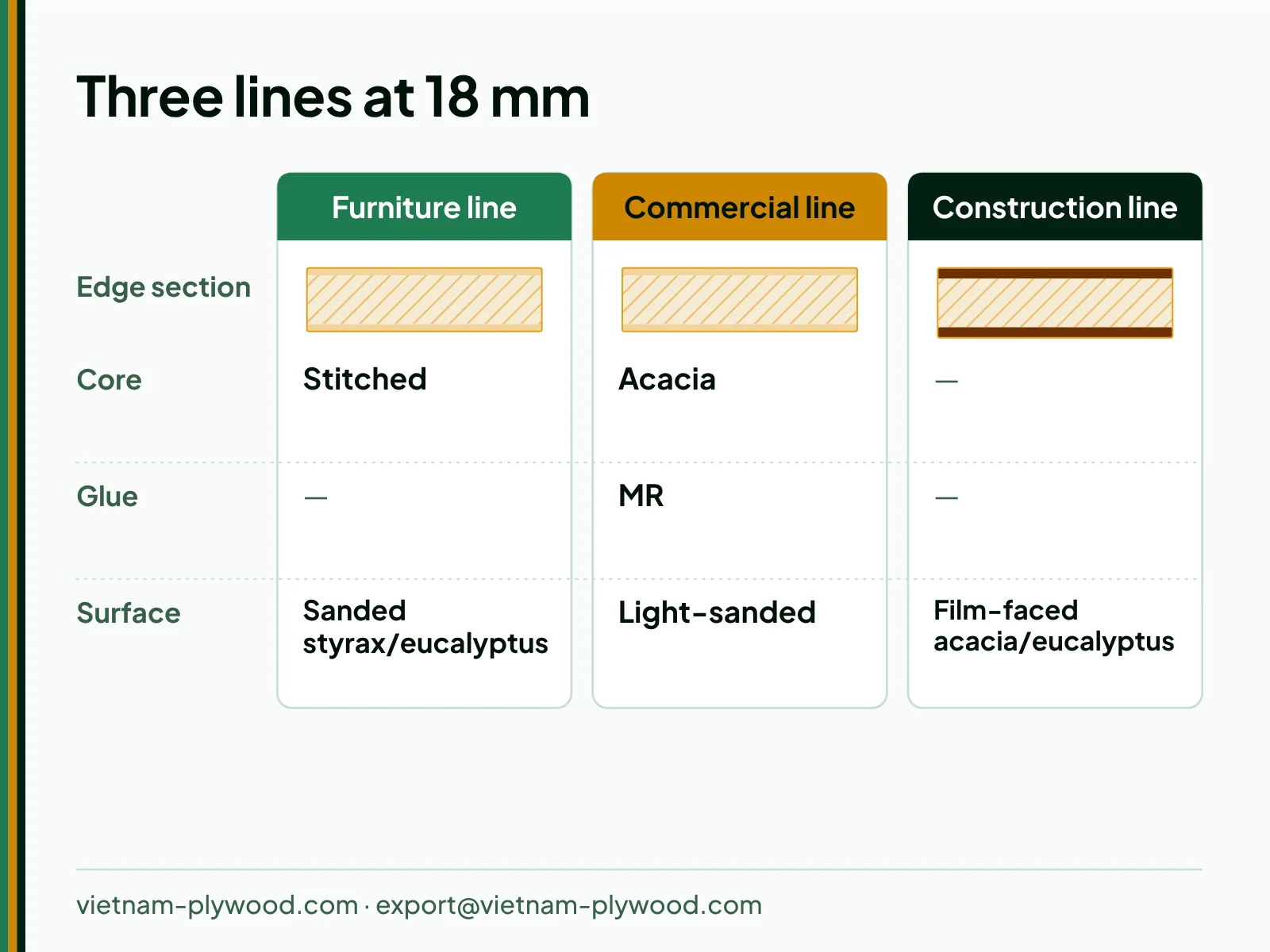
| Line | 18 mm build and core | Surface and tolerance | Suitable purchasing decision |
|---|---|---|---|
| Furniture | Full-stitched styrax or eucalyptus | Sanded, ±0.2 or ±0.3 mm ordered | Candidate for poplar-face cabinet trials |
| Commercial and packing | Acacia core; MR glue | Unsanded or light-sanded, ±0.5 mm commercial; packing ±0.5–1.0 mm | Packing and commercial work, not direct calibrated furniture replacement |
| Construction | Acacia or eucalyptus core; film-faced | Film surface, unsanded core; ±0.5 mm | Concrete formwork, not exposed poplar furniture |
At the producing factory, inspectors can witness veneer selection, core stitching and finished thickness measurement. Independent reports remain necessary where specified.
For an 18 mm, 1220 × 2440 mm container illustration, the stated formula gives 990 styrax-core sheets, 880 acacia-core sheets or 795 eucalyptus-core sheets under the respective pallet assumptions. These are alternative homogeneous-load calculations; they are not a promise that all three totals can fit together. Mixed specifications require a payload calculation against 28.5 t. The container loading method owns the full calculation.
How should a furniture buyer test a proposed substitution?
Test the proposed substitution against the original component drawing and an agreed control sample. A useful inspection starts with traceability and dimensions, then moves to machining and finishing. It ends with documented acceptance rather than a subjective description of “European quality.”
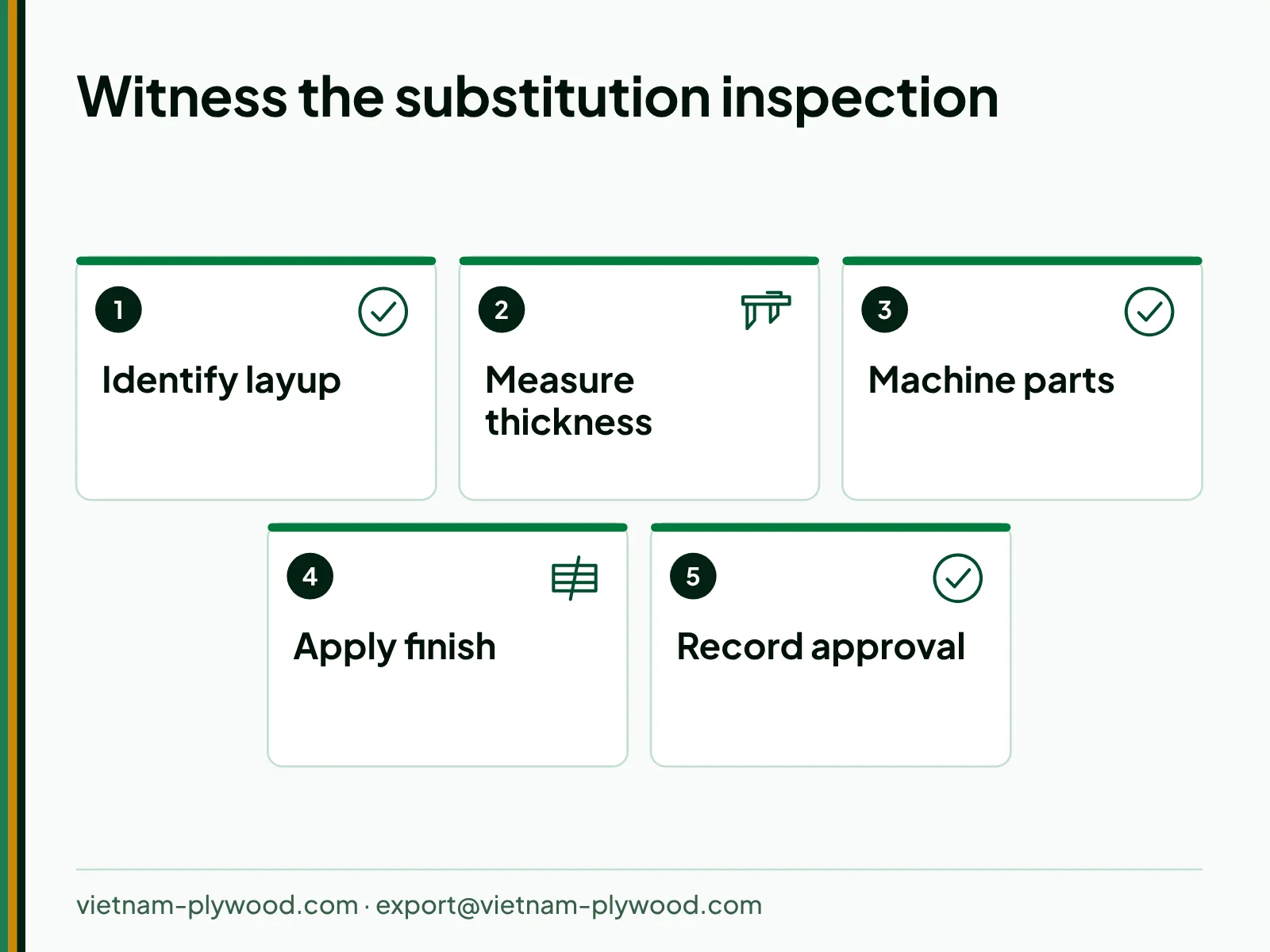
- Identify the reference. Record the Italian supplier’s product name, full layup, bond, declared emission class and intended use. Separate rigid furniture panels from directional bending stock.
- Lock the proposed build. Specify poplar A/B face, styrax or eucalyptus core, glue field, emission field, nominal thickness, tolerance and sheet size. Do not leave “poplar plywood” as the entire bill of materials.
- Measure the panels. Sample thickness across the face, check length and width against the agreed ±2 mm dimensional tolerance, and record warp and surface defects against agreed limits.
- Cut representative parts. Use the buyer’s saws, routers, drills and edge treatment. Compare breakout, core void exposure, edge quality and assembly fit with the original panel.
- Apply the real finish. Test primer, paint or veneer adhesion using the buyer’s process. Check both faces and cut edges after the specified conditioning period.
- Approve evidence. Keep the sample identity, measurement record, agreed test reports and decision linked to the purchase specification.
Our on-site quality control team can arrange inspection at the producing factory. Buyers visit the factory office and inspect goods where they are made. A witness can see measurements and construction details, but a witnessed visual check does not establish formaldehyde emissions or structural performance without the appropriate report.
Where a job requires an emission declaration, request the certificate and test evidence for the agreed build. The 2025 U.S. Code of Federal Regulations, Title 40 Part 770, distinguishes formaldehyde emission standards from third-party certification requirements for products within its scope. This is a useful reminder that an E0/E1 designation and a TSCA Title VI compliance claim are different statements. Factory certificates, where relevant, are shown with factory details masked, on request.
What can a Vietnamese poplar-face panel not match?
It cannot match a mandatory full-poplar core, identical poplar-colored exposed plies or a specialized Italian bending layup. It also cannot inherit the original supplier’s test results, certification scope or claimed machining performance. Those are properties of a particular product and its supporting evidence.
A styrax- or eucalyptus-core substitution changes exposed edges and weight expectations even when the face looks similar.
Nor should a nominal thickness match be treated as a calibration match. A machine set for one panel’s actual thickness distribution may need adjustment for another. Write the allowable range and inspection method into the order; a tolerance stated without a measurement procedure is hard to enforce.
High-density fiberboard (HDF) outer layers and thermally fused laminate (TFL) need separate assessment. We do not press HDF or offer melamine, high-pressure laminate (HPL) or laminate faces as a product line.
For lighter alternatives with different species and constructions, consult lightweight plywood options. The choice should follow the finished component’s acceptance criteria rather than the country named in a catalog.
Which specifications, documents and commercial terms matter?
Specify face, core, glue, emissions and acceptance method before comparing quotations.
No authorized starting price is available for this poplar-face specification. Face selection, core choice, thickness, tolerance, finishing and order mix change the quotation. A tighter calibrated build requires more controlled selection and finishing than a loose-tolerance packing panel; obtain a written quote for the selected construction.
Minimum order: one 40HC; one container can carry several specifications as long as the payload limit holds. Production: 15–45 days from the 30% deposit, set by order size, line loading and the contract. The remaining 70% is paid on the scan of the bill of lading, by T/T, or by irrevocable sight L/C. Shipping: FOB Hai Phong, or CFR (CNF) or CIF to your port.
Samples: free; a first-time buyer pays the courier, and that charge comes off the first confirmed order. A sample should represent the chosen core and face, not merely the desired color. For scheduling constraints see plywood production lead time.
For each shipment the commercial invoice and packing list identify the goods and quantities; the bill of lading (B/L) records carriage. The shipment set also includes a certificate of origin (EUR.1 for EU lots), phytosanitary and fumigation papers, insurance under CIF, and the order’s certificate documents and agreed test reports. EU lots include the European Union Timber Regulation / Deforestation Regulation file set. After loading, the draft shipping documents come to you for approval.
The EU buyer remains responsible for determining applicable due-diligence obligations and verifying the supporting information. A supplied document set should be reviewed for consistency with species, origin, quantity and the actual producing factory. No certificate is implied merely because a document type appears on the shipment checklist.
What should the buyer ask before placing an order?
Ask whether the intended substitution changes any requirement that the finished furniture customer has already approved. The core, edge appearance, thickness spread and evidence package deserve the same attention as the visible face. Resolve those points before comparing landed quotations.
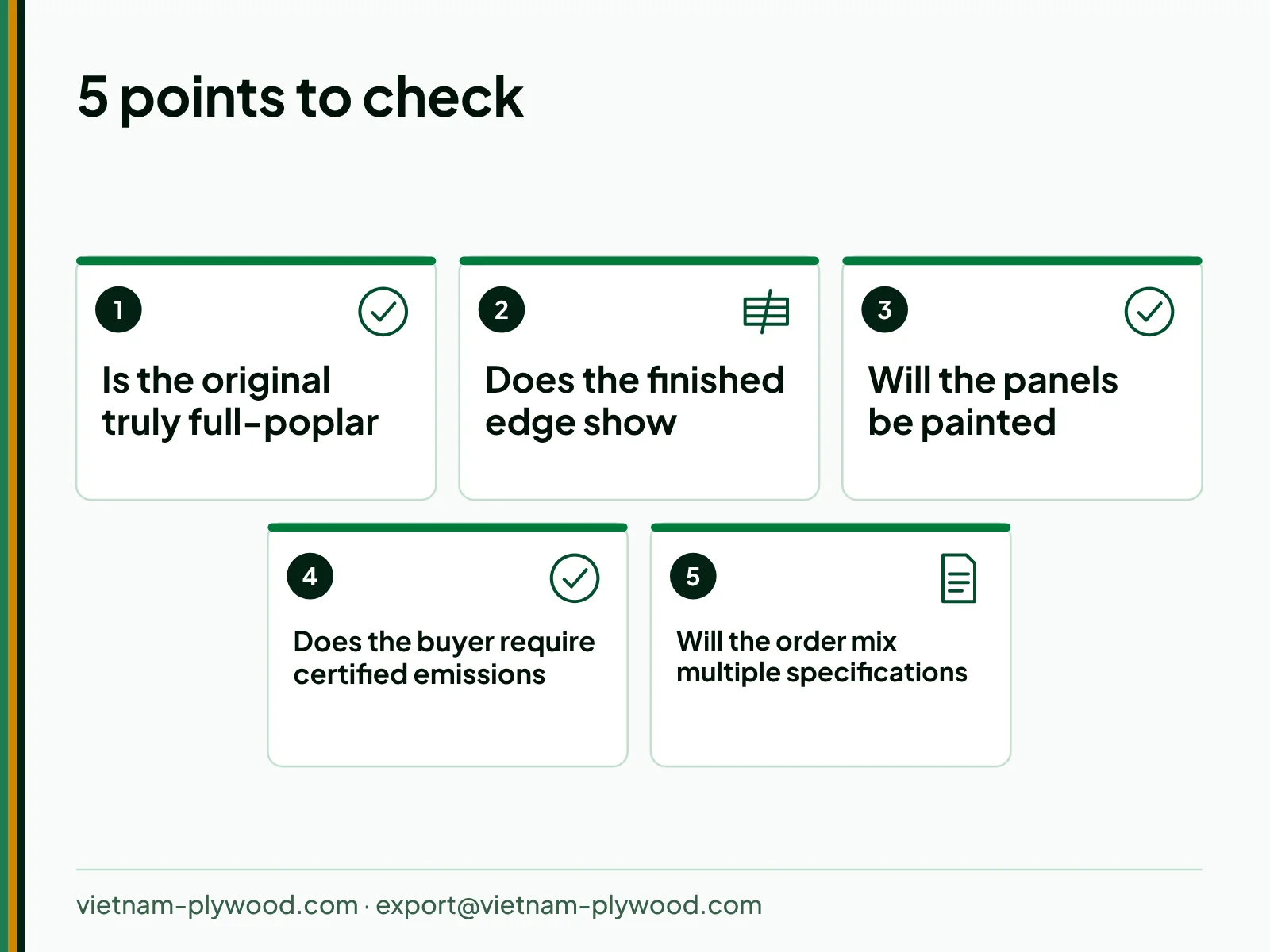
Is the original truly full-poplar? Obtain a cross-section or a manufacturer-issued construction description. A poplar-faced mixed-core board is a different construction even when marketed under a similar shorthand.
Does the finished edge show? If it does, request a finished corner sample showing the exact edge treatment. An edge band can conceal the different core visually, but it does not change the panel’s construction.
Will the panels be painted? Test the buyer’s real coating system on production-representative samples. A smooth sanded face is a starting condition, not proof of a specific coating outcome.
Does the buyer require certified emissions evidence? State the destination-market requirement and the exact build. Review the member factory’s masked certificate details on request and match the report to the ordered material.
Will the order mix multiple specifications? Provide the quantities by core and thickness for a payload check. A nominal sheet count from a single-specification example cannot establish the loading plan for a mixed order.
What specification should be sent for approval?
Send a line-by-line specification that makes the substitution boundary explicit. HCPLY can quote the poplar-faced furniture build and arrange a representative sample; it cannot quote a full-poplar core as its own production. A written comparison protects the buyer’s drawing approval and the factory’s production instructions.
The request should name the actual destination port and whether the furniture components will have exposed edges. Include the control sample or original supplier’s specification where available. If the buyer’s tolerance or finishing test is stricter than the proposed build, settle that gap before production starts.
Application: interior cabinet and furniture components; exposed edges [yes/no]
Line or core: furniture line; styrax core OR eucalyptus core
Glue: [specified adhesive system and bond requirement]
Emission: E0 OR E1; required supporting evidence [state]
Face and grade: poplar veneer, A/B; reference finish sample [identify]
Thickness and tolerance: 18 mm; ±0.2 mm OR ±0.3 mm as ordered
Size: 1220 × 2440 mm; length/width tolerance ±2 mm
Quantity: [sheets and cubic metres]; one 40HC minimum
Destination port: [port and country]; delivery term [FOB/CFR/CIF]
Request the poplar-face specification sheet from Lucy at export@vietnam-plywood.com with the completed lines and the Italian reference build.