





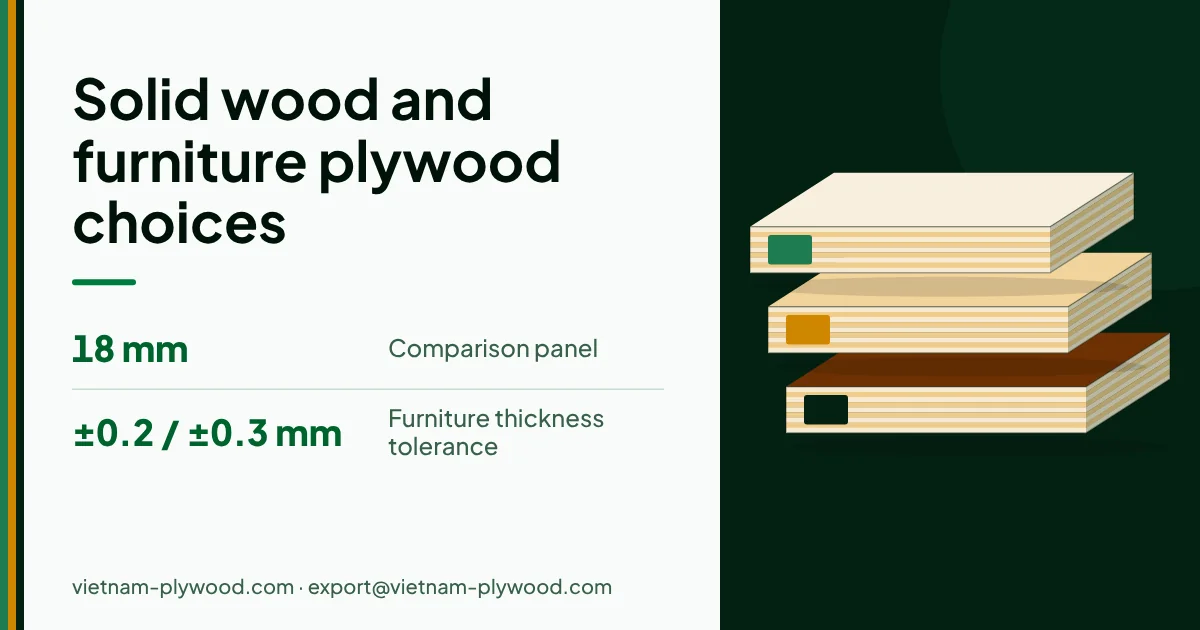
What are the best types of wood for furniture?
The best types of wood for furniture depend on the component: solid hardwood for exposed load-bearing frames, pine or rubberwood for selected economical solid parts, and veneered plywood for broad cabinet and furniture panels. Specify movement allowance, visible grain, machining yield and finish acceptance before choosing a species.
For HCPLY furniture orders, our furniture line presses full-stitched, sanded styrax- or eucalyptus-core plywood with selected decorative faces. A furniture maker can keep solid wood for legs and exposed rails while using plywood for doors, shelves and cabinet sides.
Start with the Applications articles for adjacent fit-out decisions.
How do solid hardwood, rubberwood, pine and plywood compare?
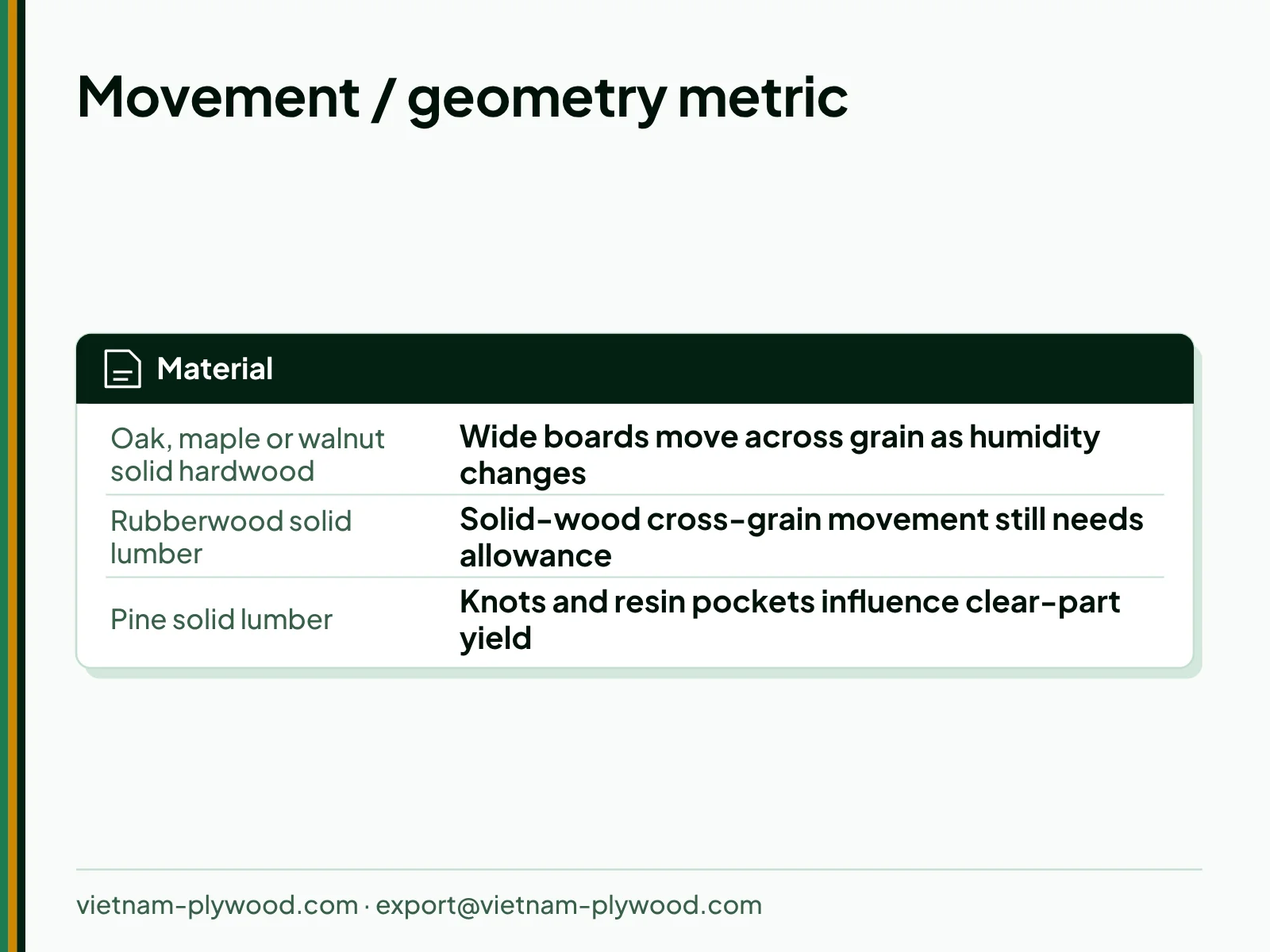
The correct material changes with the part geometry and finish schedule. Solid lumber offers continuous grain through an edge, whereas a plywood face presents decorative grain over cross-oriented veneers.
| Material | Movement / geometry metric | Cutting and finish metric | Verdict by use |
|---|---|---|---|
| Oak, maple or walnut solid hardwood | Wide boards move across grain as humidity changes | Premium exposed edges; match grain and remove defects | Visible legs, rails and carved profiles |
| Rubberwood solid lumber | Solid-wood cross-grain movement still needs allowance | Jointing, color matching and protective finish affect yield | Painted or stained frames when qualified stock is available |
| Pine solid lumber | Knots and resin pockets influence clear-part yield | Soft surface dents more readily; test stain and knot sealing | Painted frames and rustic exposed parts |
| Veneered plywood | Cross-laminated panel limits broad-face movement | Rectangular nesting and consistent face grading | Cabinet sides, shelves and broad flat panels |
Hardwood and softwood are botanical categories, not performance grades. The USDA Forest Service’s 2021 Wood Handbook, Chapter 13, explains that moisture content approaches equilibrium with surrounding relative humidity and that controlled drying and storage limit dimensional change. Read the USDA Forest Service chapter.
Is poplar good for furniture?
Poplar is useful for paint-grade solid furniture parts and as a decorative plywood face where a light, relatively even appearance is wanted. Its comparatively soft surface is less suitable for heavily abraded exposed edges than harder selected hardwoods. Check the actual species, surface hardness and coating schedule before substituting it for oak or maple.
HCPLY offers poplar as a face veneer, not as a poplar core. Our furniture cores are styrax or eucalyptus; density follows the core rather than the poplar face. This distinction matters when a purchasing sheet says “poplar plywood” but the buyer expects a poplar-core mass or fastening response.
For transparent finishes, request an approved face sample and judge color, patches and grain under the intended coating. For painted panels, focus on surface preparation, edge treatment and paint adhesion.
How does movement change the furniture design?
Solid boards need joints and panel details that accommodate cross-grain expansion and contraction. A rigid wide solid panel trapped in a fixed frame can distort or split when ambient humidity changes. Plywood’s alternating veneer directions reduce broad-panel movement, though its edges still need protection.
Evaluate a full assembly, not a coupon alone: measure panel flatness after conditioning, check door clearances and inspect the coating near edges.
The USDA Forest Service’s 2021 moisture-control discussion provides the basis for managing storage and humidity; it does not prescribe a single moisture number for every destination climate.
Which material gives better yield per cubic metre?
Plywood often gives more repeatable rectangular parts per purchased cubic metre when a cabinet bill uses large flat components. Solid lumber yield loses volume to sawing, drying defects, planing, knots, grain selection and jointing. Neither advantage can be priced without a cutting list and actual reject counts.
Calculate usable output as accepted finished-part volume divided by purchased material volume. Track separately the nesting offcuts, machining allowance, surface rejects and rework.
Use the same drawing revision for both quotations. Compare material purchase, labor, finish, edge work, rejects and freight per accepted furniture unit. A lower board price can still create a higher finished-unit cost.
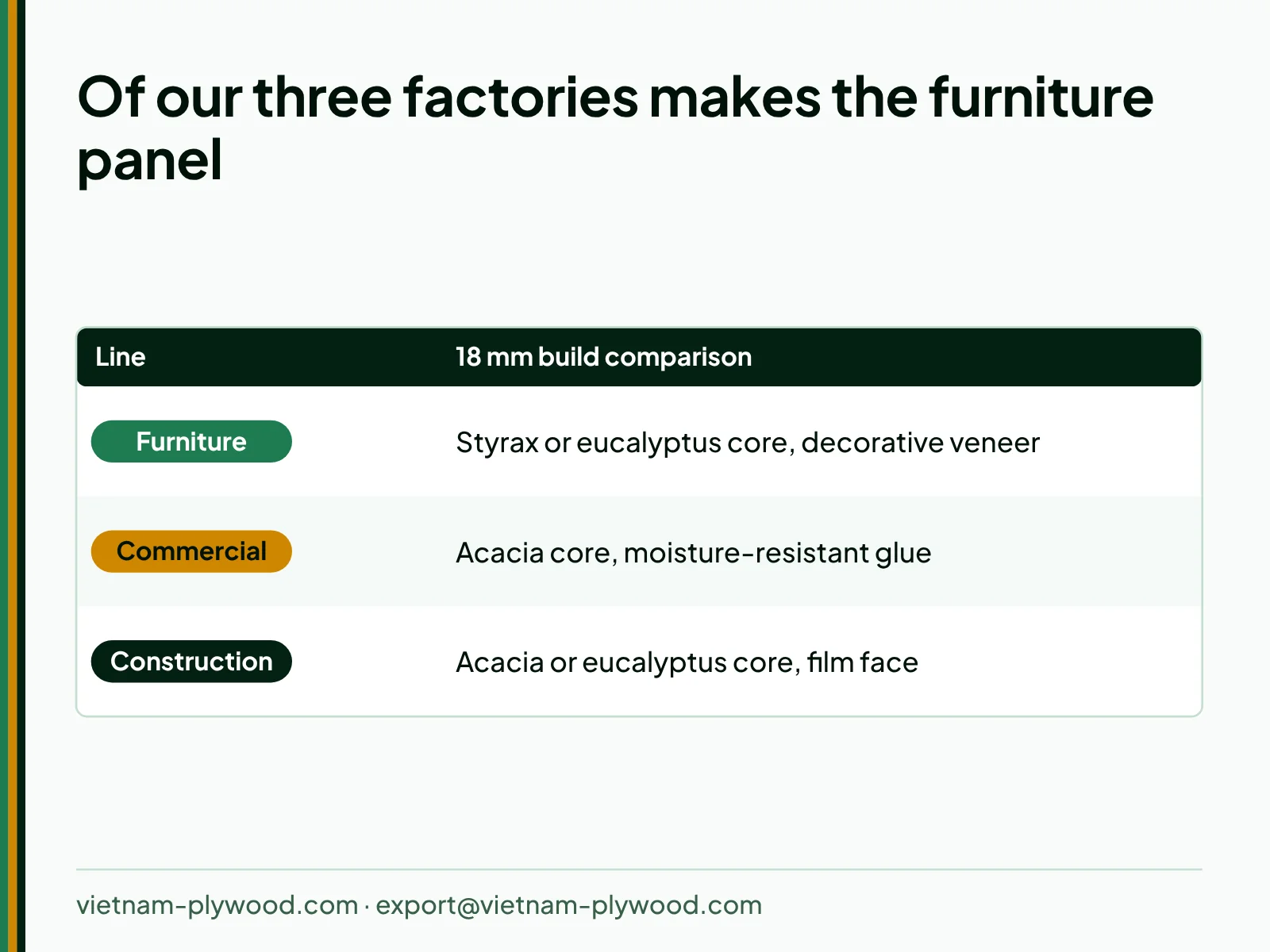
Which of our three factories makes the furniture panel?
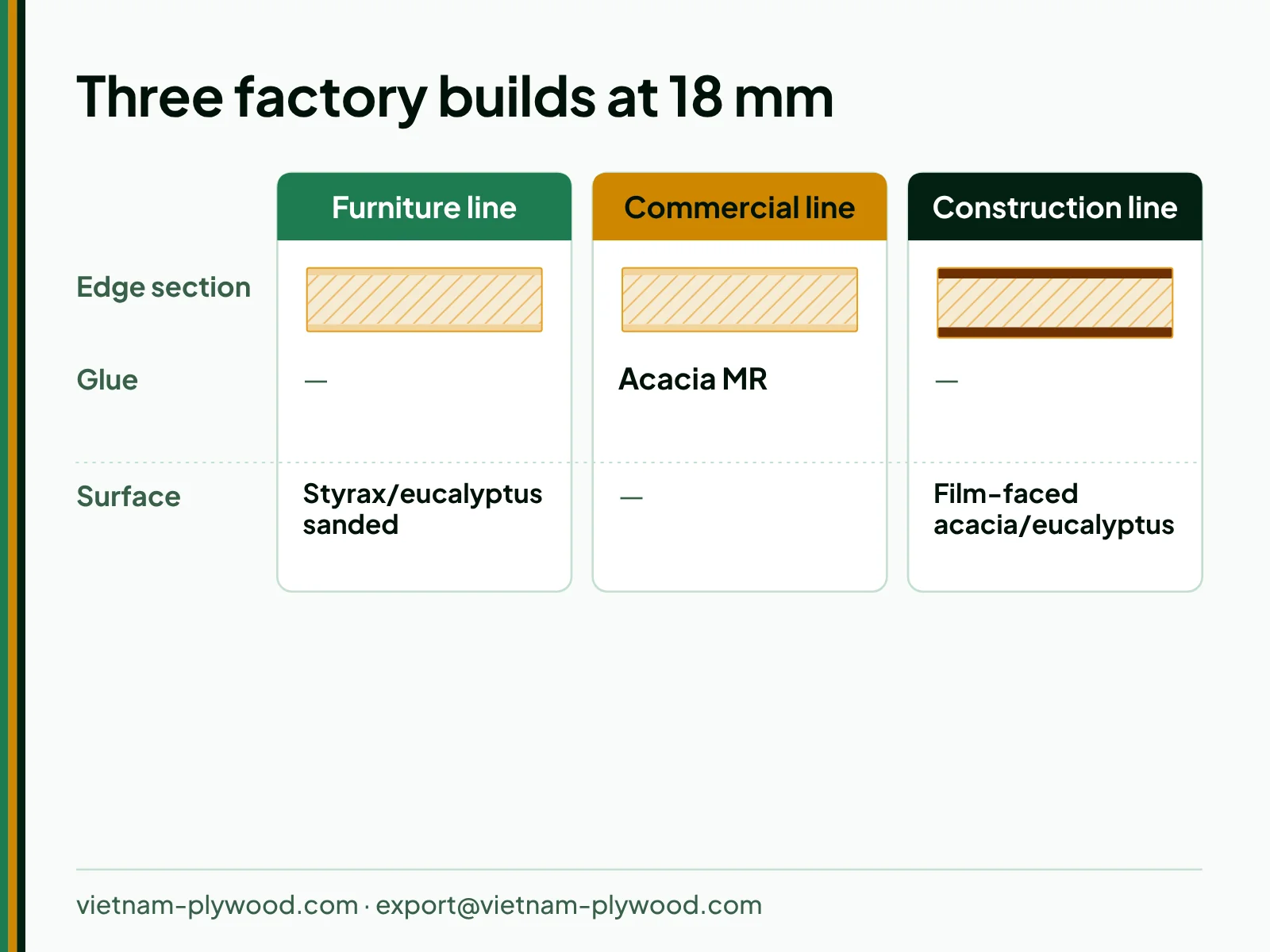
Our furniture line makes the sanded, full-stitched decorative panel. The other lines serve different applications and surface expectations. HCPLY assigns each order to the producing factory that matches its written build, with on-site quality control and direct factory shipment.
| Line | 18 mm build comparison | Surface and tolerance | Suitable decision |
|---|---|---|---|
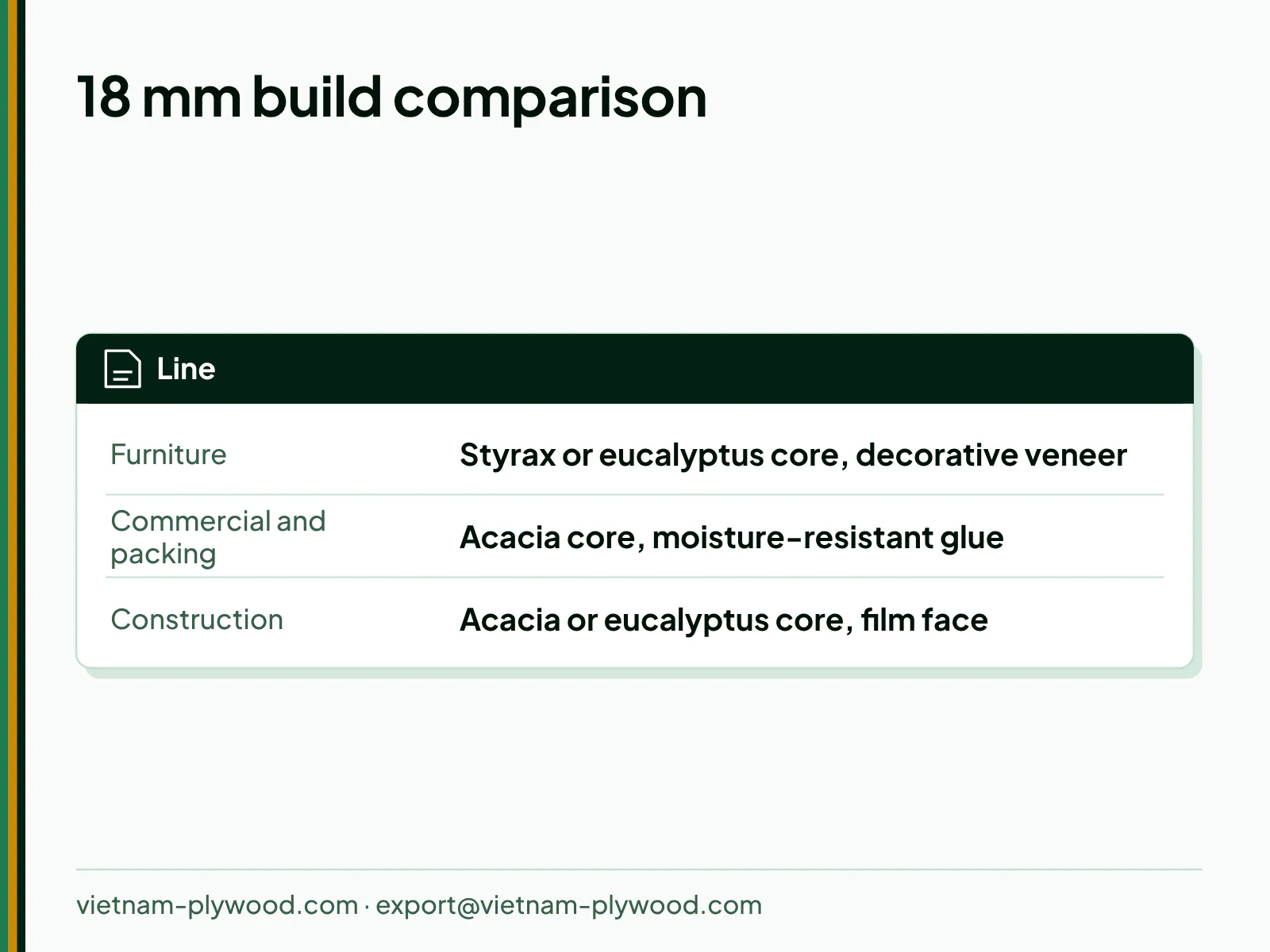
| Furniture | Styrax or eucalyptus core, decorative veneer | Sanded, ±0.2 or ±0.3 mm as ordered | Finished cabinet and furniture panels |
| Commercial and packing | Acacia core, moisture-resistant glue | Unsanded or light-sanded, commercial ±0.5 mm | Concealed or packing components |
| Construction | Acacia or eucalyptus core, film face | Unsanded, ±0.5 mm | Concrete formwork rather than decorative furniture |
The furniture range covers 3–40 mm thickness and standard formats including 1220 × 2440 mm. For appearance choices, see the Vietnam plywood manufacturing range and edge-banding options.
What face, core and adhesive should a cabinet buyer specify?
Specify the decorative face separately from the core, glue and emission class. Available faces include bintangor, okoume, engineered veneer, gurjan, pine, poplar, eucalyptus, birch and sapele; matt denotes an unfaced raw core. Common face veneer thickness is 0.2–0.4 mm, with A/B face grades and D/E/F for birch.
For furniture, our styrax or eucalyptus core is full stitched and sanded. Melamine moisture-resistant glue and phenolic weather-and-boil-proof glue describe bond systems; E0 and E1 describe emission classes on the furniture line. An emission designation is never a glue name. Where the buyer needs a United States emissions compliance route, request the member factory’s applicable CARB Phase 2 or TSCA Title VI certificate documentation, shown with factory details masked, on request.
Melamine, high-pressure laminate and other laminate faces are separate surface technologies, not an HCPLY product line.
How does panel mass affect furniture shipping?
Core density changes freight mass even when the face and nominal thickness match. At 18 mm and 1220 × 2440 mm, a styrax-core sheet weighs 26.79 kg, compared with 34.83 kg for eucalyptus core. The difference matters to handling plans and a mixed-container payload calculation.
A full 40HC reference load at this size and thickness is 990 styrax-core sheets, 880 acacia-core sheets or 795 eucalyptus-core sheets, respectively 26.52 t, 27.35 t and 27.69 t. The payload ceiling is 28.5 t; these figures represent separate full-core reference loads, not a mixed-load allocation. Furniture plywood can share a container with other agreed specifications within that ceiling.
For packing arithmetic across formats, use the container-load topic.
What should the inspector check at the producing factory?
The inspector should witness checks tied to the approved furniture sample and the purchase specification. Start with face color and grade under consistent lighting, then inspect the stitched core at representative cut edges. Measure thickness at agreed positions and record sanding variation against the ordered ±0.2 or ±0.3 mm furniture tolerance.
Check length and width against ±2 mm, then examine flatness, open joints, veneer defects and edge condition. For finishing, test the agreed coating on the approved face rather than assuming all species stain identically.
Buyers may visit the factory office and inspect goods at the producing factory. After arrival, follow the storage and receiving claims guide to preserve evidence of transit damage or handling defects.
What makes one wood choice cost more?
For solid furniture, species and clear-grade yield usually drive the largest material differences, followed by drying, machining, jointing and finish matching. For plywood, decorative face grade and species, core construction, sanding tolerance, adhesive and emission requirement change the quotation. Complex cutting and edge finishing add conversion cost after panel purchase.
HCPLY’s indicative furniture plywood starting price is from US$350/m³ FOB Hai Phong (October 2026). That figure is a starting point for a written furniture-panel specification, not a price for a solid hardwood assembly. Our commercial and packing line starts from US$250/m³ FOB Hai Phong (October 2026) for commercial plywood, whose surface and build are different.
Compare finished-unit cost using accepted yield and reject rate, not raw volume alone. For repeated distributor purchases, review plywood supply programmes.
What should the order and shipping paperwork say?
The order should identify application, face grade, core, bond system, emission requirement, size, tolerance and packing mix. HCPLY manages specifications, factory inspection, export documents and loading, with shipments departing FOB Hai Phong or under agreed CFR (CNF) or CIF terms.
The shipment document set includes the commercial invoice, packing list, bill of lading, certificate of origin, phytosanitary and fumigation papers, plus applicable order certificates and test reports. EU shipments add EUR.1 and the relevant EUTR/EUDR file set; CIF shipments include insurance. After loading, the draft shipping documents come to you for approval.
Minimum order is one 40HC, with mixed specifications allowed within the payload limit. Factory lead time runs 15–45 days from receipt of the 30% deposit; the exact figure depends on order size, line loading and what the contract fixes; the 70% balance is against the scanned bill of lading by telegraphic transfer or irrevocable letter of credit at sight. Samples are free; new buyers book their courier, whose cost can be credited against a real order.
How should a furniture factory make the final choice?
Choose solid hardwood where exposed edge grain, carved shape and joint strength define the product. Choose qualified pine or rubberwood where the factory’s finish and machining trials support the target cost. Choose veneered plywood for broad, flat furniture components that benefit from repeatable dimensions and nesting.
A practical comparison trial uses one drawing, one finish standard and the same inspection acceptance criteria. Record actual accepted parts per purchased cubic metre, coating rejects and assembly fit. The result is a purchasing decision supported by factory measurements rather than a species popularity ranking.
For printed decorative surfaces, the printing-on-plywood topic covers a different finishing route; for lightweight interiors, see caravan and RV panels.
What specification should the buyer send?
Send the following fields to Lucy at export@vietnam-plywood.com so our furniture line can quote the exact decorative build.
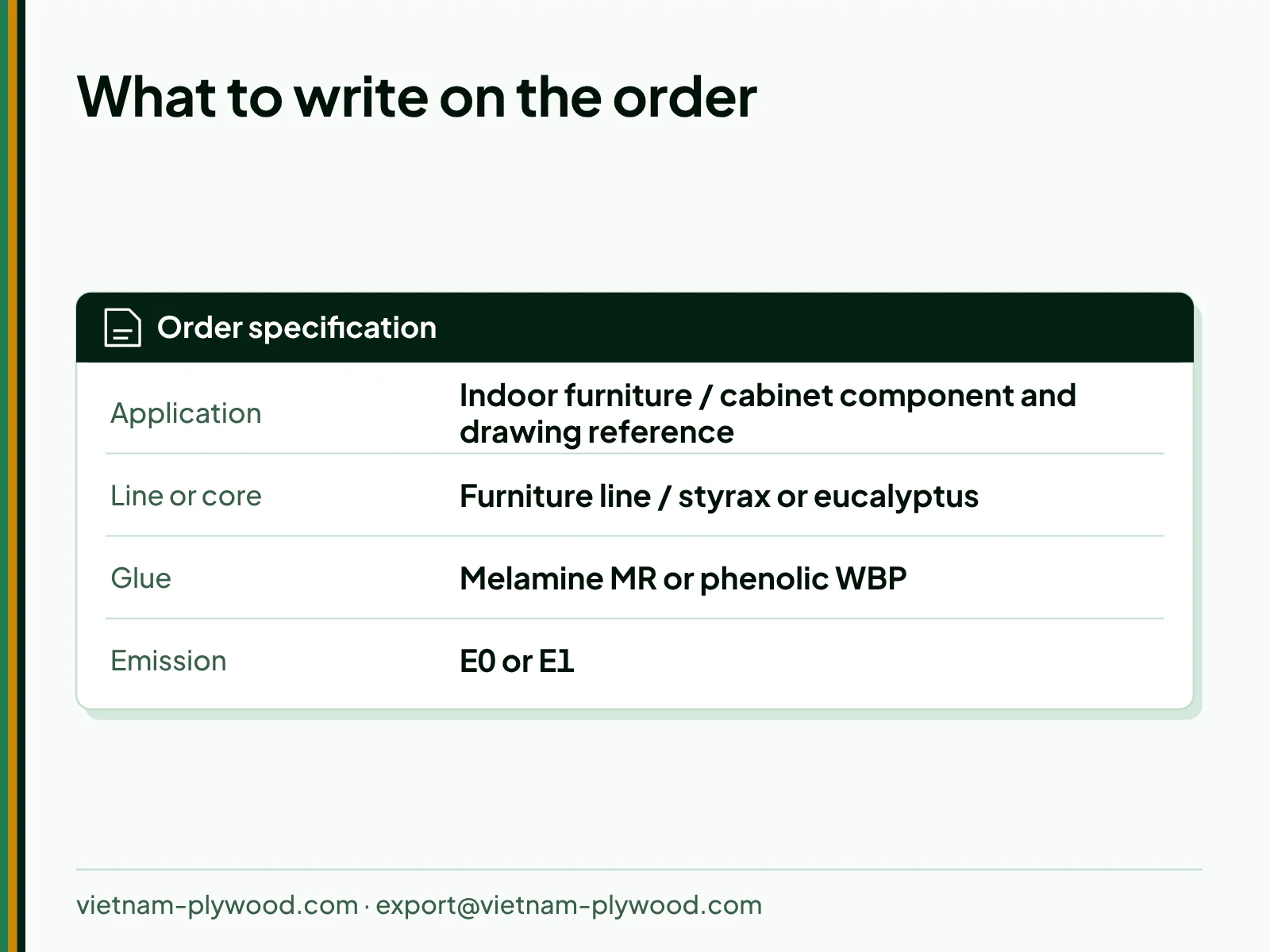
Application: indoor furniture / cabinet component and drawing reference
Line or core: furniture line / styrax or eucalyptus
Glue: melamine MR or phenolic WBP, as required
Emission: E0 or E1, with required documentary evidence
Face and grade: species, A/B (birch D/E/F), approved sample
Thickness and tolerance: mm; ±0.2 or ±0.3 mm as ordered
Size: length × width in mm
Quantity: sheets or m³; mixed-load schedule if applicable
Destination port: port and country
Next step: book a factory visit to inspect the proposed build at the producing factory.