





What plywood is used in caravans?
Caravan ply is usually specified by component: thin decorative plywood for wall and ceiling linings, thicker plywood for cabinets, and a moisture-conscious build near wet areas. For HCPLY, our furniture line is the starting point for visible interiors because it combines a stitched core, sanded surface, selectable veneer face and E0 or E1 emission class. The fastening design still needs its own trial.
RV plywood should be chosen from the finished assembly backward. A ceiling lining carried by battens has different demands from a hinged locker door or a cabinet side receiving repeated screw loads. A visible panel also needs a defined face grade and finish schedule. Our Applications library places this choice alongside other industrial panel uses.
A core description cannot replace a fastening test.
What thickness of plywood is used for RV wall panels?
For RV wall panels, 3, 5 and 9 mm are practical specification candidates for evaluation, with support layout and fastening loads determining the final selection. These are available thicknesses, not a universal vehicle construction standard. A non-load-bearing lining can be thinner than a cabinet partition.
Start with 3 mm for a supported decorative ceiling or wall skin, then compare 5 mm where handling stiffness matters. Evaluate 9 mm where the panel spans farther or must accept fittings. Cabinet parts can move to 12, 15 or 18 mm when the assembly calls for more section depth. None of these thicknesses establishes a vehicle structural rating.
We make panels from 3–40 mm, with common thicknesses of 3, 5, 9, 12, 15, 18, 21 and 25 mm. Sanded furniture plywood is ordered at ±0.2 or ±0.3 mm thickness tolerance; length and width tolerance is ±2 mm. Check clearance at trim channels, edge joints and door reveals against the ordered tolerance rather than the nominal dimension alone.
Standard formats include 1220×2440 and 1250×2500 mm, alongside custom cutting.
How do styrax-core and poplar panels compare by weight per sheet?
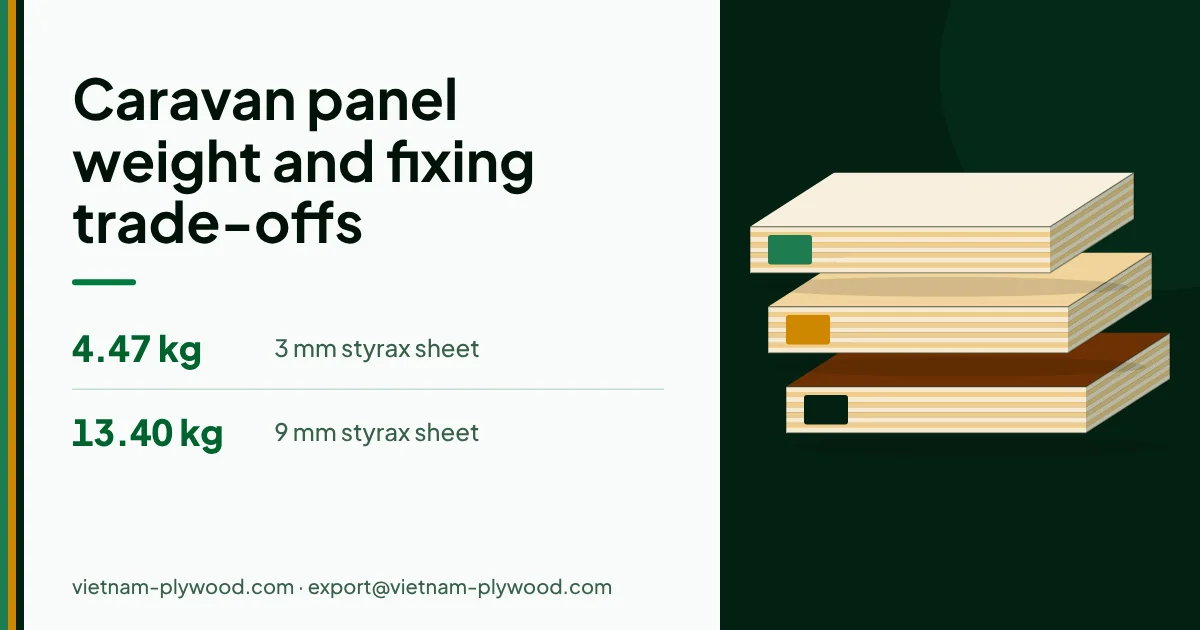
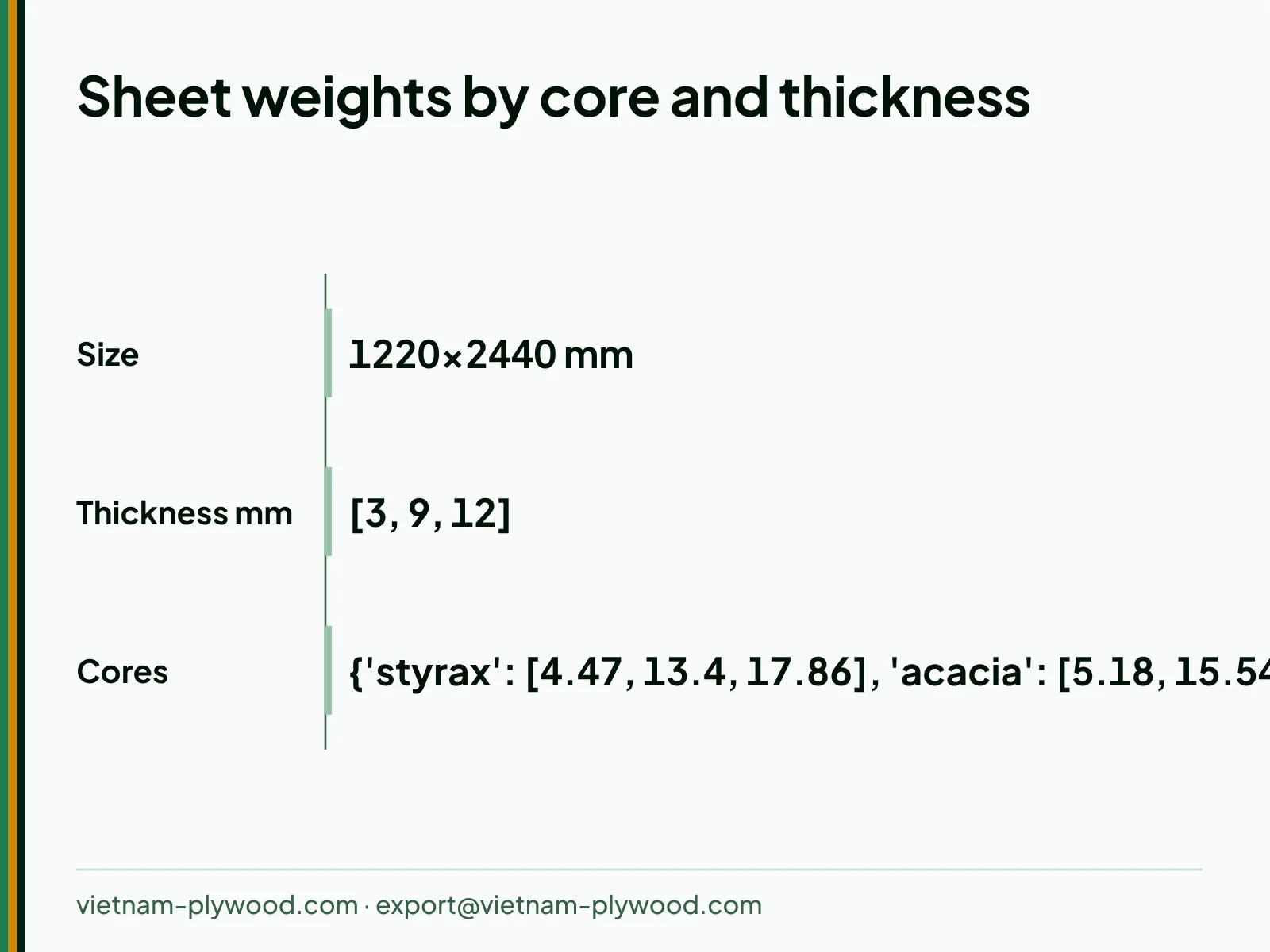
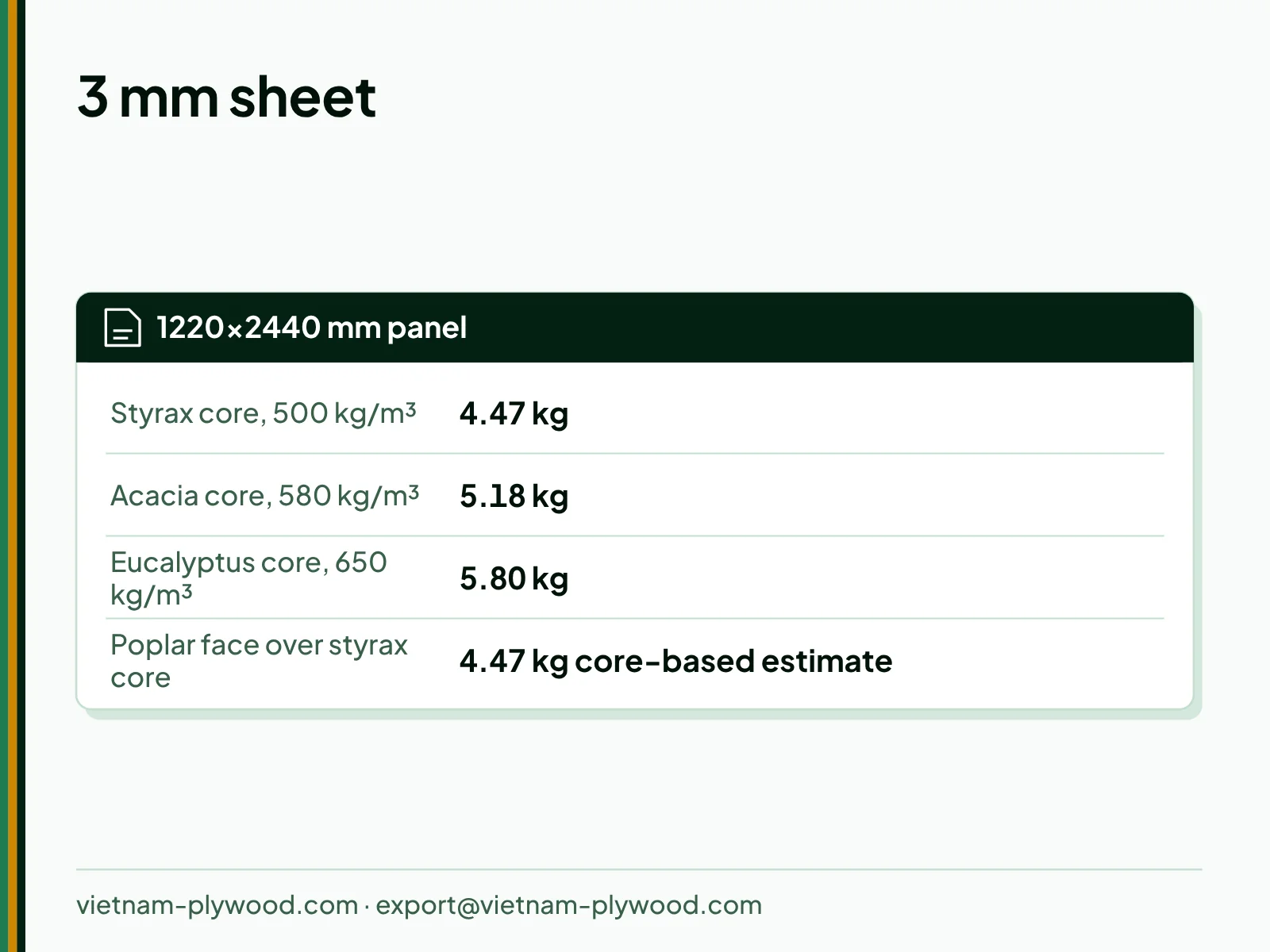
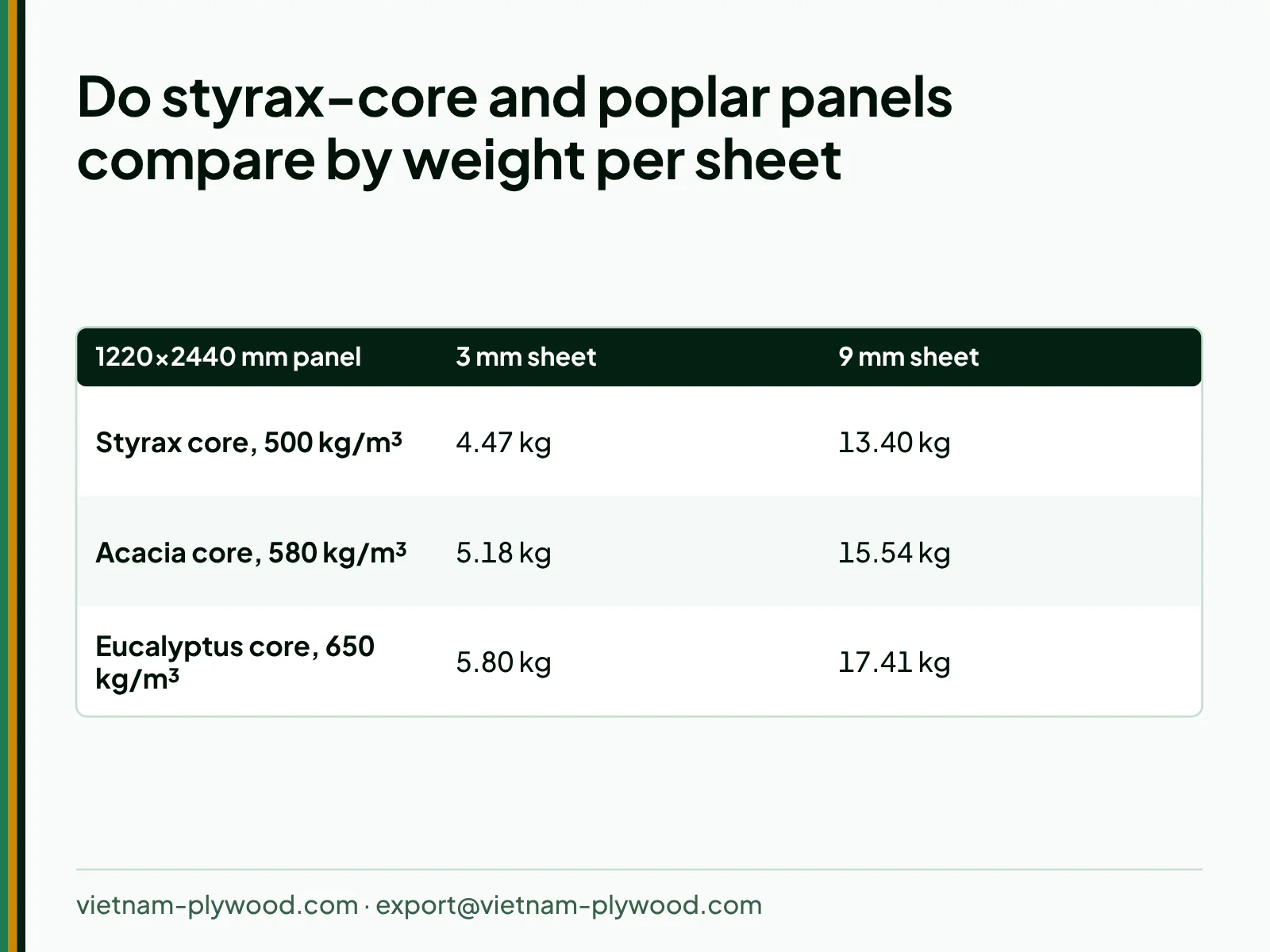
A 1220×2440 mm, 3 mm styrax-core sheet weighs 4.47 kg; at 9 mm it weighs 13.40 kg. These are core-density calculations from our build data, excluding fittings and finishes. Poplar is an available face veneer, but we have no poplar-core density or poplar-core sheet-weight figure to quote.
| 1220×2440 mm panel | 3 mm sheet | 9 mm sheet | 12 mm sheet | Verdict by use |
|---|---|---|---|---|
| Styrax core, 500 kg/m³ | 4.47 kg | 13.40 kg | 17.86 kg | First weight comparison for supported interior lining |
| Acacia core, 580 kg/m³ | 5.18 kg | 15.54 kg | 20.72 kg | Consider for packing or less finish-sensitive parts |
| Eucalyptus core, 650 kg/m³ | 5.80 kg | 17.41 kg | 23.22 kg | Compare where a denser core is desired for trial |
| Poplar face over styrax core | 4.47 kg core-based estimate | 13.40 kg core-based estimate | 17.86 kg core-based estimate | Choose for appearance; face does not redefine core density |
The figures are nominal calculations for the stated core and sheet size, with face and finish contributions not separately quantified. A poplar-faced styrax board is still classified by its styrax core for density. A separate poplar-core product sold elsewhere cannot be assigned these figures.
For a finish-sensitive fit-out, specify poplar face and A/B face grade with the styrax core when the visual sample suits the project. The poplar plywood product topic helps buyers distinguish a poplar appearance from an assumed poplar core. We do not press poplar-core or birch-core plywood.
How does a lighter core affect screw holding?
A lighter core reduces nominal panel mass, but screw holding must be checked at the actual fastener location and edge distance. Density alone does not supply a pull-out load or repeated-cycle result. The installer must distinguish a screw driven into a face from one driven into a thin panel edge.
Test hinge plates with the intended screws, pilot holes, edge distances and reinforcement.
Full stitched cores are the furniture-line choice. Stitched outer layers with edge-trimmed inner layers, finger-jointed cores and loose-laid cores represent different construction options, with different implications for void inspection and fixing placement. Do not assume a lower mass automatically gives acceptable screw performance.
A useful incoming inspection cuts representative pieces through planned fastening zones and records visible gaps. The factory inspector can witness thickness measurements and a buyer-agreed fastener trial at the producing factory. No screw withdrawal value is offered without an agreed test report.
Which glue should be specified for caravan walls and ceilings?
Specify the adhesive separately from the emission class: melamine moisture-resistant (MR) glue is rated here for a 12-hour boil, while phenolic weather-and-boil-proof (WBP) glue is rated for a 72-hour boil. These are glue-system descriptions, not declarations that an unsealed caravan panel is waterproof.
For dry, lined walls and RV ceiling panels, begin the discussion with the intended indoor exposure and the furniture-line construction. For wash areas, condensation-prone cavities or cutouts near plumbing, specify the exposure and request a suitable bond test before approving the build. Protect cut edges and penetrations in the finished assembly; adhesive choice cannot compensate for trapped water.
E0 and E1 describe emission classes. They do not describe adhesive chemistry. A buyer specifying MR glue plus E1 is asking for two different attributes, which must appear as separate lines on the purchase specification.
For U.S. importers, the U.S. Environmental Protection Agency’s 2016 formaldehyde rule identifies hardwood plywood among regulated composite wood products and requires third-party certification for covered products. Its official rule summary explains the labeling and certification framework. CARB Phase 2 and Toxic Substances Control Act (TSCA) Title VI requirements should be addressed through the relevant member-factory documentation, shown with factory details masked, on request.
Which line builds each caravan ply component?
Our furniture line presses the sanded, full-stitched styrax or eucalyptus core intended for visible RV interior wall panels and cabinet components. Our commercial and packing line instead builds acacia-core MR panels, while our construction line presses film-faced panels for formwork-oriented applications.
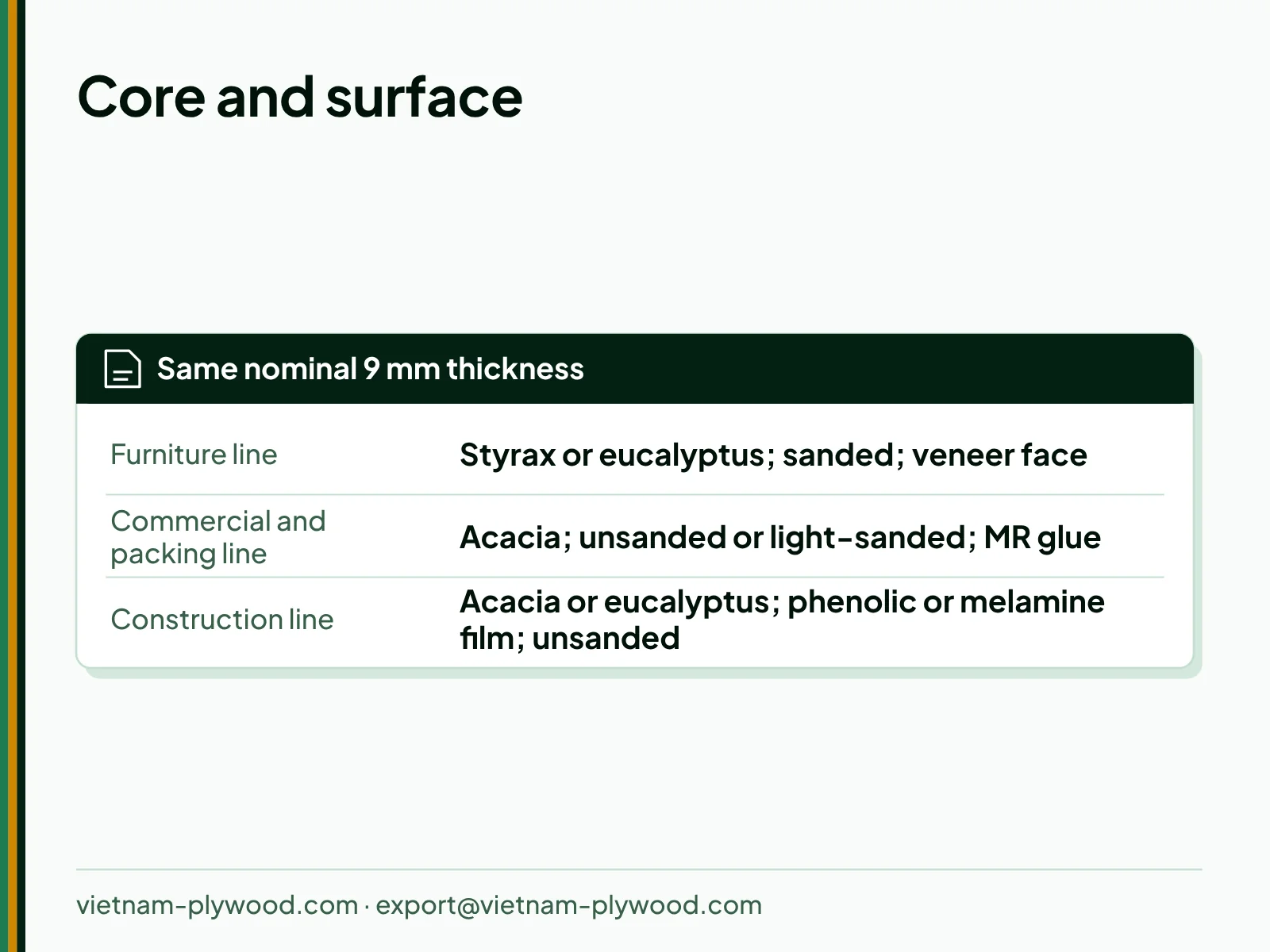
| Same nominal 9 mm thickness | Core and surface | Tolerance | Practical purchasing verdict |
|---|---|---|---|
| Furniture line | Styrax or eucalyptus; sanded; veneer face | ±0.2 or ±0.3 mm as ordered | Evaluate for caravan interiors and cabinetry |
| Commercial and packing line | Acacia; unsanded or light-sanded; MR glue | ±0.5 mm commercial | Consider for concealed non-finish parts after testing |
| Construction line | Acacia or eucalyptus; phenolic or melamine film; unsanded | ±0.5 mm | Formwork-oriented surface, not the default decorative RV lining |
We operate three member factories in Phu Tho and Hai Phong. Each order is produced in the factory matching the agreed specification and shipped directly from that location, FOB Hai Phong. Buyers can inspect the goods and meet our team at the producing factory’s office.
The commercial plywood range explains the alternative build, while the application engineering overview helps separate vehicle lining from other end uses.
Can different caravan specifications share a container?
One 40HC can contain mixed specifications within the 28.5 t payload limit, provided the loading plan accounts for core weight, dimensions and pallet configuration. For 1220×2440 mm at 18 mm, the full-container references are 990 styrax sheets at 26.52 t, 880 acacia sheets at 27.35 t, and 795 eucalyptus sheets at 27.69 t.
Those are full homogeneous-load references, not a mixed-load schedule. To build a mixed order, multiply each selected sheet count by its corresponding sheet weight, add the planned cargo masses, and compare the total with the payload ceiling. For example, 18 mm styrax sheets weigh 26.79 kg each and 18 mm acacia sheets weigh 31.08 kg each; actual mix quantities must be stated before the combined tonnage can be calculated.
Packaging, pallets and any additional components need consideration in the final load plan. The container loading reference owns the detailed sheet-count method. Distributors arranging several fit-out specifications can also review supply programmes.
How should RV plywood be specified for wet areas?
Wet-area panels need a defined exposure scenario, suitable adhesive and an edge-protection detail. A sink enclosure, washroom wall and ventilated ceiling can experience different moisture paths even within the same vehicle. Decide whether the panel is exposed to splashes, prolonged dampness or only intermittent humidity.
Do not label a board marine plywood solely because it uses phenolic glue. A marine designation or BS 1088 claim needs a test report the buyer accepts. We can discuss a proposed build against such a report; the order must identify the acceptance criteria.
The fit-out manufacturer should validate the full assembly, including decorative coatings, cutouts, sealant and mechanical fixings. A water-resistant bond does not stop moisture entering an unsealed edge or behind an impermeable finish. This is particularly relevant when wall panels meet flooring, plumbing chases and exterior openings.
What face and finish should a caravan builder order?
Order the visible face by species and grade, then evaluate it against the actual interior finish. Our face choices include poplar, okoume, bintangor, engineered veneer, pine, eucalyptus, sapele, gurjan and birch; the panel is named by its face, while weight follows the core.
Common face veneer thickness is 0.2–0.4 mm. A/B is the normal face-grade language for the offered faces; birch uses D/E/F grading. A decorative face should be sampled under the intended coating and lighting, especially where adjacent panels must match.
Melamine, high-pressure laminate (HPL) and other laminate faces are useful market references, but they are not HCPLY product lines. A fit-out maker can purchase a raw plywood substrate and arrange a separate finishing process. For thin matching skins and doors, compare the door-skin plywood topic and shopfitting panel requirements.
What should an inspector check before loading?
The inspector should compare the approved specification with physical panels, witness targeted checks and record deviations before loading. Thickness, core gaps, face grade, panel dimensions and packing identification are practical inspection points for caravan ply.
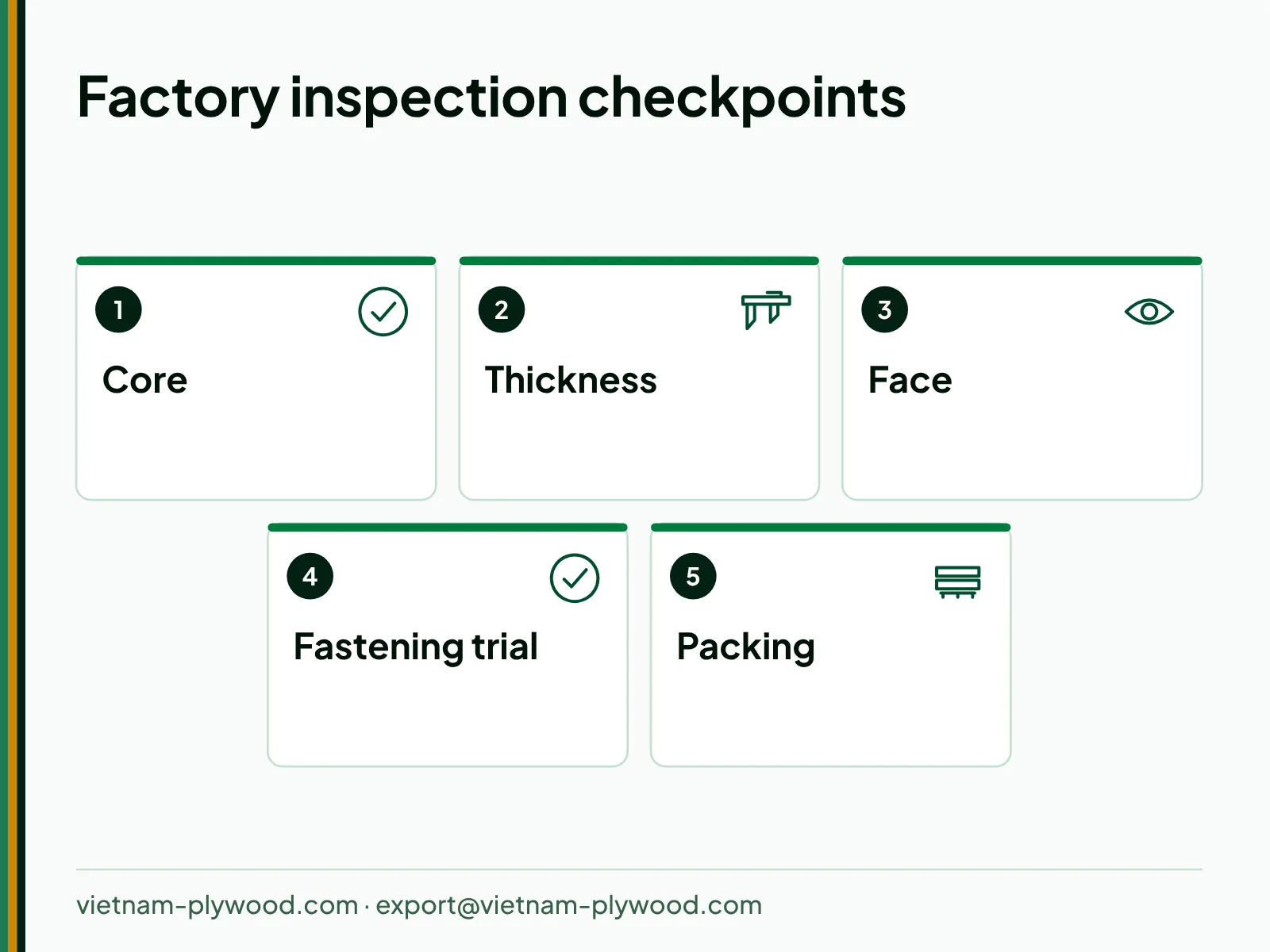
- Verify the producing line, core species, face veneer and adhesive against the signed specification.
- Measure panel thickness at agreed positions and compare it with the ordered sanded tolerance.
- Inspect cut cross-sections for core construction and gaps, especially around planned screw locations.
- Review the buyer’s finish sample and perform the agreed fastening or bond tests when specified.
- Check pallet labels, counts, edge protection and the loading plan against the packing list.
Our on-site quality control team supports buyer inspection at the producing factory. A buyer can also use the receiving and claims checklist to preserve comparable evidence after delivery.
The commercial invoice and packing list identify the shipment and quantities; the bill of lading (B/L) records carriage. Order-specific emission certificates or agreed test reports belong in the export document set. After loading, the draft shipping documents come to you for approval.
How should importers request a comparable quotation?
A comparable quotation needs the same core, thickness tolerance, face grade, glue, emission class, sheet size and inspection criteria across suppliers. Otherwise a lower offer can conceal a different panel construction or finish burden.
The main cost drivers are core construction and selection, face veneer quality, thickness and sanding requirements, adhesive specification, and the size and cutting plan. A full-stitched, sanded furniture build costs more to produce than a less finished, loose-laid packing build because it requires more core preparation and surface work. The actual caravan build is quoted against its written specification; no caravan-specific price is published here.
Minimum order is one 40HC. Factory lead time runs 15–45 days from receipt of the 30% deposit; the exact figure depends on order size, line loading and what the contract fixes. The remaining 70% is paid on the scan of the bill of lading, by T/T, or by irrevocable sight L/C. We ship FOB Hai Phong, or CFR (CNF) or CIF to your port. Samples cost nothing: a first-time buyer pays the courier, and that charge comes off the first confirmed order.
Lucy at export@vietnam-plywood.com handles the specification discussion, factory inspection arrangements and export paperwork. For repeat distributors, the order should also state which drawings or finish samples govern future batches.
What details should the first RV panel inquiry contain?
The first inquiry should identify the part, fixing demand, moisture exposure and weight target before naming a veneer. That gives the producing team a practical basis for proposing samples and a test plan.
Include support spacing, fastening positions, edge sealing and the agreed test method.
Use this request format so the first specification sheet can address the right build:
Application: RV wall lining / ceiling / cabinet part; exposure and fixing layout
Line or core: Furniture line; styrax core (or eucalyptus core for comparison)
Glue: MR melamine or WBP phenolic; state exposure and test requested
Emission: E0 or E1; add destination-specific documentation requirements
Face and grade: Poplar face A/B or another listed veneer and grade
Thickness and tolerance: e.g., 5 mm, sanded ±0.2 mm as ordered
Size: e.g., 1220 × 2440 mm; identify custom cuts
Quantity: One 40HC minimum; list each specification and sheet count
Destination port: [port and country]
Request the caravan panel specification sheet with the completed lines.