





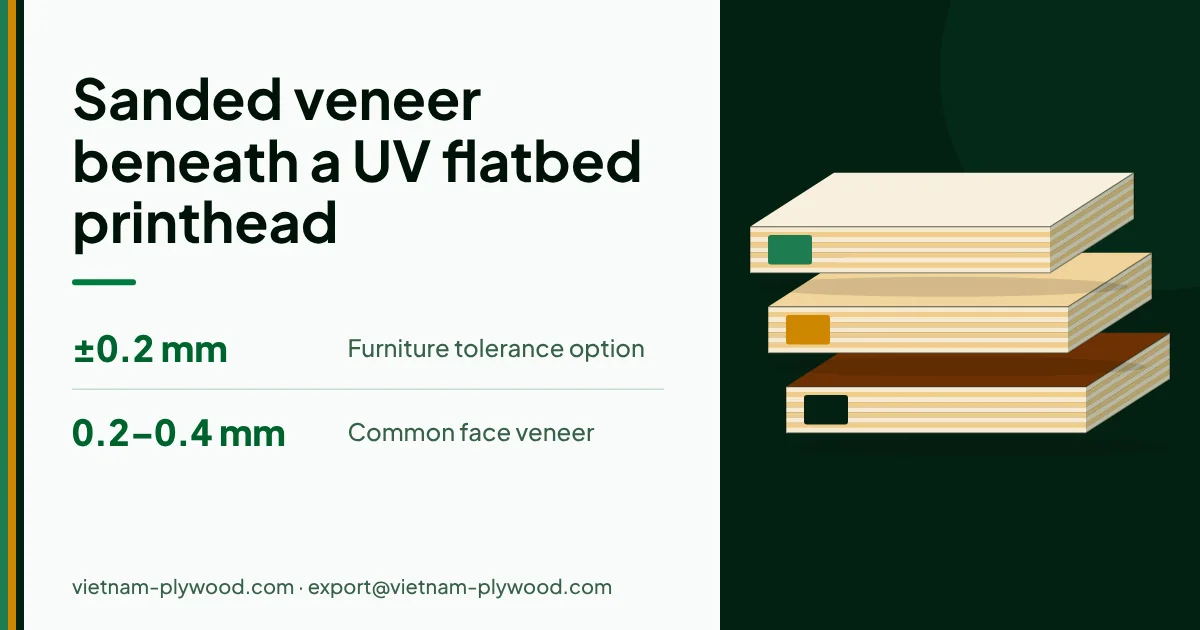
HCPLY prepares plywood print substrates on our furniture line with calibrated thickness and a consistently sanded veneer face. A mismatched surface can waste ink, delay a production run or leave a rejected decorative-panel load. The right specification starts with the printer’s surface and clearance requirements, then selects the face and core that suit the job.
Can you print directly on plywood?
Yes. A plywood print can be applied directly to a prepared veneer face using ultraviolet (UV) flatbed equipment or screen printing. The face must be clean, consistently sanded and flat enough for the chosen printer clearance. Direct printing avoids a separate decorative sheet, but the print shop must approve ink adhesion and appearance on an actual production sample.
UV flatbeds deposit ink onto a stationary panel and cure it with UV light. Screen printing pushes ink through a patterned mesh onto the surface. Both methods reproduce defects in the substrate: open grain, sanding scratches, raised patches and veneer repairs can remain visible beneath the artwork. A printer’s own ink and pretreatment instructions govern the final process.
For cabinet doors, retail fit-outs and decorative panels, specify the face before choosing the image. A pale, even veneer can provide a more predictable visual base for light artwork. A visible wood grain can instead become part of a design, provided the buyer approves that effect. Our applications library covers adjacent panel uses.
Which plywood face prints best?
A consistently sanded A/B furniture face is the starting point for controlled UV or screen printing. Bintangor, okoume, engineered veneer (EV) and poplar are candidate faces when their actual colour and grain match the artwork. None is automatically the winning choice for every ink system.
A light face helps pale colours retain their appearance. A darker or more figured face can change colour perception, especially where the print leaves wood exposed. Print shops should compare samples from the intended veneer lot under the same artwork, ink, primer and curing settings.
Face veneer is commonly 0.2–0.4 mm. That thin decorative layer makes aggressive re-sanding a poor remedy for a bad initial finish. Specify the face grade and a consistent sanding finish at purchase rather than relying on the print shop to remove substantial material later. For matching wall installations, see plywood wall panelling.
What sanding grade does a UV flatbed need?
A UV flatbed needs a smooth, uniformly sanded face with a finish approved through a print trial. There is no universal abrasive-grit number in the HCPLY specification: the required surface profile follows the ink, primer, artwork and printer setup. Ask the print shop to state its acceptance criteria in writing.
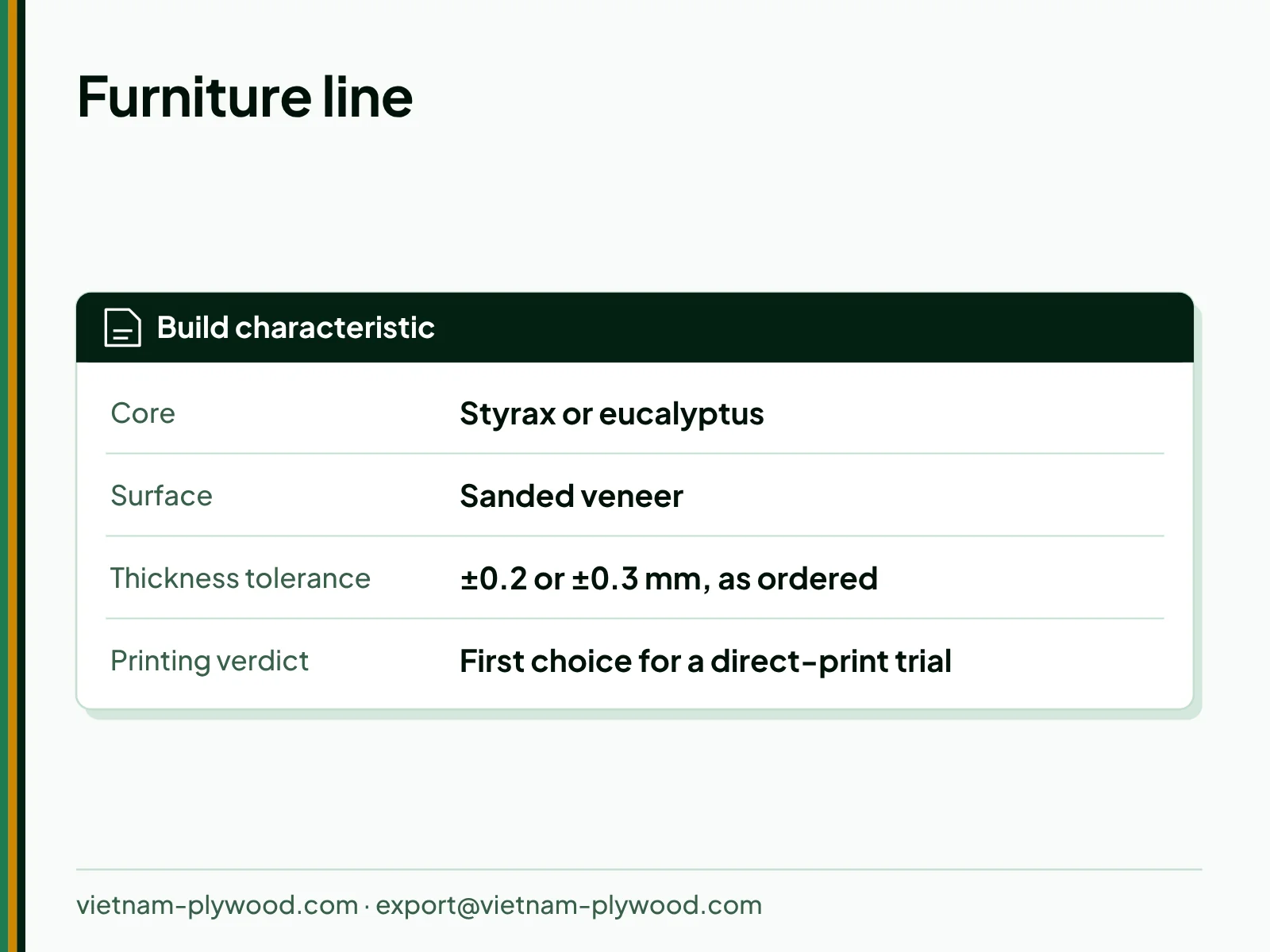
Our furniture line uses full-stitched cores and sanded faces, with an ordered thickness tolerance of ±0.2 or ±0.3 mm. This controls panel thickness more closely than the commercial or construction line’s ±0.5 mm tolerance. Surface smoothness and thickness calibration are separate checks: a panel can feel smooth yet still present a height change to the printhead.
The print shop should assess scratches in raking light, wipe away dust, inspect veneer patches and check panel flatness. Use a test print across both the centre and edges. If a primer is needed, document its application and curing procedure rather than assuming that sanding alone delivers adhesion.
Why does calibration matter more than species?
Calibration controls the distance between the printhead and the working face, so thickness consistency can matter more than the species name. An attractive veneer still prints poorly when its surface rises into the head clearance or sits unevenly beneath the ink jets.
For a specified panel thickness, the furniture-line tolerance can be ordered at ±0.2 or ±0.3 mm. That is a manufacturing thickness tolerance, not a promise about local flatness, bow or printer clearance. A print shop should set its own permissible surface-height envelope and check samples against it.
Core species still affect mass and handling. Styrax is 500 kg/m³ and eucalyptus 650 kg/m³; those densities follow the core rather than the printed face. Species selection therefore influences loading and handling while the surface preparation and calibration determine the print trial’s immediate suitability.
Which HCPLY line makes the print substrate?
Our furniture line presses the sanded, full-stitched panels intended for decorative printing trials. The other lines serve different applications and should not be treated as interchangeable merely because a sheet carries the same nominal thickness.
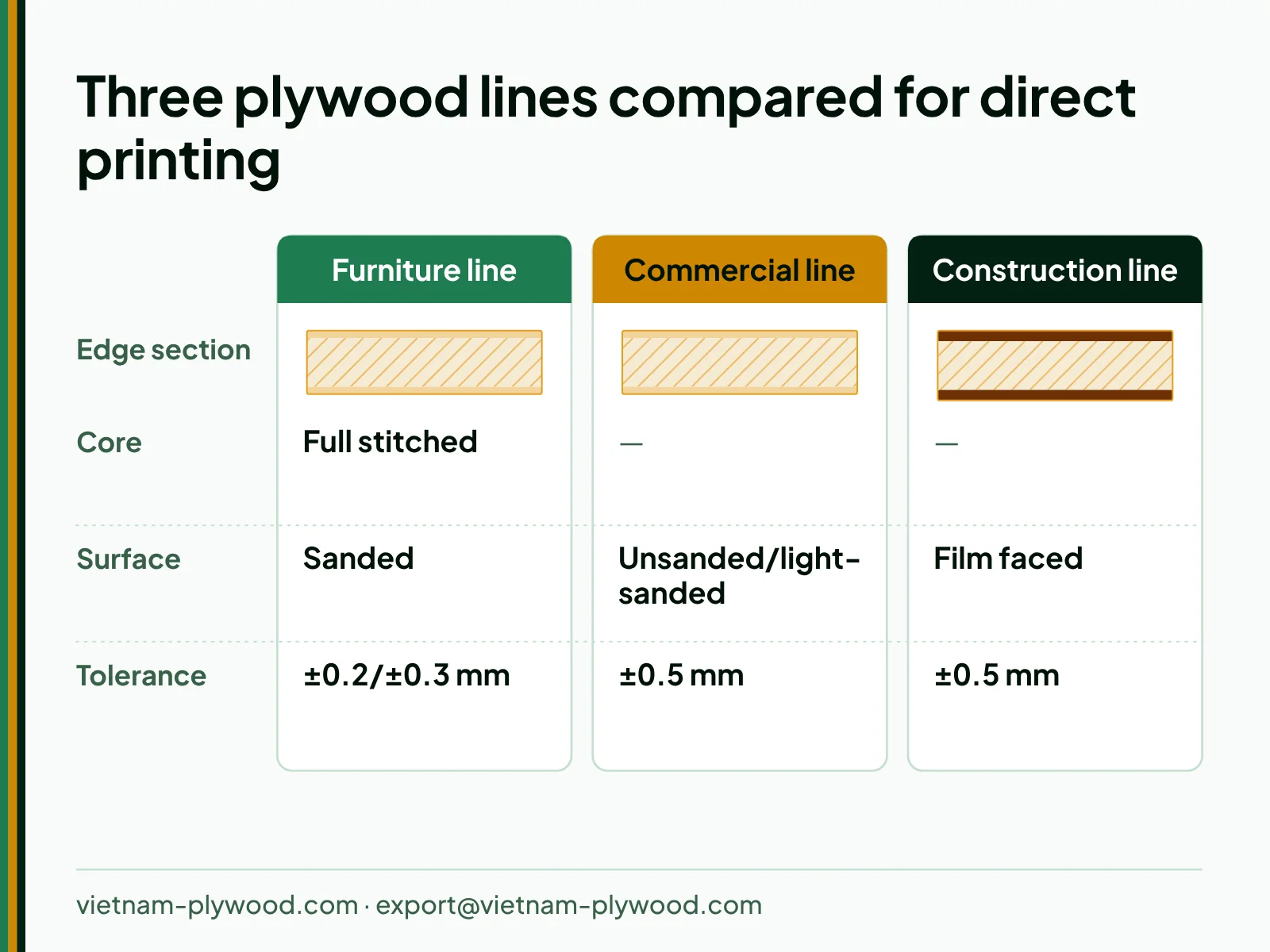
| Build characteristic | Furniture line | Commercial and packing line | Construction line |
|---|---|---|---|
| Core | Styrax or eucalyptus | Acacia | Acacia or eucalyptus |
| Surface | Sanded veneer | Unsanded or light-sanded | Phenolic, melamine or anti-slip film |
| Thickness tolerance | ±0.2 or ±0.3 mm, as ordered | ±0.5 mm; packing ±0.5–1.0 mm | ±0.5 mm |
| Printing verdict | First choice for a direct-print trial | Consider only after surface preparation and print validation | Formwork surface; not the furniture print specification |
Our commercial and packing line makes utility panels where appearance is secondary. Our construction line makes film-faced panels for concrete formwork, including formwork by structural element. We do not press medium-density fibreboard, oriented strand board, chipboard, blockboard, bamboo panels, MDO or HDO. Melamine, high-pressure laminate and other laminate faces are separate finishing topics, not an HCPLY product line.
Which furniture-line panels take ink evenly?
The most promising candidates combine a continuous A/B face, full-stitched core and repeatable sanding. Our furniture line offers styrax or eucalyptus cores with E0 or E1 emission classes. Choose bintangor, okoume, EV or another specified veneer by its approved sample rather than assuming that the name predicts ink absorption.
A continuous face limits sudden transitions from veneer to exposed repairs. A full-stitched core provides a more uniform construction beneath the decorative surface. Neither feature replaces a print test: ink wetting, adhesion, colour and cure remain properties of the complete substrate-and-ink combination.
For artwork with solid colour fields, request side-by-side prints on the proposed face grades. For artwork that deliberately shows grain, approve both the printed image and the uncovered wood. Retain a signed reference panel so later production lots can be judged against the same target.
What should an inspector check at the producing factory?
An inspector should compare the ordered face, sanding and thickness with marked samples before the goods are loaded. Buyers can visit the factory office and inspect panels at the producing factory, where the print-substrate build is made.
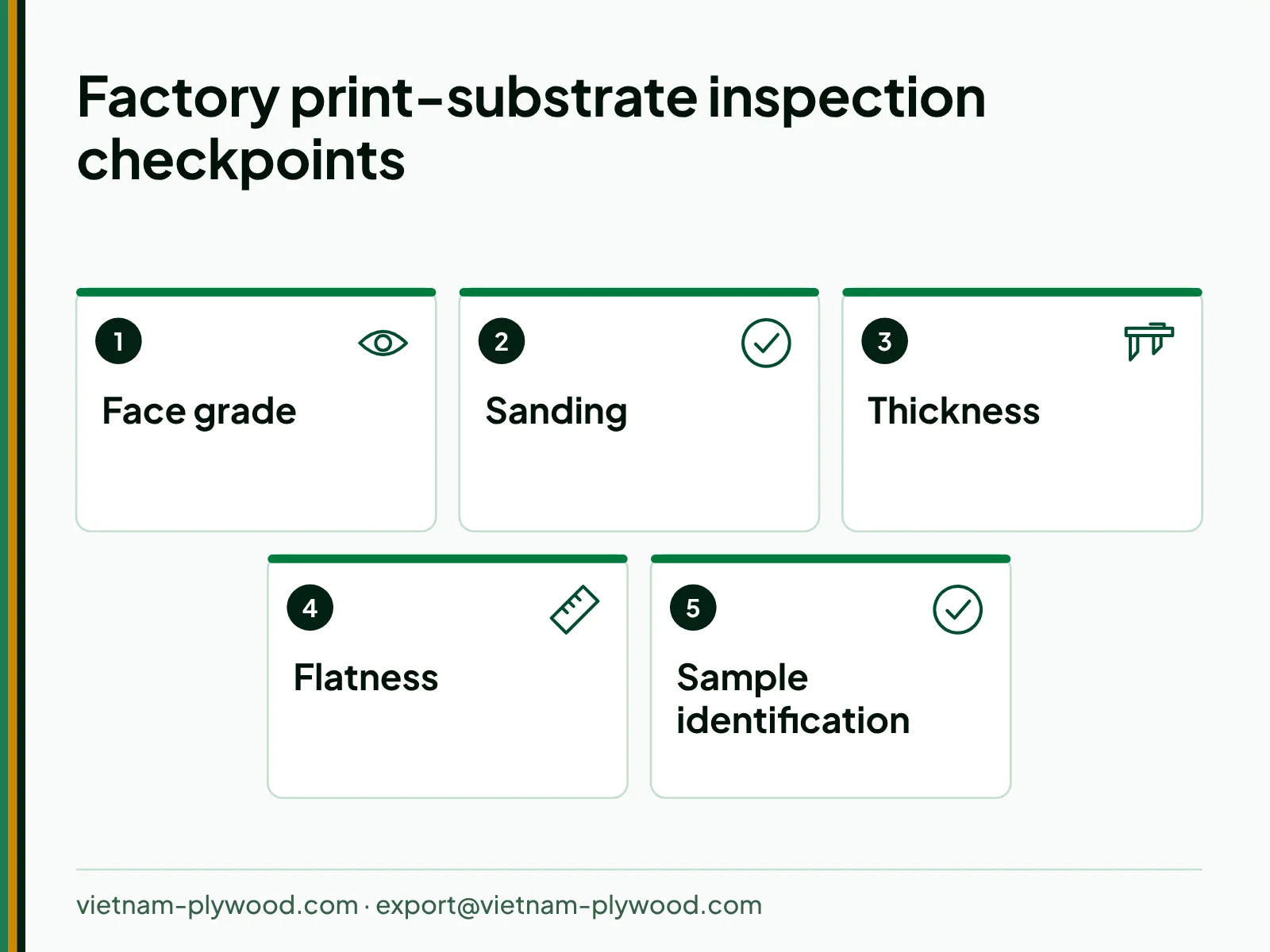
- Identify the face veneer, grade, core and intended printed side against the purchase specification.
- Examine panels under angled light for sanding marks, open joints, dust and surface repairs.
- Measure thickness at agreed locations and record whether the ordered ±0.2 or ±0.3 mm furniture tolerance is met.
- Check face continuity, edge condition, sheet dimensions and packaging protection.
- Select traceable samples for the buyer’s printer trial and record the lot identification.
These factory checks establish substrate conformity. They do not replace the printer’s ink-adhesion, cure and colour acceptance tests. For repeat-cut components, specify dimensions through cut-to-size plywood supply.
Can printed-panel orders share a container?
Furniture print substrates can share a 40HC container with other specified plywood builds within its 28.5 t payload limit. The shipping calculation follows core density, thickness and pallet allocation, rather than the decorative face alone.
For 18 mm, 1220 × 2440 mm sheets, the styrax-core lookup gives 26.79 kg per sheet and 990 sheets in a full 40HC load, totalling 26.52 t. The eucalyptus-core alternative gives 34.83 kg per sheet and 795 sheets, totalling 27.69 t. Those full-load counts describe separate single-core scenarios, not a combined allocation.
For a mixed shipment, calculate the weight of each specification and add pallet and packing constraints before approving the loading plan. See mixed-container loads and the container packing reference for the wider logistics question. HCPLY manages on-site quality control, documents and loading through the export process.
What belongs in the purchase specification?
A print-ready purchase specification names the surface and the measurable panel characteristics separately. Include the artwork process as an application note, but let the print shop approve ink compatibility using representative samples.
Specify the furniture line, styrax or eucalyptus core, face species and A/B grade, sanding expectation, nominal thickness and tolerance. Available thicknesses span 3–40 mm, including common 9, 12, 15 and 18 mm builds. Standard sizes include 1220 × 2440 mm and 1250 × 2500 mm, with custom cutting available.
Glue and emission class are distinct fields. State the adhesive system required for the order and E0 or E1 as a separate emission requirement. If panels enter the US market, the US Environmental Protection Agency’s 2016 formaldehyde rule addresses regulated hardwood plywood and third-party certification under Toxic Substances Control Act Title VI. Ask for the order’s applicable emission certificate and test documentation. Member-factory certificates, including CARB P2, are shown with factory details masked, on request.
How should a print shop qualify the substrate?
A print shop should qualify the actual plywood face using its production artwork and ink process before approving a larger order. A controlled trial separates substrate defects from printer settings and finishing choices.
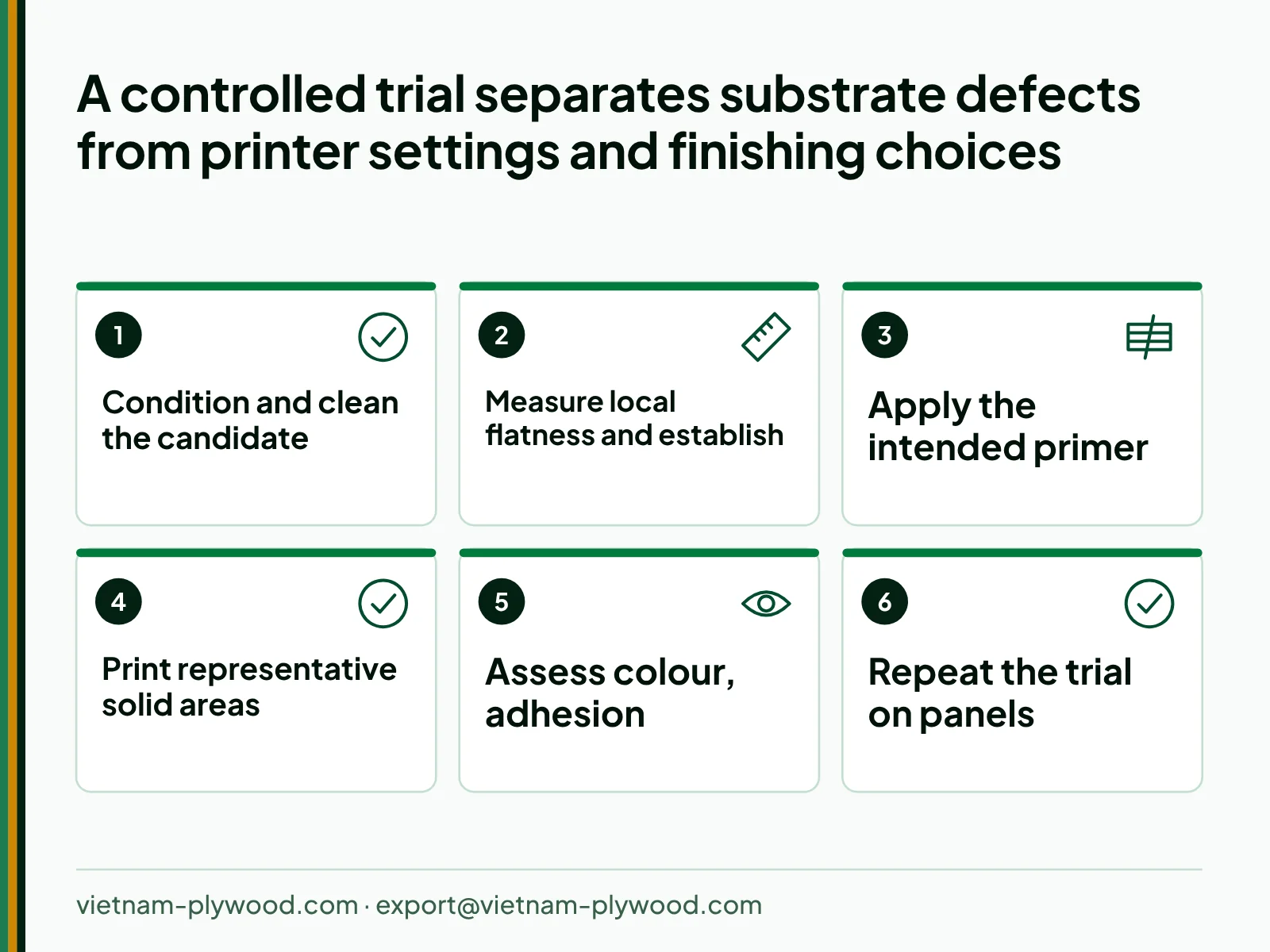
- Condition and clean the candidate panels according to the printer and ink supplier’s procedure.
- Measure local flatness and establish safe printhead clearance across the full print area.
- Apply the intended primer, if specified, and record the ink and cure settings.
- Print representative solid areas, fine detail and edge-to-edge patterns.
- Assess colour, adhesion, abrasion and visible grain against the buyer’s acceptance sample.
- Repeat the trial on panels selected from the intended production build before release.
For screen printing, include mesh, ink deposit and drying or curing conditions in the trial record. For UV flatbed printing, pay particular attention to height sensing, head clearance and any edge lift. The printer’s operating limits control both processes.
How are export documents and delivery handled?
The shipment’s packing list identifies the panel quantities and specifications, while the agreed test and emission documents support the ordered build. HCPLY prepares the commercial invoice, packing list, bill of lading, certificate of origin and applicable phytosanitary and fumigation papers. EU lots include EUR.1 and the EUTR/EUDR file set; CIF shipments include insurance documents.
Order-specific certificate documents can include an FSC claim on sales documents, an emission certificate and agreed test reports. After loading, the draft shipping documents come to you for approval. The member factories’ FSC, CARB P2, ISO 9001 and CE documents are shown with factory details masked, on request.
The minimum order is one 40HC. Factory lead time runs 15–45 days from receipt of the 30% deposit; the exact figure depends on order size, line loading and what the contract fixes. The remaining 70% is paid on the scan of the bill of lading, by T/T, or by irrevocable sight L/C. We ship FOB Hai Phong, or CFR (CNF) or CIF to your port.
What is the next step for a print-substrate order?
Send the intended printing process and an acceptance sample alongside the panel build. Lucy at export@vietnam-plywood.com can coordinate a specification discussion and a factory-line sample for the proposed order.
Samples cost nothing: a first-time buyer pays the courier, and that charge comes off the first confirmed order. For the commercial discussion, request a quotation against the written build rather than assuming that decorative faces, tighter calibration and different cores have one price. Furniture plywood starts from US$350/m³ FOB Hai Phong (October 2026); the final quotation reflects the ordered specification.
For a broader combination of furniture and utility panels, see several plywood types. Use the contact page to send the details below.
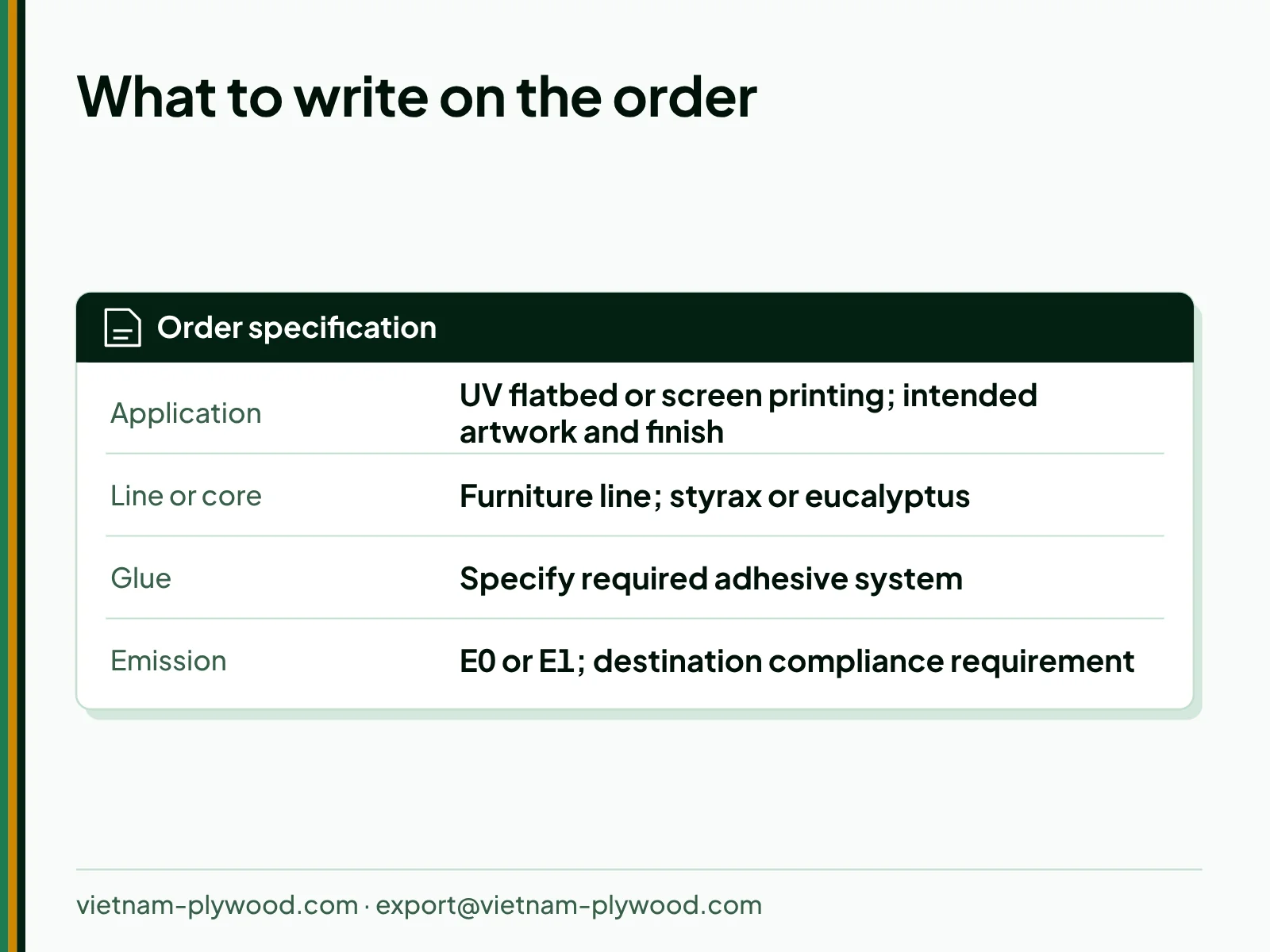
Application: UV flatbed or screen printing; intended artwork and finish
Line or core: Furniture line; styrax or eucalyptus
Glue: Specify required adhesive system
Emission: E0 or E1; destination compliance requirement
Face and grade: Named veneer; A/B; approved sanding sample
Thickness and tolerance: ___ mm; ±0.2 or ±0.3 mm as ordered
Size: ___ × ___ mm
Quantity: ___ sheets / ___ 40HC
Destination port: ___
Request the print-substrate spec sheet.