





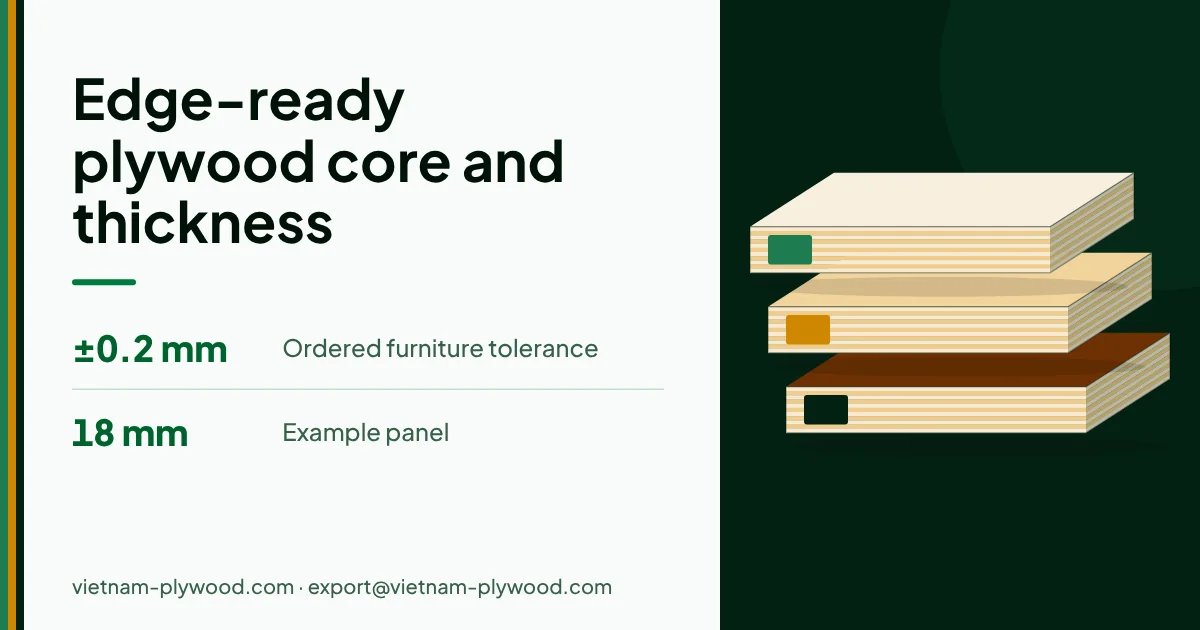
Plywood edge banding works reliably when the plywood has a filled core edge and consistent sheet thickness. A wrong substrate or tape choice can mean rejected cabinet parts, machine stoppages and rework. HCPLY builds sanded furniture plywood for industrial edgebanding, with ordered thickness tolerance and cut-edge inspection criteria agreed before production.
For furniture and fit-out purchasing teams, the applications overview places cabinet edging among other panel uses.
What is plywood edge banding?
Plywood edge banding is a strip bonded over the exposed layered edge of a plywood panel. It conceals the ply edge texture, provides a finished appearance and protects the vulnerable edge from routine knocks. For production edgebanders, the result depends on the substrate edge, the selected banding and the machine settings together. A decorative strip cannot bridge every internal void or correct a wandering sheet thickness.
The exposed edge can be a deliberate design feature when a designer wants visible layers. Cabinet doors, shelves and fit-out panels usually call for a matched finish instead. Banding also limits direct exposure of an unfinished edge, although the assembled product still needs appropriate moisture detailing. This is why we ask buyers to identify the edges that will be covered before the panel build is fixed.
Which plywood edging suits veneer, PVC, ABS or solid lipping?
Choose edging by the visible face, expected wear, corner profile and downstream finishing method. Wood veneer edgebanding follows a natural-veneer appearance and can receive a compatible stain or coating. Polyvinyl chloride (PVC) and acrylonitrile butadiene styrene (ABS) strips provide repeatable colours and patterned finishes. Solid hardwood lipping permits heavier profiling and repair but requires machining and an appropriate joint.
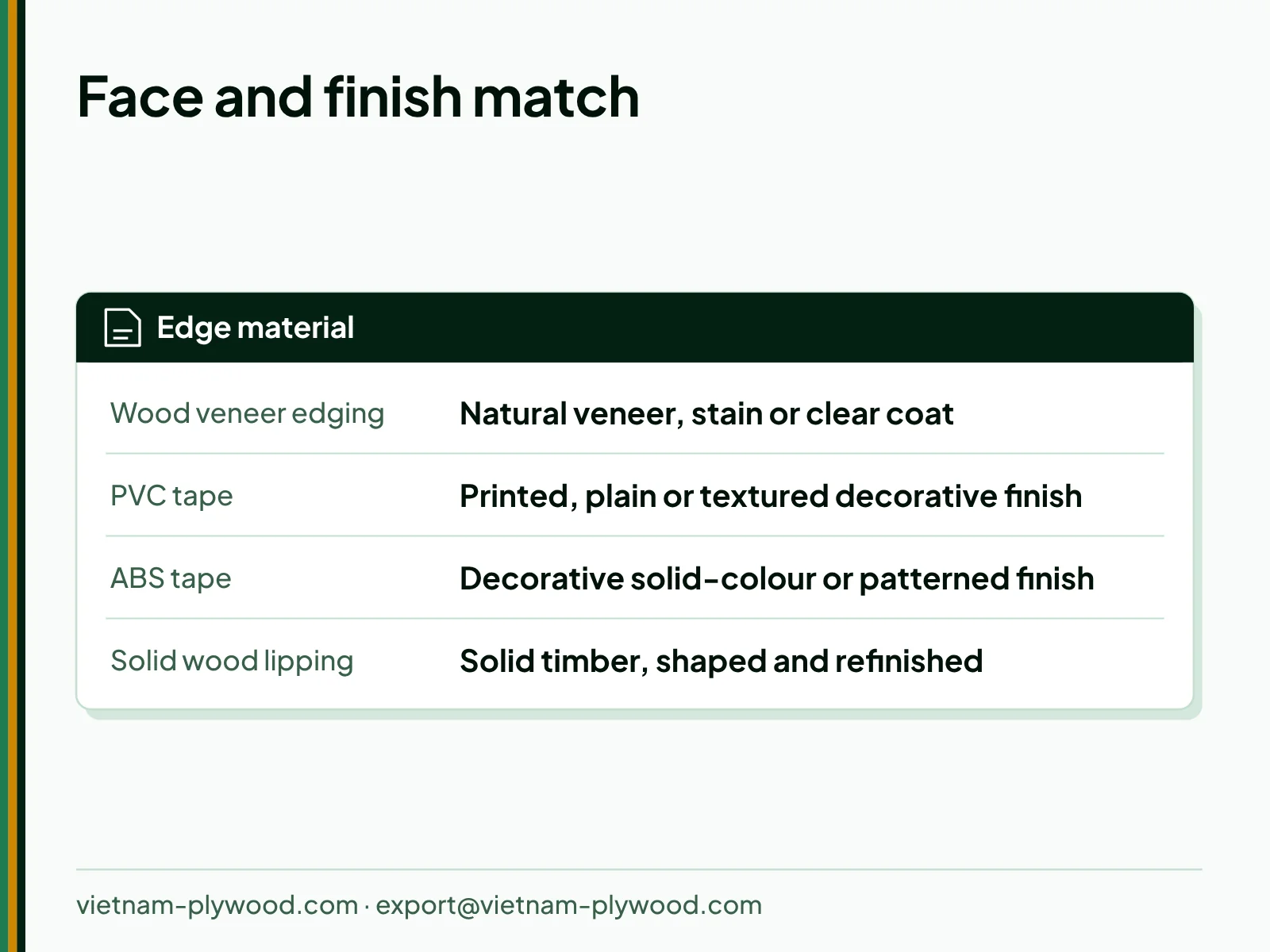
| Edge material | Face and finish match | Production consideration | Verdict by use |
|---|---|---|---|
| Wood veneer edging | Natural veneer, stain or clear coat | Check grain, colour and backing; trim carefully | Visible veneered cabinet edges |
| PVC tape | Printed, plain or textured decorative finish | Match adhesive and edge profile to the machine | High-volume colour-matched cabinets |
| ABS tape | Decorative solid-colour or patterned finish | Verify adhesive, trimming and corner behaviour | High-contact commercial interiors |
| Solid wood lipping | Solid timber, shaped and refinished | Requires a thicker joint and further machining | Routed or repeatedly handled edges |
Wood veneer edgebanding can be supplied by specialist tape makers as pre-glued or fleece-backed rolls. WiseWood Veneer distinguishes these backings; production machinery must be set for the selected adhesive system. Oak veneer edging is a tape-selection example, rather than evidence that the underlying plywood has an oak core. A birch-faced panel likewise need not have a birch core.
Melamine edge tape is a decorative paper-based edging category. A melamine plywood edge or melamine faced plywood rounded edge needs a matched edge design and suitable radius; a rounded edge cannot simply be assumed from a square-edge sheet order. Laminate wood edging and laminate plywood edge banding refer to separate finishing choices. We explain melamine, high-pressure laminate (HPL) and laminate faces as topics, but does not offer those as panel product lines.
Why does the plywood core matter for edge banding?
A continuous, filled core edge gives the adhesive and pressure rollers a more consistent contact surface. Gaps between veneers can leave unsupported sections beneath a thin tape. Loose core pieces can show through after trimming, while uneven repairs create local highs and lows along the cut edge.
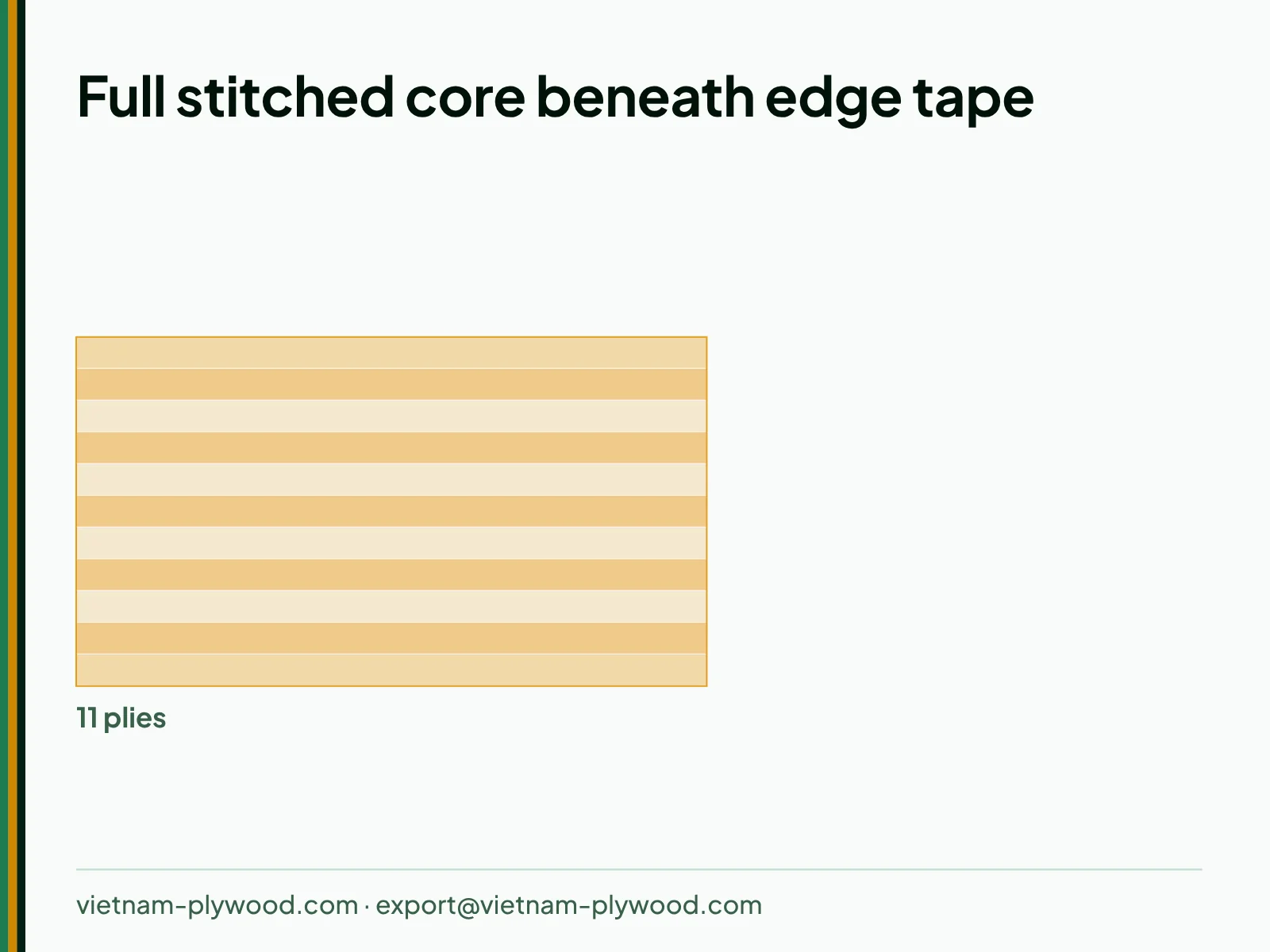
Our furniture line uses full stitched styrax or eucalyptus core, sanded faces and E0 or E1 emission classes. The purpose of full stitching is to control the core assembly before pressing; the finished cut edge must still be inspected for openings. For plywood edging, ask for the acceptable visible edge condition and a trial cut across the intended production direction.
The core determines density, rather than the decorative face. Styrax is 500 kg/m³ and eucalyptus is 650 kg/m³ in our available core specifications. An okoume or bintangor face therefore does not determine the weight of a finished cabinet sheet. Core choice changes handling and machine feed behaviour, while the face controls the visual match with veneer edgebanding.
Finger-jointed and loose-laid constructions have different edge appearances from a full stitched build. A visible plywood edge texture can be acceptable for an intentionally exposed edge, yet unsuitable under thin edging veneer. Specify the expected cut-edge finish instead of judging the face alone.
What thickness tolerance does an edgebander need?
An edgebander needs a thickness range that fits its pressure, tracking and trimming setup. The machine maker’s approved operating window and the banding supplier’s width guidance set the acceptance target; there is no universal tolerance for every edgebander. Our sanded furniture panels can be ordered at ±0.2 mm or ±0.3 mm thickness tolerance.
For example, an ordered 18 mm panel at ±0.2 mm has an acceptance range of 17.8–18.2 mm. At ±0.3 mm, the range is 17.7–18.3 mm. These are specification bands, not measurements of an individual shipment. Compare them with the machine’s actual roller and top/bottom trimming capability before signing off the purchase order.
The standard furniture panel thickness range is 3–40 mm, with common orders including 9, 12, 15, 18 and 21 mm. For 18 mm plywood, core construction typically uses 11–13 plies, depending on veneer thickness. The number of plies alone cannot establish whether a machine will band the cut edge successfully.
Banding width must cover the panel’s maximum actual thickness plus the trimming allowance recommended for that material and machine. Excessive overhang wastes tape and can complicate trimming. A nominal panel thickness printed on a catalogue is insufficient to set the trim heads.
How do the three production lines compare for an 18 mm order?
The furniture line is the appropriate build when the buyer needs a sanded, tightly assembled substrate for automatic edge application. Our commercial and packing line instead makes acacia-core, MR-glue panels with unsanded or light-sanded surfaces. Our construction line presses acacia- or eucalyptus-core film-faced panels for formwork applications.
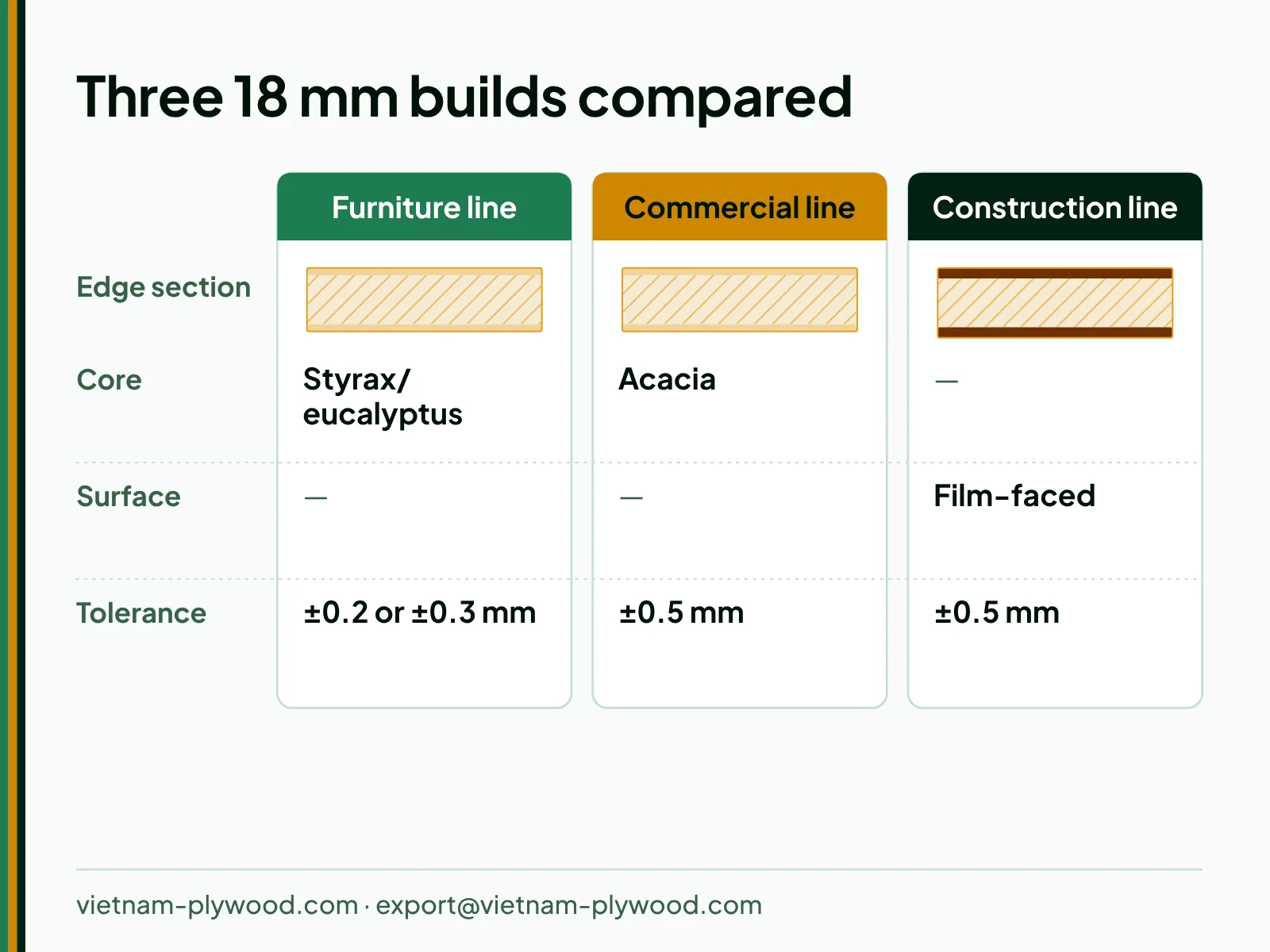
| Production line | 18 mm core and surface | Ordered thickness tolerance | Edge-banding verdict |
|---|---|---|---|
| Furniture | Full stitched styrax or eucalyptus, sanded | ±0.2 or ±0.3 mm | Preferred specification for cabinet edgebanders |
| Commercial and packing | Acacia, unsanded or light-sanded | ±0.5 mm; packing ±0.5–1.0 mm | Evaluate only against a less demanding edge process |
| Construction | Acacia or eucalyptus, film-faced, unsanded | ±0.5 mm | Designed for formwork rather than decorative cabinet edges |
For a cabinet program, begin with furniture plywood. The commercial and packing plywood and construction supply pages describe different end uses. A buyer specifying the same nominal thickness across the lines is purchasing different core and surface conditions.
How should an industrial edgebanding trial run?
A trial should use panels from the proposed build, cut with the production saw and fed through the buyer’s actual edgebander. The trial tests the combination of edge integrity, adhesive, banding material and machining settings. It is more useful than approving a decorative face sample without a cut edge.
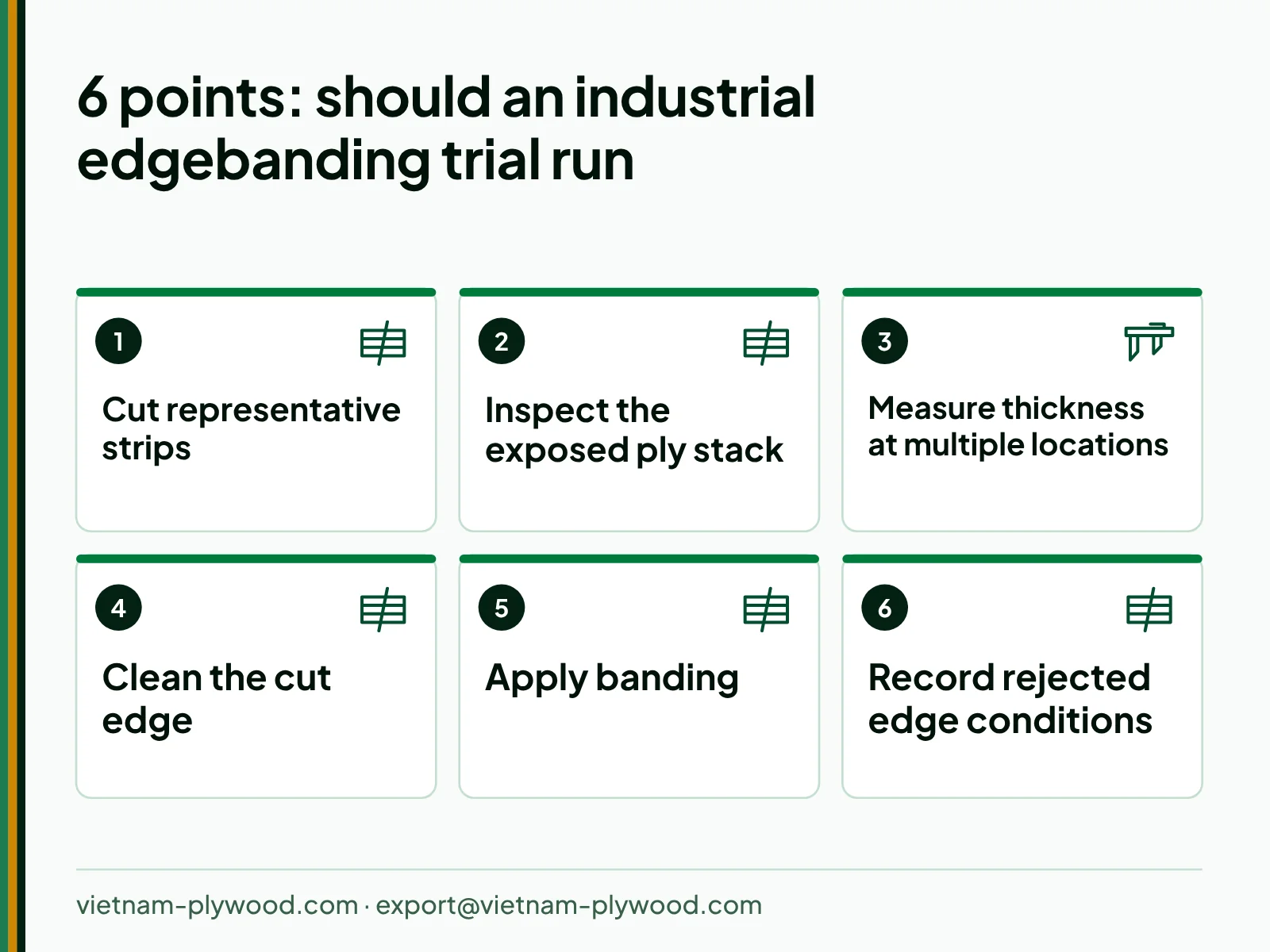
- Cut representative strips from the proposed sheet and identify the face, grain direction and cut orientation.
- Inspect the exposed ply stack for gaps, loose repairs, delamination and raised veneer ends.
- Measure thickness at multiple locations and compare the readings with the written order tolerance.
- Clean the cut edge and set the machine for the selected tape backing, adhesive and pressure conditions.
- Apply banding, then inspect both trim lines, corners, adhesion and visible telegraphing from core gaps.
- Record rejected edge conditions and repeat the trial after any core-build or machine-setting change.
Iron-on edging tape for plywood is often described in retail instructions, but factory edgebanders have controlled feed, glue application and trimming stations. Do not copy hand-ironing temperatures into an industrial machine setup. The buyer’s machine documentation and adhesive supplier’s instructions govern those settings.
What can the buyer inspect at the producing factory?
The buyer or appointed inspector can witness cut-edge inspection and thickness measurement on panels from the agreed production lot. At the producing factory, sample panels can be cut to reveal the core assembly rather than relying only on their sanded faces. Record the inspection location, sampling method and acceptance criteria in the order.
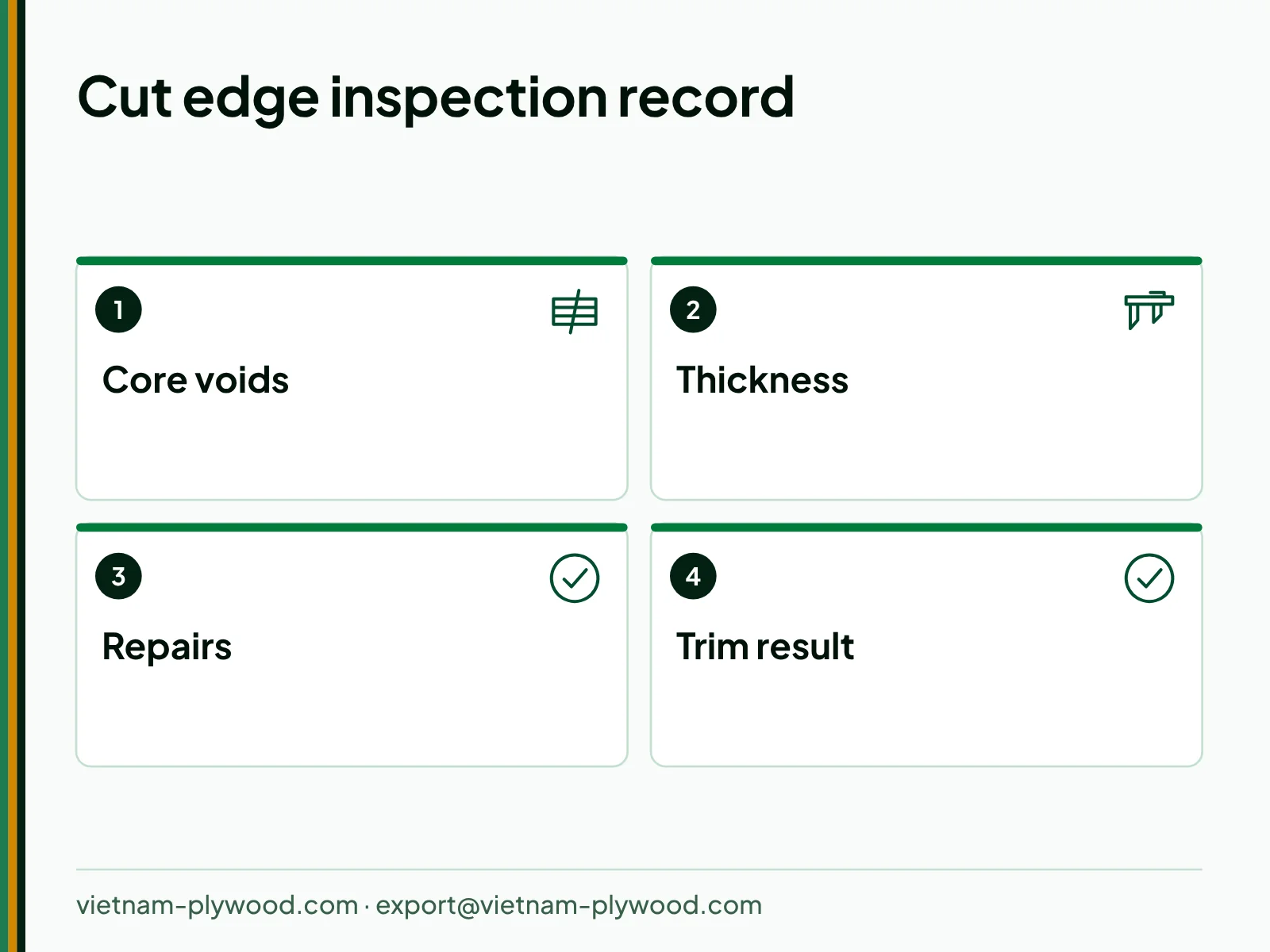
A useful check strip records face and back condition, measured thickness, visible voids and edge repairs. It also identifies which edges are destined for banding. Inspectors should distinguish a cosmetic veneer patch on the face from a gap exposed in the structural ply stack.
For a factory visit, request access through Lucy before the production inspection. HCPLY manages specification, on-site quality control, export documents and loading. Buyers visit the factory office and inspect goods at the factory producing their order.
How should mixed panel specifications be loaded?
A mixed order can combine specifications in one 40HC container within its 28.5 t payload limit. The relevant constraint is the weight of each selected panel build, rather than the visual face or the tape colour. For 18 mm, 1220×2440 mm panels, the full-container reference is 990 styrax sheets at 26.52 t, 880 acacia sheets at 27.35 t or 795 eucalyptus sheets at 27.69 t.
Those are single-core full-load references, excluding film weight. A mixed load requires its own quantity-by-core weight calculation and pallet plan. The container-loading reference covers the broader loading question. The minimum order is one 40HC; one container can carry several specifications as long as the payload limit holds.
The edge-banding specification should remain identifiable on the packing list, especially when cabinet-grade panels travel alongside a different finish or thickness. That prevents a warehouse from treating visually similar pallets as interchangeable.
What should a plywood order state for edge banding?
An edge-banding order should name the intended machine process, core construction, face and finish, tolerance, and inspection method. State whether the buyer will apply wood veneer tape, PVC, ABS or solid lipping after receipt. Include an edge acceptance criterion based on trial cuts, rather than writing only “furniture grade.”
Choose the face veneer from bintangor, okoume, engineered veneer (EV), gurjan, pine, poplar, eucalyptus, birch or sapele. Common face veneer thickness is 0.2–0.4 mm. Face grades A/B are available for the listed faces except birch, which uses D/E/F grades. An unfaced raw core is called matt.
Glue and emission are separate order fields. Melamine glue is the MR option with a 12-hour boil condition; phenolic glue is the WBP option with a 72-hour boil condition. E0, E1 and E2 are emission classes. For US-bound regulated products, CARB Phase 2 and TSCA Title VI requirements involve third-party certification and must be addressed through the agreed factory documents.
For European furniture applications, Commission Regulation (EU) 2023/1464, adopted in 2023, sets a 0.062 mg/m³ formaldehyde release limit for furniture and wood-based articles placed on the market after 6 August 2026, with specified exclusions and test conditions. The official EU text should be checked against the finished article and intended use. An E1 label alone does not establish compliance with that specific article-level requirement.
Which export documents identify the agreed build?
The commercial invoice and packing list identify the shipment and its declared goods, while the agreed specification and applicable test reports document the selected panel build. Each shipment includes a bill of lading, certificate of origin, phytosanitary and fumigation papers, with insurance under CIF. EU lots include EUR.1 where applicable and the EUTR/EUDR file set.
Factory-held FSC, CARB P2, ISO 9001 and CE certificates, and EUDR/EUTR documents, are shown with factory details masked, on request. Certificate claims on sales documents and emission or test reports follow the order’s agreed build. After loading, the draft shipping documents come to you for approval.
For related end uses, see plywood wall panelling and the wider applications library. They address finished surfaces and application selection beyond cabinet edge finishing.
What are common edge-banding failures?
Core gaps, inconsistent thickness and incompatible adhesive settings are the first items to investigate when tape lifts or trim lines wander. A void beneath the strip can leave a depressed area; a protruding repair can cause a visible ridge. Tape that appears sound immediately after pressing can still fail a later adhesion check if its adhesive system is wrong.
If the tape is wider than the sheet, the excess needs controlled top and bottom trimming. If it is narrower than the thickest accepted sheet, a raw line can remain visible. Rounded profiles demand a banding material and machine setup capable of following the radius.
Do not assume edge banding repairs a structural delamination or converts an interior glue build into an exterior panel. A cabinet designer should detail wet zones separately. Where an edge is concealed inside a groove, banding can be omitted when the assembly drawing and service conditions allow it.
What is the next step for a cabinet buyer?
Send a written panel and edge-process specification so our furniture line can prepare the matching spec sheet. The request should identify the target edgebander, the selected tape and the cut-edge acceptance trial. We can discuss the production build and inspection at the same time as the shipping requirements.
Furniture plywood starts from US$350/m³ FOB Hai Phong (October 2026). Final quotation reflects core construction, face selection, thickness tolerance, size, quantity and inspection requirements. Factory lead time runs 15–45 days from receipt of the 30% deposit; the exact figure depends on order size, line loading and what the contract fixes. The remaining 70% is paid on the scan of the bill of lading, by T/T, or by irrevocable sight L/C. Shipping: FOB Hai Phong, or CFR (CNF) or CIF to your port.
Samples: free; a first-time buyer pays the courier, and that charge comes off the first confirmed order. Contact Lucy at export@vietnam-plywood.com with the following lines:
Application: cabinet components for automatic edge banding
Line / core: furniture / full stitched styrax core
Glue: melamine MR
Emission: E1; destination-specific evidence requested
Face and grade: okoume A/B
Thickness and tolerance: 18 mm, ±0.2 mm
Size: 1220 × 2440 mm
Edge finish: gap-free trial cut; veneer tape on exposed edges
Quantity: one 40HC, with sheet count agreed by load plan
Destination port: [buyer to insert]