





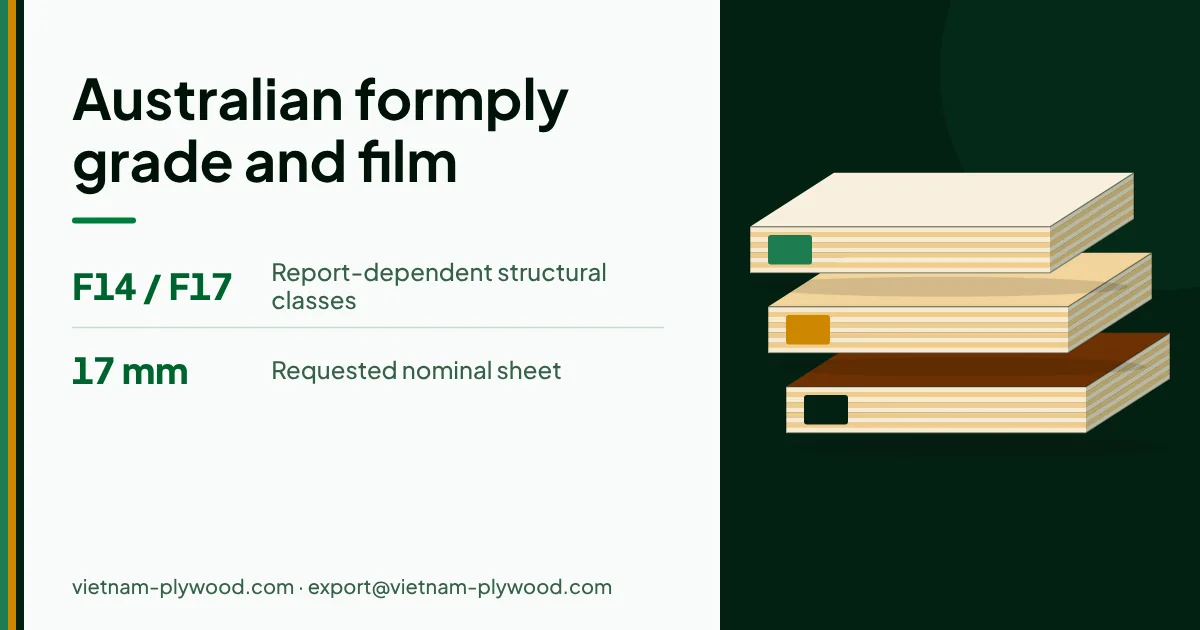
Formply for an Australian order combines a film-faced concrete-contact surface with a specified structural grade supported by acceptable test evidence. Choosing the wrong grade or sheet size can mean rejected material, replacement freight and lost site days. HCPLY makes the proposed film-faced construction in Vietnam; importers should separate F17 or F14 evidence from film weight, thickness and moisture resistance.
What is formply?
Formply is film-faced plywood used as a concrete-forming surface, with Australian structural products specified by grade and supporting evidence. The overlay helps release concrete and protects the veneer beneath during wet work. For an Australian purchase, the name alone cannot establish an F-grade: the specified panel, its applicable standard and its accepted test report must agree. A non-structural film-faced sheet can look similar.
Australian buyers commonly use form ply and formply plywood for this category. AS 6669 is associated with formwork plywood; structural suitability must be assessed against the applicable specification and supporting structural test evidence. HCPLY presses the proposed film-faced build on our construction line, using acacia or eucalyptus core and phenolic or melamine film. For broader product choices, see our concrete formwork plywood specification guide.
What is the difference between F14 and F17 formply?
F14 and F17 designate different structural stress-grade classes; F17 denotes a higher class than F14. The grade is a performance designation rather than a film colour, veneer species, nominal thickness or guarantee of allowable formwork spacing. Structural design still needs the relevant panel properties, support geometry, concrete pressure and project requirements.
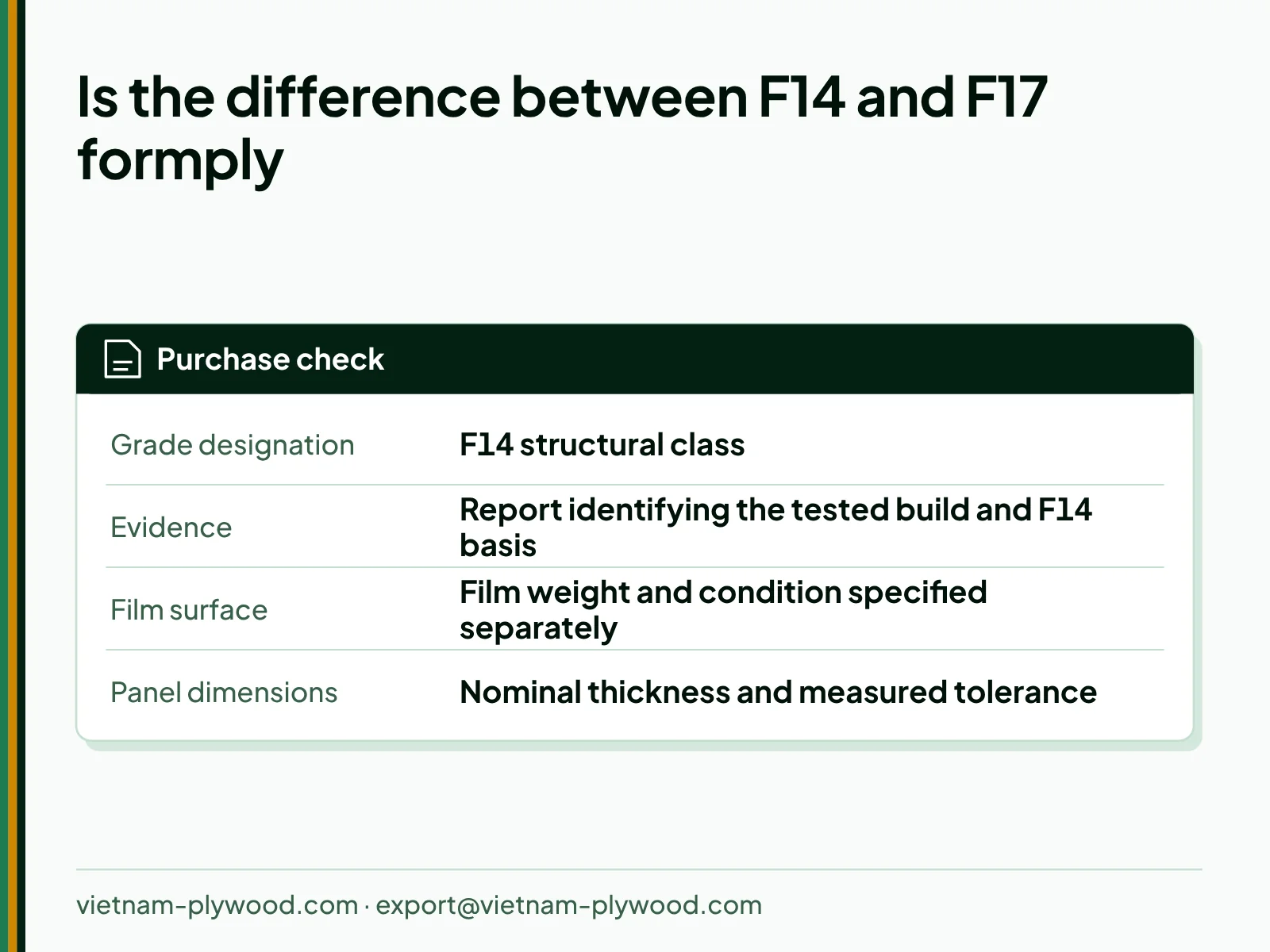
| Purchase check | F14 formply | F17 formply | Buying verdict |
|---|---|---|---|
| Grade designation | F14 structural class | F17 structural class | Specify the class the design calls for |
| Evidence | Report identifying the tested build and F14 basis | Report identifying the tested build and F17 basis | Accept neither label without matching evidence |
| Film surface | Film weight and condition specified separately | Film weight and condition specified separately | Choose surface by finish and reuse needs |
| Panel dimensions | Nominal thickness and measured tolerance | Nominal thickness and measured tolerance | Match the engineered formwork design |
| Intended use | Engineered work where F14 is accepted | Engineered work where F17 is required | Higher grade does not replace design checks |
The designation F17 plywood describes a structural class, while F17 formply adds a formwork-facing application. Neither the grade name nor a vendor’s catalogue proves a particular imported batch has achieved that class. HCPLY offers a structural-grade description only against a test report the buyer accepts.
Why is formply 17 mm thick?
The 17 mm dimension is a familiar Australian formply market specification, not a universal requirement for every formwork job. Designers and yards select thickness together with grade, span, support spacing and expected concrete pressure. A thicker panel without accepted structural evidence is not automatically an F17 panel.
Our construction line makes plywood from 3–40 mm, including common 15, 18 and 21 mm builds. A requested 17 mm sheet needs its own written specification, tolerance and inspection plan; it must not be silently substituted with 18 mm. Our film-faced thickness tolerance is ±0.5 mm. Buyers should state whether 17 mm means nominal manufactured thickness or a required measured acceptance range.
Is 17 mm formply structural?
A 17 mm sheet is structural only when its identified build meets the relevant performance requirements and the buyer accepts its evidence. Thickness and film alone do not establish structural status. Ask for the tested specimen description, grading basis, sampling details and correspondence with the shipment specification.
A non-structural film-faced sheet can be appropriate for a non-load-bearing facing role within an engineered assembly. It cannot be substituted for structural form ply simply because both have a smooth surface. The structural engineer determines allowable spans and support arrangements; the importer checks that the delivered panel matches the approved material.
What is formply used for?
Formply provides the contact face for cast-in-place concrete in walls, slabs, beams, columns and repeated formwork assemblies. Contractors value a consistent face and controlled stripping. Formwork yards also assess edge integrity, handling damage and the number of useful cycles between replacements.
The film-faced plywood product covers the construction build. An anti-slip film serves walking surfaces where the surface specification calls for grip, whereas smooth formwork film targets concrete contact. White formply or white form ply describes an appearance or film colour in some catalogues; colour alone gives no structural grade or bond performance. We do not offer high-density overlay (HDO) panels as a separate product.
What sheet sizes does 17 mm formply come in?
Australian catalogues include 2400 × 1200 mm formply, while an import order must state its exact length and width. Our listed manufacturing sizes include 1220 × 2440, 1250 × 2500, 1220 × 2135 and 915 × 2440 mm, with custom cutting available. Length and width tolerance is ±2 mm.
Specify which orientation is the long dimension and whether the drawing uses millimetres or a rounded trade description. The 2400 × 1200 mm catalogue format should not be assumed equivalent to 2440 × 1220 mm. Check sheet size against the shutter layout, pallet footprint and handling equipment before production. See shutterply sizes and grades for related naming differences.
Is formply waterproof?
Formply’s film slows surface water entry, while the glue system and sealed edges control other moisture paths. Cuts, screw holes and damaged film expose veneer; prolonged wet storage can still damage a panel. The term waterproof must therefore be tied to the specified bond, handling and exposure conditions.
Our construction line offers melamine glue (MR, 12-hour boil) or phenolic glue (WBP, 72-hour boil). Those are glue-system descriptions, separate from an F-grade and from emission classification. Film weights are 120 g/m² standard and 135 g/m² premium; 220 g/m² is for anti-slip film only. For surface comparisons, read plastic-faced versus phenolic film plywood.
How many pours does 17 mm formply give?
Reuse follows the film, bond, edge protection and site handling rather than thickness alone. With proper handling, a release agent on every pour and sealed edges (cut edges included), melamine-glue film-faced plywood gives about 12–15 pours; phenolic-glue film-faced plywood gives up to about 25 pours.
A site log should record each pour, release-agent application, stripping damage, edge resealing and rejection reason. Sharp tools and dragging panels across concrete can end a sheet’s service before the indicative count. The film-faced reuse cycles page covers the maintenance variables, and the release-agent procedure explains the recurring application step.
Which of our production lines makes the Australian build?
Our construction line presses film-faced formwork plywood with an acacia or eucalyptus core. Our furniture line instead makes sanded, full-stitched styrax or eucalyptus-core panels for cabinet and furniture applications. Our commercial and packing line uses acacia core, MR glue and an unsanded or light-sanded surface for packing and general commercial uses.
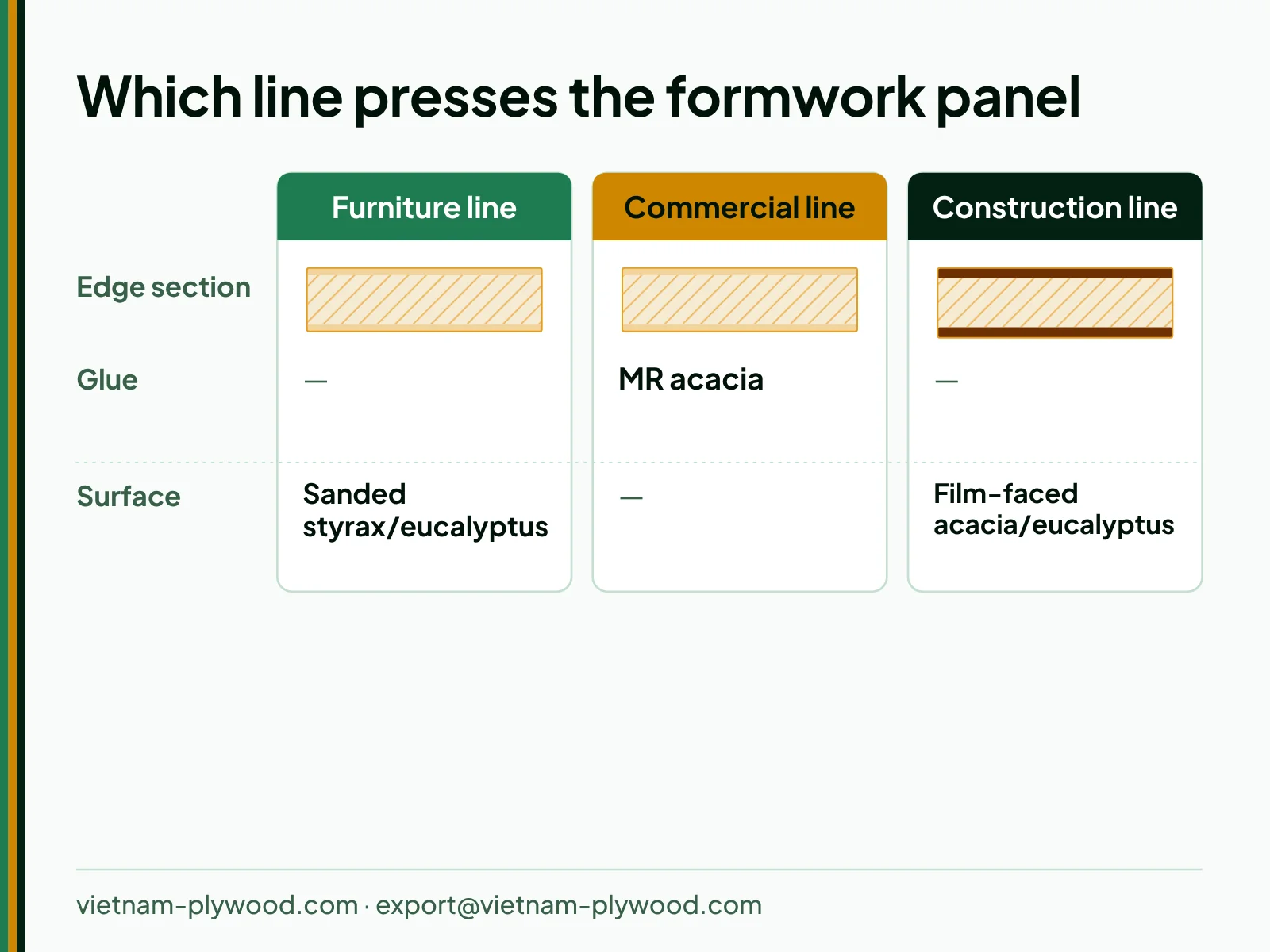
| Line | Example 18 mm build | Core and surface | Appropriate order |
|---|---|---|---|
| Construction | Film-faced, ±0.5 mm | Acacia or eucalyptus; film | Formwork facing, with structural claim only against accepted report |
| Furniture | Sanded, ±0.2 or ±0.3 mm as ordered | Styrax or eucalyptus; veneer face | Furniture components |
| Commercial and packing | Unsanded or light-sanded, ±0.5–1.0 mm for packing | Acacia; MR glue | Crates and packing panels |
The producing factory can show an inspector the film face, core edge, thickness measurement and packed-sheet identification. For mixed procurement, the commercial and packing plywood and distributor supply programmes explain other specification families.
What test report supports an F17 claim on imported formply?
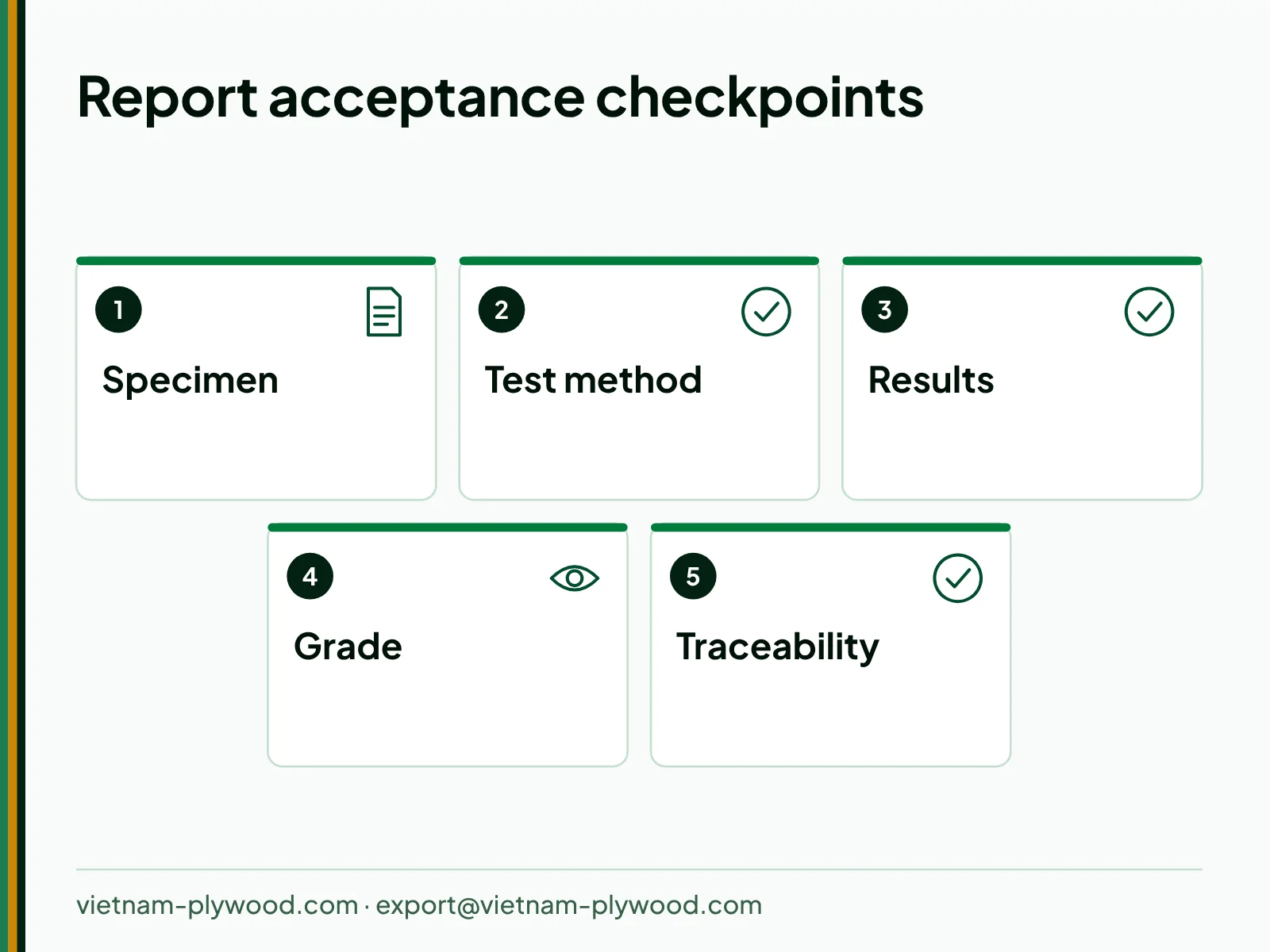
An F17 claim needs a report accepted by the buyer that identifies the applicable test and grading basis and the actual construction being supplied. Request the laboratory identity, report date, specimen description, thickness, core and bonding details, results, grading conclusion and traceability to the order. A generic catalogue declaration is weaker evidence than a report tied to the agreed build.
Standards Australia states on its official FAQ page (accessed in 2026): “Standards Australia does not determine whether products comply with Australian Standards® and does not certify products/services/organisations.” See the Standards Australia explanation. That distinction matters: a standards reference is not a product certificate.
The buyer’s engineer or appointed assessor should evaluate whether the report supports the specified use, including design values and relevant formwork requirements. Ask for any applicable independent inspection records and the laboratory’s test scope. HCPLY can supply the agreed build’s test reports among the order documents, with factory certificates shown with factory details masked, on request. We do not apply an Australian stress-grade stamp to our panels.
What should an importer inspect before loading?
Inspection starts with the approved specification and ends with marked pallets matching the packing list. The inspector should sample sheets from production, measure length, width and thickness, inspect film defects, examine exposed core edges and check sealing at original and cut edges. Photograph each sampled panel identifier beside its measurements.
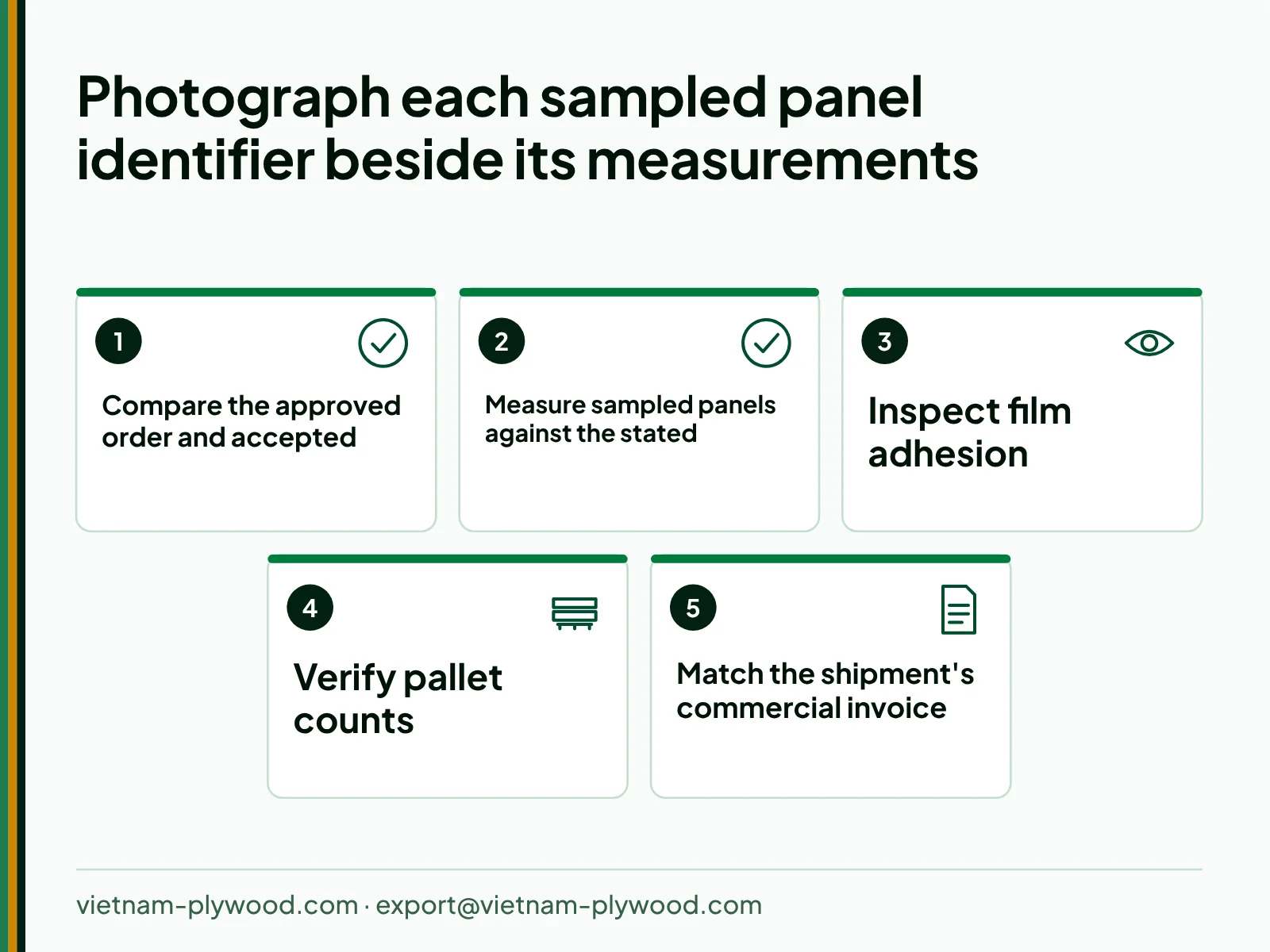
- Compare the approved order and accepted report with the actual build and production record.
- Measure sampled panels against the stated dimensions and tolerances.
- Inspect film adhesion, face condition, corners and edge sealing.
- Verify pallet counts, labels, protection and loading photographs.
- Match the shipment’s commercial invoice, packing list and bill of lading to the approved goods.
HCPLY coordinates on-site quality control, export documents and loading from the producing factory. After loading, the draft shipping documents come to you for approval. A certificate of origin and any agreed test report belong in the shipment documentation.
How should the importer specify and ship the order?
A quotation should separate film weight, core species, glue, sheet dimensions, structural evidence and delivery terms. Phenolic-glue film-faced plywood is a higher-specification bond choice than the melamine-glue alternative; thicker veneer construction, tighter selection and additional testing also affect cost. No fixed formply price is given without the written build.
Minimum order is one 40HC; one container can carry several specifications as long as the payload limit holds. At 18 mm and 1220 × 2440 mm, an acacia-core full 40HC lookup is 880 sheets, 47.15 m³ and 27.35 t, excluding film weight. An eucalyptus-core lookup is 795 sheets, 42.60 m³ and 27.69 t, excluding film weight. A mixed load requires a fresh weight check against the 28.5 t payload limit; the container loading guide owns the full calculation.
We ship FOB Hai Phong, or CFR (CNF) or CIF to your port. Factory lead time runs 15–45 days from receipt of the 30% deposit; the exact figure depends on order size, line loading and what the contract fixes. The remaining 70% is paid on the scan of the bill of lading, by T/T, or by irrevocable sight L/C. Samples cost nothing: a first-time buyer pays the courier, and that charge comes off the first confirmed order.
What specification should the formwork yard send?
Send one written specification that names the structural requirement and the evidence acceptance step before the order is released. A precise request prevents a visually similar non-structural film-faced panel from entering a structural procurement schedule. State the Australian destination port and the intended inspection hold point.
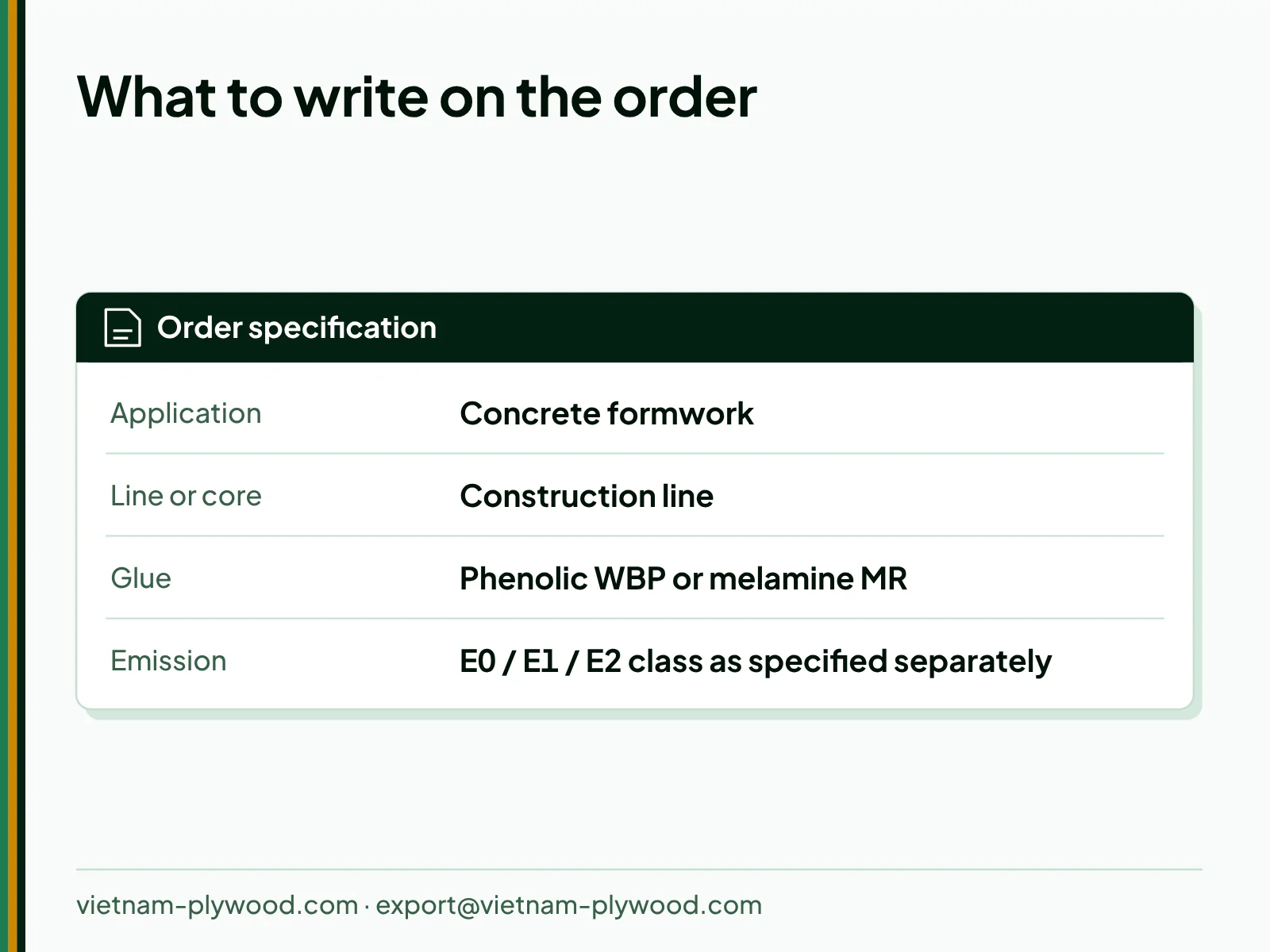
Application: Concrete formwork; engineered structural or non-structural use
Line or core: Construction line; acacia or eucalyptus core
Glue: Phenolic WBP or melamine MR
Emission: E0 / E1 / E2 class as specified separately
Face and grade: Film-faced, 120 or 135 g/m²; F14/F17 only against buyer-accepted test report
Thickness and tolerance: 17 mm nominal requested; agreed acceptance range (or specified alternative), film-faced ±0.5 mm
Size: Exact length × width in mm; length/width ±2 mm
Quantity: One 40HC minimum; sheet count and pallet plan to be agreed
Destination port: [Australian port]
Request the formply spec sheet from Lucy at HCPLY or export@vietnam-plywood.com.