






A compatible, thin release agent for concrete formwork should match the film surface and the concrete finish specified for the job. The wrong agent can damage a reusable face during stripping, waste cleaning time and turn a planned sequence of pours into replacement-panel expense. HCPLY presses phenolic and melamine film-faced plywood on our construction line; we supply the panels, not release agents.
Which release agent should be used on film-faced plywood formwork?
For film-faced plywood, begin with a chemically active concrete form release agent or a water-based emulsion whose technical data sheet permits use on the specified overlay. Apply a thin, continuous coat to a clean face before every pour. Trial the selected agent with the actual concrete mix and finish requirement before ordering a full programme of panels.
A release agent is part of the site method statement, alongside the panel specification and stripping procedure. A product suitable for a bare timber form is not automatically suitable for a resin film. Ask the agent supplier for compatibility, coverage, drying and recoating instructions in writing.
Our concrete formwork plywood specification guide explains the wider choices of panel face, core and bonding. The release-agent decision comes after the form-face specification, because the exposed surface controls the interface with wet concrete.
Will concrete stick to plywood?
Yes. Cement paste can adhere to plywood through exposed wood fibres, scratches, dried residue or an insufficient release coat. Film-faced plywood has a closed overlay that reduces absorption, but the film alone does not replace a release agent. Difficult stripping can tear the overlay or leave concrete marks that need rework.
A clean strike matters for both the finished wall and the next use of the panel. If the face comes away with attached paste, examine coverage, the product’s drying window and the surface condition before blaming the plywood grade.
Does phenolic film need a different agent from melamine film?
Phenolic and melamine film do not automatically require different chemical families, but compatibility must be established for each actual surface. A release-agent data sheet naming phenolic overlay alone does not establish suitability for melamine film. Treat film chemistry, concrete appearance and stripping results as separate acceptance checks.
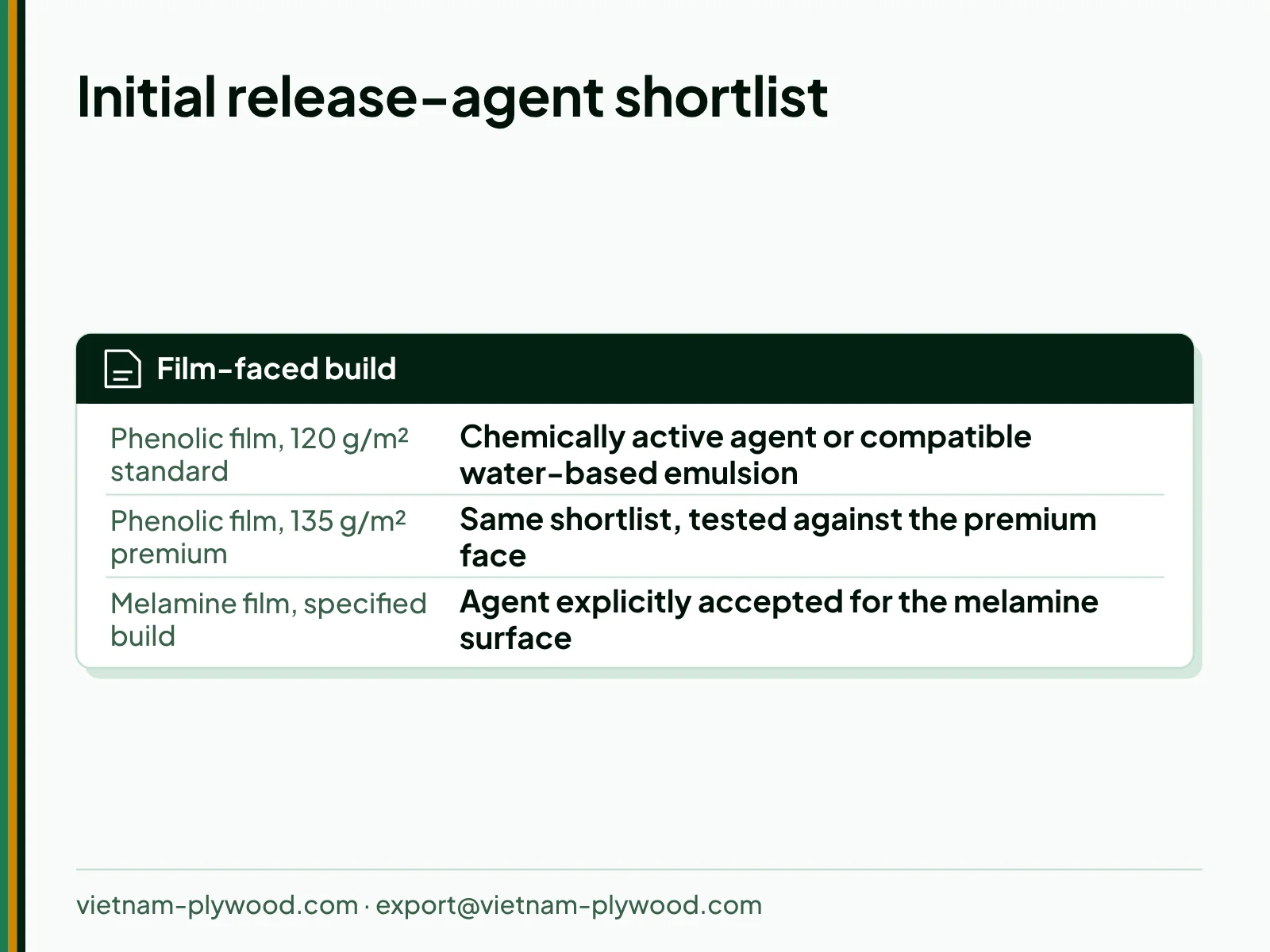
| Film-faced build | Initial release-agent shortlist | Check before approval | Verdict by use |
|---|---|---|---|
| Phenolic film, 120 g/m² standard | Chemically active agent or compatible water-based emulsion | No film lift, staining or trapped residue after trial strip | Starting point for routine repeated formwork |
| Phenolic film, 135 g/m² premium | Same shortlist, tested against the premium face | Exposed concrete appearance and consistent release | Prefer when the written finish specification demands a premium face |
| Melamine film, specified build | Agent explicitly accepted for the melamine surface | Trial for staining, adhesion and coating residue | Approve only after a separate melamine-face trial |
| Anti-slip film, 220 g/m² | Agent recommended for the textured surface | Release from texture without puddling or trapped paste | Use where the textured face is specified, rather than assuming a smooth cast finish |
Film weight describes the facing, while the adhesive bond describes the core assembly. A 120 g/m² phenolic film is not the same specification as phenolic glue. Our film-faced plywood product page covers the construction product; the formply and shutterply names guide helps buyers translate regional descriptions into written requirements.
What types of concrete form release agent are there?
Two main mechanisms are barrier and chemically active release. The American Concrete Institute (ACI), in its technical FAQ Form release agents (accessed 2026), identifies these families and notes that chemically active products can reduce surface defects on architectural concrete. Its technical explanation is a useful starting point for finish-sensitive specifications.
Chemically active agents contain ingredients that react at the cement interface to create a separating layer. They are a strong first candidate for exposed concrete, provided the particular product is approved for the plywood film. Check the formulation and site conditions rather than relying on the word “reactive” alone.
Barrier agents separate concrete from the form with an intervening coating. Mineral-oil, silicone and wax-based materials can act as barriers, but their residues and finish effects differ. An oil that works on uncoated timber may leave marks or pooling on a smooth film face.
Water-based emulsions describe how active ingredients are carried and delivered. A water-based product can still work through barrier or reactive chemistry. Follow the label’s film-forming and drying instructions; pouring while the coat is still wet can produce inconsistent results.
Vegetable-derived and petroleum-derived oils are ingredient descriptions, not proof of film compatibility. Similarly, an aerosol format says little about concrete finish. Compare the product data sheet, safety data sheet and trial results before selecting a releasing agent for concrete forms.
What is formwork oil or shuttering oil for plywood?
Formwork oil is the site name for a liquid product applied to a form face to assist concrete release. Shuttering oil for plywood can mean a mineral-oil barrier, an emulsion or a formulated reactive liquid. The name alone does not identify its chemistry, application rate or suitability for a film overlay.
Specify the product by manufacturer, grade and technical data sheet rather than ordering only “formwork oil.” Ask whether it is suitable for resin-coated plywood and for concrete that will later receive paint, render or another finish. Heavy residual oil can interfere with later surface treatments.
Do not use diesel or used engine oil as a substitute. The ACI discussion flags finish problems and volatile organic compound concerns with diesel-based release. For a controlled export project, a purpose-made agent with written handling instructions is the defensible procurement choice.
Can the wrong release agent shorten reuse life?
Yes. A poor release can pull film during stripping, while an excessively heavy coat can leave residue that needs abrasive cleaning. Both outcomes consume the useful face condition that a formwork yard paid for. A release agent cannot repair a damaged overlay or seal a freshly cut core.
With proper handling, a release agent on every pour and sealed edges, including cut edges, melamine-glue film-faced plywood gives about 12–15 pours; phenolic-glue film-faced plywood reaches up to about 25 pours. These figures describe adhesive builds and their handling conditions, rather than a guarantee from a particular release-agent brand.
Keep a pour log that records panel identification, release-agent batch, cleaning method, edge repairs and visible film damage. That record separates agent-related problems from rough handling, premature stripping and water entry. A yard comparing grades should evaluate cost per usable pour, not just purchase price per sheet.
How should crews apply a release agent before each pour?
A repeatable application procedure starts with a clean, dry face and finishes with an inspection before concrete placement. The exact coverage rate and waiting time must come from the selected agent’s instructions; a universal litres-per-square-metre figure would be misleading.
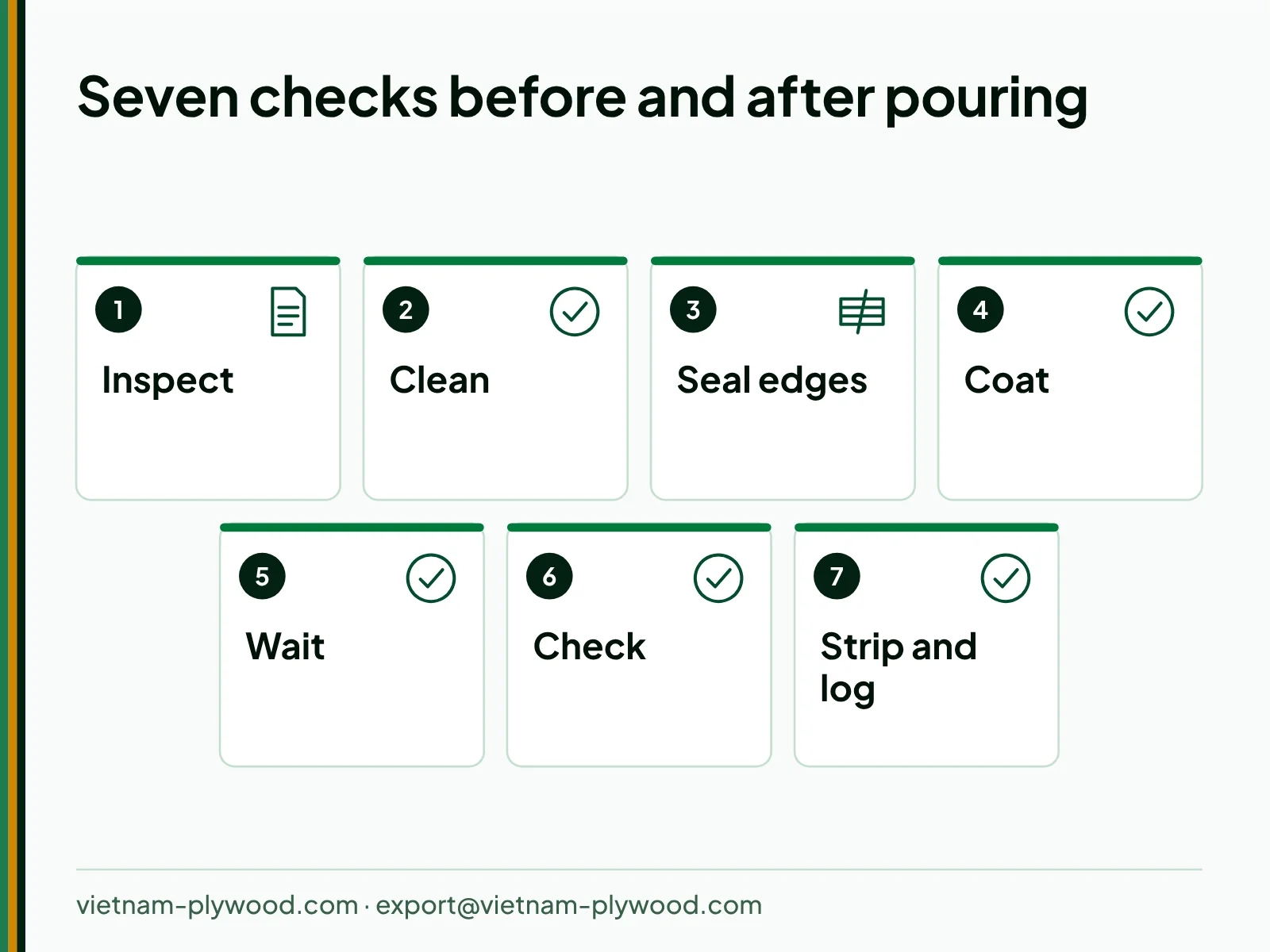
- Inspect the panel. Look for lifted film, hardened paste, scratches and exposed or swollen edges. Remove damaged panels from the casting face until repaired or replaced.
- Clean gently. Remove residue using non-gouging tools, then wipe away dust and let the surface dry. Aggressive scraping can create permanent adhesion points.
- Seal cuts and holes. Renew edge sealing on newly cut edges and exposed penetrations. Release oil on the face is not an edge sealer.
- Apply a light, even coat. Use the applicator named by the agent maker and avoid puddles at corners, joints and tie positions. Cover missed patches without soaking the overlay.
- Observe the waiting window. Let the coating form or dry as directed before placement. Reassess the coat after rain, dust contamination or prolonged exposure.
- Inspect before pouring. Check uniformity under the same lighting and correct missed or pooled areas. Record the agent used for traceability.
- Strip and assess. Follow the engineer’s stripping criteria, then record concrete appearance and any film damage before the next cleaning cycle.
How does the agent affect the finished concrete?
A correctly matched release coat helps preserve surface texture and reduces damage during stripping. Too much product can leave stains or surface voids; too little can create paste adhesion and torn areas. The same panel can give different results when the concrete mix, application technique or weather changes.
For exposed architectural concrete, trial the complete combination: plywood film, release product, concrete mix, vibration method and stripping sequence. Examine colour consistency, air voids and any residue that might affect later coatings. For concealed structural work, clean stripping and panel life may carry more weight than appearance.
What can a buyer inspect at the producing factory?
A buyer can witness face identification, thickness measurement, edge sealing and packing checks at the producing factory. HCPLY’s construction line presses the film-faced build; our furniture line makes full-stitched, sanded styrax- or eucalyptus-core panels, while our commercial and packing line makes acacia-core MR panels. Those other lines serve different uses rather than substituting an uncoated panel for a specified film face.
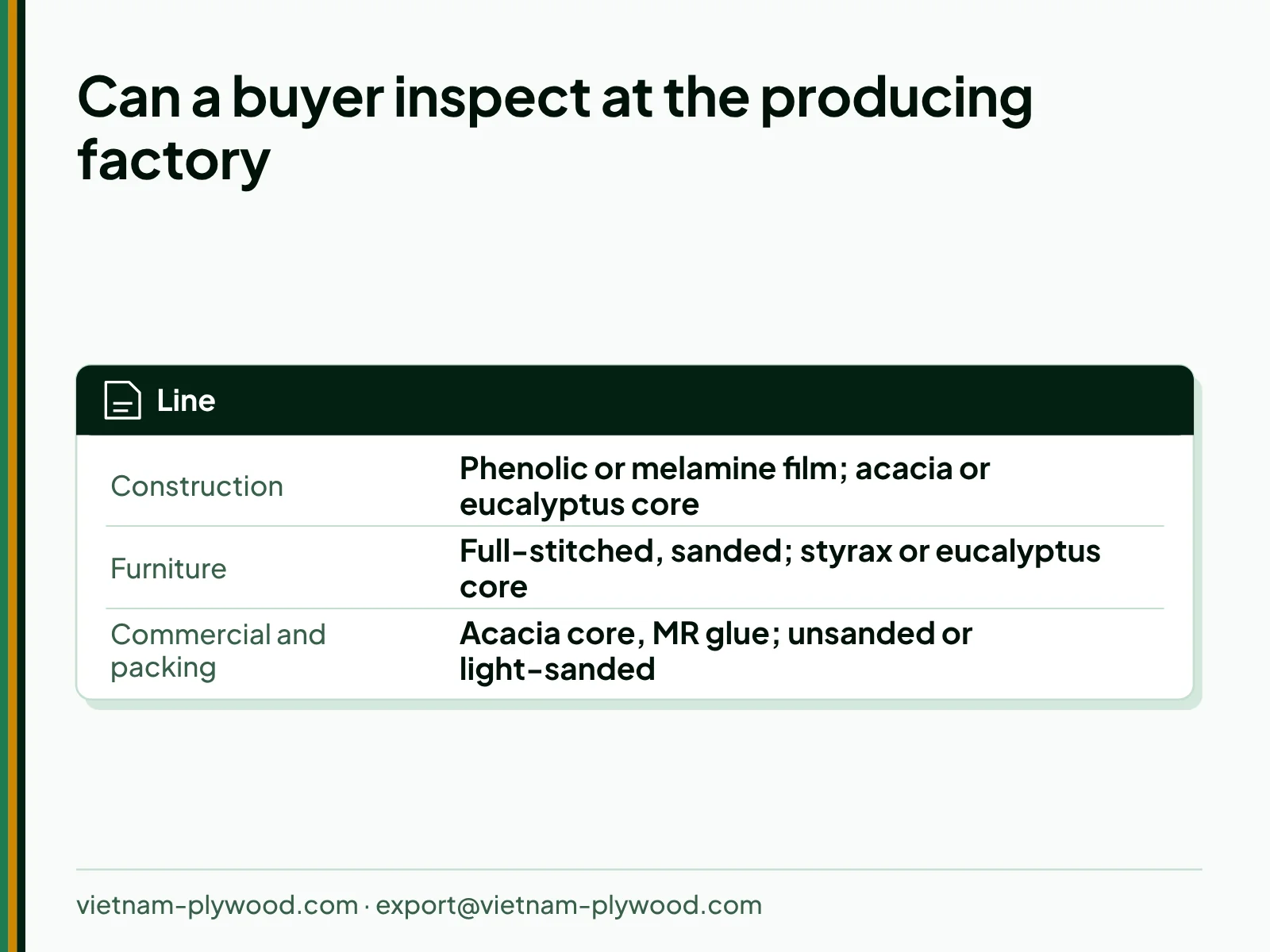
| Line | Relevant build | Surface inspection | Buyer decision |
|---|---|---|---|
| Construction | Phenolic or melamine film; acacia or eucalyptus core | Check film type, film weight, surface defects and edge sealing | Select for concrete formwork trials |
| Furniture | Full-stitched, sanded; styrax or eucalyptus core | Check sanded face and ordered thickness tolerance | Specify for furniture, not repeated wet casting |
| Commercial and packing | Acacia core, MR glue; unsanded or light-sanded | Check veneer face and packing-grade tolerance | Specify for commercial or packing applications |
For the construction build, the film-facing specification can state 120 g/m² standard or 135 g/m² premium; 220 g/m² applies to anti-slip film only. Film-faced thickness tolerance is ±0.5 mm, and length and width tolerance is ±2 mm. Inspectors can check these against the purchase specification before loading.
The factory inspection verifies the panel build and visible condition. Release-agent compatibility is established through a representative casting trial with the agent chosen by the contractor. Ask for the producing-factory inspection record and the agreed test reports as part of the order’s certificate documents.
What should importers specify for a repeat-pour programme?
A usable purchase specification identifies the film, glue, core, size, tolerance and intended concrete finish. It should also record the planned release-agent chemistry and the buyer’s trial acceptance criteria. Avoid describing the requirement only as “phenolic plywood,” since that phrase can refer to film or adhesive.
Our construction line offers acacia or eucalyptus core with phenolic or melamine film and an unsanded build. Glue options are melamine MR, described as a 12-hour boil, or phenolic weather and boil proof (WBP), described as a 72-hour boil. Emission class is a separate field: E0, E1 or E2 should be specified independently of the glue.
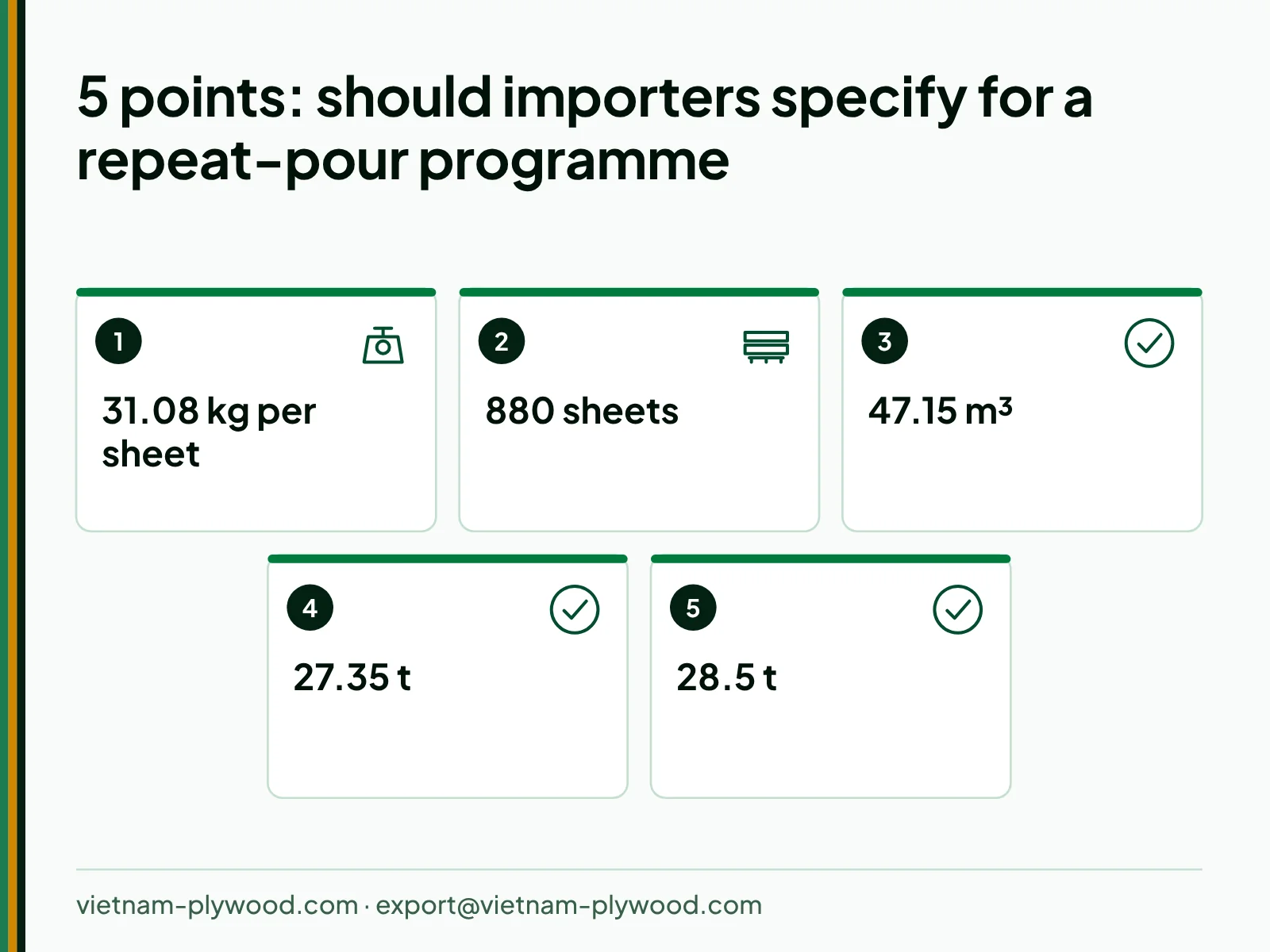
For an 18 mm, 1220 × 2440 mm acacia-core panel, the core-only lookup is 31.08 kg per sheet, excluding film weight. A full 40HC acacia-core reference load is 880 sheets, 47.15 m³ and 27.35 t, within the 28.5 t payload limit. The container loading reference owns the broader loading calculations; mixed specifications must remain within the payload limit.
A minimum order is one 40HC, and one container can carry several specifications as long as the payload limit holds. Buyers planning regular yard replenishment can also review plywood supply programmes for distributors and several plywood types in one supply programme.
Which documents should accompany the film-faced order?
The order specification and agreed test reports identify the panel build; the commercial invoice and packing list identify what was shipped. HCPLY coordinates on-site quality control, export documents and loading, with shipment from the producing factory under FOB Hai Phong arrangements.
Shipment papers include the bill of lading, certificate of origin, phytosanitary and fumigation papers, and insurance under CIF. EU lots include EUR.1 and the EUTR/EUDR file set; order-specific certificate documents can include an emission certificate, test reports and an FSC claim on sales documents. Member-factory FSC, CARB P2, ISO 9001 and CE certificates are shown with factory details masked, on request.
After loading, the draft shipping documents come to you for approval. Release-agent product data sheets and site trial records belong in the contractor’s technical file, because the release agent itself is procured separately from the plywood.
What specification should the buyer send next?
Send a written panel specification that names the film and the proposed release-agent trial. HCPLY can then prepare the construction-panel specification for the producing factory and the buyer’s inspection plan. Lucy at export@vietnam-plywood.com handles export enquiries.
Application: repeated concrete formwork; required concrete finish: [state]
Line or core: construction line; acacia or eucalyptus core
Glue: melamine MR or phenolic WBP [choose]
Emission: E0 / E1 / E2 [choose]
Face and grade: phenolic or melamine film; 120 or 135 g/m² [choose]
Thickness and tolerance: [mm]; ±0.5 mm
Size: [1220 × 2440 mm or specified listed size]
Quantity: [sheets / 40HC containers]
Destination port: [port, country]
Release-agent trial: [product, chemistry, finish criteria]
Request the spec sheet for the chosen film-faced build.