






With proper handling, a release agent on every pour and sealed edges (cut edges included), HCPLY melamine-glue film-faced plywood gives about 12–15 pours; phenolic-glue reaches up to about 25. Choosing a count without the matching build and site routine can cost replacement sheets, crew time and rejected concrete finishes. The deciding question is how many times can film faced plywood be reused under the project’s actual inspection rule.
How many times can film faced plywood be reused?
With proper handling, a release agent on every pour and sealed edges (cut edges included), melamine-glue film-faced plywood gives about 12–15 pours, while phenolic-glue panels reach up to about 25 pours. Those figures apply when the stated handling and edge-sealing conditions are followed. The count stops when a panel no longer meets the approved formwork or concrete-finish requirement.
A pour is a concrete placement against a panel face followed by stripping, cleaning and inspection. Turning a sheet over does not erase previous wear. Record accepted pours by panel identity and intended finish, rather than treating every surviving sheet as an acceptable reuse.
HCPLY quotes a defined construction-line build. A purchaser should record both the target pour sequence and the criteria for acceptable concrete surfaces. Our concrete formwork specification guide explains the wider formwork selection; the reuse decision begins with the actual panel construction and continues at the jobsite.
What determines the count before the first pour?
The construction line presses film-faced panels with acacia or eucalyptus cores, melamine or phenolic glue and specified film. Film protects the contact surface; glue bonds the veneers; the core supports the face under the approved formwork design. None of these elements substitutes for the others.
Our standard film is 120 g/m², premium film 135 g/m², and 220 g/m² film is reserved for anti-slip. Film weight alone does not establish a reuse count. Inspect film continuity and adhesion as well as the actual edge construction. A heavier film cannot repair an open core joint or an exposed cut.
Melamine glue is the MR (moisture-resistant) system associated with a 12-hour boil description in our specification. Phenolic glue is the WBP (weather-and-boil-proof) system associated with a 72-hour boil description. These are glue-system descriptions, not promises that installed panels withstand uninterrupted water exposure. Film-faced boards remain vulnerable where wood is exposed.
Acacia core density is 580 kg/m³ and eucalyptus is 650 kg/m³. Higher density changes weight and handling demands; it does not alone establish more acceptable pours. For a specified 18 mm panel, 11–13 plies are typical because veneer thickness changes the lay-up. Ask for the core and glue specification rather than inferring either from the face colour.
For the available builds and formats, see film-faced plywood from Vietnam and the construction formwork solutions.
Which factory line makes the reuse-critical build?
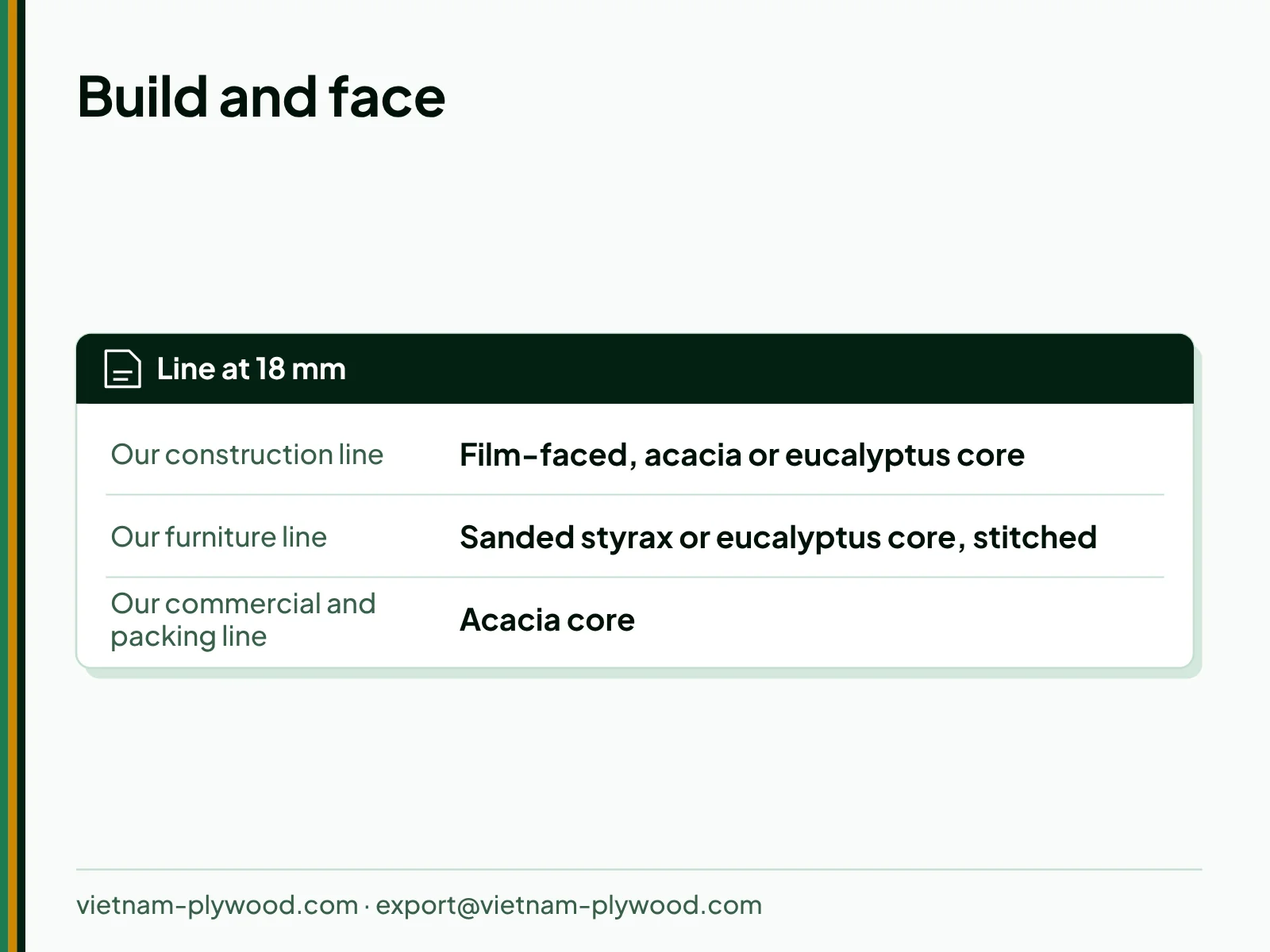
Our construction line makes film-faced formwork panels; the other lines serve different applications. The same nominal thickness can carry a different face, core, glue and tolerance, making substitution a specification error.
| Line at 18 mm | Build and face | Thickness tolerance | Verdict by use |
|---|---|---|---|
| Our construction line | Film-faced, acacia or eucalyptus core; melamine or phenolic glue | ±0.5 mm | Specify for concrete formwork under the approved design |
| Our furniture line | Sanded styrax or eucalyptus core, stitched; decorative veneer face | ±0.2 or ±0.3 mm as ordered | Furniture and cabinet work, not the film-faced formwork specification |
| Our commercial and packing line | Acacia core, MR glue, unsanded or light-sanded | ±0.5 mm commercial; ±0.5–1.0 mm packing | Packaging and commercial use, not a substitute for the film-faced face |
The construction-line sheet is unsanded under its film. Film-facing and an unsanded construction substrate should not be confused with a sanded furniture face. Our three factories work to their respective specifications; each order is inspected at the producing factory.
For a 1220 × 2440 mm sheet, the agreed length and width tolerance is ±2 mm. Thickness selection must also match support spacing, pour pressure and the designer’s requirements. The formwork thickness selection page covers that separate design question.
How should the reuse figure on a quotation be read?
Read the figure together with its conditions, build and acceptance rule. A quotation stating a conditional pour count without identifying glue, core, film and site handling leaves a procurement gap. The maximum is an upper planning reference tied to the specified handling and acceptance criteria.
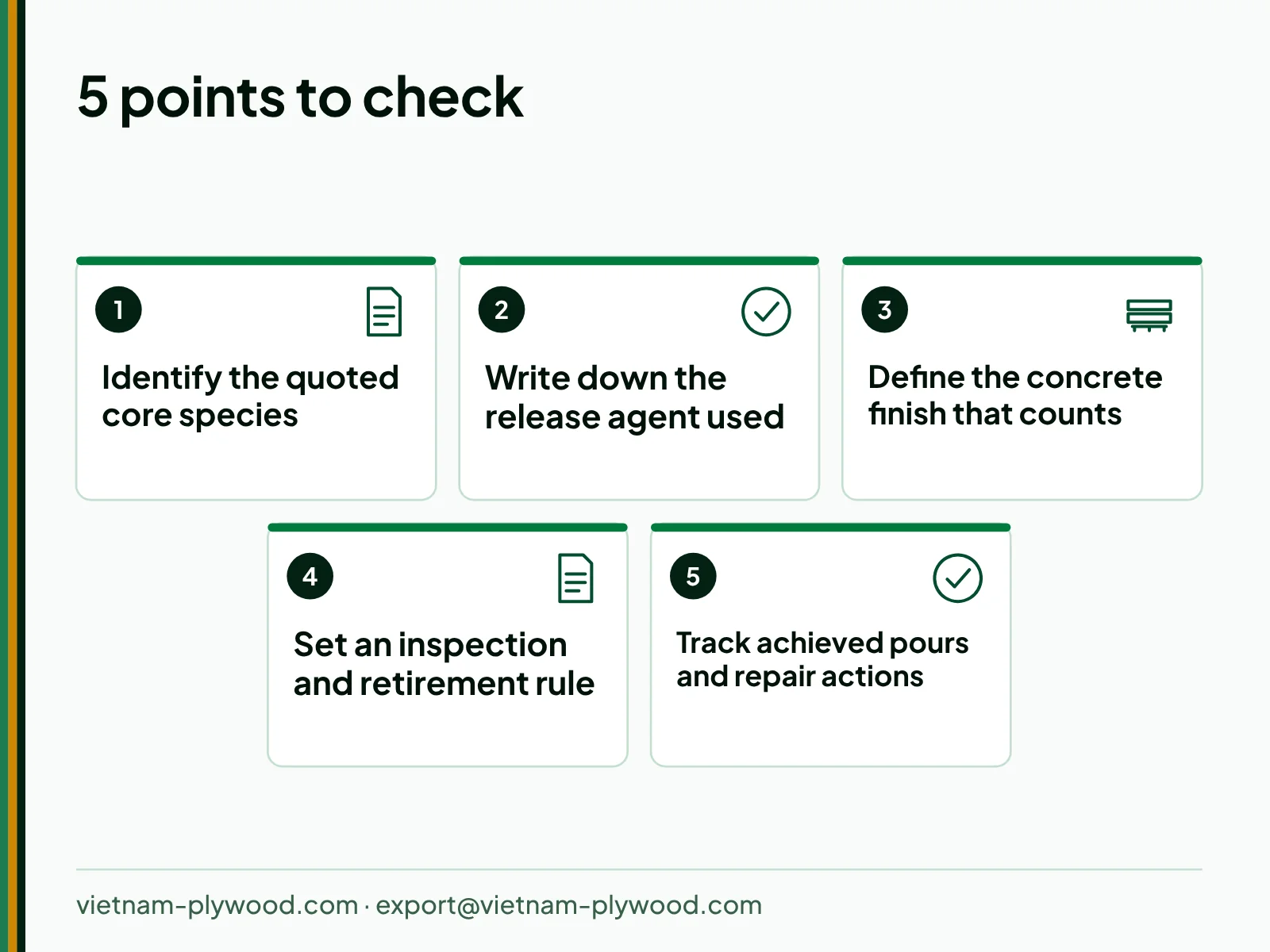
- Identify the quoted core species, film weight, glue system, thickness, size and tolerance.
- Write down the release agent used on every pour and the requirement to seal all factory and cut edges.
- Define the concrete finish that counts as acceptable and the permitted changes of application.
- Set an inspection and retirement rule with the formwork designer and site supervisor.
- Track achieved pours and repair actions on the same panel or mapped form set.
Use a cost-per-accepted-pour calculation: landed panel cost plus sealing, cleaning, repair, handling and attributable rework, divided by accepted pours. Keep the cost scope and finish standard identical when comparing alternatives.
A phenolic-glue build costs more than a comparable melamine-glue build when the more demanding bond system drives the specification; premium film can also raise cost relative to standard film. Core choice, thickness, cutting and ordered volume affect the quotation.
What site routine preserves usable film?
A repeatable handling routine protects the surface and keeps the retirement decision visible. The construction line can deliver the specified face, but no press operation controls the crew’s cutting, release agent or stripping method.
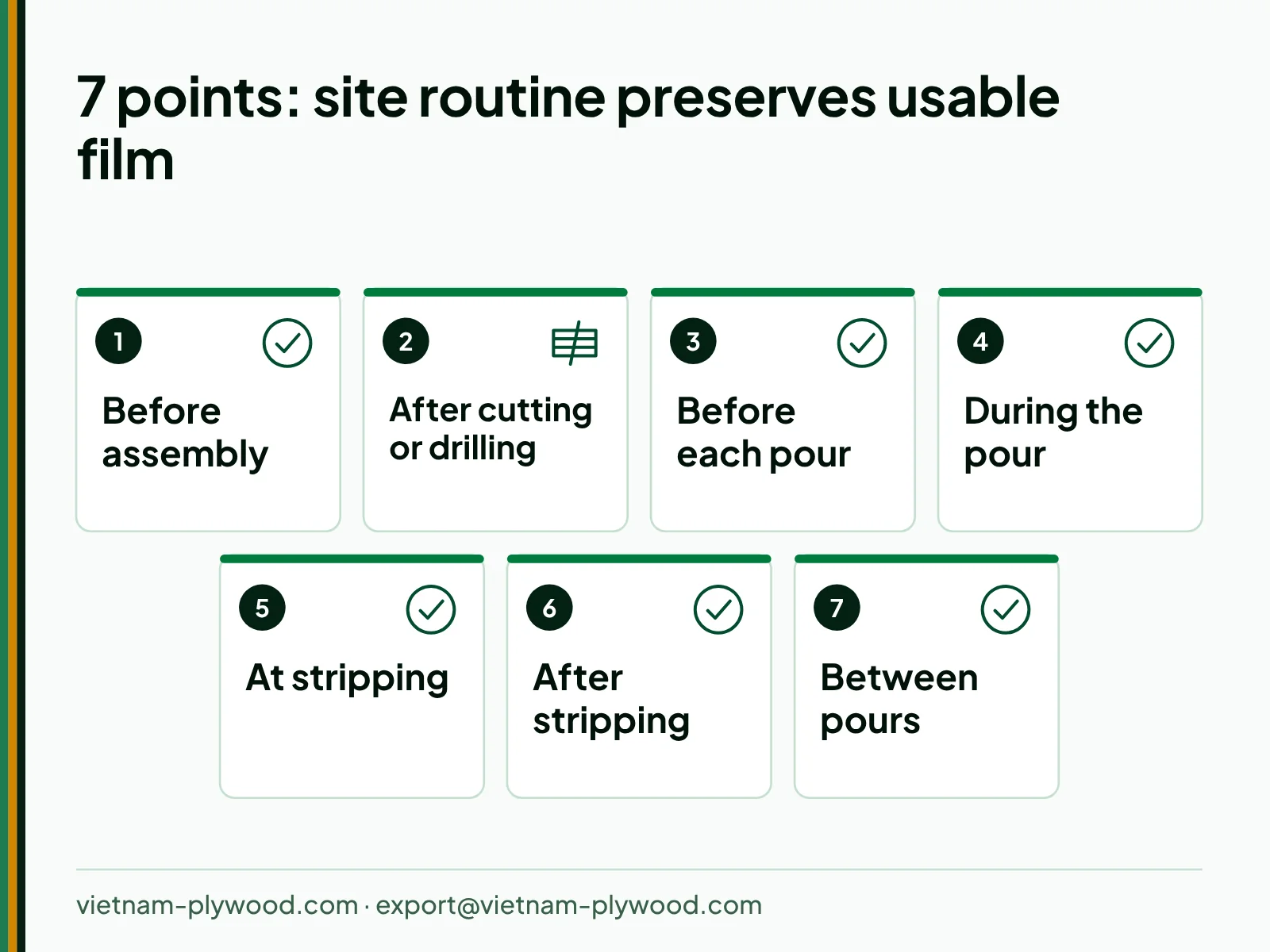
- Before assembly: Check the panel ID, face, edge seal, flatness, fixing zones and planned concrete finish. Set aside sheets with suspected bond separation.
- After cutting or drilling: Seal exposed wood and every new cut edge before wet work. Follow the edge-sealing procedure for the related treatment topic.
- Before each pour: Apply a compatible release agent evenly to the contact face. Avoid pooling that could mark the concrete.
- During the pour: Keep bracing, support and connections within the approved formwork design. Stop and escalate unexpected movement or joint opening.
- At stripping: Follow the engineer’s removal criteria; release the form without levering metal tools across the film.
- After stripping: Remove residue with non-damaging tools, inspect both faces and edges, photograph defects, and record the next permitted use.
- Between pours: Stack flat on sound supports, above standing water, under cover with ventilation, and segregate repair candidates.
The US Occupational Safety and Health Administration’s 1996 formwork rule, 29 CFR 1926.703, requires formwork to support reasonably anticipated vertical and lateral loads. Its removal provisions tie stripping to demonstrated concrete strength or stipulated plan conditions. Project engineers should apply the governing local requirements and approved formwork plan.
Which marks are normal wear and which are defects?
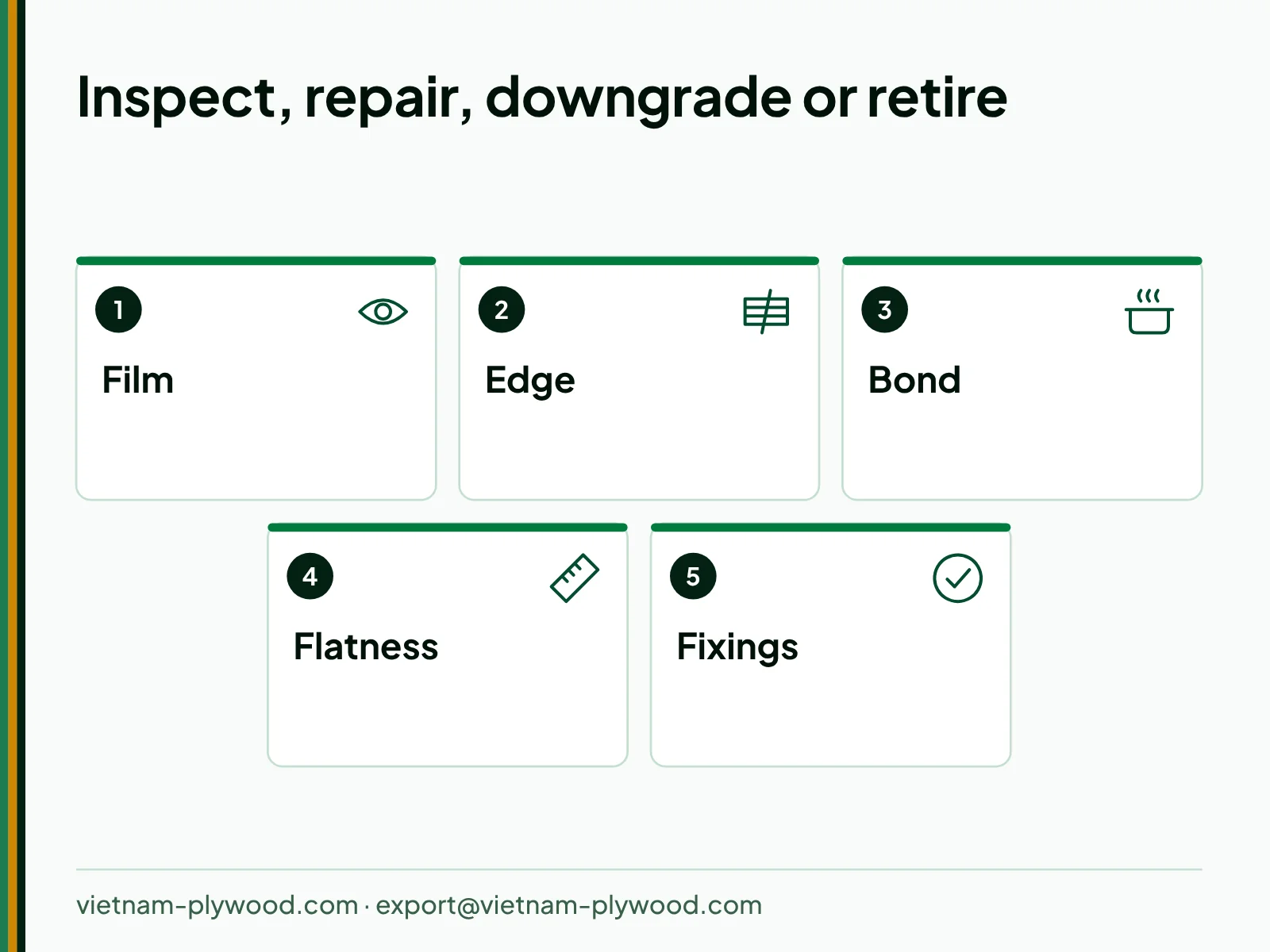
Minor scuffing can be ordinary wear when the film remains intact and the resulting concrete finish meets the job specification. A deep gouge, peeling film, swollen edge or suspected glue-line separation calls for a different response. Compare the observed condition with the approved finish and load requirements before reuse.
| Observation | What to check | Disposition |
|---|---|---|
| Light surface rub, film intact | Cleanliness and finish imprint | Clean and inspect for the same finish class |
| Shallow local scratch | Whether wood is exposed and finish is affected | Repair or downgrade after approval |
| Small isolated tie hole | Hole edge, seal and planned fastening | Seal or patch under approved repair procedure |
| Deep gouge through film | Core exposure, local damage and finish imprint | Hold for assessment; patch only if permitted |
| Raised or swollen edge | Joint closure, moisture entry and bond integrity | Hold; retire if dimensional or bond criteria fail |
| Film peeling or veneer separation | Extent and evidence of bond failure | Quarantine; retire if integrity is compromised |
| Persistent bow or crushed fixing area | Support contact, alignment and connection capacity | Do not reuse until engineering assessment |
Normal veneer pattern visible at a sound cut edge is different from a separated glue line. Record the condition before cleaning destroys evidence of its location.
Which face damage can be patched?
Local, stable face damage can be a repair candidate when the approved formwork procedure permits it. Patching is intended to restore a usable contact surface or seal exposed wood; it cannot certify the panel’s remaining strength or undo widespread delamination.
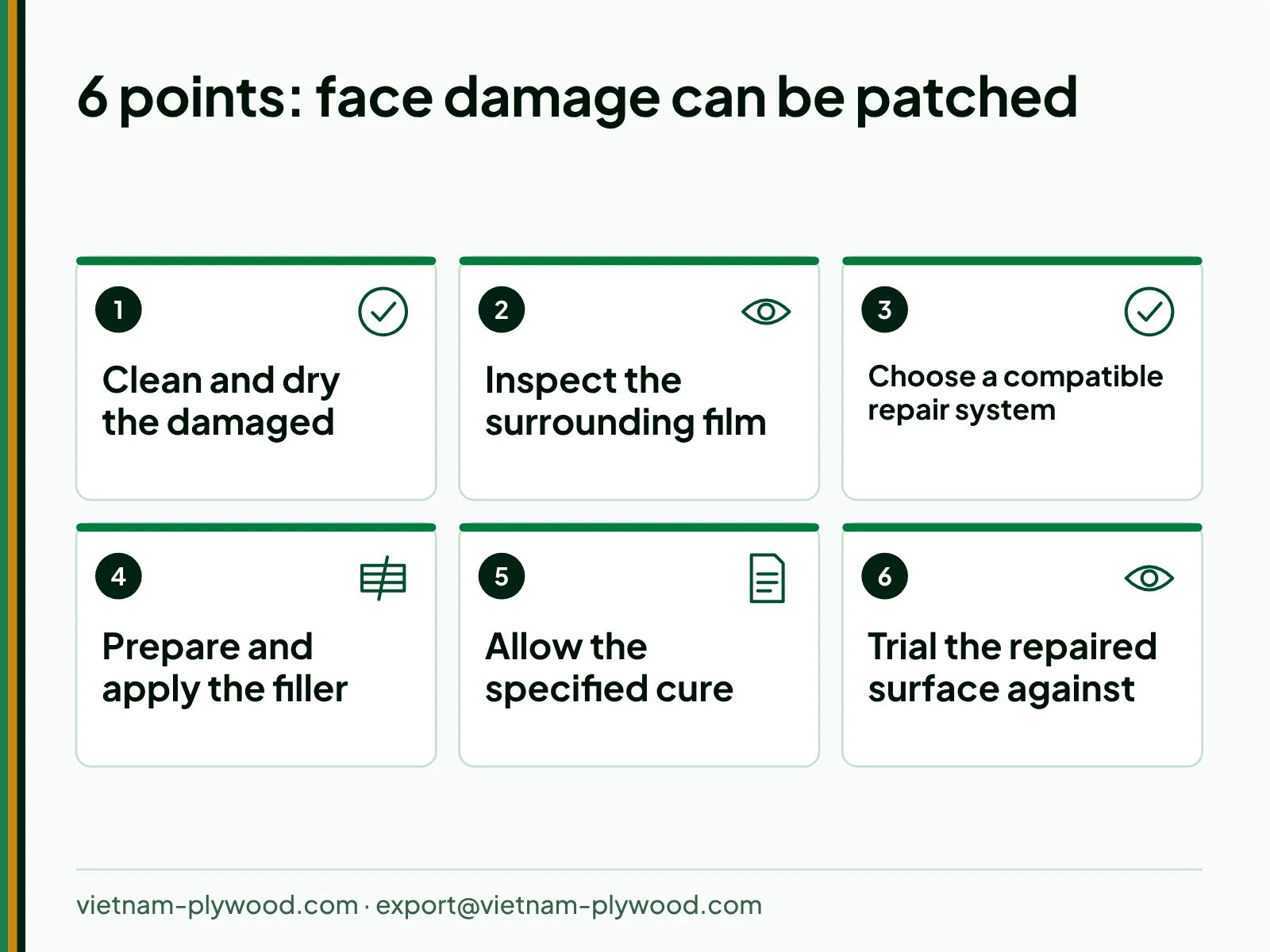
- Clean and dry the damaged area without widening the defect.
- Inspect the surrounding film, veneers and bond for lifting, softness or moisture damage.
- Choose a compatible repair system approved for the concrete finish and release agent.
- Prepare and apply the filler or patch according to its manufacturer’s instructions.
- Allow the specified cure, smooth only as permitted, and reseal exposed edges.
- Trial the repaired surface against the required finish before returning it to production.
Tie holes and small gouges often need a suitable water-resistant, compatible repair filler or resin system; no single filler is suitable for every film and release agent. The repair product’s technical instructions govern preparation, cure and compatibility. Do not invent a resin brand, cure time or patch depth from the plywood specification alone.
Patching formwork plywood may leave an imprint on exposed architectural concrete. Where the repair remains visible, consider a lower finish-demand location only with the designer’s approval. Repaired holes also require review of fastening and leakage risk; a smooth surface alone does not establish suitability.
Is edge swelling the end of a panel?
Edge swelling is a warning that needs inspection, not an automatic permission to keep pouring. Water enters exposed veneer ends and cut edges more readily than intact film. Swelling can prevent a tight joint, leave fins on concrete and indicate deeper bond damage.
Measure whether the edge still meets the form joint and dimensional requirements. Look for veneer lifting, gaps, soft areas and persistent distortion after appropriate drying. Do not plane away substantial swelling simply to force a joint closed; that can remove material needed by the design.
A minor surface disturbance might be repairable after assessment and resealing. A joint that will not close, delaminated plies, unreliable fastening or a weakened panel requires retirement from that application. Segregate questionable sheets before the next pour instead of hiding them in a stack.
Inspect cut edges especially after repetitive drilling and recutting.
When should formwork plywood be retired?
Retire a panel when it fails the approved structural, dimensional, connection or concrete-finish criteria for any proposed next use. Some sheets can be reassigned to a less demanding finish class, but only where the approved design permits.
Use three dispositions: continue when film, edges, shape and connections pass; hold or repair when local damage needs assessment; retire when integrity or approved finish cannot be restored. A panel with exposed core over a broad working area should not be retained merely because a patch hides the opening.
Separate finish serviceability from safe formwork serviceability. A scratched sheet might still make acceptable concealed concrete after approval, while a seemingly clean sheet with delamination may be unsafe. Record the reason and responsible inspector for every downgrade or retirement.
Never use the supplier’s quoted count as a substitute for the engineer’s formwork plan. Under the OSHA 1996 rule cited above, shoring equipment is inspected before erection and erected shoring is inspected around concrete placement. Local project regulations and engineering documents govern the actual work.
How can a buyer inspect the build at the factory?
At the producing factory, the buyer or appointed inspector can compare the written specification with sampled sheets before loading. That is where film, core, thickness and edge workmanship can be checked against the quotation; future site pours cannot be witnessed in a factory inspection.
- Match bundle identification and order documents to the construction-line specification.
- Check film weight designation and visible face continuity against the agreed sample.
- Measure thickness at agreed positions against the ±0.5 mm film-faced tolerance; verify size against ±2 mm.
- Inspect cut edges for veneer gaps, exposed ends and signs of bond separation.
- Review the specified glue and any agreed test report for the actual build.
- Record photos, sampled measurements, nonconformities and corrective disposition before loading.
For a US-bound or EU-bound order, do not infer a certificate from a panel’s appearance. Member-factory certificates and related records, where applicable, are shown with factory details masked, on request. Ask which test report applies to the specific agreed build and destination requirement.
HCPLY manages the specification, on-site quality control, documents and loading. Buyers visit the factory office and inspect goods at the producing factory. The shipment’s packing list identifies shipped goods; agreed test reports or certificate documents establish the declared build where those documents are part of the order.
How does the order and container affect the plan?
A minimum order is one 40HC, and specifications can be mixed within its 28.5 t payload limit. A mixed container can combine the construction-line film-faced specification with other agreed plywood specifications, provided the weights and loading plan fit. That can support staged formwork procurement without pretending different faces have identical performance.
For 18 mm, 1220 × 2440 mm construction sheets, a full 40HC holds 880 acacia-core sheets on 16 pallets, at 31.08 kg per sheet and 27.35 t total. The eucalyptus-core build holds 795 sheets on 15 pallets, at 34.83 kg per sheet and 27.69 t total. These are separate full-load examples, not additive quantities.
See the container loading calculations for that separate topic. Avoid translating container capacity into a site reuse promise.
Factory lead time runs 15–45 days from receipt of the 30% deposit; the exact figure depends on order size, line loading and what the contract fixes. The remaining 70% is paid on the scan of the bill of lading, by T/T, or by irrevocable sight L/C. We ship FOB Hai Phong, or CFR (CNF) or CIF to your port. After loading, the draft shipping documents come to you for approval.
What should be recorded after every pour?
A short, consistent record turns the quoted reuse condition into a measurable site result. Assign each sheet or mapped form set an identifier and record the pour zone, finish class, handling conditions and inspection outcome.
| Log field | Minimum useful entry |
|---|---|
| Identity | Bundle, panel or form-set code; quoted build |
| Exposure | Pour location, date, face used and intended finish |
| Preparation | Cut edges sealed; release agent applied |
| After stripping | Film condition, edge condition, flatness, fastening damage |
| Action | Continue, clean, repair, downgrade, hold or retire |
| Decision | Inspector, next approved use and supporting photographs |
Review actual accepted pours by build and work zone. If one group retires early, examine cutting, storage, concrete finish and stripping records before attributing the result to glue alone.
Contractors managing multiple sites can align this log with construction-project supply planning. Distributors can use the same fields in repeat supply programmes to compare written specifications with customer feedback.
What specification should be sent for the next order?
Send the intended pour programme, finish requirement and repair policy alongside the panel specification. State whether the work includes repeated cuts, exposed faces or concealed concrete. The quotation can then identify the build and the conditional reuse figure for the stated site conditions.
The order’s export documents include the commercial invoice, packing list, bill of lading (B/L), certificate of origin, applicable phytosanitary and fumigation papers, and insurance under CIF. Additional agreed certificate documents and test reports accompany the shipment as specified. For European Union lots, the certificate of origin is EUR.1 and the EUTR/EUDR file set is included where applicable.
Use this written request to keep the construction-line build and site acceptance conditions together:
Application: Repeated concrete formwork; finish class and pour programme: [state]
Line or core: Our construction line; acacia or eucalyptus core: [choose]
Glue: Melamine (MR) or phenolic (WBP): [choose]
Emission: E0 / E1 / E2 class as required: [state separately from glue]
Face and grade: Film-faced; 120 g/m² standard or 135 g/m² premium; grade/finish requirement: [state]
Thickness and tolerance: [3–40 mm requested thickness]; ±0.5 mm
Size: [listed size or custom cut]; length/width tolerance ±2 mm
Quantity: [sheets, pallets and 40HC mix if applicable]
Destination port: [port and country]
Site conditions: Release agent each pour; all edges sealed including cuts; inspection/retirement rule: [state]
Next step: book a factory visit with Lucy at export@vietnam-plywood.com to inspect the proposed build at the producing factory.