






Film faced plywood defects must be sorted by when they first appeared: at the press, during transport or during concrete forming. A mistaken diagnosis can mean rejected loads, replacement costs and lost pour days. At HCPLY, buyers can inspect finished panels at the producing factory before loading and record the evidence against the agreed specification.
What film faced plywood defects should an inspector flag?
Film faced plywood defects include lifted film, blisters, wrinkles, pinholes, core voids, open glue lines, damaged edge seals and dimensional errors. Some are visible before dispatch; others emerge only after moisture exposure or repeated stripping. Inspect unused panels first, then compare their condition with photographs taken at receipt and during use. A defect classification must distinguish cosmetic marks from loss of film integrity or bonding.
The concrete formwork plywood specification guide explains how the panel specification relates to the intended concrete finish and formwork arrangement. Use angled light on both faces and examine corners where impacts and incomplete edge coverage are easiest to see.
Which problems start at the press, in transit or on site?
Press-origin faults are present in the finished panel before dispatch; transit and site faults arise after production.
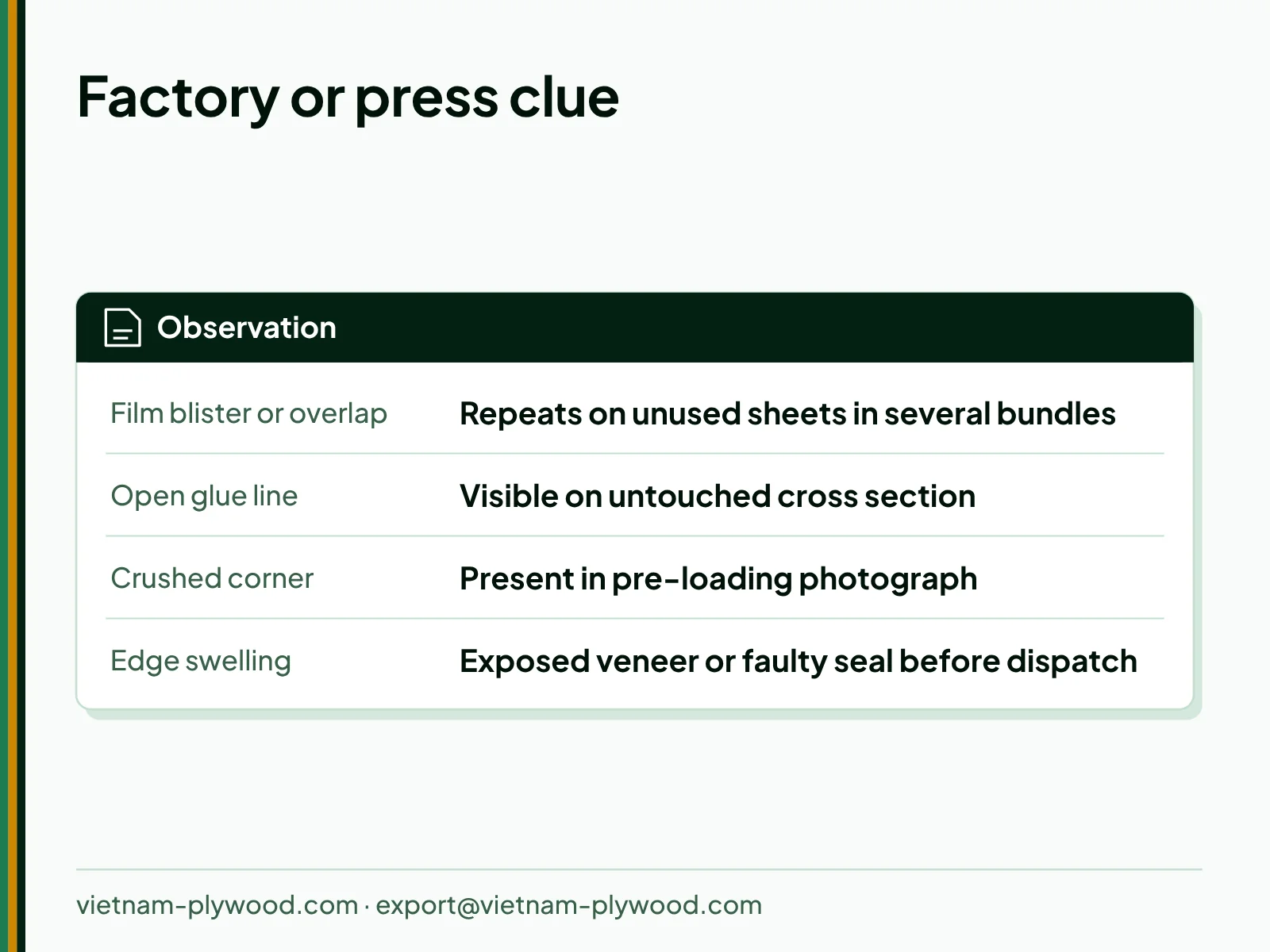
| Observation | Factory or press clue | Transit or site clue | Acceptance action |
|---|---|---|---|
| Film blister or overlap | Repeats on unused sheets in several bundles | Local puncture follows handling | Photograph and compare with approved surface limit |
| Open glue line | Visible on untouched cross section | Separation begins at a later damaged cut | Isolate samples for agreed bond test |
| Crushed corner | Present in pre-loading photograph | Matches damaged pallet or impact point | Record at handover and receipt |
| Edge swelling | Exposed veneer or faulty seal before dispatch | Water entry at site cut or drilled hole | Check original edge and later cuts separately |
| Bow or twist | Present on flat factory inspection surface | Appears after wet storage or uneven stacking | Measure against agreed flatness method |
| Film scratches | Under film or pressed-in debris | Fresh scoring from tools or stripping | Record depth, area and timing |
These are diagnostic clues, not automatic proof of liability. Compare a retained unused sheet with the disputed sheet from the same identifiable lot.
Why does film-faced plywood delaminate after a few pours?
Delamination after a few pours can follow an inadequate original bond, water entering exposed veneer or damage during stripping. Check whether the film lifts from the face or the veneer layers separate internally; those failures have different mechanisms.
Our construction line uses melamine (MR) or phenolic (WBP, weather and boil proof) glue according to the order. The specified melamine system has a 12-hour boil description; the phenolic system has a 72-hour boil description. These are adhesive-system descriptions, not a field prediction for a particular panel. A laboratory result must be linked to the sampled build and the agreed method.
For reuse planning, with proper handling, a release agent on every pour and sealed edges including cut edges, melamine-glue film-faced plywood reaches about 12–15 pours and phenolic-glue plywood up to about 25 pours. The film-faced plywood reuse cycles page covers maintenance in more detail. The APA – The Engineered Wood Association’s 2012 Concrete Forming Design/Construction Guide includes stripping, cleaning, release-agent application, handling and storage among its form-maintenance topics: APA technical guide.
What thickness tolerance should the panels hold?
Film-faced panels from our construction line have a thickness tolerance of ±0.5 mm; length and width tolerance is ±2 mm. Record actual readings at agreed points across several sheets and bundles. A nominal 18 mm sheet therefore has an ordered thickness acceptance band of 17.5–18.5 mm, excluding localized physical damage from the measurement point.
Use a calibrated caliper, identify each sheet and preserve the measurement locations. Match the formwork design to the panel build; see formwork plywood thickness choice and shutterply sizes and grades.
Why do edges swell after delivery?
Film faced plywood edge swelling begins when moisture reaches the wood veneer through exposed or damaged edges. Factory-applied edge coating can be interrupted by impacts, sawing, drilling or repeated wetting. Inspect the original perimeter seal separately from any cut edge made by the formwork crew.
Photograph the pallet wrap and corner protectors at unloading before moving bundles. Look for condensation, standing water, crushed corners and wet packaging, then compare the affected panel locations with the loading photographs. If swelling follows a site cut, record when that cut was made and how it was resealed.
How do two offers with the same product name differ?
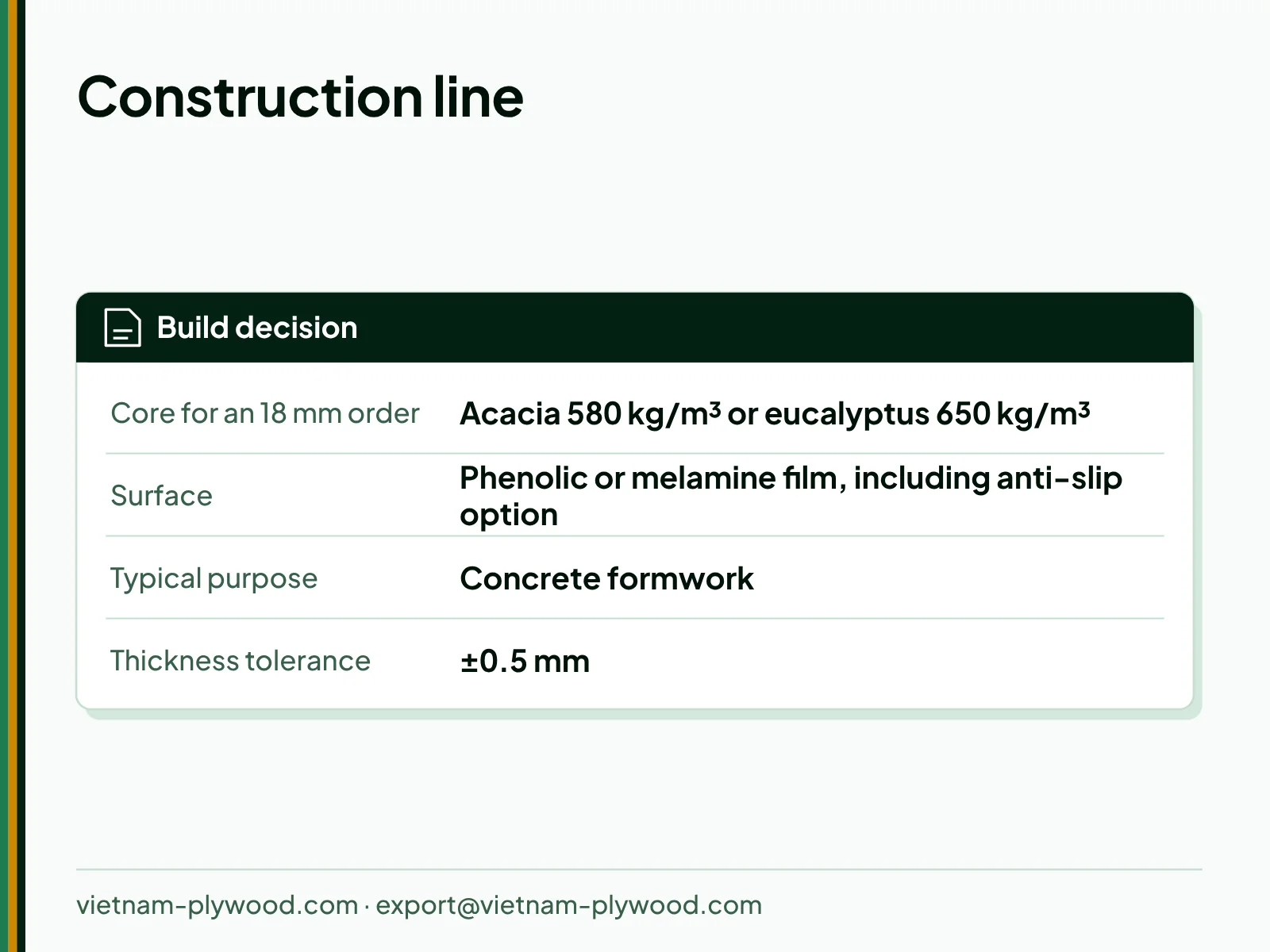
Two offers labelled film-faced plywood can have different cores, adhesive systems, film weights and inspection rules. HCPLY’s construction line presses film-faced panels with acacia or eucalyptus cores and an unsanded build. The face film names the product; core density affects weight and handling.
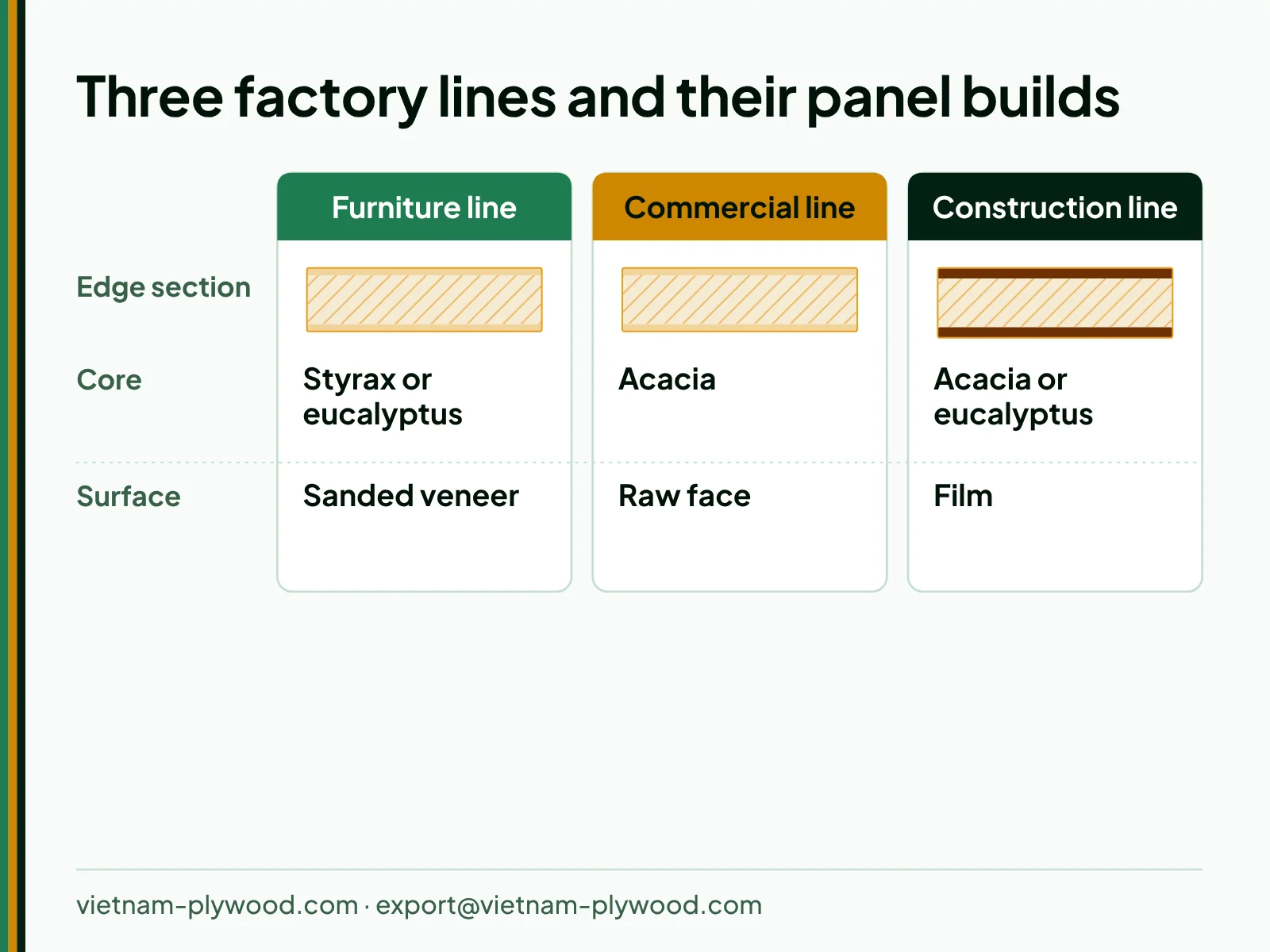
| Build decision | Construction line | Furniture line | Commercial and packing line |
|---|---|---|---|
| Core for an 18 mm order | Acacia 580 kg/m³ or eucalyptus 650 kg/m³ | Styrax 500 kg/m³ or eucalyptus 650 kg/m³ | Acacia 580 kg/m³ |
| Surface | Phenolic or melamine film, including anti-slip option | Sanded veneer face | Raw, unsanded or light-sanded |
| Typical purpose | Concrete formwork | Furniture or cabinets | Commercial and packing use |
| Thickness tolerance | ±0.5 mm | ±0.2 or ±0.3 mm as ordered | Commercial ±0.5 mm; packing ±0.5–1.0 mm |
The construction specification also distinguishes 120 g/m² standard film, 135 g/m² premium film and 220 g/m² anti-slip film. Compare adhesive, core layup, edge seal, surface acceptance and the testing plan together. Our furniture line would produce a sanded furniture panel instead; our commercial and packing line would produce a raw-faced commercial or packing panel. For the product build, see film-faced plywood from Vietnam. Medium-density and high-density overlays are separate product concepts discussed in HDO or MDO plywood; we do not press those panels.
What should the pre-loading inspection checklist cover?
A pre-loading inspection should connect the approved purchase specification to identifiable finished panels, measurements and shipment records. Buyers or their inspectors can witness checks at the producing factory before the load is closed.
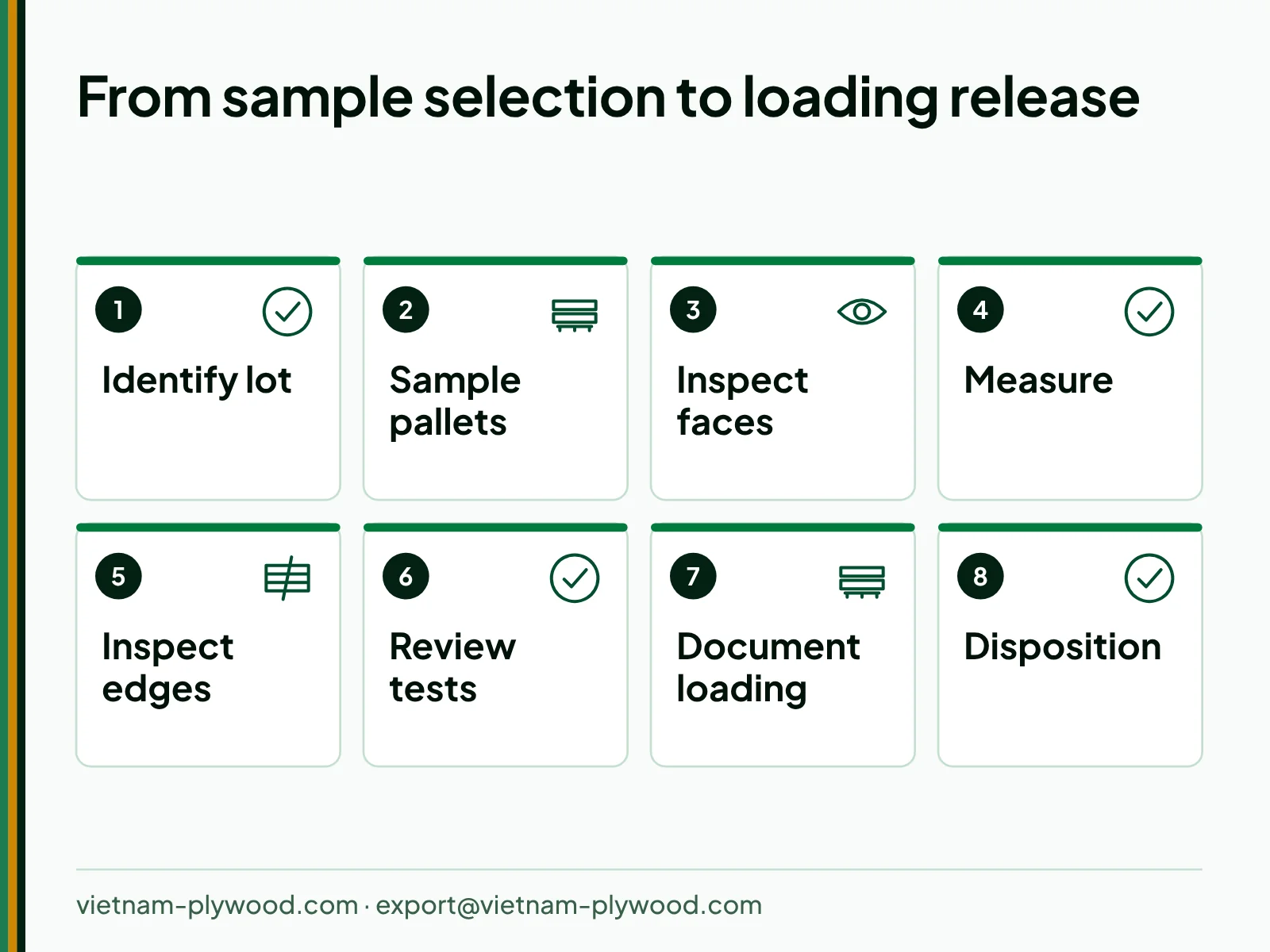
- Identify the lot. Match pallet labels, sheet dimensions, core and film specification to the order and reference sample.
- Sample across pallets. Select top, middle and lower positions according to the agreed sampling plan; record the selection method.
- Inspect both faces. Photograph blisters, wrinkles, overlaps, scratches, gloss variation and exposed substrate with a scale.
- Measure panels. Record thickness, length, width, diagonal comparison and any agreed flatness readings.
- Inspect edges and core. Check seals, voids, visible veneer joints and cut-section integrity on approved sacrificial sheets.
- Review bond evidence. Match agreed laboratory reports or witnessed tests to the lot and adhesive system; do not substitute tapping for a bond test.
- Review loading. Photograph pallets, wrapping, corners, labels, container condition and final loading sequence.
- Issue a disposition. Mark observations as accepted, reworked, held or rejected using the purchase-order limits, with a dated sign-off.
The agreed sampling method and permitted defect sizes belong in the purchase order. HCPLY coordinates the specification, on-site quality control and loading record for its export orders.
Which findings require a hold or further testing?
Hold panels when a finding affects the ordered bond, usable face, dimensions or traceability and cannot be resolved by the agreed visual criteria. Film discoloration with intact coating may be acceptable under an approved sample; a film gap exposing veneer is a different category. Do not apply another manufacturer’s surface-grade allowances to this purchase without agreement.
Where bond failure is suspected, isolate identified samples and compare an agreed laboratory method with the ordered adhesive and intended exposure. Separate a repairable edge coating issue from widespread internal separation.
What should be recorded when the container is loaded?
The loading record should preserve panel identity and packaging condition so the receiving inspector has a starting point. Photograph pallet marks, container interior, floor condition, door seals and any visible package damage. The container loading calculation covers full-load quantities and payload planning.
For reference, 18 mm, 1220 × 2440 mm acacia-core panels calculate to 880 sheets, 47.15 m³ and 27.35 t in a full 40HC before film weight. The corresponding eucalyptus-core lookup is 795 sheets, 42.60 m³ and 27.69 t. The 40HC payload limit is 28.5 t; mixed specifications require a fresh total-weight check including film, pallets and packaging.
How is a film-faced plywood claim documented?
A claim should connect the exact ordered specification, inspected lot, observed failure and handling history in a single dated evidence trail. Send the original order and acceptance schedule alongside the factory report, then add receiving photographs and site-use records.
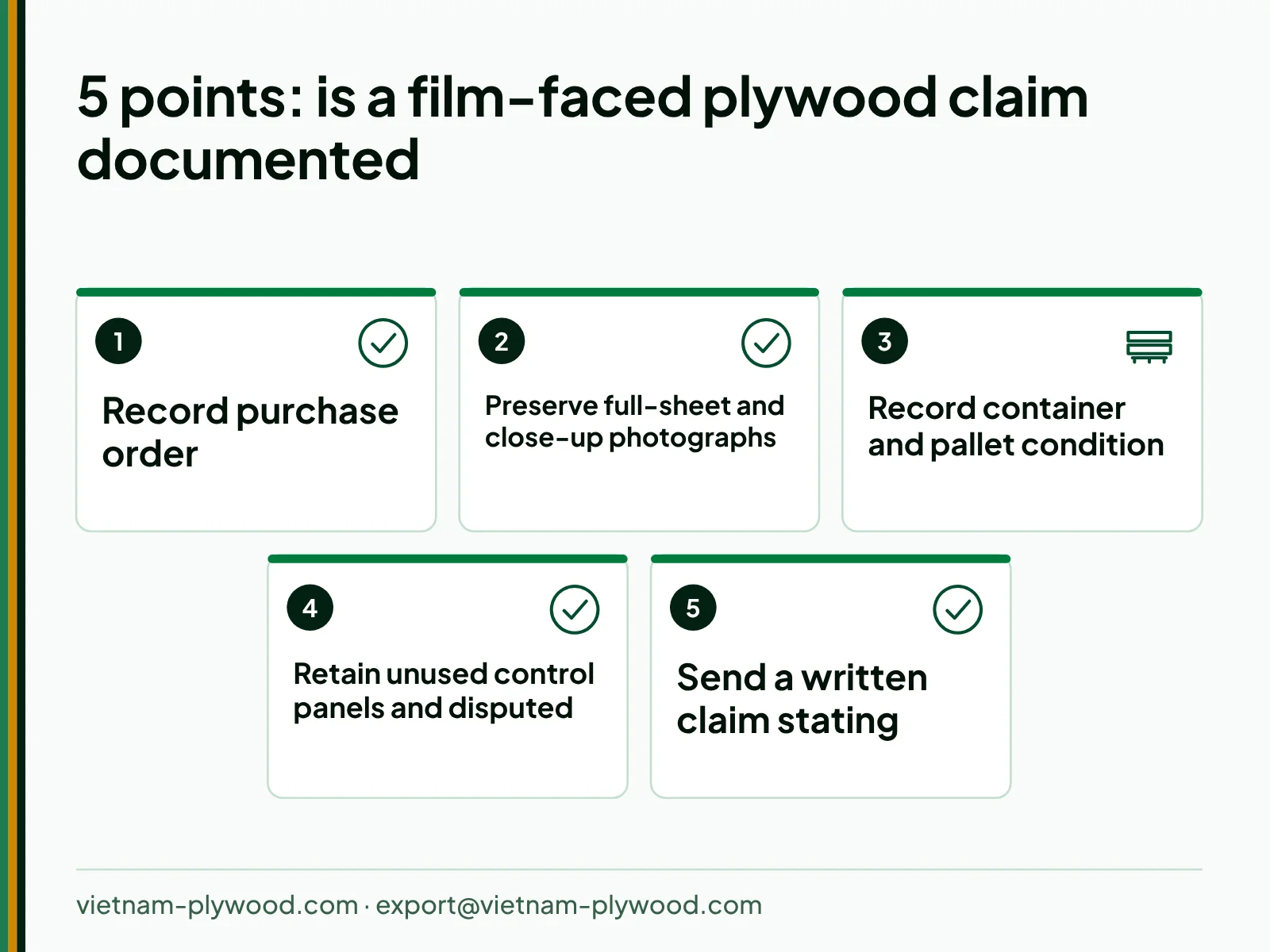
- Record purchase order, panel build, lot and pallet identifiers, quantity affected and first observation date.
- Preserve full-sheet and close-up photographs with scale, plus measurements and the position of each defect.
- Record container and pallet condition at opening, weather exposure, storage arrangement, edge resealing and number of pours.
- Retain unused control panels and disputed panels for matched inspection or an agreed laboratory test.
- Send a written claim stating the requested remedy, supporting evidence and the contract acceptance clause.
The packing list identifies the shipped quantities and packaging; the commercial invoice identifies the commercial shipment. The bill of lading (B/L) documents carriage, while agreed test reports and certificate documents support the ordered build. After loading, the draft shipping documents come to you for approval.
What specification should the buyer send next?
Send the intended formwork use, exact build and acceptance method before production. Define appearance limits, sampling, bond evidence, packaging and the claim notification process in the order. Lucy at export@vietnam-plywood.com can prepare the construction-line specification and factory inspection arrangements. For broader procurement coordination, see plywood supply programmes for distributors.
Application: Repeated concrete formwork; required finish and support design
Line or core: Construction line; acacia or eucalyptus core
Glue: Melamine MR or phenolic WBP; agreed bond test method
Emission: E0 / E1 / E2 class as specified separately
Face and grade: Film-faced; 120 or 135 g/m², or 220 g/m² anti-slip; agreed visual acceptance
Thickness and tolerance: 18 mm; ±0.5 mm
Size: 1220 × 2440 mm; length/width ±2 mm
Quantity: One 40HC or specified mixed build within payload limit
Destination port: [port and country]
Request the film-faced inspection specification sheet with the proposed sampling and acceptance schedule.