





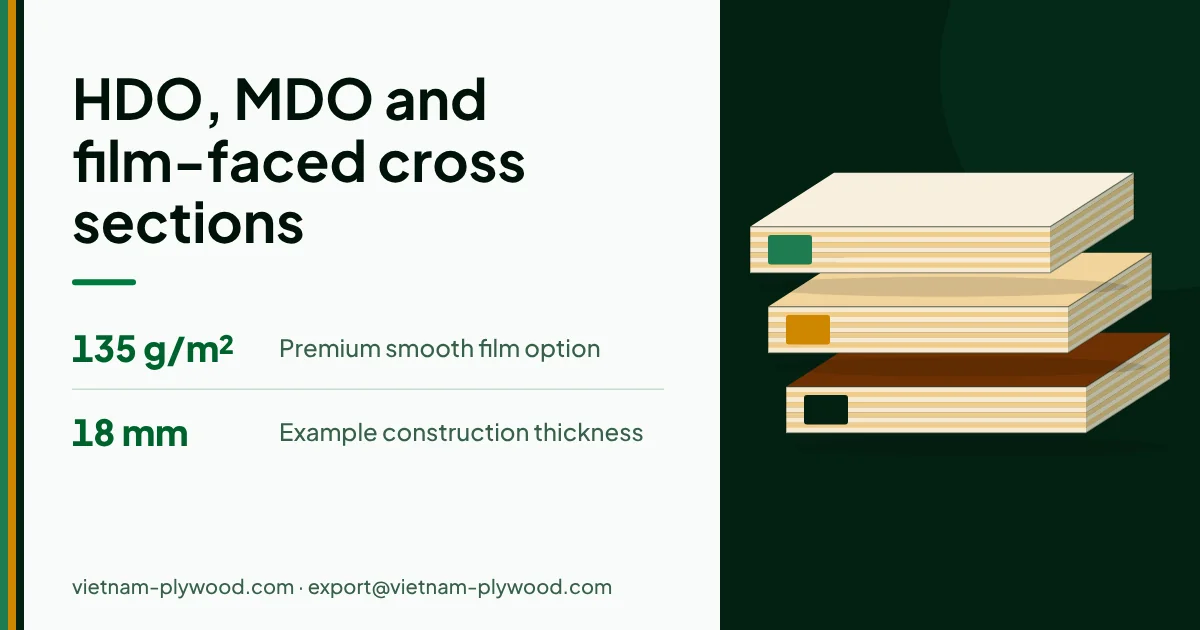
HCPLY does not manufacture HDO plywood; our construction line quotes phenolic film-faced plywood as a possible alternative for eligible US formwork orders. Choosing the wrong overlay can mean rejected panels, extra finishing work or lost site days. The decision starts with whether the specification requires genuine HDO or accepts an evaluated substitute.
What is HDO plywood?
HDO plywood is exterior-type plywood faced with a high-density, resin-impregnated fiber overlay bonded under heat and pressure. Its hard, smooth surface serves repeated concrete forming and demanding industrial applications. In US specifications, the overlay category and concrete-form grade matter alongside the underlying panel. An ordinary phenolic film face does not become HDO merely by increasing its stated weight.
APA – The Engineered Wood Association describes HDO and medium density overlay (MDO) as distinct overlaid plywood products. Its MDO/HDO technical overview distinguishes concrete-form HDO from industrial HDO and separates MDO concrete-form from general MDO. The APA product guide, revised in 2011, also addresses finishing and specifications. These distinctions are useful when an American purchase order uses only the word “HDO.”
A buyer should first identify whether the required outcome is a smooth concrete cast, a documented US product grade, or an industrial surface. The answer determines whether a film-faced plywood alternative can be evaluated at all.
What is the difference between HDO and MDO plywood?
HDO and MDO use distinct resin-impregnated fiber overlays within the APA product system; concrete-form versions also produce different finishes. Both categories have grades intended for concrete forms, while other grades serve different industrial or painted uses. The words “high” and “medium” refer to overlay categories, rather than core density.
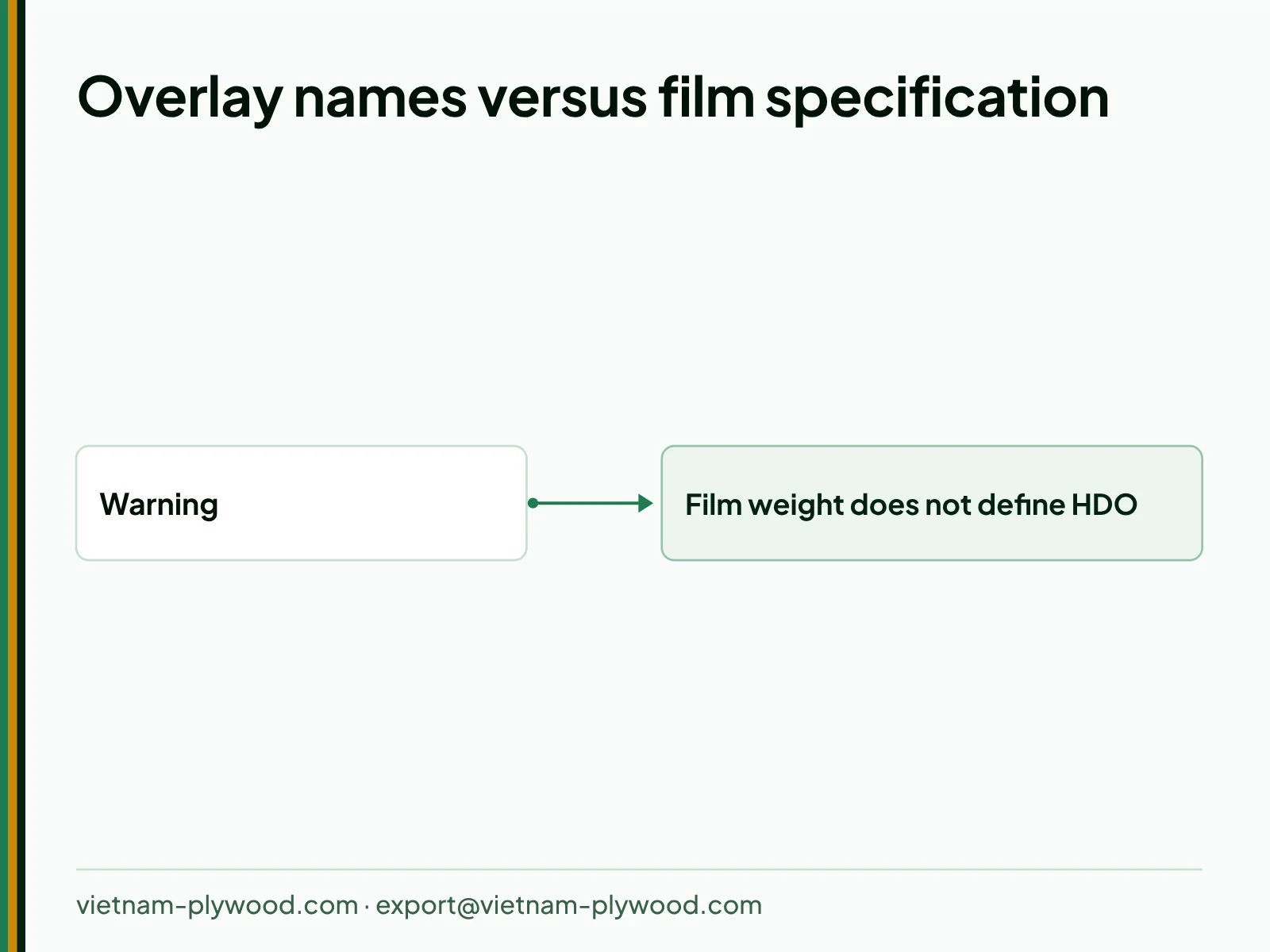
| Comparison metric | HDO plywood | MDO plywood | Film-faced alternative | Verdict by use |
|---|---|---|---|---|
| Face construction | Resin-impregnated fiber overlay | Resin-impregnated fiber overlay with lower resin content | Phenolic or melamine film, specified by film weight | Use the named overlay where the contract requires it |
| Concrete finish | Smooth, near-polished cast | Matte or flat cast in concrete-form grade | Finish evaluated against approved sample | Trial film-faced for finish-based substitution |
| Typical other application | Demanding industrial panels | Painted siding and signage | Construction forms and anti-slip applications | Match the actual end use |
| Production route | Not pressed | Not pressed | Pressed on our construction line | Quote film-faced only when substitution is allowed |
APA’s concrete-forming guidance identifies HDO Plyform as a smooth-finish option and MDO Plyform as a matte-finish option. A specification calling for an APA trademark or PS 1 compliance must be supplied with panels carrying the required evidence from an eligible manufacturer.
What is HDO plywood used for?
HDO concrete-form panels are selected for repeated wall, column and architectural concrete pours where surface appearance matters. Industrial-grade HDO serves demanding surfaces such as signs and industrial equipment panels. These applications should be separated because an industrial overlay designation does not automatically establish concrete-form suitability.
Concrete-form buyers assess the finish after stripping, the surface condition after cleaning and the structural support design. A smoother surface alone cannot establish allowable concrete pressure or span. The designer must use documented properties for the exact panel and support arrangement, as explained in the concrete formwork specification guide.
A buyer specifying an HDO board for signage, painted exterior components or repeated industrial wear should retain the actual overlay and finishing requirements. A formwork-oriented film panel is a different construction and is not a routine substitute for paint-base MDO.
Does HCPLY make HDO plywood?
HCPLY does not press HDO or MDO plywood. Our construction line presses film-faced plywood with phenolic or melamine film, using acacia or eucalyptus cores. We quote that construction as film-faced plywood, with its actual film weight and glue system stated explicitly.
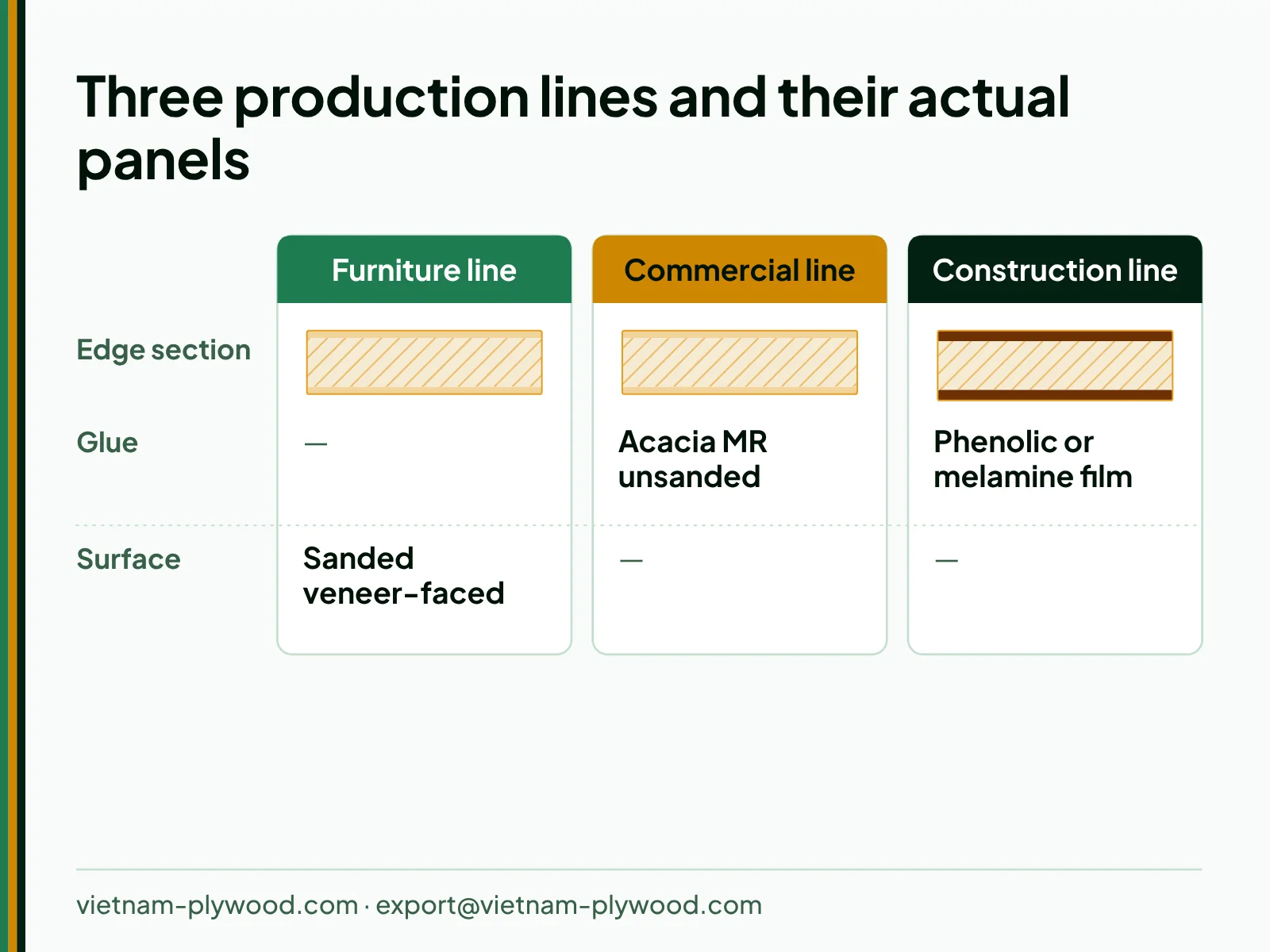
Our furniture line instead produces full-stitched, sanded panels with styrax or eucalyptus cores and E0/E1 emission classes. Our commercial and packing line makes acacia-core MR-glued panels, unsanded or light-sanded. Neither is presented as an overlaid concrete-form product. This separation prevents an HDO inquiry from becoming a quote for a panel built for a different job.
Orders are produced at the producing factory in Phu Tho or Hai Phong that matches the specification. Buyers can inspect at that factory, while our export team handles the specification, on-site quality control, documents and loading.
Can film-faced plywood fill an HDO specification?
Film-faced plywood can be evaluated for an HDO application only when the buyer’s specification permits an alternative construction and defines acceptance criteria. If the purchase order explicitly requires HDO Concrete Form, an APA trademark, PS 1 performance or a named overlay, a film-faced offer does not satisfy that requirement by name.
For a performance-based formwork order, begin with the required concrete finish and panel support design. Then specify the face, core, bond system, thickness, tolerances, dimensions, edge treatment and inspection criteria. A witnessed trial pour can establish whether the actual film surface produces the accepted finish. It cannot replace structural documentation required by the formwork engineer.
The construction line’s smooth film options are 120 g/m² standard or 135 g/m² premium. Its 220 g/m² film is anti-slip only, suited to traction applications rather than smooth concrete contact. A heavier film-weight figure is not an HDO resin-content measurement. The formwork solutions overview explains the construction category in more detail.
Which film, glue and core build should the buyer specify?
For an HDO-slot trial, start with smooth 135 g/m² film, phenolic WBP glue and a selected acacia or eucalyptus core when the project prioritizes face wear and wet-service bond. The 120 g/m² smooth film is the standard face option for a cost-sensitive formwork trial. Neither option carries an HDO designation.
Our construction line uses phenolic WBP (weather and boil proof) glue with a 72-hour boil designation or melamine MR glue with a 12-hour boil designation. These describe glue performance categories in our specification vocabulary; they do not by themselves establish an APA bond classification. Core species affects mass: acacia is 580 kg/m³ and eucalyptus 650 kg/m³. Face selection does not change the core-density figure.
The available thickness range is 3–40 mm, with 12, 15, 18 and 21 mm among the common construction-relevant choices. Film-faced thickness tolerance is ±0.5 mm and length/width tolerance is ±2 mm. For a 3/4 HDO plywood or 1/2 HDO plywood inquiry, translate the inch designation into the required nominal and measured dimensions before selecting a metric build; do not treat 18 mm or 12 mm as automatic exact-inch equivalents. The formwork thickness selection guide covers design inputs.
What can the inspector witness at the producing factory?
The inspector can compare the approved order with the actual face, edge, thickness, core and pallet identification before loading. This is the most direct way to prevent a film-faced alternative from being mislabeled as an HDO panel.
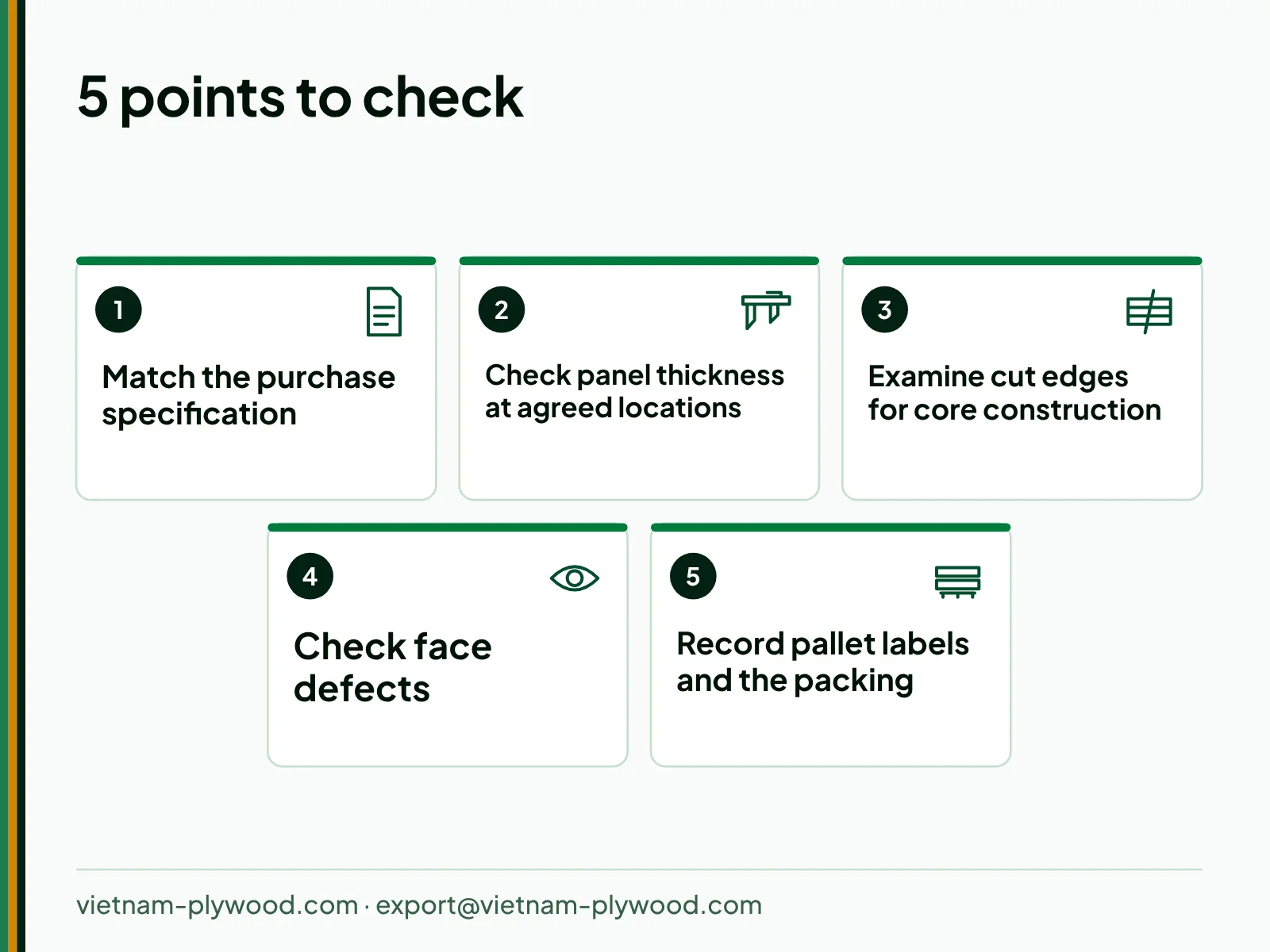
- Match the purchase specification to the film designation: 120 or 135 g/m² smooth film, or 220 g/m² anti-slip film when that is the actual application.
- Check panel thickness at agreed locations against the ordered ±0.5 mm tolerance, and verify length and width against ±2 mm.
- Examine cut edges for core construction, visible voids and the specified acacia or eucalyptus veneer build; record the sample identification.
- Check face defects, corner damage and sealed edges, including any newly cut edges, against the approved acceptance sample.
- Record pallet labels and the packing list against the approved quantity and specification before the container is sealed.
The agreed test reports and order’s certificate documents accompany the commercial invoice, packing list and bill of lading where applicable. The buyer receives draft shipping documents for approval after loading. Factory certificates, where relevant to the agreed order, are shown with factory details masked, on request.
How does the core change a trial container?
At 18 mm and 1220 × 2440 mm, a full 40HC lookup is 880 acacia-core sheets at 27.35 t or 795 eucalyptus-core sheets at 27.69 t. The film weight is excluded from those figures. The 40HC payload limit is 28.5 t, and pallet layouts differ by core.
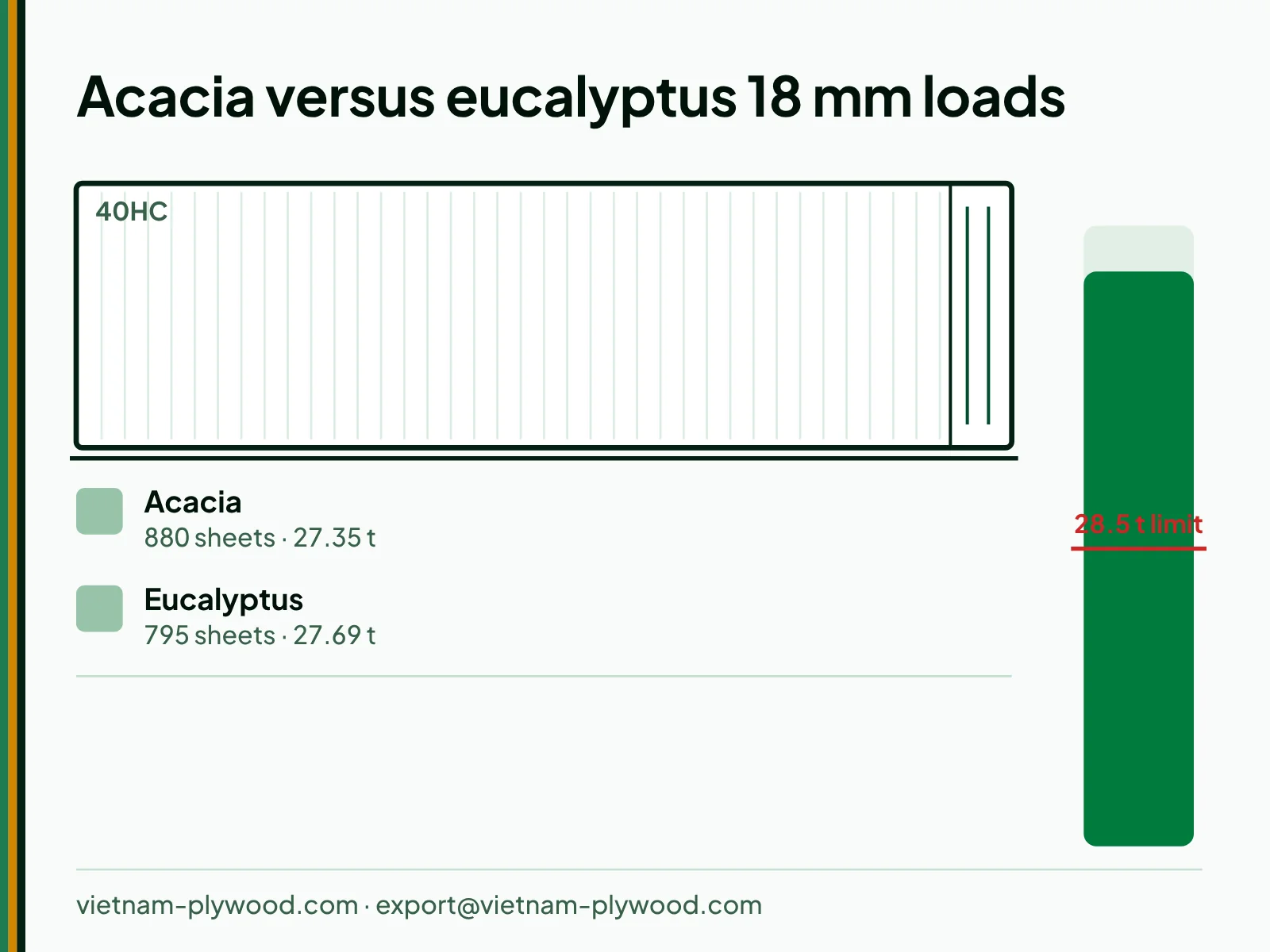
| 18 mm build | Sheet mass | Sheets per pallet | Pallets | Full 40HC sheets | Loaded plywood mass |
|---|---|---|---|---|---|
| Acacia core | 31.08 kg | 55 | 16 | 880 | 27.35 t |
| Eucalyptus core | 34.83 kg | 53 | 15 | 795 | 27.69 t |
For a mixed load, request a pallet-by-pallet packing plan and check the actual gross weight before loading. The minimum order is one 40HC, and one container can carry several specifications as long as the payload limit holds. Use the container loading guide and formwork calculator for the wider loading question.
Which jobs still need real HDO?
A job still needs real HDO when the contract names the recognized overlay product, requires a qualifying mark, or demands documented properties specific to that grade. The same applies when a consultant has approved only a particular HDO system and has not accepted a substitute.
A US public or engineered formwork project can tie panel acceptance to a grade stamp, structural class, allowable span or established product evaluation. The actual specified HDO product should then be sourced from a manufacturer able to supply those documents. Our film-faced panels do not carry APA or PS 1 stamps.
Architectural concrete with tightly controlled reflectance or texture also warrants the specified HDO until a sample pour establishes an acceptable alternative. Industrial HDO used for repeated abrasion, signs or a coating system should not be replaced with smooth form film solely because both surfaces look dark and hard. The MDO overlay plywood comparison addresses the separate paintable-overlay decision.
How should buyers compare reuse and cost?
Compare the cost per accepted pour using the actual quoted landed cost, achieved reuse and the cost of face repair or rejected concrete. A lower initial panel price can lose its advantage when the finish deteriorates before the planned pours. Conversely, an expensive overlay is difficult to justify when the project uses each sheet only briefly.
With proper handling, a release agent on every pour and sealed edges (cut edges included), melamine-glue film-faced plywood gives about 12–15 pours; phenolic-glue film-faced plywood gives up to about 25 pours. These are our film-faced conditions, not HDO ratings. APA describes HDO Plyform as an option for repeated concrete forming with proper care.
For a film-faced quote, film selection and glue system are major price drivers, followed by core choice, thickness, size and the ordered quantity. A premium smooth film and phenolic glue build costs more to produce than a standard-film MR build because the materials and pressing requirements differ. We quote against the written build rather than assigning an HDO price to a different product.
What should go into a US formwork RFQ?
An effective RFQ says whether the project requires an actual HDO product or permits a film-faced alternate. It then identifies the approved concrete finish, panel properties and inspection method. A purchasing team should request a trial before committing a full forming programme to a substitute.
For the alternative build, state smooth film weight, core species, glue, thickness, tolerance, dimensions and destination port. Add the approved sample or trial-pour acceptance conditions and any required engineering documents. The birch-versus-hardwood film-faced comparison can clarify core terminology; our construction line uses acacia or eucalyptus rather than birch-core plywood.
We ship FOB Hai Phong, or CFR (CNF) or CIF to your port. Factory lead time runs 15–45 days from receipt of the 30% deposit; the exact figure depends on order size, line loading and what the contract fixes. The remaining 70% is paid on the scan of the bill of lading, by T/T, or by irrevocable sight L/C. The distributor supply programme and multiple plywood types overview address broader assortments.
What specification should start a trial?
Start with a film-faced trial specification that explicitly records the HDO requirement being evaluated. The producing factory can prepare samples for buyer review and agree on witness points before the production order. For a genuine HDO-only tender, retain the named grade and purchase from a qualified HDO producer instead.
Application: US concrete formwork; proposed film-faced alternative to HDO
Line or core: construction line; acacia core (or eucalyptus as specified)
Glue: phenolic WBP (72-hour boil)
Emission: state the required E0, E1 or E2 class separately
Face and grade: smooth phenolic film, 135 g/m²; approved visual sample
Thickness and tolerance: 18 mm; ±0.5 mm
Size: 1220 × 2440 mm; length/width ±2 mm
Quantity: one 40HC trial container; mix by agreed payload plan
Destination port: [buyer to insert US destination port]
Acceptance: agreed face sample, edge inspection and trial-pour criteria
Plan a trial container with Lucy at contact or export@vietnam-plywood.com.