





China plywood suppliers can fit broad board procurement, while Vietnamese mills merit comparison for specified plywood builds. A wrong origin or specification choice can add duty costs, delay clearance or leave an importer with rejected panels. HCPLY manufactures furniture, commercial, packing and construction plywood in Vietnam, with the producing factory matched to the order.
Can I import plywood from China?
Yes. Importers can buy plywood from China when the product classification, origin, duties, technical requirements and shipment paperwork satisfy the destination market. China can be attractive for a broad catalogue of panels, while a Vietnamese factory is worth comparing for a defined plywood build. Ask both origins to quote the same specification before choosing.
The first decision is the destination customs treatment. The second is whether the producing factory can demonstrate the requested construction and inspection results. A low invoice figure can disappear after additional duties, rejected panels or replacement freight.
Use the broader plywood-producing countries comparison to shortlist origins, then evaluate the actual shipment.
Which origin fits the buying requirement?
China is worth considering when the purchase order includes board categories outside our plywood production range; Vietnam is a practical comparison for furniture, commercial, packing and film-faced plywood. The useful metric is landed cost for an accepted panel, with customs treatment checked for each origin.
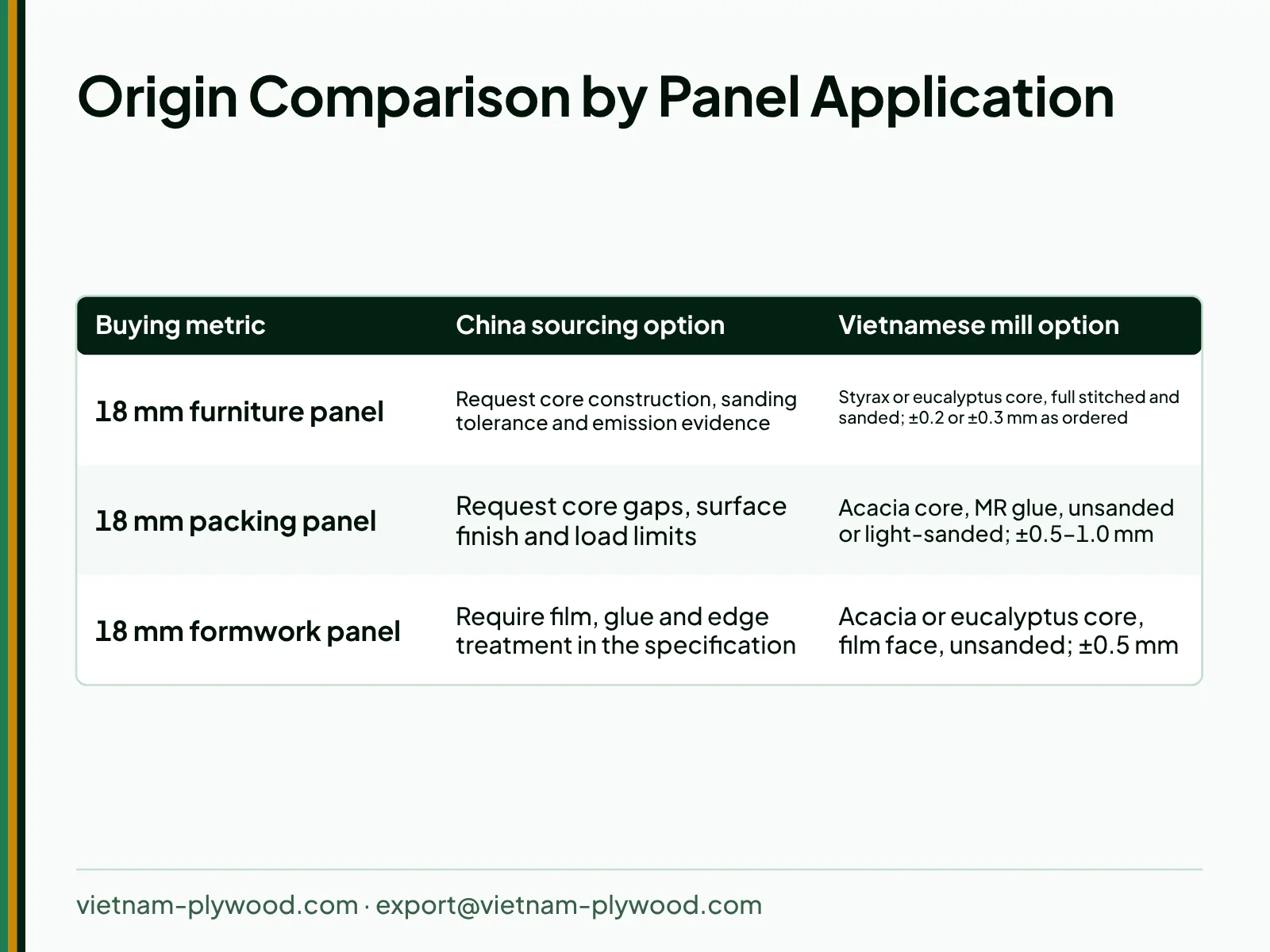
| Buying metric | China sourcing option | Vietnamese mill option | Verdict by use |
|---|---|---|---|
| Product range | Broad supplier catalogues can include MDF, oriented strand board (OSB), chipboard and laminated surfaces | HCPLY presses plywood on dedicated lines; we do not press MDF, OSB, chipboard, blockboard, bamboo, MDO, HDO, 3-ply spruce panels or birch-core plywood | China when those other board categories are mandatory |
| 18 mm furniture panel | Request core construction, sanding tolerance and emission evidence | Styrax or eucalyptus core, full stitched and sanded; ±0.2 or ±0.3 mm as ordered | Compare inspected cabinet-grade panels |
| 18 mm packing panel | Request core gaps, surface finish and load limits | Acacia core, MR glue, unsanded or light-sanded; ±0.5–1.0 mm | Compare packing performance and delivered cost |
| 18 mm formwork panel | Require film, glue and edge treatment in the specification | Acacia or eucalyptus core, film face, unsanded; ±0.5 mm | Compare formwork performance under site handling |
| Customs duty | Destination-specific classification and origin treatment | Destination-specific classification and origin treatment | Neither origin wins without a customs calculation |
| Factory acceptance | Witness the agreed checks before loading | Inspection at the producing factory | Prefer the offer with measurable acceptance criteria |
The Vietnam-versus-China plywood comparison covers the broader origin choice; this page focuses on the importer’s purchasing decision.
What duties change the China-versus-Vietnam calculation?
Import duty depends on the importing country, tariff classification, declared origin and any trade-remedy scope. Request a written classification assessment from the destination customs adviser before placing the order.
In its July 2026 final determinations, the US Department of Commerce reported affirmative antidumping and countervailing findings for hardwood and decorative plywood from both China and Vietnam. Those findings do not establish one universal duty for every plywood shipment; the named scope, producer/exporter and subsequent trade-remedy process matter. See the US Department of Commerce notice.
For EU imports, check the applicable tariff line, preferential-origin eligibility and trade-remedy measures for the actual panel. A certificate of origin alone does not decide whether a product meets a preference rule. Keep species, manufacturing records and invoice descriptions consistent with the declaration.
How do shipping terms affect the comparison?
Compare both offers on the same delivery basis and destination port. FOB isolates the origin-port handover; CFR and CIF add different freight and insurance responsibilities to the price comparison.
HCPLY ships directly from the producing factory through Hai Phong. We offer FOB Hai Phong, CFR (CNF) or CIF. Our export team manages specification, on-site quality control, documents and loading.
Freight quotes should identify container type, cargo weight, port charges and any destination handling outside the seller’s quotation. For a long-running distributor programme, record the same assumptions on each tender rather than comparing a China FOB quotation with a Vietnam CIF quotation. See plywood supply programmes for distributors.
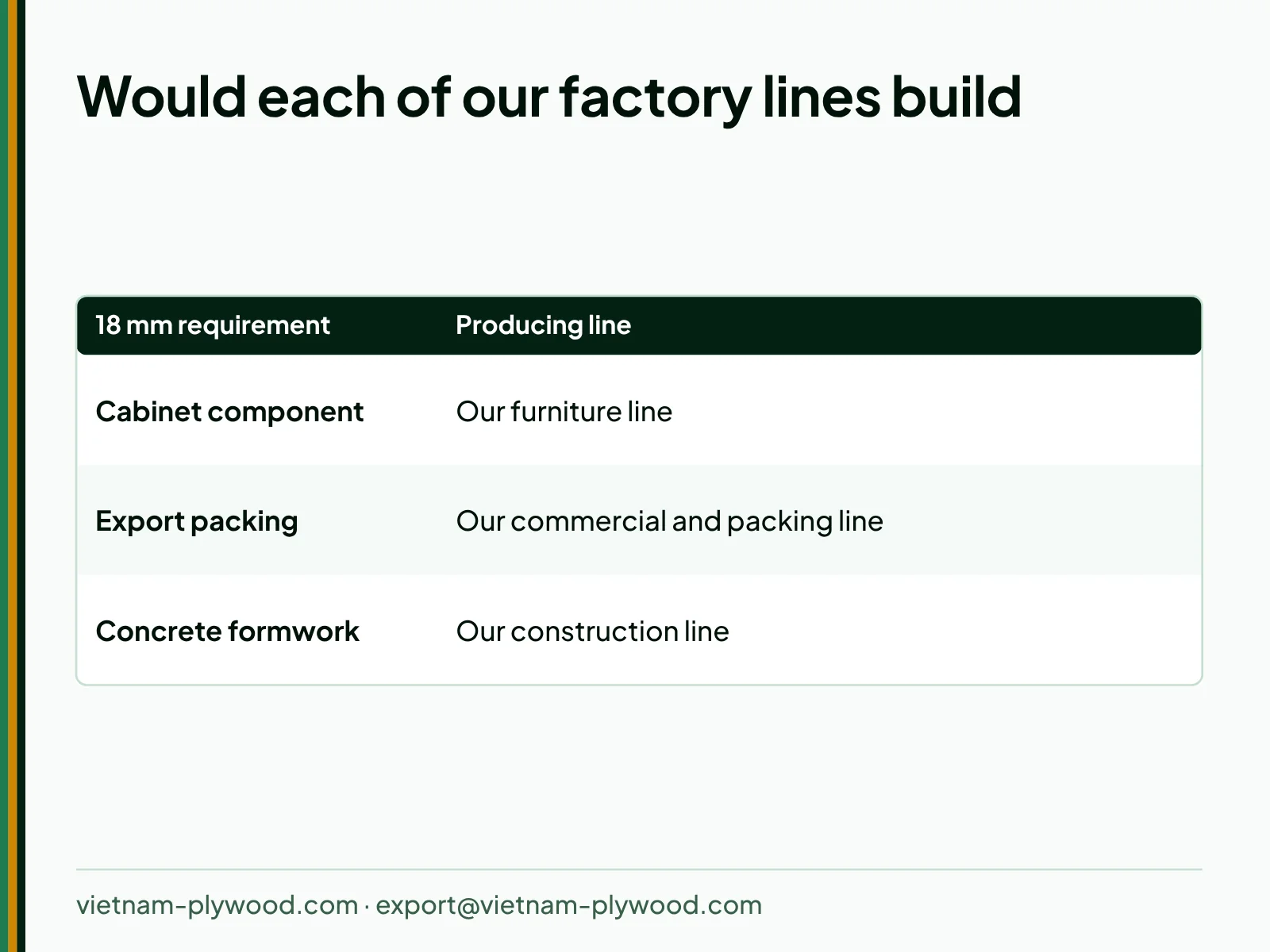
What would each of our factory lines build?
Our three factories in Phu Tho and Hai Phong serve different plywood applications. An 18 mm requirement therefore needs a use description before the appropriate press line is selected.
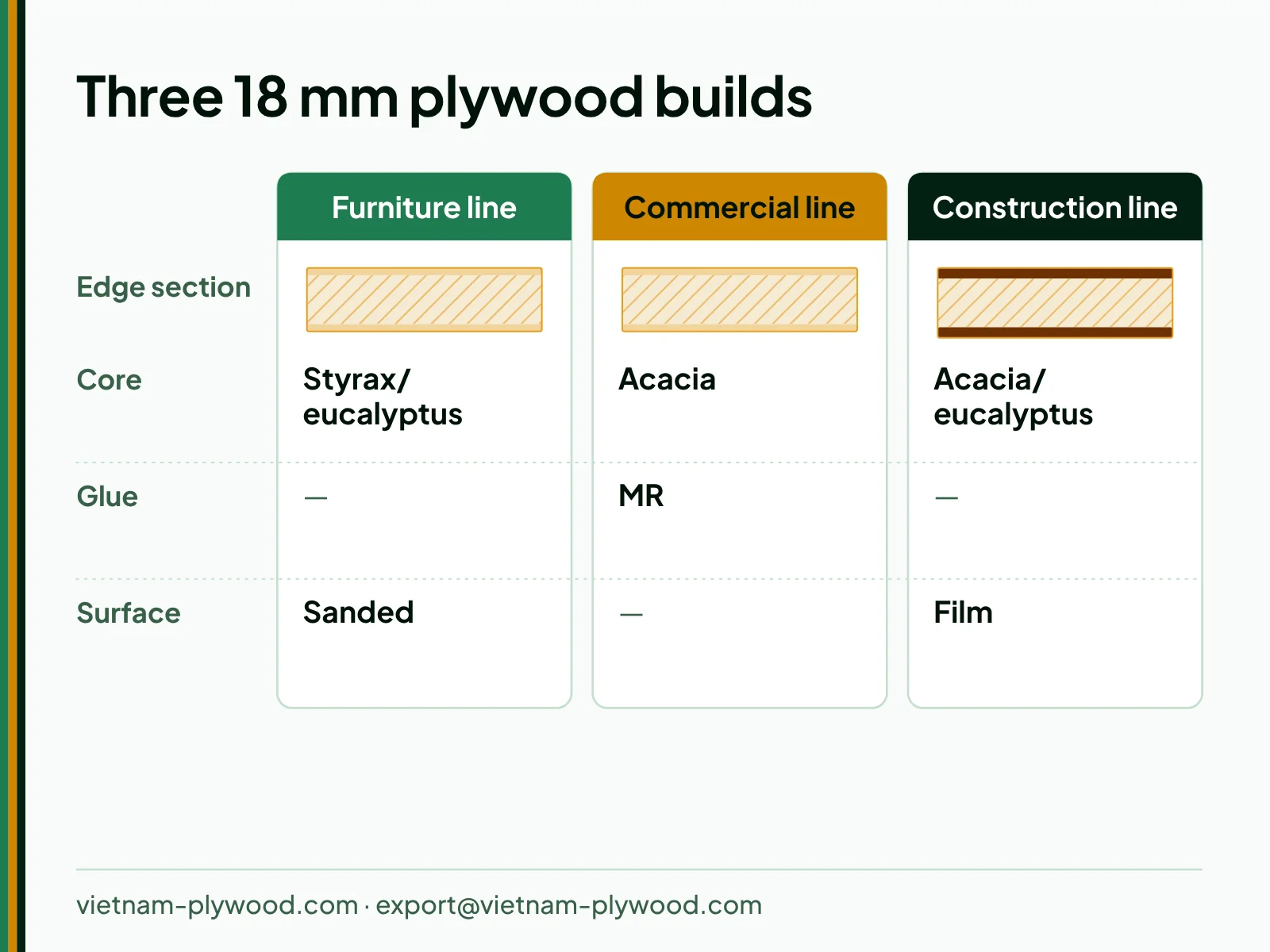
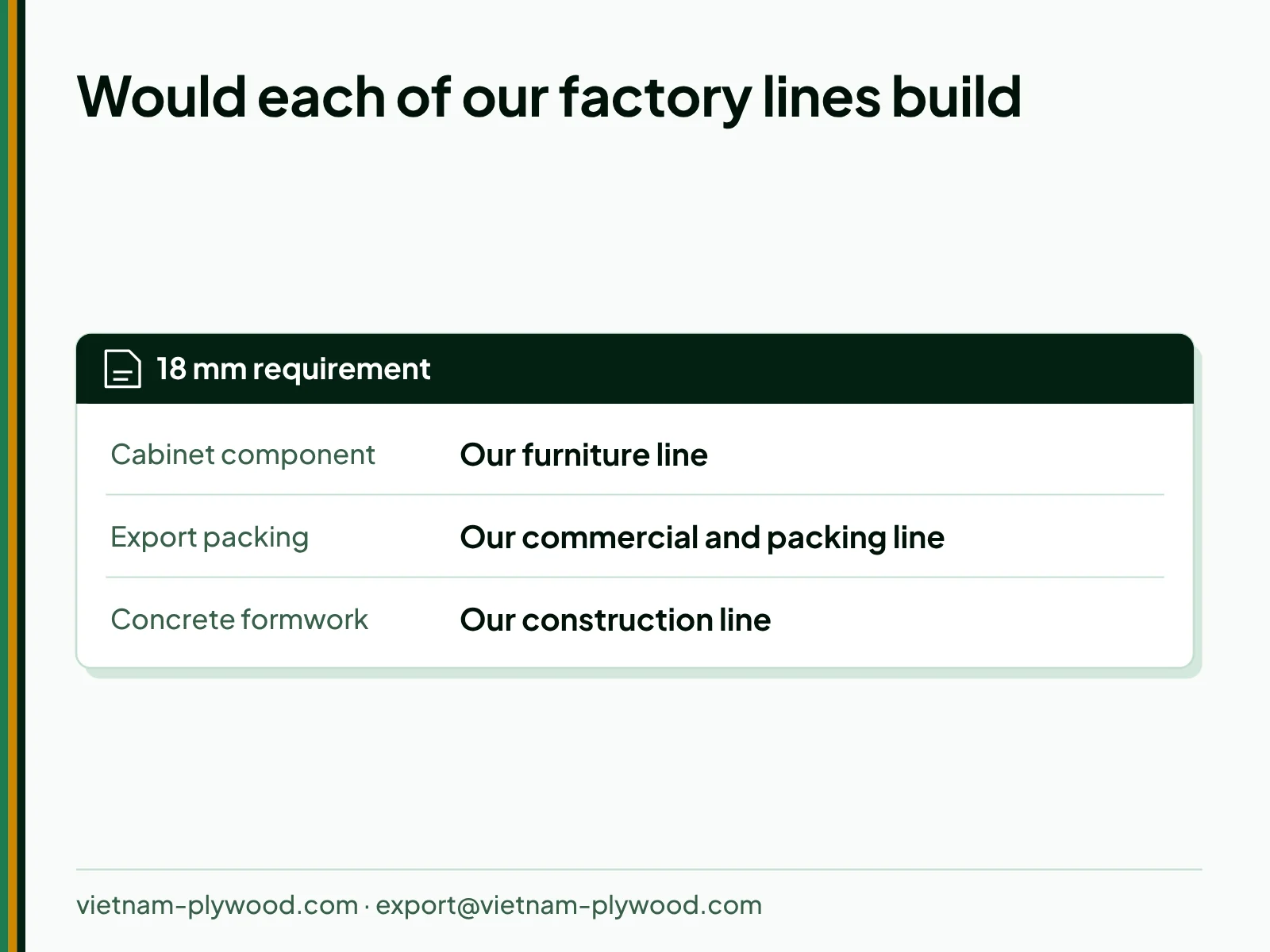
| 18 mm requirement | Producing line | Core and build | Inspection focus |
|---|---|---|---|
| Cabinet component | Our furniture line | Styrax or eucalyptus, full stitched, sanded, E0/E1 | Face, gaps and ordered thickness tolerance |
| Export packing | Our commercial and packing line | Acacia, moisture-resistant (MR) glue, unsanded or light-sanded | Edge gaps, dimensions and pallet condition |
| Concrete formwork | Our construction line | Acacia or eucalyptus, phenolic or melamine film, unsanded | Film surface, edges and panel thickness |
For furniture enquiries, specify the decorative face separately from the core. Bintangor, okoume, engineered veneer, gurjan, pine, poplar, eucalyptus, birch and sapele are face choices; the density follows the core. The furniture plywood specification explains the cabinet-facing choices.
A Chinese offer using the same face name might contain a different core layup. Compare the cross-section and grade limits rather than the marketing name alone.
Which technical checks should the inspector witness?
The inspector should check a sample from the actual production lot against the purchase-order limits. Photographs and a written inspection record should identify the lot and the measurement method.
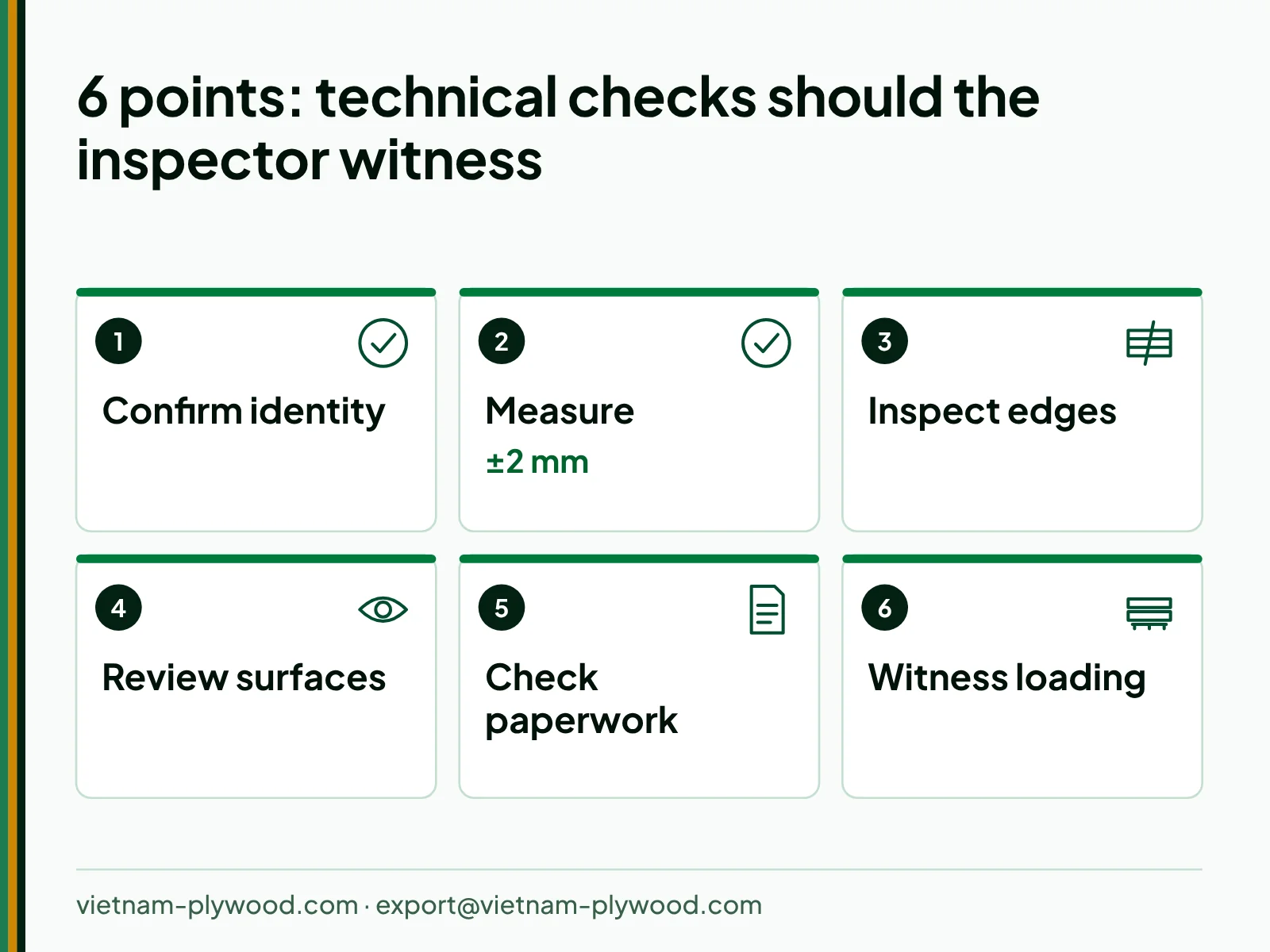
- Confirm identity: match pallet labels, face description, core species and production records to the order.
- Measure: check thickness at agreed points and length and width against the specified tolerances; our length and width tolerance is ±2 mm.
- Inspect edges: look for voids, overlaps and open joints; record the core construction seen in representative cuts.
- Review surfaces: examine face grade, sanding consistency or film damage under the agreed acceptance criteria.
- Check paperwork: match the declared glue, emission class and any ordered laboratory report to the lot.
- Witness loading: reconcile pallet counts, protection and container condition with the packing list.
For our furniture line, the sanded thickness tolerance is ±0.2 or ±0.3 mm as ordered. Commercial and film-faced panels use ±0.5 mm; packing panels use ±0.5–1.0 mm. Glue and emission must be specified separately: MR melamine and weather-and-boil-proof (WBP) phenolic describe bonding systems, while E0, E1 and E2 describe emission classes.
What core, face and glue should be specified?
A useful purchase specification identifies the core before discussing face appearance. Acacia is 580 kg/m³, styrax 500 kg/m³ and eucalyptus 650 kg/m³ in our plywood calculations.
Face veneer is commonly 0.2–0.4 mm. Our face grades include A/B, while birch face is described with D/E/F grades. The 18 mm construction typically contains 11–13 plies, depending on core veneer thickness of 1.4–2.0 mm.
Ask a prospective Chinese producer to disclose the same details. Full stitched cores are more demanding to build than stitched outer layers with edge-trimmed inner plies; finger-jointed and loose-laid constructions are different cost and acceptance choices. A buyer paying for full stitching should inspect the section rather than rely on a face photograph.
Where a marine or structural description is requested, specify the applicable test and accept the description only against a test report the buyer accepts. Neither an adhesive name nor a face species establishes structural performance.
How much can share a trial container?
A trial 40HC can mix specifications within its 28.5 t payload limit. The correct mix is calculated from actual panel dimensions, core density and pallet arrangement before loading.
For 18 mm, 1220×2440 mm sheets, the computed full-container references are 990 styrax sheets at 26.52 t, 880 acacia sheets at 27.35 t and 795 eucalyptus sheets at 27.69 t. The respective sheet weights are 26.79 kg, 31.08 kg and 34.83 kg; these calculations exclude film weight.
A mixed load could combine furniture and packing plywood, but the remaining payload must be calculated from each pallet’s quantity and sheet weight. For example, 400 styrax sheets weigh 10,716 kg and 400 acacia sheets weigh 12,432 kg, totaling 23,148 kg before pallets and packaging. The load planner then checks pallet space and the remaining weight allowance. Detailed full-load planning belongs to the container loading reference.
Which documents should be checked before dispatch?
A shipment needs a consistent document trail from the manufacturing specification through the customs declaration. Ask for drafts early enough to correct product descriptions before the final set is issued.
HCPLY prepares one set of export documents per shipment: commercial invoice, packing list, bill of lading (B/L), certificate of origin, phytosanitary and fumigation papers, insurance under CIF, plus ordered certificate documents and test reports. EU lots include EUR.1 where applicable and the EUTR/EUDR file set. After loading, the draft shipping documents come to you for approval.
Factory-held FSC, CARB P2, ISO 9001 and CE documents, along with EUDR/EUTR records, are shown with factory details masked, on request. The buyer should match the document’s scope to the producing factory, ordered build and destination requirements.
For EU wood due diligence, request traceability data for face and core material, including species and harvest-origin records where required. Origin documentation and deforestation due diligence address different questions.
What should an importer compare on price?
Compare the landed price for a written specification, starting with core construction and face quality. Full stitched, sanded furniture panels cost more to build than basic unsanded packing panels because preparation and surface finishing differ.
Our commercial plywood starts from US$250/m³ FOB Hai Phong (October 2026). Furniture plywood starts from US$350/m³ FOB Hai Phong (October 2026). These starting points are for different builds, so they cannot be used as a like-for-like origin comparison.
Next compare glue system, emission evidence, thickness tolerance, face grade, pallet arrangement, freight and customs treatment. A film-faced or specially tested grade needs a quotation against the written specification. For a formwork order, review construction plywood supply and the film-faced origin comparison.
How should a first order be placed?
Start with a documented trial order that can be inspected at the producing factory. The trial should prove the specification, packaging and paperwork process before a repeating programme is agreed.
Our minimum order is one 40HC. Factory lead time runs 15–45 days from receipt of the 30% deposit; the exact figure depends on order size, line loading and what the contract fixes. The remaining 70% is paid on the scan of the bill of lading, by T/T, or by irrevocable sight L/C. Samples cost nothing: a first-time buyer pays the courier, and that charge comes off the first confirmed order.
Ask the supplier to record the acceptance limits in the contract and agree who witnesses the inspection. Buyers can visit our factory office and inspect goods at the producing factory. HCPLY can coordinate the production and export steps against that written specification.
What should I send for a comparable quotation?
Send the same application, construction, tolerance and destination details to each candidate. A quotation that omits core construction or emission evidence cannot be compared fairly with a fully specified offer.
Application: furniture / commercial / packing / formwork
Line or core: furniture / commercial and packing / construction; styrax / acacia / eucalyptus
Glue: MR melamine / WBP phenolic
Emission: E0 / E1 / E2; destination evidence required
Face and grade: species or film type; specified grade
Thickness and tolerance: ___ mm; ___ mm
Size: ___ × ___ mm
Quantity: ___ sheets / ___ m³; pallet mix ___
Destination port: ___
Plan a trial container with Lucy at export@vietnam-plywood.com through the contact page.