





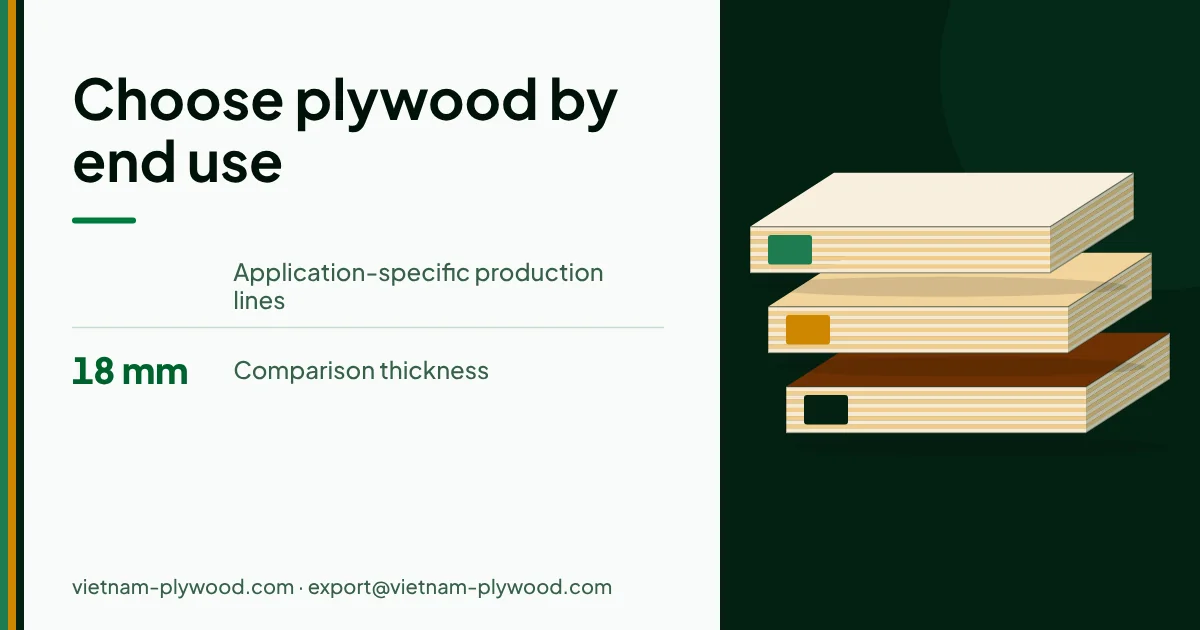
The best plywood in the world is the panel that passes the tests and tolerances for its intended use. Choosing by country reputation alone can cost rejected sheets, delayed production or unnecessary replacement. HCPLY compares furniture, formwork and packing builds by their measurable specifications, while marine buyers must demand an accepted test report.
Which country makes the best plywood in the world?
The best plywood in the world comes from the factory whose panel meets the intended application, inspection criteria and import requirements. Finland and Russia are associated with birch panels, Indonesia and Malaysia with tropical hardwood, China with broad product variety, and Vietnam with several export-oriented builds. No origin wins every application. Compare written specifications and inspected samples before choosing a country.
A country label cannot describe the bond, face quality, core assembly or actual thickness of a shipment. An importer choosing on reputation alone risks rejected cabinet faces, damaged packing panels or premature formwork replacement. HCPLY evaluates the build at the producing factory, where buyers can inspect the actual goods.
What does each plywood origin offer?
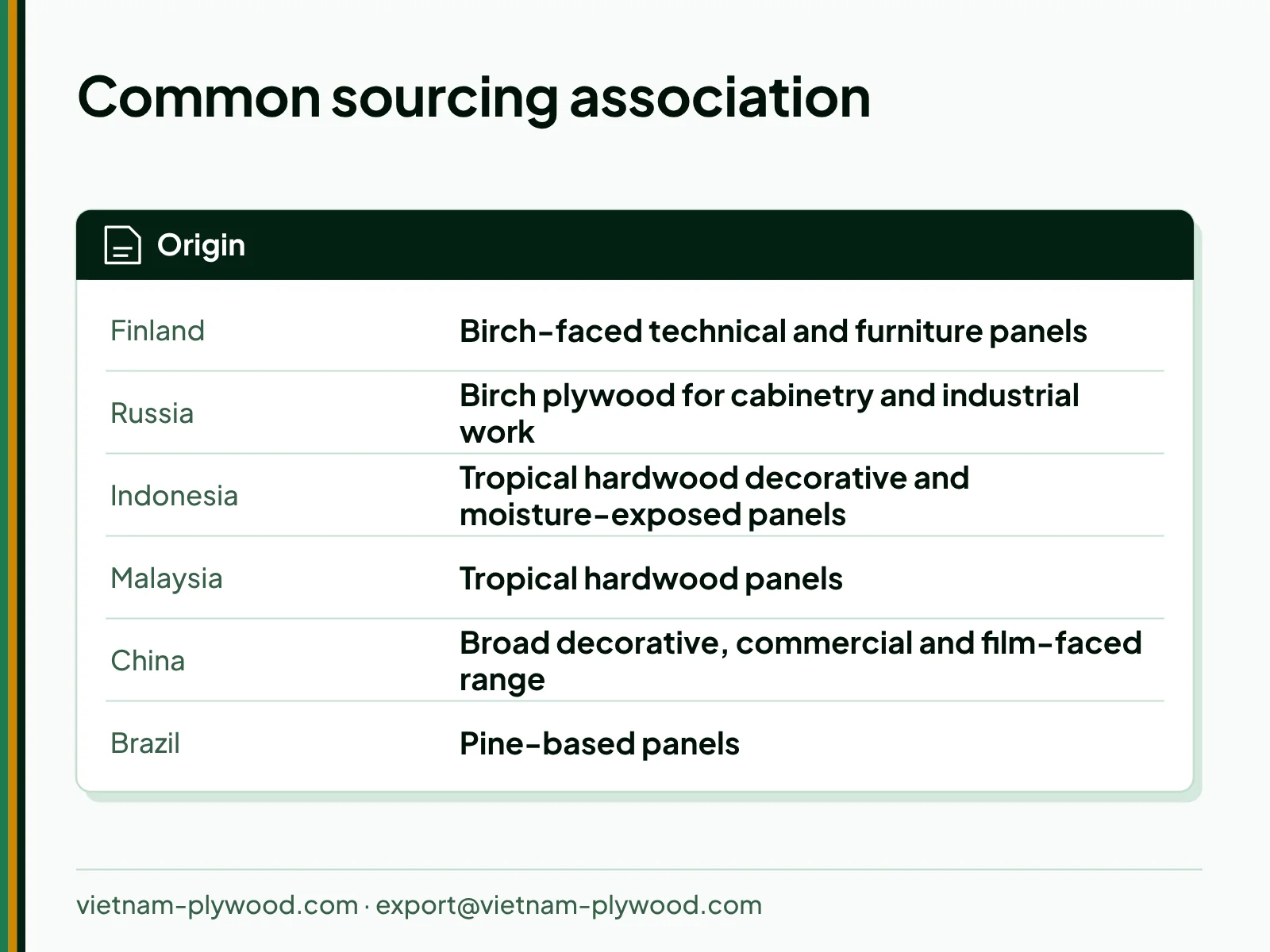
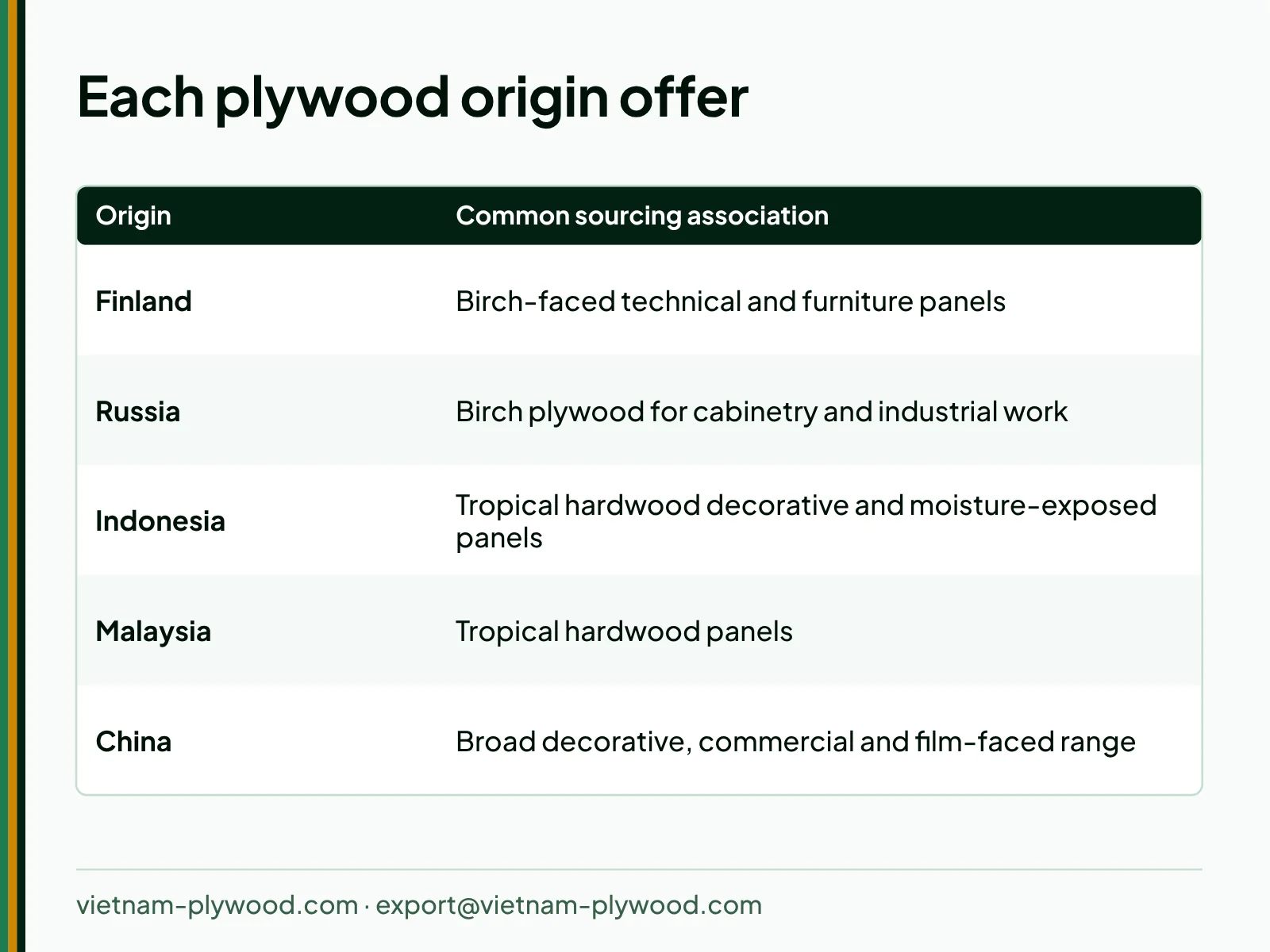
The practical comparison is between product families available from each origin, rather than a national quality ranking. The following are sourcing starting points, not claims that every producer in a country makes the same panel.
| Origin | Common sourcing association | Metric to request | Verdict by use |
|---|---|---|---|
| Finland | Birch-faced technical and furniture panels | Thickness deviation and bond test report | Shortlist for precision furniture |
| Russia | Birch plywood for cabinetry and industrial work | Veneer construction and origin documentation | Evaluate for furniture after trade screening |
| Indonesia | Tropical hardwood decorative and moisture-exposed panels | Face grade and accepted bond report | Shortlist for decorative or marine evaluation |
| Malaysia | Tropical hardwood panels | Species, bond and flatness measurements | Compare for general hardwood applications |
| China | Broad decorative, commercial and film-faced range | Factory-specific inspection and test results | Compare for formwork and volume buying |
| Brazil | Pine-based panels | Structural classification where required | Consider for specified softwood uses |
| United States and Canada | Regional structural and hardwood product families | Applicable grade stamp or test documentation | Evaluate for regulated structural work |
| Vietnam | Furniture, commercial, packing and film-faced builds | Core assembly, glue, tolerance and surface inspection | Compare across furniture, packing and formwork |
For closer origin comparisons, review Malaysian plywood, Vietnam plywood vs China plywood, Chinese film faced plywood and plywood Indonesia. These comparisons help define a shortlist; the purchase specification determines acceptance.
Which origin makes the best plywood for furniture?
Furniture buyers should select by face appearance, sanding consistency, void control and emissions documentation. Birch-faced panels from northern European sources are one option for a uniform visible surface; tropical-faced and engineered-veneer panels from Asian sources offer other appearance choices.
Our furniture line uses a styrax or eucalyptus core, full-stitched construction and sanded faces, with E0 or E1 emission classes specified separately from glue. Face choices include bintangor, okoume, engineered veneer and sapele, with A/B face grades; birch faces use D/E/F grades. A common face veneer thickness is 0.2–0.4 mm.
For a cabinet programme, compare the same face grade and core specification across samples. Check the edges for gaps, measure finished thickness at multiple points and inspect face repairs under consistent lighting. Our sanded furniture thickness tolerance is ±0.2 or ±0.3 mm as ordered. See furniture plywood for the build discussion.
Which origin makes the best plywood for concrete formwork?
Formwork quality is decided by bond performance, film condition, core integrity and the handling regime on site. Chinese, Vietnamese and other film-faced panels should be compared on those measurements rather than country alone.
Our construction line presses phenolic or melamine film-faced panels with acacia or eucalyptus cores. Film choices are 120 g/m² standard, 135 g/m² premium and 220 g/m² for anti-slip only. The panels are unsanded beneath their film finish; film-faced thickness tolerance is ±0.5 mm.
With proper handling, a release agent on every pour and sealed edges including cut edges, melamine-glue film-faced plywood delivers about 12–15 pours; phenolic-glue film-faced plywood reaches up to about 25 pours. A trial should record actual handling and edge treatment alongside surface wear. Ask an inspector to witness film coverage, edge sealing and core cross-sections before loading.
Which origin suits marine and packing use?
Marine procurement requires an accepted test report against the project’s marine specification; a tropical origin or a waterproof-sounding label is insufficient. For BS 1088 or another marine requirement, obtain a test report the buyer accepts before treating a panel as suitable. A marine label alone cannot substitute for the report or the application’s engineering review.
Packing plywood is a different purchase. Our commercial and packing line presses acacia-core panels with moisture-resistant (MR) glue, unsanded or light-sanded, for packaging and commercial applications. Packing thickness tolerance is ±0.5–1.0 mm. The purchase decision turns on handling loads, edge quality, moisture exposure and the buyer’s acceptance standard.
A packer usually gains more from consistent core assembly and predictable pallet weights than a decorative face. Ask for photographs of cut edges, a witnessed panel check and an agreed packing pattern. Compare the export cost factors when landed economics matter.
What quality criteria decide the panel?
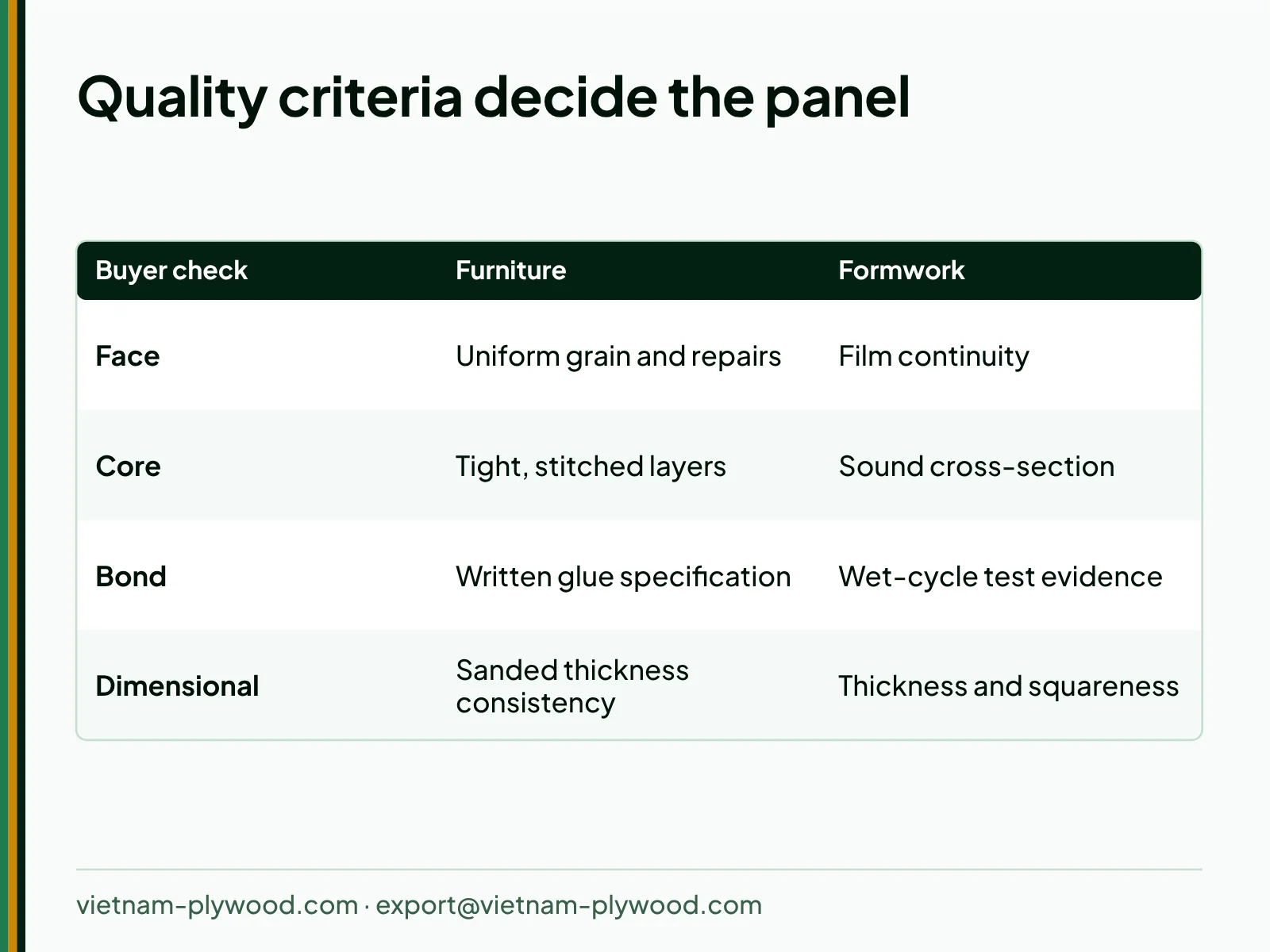
The decisive criteria change with use: visible-face defects for cabinets, bond and film durability for formwork, documented moisture performance for marine work, and handling strength for packing.
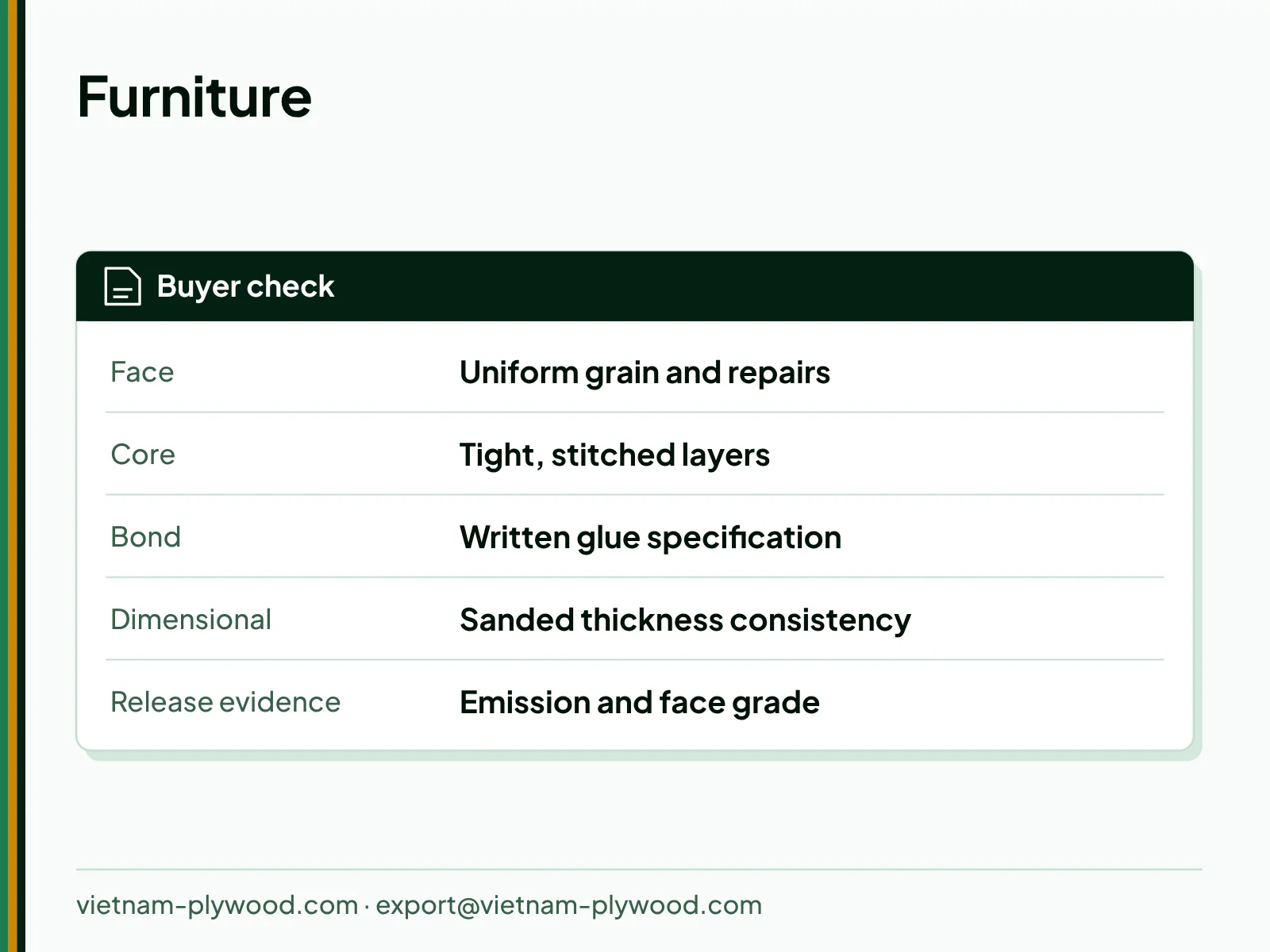
| Buyer check | Furniture | Formwork | Marine | Packing |
|---|---|---|---|---|
| Face | Uniform grain and repairs | Film continuity | Face and edge integrity | Functional surface |
| Core | Tight, stitched layers | Sound cross-section | Build matching accepted report | Gaps and handling damage |
| Bond | Written glue specification | Wet-cycle test evidence | Accepted marine test report | MR specification |
| Dimensional | Sanded thickness consistency | Thickness and squareness | Project-specific tolerances | Fit to crate design |
| Release evidence | Emission and face grade | Film, bond and inspection | Accepted test results | Packing inspection |
Glue chemistry and formaldehyde emission are separate specification fields. MR melamine glue is described with a 12-hour boil condition; phenolic weather-and-boil-proof (WBP) glue with a 72-hour boil condition. These descriptions do not replace an independent test result for a specific lot. Emission classes E0, E1 and E2 must be distinguished from the United States CARB Phase 2 / TSCA Title VI limits and third-party certification requirements.
How do Vietnamese panels fit across three production lines?
Vietnamese plywood can be specified for furniture, construction and packing, with a different build selected for each use. HCPLY’s three factories in Phu Tho and Hai Phong assign orders to the line suited to the written specification.
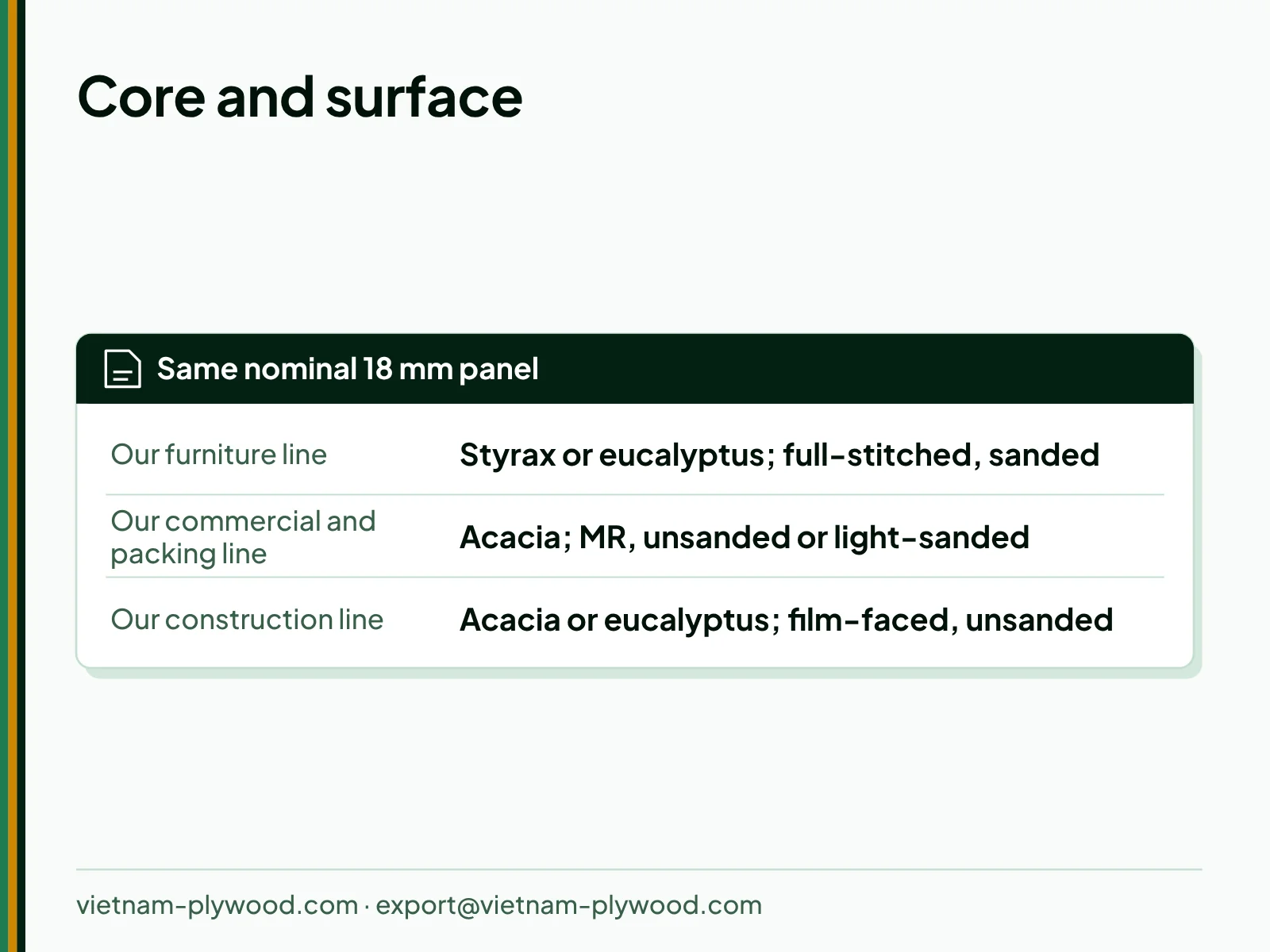
| Same nominal 18 mm panel | Core and surface | Thickness tolerance | Buyer priority |
|---|---|---|---|
| Our furniture line | Styrax or eucalyptus; full-stitched, sanded | ±0.2 or ±0.3 mm as ordered | Cabinet machining and face appearance |
| Our commercial and packing line | Acacia; MR, unsanded or light-sanded | Commercial ±0.5 mm; packing ±0.5–1.0 mm | Functional handling and packing fit |
| Our construction line | Acacia or eucalyptus; film-faced, unsanded | ±0.5 mm | Concrete release surface and edge care |
An 18 mm sheet commonly has 11–13 plies, with actual count linked to veneer thickness. At inspection, compare the sample’s cross-section with the approved production sample, then record thickness, face defects and packing condition. Factory-specific FSC, CARB P2, ISO 9001 and CE certificates, along with EUTR/EUDR documents, are shown with factory details masked, on request.
Does export volume prove plywood quality?
Export volume measures trade activity, not whether a particular lot meets its cabinet, formwork or marine specification. A country can ship large quantities across several quality grades; customs statistics do not report each sheet’s glue bond or core gaps.
The US Department of Commerce’s 2017 hardwood plywood notice describes face and back veneers as the outermost wood veneers around the core. Its product definition describes construction, not a quality ranking of countries.
Use trade data to find potential supply regions, then apply the same sample approval and lot inspection rules to every origin. The supplier evaluation checklist can structure that comparison.
How should an importer compare container economics?
Compare sheet weight and allowable payload before treating a lower unit quotation as the lower landed cost. For 18 mm, 1220 × 2440 mm sheets, the full 40HC reference is 990 styrax-core sheets at 26.52 t, 880 acacia-core sheets at 27.35 t, or 795 eucalyptus-core sheets at 27.69 t. These calculations exclude film weight and use a 28.5 t payload limit.
The three core densities are 500 kg/m³ for styrax, 580 kg/m³ for acacia and 650 kg/m³ for eucalyptus. A mixed shipment must be checked against its combined weight, pallet configuration and loading plan. Specifications can share a container within the payload limit; use the mixed container loads and container load calculator for the detailed packing question.
The starting commercial plywood price is from US$250/m³ FOB Hai Phong (October 2026); furniture plywood is from US$350/m³ FOB Hai Phong (October 2026). Face selection, core construction, sanding and testing requirements change the final quotation. Request equivalent specifications before comparing origins.
What should a buyer witness before release?
A buyer or appointed inspector should check the actual lot against the signed specification at the producing factory. First identify the approved sample and lot marks. Next measure thickness and dimensions, examine both faces and cut edges, and compare the glue and emission documents with the order. Finally inspect pallets and the loading tally.
HCPLY manages specification, on-site quality control, shipping documents and loading, with shipment directly from the factory under FOB Hai Phong. The export paperwork includes the commercial invoice, packing list, bill of lading, certificate of origin, applicable phytosanitary and fumigation papers, and agreed certificate or test documents. EU lots also carry their EUTR/EUDR file set and EUR.1 where applicable; CIF adds insurance. Draft shipping documents are sent for buyer approval after loading.
For repeat purchasing, document the acceptance limits before the first lot. The distributor supply programmes and importer guide address ongoing ordering and preparation.
What specification should start the trial?
The first trial should test one defined application against a measurable panel specification and witnessed inspection. Specify the core, glue, emission class, face, dimensions, quantity and destination before asking for comparable offers.
Application: furniture cabinetry / concrete formwork / marine evaluation / packing
Line or core: furniture-styrax / furniture-eucalyptus / commercial-acacia / construction-acacia or eucalyptus
Glue: MR melamine / WBP phenolic, as applicable
Emission: E0 / E1 / E2 or agreed market requirement
Face and grade: species or film weight; A/B or birch D/E/F where applicable
Thickness and tolerance: ___ mm; ___ mm
Size: ___ × ___ mm
Quantity: ___ sheets / pallets / 40HC
Destination port: ___
Send this to Lucy at export@vietnam-plywood.com through contact and plan a trial container.