





Is chinese film faced plywood good?
Chinese film-faced plywood can perform well in concrete formwork when its core, bond and film match the job. A weak specification can cost replacement sheets, delayed pours and rejected deliveries. For HCPLY, the useful comparison is a documented Chinese sample against a defined hardwood-core panel from our construction line, followed by the same site trial.
Origin alone cannot establish bond durability, edge integrity or the number of successful pours. Request the actual layup, resin system, film weight, thickness tolerance and test records for each offer. A good Chinese panel can outperform a poorly made Vietnamese panel; the reverse is equally possible. The decision belongs to the tested build and the landed cost per usable pour.
How does Vietnamese film-faced plywood compare with Chinese film-faced plywood for formwork?
Compare measurable specifications before comparing flags. The Vietnam film-faced plywood product provides the construction-line reference; the Chinese column is a purchasing checklist, because a national origin does not define one construction.
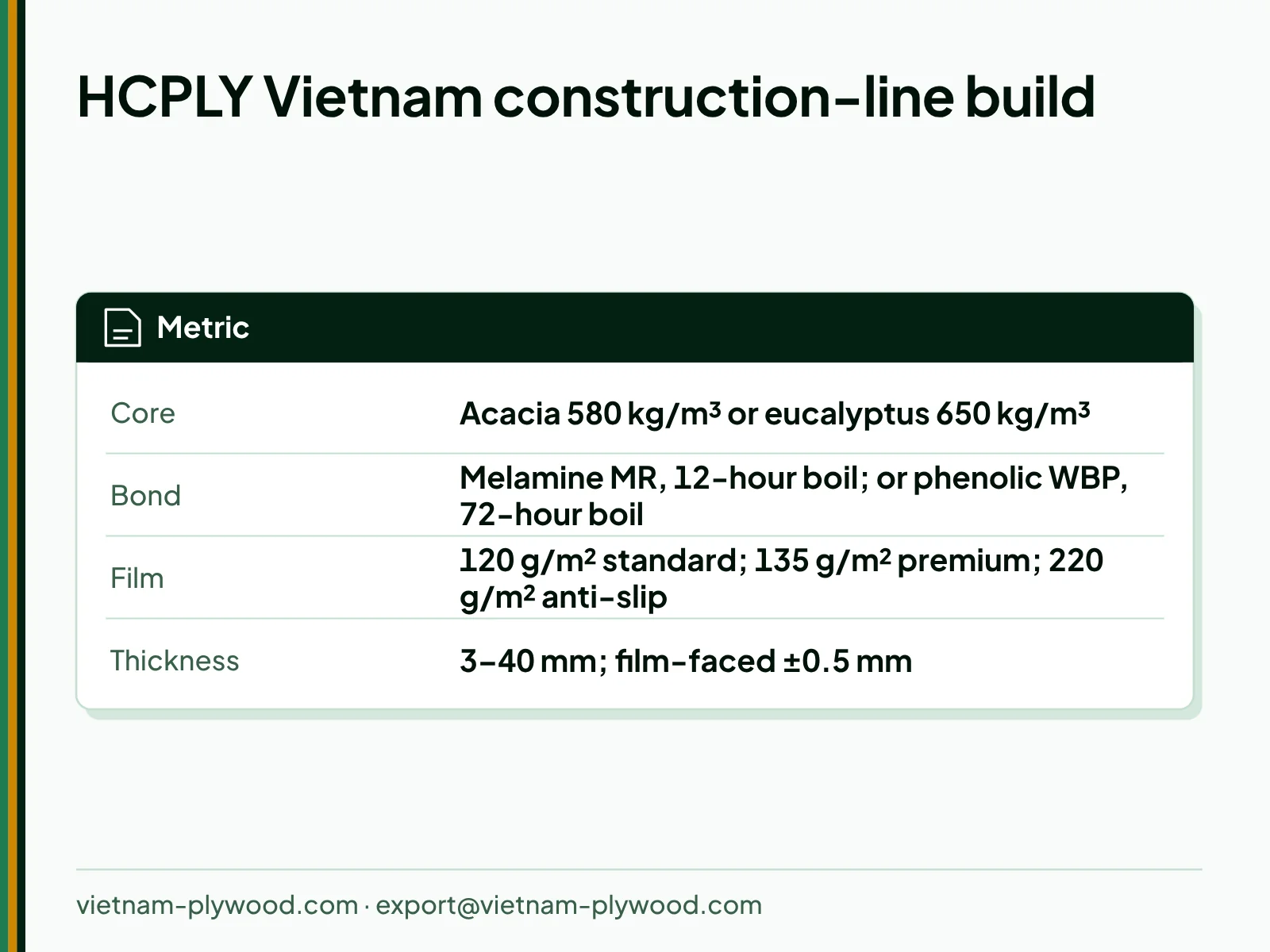
| Metric | HCPLY Vietnam construction-line build | Chinese offer to verify | Verdict by use |
|---|---|---|---|
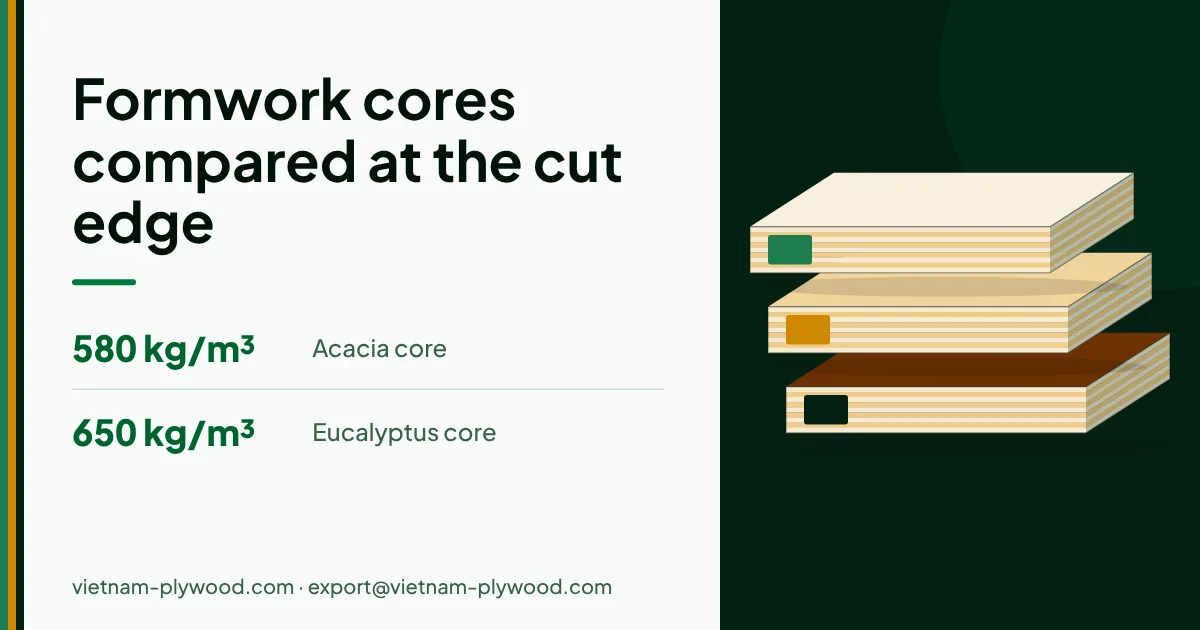
| Core | Acacia 580 kg/m³ or eucalyptus 650 kg/m³ | Species, density and layup stated on the offer | Compare equal thickness and bending needs |
| Bond | Melamine MR, 12-hour boil; or phenolic WBP, 72-hour boil | Named resin and agreed bond-test report | Phenolic build for longer wet-cycle demands |
| Film | 120 g/m² standard; 135 g/m² premium; 220 g/m² anti-slip | Film weight and face condition | Smooth form faces versus grip surfaces |
| Thickness | 3–40 mm; film-faced ±0.5 mm | Measured range across sampled sheets | Reject batches outside ordered tolerance |
| 18 mm sheet weight, 1220×2440 mm | Acacia 31.08 kg; eucalyptus 34.83 kg, excluding film | Weigh and identify actual core | Plan lifting and payload by real build |
| Reuse | Melamine about 12–15 pours; phenolic up to about 25, with specified care | Trial results under identical care | Select by cost per accepted pour |
A film-faced panel is a reusable concrete-contact surface, typically selected for its release behaviour and resistance to repeated wetting. Film colour alone says little about its core. A claimed waterproof surface also cannot substitute for sound edges, bonding and correct handling. For broader origin comparisons, see Vietnam versus China plywood for export and the plywood-producing countries overview.
How do core species, glue line and film differ?
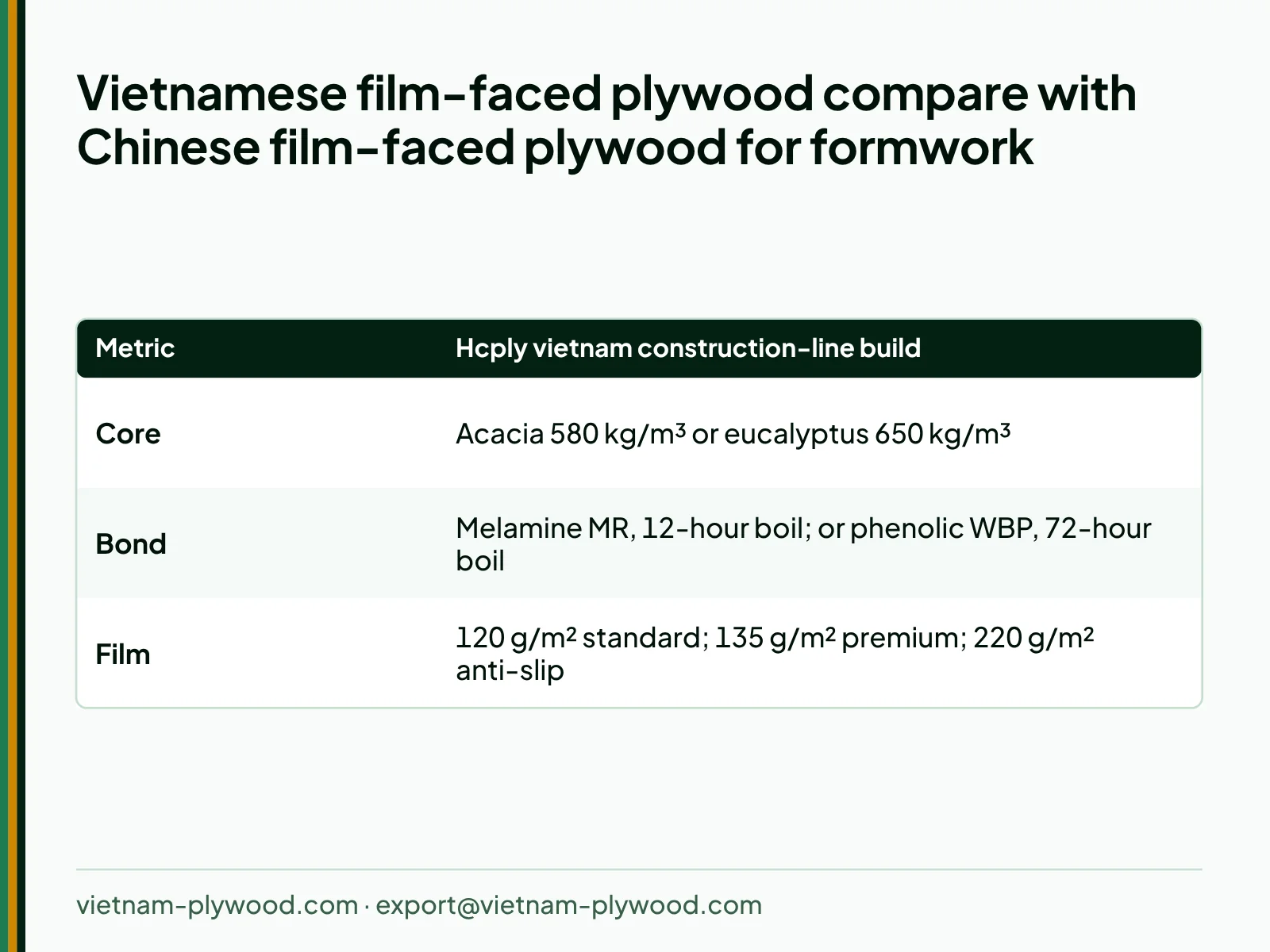
The core carries the panel; the glue line holds veneers together; the film protects the concrete-contact faces. These are separate purchase fields. Our construction line uses acacia or eucalyptus cores, phenolic or melamine film, and unsanded construction panels beneath the overlay.
Acacia at 580 kg/m³ gives a different handling weight from eucalyptus at 650 kg/m³. That density comparison is not a certified strength ranking. For a Chinese sample, record the actual species and any mixed-core layers, then inspect cut edges for gaps and overlaps. Never infer species from the colour of the overlay.
Melamine glue is designated MR with a 12-hour boil condition; phenolic glue is WBP with a 72-hour boil condition in our stated builds. These process descriptions do not replace a buyer-accepted bond test. Film weight is 120 g/m² standard or 135 g/m² premium, while 220 g/m² is reserved for anti-slip film. Specify whether the job needs a smooth concrete finish or a textured working surface.
Which of our three factories makes the comparison panel?
Our construction line presses the film-faced sample at the producing factory. Our furniture line would instead build a sanded, full-stitched styrax or eucalyptus core with E0/E1 emission class; our commercial and packing line would build an acacia-core MR panel, unsanded or light-sanded. Neither is a substitute for a specified film-faced formwork panel.
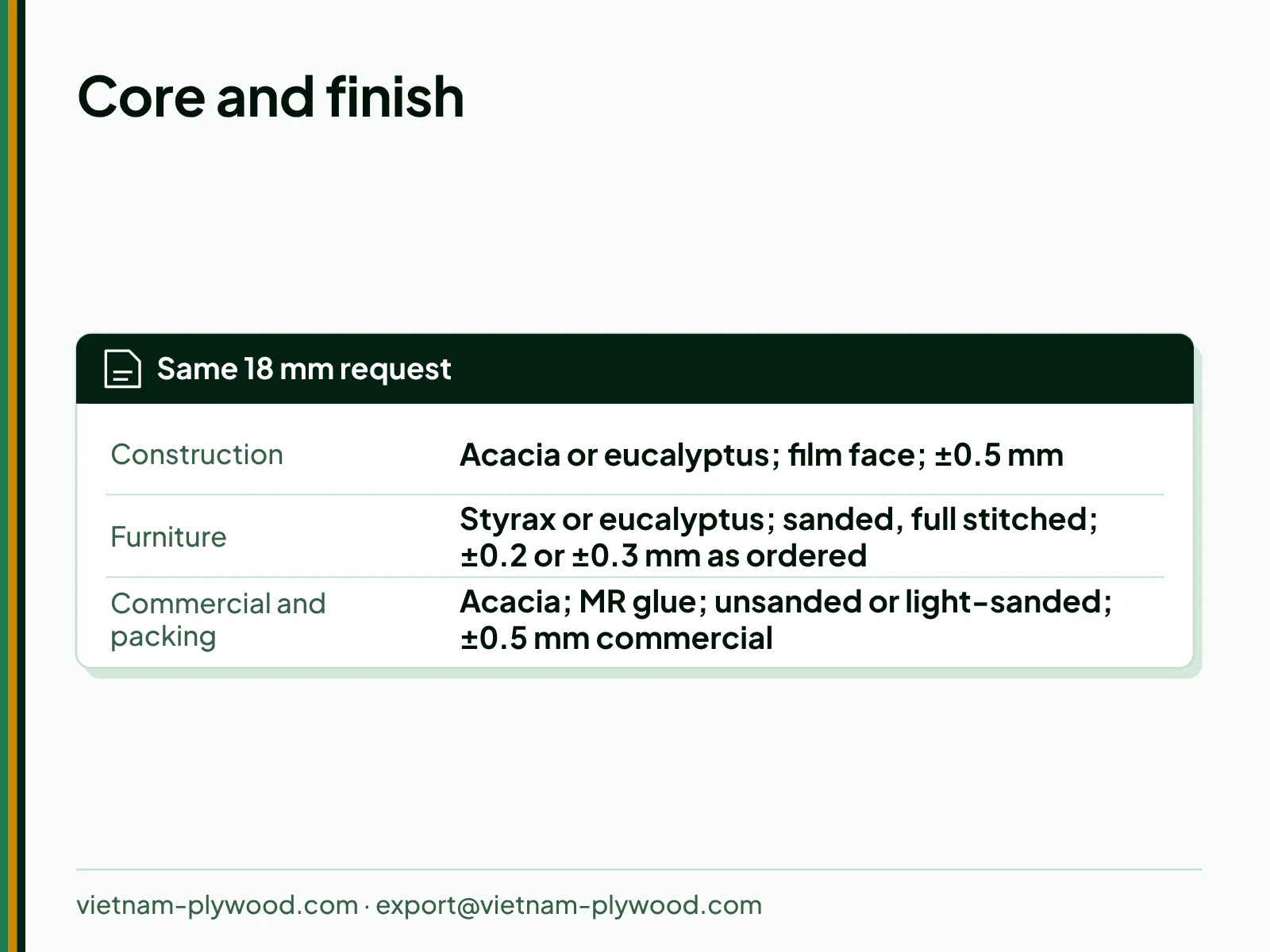
| Same 18 mm request | Core and finish | Relevant buyer check |
|---|---|---|
| Construction | Acacia or eucalyptus; film face; ±0.5 mm | Film bond, edge sealing and concrete release |
| Furniture | Styrax or eucalyptus; sanded, full stitched; ±0.2 or ±0.3 mm as ordered | Face and thickness consistency for cabinetry |
| Commercial and packing | Acacia; MR glue; unsanded or light-sanded; ±0.5 mm commercial | Core gaps and packing suitability |
HCPLY produces each order in the factory matching its specification and ships directly from that factory. Buyers can visit the factory office and witness inspection at the producing factory in Phu Tho or Hai Phong.
Which origin gives more reuse cycles?
Neither origin has an automatic reuse advantage. With proper handling, a release agent on every pour and sealed edges, including cut edges, our melamine-glue film-faced panels give about 12–15 pours; phenolic-glue panels reach up to about 25 pours. These figures describe the specified builds under that care regime, not a universal benchmark for all Vietnamese sheets.
Ask a Chinese supplier for comparable evidence under the same form geometry, concrete mix, stripping method and cleaning routine. A headline cycle count without its conditions is weak purchasing evidence. Record damage after each pour and stop counting when the panel no longer produces the agreed concrete finish.
For bid evaluation, divide the delivered panel cost by accepted pours. Include replacement labour, surface repairs and downtime in the project comparison. A higher initial panel cost can be preferable when the verified usable-cycle count and finish reduce total formwork expense.
What pour test can a buyer run on both panels?
Run one paired trial with the same concrete, form geometry, release agent and stripping procedure. This creates a direct comparison of actual panels rather than supplier claims.
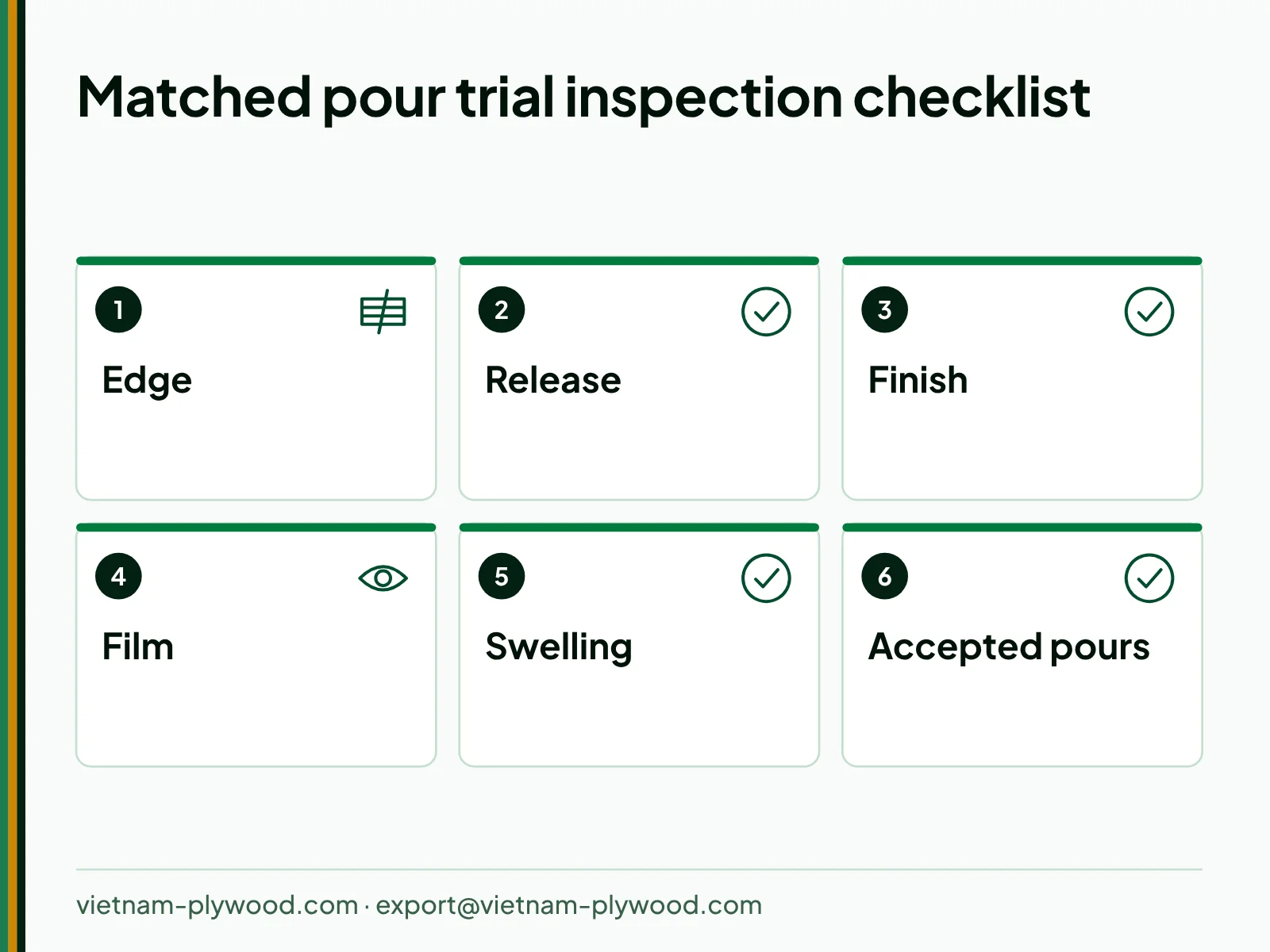
- Label and photograph both sample sheets; log thickness, dimensions, weight, film condition and visible edge gaps.
- Seal every cut edge identically and apply the same release agent before each pour.
- Place both panels in matched form sections with the same support spacing and concrete conditions.
- After stripping, photograph concrete finish, sticking, film loss, edge swelling and delamination.
- Clean both using the same method; repeat and count only pours that meet the agreed finish criterion.
- Record failure mode, panel replacement and labour, then calculate cost per accepted pour.
A buyer or inspector can also witness thickness measurement, cut-edge inspection, film adhesion checks and loading at the producing factory. Agree pass/fail criteria in writing before samples are tested. A laboratory bond report is useful alongside this site trial; it answers a different question from concrete-release performance.
How does duty exposure differ by destination market?
Duty exposure follows the destination’s tariff classification, origin rules and trade measures, rather than a blanket China-versus-Vietnam percentage. In its 2026 TARIC explanation, the European Commission lists third-country duties, preferences, antidumping duties and countervailing duties as separate measures. Check the current classification and origin-specific entries in the EU TARIC explanation.
The Commission’s rules-of-origin guidance explains that origin reflects production or manufacture, rather than the shipping port. An EU preference requires compliance with the applicable product-specific origin rule. For qualifying EU lots, the shipment document set includes EUR.1 and the EUTR/EUDR file set.
For US imports, the US Department of Commerce reported final affirmative antidumping and countervailing determinations in July 2026 concerning hardwood and decorative plywood from China, Indonesia and Vietnam. That case title cannot establish that every film-faced formwork panel is covered. Have the importer determine the exact scope, classification, exporter combination and measures effective on the entry date using the official Commerce notice. Do not apply decorative-plywood rates automatically to construction formwork.
For Middle East, African and other destinations, obtain the local tariff line, origin treatment, import taxes and any product-specific restrictions before comparing landed offers. A quote that omits duty treatment cannot settle the origin choice.
How do weights and mixed specifications affect a shipment?
A full 40HC reference load of 18 mm, 1220×2440 mm acacia-core sheets is 880 sheets, 47.15 m³ and 27.35 t, excluding film weight. The corresponding eucalyptus-core load is 795 sheets, 42.60 m³ and 27.69 t. The 40HC payload limit is 28.5 t; actual load planning must account for the full shipment weight.
At this thickness and size, an acacia sheet weighs 31.08 kg and a eucalyptus sheet 34.83 kg before film. Mixing these constructions changes the weight calculation even if every pallet contains the same nominal thickness. Specifications can share a container within the payload limit, with a minimum order of one 40HC. Use the container-loading reference for the owner calculation.
A buyer can ask for separate pallet counts by core, thickness and film weight on the packing list. That makes the shipment traceable against the purchase specification and avoids treating one nominal sheet size as one fixed cargo weight.
What specification makes the comparison fair?
Specify both origins against one written acceptance schedule. Fix the intended formwork use, core species, glue class, film weight, nominal thickness, tolerance, sheet size and test method. Require a sample drawn from the proposed production build, rather than a display sample with unknown construction.
For HCPLY, common thicknesses include 9, 12, 15, 18 and 21 mm, with length and width tolerance ±2 mm. At 18 mm, the ply count is 11–13, depending on the 1.4–2.0 mm core veneer thickness. Record the number and continuity of layers when examining cut edges.
Check face finish after a representative pour, not merely the appearance of an unused panel. A smooth film may be right for exposed concrete; anti-slip film has a different purpose. Confirm support design and any required structural performance against an accepted test report rather than assuming a grade from the country label.
Which build costs more, and what should a quote include?
For like-for-like construction, a heavier film and phenolic bonding typically add material cost relative to a lighter-film melamine build; a denser or more carefully assembled core can also affect cost. Film-faced construction has no published starting price in our offer facts, so request a quotation against the complete specification.
Compare the ex-factory build, freight basis, import duties, replacement rate and inspection terms. HCPLY offers FOB Hai Phong, CFR (CNF) or CIF. Factory lead time runs 15–45 days from receipt of the 30% deposit; the exact figure depends on order size, line loading and what the contract fixes. The remaining 70% is paid on the scan of the bill of lading, by T/T, or by irrevocable sight L/C.
For an importer’s wider supply planning, production lead times and distributor supply programmes provide related purchasing topics. Compare quotes on the same destination port and delivery term before deciding which origin is less costly.
Which documents and inspections should accompany the order?
The packing list identifies quantities and packages, while the commercial invoice states the transaction description and value. The bill of lading covers carriage; the certificate of origin supports the declared origin. The shipment set also includes phytosanitary and fumigation papers, insurance under CIF and the agreed certificate documents or test reports.
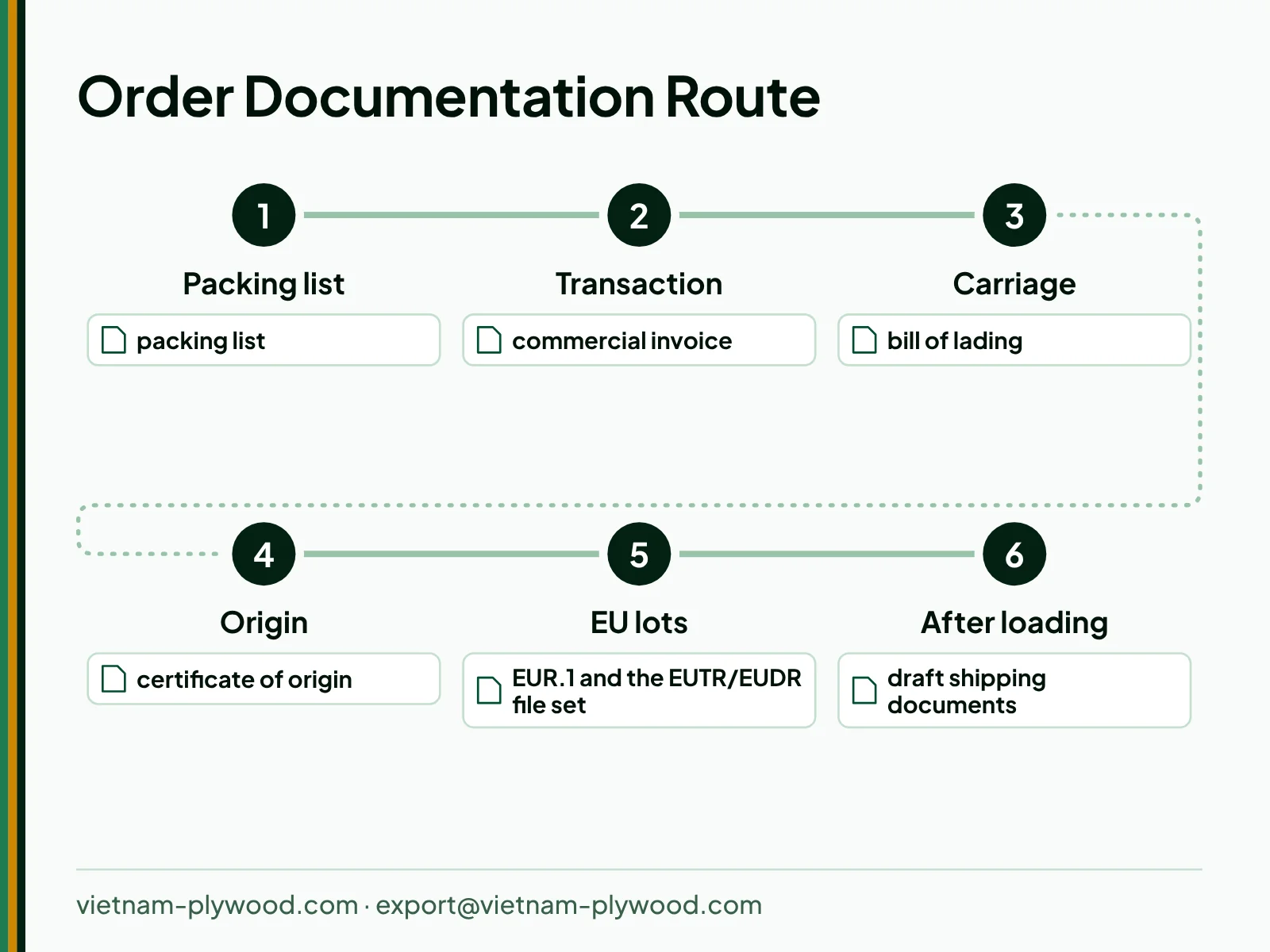
For EU lots, add EUR.1 where applicable and the EUTR/EUDR file set. Member-factory certificates, including FSC, CARB P2, ISO 9001 and CE, are shown with factory details masked, on request. A certificate’s scope and the agreed panel build should be checked together; the label alone cannot establish suitability for repeated formwork pours.
After loading, draft shipping documents go to the buyer for approval. HCPLY handles specification, on-site quality control, export documents and loading. Ask the inspector to match sampled boards, pallet marks and packing-list quantities to the written acceptance schedule.
What should a formwork buyer send for a matched sample?
Send the same performance request for the Chinese candidate and the Vietnamese construction-line sample. State the expected concrete finish, planned reuse conditions, handling method and destination so the paired trial and import comparison answer the same purchasing question.
Application: repeated concrete formwork; required finish and trial criteria
Line or core: construction line; acacia or eucalyptus core
Glue: melamine MR or phenolic WBP; agreed bond test
Emission: E0 / E1 / E2 as specified separately from glue
Face and grade: film-faced; 120 or 135 g/m² smooth film, or 220 g/m² anti-slip
Thickness and tolerance: 18 mm; ±0.5 mm
Size: 1220 × 2440 mm; length and width ±2 mm
Quantity: one 40HC minimum; specify each build's pallet allocation
Destination port: [port and country]; requested FOB / CFR / CIF basis
Ask Lucy at export@vietnam-plywood.com for a matched sample set through the contact page. Samples cost nothing: a first-time buyer pays the courier, and that charge comes off the first confirmed order.