





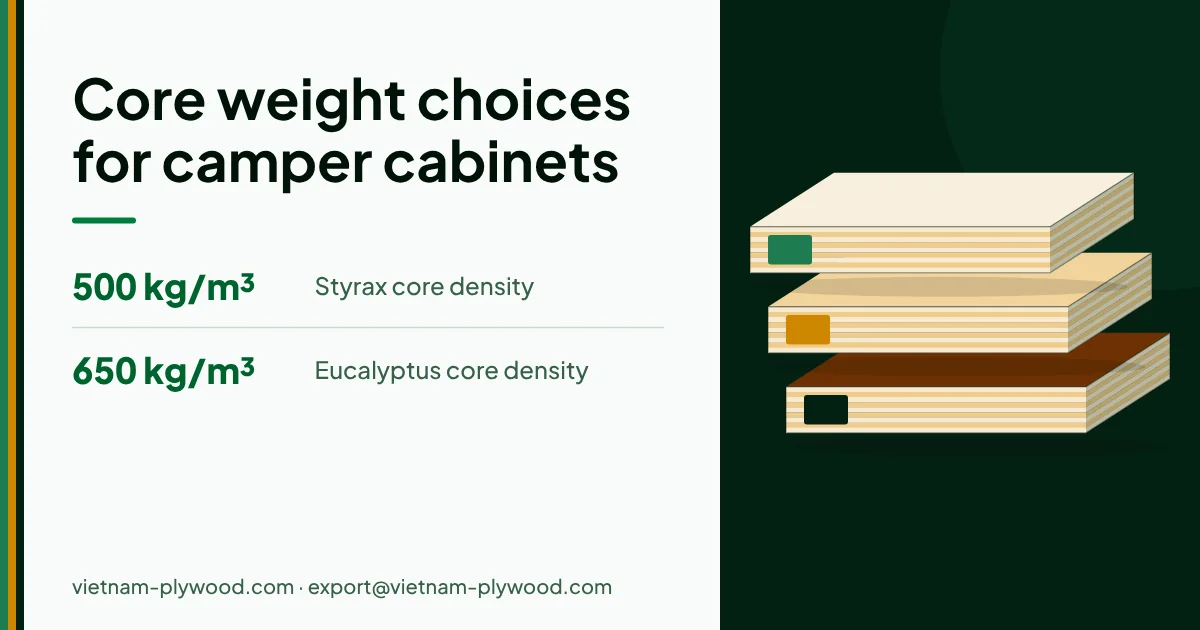
HCPLY recommends lightweight, sanded plywood with a specified core and fastening plan for campervan furniture board orders. A poor match adds vehicle weight, rework and rejected cabinet parts. Our furniture line offers styrax-core and eucalyptus-core builds for fit-out manufacturers, while floor panels require a separate load and support check.
What makes a campervan furniture board suitable?
A campervan furniture board needs low mass, dependable fastening and a glue specification matched to interior moisture exposure. For cabinet makers, styrax-core furniture plywood offers a lighter starting point than eucalyptus-core plywood at the same nominal dimensions. Panel thickness, joint design and edge protection still determine whether a finished unit works.
The material schedule should distinguish overhead cupboards, vertical cabinet sides, drawer boxes and floors. Each sees a different combination of vibration, moisture, edge fasteners and bending. A face that looks attractive on a sample does not establish how the panel will behave around a hinge screw.
The applications library covers related end uses. For camper work, begin with the weight budget of the completed vehicle and then allocate material to each assembly.
The 2024 US Code of Federal Regulations, 49 CFR § 571.110, requires vehicle capacity information for covered vehicles. Its vehicle placard describes the combined occupant and cargo weight limit. This is a vehicle-level consideration, rather than a plywood performance rating.
What thickness plywood should a camper floor use?
A camper floor thickness must follow the vehicle floor support spacing, point loads and fixing layout; no single plywood thickness fits every floor. Start a structural review with 12, 15 or 18 mm panels, then check deflection, fastener pull-through and moisture at penetrations.
A floor sheet spans between supports and carries concentrated loads from occupants, cabinets and equipment. Request the vehicle designer’s support layout, allowable deflection, attachment method and exposure details before locking thickness. If a panel is expected to serve a structural function, evaluate it against a test report the buyer accepts.
A 9 mm sheet can be a useful candidate for a supported lining, while 12, 15 and 18 mm are common thicknesses for a floor design review. Those numbers describe available thickness choices, not an approved floor assembly. Where the original vehicle floor is intact, a thin covering and a load-bearing replacement have different duties.
Check the floor at wheel-arch transitions and at service penetrations. Seal cut edges and keep water from pooling beneath a finish. Define how bolts and brackets transfer loads to the vehicle structure; a plywood thickness alone cannot answer that connection question.
For industrial applications with different loads and fixing conditions, see industrial plywood uses.
Which lightweight ply works for camper units?
Styrax-core furniture plywood is the first comparison for weight-sensitive cabinet carcasses; eucalyptus-core furniture plywood is the heavier alternative. Both can use full-stitched, sanded construction, with face grade and thickness chosen around visible doors, drawer boxes and shelves.
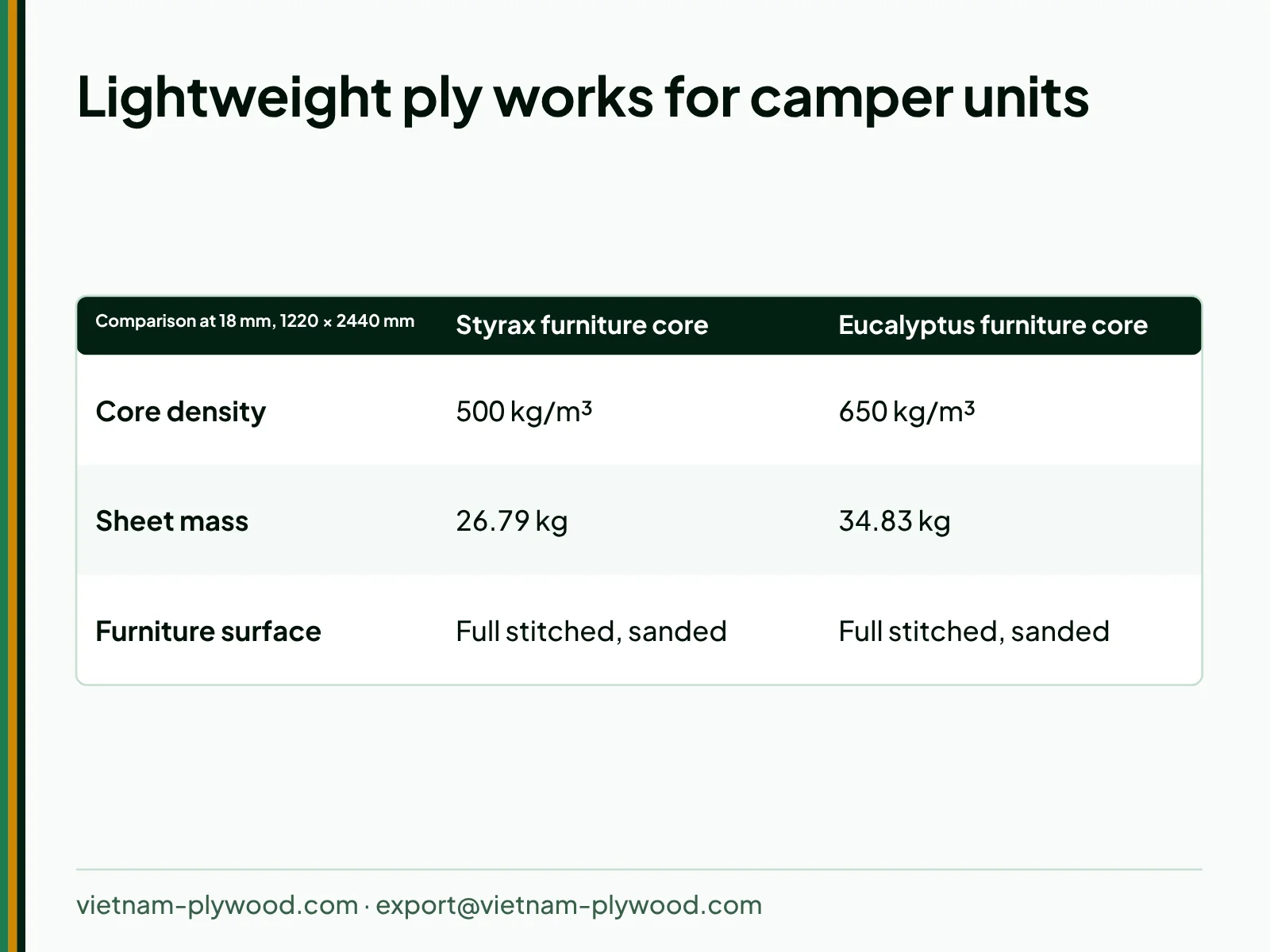
At 18 mm and 1220 × 2440 mm, a styrax-core sheet weighs 26.79 kg, compared with 34.83 kg for eucalyptus core. The core-density figures are 500 kg/m³ for styrax and 650 kg/m³ for eucalyptus. Density follows the core, even when both panels carry the same decorative face.
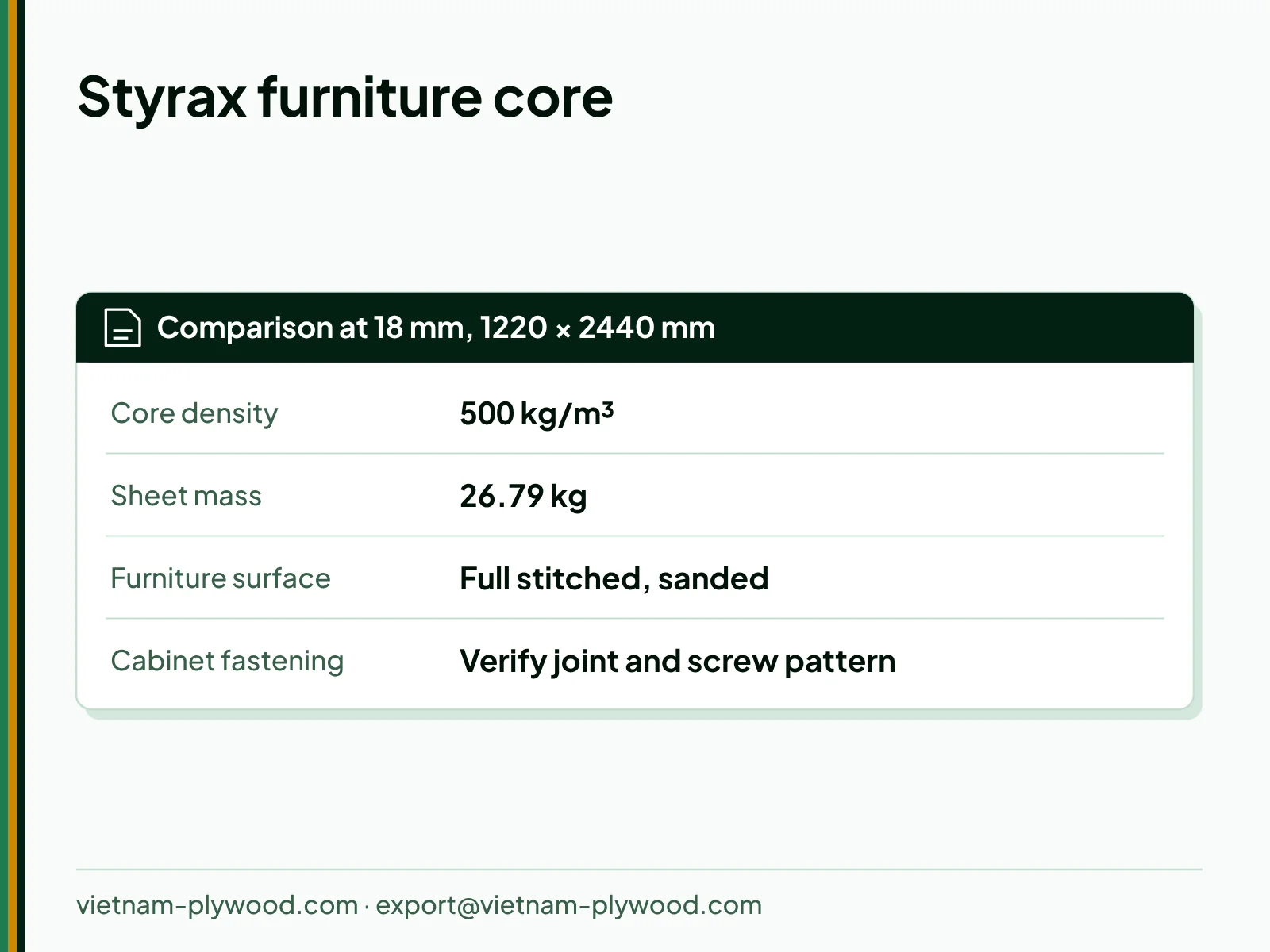
| Comparison at 18 mm, 1220 × 2440 mm | Styrax furniture core | Eucalyptus furniture core | Verdict by use |
|---|---|---|---|
| Core density | 500 kg/m³ | 650 kg/m³ | Styrax for mass-sensitive cabinets |
| Sheet mass | 26.79 kg | 34.83 kg | Styrax for overhead units |
| Furniture surface | Full stitched, sanded | Full stitched, sanded | Either for prepared cabinet surfaces |
| Cabinet fastening | Verify joint and screw pattern | Verify joint and screw pattern | Prototype both for critical hinges |
Weight savings matter most in repeated cabinet components. Do not infer greater screw-holding from a density figure alone: fastener diameter, edge distance, ply construction and local reinforcement change the result. Test the intended hinge and bracket details on actual cut parts.
Our furniture panels are made in thicknesses from 3 to 40 mm, including common 5, 9, 12, 15 and 18 mm choices. Thin backs and partitions need different bending checks from shelves. For a different face-led product topic, see poplar plywood; the product name does not change the stated core-density rule.
MDF or plywood for a campervan?
Plywood is the practical starting point where cabinet joints need screw engagement and the fit-out must limit mass. Medium-density fibreboard (MDF) can provide a smooth surface for decorative applications, but its fastening and moisture behaviour require separate evaluation; HCPLY does not press MDF.
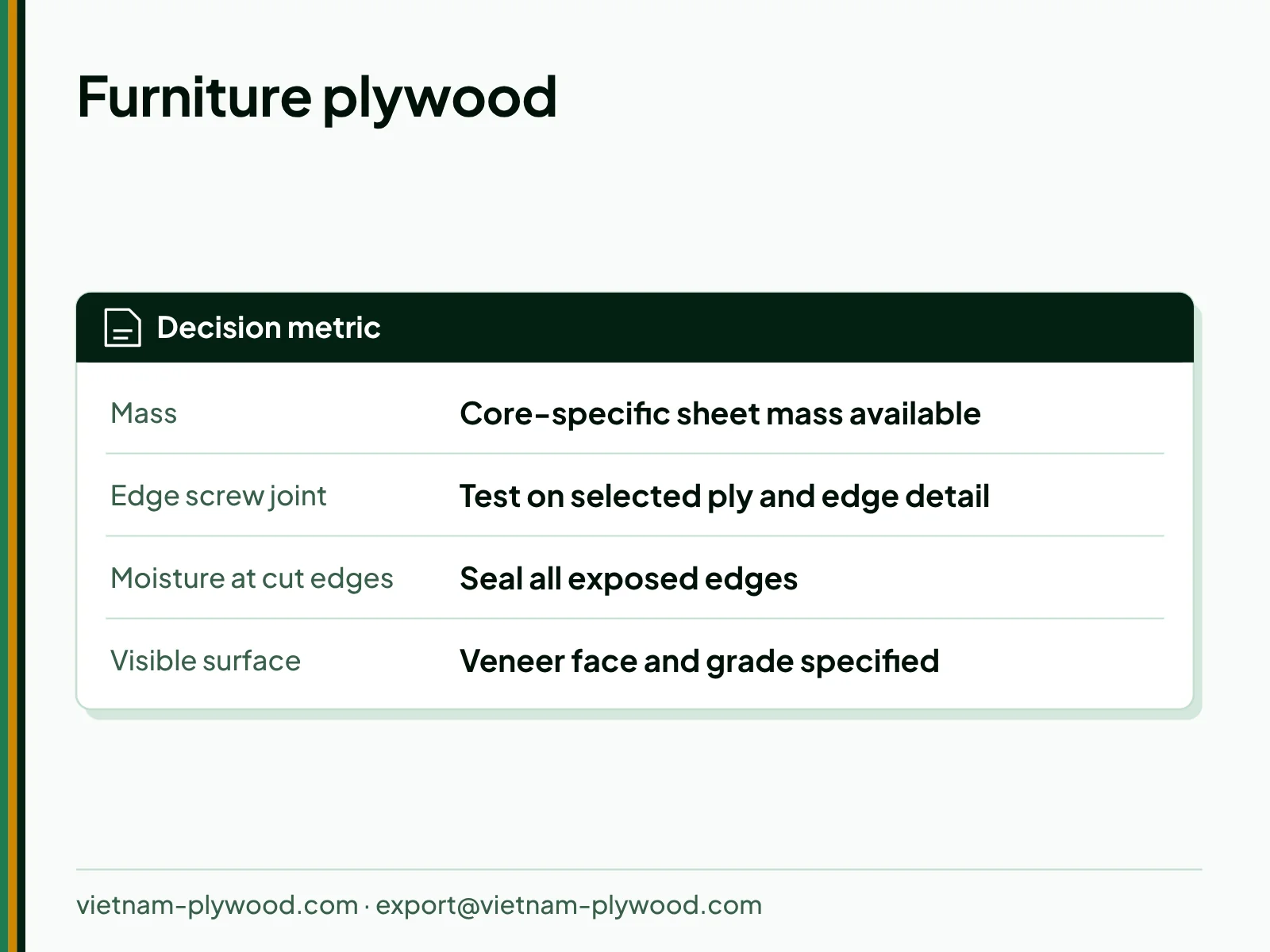
| Decision metric | Furniture plywood | MDF | Fit-out verdict |
|---|---|---|---|
| Mass | Core-specific sheet mass available | Grade-specific mass must be obtained | Compare actual bills of materials |
| Edge screw joint | Test on selected ply and edge detail | Test on selected board and insert detail | Prototype the real connection |
| Moisture at cut edges | Seal all exposed edges | Require a separate moisture specification | Keep wet zones protected |
| Visible surface | Veneer face and grade specified | Smooth decorative substrate | Choose by finishing system |
Decorative thermally fused laminate, melamine-faced panels and high-pressure laminate are distinct surface topics. They should be assessed for abrasion, cleaning, adhesive compatibility and edge finishing. HCPLY does not offer melamine, HPL or laminate faces as a product line.
A fit-out maker should compare completed cabinet parts, including hardware and finish, rather than comparing bare-board labels. The design drawing must identify joints and the acceptable finished weight.
How do the three production lines differ?
Our furniture line presses the sanded, full-stitched styrax- or eucalyptus-core panels suited to cabinet parts. Our commercial and packing line presses acacia-core panels with moisture-resistant glue and a rougher surface; our construction line presses film-faced acacia- or eucalyptus-core panels for temporary formwork applications.
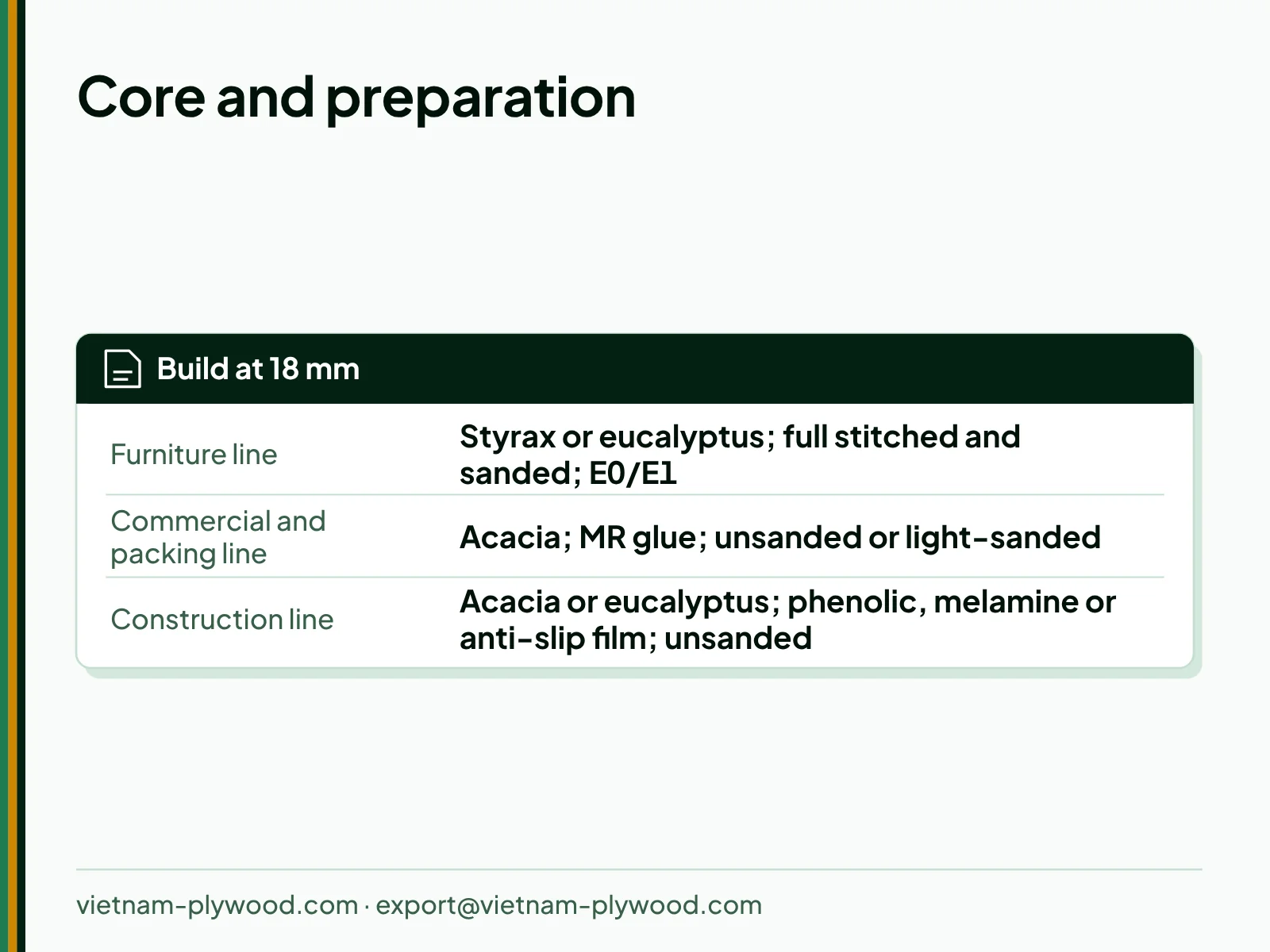
| Build at 18 mm | Core and preparation | Typical decision |
|---|---|---|
| Furniture line | Styrax or eucalyptus; full stitched and sanded; E0/E1 | Cabinet bodies and visible furniture parts |
| Commercial and packing line | Acacia; MR glue; unsanded or light-sanded | Packing and utilitarian non-visible components |
| Construction line | Acacia or eucalyptus; phenolic, melamine or anti-slip film; unsanded | Formwork-related applications, not decorative cabinetry |
The same nominal thickness therefore describes different surface preparation and core choices. The commercial option is worth evaluating for non-visible protective components, while the furniture option better matches precision-cut cabinet work. A film surface is a different finishing system and should not be substituted for a furniture veneer without redesign.
The three factories operate in Phu Tho and Hai Phong. Each order is produced on the line matching its written specification and shipped from that location. Our export team manages specification, on-site quality control, shipping papers and loading.
Which glue and emission class should a buyer specify?
Specify the adhesive performance and formaldehyde emission category separately. Melamine moisture-resistant (MR) glue has a 12-hour boil description; phenolic weather and boil proof (WBP) glue has a 72-hour boil description. Neither description substitutes for a finished-joint test in the fit-out.
Moisture-resistant describes the glue category; it does not make a cabinet waterproof. Water can still enter an unsealed cut edge or a poorly detailed floor penetration. Use a separate acceptance check for bonded joints after the actual finishing and exposure sequence.
E0, E1 and E2 are emission classes. CARB Phase 2 and TSCA Title VI describe a US formaldehyde limit with third-party certification, which is a different field from glue selection. For a US-bound build, identify the relevant emission evidence in the purchase specification.
Factory certificates including FSC, CARB P2, ISO 9001 and CE, along with EUDR/EUTR documents, are shown with factory details masked, on request. The certificate must be checked against the member factory producing the ordered build.
For furniture work, specify the ordered sanded thickness tolerance of ±0.2 or ±0.3 mm. This matters when cabinet components are nested, edged and assembled with fixed hardware clearances.
How should faces, edges and fasteners be detailed?
Face veneer changes appearance, while core construction controls the panel interior. Specify face species and grade, screw location, pilot holes, edge sealing and hardware reinforcement on the fabrication drawing before ordering a batch.
The available veneer faces include bintangor, okoume, engineered veneer (EV), gurjan, pine, poplar, eucalyptus, birch and sapele. Common face-veneer thickness is 0.2–0.4 mm. A/B face grades apply to the relevant veneers; birch faces use D/E/F grades. Matt identifies an unfaced raw core.
Specify face direction and show which faces remain visible after assembly. A cabinet maker should define whether exposed edges receive a band, sealant or another protective finish. Screw pilot holes and insert placement belong on the same manufacturing drawing as the panel cut list.
Furniture construction uses full-stitched cores. A cross-section inspection should look for open gaps, overlaps and edge voids that interfere with hardware placement. For another thin-panel application, see door skin plywood.
Standard sheet sizes include 1220 × 2440 and 1250 × 2500 mm, with custom cutting available. Length and width tolerance is ±2 mm. Build the nesting plan around finished cut sizes, including machining allowance and edge treatment.
Can furniture and other panels share a container?
Specifications can be mixed within one 40HC when the payload stays at or below 28.5 tonnes. The 18 mm, 1220 × 2440 mm lookup shows why core choice affects the load plan: a full styrax load is 990 sheets at 26.52 t, compared with 880 acacia sheets at 27.35 t.
For 18 mm, 1220 × 2440 mm stock, the lookup also gives 795 eucalyptus-core sheets at 27.69 t. These full-load figures exclude film weight. A mixed load needs a pallet-by-pallet weight schedule and sufficient payload headroom for the chosen combination.
A cabinet programme can share container space with commercial panels for packaging-related components, provided the specification and weight plan fit. See mixed-container arrangements and the container loading reference for the owner calculation.
The minimum order is one 40HC. Factory lead time runs 15–45 days from receipt of the 30% deposit; the exact figure depends on order size, line loading and what the contract fixes. The remaining 70% is paid on the scan of the bill of lading, by T/T, or by irrevocable sight L/C.
For related distributor planning, see plywood supply programmes.
What can an inspector witness at the producing factory?
An inspector can check panel identity, caliper thickness, cut-edge core arrangement, face condition and packed quantities against the signed specification. The producing factory is where the ordered panels and packing marks can be matched to the inspection record.
Ask the inspector to witness a sample drawn from identified pallets, rather than only a display panel. Check the actual ordered thickness using a calibrated caliper at agreed points. Compare the exposed cut edge with the ordered full-stitched construction and record face defects under the agreed grade.
The buyer can visit the factory office and inspect goods at the producing factory. Include screw-joint prototypes in the buyer’s own qualification process, since a visual inspection does not quantify pull-out strength. The inspection record should identify the lot, sample locations, instruments and any corrective action.
A cabinet fit-out requires repeatable cutting and assembly. Check surface flatness on a supported bench and look for sanding-through or damaged veneer around likely door and drawer positions. Record observations against the signed acceptance criteria.
What documentation follows the shipment?
The shipment document set covers the commercial invoice, packing list, bill of lading, origin papers and applicable phytosanitary and fumigation papers. Add the order-specific emission certificate or agreed test report and, for EU lots, the EUTR/EUDR file set.
After loading, the draft shipping documents come to you for approval. The certificate of origin is EUR.1 for EU lots; insurance accompanies CIF shipments. The applicable order documents can include an FSC claim on sales documents and test reports for the agreed build.
Available delivery terms are FOB Hai Phong, CFR (CNF) or CIF. When reviewing the invoice and packing list, compare panel size, thickness, face and grade with the production order and pallet labels. This links the receiving inspection to the original purchase specification.
A fit-out exporter should also keep its own cabinet drawings and vehicle installation checks. Those records answer different questions from plywood export documents.
How should a fit-out maker order a trial container?
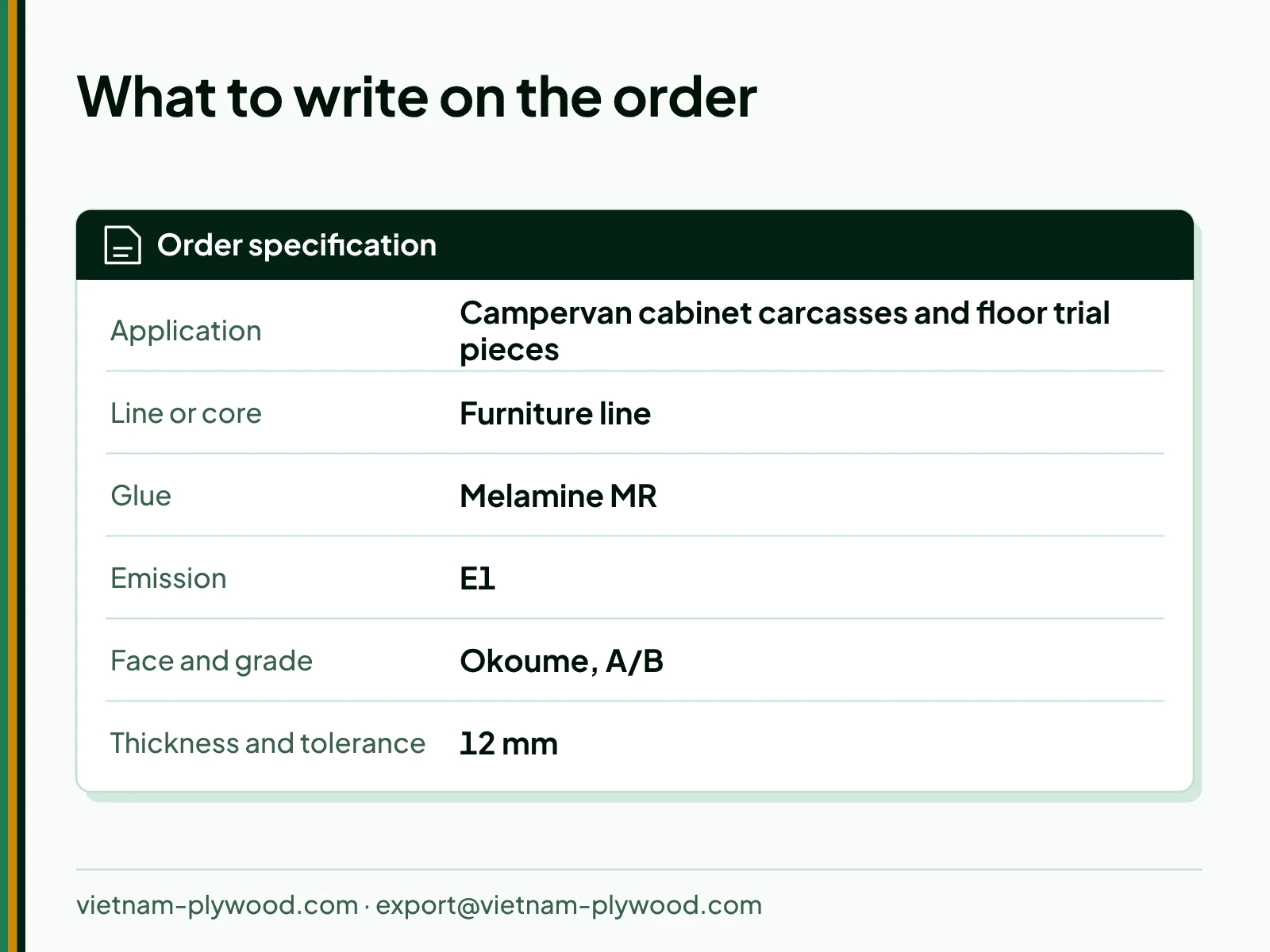
Send a single written build specification with the vehicle application, chosen core, adhesive, emission class, faces, dimensions and destination port. HCPLY can then quote the agreed build and arrange a trial container through Lucy at export@vietnam-plywood.com.
For a trial programme, identify the most repeated cabinet component and its target mass first. Then select the candidate furniture core and make sample joints with the intended hardware. Compare actual part weights and machining outcomes before committing the full cutting schedule.
Samples cost nothing: a first-time buyer pays the courier, and that charge comes off the first confirmed order. Lucy can review the panel specification at contact. For adjacent fabrication requirements, see shopfitting plywood and export wood packaging options.
Application: campervan cabinet carcasses and floor trial pieces
Line or core: furniture line; styrax core
Glue: melamine MR
Emission: E1
Face and grade: okoume, A/B
Thickness and tolerance: 12 mm; sanded ±0.2 mm
Size: 1220 × 2440 mm
Quantity: one 40HC, mixed specification schedule attached
Destination port: [buyer to specify]
Next step: plan a trial container with a signed cut list and inspection checklist.