





Which plywood for shop walls, counters and display units?
At HCPLY, plywood for shop walls is specified as a sanded, faced panel with a documented thickness, face grade and emission class. For visible retail walls, counters and freestanding display units, our furniture line uses a stitched core and a selected veneer face. The installation drawing must govern fixing, spans and edge treatment; panel appearance alone cannot establish structural suitability.
We cut furniture panels for fit-out makers working from an approved schedule. Wrong veneer selection can trigger refinishing, while a wrong cut size can delay a store opening. A furniture plywood specification starts with the application, finished face and required dimensions.
For wall cladding, specify which face remains visible and whether the installer will paint, clear-coat or cover it. For counters, distinguish vertical front panels from horizontal working surfaces exposed to repeated contact. For displays, record the bracket positions and any holes before approving the cut list. These differ even at identical nominal thickness.
Can panels be cut to the shopfitter’s drawing?
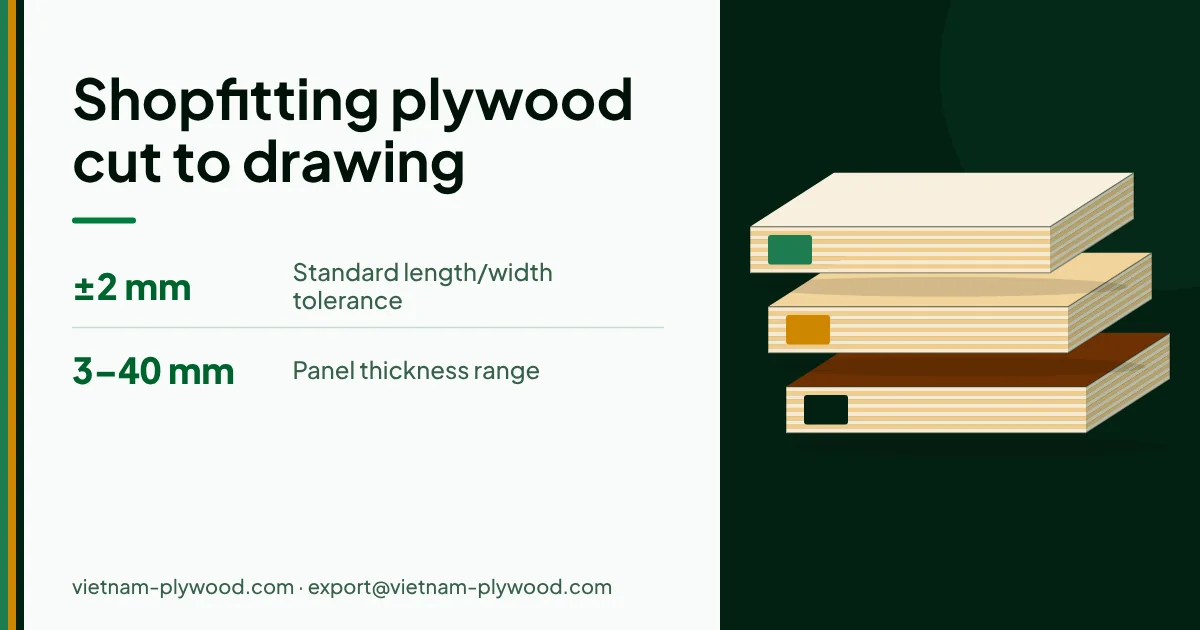
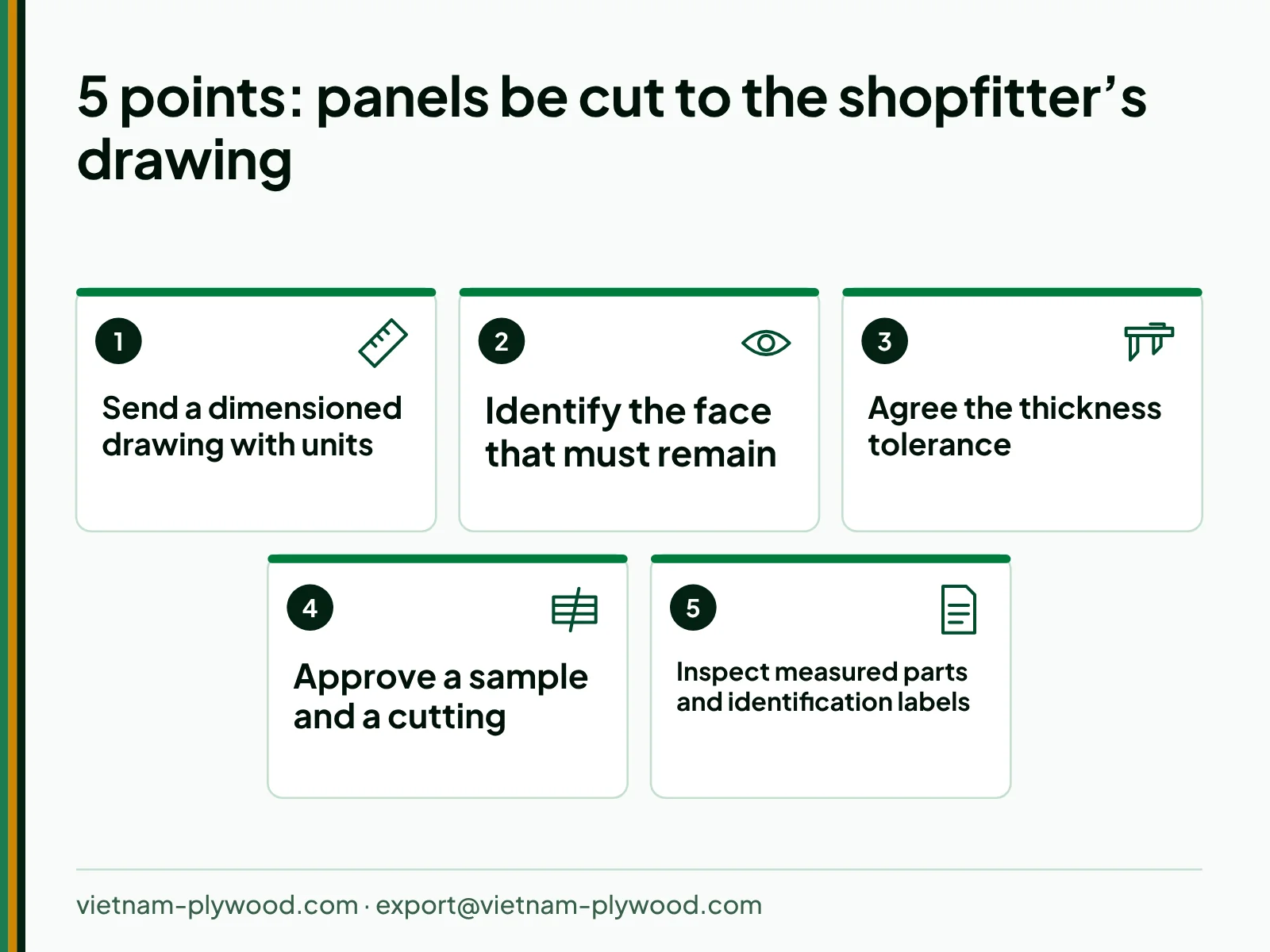
Yes. Our furniture line can custom-cut faced panels to an approved shopfitter’s drawing before export. This moves repetitive rectangular cutting away from the installation site and gives the receiving team a defined component list to check.
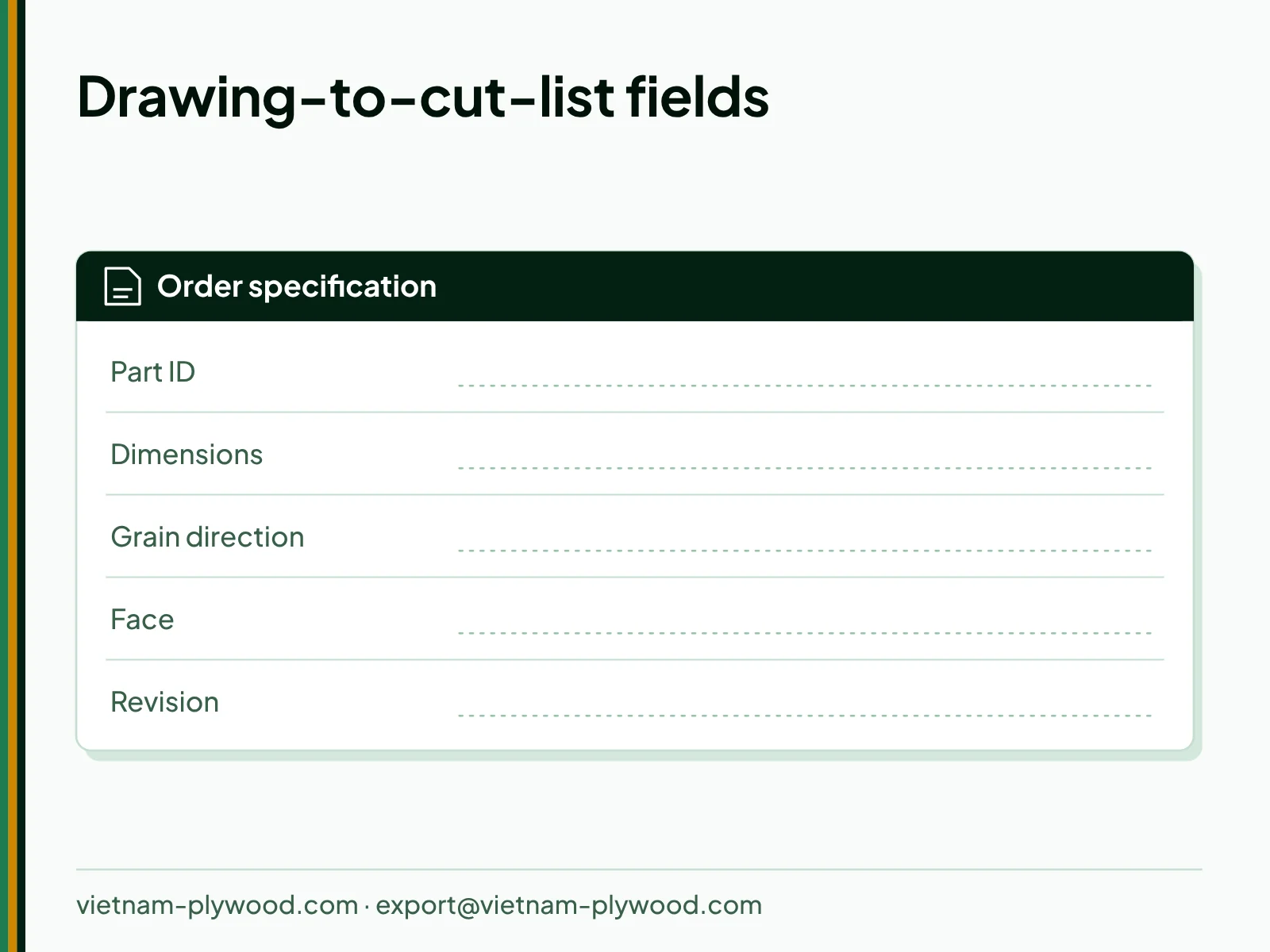
- Send a dimensioned drawing with units, part IDs, quantity and grain direction.
- Identify the face that must remain visible and mark any matched adjacent panels.
- Agree the thickness tolerance, cut-size acceptance and treatment of exposed edges.
- Approve a sample and a cutting schedule with the same revision identifier.
- Inspect measured parts and identification labels at the producing factory before loading.
The standard length and width tolerance is ±2 mm. A drawing demanding tighter cut dimensions needs a separately agreed acceptance method. Complex routed profiles, drilled holes or installed hardware should be distinguished from simple custom cutting in the enquiry; the written production scope controls what is ordered.
Which face and emission class belong on the order?
State the veneer species, face grade and emission class as separate purchase-order fields. A named face tells the factory which surface is visible; it does not identify the core species or establish an emission limit.
Our furniture line offers bintangor, okoume, engineered veneer (EV), gurjan, pine, poplar, eucalyptus, birch and sapele faces. Common face veneer thickness is 0.2–0.4 mm. A/B is the available face-grade description for most faces; birch face is graded D/E/F. Specify the required appearance against an approved sample rather than assuming that a letter grade fixes every visual characteristic.
For this line, E0 or E1 is an emission-class field. Glue type is another field: melamine moisture-resistant (MR) or phenolic weather-and-boil-proof (WBP), according to the agreed build. The emission entry should never be substituted for a glue specification.
For a project requiring United States compliance documentation, CARB Phase 2 and TSCA Title VI refer to a separate third-party-certified limit, rather than an alternative name for E0. Certificate evidence from the relevant member factory can be shown with factory details masked, on request. Match the requested documentation to the exact producing factory and panel build.
Birch or poplar face for display units?
Choose birch face when its particular grain and visual character match the approved display sample; choose poplar face when the finish design calls for its appearance. Neither face name alone proves load capacity, core density or suitability for a specified coating.
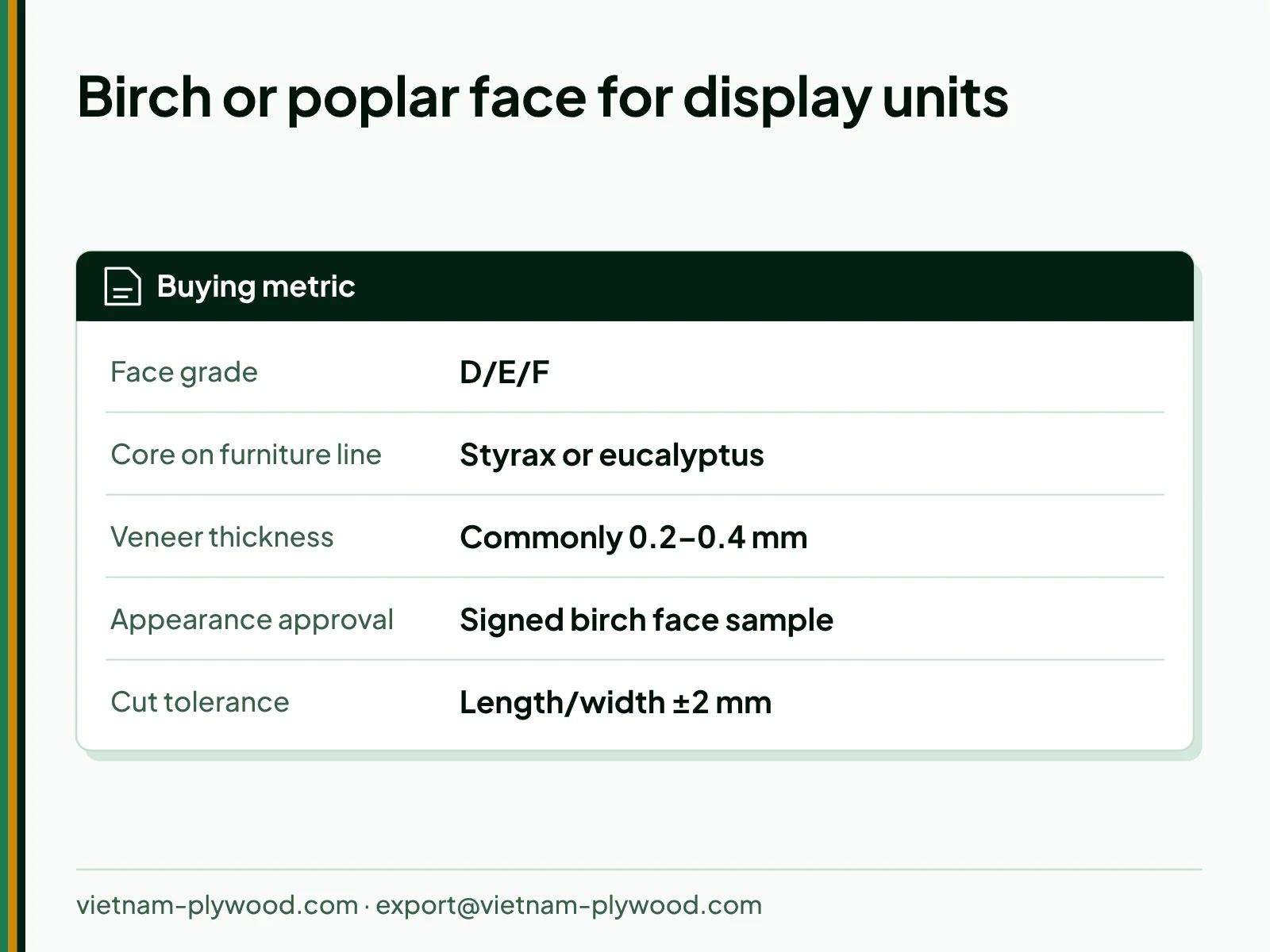
| Buying metric | Birch-faced option | Poplar-faced option | Selection for use |
|---|---|---|---|
| Face grade | D/E/F | A/B | Compare samples under store lighting |
| Core on furniture line | Styrax or eucalyptus | Styrax or eucalyptus | Select core separately for weight and machining |
| Veneer thickness | Commonly 0.2–0.4 mm | Commonly 0.2–0.4 mm | Specify finished surface expectations |
| Appearance approval | Signed birch face sample | Signed poplar face sample | Use the approved sample for visible stands |
| Cut tolerance | Length/width ±2 mm | Length/width ±2 mm | Set assembly clearance in drawings |
For exhibition stands, confirm whether components are temporary and repeatedly assembled. Exposed corners, screw locations and edge finishing matter as much as the chosen face. A lighter-looking veneer does not establish a lighter panel: density follows the core.
Our furniture line uses styrax at 500 kg/m³ or eucalyptus at 650 kg/m³. Birch-core plywood is outside our pressed range. The choice between these cores affects handling mass, while the chosen face governs the visible wood pattern. Buyers seeking a wood display board with consistent presentation should sign off the face sample before a large cutting run.
Which factory line makes the retail panel?
Our furniture line presses the sanded, full-stitched faced panel for visible shopfitting. The other production lines address different finish and service requirements, so the same nominal thickness is not an interchangeable specification.
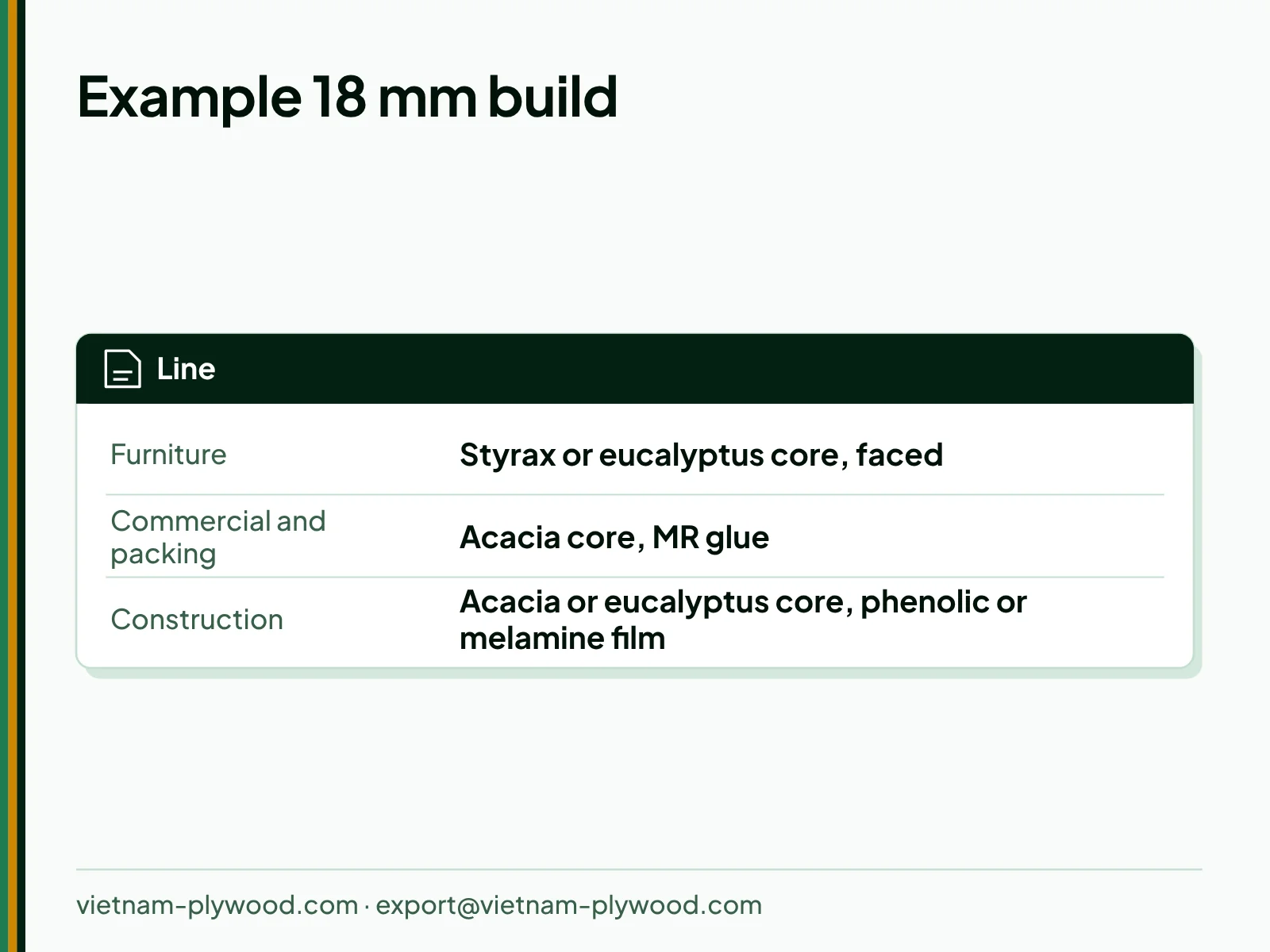
| Line | Example 18 mm build | Finish and tolerance | Retail decision |
|---|---|---|---|
| Furniture | Styrax or eucalyptus core, faced | Sanded; ±0.2 or ±0.3 mm as ordered | Preferred starting point for visible walls and counters |
| Commercial and packing | Acacia core, MR glue | Unsanded or light-sanded; ±0.5 mm commercial | Consider for concealed packing or backing functions |
| Construction | Acacia or eucalyptus core, phenolic or melamine film | Unsanded; ±0.5 mm | Intended for formwork-style applications, not decorative veneer display |
These comparisons explain why a shopfitter should not replace a visible panel with an identically sized industrial sheet on a bill of materials. Core preparation, face, sanding and tolerance change the resulting component. Our applications library covers related uses without treating every plywood type as a decorative panel.
At the producing factory, a buyer can witness face sorting, thickness checks and measurement of the cut schedule. Ask the inspector to record part IDs against the drawing revision and photograph any rejected edge or face defects. The inspection record should identify which lot was examined.
What thickness and size should a fit-out drawing use?
Select thickness from the fixture design and its support conditions, then order it with an explicit tolerance. Available thickness spans 3–40 mm, with common choices of 3, 5, 9, 12, 15, 18, 21 and 25 mm. These are manufacturing options rather than span ratings.
Standard sheet sizes include 1220×2440, 1250×2500, 1220×2135, 1220×1830, 915×2440, 915×2135 and 915×1830 mm. Custom cutting can reduce trimming at the installation site when the drawing aligns with an agreed blank and cutting plan. The shopfitter must still calculate panel support, fixture loading and fixing requirements.
An 18 mm panel has 11–13 plies according to core veneer thickness. The ply count is useful when reviewing exposed edges, but it does not replace a sample of the actual construction. If edges remain visible, describe the acceptable gaps and finishing method on the approved sample.
Does furniture plywood carry a fire rating?
HCPLY does not claim a fire rating for its furniture plywood. A retail project that requires classified reaction-to-fire performance must obtain evidence accepted for the specified material or assembly before approving it for that use.
The European Commission’s 2016 Delegated Regulation (EU) 2016/364 describes reaction-to-fire classes for construction products and the associated classification system. Its Article 1 ties classification to products whose intended use can contribute to fire and smoke spread; the official EU text explains the framework. A face veneer, adhesive class or emission label is not a substitute for fire-performance documentation.
Ask the project designer which code, test configuration and evidence are acceptable for the installed wall, counter or exhibition structure. Record that requirement separately from the plywood cutting schedule. Where the contract calls for a fire-rated product or assembly, procure that requirement against an accepted report from an appropriate source rather than assigning a rating to an ordinary faced sheet.
Retail installation requirements can differ by jurisdiction and whether the panel forms part of a wall lining, furniture fixture or temporary exhibition stand. The design authority should define the application before a buyer treats a classification report as applicable.
Can plywood blanks be used for pegboard or slatwall?
Plywood blanks can be ordered for a plywood pegboard or display board when the shopfitter controls the drilling and fixing design. Our furniture line can provide faced, cut blanks; hole geometry and hanging-load capacity need an approved fabrication drawing and fixture assessment.
For pegboard, state the hole diameter, spacing, edge distance and face orientation in the downstream machining plan. A hole pattern near an unsupported edge can change the behaviour of the finished panel. The panel purchase should therefore distinguish a flat blank from a fully machined fixture.
A plywood rack for shop merchandise needs bracket and support details, particularly where concentrated loads act on a small area. Ask the fixture engineer to specify anchorage, shelf spans and acceptable deflection. The plywood veneer selection alone cannot answer those questions.
Grooved slatwall systems also involve profiles and compatible fittings. They should not be treated as identical to a flat faced plywood sheet. If a project calls for a tongue-and-groove or slotted proprietary system, document that finished-system requirement separately; our quotation can cover the agreed plywood blank scope.
How can a mixed shopfitting container be planned?
A 40HC order can mix specifications within the 28.5 t payload limit. For 18 mm, 1220×2440 mm sheets, the core determines the weight of each blank before packaging and any added finishing materials.
Styrax-core sheets weigh 26.79 kg each, acacia-core sheets 31.08 kg and eucalyptus-core sheets 34.83 kg. For example, 400 styrax sheets and 300 eucalyptus sheets total 10,716 kg plus 10,449 kg, or 21,165 kg of panel mass. That leaves 7,335 kg against the payload limit for additional goods and loading materials; actual pallet configuration and stowage must be planned separately.
The full-container reference for this size and thickness is 990 styrax sheets, 880 acacia sheets or 795 eucalyptus sheets. See container load planning for the dedicated loading topic. Mixed panel sizes should be recorded by pallet and part ID so that the receiving team can locate store-specific kits without opening every bundle.
What should the factory inspection and export file show?
Inspect face appearance, panel dimensions and cutting identifiers against the signed sample and current drawing revision. At the producing factory, the buyer or appointed inspector can check thickness, veneer defects, cut dimensions and pallet labels before dispatch.
A practical acceptance sheet separates cosmetic defects from dimension failures. Record whether a mark sits on the visible face, whether an edge will be concealed and whether the component can be used in its assigned location. Photographs should include a ruler or thickness gauge where measurement is disputed.
The shipment document set includes a commercial invoice, packing list, bill of lading (B/L), certificate of origin, phytosanitary and fumigation papers, and the certificate or test documents agreed for the build. European Union lots include EUR.1 where applicable and the EUTR/EUDR file set; CIF shipments include insurance. After loading, the draft shipping documents come to you for approval.
The packing list is the key export document for reconciling pallet counts and component groups. The drawing revision and inspection record should be retained with the order records, while the invoice and B/L establish the commercial and shipping particulars. HCPLY manages specification, on-site quality control, documentation and loading through export.
How should an importer request a shopfitting quotation?
Send the complete panel specification and the cut list together, with a destination port and a sample approval plan. For furniture plywood, the indicative starting price is from US$350/m³ FOB Hai Phong (October 2026); a cut-to-drawing order is quoted against its actual veneer, core, grade, machining scope and quantities.
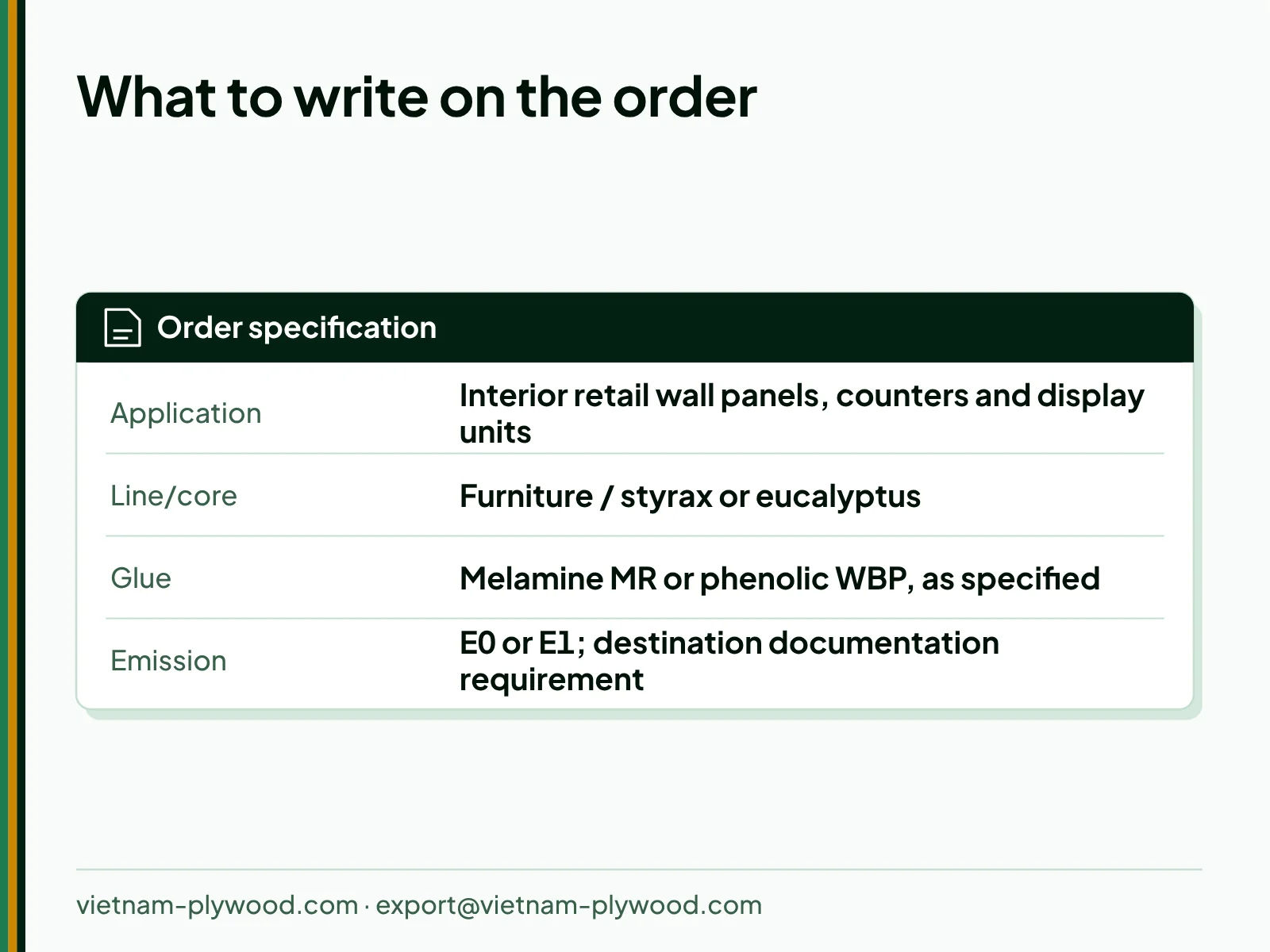
Face selection and core construction affect the build first, followed by thickness, cutting complexity, tolerance and packing segregation. A full-stitched, sanded furniture build costs more to prepare than a less-finished commercial backing sheet because it requires more core preparation and finishing. A quotation should identify the exact accepted build instead of assuming that a generic plywood price covers cut components.
The minimum order is one 40HC, with specifications mixed within the payload limit. Factory lead time runs 15–45 days from receipt of the 30% deposit; the exact figure depends on order size, line loading and what the contract fixes. The remaining 70% is paid on the scan of the bill of lading, by T/T, or by irrevocable sight L/C. We ship FOB Hai Phong, or CFR (CNF) or CIF to your port.
Free samples are available; a first-time buyer pays the courier, and that charge comes off the first confirmed order. For related components, compare door skin plywood and plywood supply programmes for distributors. Send the completed schedule to Lucy at HCPLY or export@vietnam-plywood.com.
Application: Interior retail wall panels, counters and display units
Line/core: Furniture / styrax or eucalyptus
Glue: Melamine MR or phenolic WBP, as specified
Emission: E0 or E1; destination documentation requirement
Face and grade: Named veneer, grade, approved sample reference
Thickness and tolerance: ___ mm; ±0.2 or ±0.3 mm as ordered
Size: Sheet blank and component cut schedule, mm; drawing revision ___
Quantity: ___ sheets / ___ component IDs; mixed 40HC plan
Destination port: ___
Ask for a sample set matched to the face, core and cutting specification before approving production.