





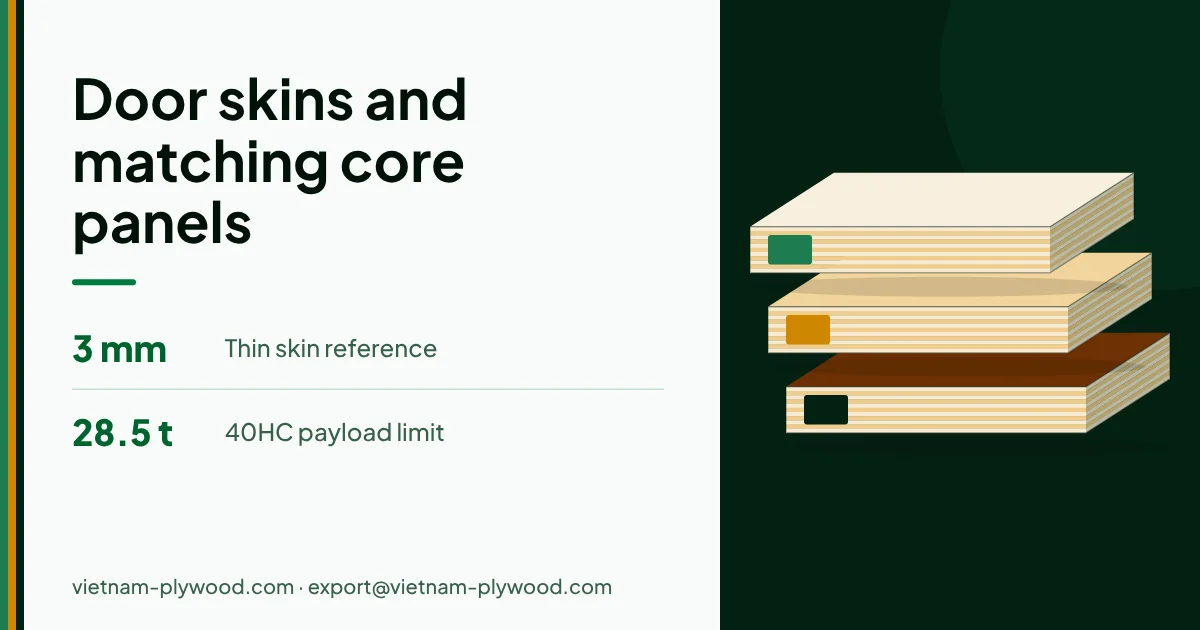
What is plywood door skin?
Plywood door skin is a thin, veneer-faced plywood panel bonded to a door assembly as its visible outer layer. HCPLY supplies plywood door skin specifications for flush-door production, with face appearance, thickness and flatness selected together. A mismatched face or bowed sheet can waste finishing work and cause rejected door components.
A skin supplies the visible wood surface; the frame, infill and door-core construction determine much of the finished leaf’s behaviour. Door makers should distinguish a plywood skin from a complete door leaf and from a moulded fibreboard skin. Our furniture line presses sanded, full-stitched veneer-core panels for visible door faces. Our commercial and packing line builds acacia-core panels where a less refined surface is acceptable.
See the Applications category and plywood furniture components. These pages cover broader components.
Which face veneer fits a door skin?
Okoume, bintangor and engineered veneer (EV) serve different visual specifications. The face names the product, while the underlying styrax or eucalyptus core determines its density. A 0.2–0.4 mm face veneer is common; face thickness should be written into the purchase specification when sanding or finishing allowance matters.
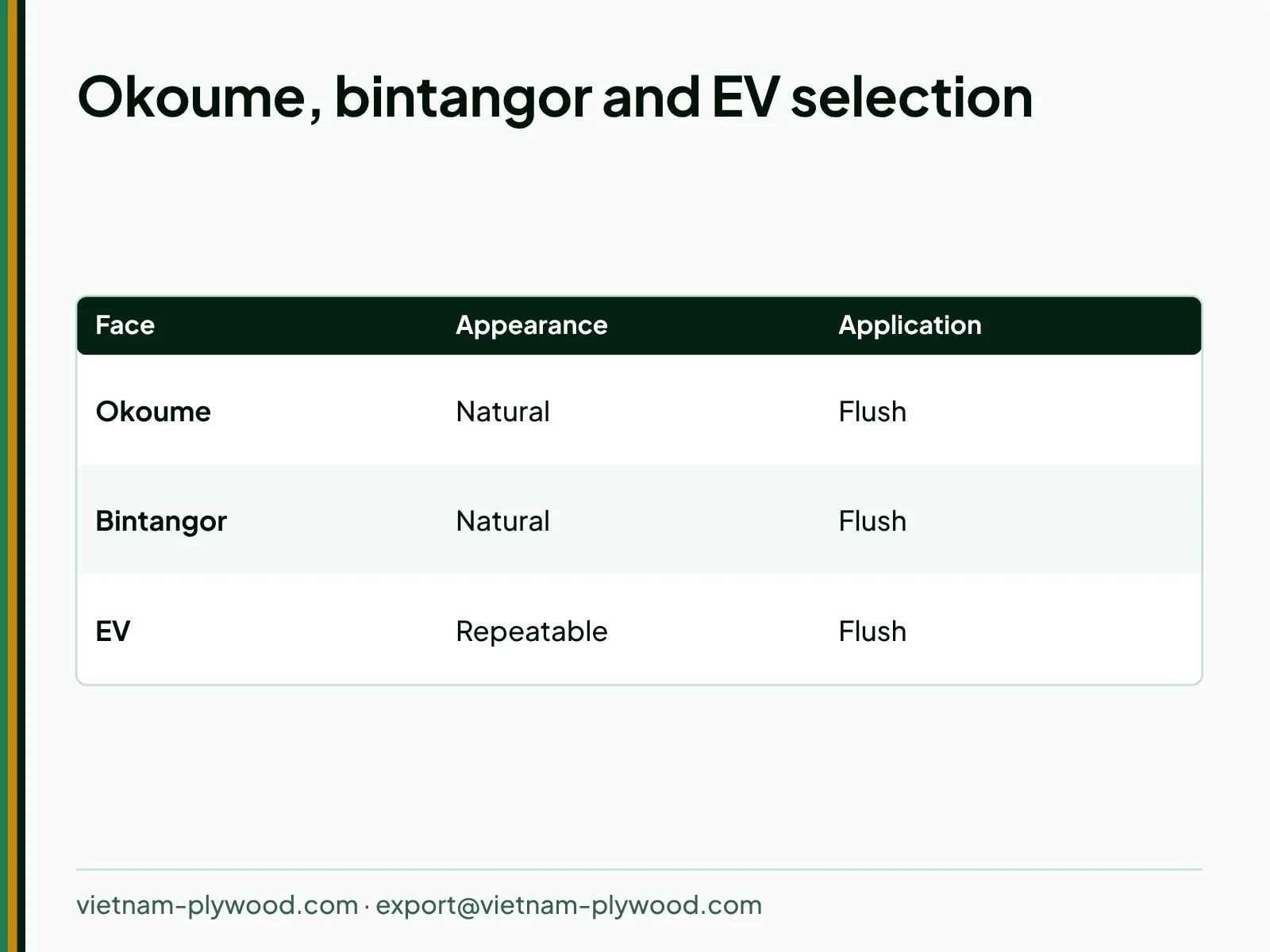
| Face | Visible character and selection metric | Preferred door use | Buying decision |
|---|---|---|---|
| Okoume | Natural wood figure; agree the colour range and matching standard against approved samples | Clear-finished flush doors | Choose for an agreed natural appearance and inspect variation across the lot |
| Bintangor | Natural veneer with its own colour and grain range; grade A/B can define visible acceptance | Painted or stained flush-door faces, depending on the finishing trial | Choose when the approved face sample meets the finish target |
| EV | Engineered veneer with a repeatable designed appearance; specify pattern orientation | Repeated flush-door programmes with a consistent visual brief | Choose when pattern matching across batches matters most |
None is automatically superior for every finishing system. Request paired samples after the intended stain, sealer or paint trial, then record which face and grade passed. For a visible face, the furniture build’s sanded surface and full-stitched core are the starting specification; commercial unsanded sheets are a different proposition.
Which skins suit flush doors and moulded doors?
Flat plywood skins suit flush-door assemblies whose surface is designed to remain planar. A moulded door requires a shaped surface and a pressing method suited to that profile; a flat plywood sheet is not a ready-made moulded skin. HCPLY does not press medium-density fibreboard (MDF) or high-density fibreboard door skins, nor do we offer melamine-paper moulded skins as a product line.
A door maker using a moulded design should source the shaped component separately and specify plywood only for the flat parts of the assembly where appropriate. Melamine, high-pressure laminate (HPL) and other laminate faces are distinct surface systems, rather than HCPLY door-skin product lines. For a flush door, identify whether the veneer will be clear-finished, stained or painted before choosing a face grade.
The backing arrangement matters. State whether the door design uses a matched pair of skins and identify the adhesive and pressing process used in the buyer’s own door assembly. A balanced door construction must be engineered and verified at the door-maker level; panel flatness alone does not establish finished-door performance.
What thicknesses and sizes are ordered?
Our published plywood thickness range is 3–40 mm, with 3 mm and 5 mm among the common options for thin plywood for doors. A requested 4mm door skin plywood build sits within that range, but its exact lay-up, tolerance and availability must be written into the quotation specification. Do not substitute a nominal thickness for the measured acceptance band.
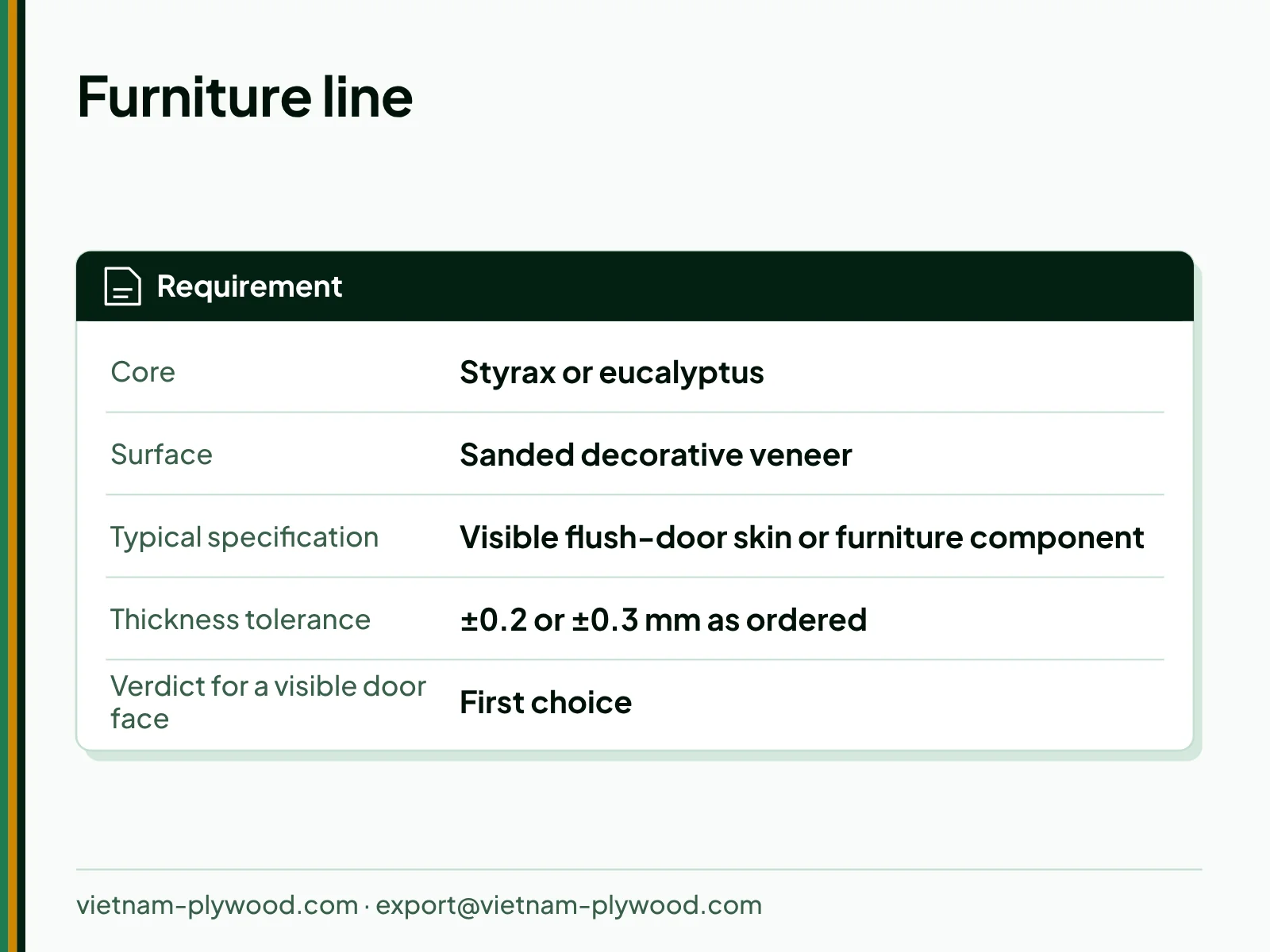
The furniture line’s sanded thickness tolerance is ±0.2 mm or ±0.3 mm as ordered. Commercial panels have ±0.5 mm tolerance, while packing panels have ±0.5–1.0 mm. Length and width tolerance is ±2 mm. These distinctions matter when a door press is set up for a repeatable glue line and a predictable finished thickness.
Available sheet formats include 1220×2440, 1250×2500, 1220×2135, 1220×1830, 915×2440, 915×2135 and 915×1830 mm. Custom cutting is available. A buyer requesting 3×7 ft doorskin plywood should send the required dimensions in millimetres rather than relying on a trade shorthand. A quoted door skin plywood size should also identify grain direction, trim allowance and the final door blank size.
A face veneer can be 0.2–0.4 mm, while the core veneer thickness is 1.4–2.0 mm. The number of plies therefore changes with the lay-up. For thicker door-core panels, an 18 mm build uses 11–13 plies; a thinner skin should be specified by the required finished panel performance rather than an assumed ply count.
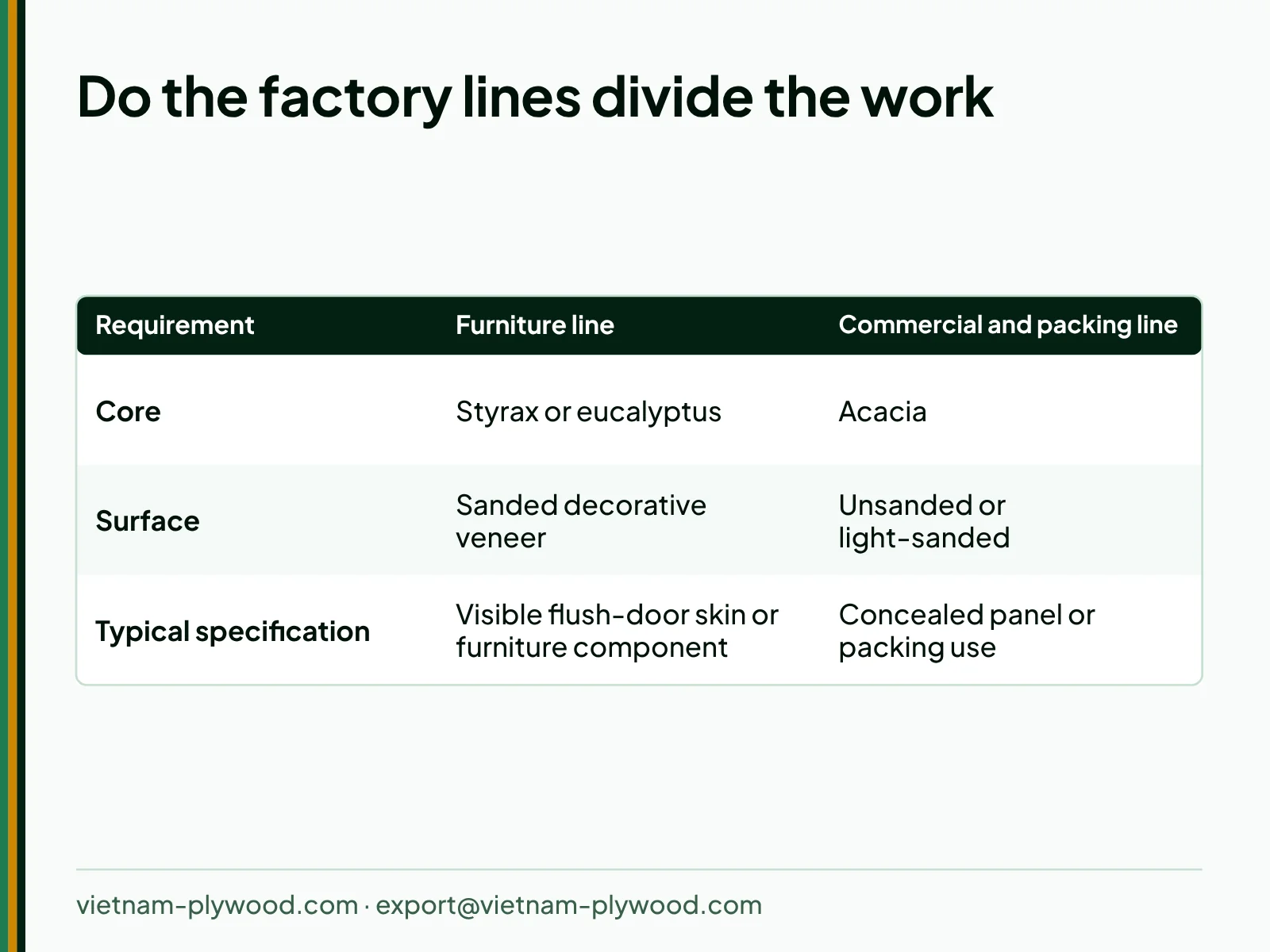
How do the factory lines divide the work?
Our furniture line is the preferred route for visible plywood door skins requiring sanded faces, full-stitched cores and a specified E0 or E1 emission class. The commercial line can supply acacia-core sheets for concealed or lower-finish components. Our construction line instead presses film-faced boards for formwork applications, not decorative door skins.
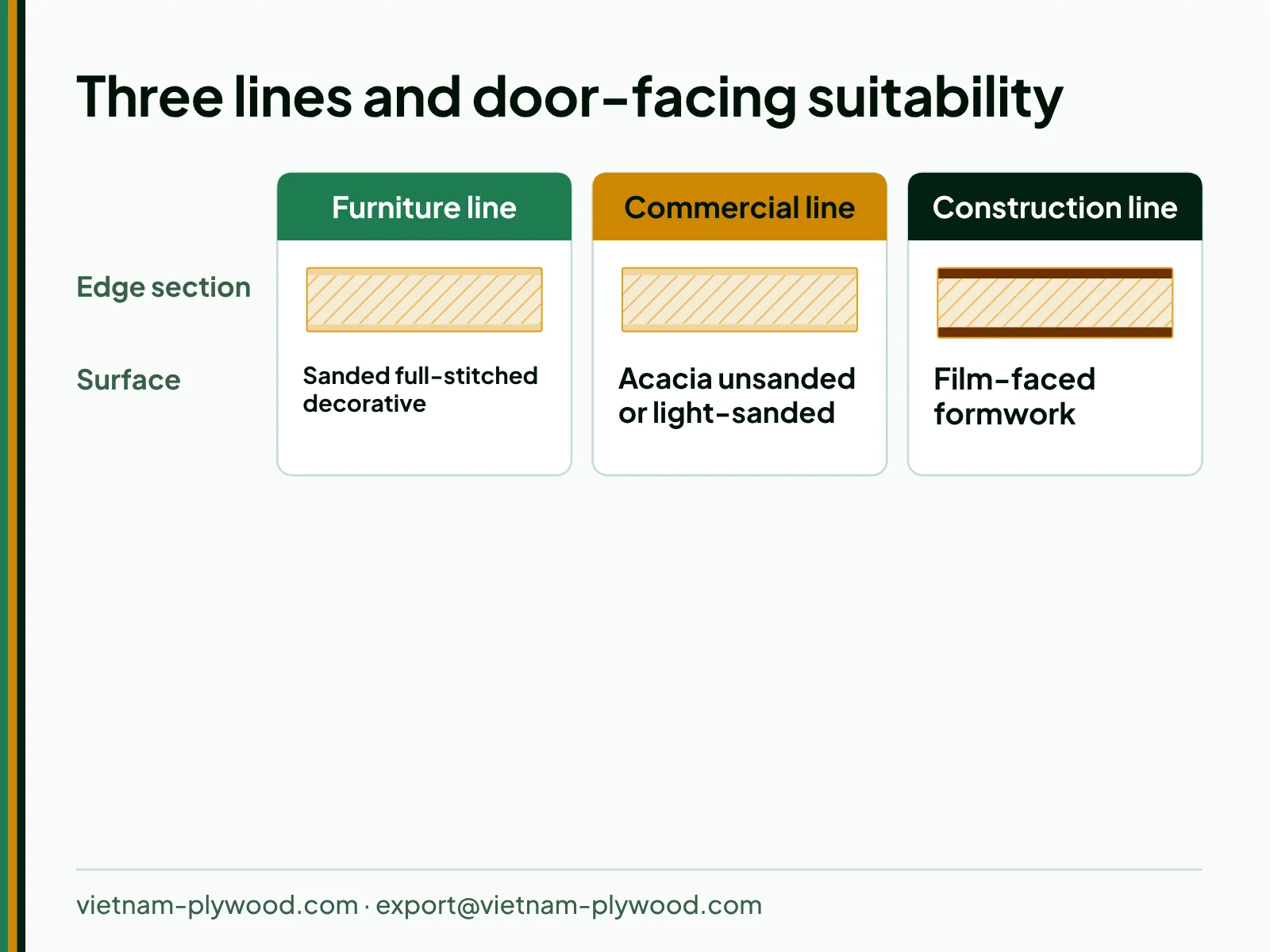
| Requirement | Furniture line | Commercial and packing line | Construction line |
|---|---|---|---|
| Core | Styrax or eucalyptus | Acacia | Acacia or eucalyptus |
| Surface | Sanded decorative veneer | Unsanded or light-sanded | Phenolic, melamine or anti-slip film |
| Typical specification | Visible flush-door skin or furniture component | Concealed panel or packing use | Formwork-facing panel |
| Thickness tolerance | ±0.2 or ±0.3 mm as ordered | ±0.5 mm commercial; ±0.5–1.0 mm packing | ±0.5 mm |
| Verdict for a visible door face | First choice | Only where finish trial accepts it | Different application |
HCPLY assigns production to the producing factory matched to the written build. This comparison prevents a surface specification intended for furniture from being treated as interchangeable with an industrial panel. See factory-line grade comparisons for the wider distinction.
Which glue and emission fields belong on the order?
Glue and formaldehyde emission class are separate specification fields. A furniture skin can be ordered with E0 or E1 as its emission class; the adhesive selection must be stated separately. Melamine adhesive is described as moisture-resistant (MR), with a 12-hour boil specification, while phenolic adhesive is described as weather-and-boil-proof (WBP), with a 72-hour boil specification.
For a US-bound order, the 2025 US Code of Federal Regulations, 40 CFR §770.10, sets a 0.05 parts-per-million formaldehyde limit for hardwood plywood with veneer or composite core. It applies to covered panels, components and finished goods, and the regulation includes third-party certification requirements. See the official 2025 regulation. An E0 or E1 label is not a substitute for a US Toxic Substances Control Act (TSCA) Title VI compliance document.
Member-factory FSC, CARB P2, ISO 9001 and CE certificates, where relevant to the agreed order, are shown with factory details masked, on request. For a regulated destination, the buyer should state the accepted certificate and test-report scope before production. The order’s emission certificate and agreed test reports are part of its shipment documentation.
Can door skins and door-core panels share a container?
Yes. The minimum order is one 40HC, and one container can carry several specifications as long as the payload limit holds. The 40HC payload limit is 28.5 t. Door-skin pallets and thicker door-core pallets can therefore share a shipment when the pallet plan and combined weight are checked against that limit.
For a 1220×2440 mm reference sheet, 3 mm styrax-core plywood weighs 4.47 kg; 18 mm styrax-core plywood weighs 26.79 kg. At full single-specification loads, the published reference is 5,994 sheets and 26.76 t for 3 mm styrax, versus 990 sheets and 26.52 t for 18 mm styrax. These are separate full-load reference configurations, not quantities to add together.
A mixed-load illustration uses ten pallets of 3 mm styrax panels at 333 sheets per pallet and eight pallets of 18 mm styrax panels at 55 sheets per pallet. That is 3,330 skins plus 440 thicker panels. Using the reference sheet weights, 3,330 × 4.47 kg + 440 × 26.79 kg = 26,674.7 kg, below 28,500 kg. This is a weight illustration, not a confirmed stowage drawing; the loading plan must also account for pallet dimensions and packaging.
For the complete load calculations and pallet rules, see container loading and packing. A mixed specification should show each pallet’s thickness, face, core, count and gross weight on the packing list. That makes receiving checks possible without opening every pallet.
How is door-skin flatness checked at the factory?
The buyer or appointed inspector can witness a flatness check on sampled door skins at the producing factory before loading. The check needs an agreed acceptance method because the task specification gives no universal flatness limit for this product. The inspector should record the measurement setup, sampled sheets and actual observations.
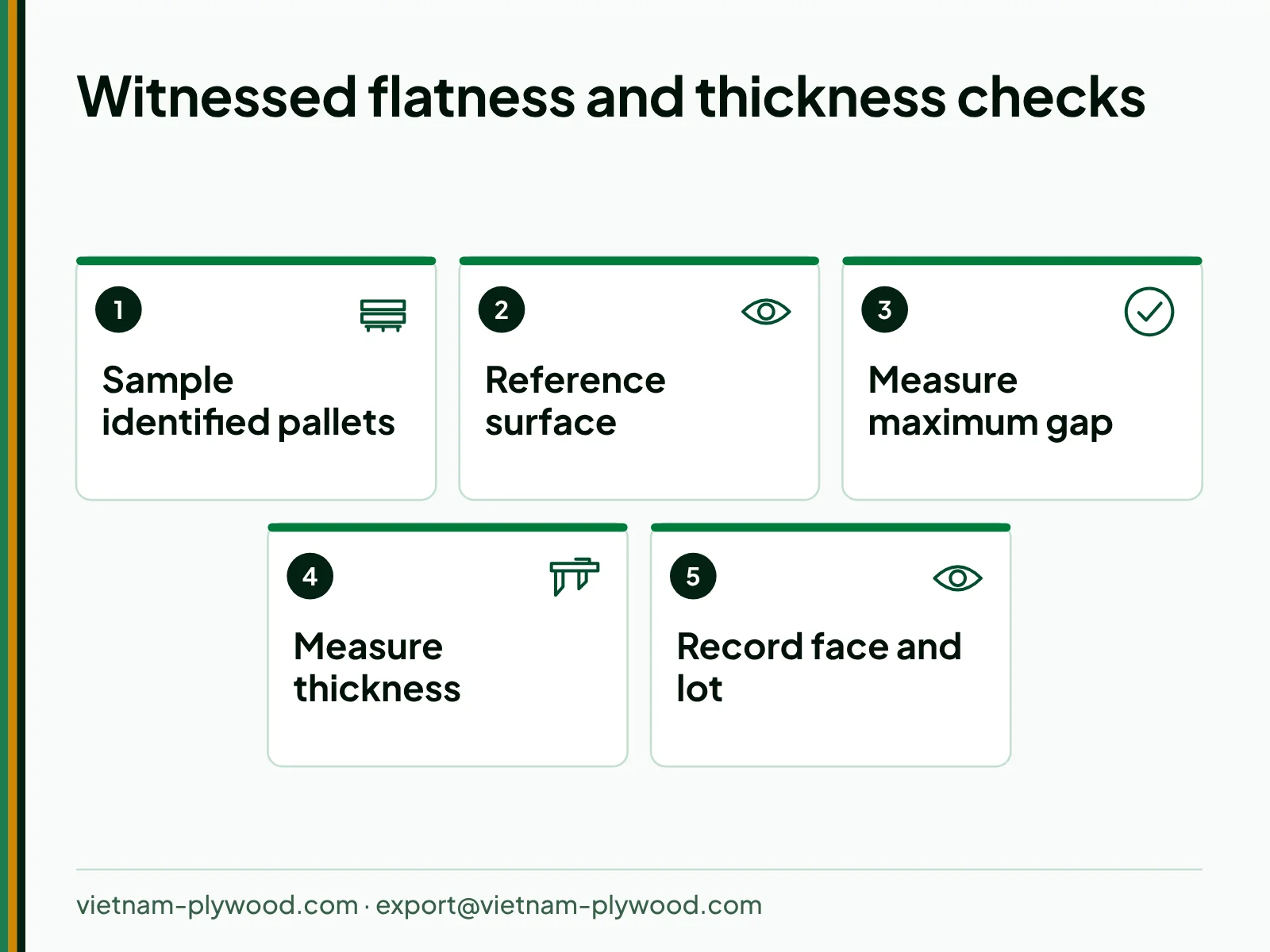
- Select samples from identified production pallets across the order rather than taking only the top sheet of one stack.
- Place each sample on the agreed reference surface and let the inspector observe any bow, twist or local lift.
- Use the buyer-approved straightedge or measurement fixture and record the greatest observed gap at the specified locations.
- Measure thickness at agreed points and compare with the ordered ±0.2 mm or ±0.3 mm furniture tolerance.
- Inspect face veneer continuity, repairs, grain orientation and visible finish defects against the approved face-grade sample.
- Mark the pallet and sample references in the inspection record; review results before loading release.
Flatness, moisture and finish compatibility are different checks. A panel that passes a thickness measurement can still be unsuitable for a particular door press if its surface or shape does not meet the buyer’s acceptance method. Agree the flatness test fixture and rejection threshold in writing before the production lot is pressed. For receipt-side evidence, see plywood storage and receiving claims.
What drives door skin plywood price?
Face selection and appearance grade usually lead the quotation discussion, followed by core construction, surface preparation, tolerance and cutting requirements. An EV pattern with strict matching or a selected natural-veneer face requires more face control than a broad-appearance acceptance range. A sanded full-stitched furniture build costs more to prepare than a loose-laid, unsanded commercial build because its veneer assembly and surface finishing involve more work.
A tighter thickness band requires closer process control than a wider band. Custom cutting adds another operation and changes the yield from the parent sheet. The glue specification, emission documentation, packing arrangement and mixed-order quantities also change the commercial specification. A buyer should request a price against the written face, grade, size, tolerance, core and destination rather than comparing two unqualified sheet prices.
There is no published door-skin-specific from-price in this specification. HCPLY quotes door skin plywood price against the agreed build. The order can use FOB Hai Phong, cost and freight (CFR/CNF) or cost, insurance and freight (CIF) delivery terms. For programme planning, see plywood supply programmes for distributors.
What goes into the shipment documents?
The packing list identifies the mixed panel quantities and pallets, while the commercial invoice records the ordered product descriptions. The bill of lading (B/L) supports the shipment record; the certificate of origin and any order-specific certificates support destination requirements. For European Union lots, the document set includes EUR.1 where applicable and the EUTR/EUDR file set.
Phytosanitary and fumigation papers accompany the shipment, with insurance documents under CIF. Agreed FSC claims appear on sales documents when included in the order, alongside the emission certificate and test reports for the agreed build. After loading, the draft shipping documents come to you for approval.
HCPLY manages specification, on-site quality control, export papers and loading. Buyers can inspect goods at the factory office and producing site in Phu Tho or Hai Phong. Shipment is dispatched directly from the producing factory, with FOB Hai Phong available.
What should a door maker verify before approving samples?
Approve the face under the actual finishing process, then check thickness, flatness and dimensional fit against the door-maker’s press. A natural face that looks acceptable unfinished can behave differently after staining. Likewise, a repeatable EV pattern still needs an approved direction and a matched visual reference.
Ask for both the thin skin and the intended door-core panel samples if the finished assembly uses both. Record the adhesive and emission requirement for each panel, rather than copying a specification from one component to another. For cabinet-facing alternatives, compare the kitchen cabinet plywood specification and its surface expectations.
For a repeat purchase, retain the signed sample description and inspection method with the purchase order. That gives the producing team a measurable acceptance target and the receiving team a matching reference.
How do you send a door-skin specification?
Send the door application, veneer face, finished thickness and inspection criteria together. A clear request lets Lucy match the face and core to the correct production line, then prepare samples that correspond to the proposed order. Include the destination port and mixed-pallet plan if door skins will ship with thicker panels.
Application: flush-door outer skin plus flat door-core components
Line or core: furniture line; styrax core for skins and specified core for thicker panels
Glue: melamine MR or phenolic WBP, selected per component
Emission: E0 or E1; destination-specific documents identified separately
Face and grade: okoume / bintangor / EV; A/B; approved finish sample
Thickness and tolerance: 3 mm skin ±0.2 mm; 18 mm core ±0.3 mm
Size: 1220×2440 mm; grain direction and cut plan attached
Quantity: skin pallets and core pallets listed separately; one 40HC
Destination port: [insert destination port]
Ask Lucy at contact or export@vietnam-plywood.com for a sample set covering the chosen face and matching door-core build.