





What is the best plywood for cabinet doors?
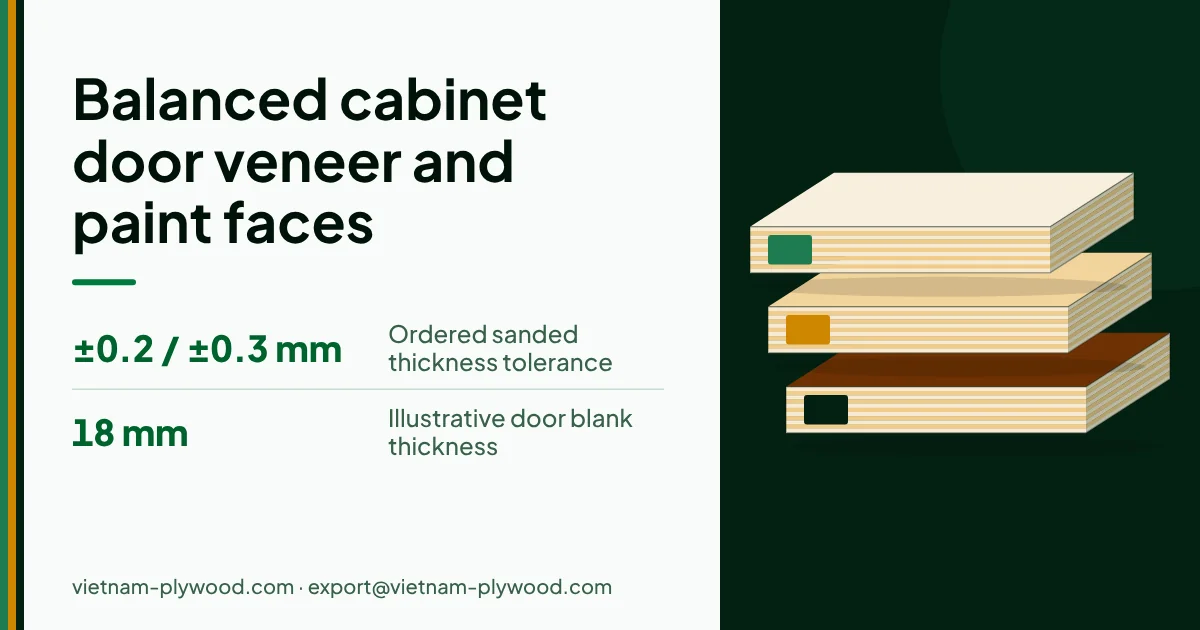
The best plywood for cabinet doors is a balanced, sanded furniture panel specified for the final finish and door dimensions. Choose a matched decorative veneer pair for clear-coated fronts or a smooth, matched pair for painted fronts. Core construction, face balance, flatness acceptance and finishing practice matter more than a species name alone.
At HCPLY, our furniture line presses styrax- or eucalyptus-core panels with full stitched construction and sanded surfaces. We discuss the front and reverse as a pair before selecting the decorative face. A front that looks attractive on a sample can still become a rejected door when its reverse pulls differently or the sheet bows after cutting.
For the wider cabinet build, see kitchen cabinet plywood. Door fronts need their own visual and flatness checks, while cabinet carcass plywood is selected around joints, shelves and concealed surfaces. Our furniture plywood is the starting specification for door blanks.
Veneer-grade versus paint-grade: what changes?
Veneer-grade fronts show the wood face; paint-grade fronts rely on a smooth substrate beneath an opaque coating. Both need balanced construction and a declared acceptance standard for the finished surface.
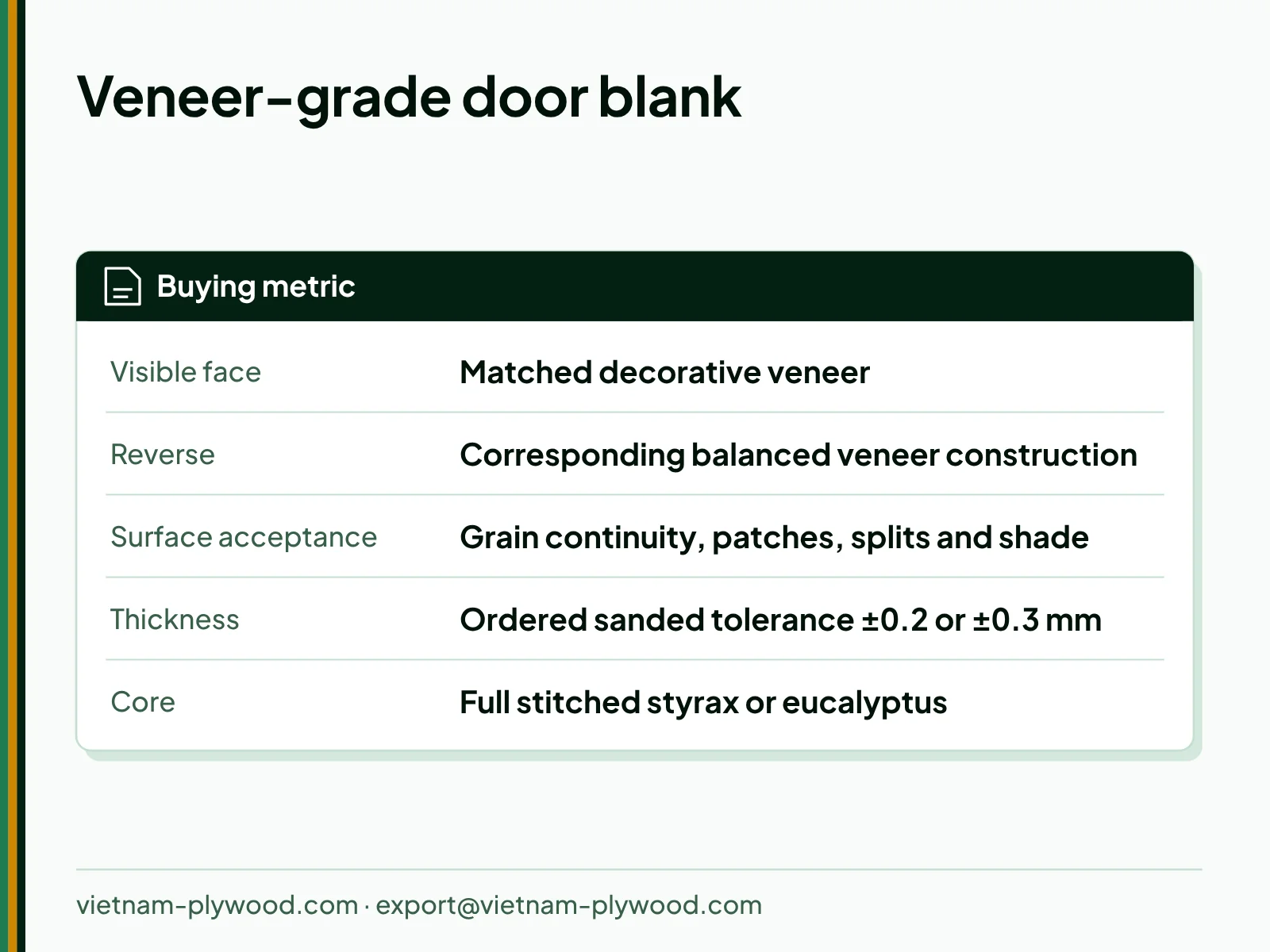
| Buying metric | Veneer-grade door blank | Paint-grade door blank | Verdict by use |
|---|---|---|---|
| Visible face | Matched decorative veneer, agreed colour and grain | Smooth sanded face with defects controlled for coating | Veneer-grade for transparent finishes; paint-grade for opaque paint |
| Reverse | Corresponding balanced veneer construction | Corresponding balanced backing face | Both require comparable face build |
| Surface acceptance | Grain continuity, patches, splits and shade | Sanding marks, patches, depressions and paint telegraphing | Inspect under the intended finish |
| Thickness | Ordered sanded tolerance ±0.2 or ±0.3 mm | Ordered sanded tolerance ±0.2 or ±0.3 mm | Same machining requirement |
| Core | Full stitched styrax or eucalyptus | Full stitched styrax or eucalyptus | Select against weight and machining needs |
| Finish trial | Clear-coat or stain sample | Primer and topcoat sample | Approve a finished coupon before production |
Bintangor, okoume, engineered veneer (EV), sapele and other listed decorative faces can be discussed for visible wood fronts.
Our common face veneer thickness is 0.2–0.4 mm. Face grades are A/B for the listed faces, while birch faces use D/E/F designations. Those labels do not replace an approved visual sample or a written list of permitted repairs. For birch-faced cabinet specifications, distinguish birch face from birch core: we do not press birch-core plywood.
Why are both faces of a door panel built alike?
Both faces are built alike to reduce unequal movement through the panel when moisture or coating conditions change. A decorative front with a materially different back can develop a bending force, especially after cutting into narrow doors.
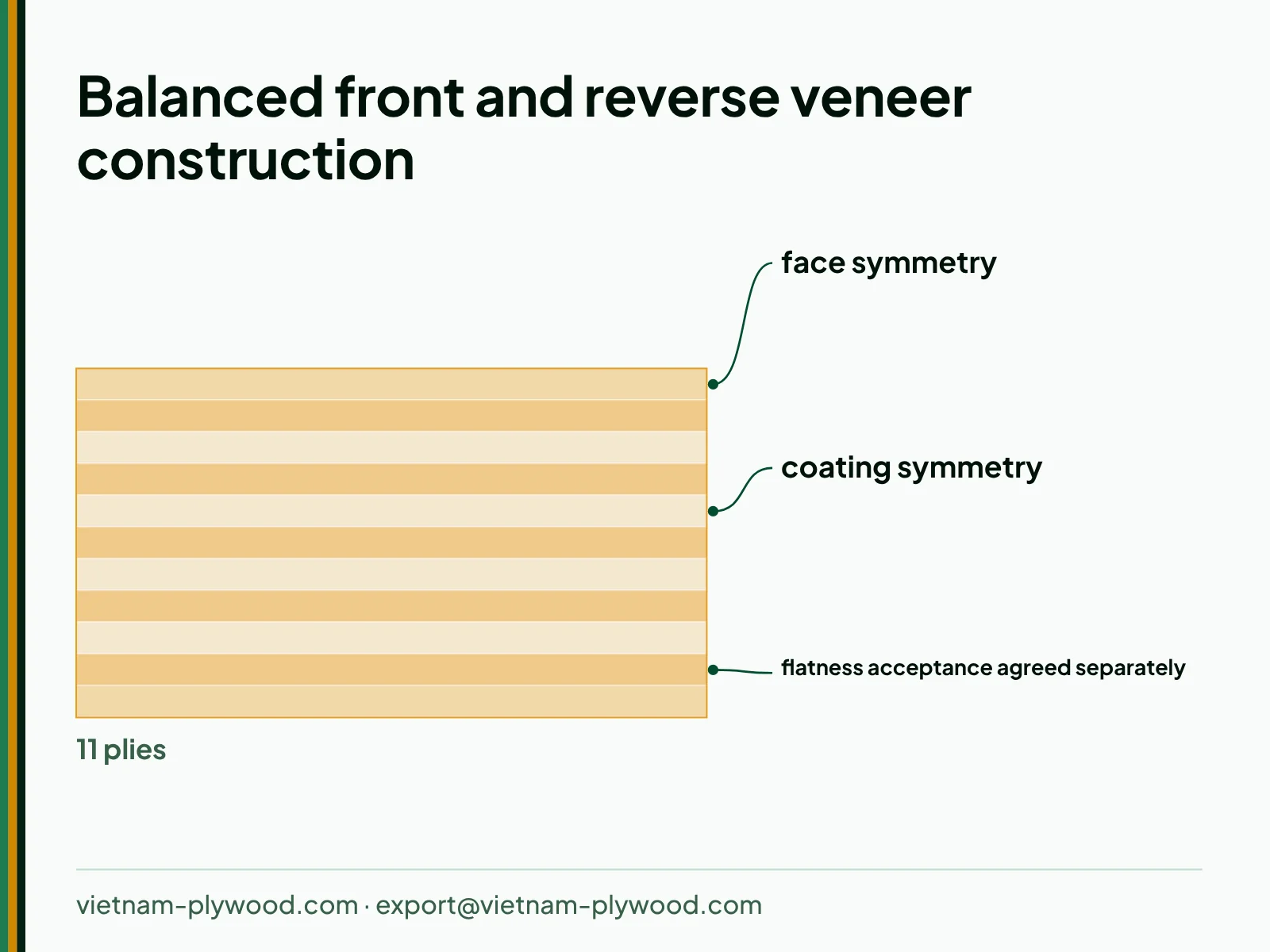
Balanced construction means agreeing the face species or comparable veneer structure, veneer thickness, orientation and finishing schedule on both sides.
The core also matters. Full stitched construction places joined veneers through the panel; gaps and discontinuities in a loose-laid core can appear as local weakness or surface irregularity. For 18 mm sheets, the core veneer thickness of 1.4–2.0 mm gives 11–13 plies, depending on the actual build. A buyer can request a cut-edge sample to see the arrangement.
Coating balance continues after pressing. When a cabinet maker coats the visible side heavily and leaves the reverse untreated, the finished door may respond differently to changing humidity. Specify the reverse coating schedule in the fabrication drawing and test it with production-size blanks.
What flatness specification should be agreed before loading?
Agree a measurable maximum bow or twist, the panel dimensions, support method and inspection conditions before loading. HCPLY has no published flatness limit for cabinet doors in this brief, so the numerical acceptance value belongs in the buyer-approved purchase specification.
A useful protocol identifies whether inspection is on the full sheet or a cut door blank. Lay the sample on a verified flat reference surface, record the largest gap under a straightedge, and document the location and orientation. Record the units in millimetres and keep the measurement photographs with the lot inspection record.
If a buyer sets a tolerance only after loading, the factory and receiving shop can measure different things and reach different conclusions.
Thickness tolerance is separate from flatness. Our sanded furniture panels are ordered at ±0.2 or ±0.3 mm thickness tolerance; length and width tolerance is ±2 mm. Neither figure is a bow or twist limit. Ask the inspector to record thickness and flatness as different checks.
Which factory line builds a cabinet door blank?
Our furniture line builds the balanced sanded door blank; the other lines are configured for different end uses. A common nominal thickness can therefore describe three different products.
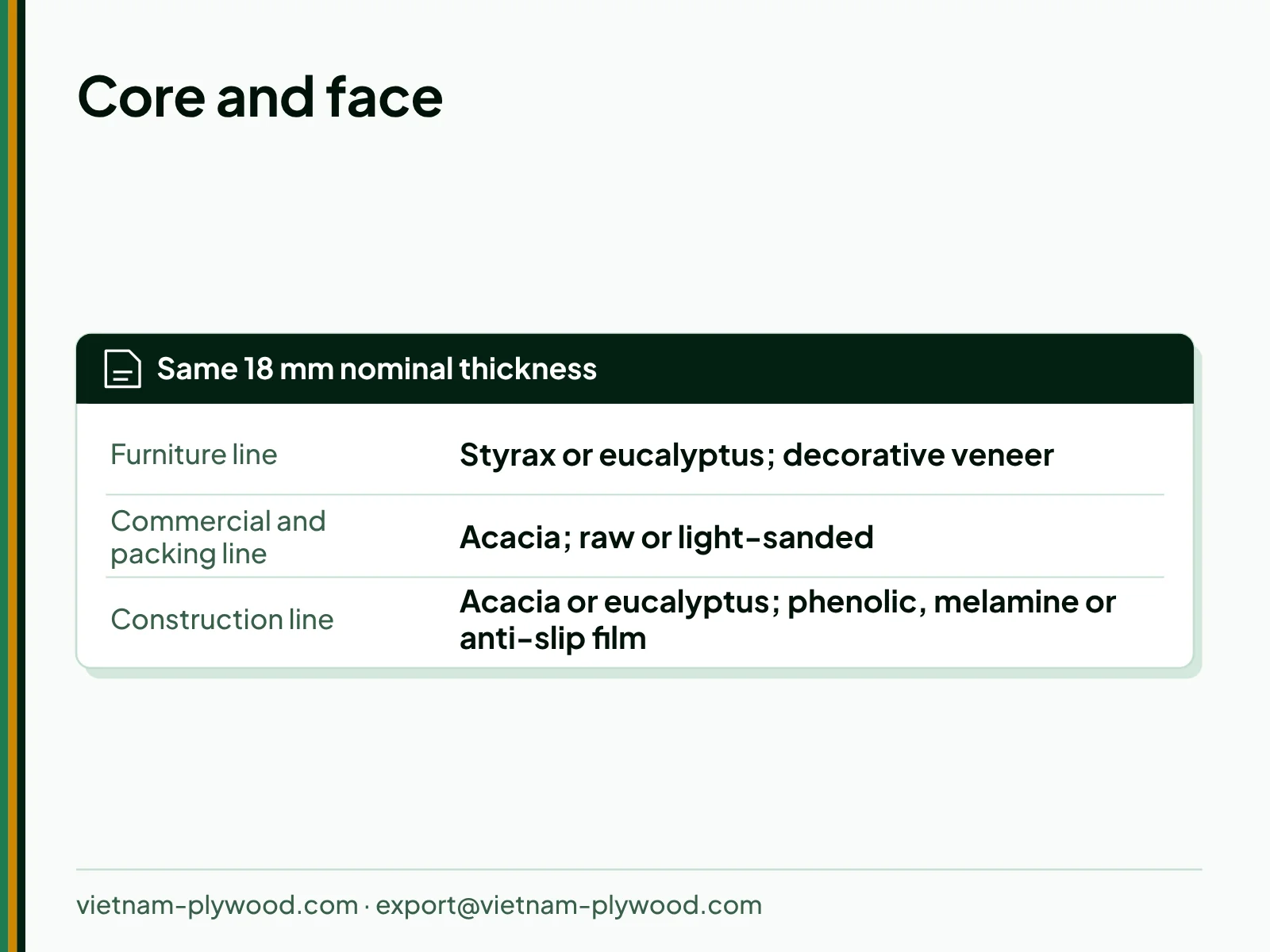
| Same 18 mm nominal thickness | Core and face | Surface and tolerance | Suitable order |
|---|---|---|---|
| Furniture line | Styrax or eucalyptus; decorative veneer | Full stitched, sanded, ±0.2 or ±0.3 mm as ordered | Veneered or painted cabinet fronts |
| Commercial and packing line | Acacia; raw or light-sanded | MR glue, commercial ±0.5 mm; packing ±0.5–1.0 mm | Packing or commercial panels, not the preferred visible door blank |
| Construction line | Acacia or eucalyptus; phenolic, melamine or anti-slip film | Unsanded, film-faced ±0.5 mm | Formwork surfaces rather than furniture fronts |
This comparison prevents a common purchasing mistake: treating an 18 mm label as a complete specification. Our three factories in Phu Tho and Hai Phong make their respective builds, and each order ships directly from the producing factory. HCPLY manages specification, on-site quality control, export papers and loading.
How do plywood cabinet doors stay flat after delivery?
Cabinet doors stay flatter when balanced panels are conditioned, cut, sealed, finished and stored consistently with the approved sample. The pressing specification is the starting point; handling and finishing complete the system.
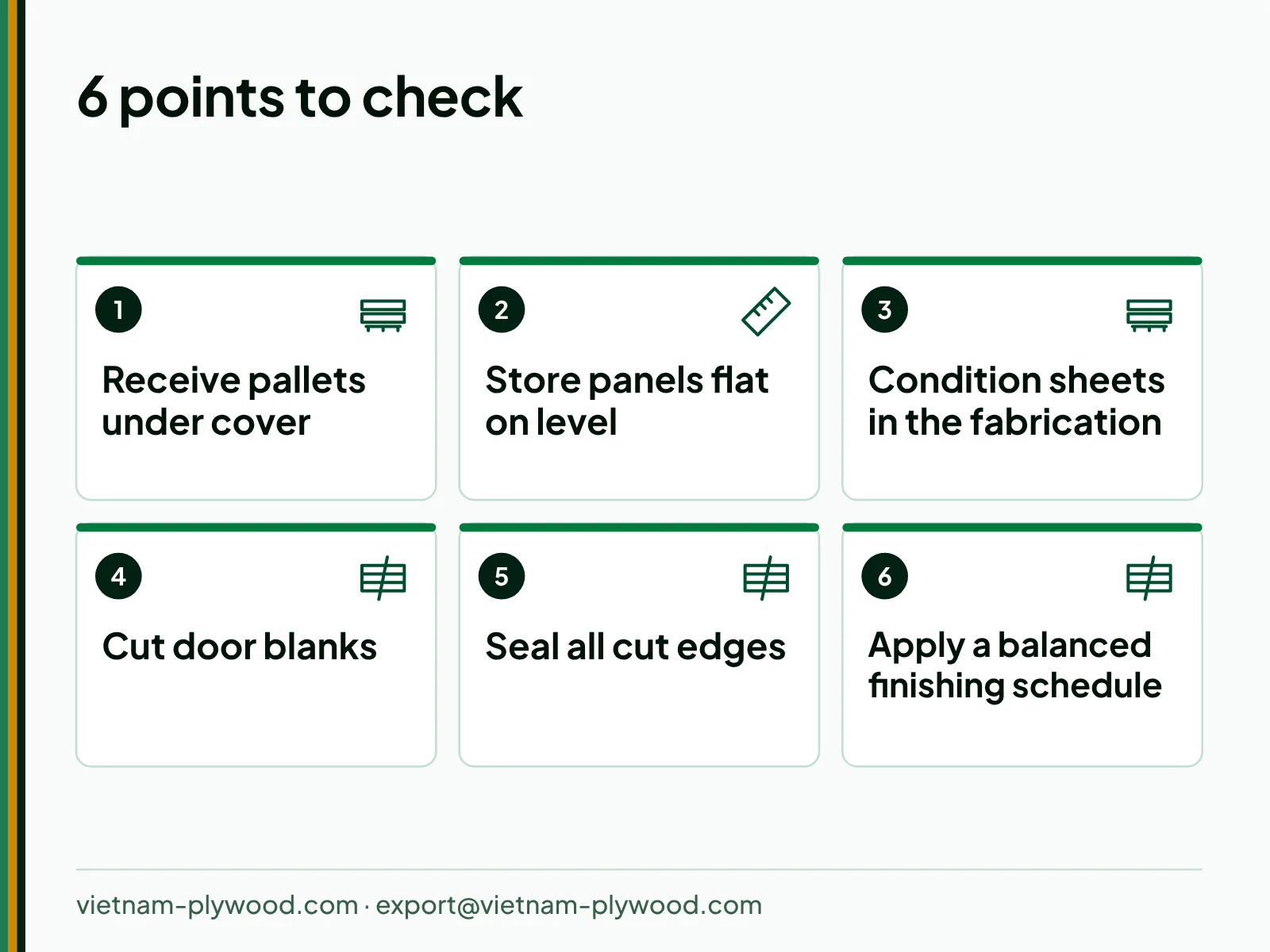
- Receive pallets under cover and inspect packaging for water exposure or impact before opening.
- Store panels flat on level supports, protected from direct wetting and uneven heat.
- Condition sheets in the fabrication environment using a schedule agreed for the destination workshop.
- Cut door blanks with a documented grain orientation and inspect bow and twist again after cutting.
- Seal all cut edges and machine openings using the approved finishing system.
- Apply a balanced finishing schedule to front and back, then recheck finished doors before fitting hardware.
Our furniture line has E0/E1 emission options, while glue and emission class are recorded as separate specification fields.
Where repeated moisture exposure is expected, the fabricator should run a finish and edge-seal trial on the actual door profile. The related bathroom vanity plywood discussion addresses a more moisture-exposed cabinet application.
Is a decorative veneer, laminate or melamine surface better?
A decorative veneer suits a visible wood finish; high-pressure laminate (HPL) and melamine are different surface systems with their own balancing requirements. Our furniture line supplies veneer-faced plywood blanks, while HPL, laminate and melamine faces are topics for comparison rather than HCPLY product lines.
For plywood kitchen cabinet doors with an opaque painted finish, a smooth veneer-faced blank can be coated by the cabinet maker. A clear-finished door instead needs approved face grain, colour and visible repairs. Laminate surfaces can offer a factory-made decorative layer, but specifying a laminate product also means specifying its backing and bonding process.
Medium-density fibreboard (MDF), oriented strand board (OSB), chipboard and blockboard are separate panel categories; we do not press them.
Which glue and emission documents belong on the order?
State the adhesive system and formaldehyde emission requirement as separate fields on the order. Melamine glue is MR with a 12-hour boil specification; phenolic glue is WBP with a 72-hour boil specification. E0, E1 and E2 are emission classes, not glue names.
For United States shipments, the 2025 U.S. Code of Federal Regulations, 40 CFR §770.10, specifies a 0.05 parts-per-million formaldehyde limit for hardwood plywood with a veneer or composite core under the prescribed test method. See the official 2025 regulation. The U.S. Environmental Protection Agency also describes third-party certification and labelling under TSCA Title VI in its rule summary.
For a U.S. order, request the applicable third-party emission certificate for the agreed factory build. FSC, CARB P2, ISO 9001, CE and EUTR/EUDR documents belong to member factories and are shown with factory details masked, on request. An emission certificate or agreed test report belongs among the order’s certificate documents, while the commercial invoice and packing list identify the shipped goods.
Can door blanks share a container with other panels?
Door blanks can share a 40HC container with other specifications within the 28.5 t payload limit.
At 1220 × 2440 × 18 mm, a styrax-core sheet weighs 26.79 kg and a full styrax configuration holds 990 sheets, 53.05 m³ and 26.52 t. The corresponding acacia-core figures are 31.08 kg per sheet, 880 sheets, 47.15 m³ and 27.35 t. Eucalyptus-core sheets weigh 34.83 kg each; the full configuration is 795 sheets, 42.60 m³ and 27.69 t.
For example, 500 styrax-core sheets weigh 13.395 t using the listed sheet weight. Another 400 acacia-core sheets weigh 12.432 t, giving 25.827 t before pallets and packing materials.
The full sheet-count method belongs to container packing. A mixed specification can be useful when an importer needs door blanks and commercial panels, but the furniture finish and core cannot be inferred from the other product’s pallet label.
What drives the quotation for plywood cabinet doors?
Face selection, face matching and core construction are the first quotation drivers, followed by thickness, sanding tolerance, size and order mix. A matched decorative veneer pair costs more to select and prepare than a less appearance-sensitive paint substrate; tighter visual sorting adds work.
Full stitched furniture construction also calls for more core preparation than a loose-laid packing build. A transparent finish often raises the importance of face consistency; an opaque finish shifts attention toward coating defects and surface preparation.
Furniture plywood has an indicative starting price of from US$350/m³ FOB Hai Phong (October 2026). This is a starting reference for furniture plywood, not a fixed cabinet-door grade quotation. Send the finish sample, dimensions, face pairing and inspection criteria to obtain a written quotation for the proposed build.
The minimum order is one 40HC, and one container can carry several specifications as long as the payload limit holds. Factory lead time runs 15–45 days from receipt of the 30% deposit; the exact figure depends on order size, line loading and what the contract fixes. The remaining 70% is paid on the scan of the bill of lading, by T/T, or by irrevocable sight L/C. We ship FOB Hai Phong, or CFR (CNF) or CIF to your port.
What should an inspector witness at the producing factory?
An inspector should compare the approved finished sample with both faces, the cut edge, thickness readings and flatness measurements on identified lots. The visit should include a clear record of which tests occur before loading.
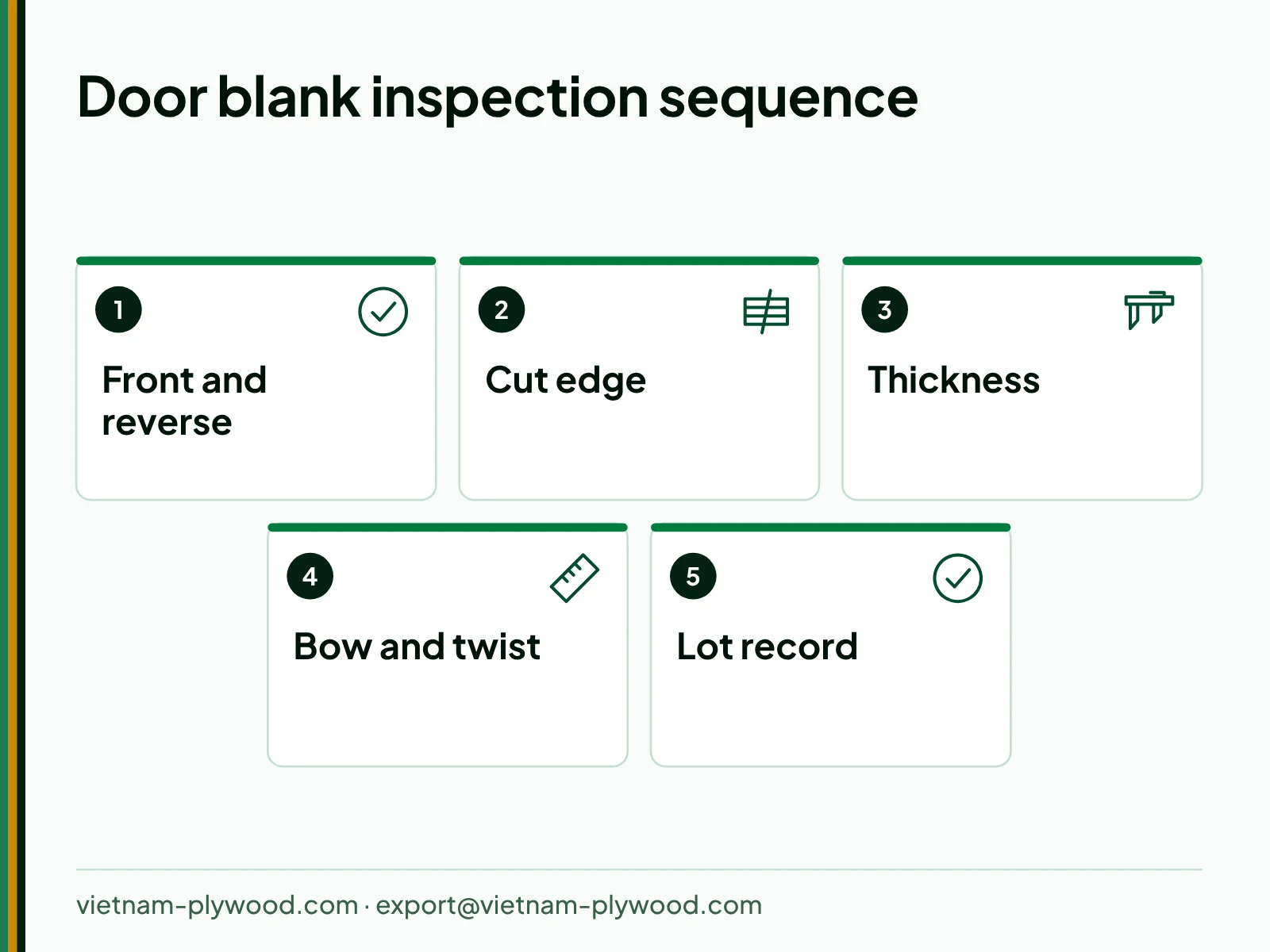
At the producing factory, the buyer can witness face grading under consistent lighting, inspect core joints on a cut edge, and compare the front and reverse veneer arrangements. A caliper check verifies the ordered thickness tolerance. The agreed straightedge or flat-reference protocol records bow and twist without confusing those values with thickness variation.
Record panel size, lot identity, sampling method, measurement position and the result for each checked sheet. Keep retained samples of the accepted veneer or paint trial, including its reverse face.
Buyers visit the factory office and inspect goods at the producing factory. After loading, the draft shipping documents come to you for approval. The single export document set includes commercial invoice, packing list, bill of lading (B/L), certificate of origin, relevant phytosanitary and fumigation papers, and order-specific certificates; insurance is included under CIF, with EUR.1 and EUTR/EUDR files for applicable EU lots.
What specification should a cabinet maker send?
Send the intended finish, balanced face construction and measurable flatness protocol alongside the usual panel dimensions. A drawing of the door blank and an approved coating coupon make the surface requirement easier to inspect.
For plywood cupboard doors, identify the visible side, reverse side, edge treatment, hardware machining and finished dimensions.
HCPLY can discuss a sample set with Lucy at export@vietnam-plywood.com. Samples cost nothing: a first-time buyer pays the courier, and that charge comes off the first confirmed order. Send the following lines with the drawing and the proposed flatness test protocol.
Application: cabinet door blanks; veneer-grade clear finish / paint-grade opaque finish
Line or core: furniture line; full stitched styrax / eucalyptus
Glue: melamine MR / phenolic WBP, as specified
Emission: E0 / E1; destination-specific documents as required
Face and grade: matched front and reverse; species and A/B grade as agreed
Thickness and tolerance: 18 mm; sanded ±0.2 mm / ±0.3 mm as ordered
Size: 1220 × 2440 mm sheets or approved cut dimensions
Flatness: maximum bow/twist, method, sampling and conditions to be agreed in writing
Quantity: one 40HC minimum; item quantities by specification
Destination port: [buyer to enter]
Request a sample set through contact before finalising the production specification.