





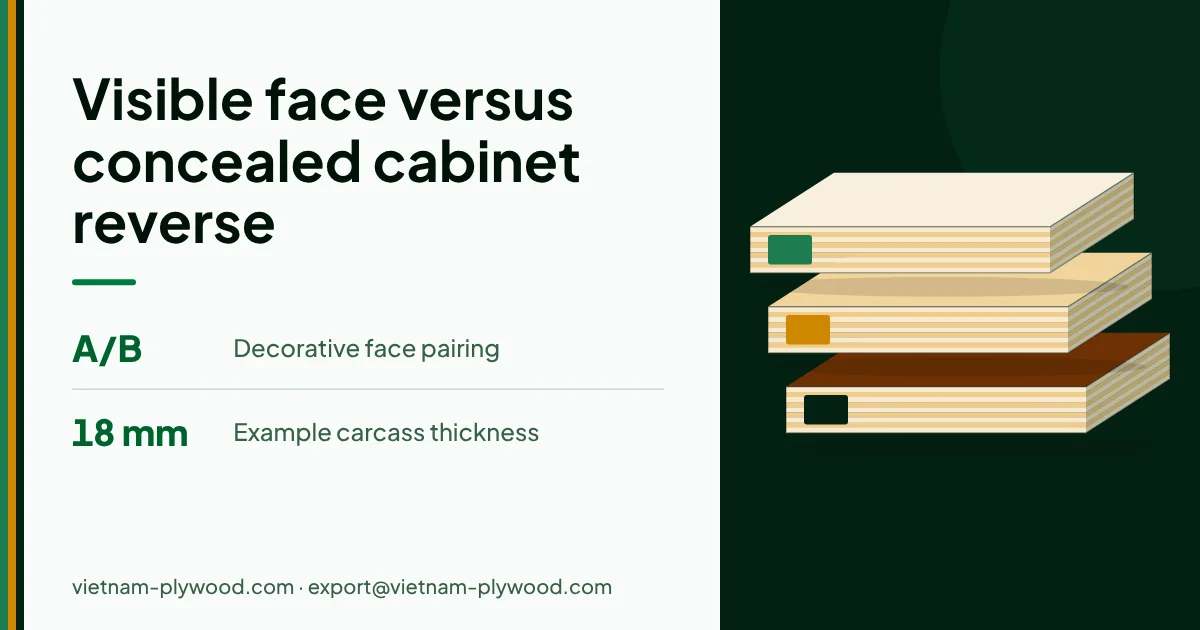
Plywood for cabinet boxes should put a smooth, attractive veneer toward the visible interior and a lower face grade against the hidden wall. Choosing identical premium faces everywhere raises material cost; choosing a rough panel for an exposed interior can cause finishing rework or rejection. HCPLY builds the visible carcass on our furniture line and can add less decorative backs and bases from our commercial and packing line.
What plywood for cabinet boxes should a maker specify?
For plywood for cabinet boxes, start with the surfaces a customer sees when opening a door, then specify the core, thickness and joinery separately. A sanded furniture panel with an A face toward the interior and a B reverse toward the concealed exterior is the starting build. Put backs and concealed bases on a separate specification where their function permits.
For the wider selection of decorative panel and application options, see kitchen cabinet plywood. For exposed doors, use the separate cabinet door plywood specification; door flatness and face matching deserve their own decision.
A visible interior needs a face that suits the buyer’s coating and color acceptance sample. A hidden face still needs intact bonding, usable edges and a stable core. Face grade is a visual sorting decision; it does not substitute for a sound inner construction.
What is a good-one-side cabinet carcass build?
A good-one-side build is a panel with the better veneer on the cabinet’s visible interior and the lower visual grade on its concealed reverse. Our furniture line uses styrax or eucalyptus core, full stitched construction, sanding and E0 or E1 emission classes. A/B is the face-grade pairing to discuss for this application.
Specify which surface faces the room or cupboard interior on the cutting drawing. For an end panel visible from outside, both sides may be seen, so the one-good-side saving disappears. Open shelving, glass-front cabinets and island ends deserve their own finish schedule rather than an automatic A/B assignment.
HCPLY offers bintangor, okoume, engineered veneer (EV), gurjan, pine, poplar, eucalyptus, birch and sapele face choices. The face names the product; the core sets its density. Common face veneer thickness is 0.2–0.4 mm. Birch face grading uses D/E/F rather than the A/B vocabulary used for the other listed faces, so write a separate approved appearance sample for birch.
HCPLY supplies plywood panels; melamine, high-pressure laminate (HPL) and other laminate faces are topics to specify with a downstream laminator, not an HCPLY panel line.
Which factory line belongs to each cabinet part?
Our furniture line presses the sanded, stitched cabinet body; the commercial and packing line builds lower-finish acacia panels for suitable concealed components. Our construction line presses film-faced panels for formwork, rather than decorative cupboard interiors. These are different builds even when the nominal thickness matches.
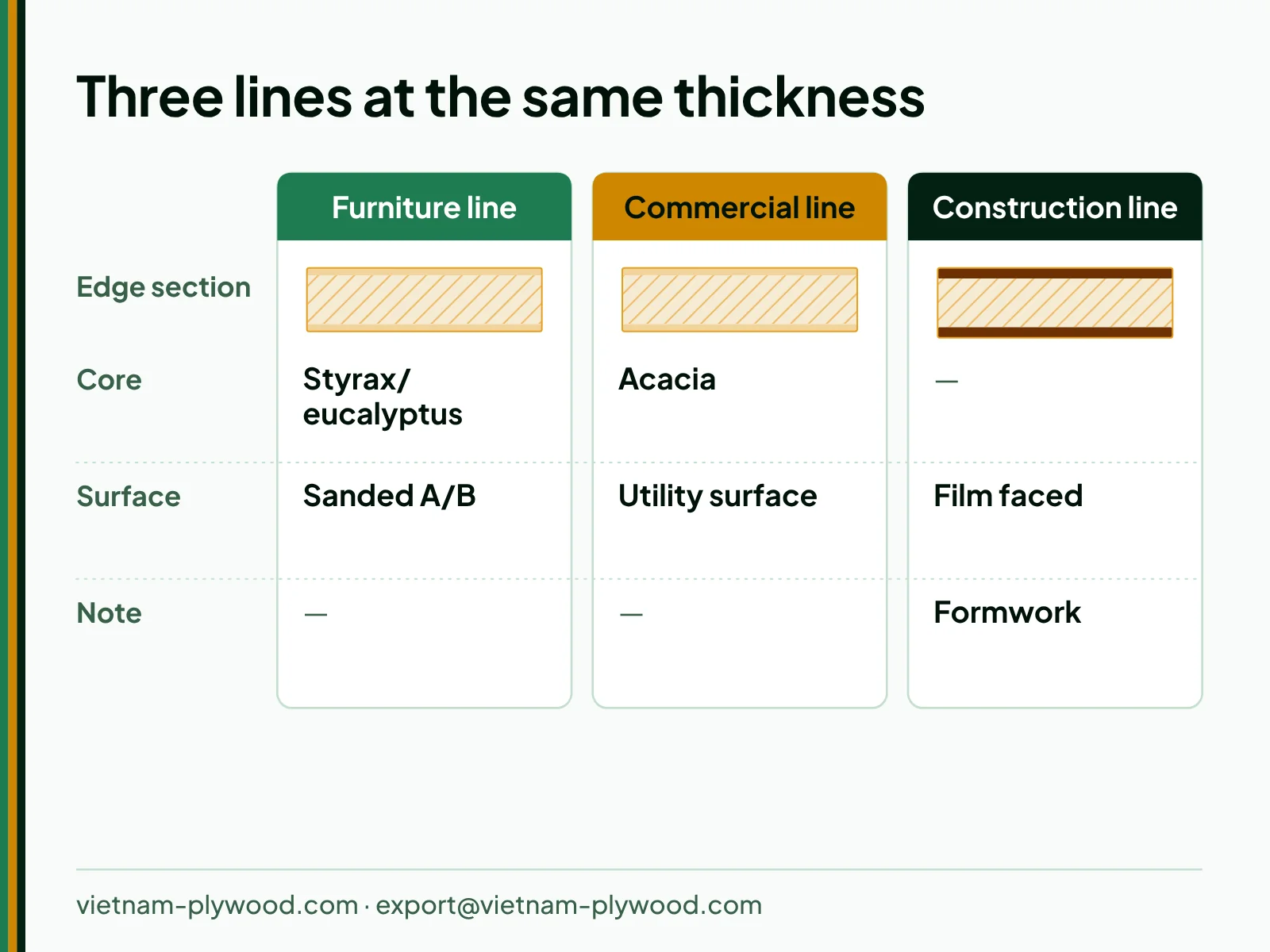
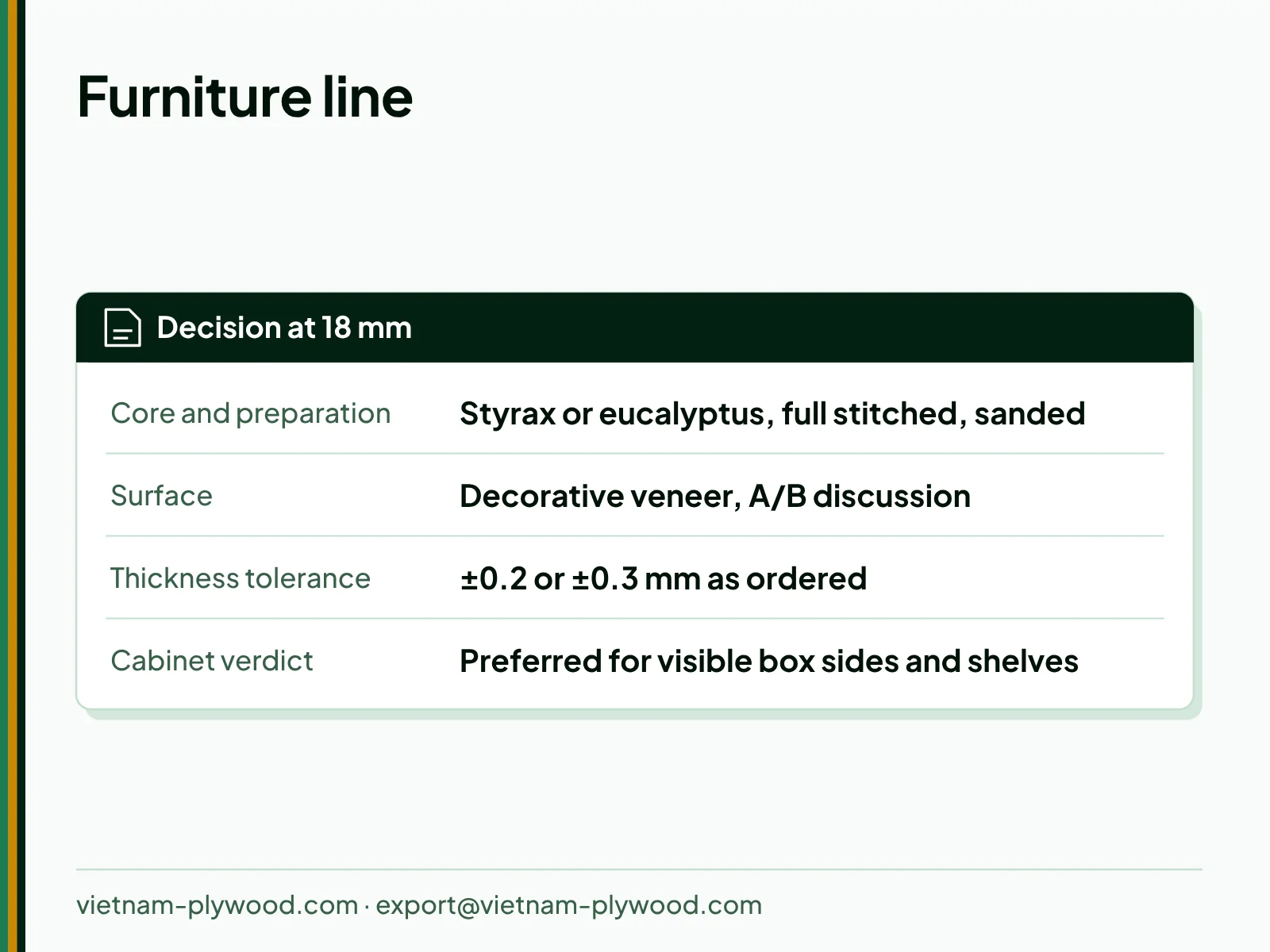
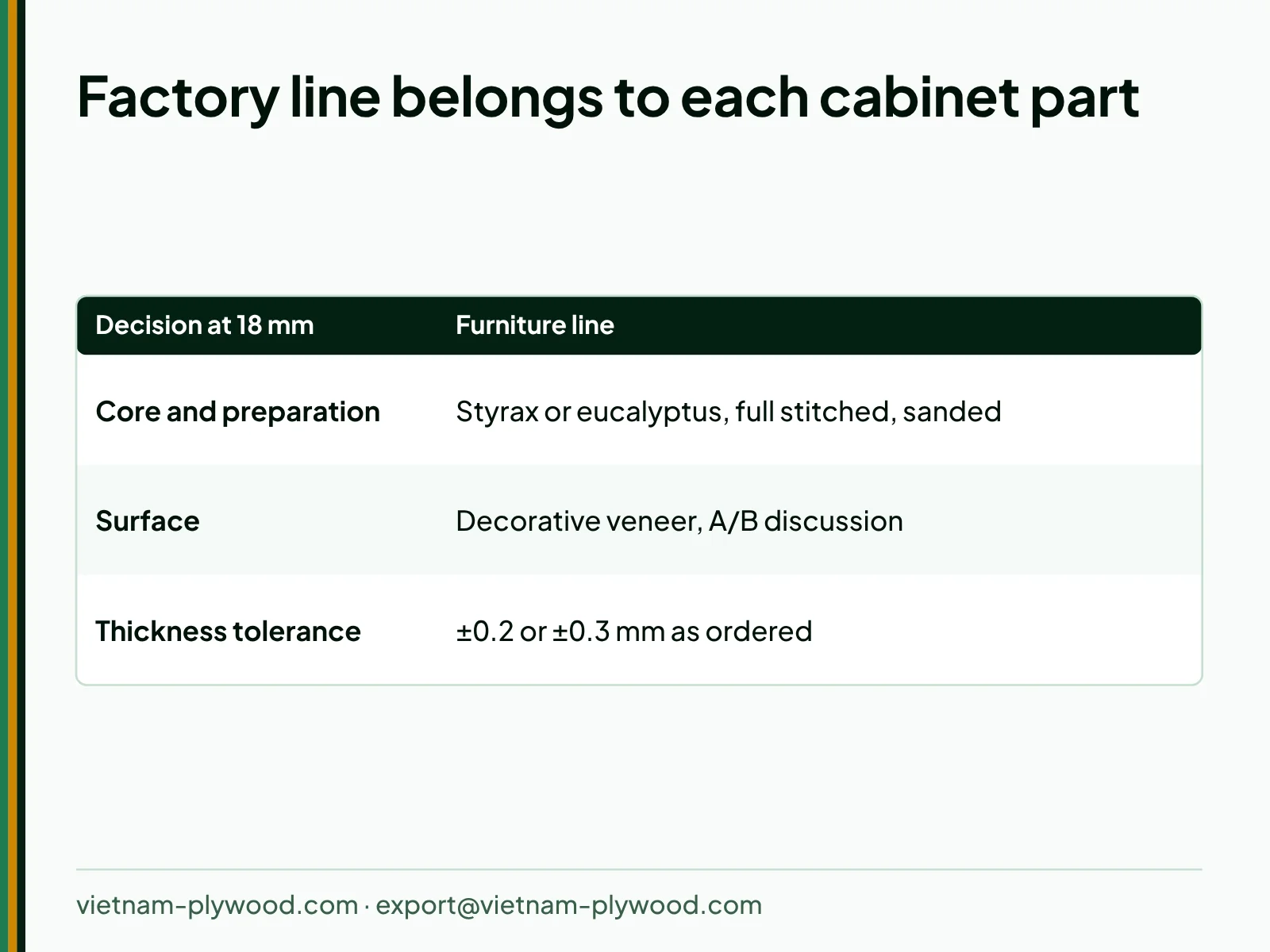
| Decision at 18 mm | Furniture line | Commercial and packing line | Construction line |
|---|---|---|---|
| Core and preparation | Styrax or eucalyptus, full stitched, sanded | Acacia, unsanded or light-sanded | Acacia or eucalyptus, unsanded |
| Surface | Decorative veneer, A/B discussion | Raw utility face | Phenolic or melamine film |
| Thickness tolerance | ±0.2 or ±0.3 mm as ordered | ±0.5 mm; packing ±0.5–1.0 mm | ±0.5 mm |
| Cabinet verdict | Preferred for visible box sides and shelves | Consider for concealed backs or bases after functional checks | Not selected for ordinary cabinet boxes |
Our three factories are in Phu Tho and Hai Phong. Each order is produced at the factory matching the specification and shipped directly from the producing factory, FOB Hai Phong. HCPLY handles specification, on-site quality control, export documents and loading.
Which grade can hidden faces and drawer sides drop to?
A concealed carcass reverse can drop from an A appearance face to B where the approved sample accepts B characteristics. Drawer sides can use a less decorative face when their visible edges and inner surfaces still pass the buyer’s finish standard. Do not downgrade the core solely because the veneer is hidden.
Full stitched core construction is the top option in the supplied core-construction hierarchy. Stitched outer layers with edge-trimmed inner veneers, finger-jointed and loose-laid constructions follow in descending order. For hinge-bearing cabinet sides and precision drawer joints, select the core build before bargaining over face appearance.
For birch-faced kitchen cabinets, do not relabel D/E/F as A/B. Use the agreed birch appearance reference and the birch plywood for kitchen cabinets discussion. For more exact machining decisions, consult cabinet plywood thickness.
Is commercial plywood enough for cabinet backs and bases?
Commercial plywood can serve a concealed back or base when the drawing, fastening plan, exposure and finish acceptance suit an acacia-core utility panel. It should not be substituted automatically for a loaded bottom, exposed shelf or hinge-bearing side. Separate the parts by duty before reducing the grade.
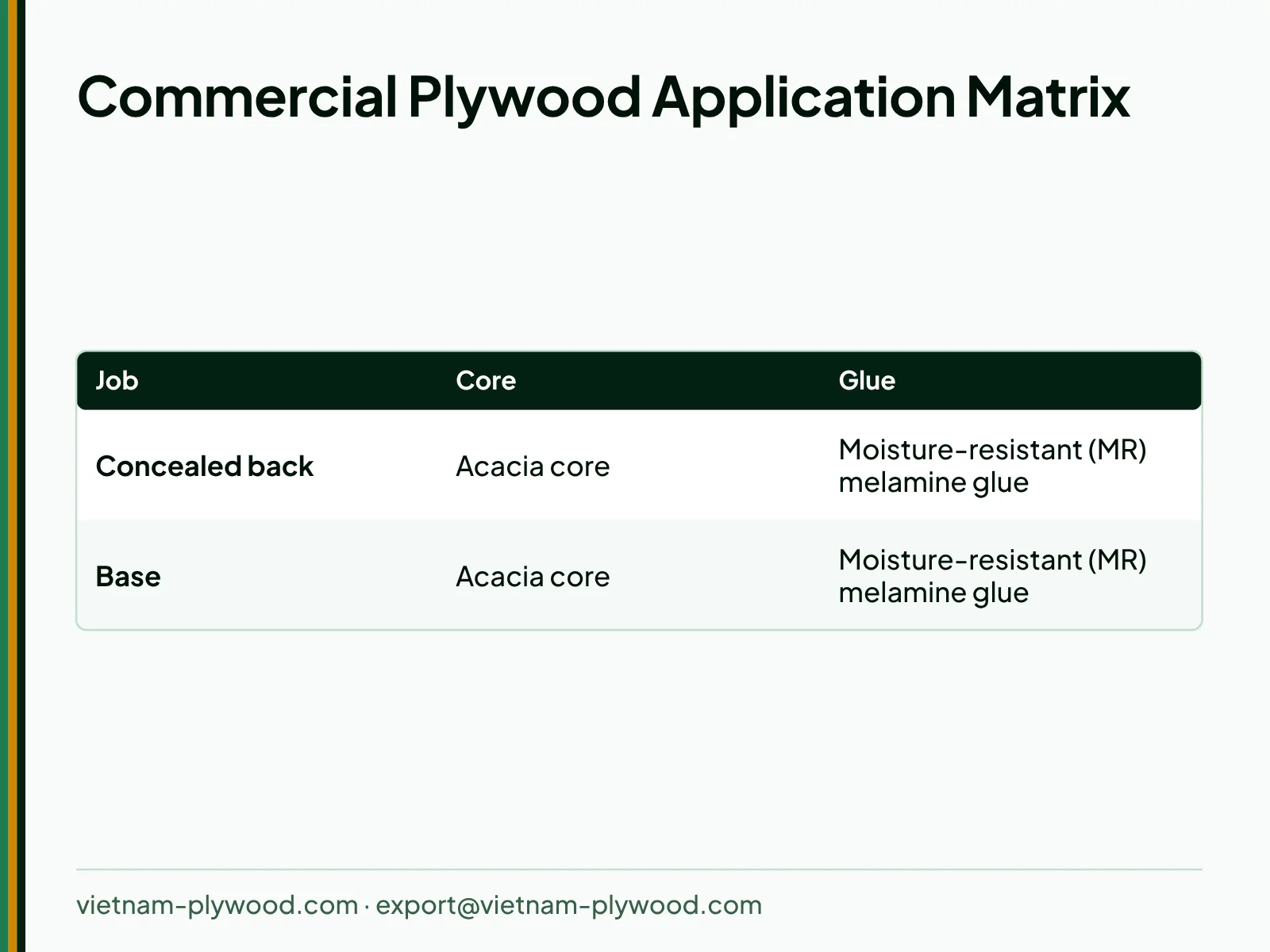
For a recessed back, determine whether the panel braces the box, carries wall fixings or merely closes the opening. A thin closure panel and a structural fixing panel have different jobs. The commercial line uses acacia core, moisture-resistant (MR) melamine glue and an unsanded or light-sanded surface. A back seen inside a cabinet still needs an acceptable interior finish.
HCPLY does not press medium-density fiberboard (MDF), oriented strand board (OSB), chipboard or blockboard. Those materials may appear in competing cabinet designs, but this order plan is for veneer-core plywood. The bathroom vanity plywood page covers the related wet-area specification.
Where does the saving actually come from?
The saving comes first from avoiding a decorative A face on a surface nobody sees, then from assigning suitable concealed parts to a lower-finish build. It is a bill-of-materials decision across parts, not a percentage discount promised for every sheet.
Rank the quote drivers by the change made to the build: decorative face species and appearance selection first, core construction and species next, then sanding and thickness requirements, followed by size and cutting yield. A fully selected decorative face on both sides requires more appearance-grade veneer than an A/B arrangement. A sanded, full-stitched furniture sheet also has a different manufacturing input from an unsanded acacia commercial sheet.
An A/B carcass can therefore cost less than a matched premium two-face carcass when only one face is exposed. A utility back can cost less than a furniture back when its lower finish and construction meet the drawing. No saving is worthwhile if rejected edges, finish preparation or assembly failures consume the difference.
The indicative starting price for furniture plywood is from US$350/m³ FOB Hai Phong (October 2026). For commercial plywood it is from US$250/m³ FOB Hai Phong (October 2026). These are starting prices for different product categories, not prices for the proposed cabinet grade pair. Request a written quotation for the exact face, core, tolerance and quantity rather than extrapolating a cabinet-sheet price.
Can carcass, back and base panels ship together?
Yes. Specifications can be mixed in a container within the payload limit, so furniture carcass panels and commercial backs or bases can form one shipment. The minimum order is one 40HC container; the maximum payload is 28.5 t. Use the weight of each selected core and thickness when planning the mix.
At 18 mm and 1220 × 2440 mm, a styrax-core furniture sheet weighs 26.79 kg and an acacia-core commercial sheet weighs 31.08 kg. For a concrete illustrative mix of 500 styrax sheets and 300 acacia sheets, the sheet-weight calculation is 500 × 26.79 + 300 × 31.08 = 22,719 kg, before pallets and packing. This illustrative mix is below the 28.5 t payload limit on panel weight alone; loading also requires pallet arrangement and packed weight checks.
A full single-core 40HC reference at that size and thickness is 990 styrax sheets or 880 acacia sheets. Eucalyptus-core furniture panels have a different density and reference load of 795 sheets. These are alternative full-load references, not quantities to add together. The container-load calculation explains the pallet and payload logic.
Mixed specifications need distinct pallet labels and packing-list lines. A maker ordering different face grades should specify which pallets contain carcass faces, which contain backs and which contain bases. This reduces the chance of a lower-finish panel entering a visible cabinet run.
What thickness, glue and emission fields belong on the order?
Write thickness, tolerance, glue and emission as separate fields. For cabinet bodies, 18 mm is a useful specification example, while 12 mm or thinner backs require a part-specific structural decision. Available thicknesses run from 3–40 mm, including common 3, 5, 9, 12, 15, 18, 21 and 25 mm.
Sanded furniture panels are ordered to ±0.2 or ±0.3 mm thickness tolerance; commercial panels use ±0.5 mm, and packing panels ±0.5–1.0 mm. Length and width tolerance is ±2 mm. Standard sheet formats include 1220 × 2440 mm and 1250 × 2500 mm, with other listed sizes and custom cutting available. Choose tolerance according to the machining and assembly system, rather than assuming the same tolerance across lines.
Glue and emission are different decisions. MR melamine glue has a 12-hour boil designation; phenolic waterproof boil-proof (WBP) glue has a 72-hour boil designation. E0, E1 and E2 are emission classes, while CARB Phase 2 and Toxic Substances Control Act (TSCA) Title VI relate to US regulatory limits and third-party certification.
The US Environmental Protection Agency, in its 2016 formaldehyde final rule, covered hardwood plywood, MDF and particleboard, including requirements for testing, labeling and third-party certification. See the EPA rule summary. For US-bound cabinet components, agree the required emission evidence with the buyer before the production specification is signed.
Member-factory FSC, CARB P2, ISO 9001 and CE certificates, along with EUTR/EUDR documentation, are shown with factory details masked, on request. Certificate documents for the agreed build belong in the shipment paperwork where applicable.
What can an inspector witness at the producing factory?
An inspector can compare the approved face samples, measure sanded thickness and inspect exposed core edges before loading. The producing factory is also the place to check that visible carcass sheets and concealed utility sheets have separate identification.
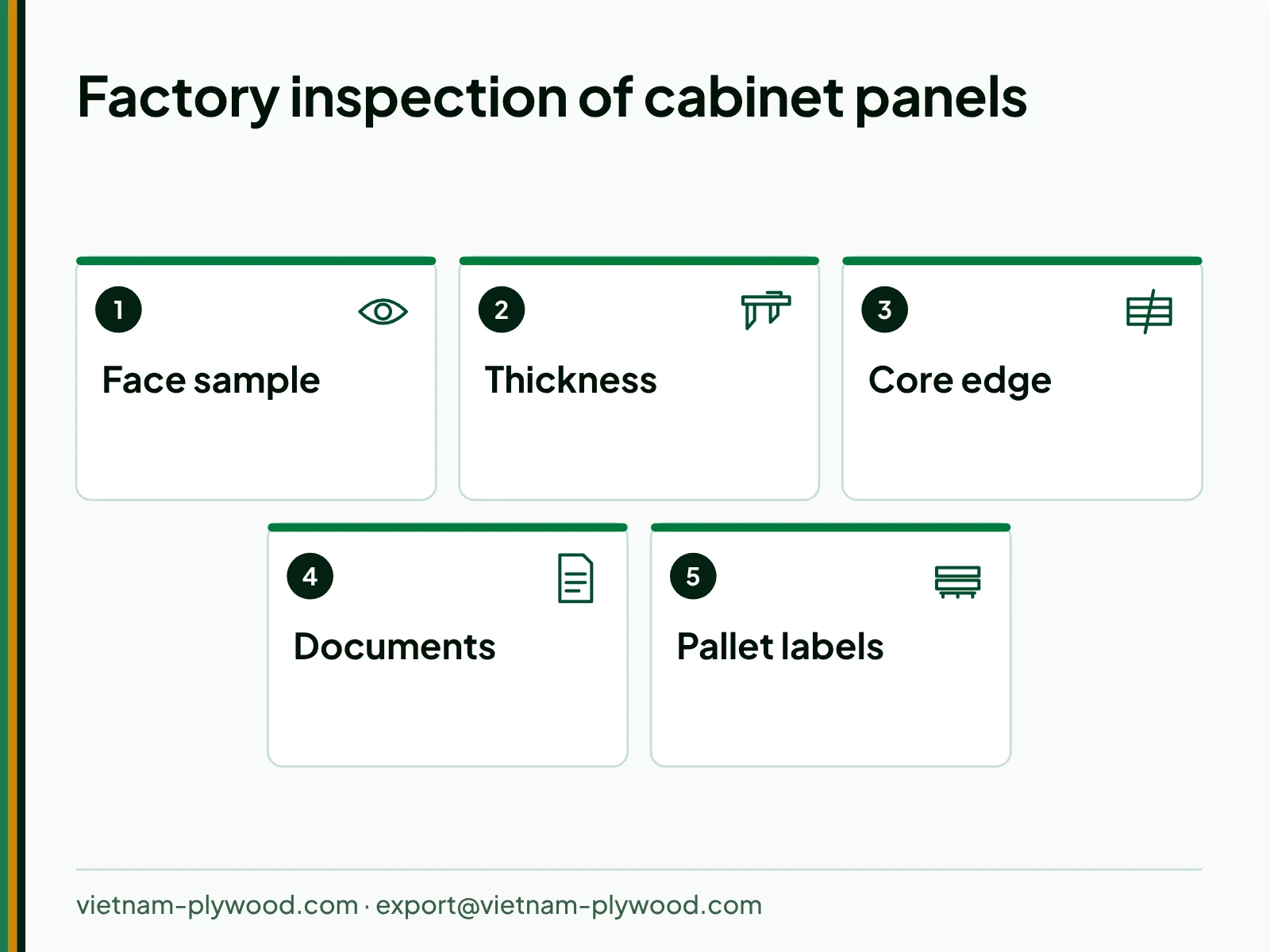
- Match the purchase specification and face-grade sample to the labelled stack; mark the intended visible side.
- Measure thickness across representative sheets and compare it with the ordered tolerance.
- Examine cut edges for gaps, core construction and machining suitability, then record any rejected sheets.
- Review the agreed emission or other test-report documents for the actual build, where required.
- Check pallet identification and the packing-list breakdown before container loading.
Buyers can visit the factory office and inspect goods at the producing factory. For production timing, the stated window is 15–45 days from the 30% deposit, set by order size, line loading and the contract; see plywood production lead time.
Which export documents identify the mixed order?
The packing list identifies the separately specified carcass, back and base quantities, while the commercial invoice records the invoiced goods. The bill of lading (B/L) records carriage, and the shipment includes the applicable certificate of origin, phytosanitary and fumigation papers, and order-specific certificate documents.
For European Union lots, the certificate of origin is EUR.1 and the EUTR/EUDR file set is included. Insurance applies under CIF. After loading, the draft shipping documents come to you for approval, allowing the specification and pallet breakdown to be checked against the documents.
We ship FOB Hai Phong, or CFR (CNF) or CIF to your port. Balance payment is 70% on the scanned bill of lading, by T/T or irrevocable sight L/C. Free samples are available; a first-time buyer pays the courier, and that charge comes off the first confirmed order.
What should the purchasing specification say?
The purchasing specification should identify each cabinet part’s visible face, concealed reverse, core, glue, emission class and tolerance. A single generic request for cabinet plywood hides the differences that create both the finish and the cost outcome.
Ask Lucy at export@vietnam-plywood.com to price the exact part schedule and sample requirements. The specification below can be copied into a request for quotation; use separate lines for carcass panels and commercial backs or bases.
Application: cabinet box sides / shelves / concealed backs / bases (list each)
Line or core: furniture — styrax or eucalyptus; commercial — acacia
Glue: MR melamine or phenolic WBP, as specified
Emission: E0 / E1 / required destination-market evidence
Face and grade: visible face species and A/B; concealed utility face separately
Thickness and tolerance: ___ mm; ±___ mm
Size: ___ × ___ mm
Quantity: ___ sheets per part and grade; mixed 40HC loading plan
Destination port: ___
Next step: book a factory visit to inspect the approved carcass and concealed-panel builds at the producing factory.