





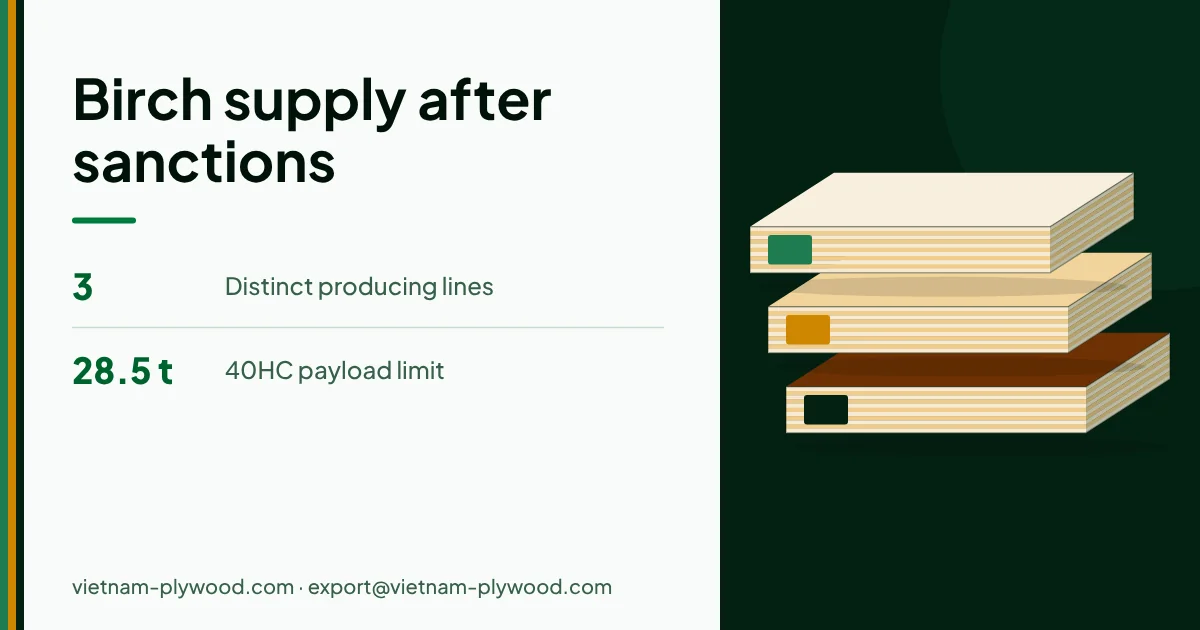
Birch plywood sourcing changed after sanctions on Russia and Belarus, leaving buyers to compare origin records and panel construction more closely. A wrong substitution can waste machining time, increase landed cost or leave a shipment facing customs questions. HCPLY addresses the baltic birch plywood shortage with birch-faced Vietnamese-core options and a documented export process.
What caused the baltic birch plywood shortage?
The baltic birch plywood shortage followed restrictions on Russian and Belarusian wood products, alongside trade-defense measures and disrupted purchasing routes. Buyers who once ordered familiar all-birch panels now need to separate legal origin, construction, and actual performance. A birch-looking surface alone cannot establish the core or the origin of a panel.
The European Commission reported in 2024 that Russian birch plywood imports into the European Union had been banned since July 2022. It also described attempts to route affected goods through other countries. See the Commission’s 2024 trade notice. The shortage therefore changes purchasing procedures as much as material selection.
Are sanctions and anti-dumping duties the same?
No. Sanctions can prohibit an import, while anti-dumping duties impose trade-defense charges on defined goods. Paying a duty does not authorize a transaction prohibited by sanctions. The country shown on a shipping document also cannot replace an origin assessment.
The European Commission’s 2024 announcement extended Russian birch-plywood anti-dumping measures to goods consigned from Kazakhstan and Türkiye after a circumvention investigation. A November 2026 EU Publications Office notice records the initiation of an expiry review of measures on Russian-origin birch plywood. An initiated review is not a finding that restrictions have ended.
For a destination-specific customs assessment, use the product’s actual construction, declared origin, tariff classification and current import rules. Our import documents and duties overview explains the purchasing workflow.
Can Vietnam supply the same all-birch panel?
HCPLY can supply birch-faced plywood with Vietnamese cores, but does not press birch-core plywood. An all-birch specification and a birch-faced specification are different products. If exposed edges, repeated machining, or a particular mechanical test require all-birch construction, do not substitute on appearance alone.
Our furniture line presses sanded, full-stitched styrax- or eucalyptus-core panels with a birch face. The core determines the density; the face determines the product name. Our Vietnam birch plywood range describes this distinction, while the birch-face and styrax-core combination provides a more focused specification route.
For buyers replacing an established material, request a physical sample and approve machining, edge finish, bonding and appearance against the intended application before ordering.
Which factory build fits each purchasing need?
The furniture line is the correct starting point for a birch-faced cabinet or fit-out specification. Our other lines build different products for packing and construction uses. Their cores, surfaces and tolerances should appear separately in a quote.
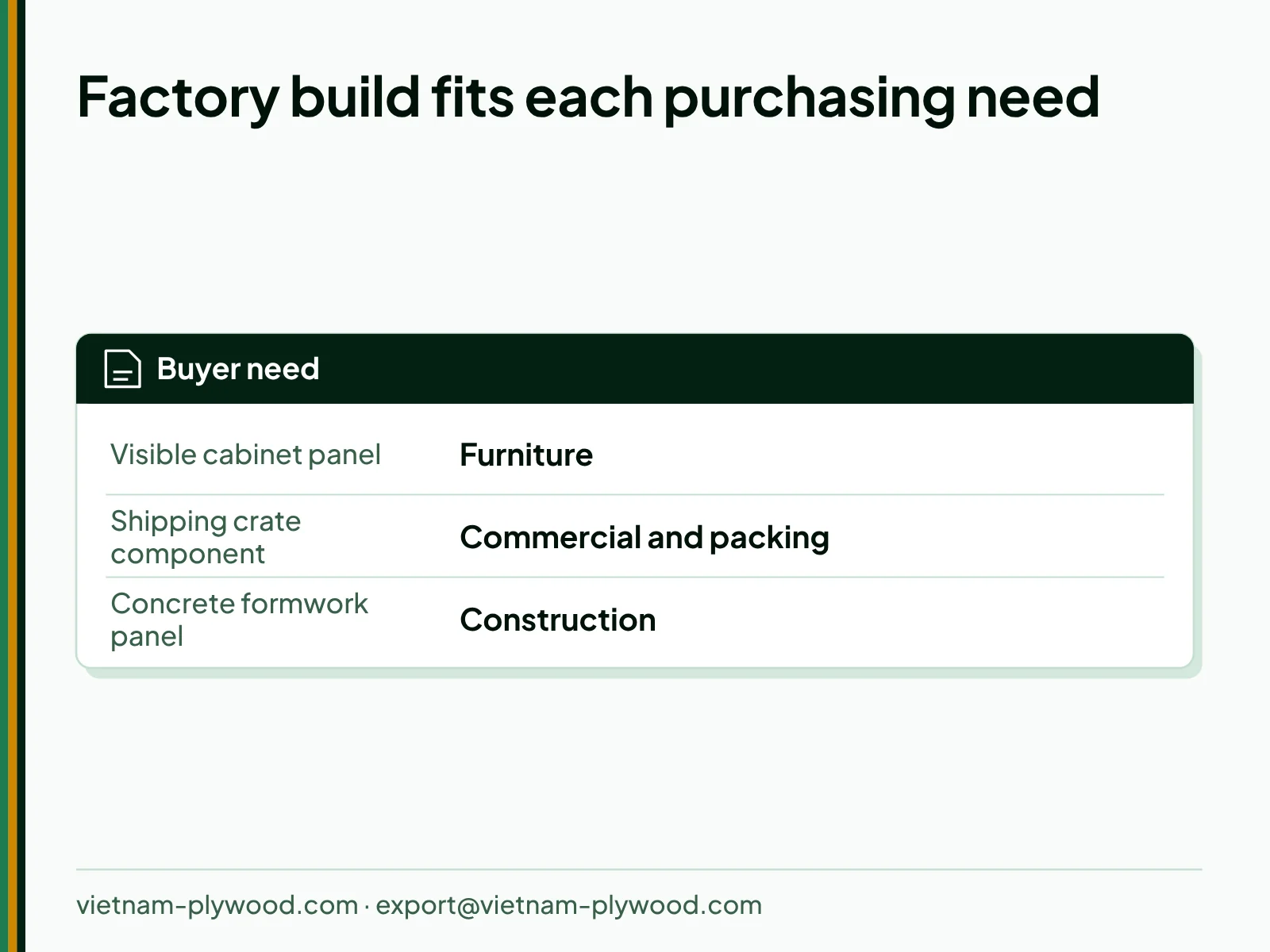
| Buyer need | Producing line | Core and surface | Thickness tolerance | Purchasing verdict |
|---|---|---|---|---|
| Visible cabinet panel | Furniture | Styrax or eucalyptus, sanded birch face | ±0.2 or ±0.3 mm as ordered | Specify face grade and edge acceptance |
| Shipping crate component | Commercial and packing | Acacia, raw or light-sanded | ±0.5–1.0 mm for packing | Compare packing performance rather than birch appearance |
| Concrete formwork panel | Construction | Acacia or eucalyptus, phenolic or melamine film | ±0.5 mm | Specify film and glue separately |
Our commercial and packing line uses moisture-resistant (MR) glue; our construction line presses film-faced products. Neither should be described as an all-birch replacement. The Baltic birch construction explainer helps purchasing teams identify the material they are replacing.
Which properties must a replacement specification preserve?
Preserve the properties that matter to the finished component: core construction, flatness, face quality, machining response, bonding and emissions documentation. Nominal thickness alone is an incomplete comparison.
For our furniture build, face veneer is commonly 0.2–0.4 mm and the core is full stitched. Available thicknesses run from 3–40 mm, including 9, 12, 15 and 18 mm. A typical 18 mm panel has 11–13 plies because veneer thickness changes the count. Face grade A/B describes the face; it does not certify the core. Birch faces are graded D/E/F in our stated range, so the requested appearance must be agreed against samples.
Glue and emission class are separate specification fields. Melamine MR and phenolic weather-and-boil-proof (WBP) describe bonding systems; E0, E1 and E2 describe emission classes. For United States orders, a CARB Phase 2 or TSCA Title VI requirement calls for the applicable third-party certification evidence, rather than an E-class label alone.
What can an inspector check at the producing factory?
An inspector can witness the build before loading and compare the order against actual panels. HCPLY coordinates on-site quality control, and buyers can inspect goods at the producing factory.
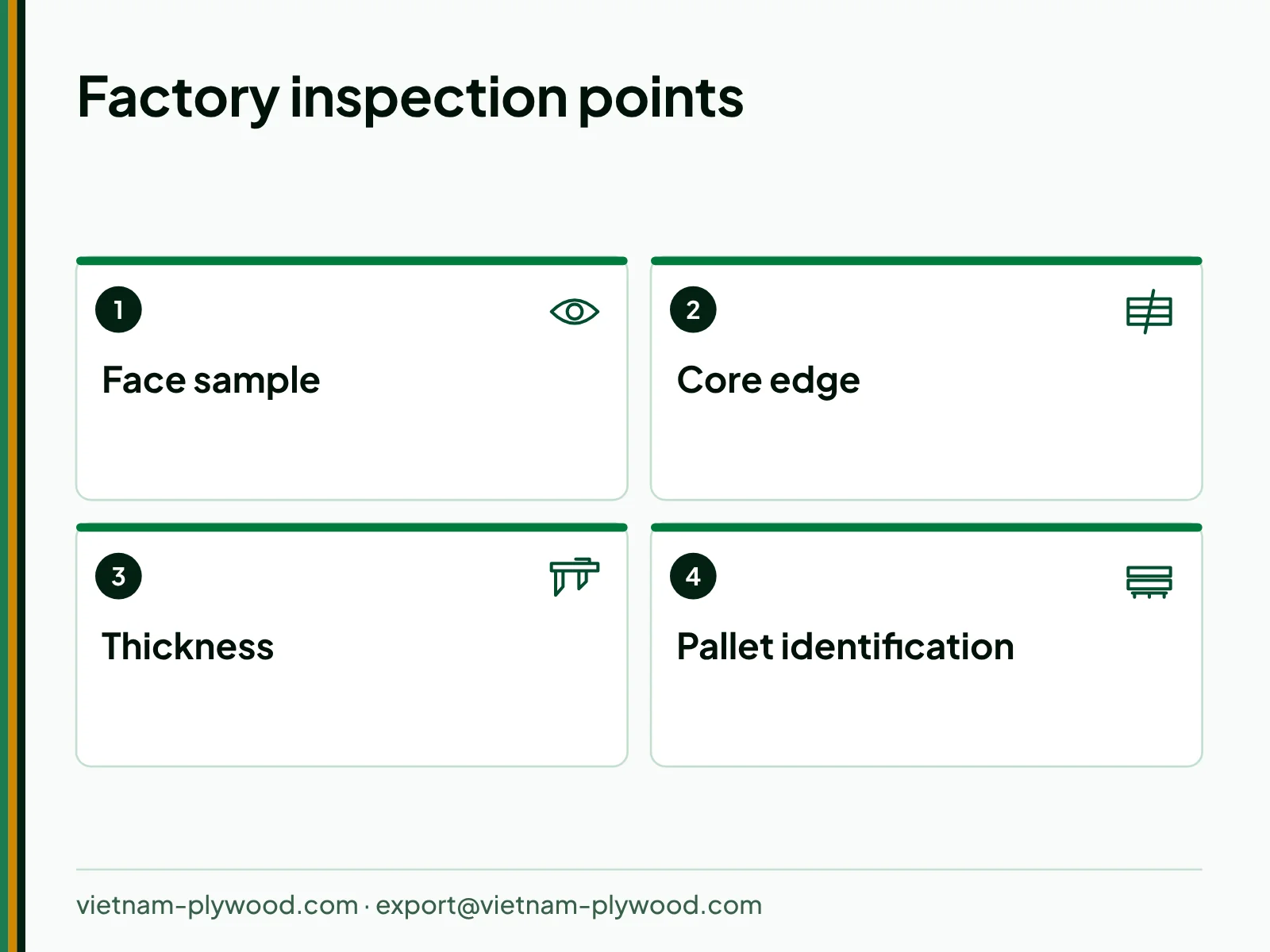
The check should start with the face and core identification, then measure thickness across representative sheets and inspect edges for voids or open joints. The inspector should compare the approved birch face sample, the sanded finish and the ordered tolerance with production. Record any rejected pieces and corrective sorting before pallet closure.
For the furniture line, inspect full-stitched core construction at a cut edge and check the ordered ±0.2 or ±0.3 mm thickness tolerance. Where a performance claim is contractually important, define the accepted test report and sampling plan in the purchase specification.
Which origin documents matter after sanctions?
A clear origin trail should connect the producing factory, commercial description, shipping route and import declaration. The country of dispatch alone is insufficient for a sanctions review.
The UK government explained in its 2026 Russia trade guidance that origin is based on where goods were grown, produced or manufactured, rather than simply where they were shipped from. Its 2026 Belarus statutory guidance also covers prohibited wood goods originating in or consigned from Belarus. Buyers should have their import compliance team assess the destination’s rules before shipment.
For HCPLY shipments, the export file includes the commercial invoice, packing list, bill of lading (B/L), certificate of origin, phytosanitary and fumigation papers, plus agreed order certificates and reports. European Union lots include EUR.1 and the EUTR/EUDR file set; insurance documents accompany CIF shipments. Member-factory certificates, including FSC, CARB P2, ISO 9001 and CE where relevant, are shown with factory details masked, on request. After loading, the draft shipping documents come to you for approval.
How does container weight change the quote?
Core choice changes both sheet weight and the number of sheets that fit a full container. At 18 mm and 1220 × 2440 mm, the styrax-core reference is 26.79 kg per sheet, compared with 34.83 kg for eucalyptus.
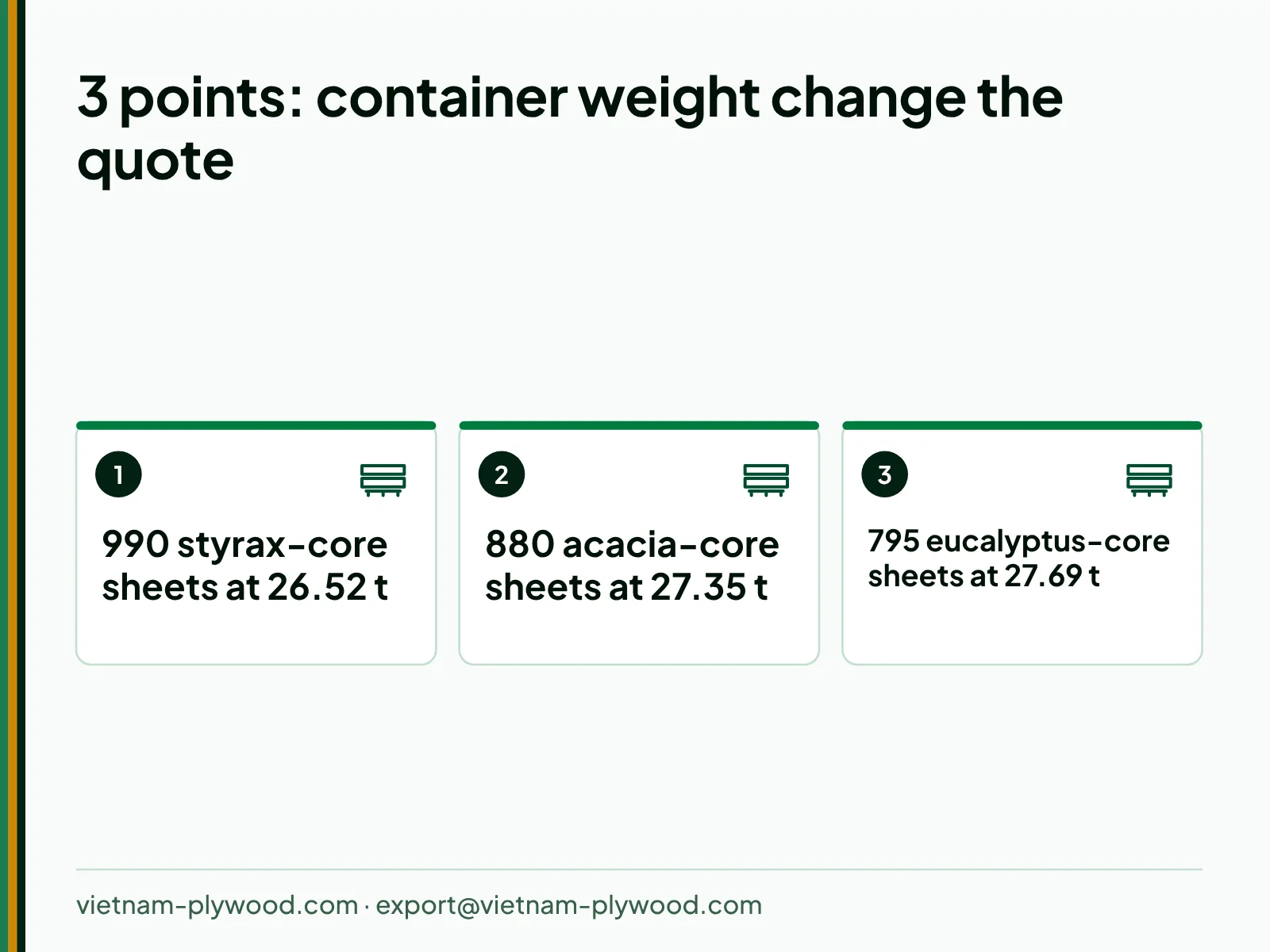
The full 40-foot high-cube (40HC) reference loads are 990 styrax-core sheets at 26.52 t, 880 acacia-core sheets at 27.35 t, and 795 eucalyptus-core sheets at 27.69 t. These figures exclude film weight and use the specified pallet arrangement. A 40HC payload limit is 28.5 t. The figures are planning references for these cores, not an all-birch loading schedule.
Specifications can be mixed within the payload limit. If cabinet panels share space with other approved plywood products, plan each pallet by core density and thickness before finalizing quantities. Use the container loading reference for other dimensions and thicknesses.
What determines the replacement panel price?
Core selection, face quality, core construction, sanding, tolerance, glue system and ordered quantity drive a replacement quote. A full-stitched sanded furniture panel with an approved birch face calls for more finishing control than an unsanded packing panel.
The indicative furniture-plywood starting price is from US$350/m³ FOB Hai Phong (October 2026). This is a category starting point, not a fixed birch-faced grade price. A birch-faced build should be quoted against its written face grade, core, tolerance and destination requirements.
For comparison, commercial plywood starts from US$250/m³ FOB Hai Phong (October 2026), but its acacia-core packing build addresses a different requirement. Compare the complete landed specification rather than treating the two starting points as interchangeable. Our distributor supply programmes outline how to organize repeated specifications.
How should a buyer approve a new source?
Approve the sample, written specification and document requirements before committing to volume. A controlled trial is more useful than a promise that two differently constructed panels are equivalent.
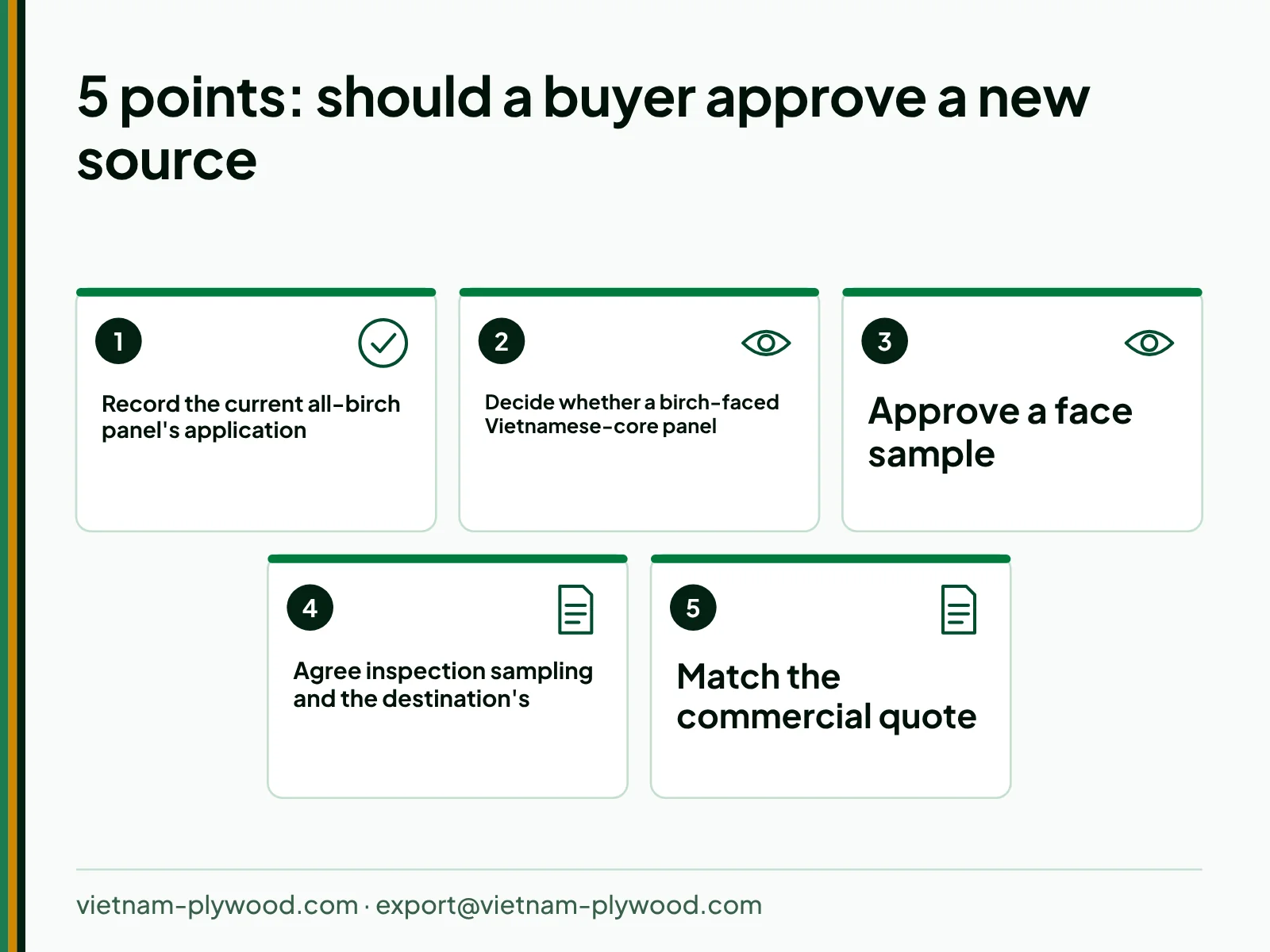
- Record the current all-birch panel’s application, exposed-edge requirements and acceptance tests.
- Decide whether a birch-faced Vietnamese-core panel can meet the finished component’s needs.
- Approve a face sample, thickness tolerance, core build and glue/emission fields.
- Agree inspection sampling and the destination’s import-document requirements.
- Match the commercial quote, pallet plan and shipment documents to that approved specification.
The minimum order is one 40HC. Factory lead time runs 15–45 days from receipt of the 30% deposit; the exact figure depends on order size, line loading and what the contract fixes. The remaining 70% is paid on the scan of the bill of lading, by T/T, or by irrevocable sight L/C. We ship FOB Hai Phong, or CFR (CNF) or CIF to your port.
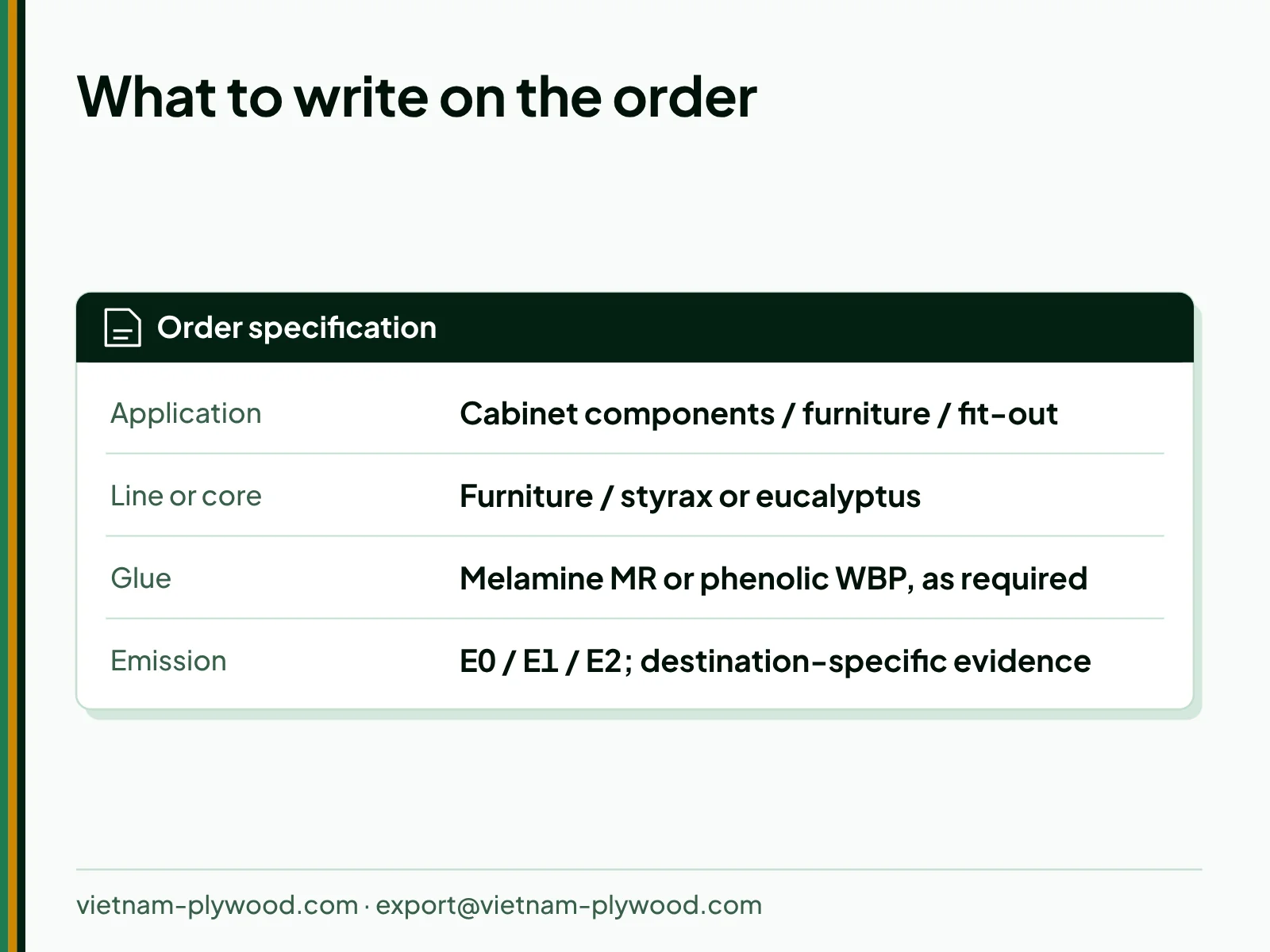
What should go into the request for a specification sheet?
A useful request names the original panel’s job and the acceptable construction change. HCPLY can then route the build to the appropriate production line and prepare a matching quotation.
Free samples are available; a first-time buyer pays the courier, and that charge comes off the first confirmed order. For an additional market comparison, see our Vietnam birch plywood manufacturer overview.
Application: cabinet components / furniture / fit-out
Line or core: furniture / styrax or eucalyptus
Glue: melamine MR or phenolic WBP, as required
Emission: E0 / E1 / E2; destination-specific evidence
Face and grade: birch / D, E or F; approved sample
Thickness and tolerance: ___ mm / ±0.2 or ±0.3 mm
Size: ___ × ___ mm
Quantity: ___ sheets / pallets / 40HC
Destination port: ___
Request the birch-faced plywood specification sheet from Lucy at export@vietnam-plywood.com.