





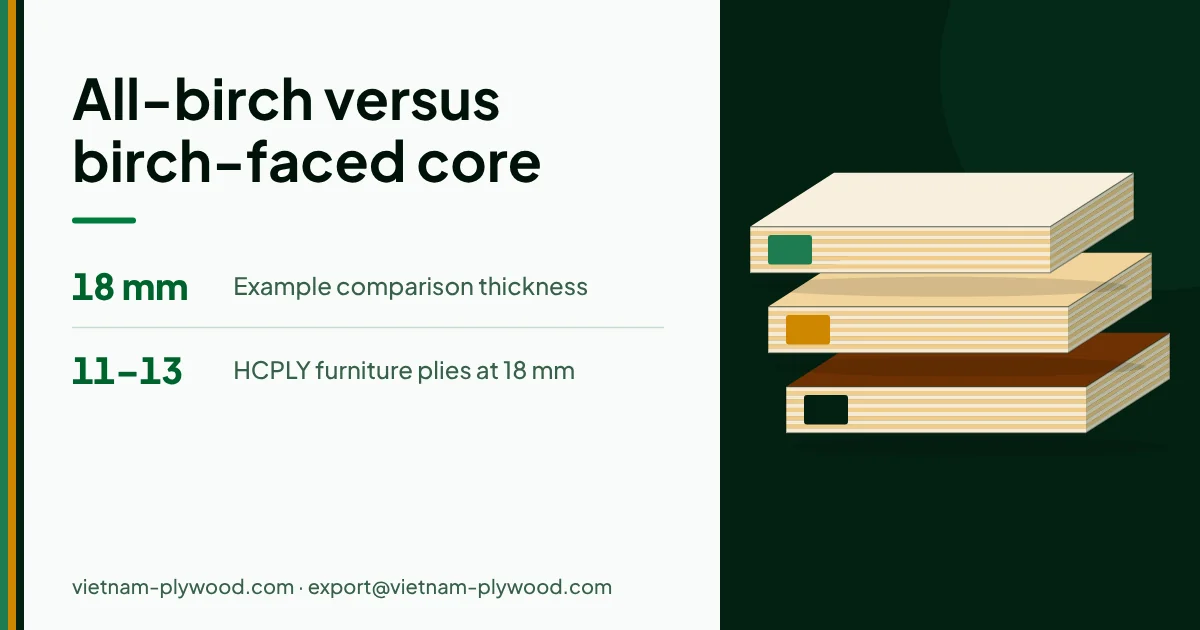
Baltic birch plywood is an all-birch veneer panel, with birch running through its faces and inner plies. Ordering a birch-faced substitute against an all-birch drawing can cause rejected components, extra machining and delayed delivery. At HCPLY, we distinguish the two builds before quoting because their exposed edges and core requirements are different.
What is Baltic birch plywood?
Baltic birch plywood is plywood assembled from birch veneers throughout its thickness, commonly with cross-oriented grain and a comparatively uniform layered edge. The name refers to a product tradition and supply region; it is not itself a universal test certificate. Buyers should specify the actual veneer species, ply arrangement, face grade and origin independently.
A label such as birch baltic plywood or baltic birch ply is insufficient for a procurement drawing. A distributor may describe an attractive birch face as Baltic-style even when the core is another wood. Cut a sample edge and inspect the entire section before accepting the description.
The important distinction is whether the buyer requires birch at the edge, within routed pockets and around fasteners. If only the broad face remains visible, a properly specified birch-faced alternative may meet the functional requirement. Our Vietnam birch plywood range addresses that different construction.
What is Baltic birch plywood made of?
An all-birch panel contains birch face veneers and birch inner veneers, bonded in a cross-laminated stack. The adhesive and emission classification are separate specification fields. The word birch alone establishes neither the bond durability nor an emission limit.
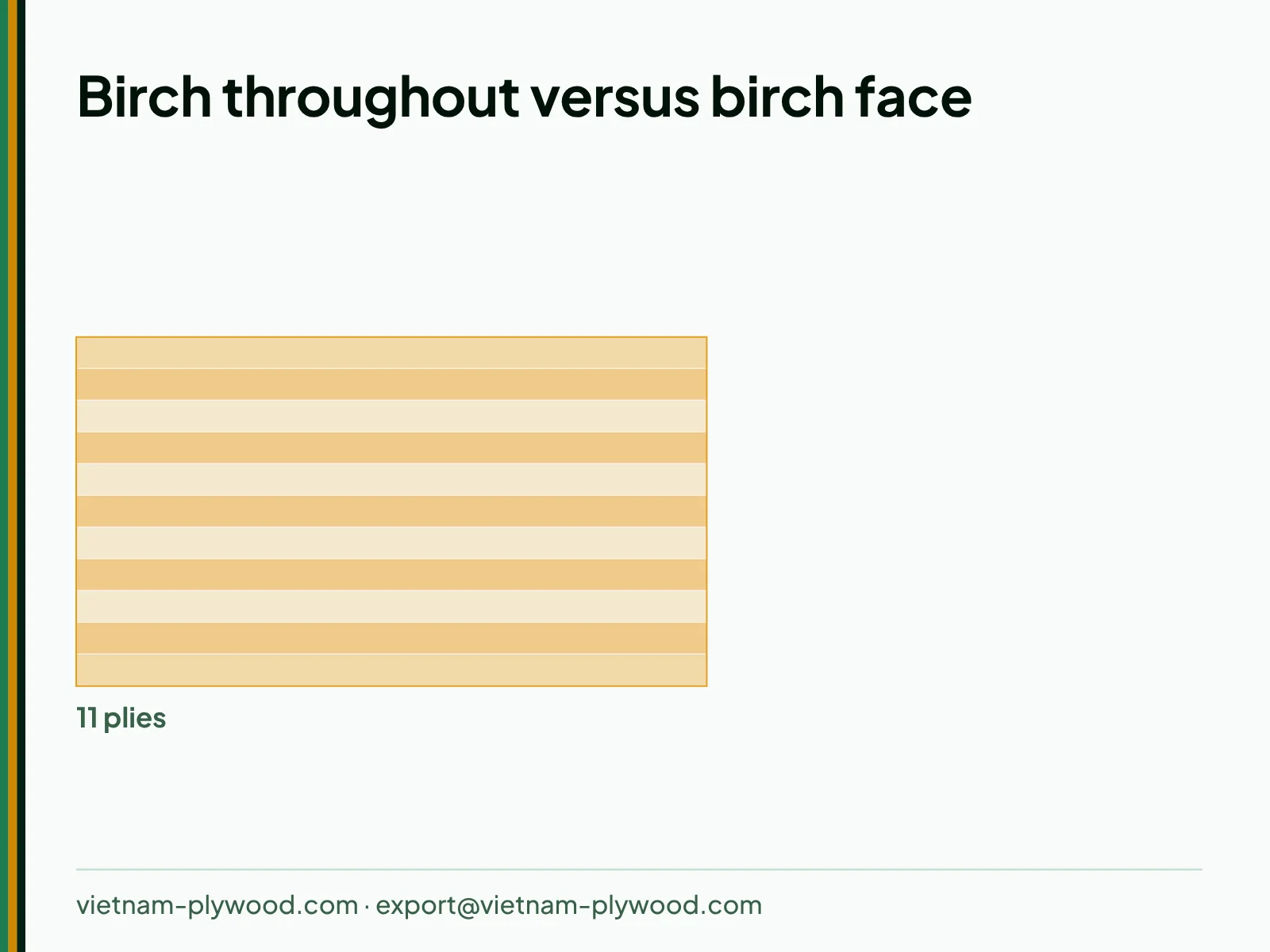
The grain direction of neighboring veneers is normally crossed to moderate directional movement. Manufacturers can use different veneer thicknesses, joint patterns and repair allowances. Consequently, an edge that looks evenly striped is a useful screening clue, but a cut edge cannot replace production records or agreed tests.
Specify whether patches, plugs, mineral streaks, open splits and inner gaps are acceptable. Face grading must refer to an identified scheme; a letter without its standard can hide material differences. For cabinet makers, the exposed edge and machining depth often matter more than the marketing name.
Our furniture line instead presses a birch face onto a full-stitched styrax or eucalyptus core. The common face veneer range is 0.2–0.4 mm. That is a real birch surface, but the interior is Vietnamese wood, and we do not press birch-core plywood.
How many plies should each thickness contain?
There is no reliable universal ply-count chart for every Baltic birch producer. Ply count follows veneer thickness, layup design and finished-panel sanding. A specification should record the actual count at each ordered thickness rather than assume a fixed count from a catalog photograph.
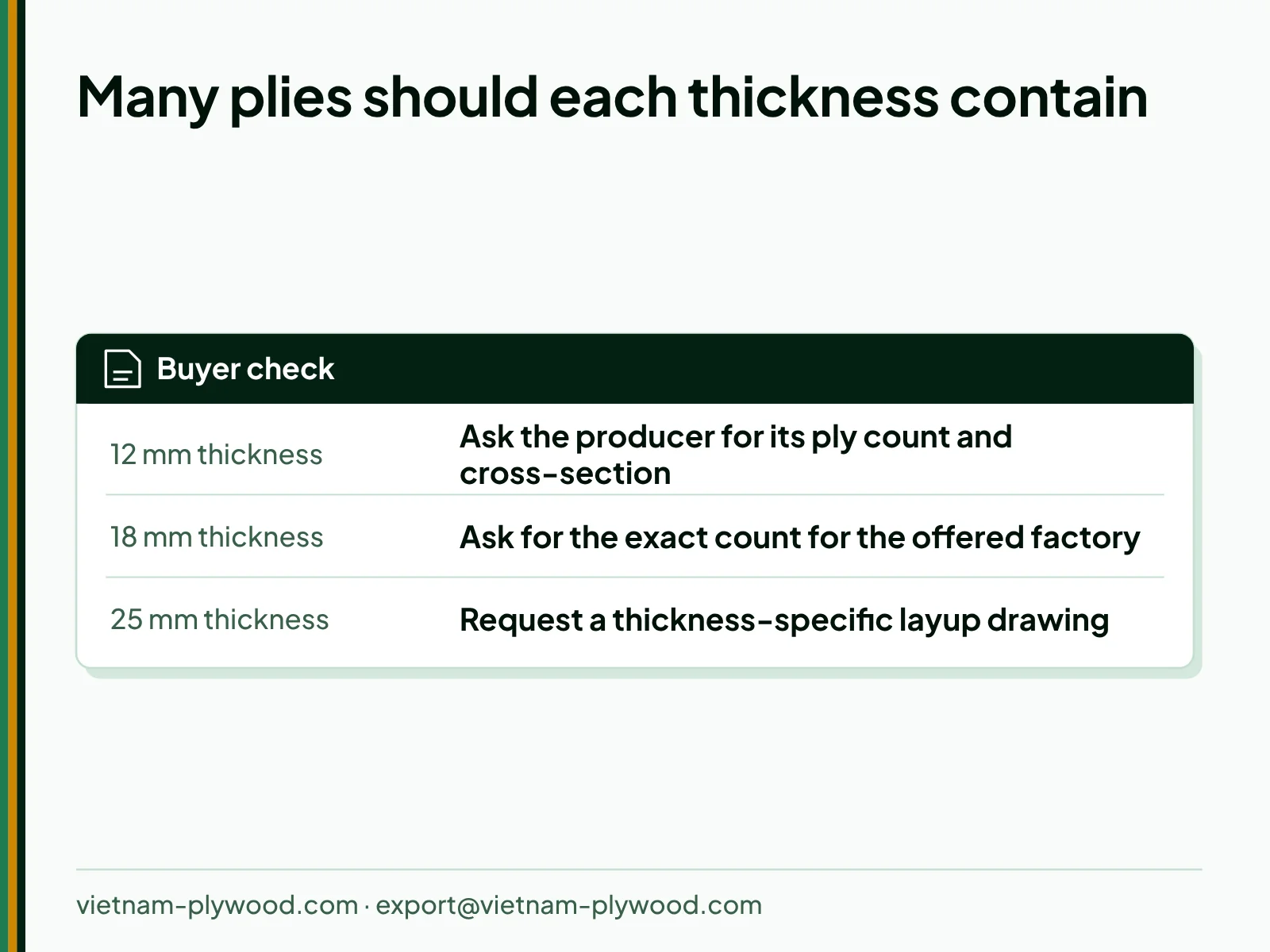
| Buyer check | All-birch request | Birch-faced furniture build | Purchasing verdict |
|---|---|---|---|
| 12 mm thickness | Ask the producer for its ply count and cross-section | Vietnamese core with birch face; count depends on veneer build | Specify the count if routed edges matter |
| 18 mm thickness | Ask for the exact count for the offered factory | 11–13 plies with our 1.4–2.0 mm core veneers | Do not infer all-birch from count alone |
| 25 mm thickness | Request a thickness-specific layup drawing | Thickness is within our 3–40 mm range | Compare finished tolerance and edge appearance |
| Visible machined edge | Birch must continue through the section | Styrax or eucalyptus appears below the birch face | Select all-birch for a specified birch edge |
For HCPLY furniture panels, core veneers are 1.4–2.0 mm, and the ordered sanded thickness tolerance is ±0.2 or ±0.3 mm. These are our construction figures, not a claim about Baltic products. Measure several points on a conditioned sample and compare them with the written tolerance.
A thick panel with fewer veneers is not automatically defective; nor does a high count prove a stronger bond. Ask for an actual cut section and the performance evidence needed by the component design. Keep nominal thickness, actual thickness and allowable variation as distinct fields.
Where does Baltic birch plywood come from?
The term traditionally points toward birch plywood associated with the Baltic region and adjacent northern European production. Russia and Belarus have also been major historical sources, while Finland produces Finnish birch plywood. A geographic adjective cannot establish where a particular shipment was manufactured.
Ask for the manufacturing country, veneer-origin evidence and the identity of the producing plant in the supplier’s supporting paperwork. Shipping through a transit port changes the route, not necessarily the product’s origin. A distributor’s address likewise does not identify where the veneers were peeled or pressed.
Finland birch plywood and Finnish birch plywood are common purchasing expressions, but their use does not automatically establish an identical grade. Request the manufacturer’s grading definition, panel construction and accepted test reports. A compliant Finnish-origin offer may be commercially available, yet the actual route and availability require verification for the order.
For an EU buyer, the distinction between claimed origin and documented origin has direct customs consequences. The European Commission’s 2026 sanctions overview identifies import restrictions covering Russian wood and expanded Belarus measures. See the European Commission’s sanctions overview.
Which origins face sanctions, and which can still ship?
Russian- and Belarusian-origin plywood face EU import restrictions; Finnish and other non-sanctioned-origin products are not automatically prohibited merely because they contain birch. That distinction is jurisdiction-specific, and importers must check the applicable rules at entry. A shipment from a third country is not proof that the wood is free of restricted origin.
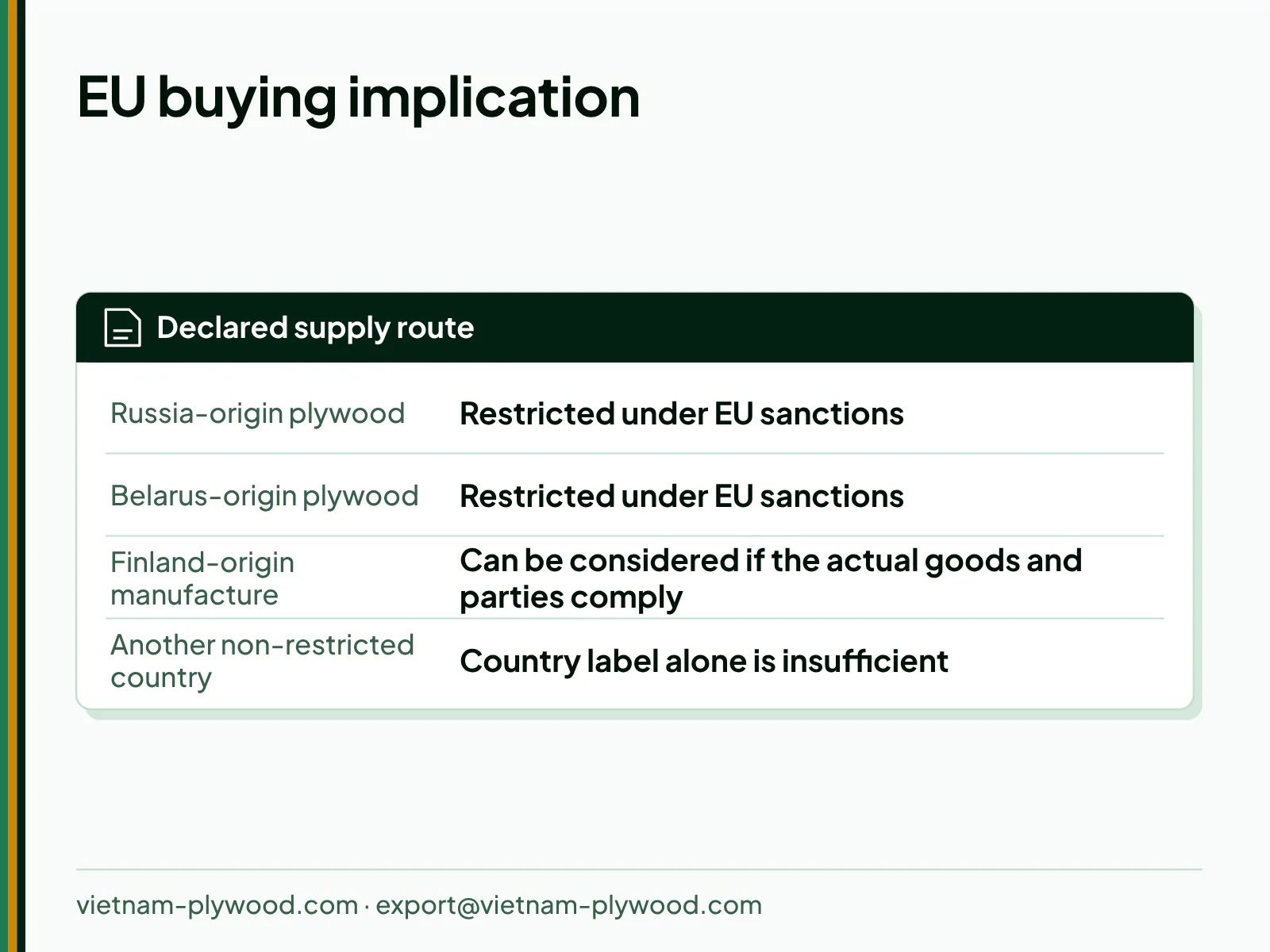
The European Commission’s 2025 plywood alert identified birch plywood as a circumvention risk and highlighted unusual logistics and third-country re-export patterns. Its separate 2026 sanctions overview confirms the wider Russia and Belarus trade restrictions. The alert also distinguishes sanctions exposure from anti-dumping duties; paying a duty does not legalize prohibited origin.
| Declared supply route | EU buying implication | Evidence to request |
|---|---|---|
| Russia-origin plywood | Restricted under EU sanctions | Do not treat re-export as a workaround |
| Belarus-origin plywood | Restricted under EU sanctions | Check origin and applicable prohibitions |
| Finland-origin manufacture | Can be considered if the actual goods and parties comply | Plant identity, veneer origin, customs documents |
| Another non-restricted country | Country label alone is insufficient | Manufacturing records, traceability and transit chain |
The United States and other destinations have their own import controls, sanctions and trade-remedy regimes. Do not copy an EU clearance conclusion into a US purchase order. Check product classification, origin and the current measures with the importing authority before shipment.
For EU orders, a credible supplier should provide a traceable production account rather than a new label applied after transit. Where the material has passed through another country, obtain evidence of what processing occurred there. A change of packaging does not establish a new manufacturing origin.
Is Baltic birch a hardwood, and how does it perform?
Birch is a hardwood species, but hardwood is a botanical classification rather than a guarantee of load-bearing performance. Actual panel behavior depends on the veneer structure, bond, defects and test conditions. The buyer’s design must establish the needed bending, fastening and dimensional requirements.
An all-birch edge can be attractive for exposed joinery and repeated CNC routing. The same dense layered structure can increase machining effort and shipment mass compared with some alternative cores. For painted cabinet carcasses with covered edges, appearance may not justify paying for birch throughout.
Moisture behavior needs separate attention. Birch veneer does not make a panel waterproof, and an exterior-use claim requires the specified adhesive and accepted test evidence. A surface finish can slow wetting, but exposed cut edges and joints still need a design appropriate to the service environment.
When a drawing calls for structural performance, obtain test results accepted by the buyer rather than assuming a grade from the Baltic name. The same principle applies to any request described as marine or to BS 1088. We do not represent our birch-faced furniture panels as structural-grade Baltic replacements.
When does an all-birch specification make sense?
Specify all-birch when the inner veneers form part of the finished component or its documented performance requirement. Visible laminated edges, deep routed profiles and a customer’s fixed all-birch material schedule are common reasons. In those cases, a birch surface over a different core is a different material.
If the face is the only birch element specified, review the finished part instead of preserving an unnecessary all-birch assumption. Cabinet sides hidden behind edging, veneered furniture panels and some interior fit-out components can be evaluated against an agreed Vietnamese-core build. This decision still requires component testing where the customer specifies mechanical performance.
For a deeper comparison of the decision, see birch or Baltic birch plywood. For factory-facing application examples, see birch plywood for European furniture factories. The key is to rewrite the bill of materials with the actual core requirement before requesting competing quotations.
What would our three production lines make instead?
We make birch-faced furniture plywood on our furniture line, not an all-birch stack. The other lines address different performance needs. The table keeps an 18 mm request constant while showing why the product specification changes between lines.
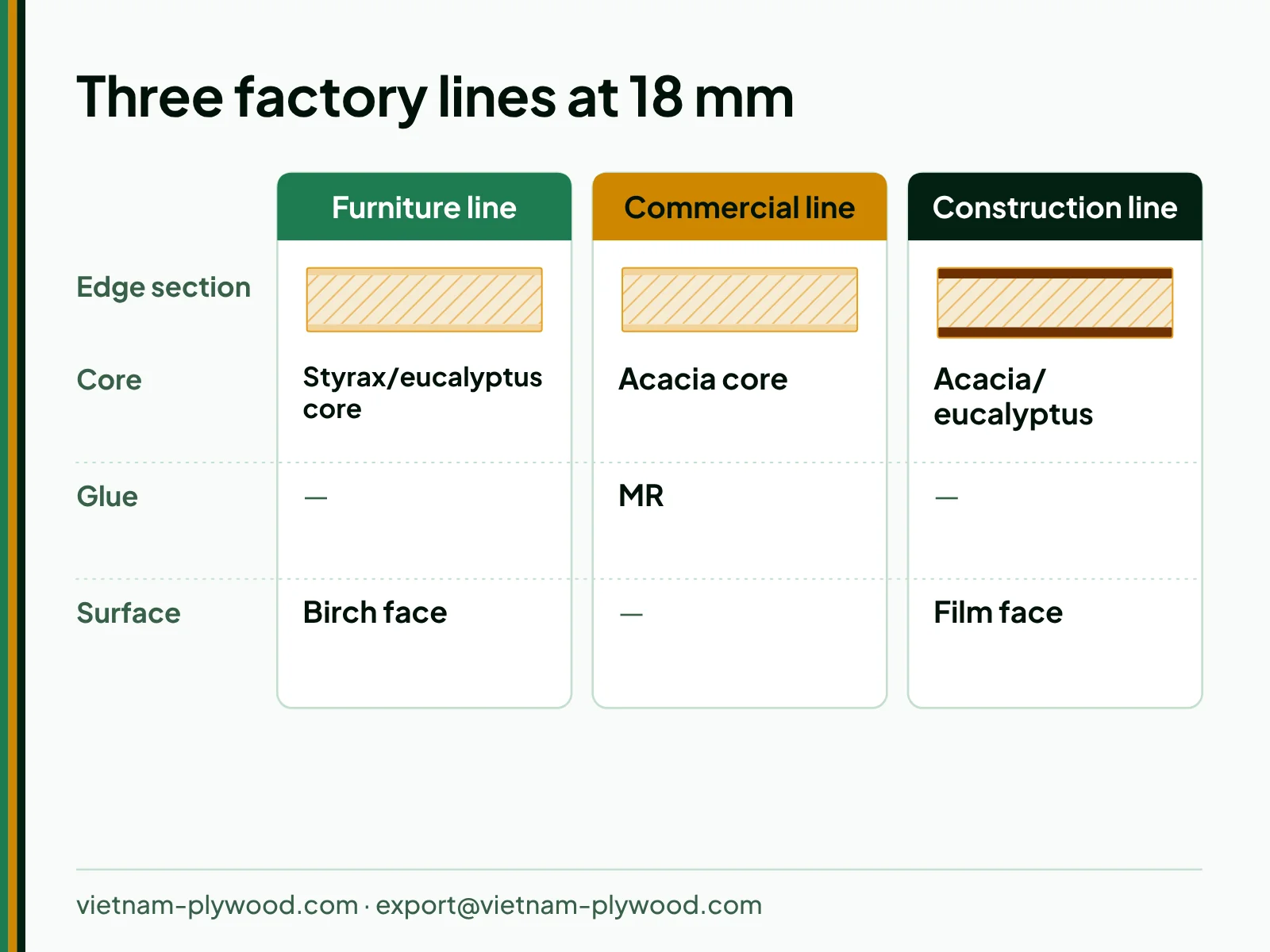
| Line | 18 mm example construction | Surface and tolerance | Appropriate buyer use |
|---|---|---|---|
| Our furniture line | Full-stitched styrax or eucalyptus core; birch face | Sanded, ±0.2 or ±0.3 mm as ordered | Cabinet and furniture components needing birch appearance |
| Our commercial and packing line | Acacia core, MR glue | Unsanded or light-sanded; commercial ±0.5 mm, packing ±0.5–1.0 mm | Packing or commercial applications without an all-birch demand |
| Our construction line | Acacia or eucalyptus core with phenolic, melamine or anti-slip film | Unsanded, ±0.5 mm | Concrete formwork applications, not exposed birch joinery |
The construction product belongs with plywood supply for construction projects, not with a cabinet’s decorative veneer schedule. A buyer who specifies only “birch plywood 18 mm” leaves the core and end use unresolved. Add the core species, surface grade and tolerance to prevent an incorrect comparison.
Our furniture line offers E0 or E1 emission classes as specified. Glue type remains a separate choice: melamine MR or phenolic WBP according to the agreed build. We do not press medium-density fibreboard, oriented strand board, chipboard, blockboard or birch-core plywood.
What should a factory inspection verify?
A buyer or inspector can verify a birch-faced furniture order at the producing factory by matching the panel to the written specification. The inspection should start with identification of the face, then examine the core, dimensions and recorded production lot. A birch-looking face is insufficient evidence of the core species.
- Match the approved sample, order specification and production lot before sampling finished panels.
- Cut a representative panel edge and check for full stitching, core gaps and the specified styrax or eucalyptus construction.
- Measure finished thickness at several points against the ordered ±0.2 or ±0.3 mm furniture tolerance.
- Check length and width against the ±2 mm tolerance and the agreed panel size.
- Review face grade, surface sanding, glue specification and the emission documentation applicable to the order.
- Record findings with photographs and sample identifiers for the buyer’s acceptance decision.
The factories are in Phu Tho and Hai Phong. Buyers visit the factory office and inspect goods at the producing factory. Certificates such as FSC, CARB P2, ISO 9001 or CE belong to the relevant member factories and are shown with factory details masked, on request; no certificate should be inferred for an untested panel.
A witnessed edge inspection also helps separate cosmetic birch-face expectations from an all-birch requirement. If a sample fails the agreed core or tolerance criteria, record the deviation before loading. An inspector should not convert an observed characteristic into a certified performance grade.
How does the core affect container planning?
Core density affects payload planning even when the outer face is birch. HCPLY uses core densities of 500 kg/m³ for styrax, 580 kg/m³ for acacia and 650 kg/m³ for eucalyptus. These are Vietnamese-core planning values, not measured densities for Baltic birch plywood.
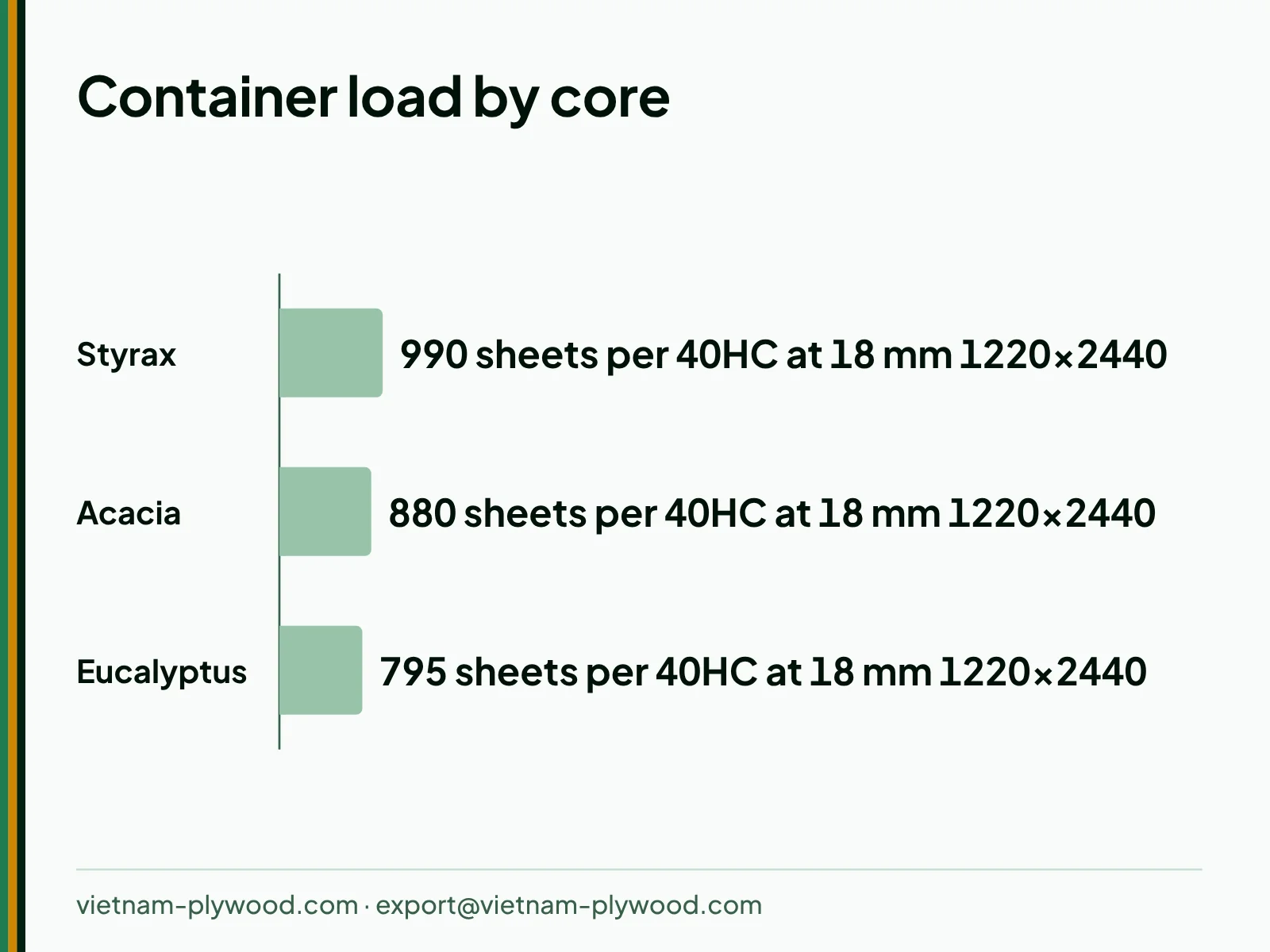
For 18 mm panels at 1220 × 2440 mm, the stated 40HC planning counts are 990 styrax, 880 acacia and 795 eucalyptus sheets. The corresponding panel masses are 26.52 t, 27.35 t and 27.69 t, respectively, excluding packaging. The 40HC payload limit is 28.5 tonnes.
A birch-faced furniture order can share a container with other agreed specifications within that payload limit. The minimum order is one 40HC, and mixed specifications are possible when the weight calculation permits. See mixed container loads for the ordering decision and the container packing calculator for detailed load planning.
Do not apply these Vietnamese-core counts to all-birch sheets. A genuine Baltic panel needs its supplier’s actual density, dimensions, pallet design and packing data. That prevents a purchase estimate from becoming an unsupported freight commitment.
What affects price and the export document set?
An all-birch build normally requires a different material input from a birch-faced Vietnamese-core panel, so compare quotations against equivalent specifications. Core species and all-birch construction are the first cost distinction; face grade, thickness tolerance, glue and documented tests follow. For a Baltic birch or birch-faced quotation, request a written build and grade specification.
We can quote the agreed furniture specification after receiving the application, face grade, core, dimensions, quantity and destination. Factory lead time runs 15–45 days from receipt of the 30% deposit; the exact figure depends on order size, line loading and what the contract fixes. The remaining 70% is paid on the scan of the bill of lading, by T/T, or by irrevocable sight L/C.
We ship FOB Hai Phong, or CFR (CNF) or CIF to your port. Samples cost nothing: a first-time buyer pays the courier, and that charge comes off the first confirmed order. The export team manages specification, on-site quality control, documents and loading.
The shipment’s certificate of origin is the central export document for the declared origin, alongside the commercial invoice, packing list and bill of lading. The set also includes phytosanitary and fumigation papers, insurance under CIF and agreed certificate documents or test reports. EU lots have EUR.1 where applicable and the EUTR/EUDR file set; after loading, the draft shipping documents come to you for approval.
For origin-sensitive material, the buyer should still seek supporting manufacturing and veneer traceability beyond the certificate heading. An export certificate cannot substitute for a sanctions review of the underlying material. We supply the agreed documentation for our own Vietnamese-core builds; we do not offer an all-birch origin certificate for a product we do not make.
What should the purchasing specification say?
The purchasing specification should name the required core and the acceptable evidence before it names a supplier. If the project requires birch throughout, retain that requirement and obtain an all-birch offer from a qualified producer. If a birch face over a Vietnamese core is acceptable, send the alternative build as a distinct line item.
Keep appearance, bond and emission requirements separate. Specify the grading scheme and allowable face repairs instead of assuming that a letter means the same thing across markets. If the application needs visible edges, request an approved routed sample before releasing production.
For finishing requirements, birch UV-coated plywood discusses the surface topic separately; UV coating is not an implied offering in this specification. The Vietnam birch plywood manufacturer overview gives additional purchasing context without changing the core distinction.
Application: Cabinet / furniture / fit-out component and edge visibility
Line or core: Our furniture line; full-stitched styrax or eucalyptus core (not all-birch)
Glue: MR melamine or WBP phenolic, as agreed
Emission: E0 or E1, separately specified
Face and grade: Birch face; D/E/F grade as agreed; permitted repairs stated
Thickness and tolerance: 18 mm; sanded ±0.2 or ±0.3 mm as ordered
Size: 1220 × 2440 mm or specified cut size
Quantity: One 40HC minimum; mixed specifications only within payload limit
Destination port: [insert destination port]
Next step: book a factory visit with Lucy at export@vietnam-plywood.com to inspect the proposed birch-faced build at the producing factory.