





Import birch plywood with a documented face source, Vietnamese core record and destination-specific customs declaration. A wrong origin claim can cost duty, clearance days or a rejected load. HCPLY manufactures birch-faced furniture panels in Vietnam and connects their production batches to the export paperwork; the imported birch veneer and locally sourced core still require separate evidence.
What documents are needed to import birch plywood from Vietnam?
To import birch plywood made in Vietnam, start with the commercial invoice, packing list, bill of lading and applicable certificate of origin. For birch-faced panels, add records identifying the imported face veneer and Vietnamese core. Customs classification, duty treatment and additional evidence depend on the destination and the actual manufacturing steps.
HCPLY prepares the shipment’s commercial invoice, packing list, bill of lading (B/L), certificate of origin and applicable phytosanitary and fumigation papers. Insurance is included under CIF shipments. The agreed order may also require an emission certificate, a test report, or an FSC claim on sales documents. EU lots have an EUTR/EUDR file set; an EUR.1 is part of the listed document package for EU lots, but preferential eligibility must be checked against the actual origin rule.
The invoice should describe the finished product as birch-faced plywood with its actual core, rather than simply “birch plywood.” The packing list should match that description to thickness, size, package count and shipment identifiers. The B/L connects the cargo to the transport record; it does not by itself prove where the face veneer was harvested or where the panel acquired customs origin.
Ask for the draft shipping documents after loading, when our export team sends them for buyer approval. Compare the invoice description, packing marks and origin paperwork before accepting the draft.
For the build itself, begin with our birch plywood from Vietnam product specification. That page covers the face-and-core combination; this page addresses the documentary trail that accompanies the imported panel.
How is origin declared when the birch face is imported?
The imported birch face and the Vietnamese core have separate material histories, while the finished plywood receives an origin determination under the importing market’s rules. A Vietnamese pressing location alone is not sufficient evidence of preferential origin, and the face’s country of harvest is not automatically the finished panel’s declared origin.
For EU entry, assess the finished panel under the applicable non-preferential origin rules and retain evidence of the manufacturing steps. Ask the importer’s customs adviser to review the input origins and processing records before an origin declaration is submitted.
For a proposed birch-faced, styrax-core panel, distinguish the country where the birch veneer was sourced, the Vietnamese origin of the styrax core material, and the factory where veneers were assembled and pressed. The answer can differ between non-preferential marking, preferential tariff eligibility and timber due-diligence requirements.
An invoice marked “Made in Vietnam” without the manufacturing trail does not settle those three questions. Conversely, identifying an imported face does not prove that the finished panel must retain the face’s origin. The rule and evidence have to be evaluated together, for the named destination.
Which proof belongs to the face, and which to the core?
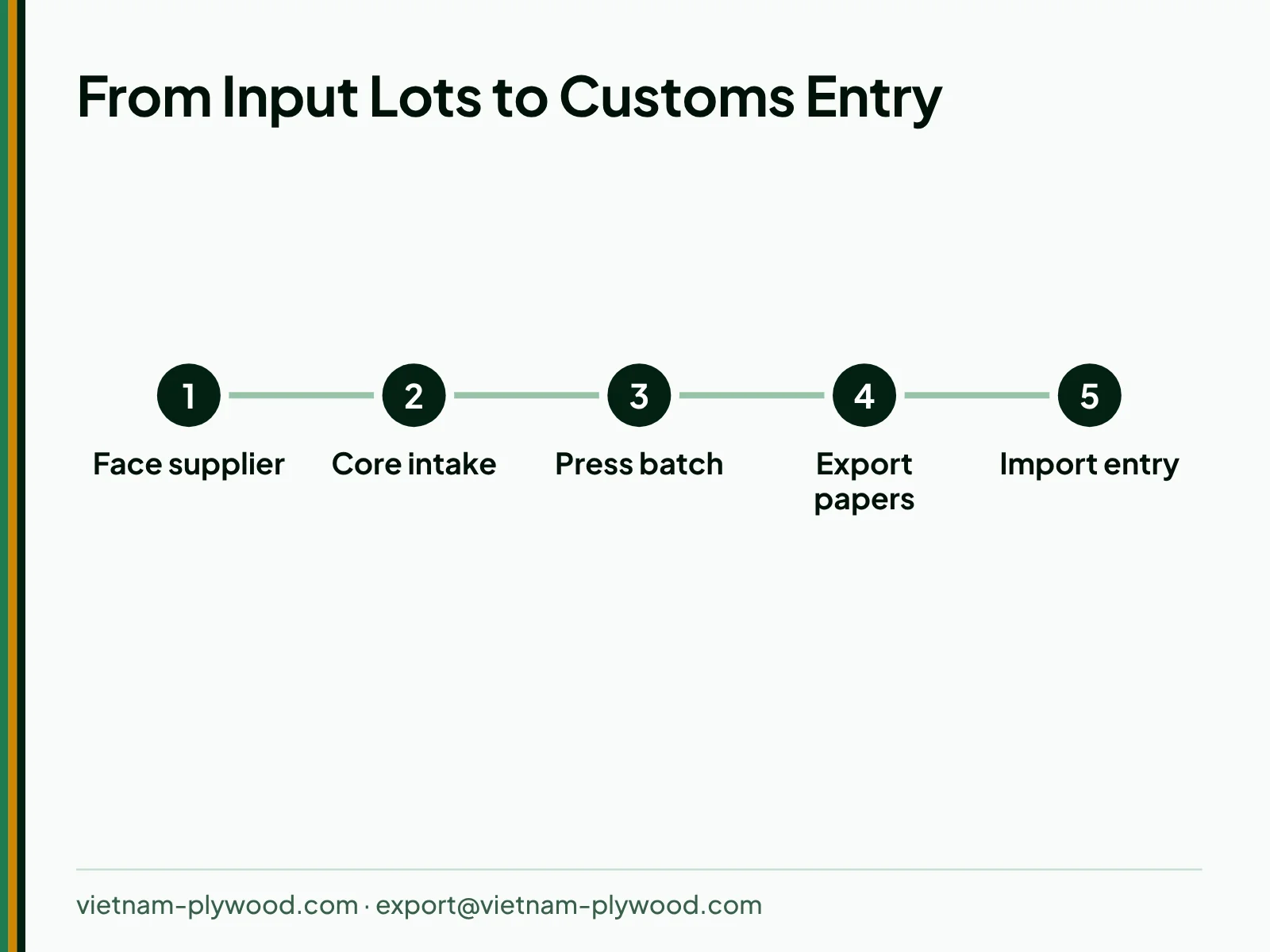
The face needs supplier and lot traceability identifying the veneer source; the core needs records identifying its Vietnamese material and the producing factory’s core construction. The finished panel additionally needs a production link between those two inputs and the exported batches.
| Evidence layer | What the buyer asks to see | What it can establish | What it cannot establish alone |
|---|---|---|---|
| Imported birch face | Supplier invoice, shipment record, veneer lot identification, species and origin declarations where available | Which face veneer entered production | Finished-panel preferential origin |
| Vietnamese core | Core procurement records, species and lot reference, factory intake records | Core material identity and claimed supply origin | Origin of the imported face |
| Production | Layup/press records, batch mapping and finished-goods labels | Connection between inputs and exported sheets | Automatic entitlement to a tariff preference |
| Export | Commercial invoice, packing list, B/L and applicable certificate of origin | Identity and declared shipment details | Every upstream timber traceability fact |
The exporter can assemble available supplier records and factory production evidence for the agreed order. Before booking, identify any missing upstream document in writing; the importer can then decide whether the destination’s requirements can be met.
A certificate belonging to a member factory is shown with factory details masked, on request. FSC, CARB P2, ISO 9001 and CE documents must never be interpreted as a blanket certificate covering every panel or every destination. Where a specific certificate claim is part of the order, match its scope to the producing factory and agreed build.
Which factory line makes birch-faced plywood?
Our furniture line presses birch-faced plywood over a styrax or eucalyptus core, with full-stitched construction and a sanded surface. The other lines serve different applications and should not be substituted under the same invoice description.
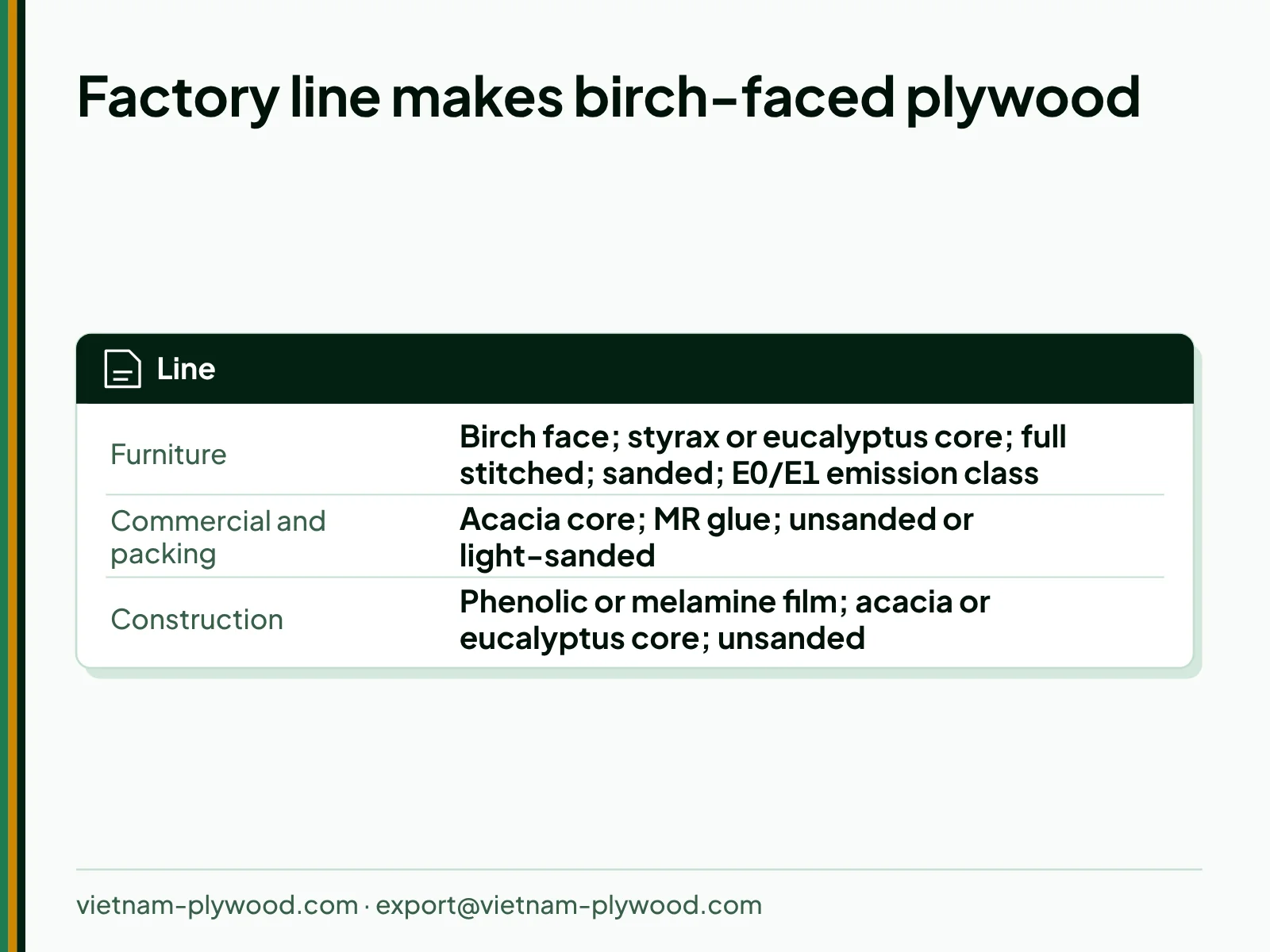
| Line | Actual build | Core density | Relevant buyer use |
|---|---|---|---|
| Furniture | Birch face; styrax or eucalyptus core; full stitched; sanded; E0/E1 emission class | Styrax 500 kg/m³ or eucalyptus 650 kg/m³ | Cabinet and furniture panels where face appearance matters |
| Commercial and packing | Acacia core; MR glue; unsanded or light-sanded | Acacia 580 kg/m³ | Packaging or commercial sheet requirements, without an assumed birch face |
| Construction | Phenolic or melamine film; acacia or eucalyptus core; unsanded | Acacia 580 kg/m³ or eucalyptus 650 kg/m³ | Concrete formwork rather than decorative birch face |
Our three factories are in Phu Tho and Hai Phong. Each order is produced at the factory matched to the written specification, and buyers inspect goods at the producing factory. HCPLY handles specification, on-site quality control, documents and loading; shipments are available FOB Hai Phong.
A birch face names the visible veneer, not the core species. The factory does not press birch-core plywood, so a buyer seeking all-birch layers should not infer that construction from a product title. Compare the birch-face and styrax-core combination with the Baltic birch construction explanation before approving a substitute.
What can an inspector witness before the panels ship?
An inspector can check incoming face veneer identification, the core layup, the press batch and finished-panel labels against the order.
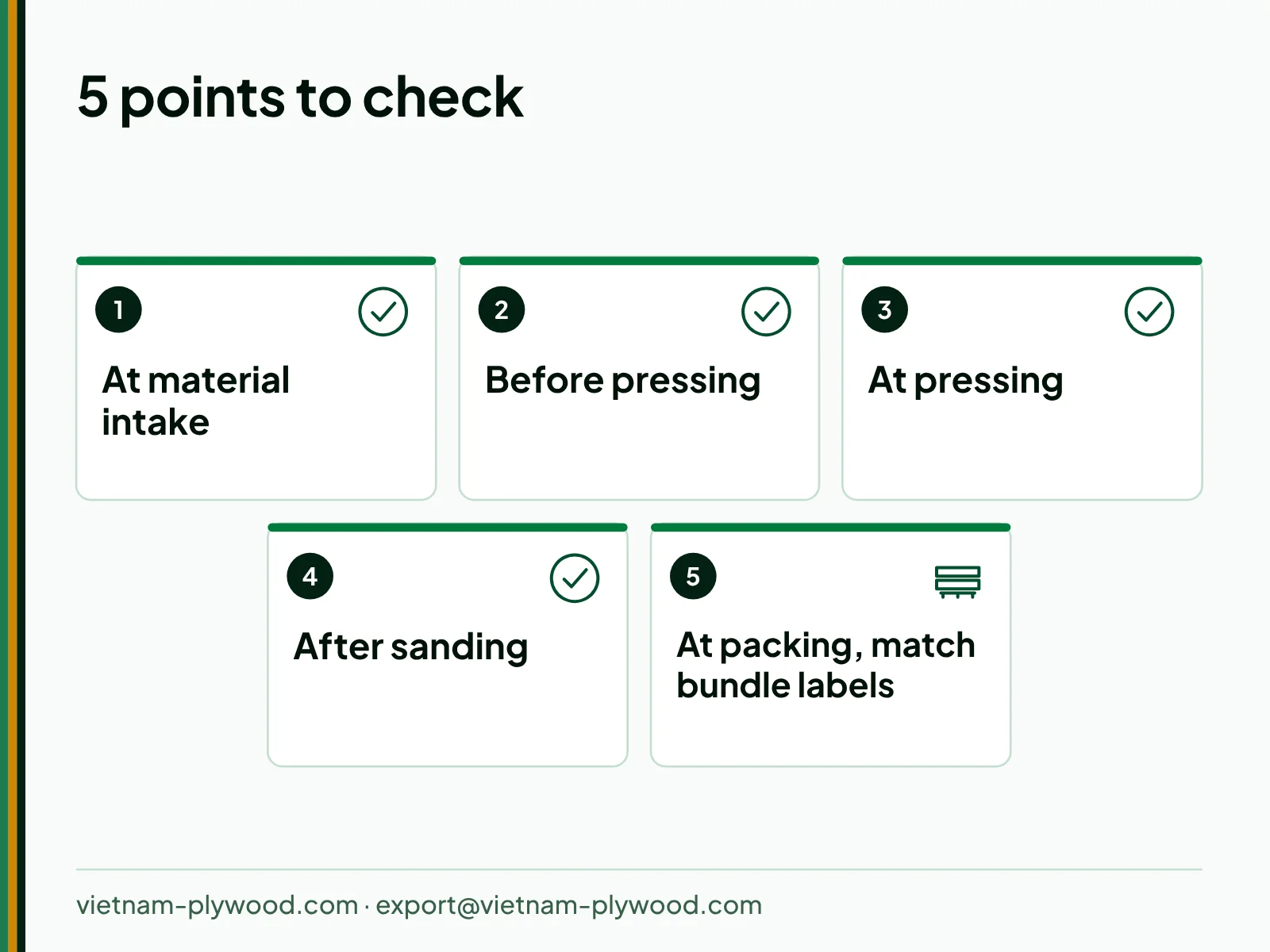
- At material intake, compare birch veneer labels and supplier paperwork with the proposed face origin and species.
- Before pressing, inspect the full-stitched core arrangement and identify whether the ordered core is styrax or eucalyptus.
- At pressing, record the batch reference and the glue specification used for the run.
- After sanding, measure thickness at agreed points and inspect the face grade and edge condition.
- At packing, match bundle labels, quantity and size to the packing list and export description.
The furniture line uses a sanded thickness tolerance of ±0.2 or ±0.3 mm as ordered. Common face veneer thickness is 0.2–0.4 mm; birch face grades offered are D/E/F. Length and width tolerance is ±2 mm. These are manufacturing specifications, not proof of the veneer harvest country.
Glue and emission are different order fields. Melamine glue is an MR option with a 12-hour boil specification; phenolic glue is a WBP option with a 72-hour boil specification. E0 and E1 are emission classes, while CARB P2/TSCA Title VI addresses a US emission limit and third-party certification. Do not replace an emission document with a glue statement.
Request photographs or witnessed inspection records tied to the batch, and state any required third-party inspection before production. The inspection should test the specified build and document identity; it cannot issue a customs-origin ruling.
Does a two-origin panel change the customs file?
A two-origin panel usually calls for more precise upstream evidence, even when the basic shipment documents remain the same. The importer needs to distinguish origin for customs marking, tariff preference, trade remedies and timber traceability, because each question applies its own test.
| Customs question | File to prepare | Decision owner |
|---|---|---|
| What is the finished article? | Layer description, species, thickness, face and core, manufacturing process | Importer and customs classifier |
| What is its non-preferential origin? | Input origins and substantial-processing evidence | Destination customs authority under applicable rules |
| Can it receive preferential duty? | Origin-rule analysis and qualifying proof such as an applicable EUR.1 | Importer/customs under the relevant agreement |
| Is a trade remedy applicable? | Product scope, exporter/producer details and current case requirements | Destination trade-remedy and customs authorities |
| Is timber due diligence complete? | Species, harvest-origin and supply-chain records required by the destination | Responsible operator/importer |
The United States Department of Commerce announced final affirmative antidumping and countervailing duty determinations in July 2026 covering hardwood and decorative plywood from Vietnam, among other countries. Its official announcement is a reason for US importers to check current orders, scope and producer-specific treatment before calculating landed cost. A determination is not a universal duty rate for every birch-faced panel.
For the EU, customs-origin proof and timber due diligence are separate workstreams. A document supporting a declared customs origin does not automatically provide the location and species information needed for timber traceability. The importer’s compliance team should define both evidence requests before approving the production batch.
How should the panel be described for classification?
Describe the panel by its construction: birch face, actual core species, ply count, thickness, size, surface finish and glue. A commercial label such as “imported birch plywood” cannot replace the construction data required to select a tariff classification.
Our furniture line can produce 3–40 mm thicknesses, with common choices of 3, 5, 9, 12, 15, 18, 21 and 25 mm. At 18 mm, the construction typically contains 11–13 plies because core veneers are 1.4–2.0 mm thick. These figures help the importer describe the article; they are not an assigned tariff code.
Sizes include 1220×2440, 1250×2500, 1220×2135, 1220×1830, 915×2440, 915×2135 and 915×1830 mm. Custom cutting is available.
Do not copy a tariff code from a Baltic birch listing. All-birch construction and birch-faced Vietnamese-core construction are different goods descriptions. The Russian birch alternative comparison helps frame the material choice, but the destination’s tariff schedule and binding classification procedures control the legal outcome.
How do quantity and mixed loads affect the paperwork?
Mixed specifications can share a 40HC container when the combined payload remains within 28.5 tonnes, but each build needs an identifiable packing-list line. The origin evidence should follow the corresponding batches instead of being attached indiscriminately to the entire container.
For an 18 mm, 1220×2440 mm panel, the loading table gives 990 styrax-core sheets, 880 acacia-core sheets or 795 eucalyptus-core sheets in the respective single-core loading examples. These examples use 18, 16 and 15 pallets respectively, with different stack-height limits. They do not authorize adding those full quantities together.
For a mixed load, request a pallet-by-pallet loading plan that identifies each specification and its listed weight. Check the combined cargo weight against the payload limit before approving the packing list.
For example, the listed sheet weight for 18 mm, 1220×2440 mm styrax-core plywood is 26.79 kg, excluding film weight. The core determines the density used in that table. Actual load planning also needs packaging and shipping constraints; use the container loading calculator and method for the full load decision.
If another specification travels in the same shipment, identify its separate core, face and production batch. Our several plywood types under one supply program explains how to frame those distinct requirements without confusing the customs descriptions.
What changes between EU, US and other destination files?
The destination changes the legal questions and the documents an importer must be ready to present.
For an EU destination, ask for the shipment’s listed EUR.1 and the EUTR/EUDR file set where applicable, while checking whether the panel meets the preferential origin rule. Do not assume an EUR.1 proves eligibility merely because it was requested. A core and imported face must be evaluated under the product-specific rule in the relevant trade agreement.
For a US destination, classify the actual construction and check current antidumping/countervailing duty scope and origin marking. The 2026 Commerce announcement makes this a live purchase-order check, not a calculation to postpone until the vessel arrives. Separately check whether a required emissions certification applies to the ordered product and the exact producer.
For other destinations, identify the customs tariff heading, origin rule, phytosanitary requirements and accepted certificates with the local customs adviser. The commercial invoice and packing list still need the same truthful layer description. The export team can prepare the agreed shipment documents, while the importer remains responsible for the destination entry.
What should be agreed before the purchase order?
Agree the product description, source evidence, customs responsibility and inspection checkpoints before the deposit. A purchase order that specifies only “birch plywood” leaves the core, face origin and document scope unresolved.
The minimum order is one 40HC; specifications can be mixed within the payload limit. Factory lead time runs 15–45 days from receipt of the 30% deposit; the exact figure depends on order size, line loading and what the contract fixes. The remaining 70% is paid on the scan of the bill of lading, by T/T, or by irrevocable sight L/C. We ship FOB Hai Phong, or CFR (CNF) or CIF to your port.
Samples cost nothing: a first-time buyer pays the courier, and that charge comes off the first confirmed order. State which evidence must accompany the sample approval and which must be available before loading.
Request a quotation for the specified birch-faced build. The main build drivers are the core and its construction, then face veneer selection and grade, then glue, emission and dimensional requirements. A full-stitched sanded furniture panel requires more preparation than a loose-laid unsanded packing build; a thicker or more demanding face selection also changes the quotation. Ask for a written quotation against the agreed specification rather than inferring a price from a different product.
What mistakes delay birch plywood clearance?
The most avoidable delays come from vague descriptions, unsupported origin assumptions and inconsistent batch references. A buyer can reduce those risks by checking the document chain before the shipment is booked.
A common mistake is treating “birch” as proof of an all-birch core. Another is accepting “Vietnam origin” as an explanation without identifying the imported face and the actual processing steps. A third is treating an FSC or emissions document as a substitute for customs-origin evidence.
Check that the packing list distinguishes different core species and thicknesses, that the invoice uses the same construction language, and that the certificate of origin refers to the actual shipment. Where the importing authority asks for upstream face documents, retain them with the production batch map. Do not invent an origin statement to fill a gap in a supplier’s records.
The commercial and packing plywood comparison is useful when a mixed order includes a different core construction. Different uses should have distinct descriptions even when they ship together.
What specification should the buyer send next?
Send a construction-specific request that states the destination and asks for the evidence available for both veneer and core. That lets our export team match the producing line, inspection points and document package to the proposed shipment.
Before placing the order, identify whether the customs adviser needs an advance classification or origin decision. Record the required supplier-origin evidence, the intended invoice wording and any preferential-origin condition. Buyers can visit the factory office and inspect the panels at the producing factory.
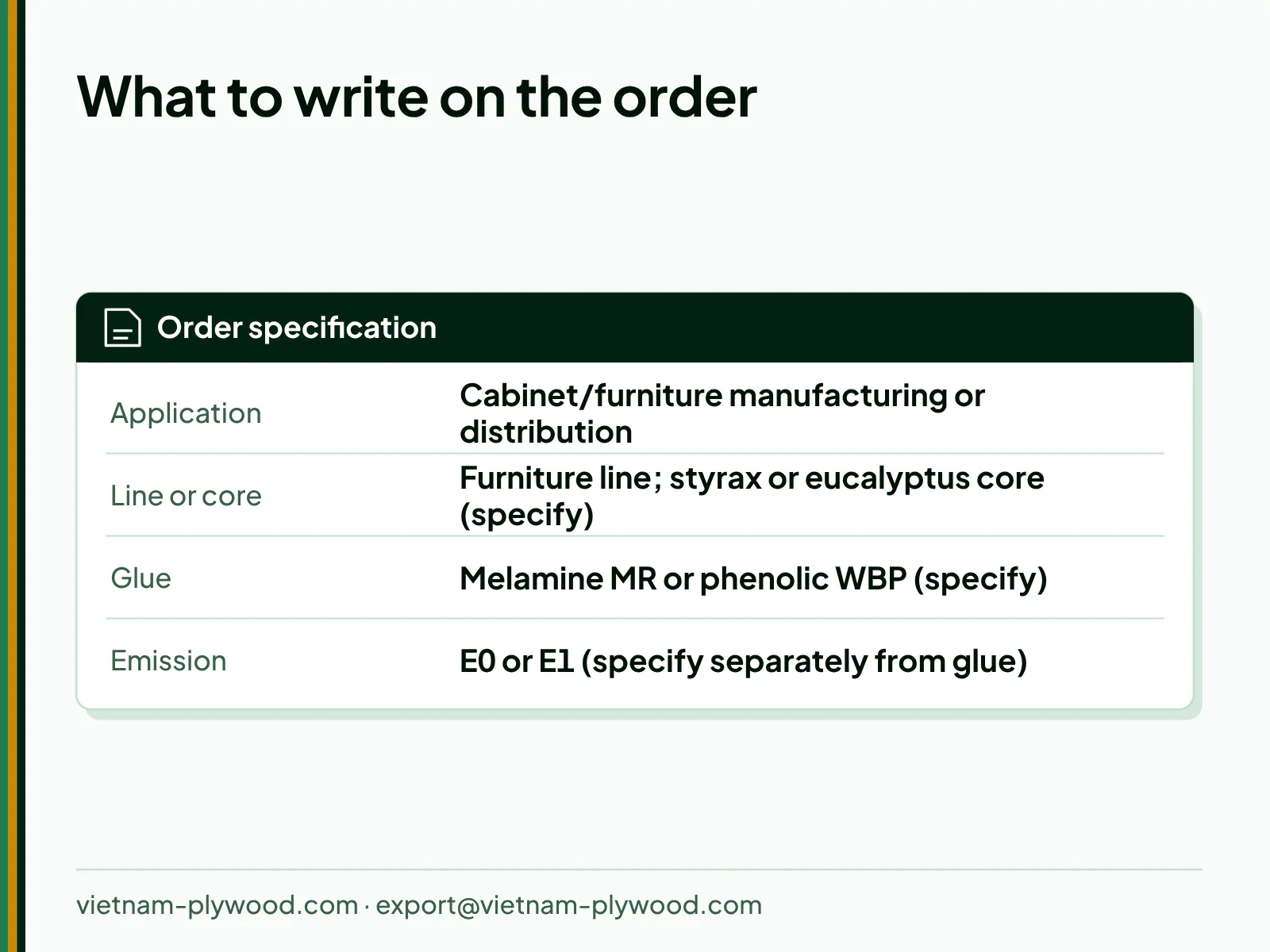
HCPLY’s contact for this request is Lucy at export@vietnam-plywood.com. The following specification keeps the product and origin questions together:
Application: Cabinet/furniture manufacturing or distribution
Line or core: Furniture line; styrax or eucalyptus core (specify)
Glue: Melamine MR or phenolic WBP (specify)
Emission: E0 or E1 (specify separately from glue)
Face and grade: Birch face, D/E/F (specify); identify face source evidence needed
Thickness and tolerance: [mm]; sanded ±0.2 or ±0.3 mm as ordered
Size: [mm × mm]
Quantity: [sheets / pallets / 40HC allocation]
Destination port: [port and country]
Origin evidence: Face supplier/lot; Vietnamese core lot; production batch link
Customs requirements: Classification, preference and destination document list
Next step: Request the birch-faced plywood spec sheet with the destination port and proposed origin-document checklist.