





HCPLY approaches plywood price in Saudi Arabia by separating commercial, furniture and shuttering specifications before quoting a project. Buying the wrong panel can raise the installed cost, delay work or produce a rejected load. Our October 2026 starting rates are from US$250/m³ FOB Hai Phong (October 2026) for commercial plywood and from US$350/m³ FOB Hai Phong (October 2026) for furniture plywood.
What drives plywood price in Saudi Arabia?
Plywood price in Saudi Arabia reflects the specified panel, the purchase unit and the costs between the producing factory and the buyer’s site. A Saudi shelf price per sheet and a Vietnam FOB price per cubic metre describe different cost positions. Compare like-for-like material before interpreting either figure as a saving.
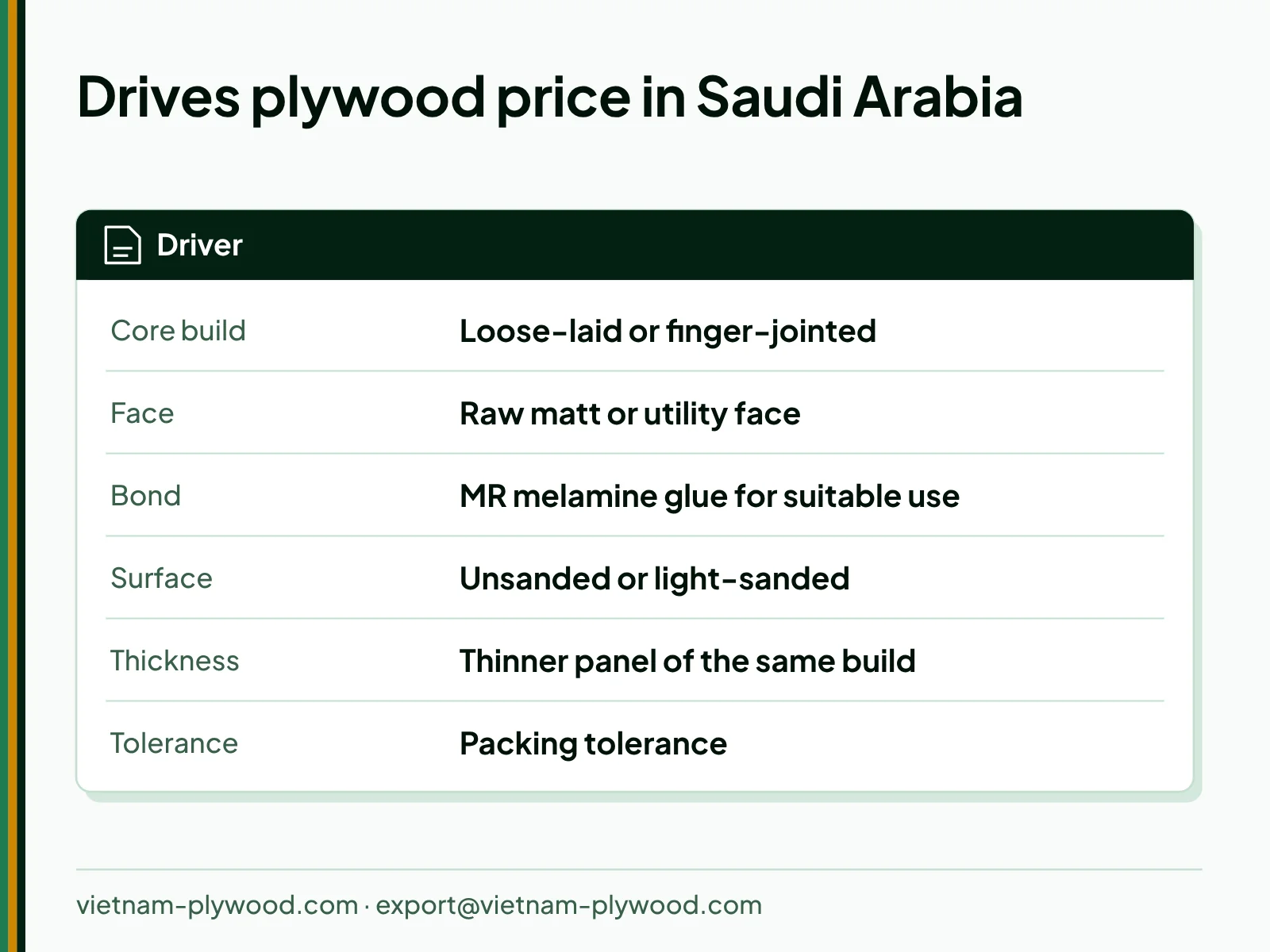
| Driver | Lower-cost direction | Higher-cost direction | Buying consequence |
|---|---|---|---|
| Core build | Loose-laid or finger-jointed | Full stitched core | Check voids, jointing and intended service |
| Face | Raw matt or utility face | Selected decorative veneer and tighter appearance grade | Finish requirements change the bill |
| Bond | MR melamine glue for suitable use | Phenolic WBP bond for demanding wet exposure | Request the agreed test scope |
| Surface | Unsanded or light-sanded | Sanded, appearance-controlled face | Dimensional finish matters for joinery |
| Thickness | Thinner panel of the same build | Thicker panel of the same build | More wood volume per sheet |
| Tolerance | Packing tolerance | Tighter sanded furniture tolerance | Reject risk rises if dimensions mismatch |
| Delivery | FOB origin | CFR or CIF destination | Freight and insurance change the comparison |
Core density follows the wood inside the panel rather than the decorative face. Our furniture line uses styrax or eucalyptus cores; our commercial and packing line uses acacia; our construction line uses acacia or eucalyptus beneath film. A comparison that calls every 18 mm panel equivalent misses these differences.
For a broader breakdown of origin and destination charges, see Vietnam plywood export cost factors. That cost structure is useful when a local offer includes handling or inland delivery that the origin quote excludes.
How do I convert a per-m³ from-price into a Saudi sheet rate?
Multiply the cubic-metre rate by the physical volume of one sheet. For 1220 × 2440 mm panels, the area is 1.22 × 2.44 = 2.9768 m². Thickness in metres gives the sheet volume; the resulting US-dollar figure is an FOB-equivalent starting calculation, not a Saudi retail quotation.
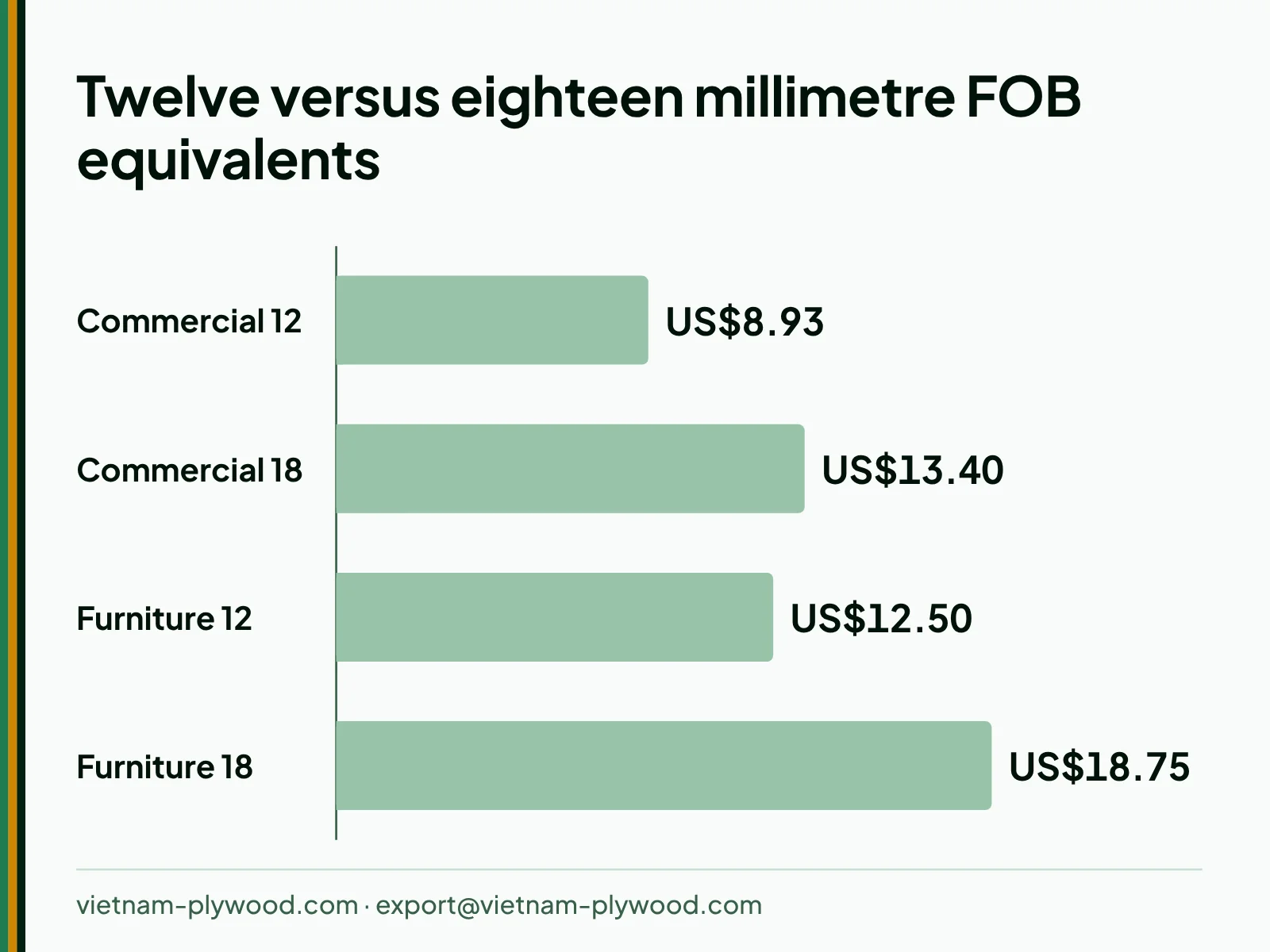
| Build and thickness | Sheet volume | October 2026 FOB starting-rate equivalent |
|---|---|---|
| Commercial, 12 mm | 0.0357216 m³ | US$8.93/sheet at US$250/m³ |
| Commercial, 18 mm | 0.0535824 m³ | US$13.40/sheet at US$250/m³ |
| Furniture, 12 mm | 0.0357216 m³ | US$12.50/sheet at US$350/m³ |
| Furniture, 18 mm | 0.0535824 m³ | US$18.75/sheet at US$350/m³ |
These calculations apply only to the two named starting-rate product families. They do not establish a film-faced or marine panel price. The per-m³, per-m² and per-sheet conversion explains how to preserve units across quotations.
A quoted sheet price also needs a defined thickness tolerance. If the quotation says 18 mm but the received panel is materially thinner, the nominal-volume comparison hides a specification difference. Record the ordered tolerance before comparing the converted figure with a local list price.
How do 12 mm and 18 mm plywood prices compare?
At equal face, core, bond and unit rate, an 18 mm sheet contains 50% more wood volume than a 12 mm sheet. The corresponding starting-rate sheet equivalent rises by the same ratio. That arithmetic is more useful than comparing two unmatched advertised sheet prices.
The 12 mm commercial starting-rate calculation is US$8.93 per 1220 × 2440 mm sheet; the 18 mm calculation is US$13.40. For furniture plywood, the corresponding figures are US$12.50 and US$18.75. Both sets remain FOB Hai Phong equivalents based on October 2026 rates.
Thickness does not independently decide whether a panel works for cabinet parts, site protection or shuttering. Support spacing, load, edge exposure, fasteners and the specified grade still control selection. The plywood price by thickness page covers thickness comparisons beyond this project example.
For the 18mm plywood price in saudi arabia, ask suppliers to identify whether their figure is a sheet rate, cubic-metre rate or delivered-site rate. Apply the same check to the 12mm plywood price in saudi arabia. A smaller number can simply represent a different quotation basis.
Can shuttering, joinery and commercial panels be quoted together?
Yes. HCPLY can prepare a project quotation with distinct specification lines for shuttering, joinery and temporary-work panels. The producing factory for each line is chosen by its build requirements, and the export coordination covers specification, on-site quality checks, documents and loading.
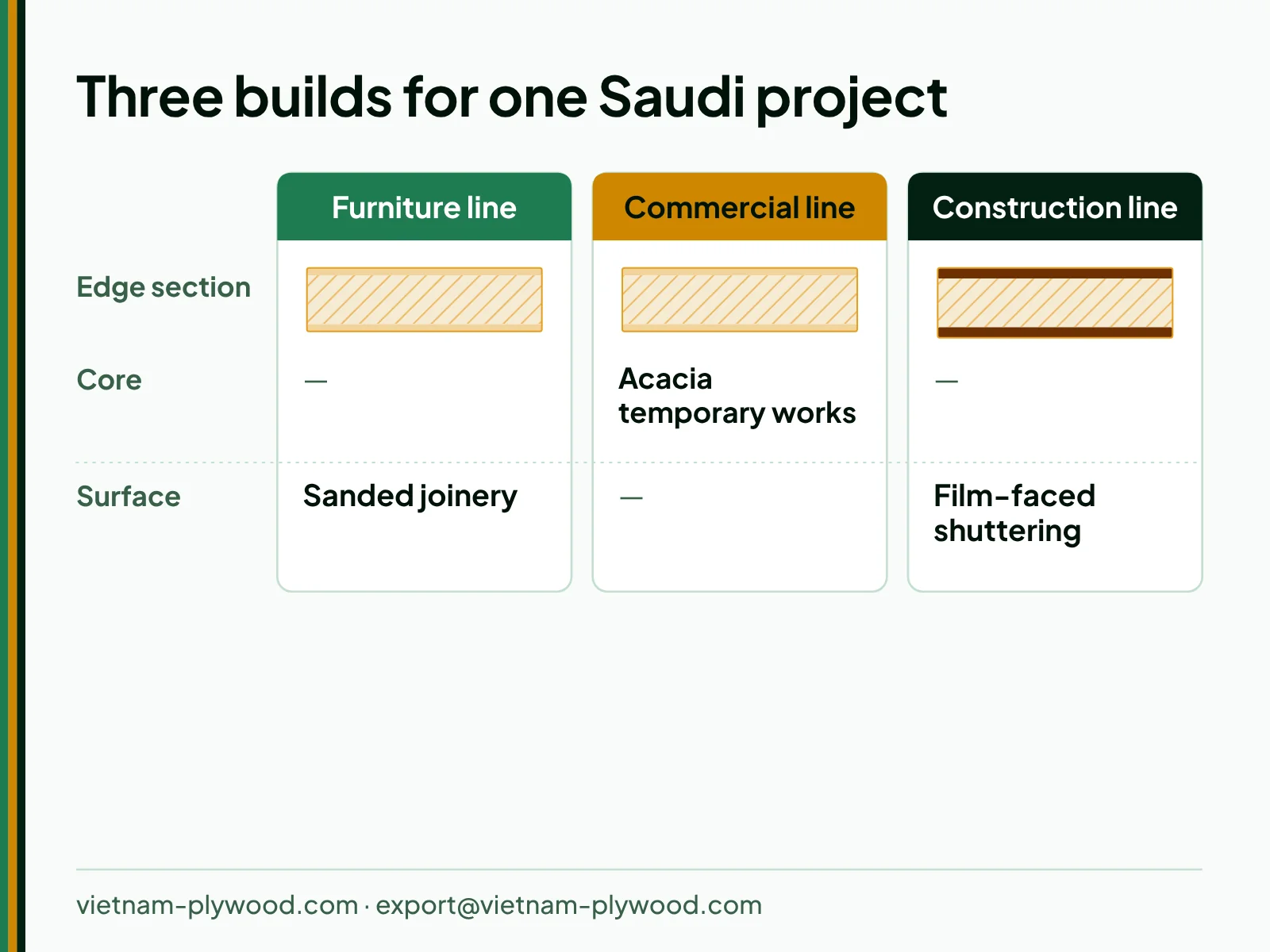
| Project use | Producing line | Typical build direction | Quotation basis and verdict |
|---|---|---|---|
| Concrete shuttering | Our construction line | Acacia or eucalyptus core; phenolic or melamine film | Separate specification quote; choose for formwork |
| Cabinet and fit-out joinery | Our furniture line | Styrax or eucalyptus, full stitched, sanded, E0/E1 | Furniture dated starting rate; choose for visible joinery |
| Site protection and temporary works | Our commercial and packing line | Acacia, MR glue, unsanded or light-sanded | Commercial dated starting rate; choose for utility applications |
The construction line uses 120 g/m² standard film, 135 g/m² premium film or 220 g/m² anti-slip film. These are surface specifications rather than a substitute for checking the panel underneath. For formwork economics, compare the cost per pour against the site handling plan.
The furniture line can build a selected veneer face, such as bintangor, okoume or engineered veneer, over a full stitched core. Its appearance and sanding specification differs from commercial packing panels. See furniture plywood for the intended finish and build discussion.
What sets marine plywood price in Saudi Arabia?
Marine plywood price in Saudi Arabia is driven first by the required bonding and test performance, then by core integrity, face quality and dimensional specification. A phenolic weather-and-boil-proof (WBP) bond costs more to specify than a basic moisture-resistant (MR) commercial build because it targets more demanding exposure.
For a marine request, state the exact accepted test report and intended exposure. The word “marine” alone does not establish panel suitability. Any marine or BS 1088 description for our panels is assessed against a test report the buyer accepts.
Our phenolic glue has a 72-hour boil specification, while melamine MR glue has a 12-hour boil specification. Glue selection and formaldehyde-emission class are separate fields; E0, E1 and E2 describe emission classes, while CARB P2 and TSCA Title VI relate to a US emissions limit with third-party certification.
Face veneer species, patching allowance and edge treatment affect the delivered panel as much as the nominal thickness. For wet service, ask for edge-sealing requirements and the test criteria in writing. For any marine designation, request the agreed build and assess suitability against a test report the buyer accepts.
How do I compare an import quote with a local KSA sheet rate?
Start with identical dimensions, grade and delivery point, then add the destination costs to the import offer. A local sheet rate may include warehousing, handling and delivery; an FOB origin rate does not. Use the same currency and tax treatment for both offers.
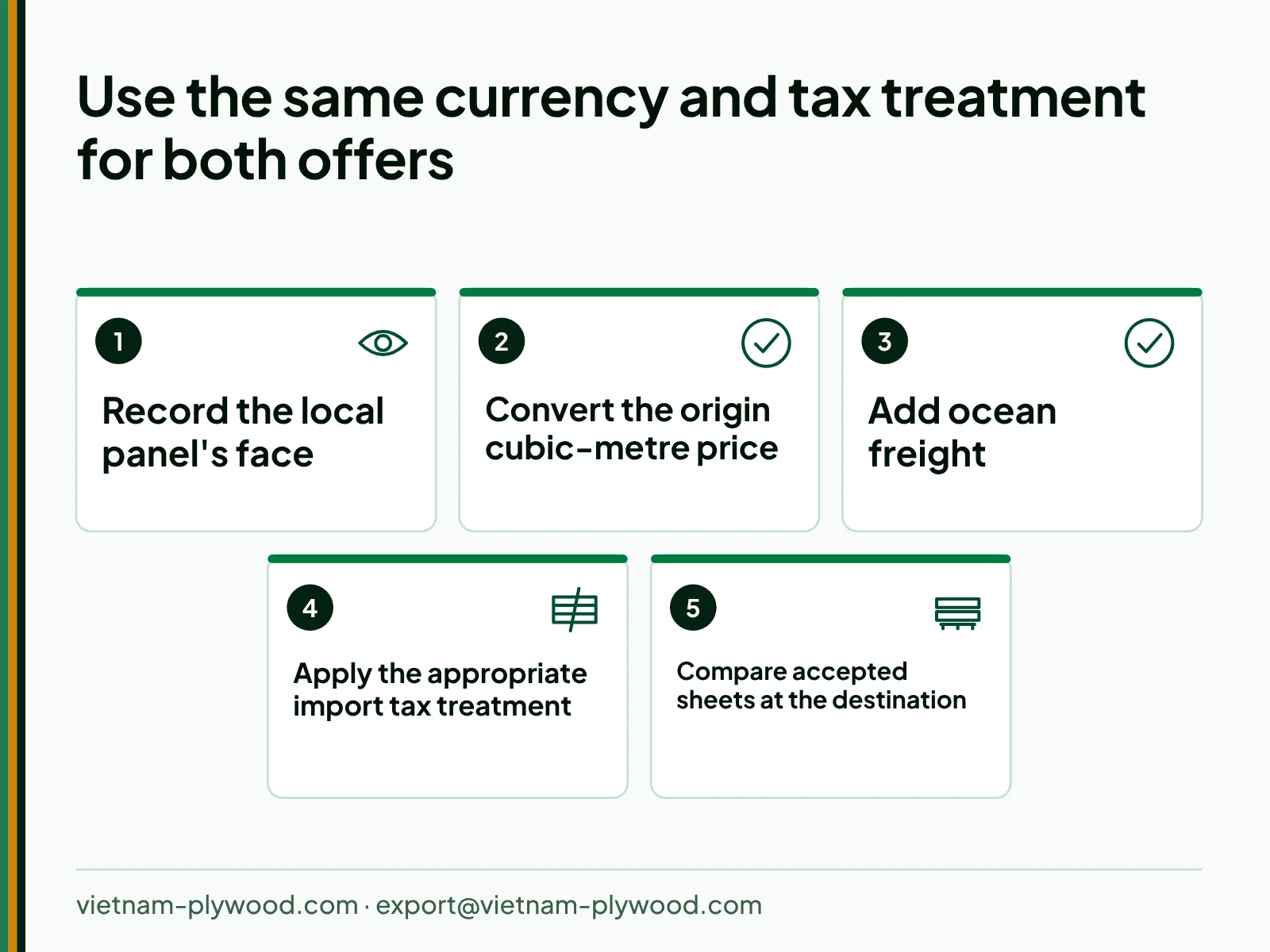
- Record the local panel’s face, core, glue, emission class, thickness tolerance and sheet size.
- Convert the origin cubic-metre price into a matching sheet equivalent.
- Add ocean freight, insurance where relevant, destination handling, customs duty, clearance and inland transport.
- Apply the appropriate import tax treatment and distinguish recoverable VAT from a final cost.
- Compare accepted sheets at the destination, including breakage and any documented quality deductions.
Saudi Arabia’s Zakat, Tax and Customs Authority (ZATCA), in its 2026 VAT information, states that the standard VAT rate increased to 15% on taxable goods and services in July 2020 (ZATCA VAT explanation). Its 2025 customs-and-tax calculator service explains that users enter the goods category and value to calculate applicable charges (official calculator service).
The applicable customs duty requires the actual tariff classification and declaration details. Avoid assigning one blanket duty percentage to every plywood construction. Check the relevant tariff classification and importer position before committing to a Saudi landed-cost comparison.
What can share a 40HC shipment for a Saudi project?
The minimum order is one 40HC, and specifications can be mixed within its 28.5-tonne payload limit. This permits a project plan that combines different panel purposes, provided the final packing schedule respects weight and dimensions.
For 18 mm, 1220 × 2440 mm panels, a full styrax-core load is 990 sheets, 53.05 m³ and 26.52 t. A full acacia-core load is 880 sheets, 47.15 m³ and 27.35 t. A full eucalyptus-core load is 795 sheets, 42.60 m³ and 27.69 t. These lookup weights exclude film weight.
For a mixed order, send the quantity of each build for a factory packing plan. Check the final pallet weights, film allowance and axle distribution before loading.
A construction-film allocation needs its own weight allowance because film is additional to the core lookup. For other thicknesses and packing arrangements, use the container loading reference rather than treating a single 18 mm example as a universal capacity.
What can a Saudi buyer inspect at the producing factory?
The buyer can witness specification checks at the factory pressing the ordered panels. HCPLY hosts factory-office visits and inspection of the goods at that producing location, with export staff coordinating the checks against the approved order.
Inspectors can measure sheet length and width against the ±2 mm specification, then check thickness at agreed points. Sanded furniture panels use ±0.2 or ±0.3 mm as ordered; commercial and film-faced panels use ±0.5 mm; packing panels use ±0.5–1.0 mm. These are distinct acceptance conditions.
A cut-edge sample can show whether the core is full stitched, stitched at outer layers with edge-trimmed inner veneers, finger-jointed or loose-laid. The inspector can also check the selected face grade, film appearance, pallet identification and sheet count. For 18 mm panels, 11–13 plies are typical because individual core veneers are 1.4–2.0 mm.
Request photographs or witnessed records tied to the actual producing lot. This gives the importer a practical basis for accepting the goods before the shipment leaves Hai Phong.
Which trade terms and papers belong in the quote?
The quotation should identify FOB Hai Phong, CFR (CNF) or CIF, the destination port and the agreed panel specification. The chosen term controls which freight and insurance components belong in the export price and which remain with the Saudi importer.
Factory lead time runs 15–45 days from receipt of the 30% deposit; the exact figure depends on order size, line loading and what the contract fixes. The 70% balance is against the scanned bill of lading, by telegraphic transfer (T/T) or irrevocable letter of credit (L/C) at sight. Free samples are available; new buyers book their courier, and the courier cost can be credited against a real order.
The shipment document package contains the commercial invoice, packing list, bill of lading, certificate of origin, phytosanitary and fumigation papers, and insurance under CIF. It also includes any agreed factory certificate documents or test reports. After loading, the draft shipping documents come to you for approval.
Member-factory FSC, CARB P2, ISO 9001 and CE documentation is shown with factory details masked, on request. If a project needs particular emissions or test evidence, identify that requirement at quotation stage. See production lead time when aligning site procurement with the factory schedule.
How should a Saudi importer request a comparable quotation?
Send one specification for each application and identify the port where the cargo will be received. The factory can then distinguish joinery appearance requirements from utility panels and concrete-contact performance, rather than combining incompatible grades into one vague price.
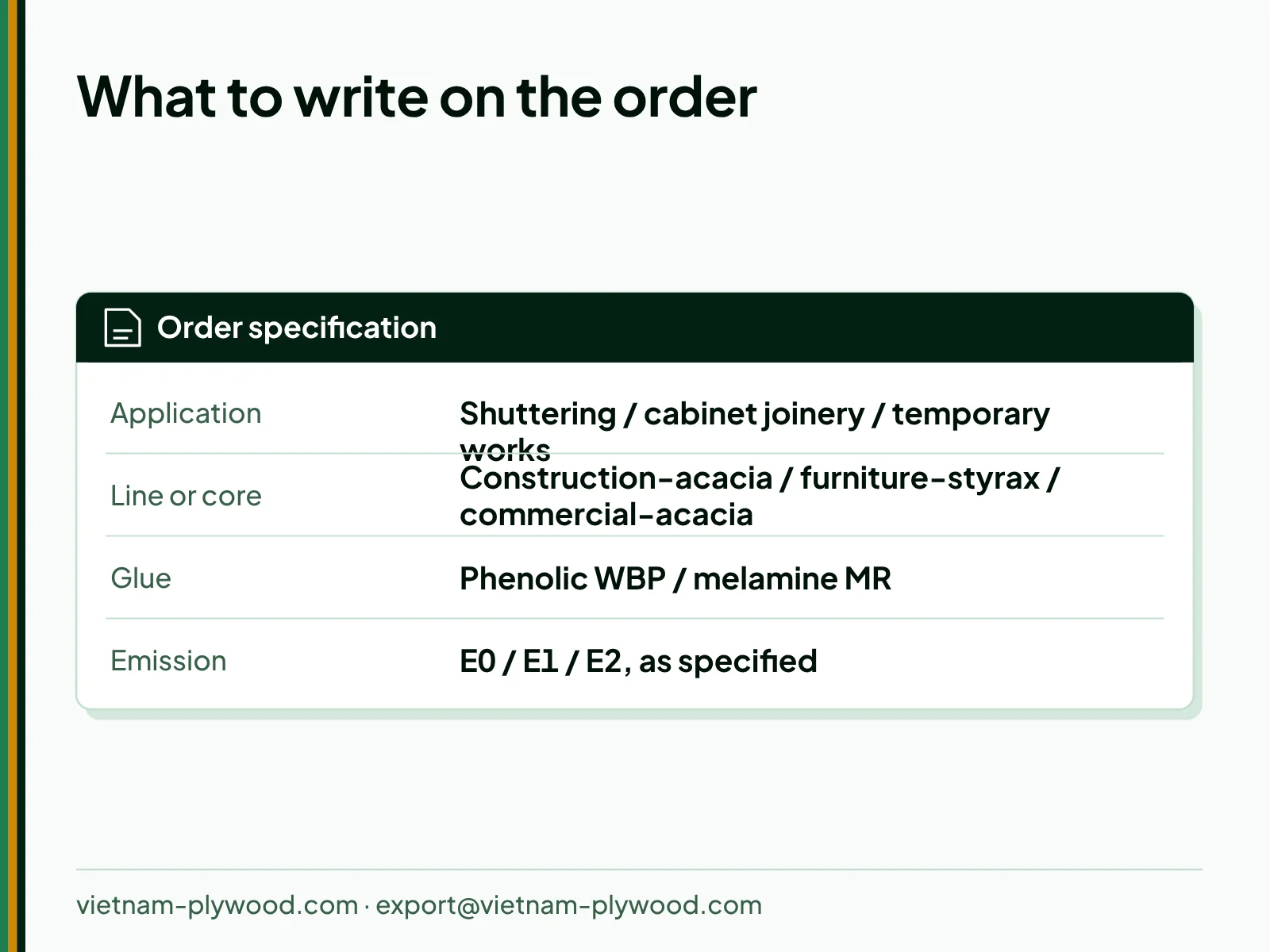
The plywood price in ksa that matters for purchasing is the accepted, landed cost of the specified panel. HCPLY can provide the export-side build and price basis; the importer adds the Saudi tariff, tax position and domestic logistics for a complete comparison.
Application: shuttering / cabinet joinery / temporary works
Line or core: construction-acacia / furniture-styrax / commercial-acacia
Glue: phenolic WBP / melamine MR
Emission: E0 / E1 / E2, as specified
Face and grade: film type and weight / veneer species and A/B grade
Thickness and tolerance: 12 or 18 mm; ordered tolerance
Size: 1220 x 2440 mm or stated cut size
Quantity: sheets and cubic metres per specification
Destination port: Saudi port name; FOB / CFR / CIF requested
Request the Saudi project specification sheet from Lucy at export@vietnam-plywood.com.