





Plywood cost per m2 is the cubic-meter quote multiplied by thickness in meters, allowing mixed-thickness lines to be compared. A wrong unit or sheet dimension can distort an order budget and cause a rejected commercial comparison. At HCPLY, we show the quoted unit and date beside each specification so importers and cabinet makers can reconcile area, sheet and volume values.
How do you calculate plywood cost per m2 from m³?
Plywood cost per m2 equals the price per cubic meter multiplied by panel thickness in meters. A 12 mm sheet uses 0.012 m³ for each square meter of face area; an 18 mm sheet uses 0.018 m³. Keep the currency, trade term and quotation date unchanged when converting. This gives a comparable area price for a specified build.
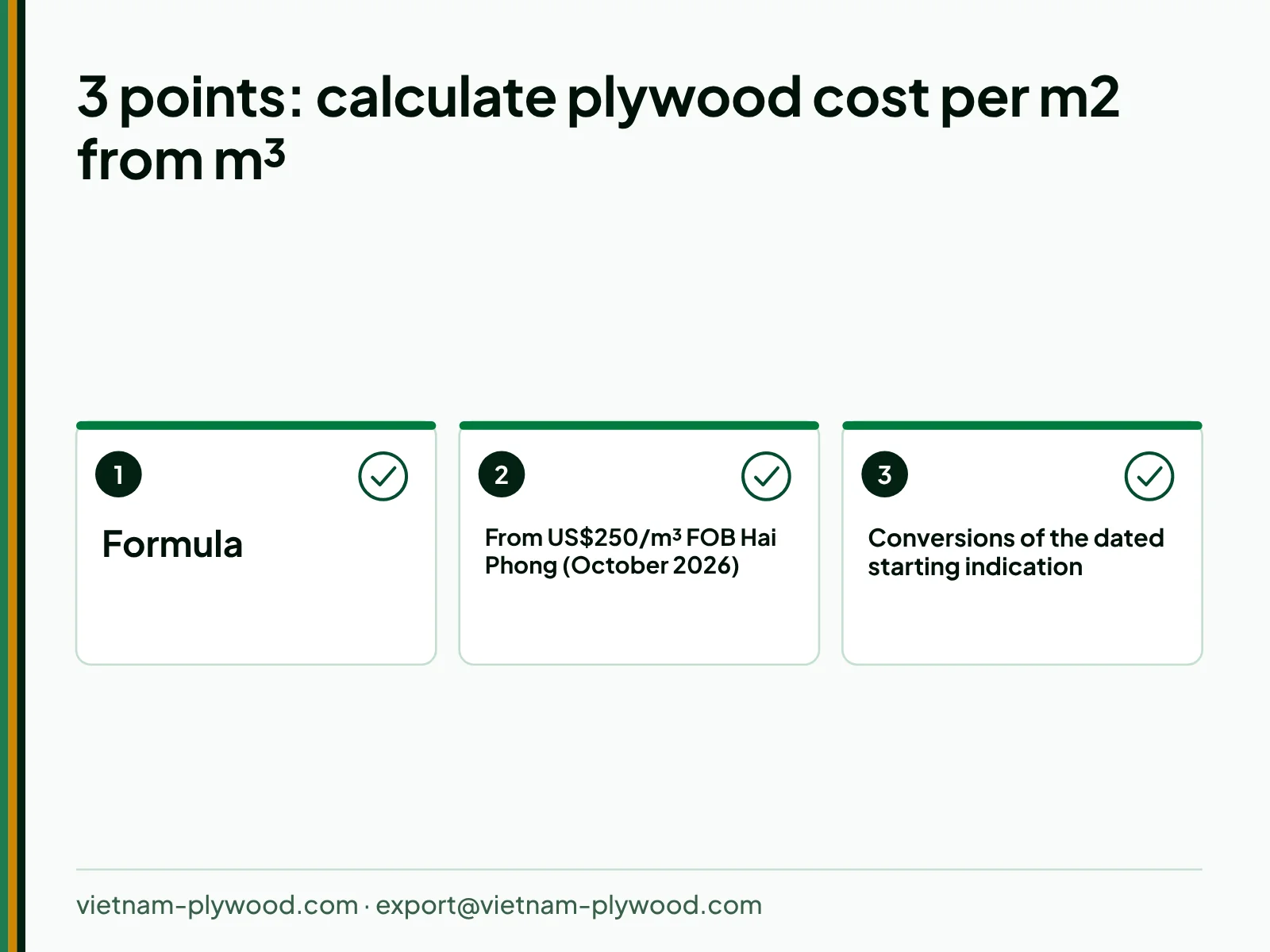
Formula: price/m² = price/m³ × thickness (mm) ÷ 1,000. The reverse calculation is price/m³ = price/m² × 1,000 ÷ thickness (mm). A quote written in cubic meters (m³ or CBM) describes panel volume, whereas square meters (m²) describe covered area. Neither calculation changes the material supplied.
For a dated commercial plywood starting indication of from US$250/m³ FOB Hai Phong (October 2026), 12 mm corresponds arithmetically to US$3.00/m² and 18 mm to US$4.50/m² at that same reference rate. These are conversions of the dated starting indication, not additional product offers or current sheet quotations. A separate specification still determines the actual quoted rate.
The U.S. Census Bureau’s Guide to International Trade Statistics, conversion tables (accessed 2026), identifies CBM as cubic meters and SQM as square meters. Its official unit tables distinguish volume from area; the thickness factor connects them for a rectangular plywood panel.
How do you calculate the price of one plywood sheet?
Multiply the quoted cubic-meter rate by length, width and thickness, all in meters. For a 1220 × 2440 mm sheet, the face area is 1.22 × 2.44 = 2.9768 m². An 18 mm sheet occupies 2.9768 × 0.018 = 0.0535824 m³. The price of that sheet therefore equals the quoted US$/m³ multiplied by 0.0535824.
Using the same dated commercial starting reference, that arithmetic yields US$13.3956 per 18 mm sheet, or approximately US$13.40 as a converted reference, not a separate sheet price. For 12 mm, volume is 0.0357216 m³ and the corresponding arithmetic is US$8.9304. Preserve the unrounded volume in the workbook, then round the displayed comparison consistently.
A buyer comparing plywood sheets cost across dimensions must change both length and width in the formula. A 1250 × 2500 mm panel covers 3.125 m²; its volume differs from a 1220 × 2440 mm panel even at identical thickness. When the purchasing unit is sheets, add an explicit sheet count and size beside every line.
Workbook columns: specification ID; face size; nominal thickness; quoted US$/m³; m²/sheet; m³/sheet; calculated US$/m²; calculated US$/sheet; number of sheets; line total. Calculate line total from unrounded volume × count × the quoted rate. Never sum per-sheet prices rounded for display and then treat the result as the commercial invoice total.
Why do exporters quote plywood by cubic meter?
A cubic-meter unit allows different sheet dimensions and thicknesses to be valued on one volume basis. Each sheet has its own cubic-meter content, so a container containing several sizes can be expressed as a single aggregate volume without pretending all sheets are equivalent. For the buyer, m² remains useful for surface coverage and sheets remain useful for cutting schedules.
The unit alone does not equalize grade, veneer, glue or delivery scope. A plywood price per cubic meter must sit next to a written build. Two identical volumes can have different face veneers, core assembly, emission classes and pressing requirements. Likewise, a wooden ply rate shown by the sheet cannot be compared with a volume rate until dimensions are stated.
The export cost breakdown explains which cost components sit beyond the panel specification. Keep product value and transport scope in separate columns when comparing offers under different trade terms. The objective is to make unlike units readable without concealing unlike products.
Which build changes the cubic-meter rate most?
Core construction and face requirements are the first specifications to compare; glue system, sanding, tolerances and logistics follow. Full stitched construction involves more core preparation than loose-laid construction. A higher face grade calls for more selective veneer, while a phenolic bond uses a different press schedule from a moisture-resistant (MR) build. The actual ranking of quoted costs must be established against matching specifications.
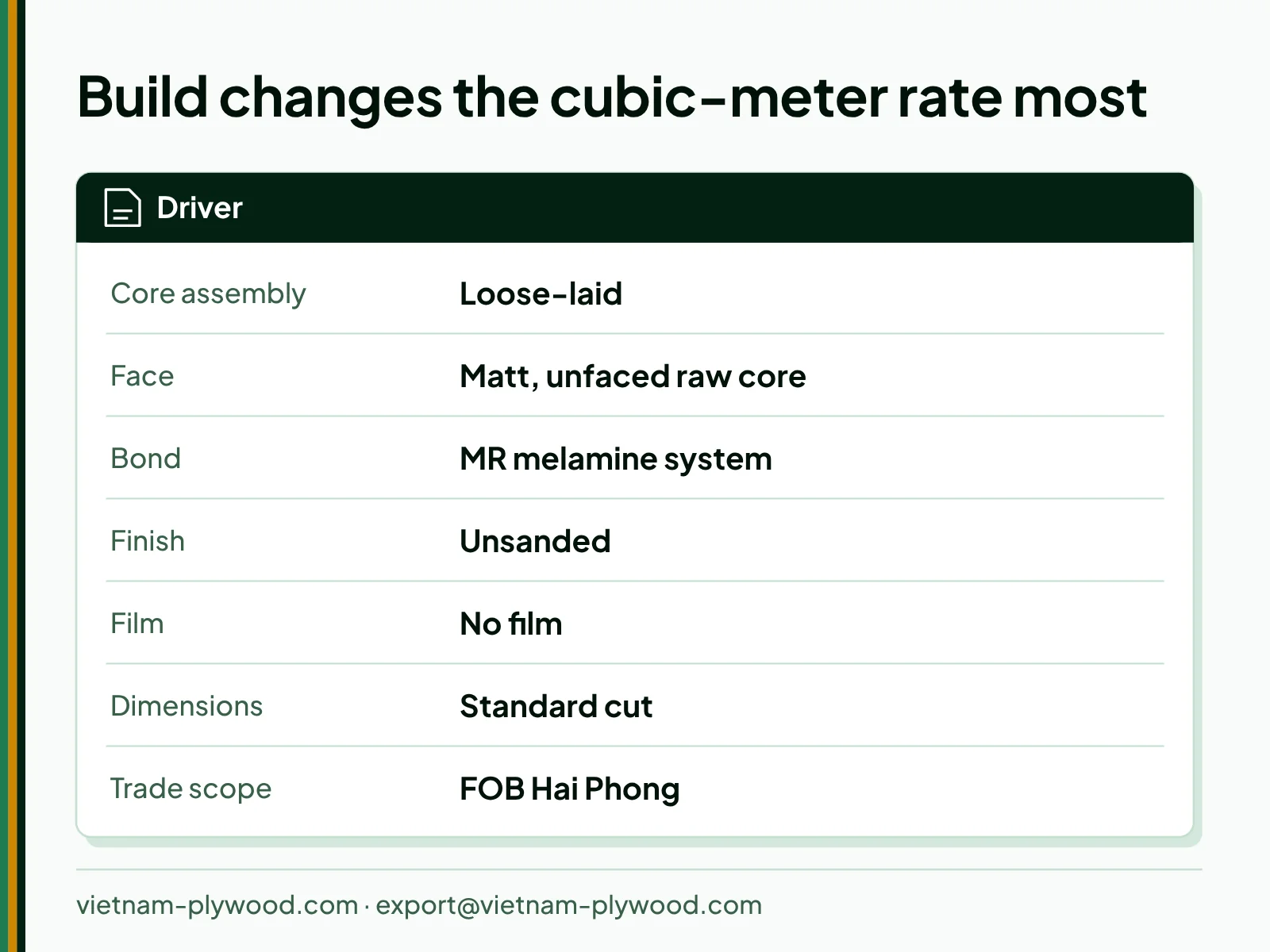
| Driver | Lower-complexity comparison | Higher-complexity comparison | What to request |
|---|---|---|---|
| Core assembly | Loose-laid | Full stitched | Core lay-up and permitted voids |
| Face | Matt, unfaced raw core | Selected decorative face and grade | Species, face grade, veneer thickness |
| Bond | MR melamine system | Phenolic weather-and-boil-proof (WBP) system | Glue specification and test basis |
| Finish | Unsanded | Sanded to ordered tolerance | Thickness measurements |
| Film | No film | Phenolic or melamine film | Film type and weight |
| Dimensions | Standard cut | Custom cutting | Cutting schedule and yield |
| Trade scope | FOB Hai Phong | CFR or CIF | Named destination and cost inclusions |
These comparisons describe process and specification differences, not a fixed percentage premium. On our furniture line, full stitched sanded panels with E0 or E1 emission classes are made using styrax or eucalyptus cores. Our commercial and packing line uses acacia cores with MR glue, unsanded or light-sanded. Our construction line produces film-faced and anti-slip panels using acacia or eucalyptus cores. The furniture plywood and commercial and packing plywood pages show the different application requirements.
What would the three producing lines quote for 18 mm?
An 18 mm nominal thickness can describe three different products, each built at the producing factory for its intended application. The thickness alone cannot identify the correct line or the price. HCPLY assigns production to the factory that matches the written specification.
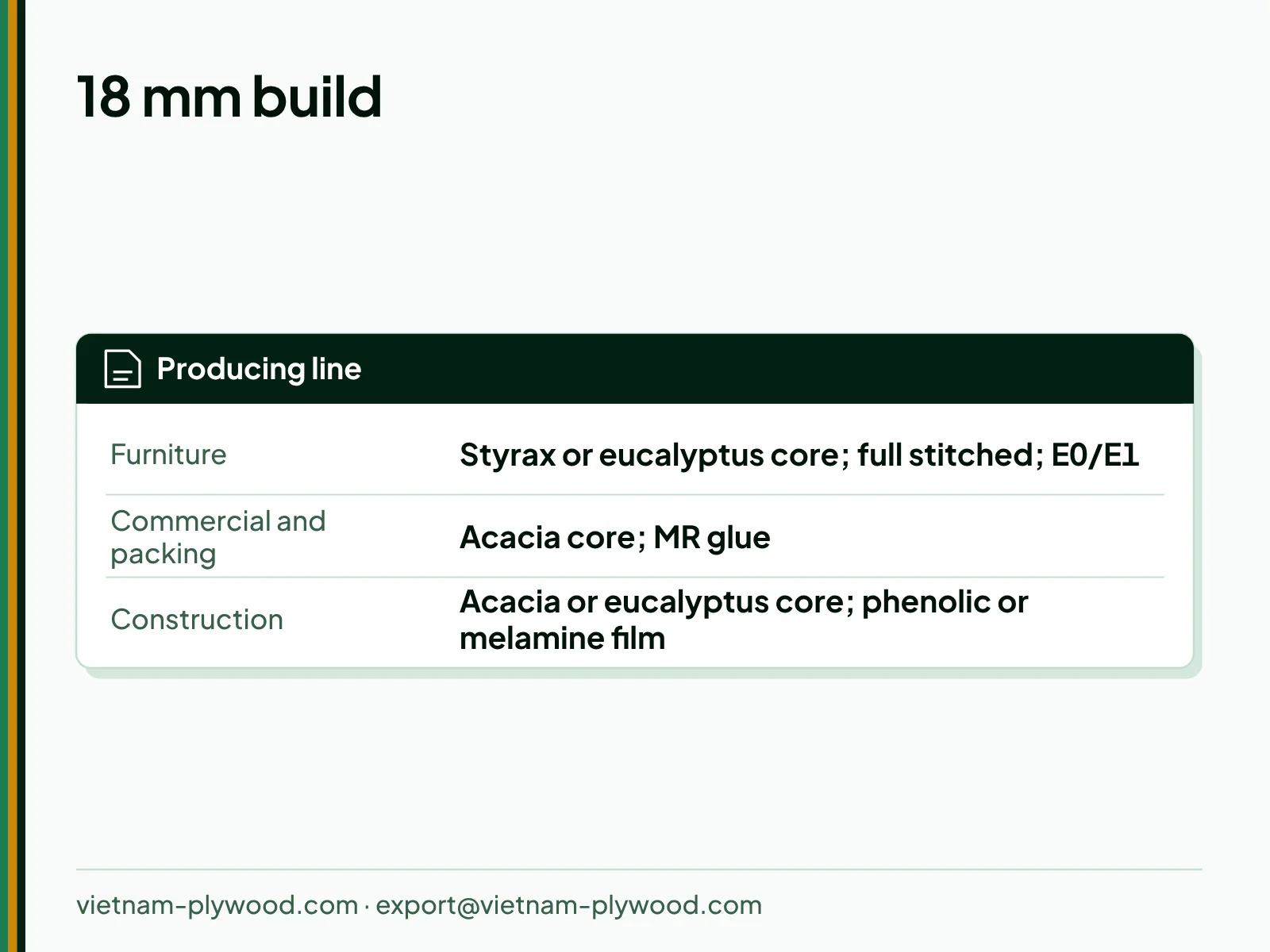
| Producing line | 18 mm build | Finish and tolerance | Buyer application |
|---|---|---|---|
| Furniture | Styrax or eucalyptus core; full stitched; E0/E1 | Sanded; ±0.2 or ±0.3 mm as ordered | Cabinet and furniture components |
| Commercial and packing | Acacia core; MR glue | Unsanded or light-sanded; ±0.5 mm, packing ±0.5–1.0 mm | General commercial use and packing |
| Construction | Acacia or eucalyptus core; phenolic or melamine film | Unsanded; ±0.5 mm | Concrete formwork |
For the furniture specification, the other lines would make different products rather than substitute a film-faced or packing board into a cabinet schedule. Face veneer names the product; density follows the core. A birch face does not mean birch-core plywood: we do not press birch-core panels. The birch plywood cost discussion distinguishes appearance from construction.
For film-faced orders, film weight is specified separately: 120 g/m² standard, 135 g/m² premium or 220 g/m² anti-slip only. The construction buyer should evaluate working life against cost per pour instead of converting price by thickness alone.
How do you compare thicknesses in a mixed container?
Keep the quoted US$/m³ for each specification as the commercial input, then convert each line to US$/m² and US$/sheet. The converted values answer different questions: area price supports coverage budgeting, sheet price supports cutting and purchase-order counts, and volume price supports the shipment total.
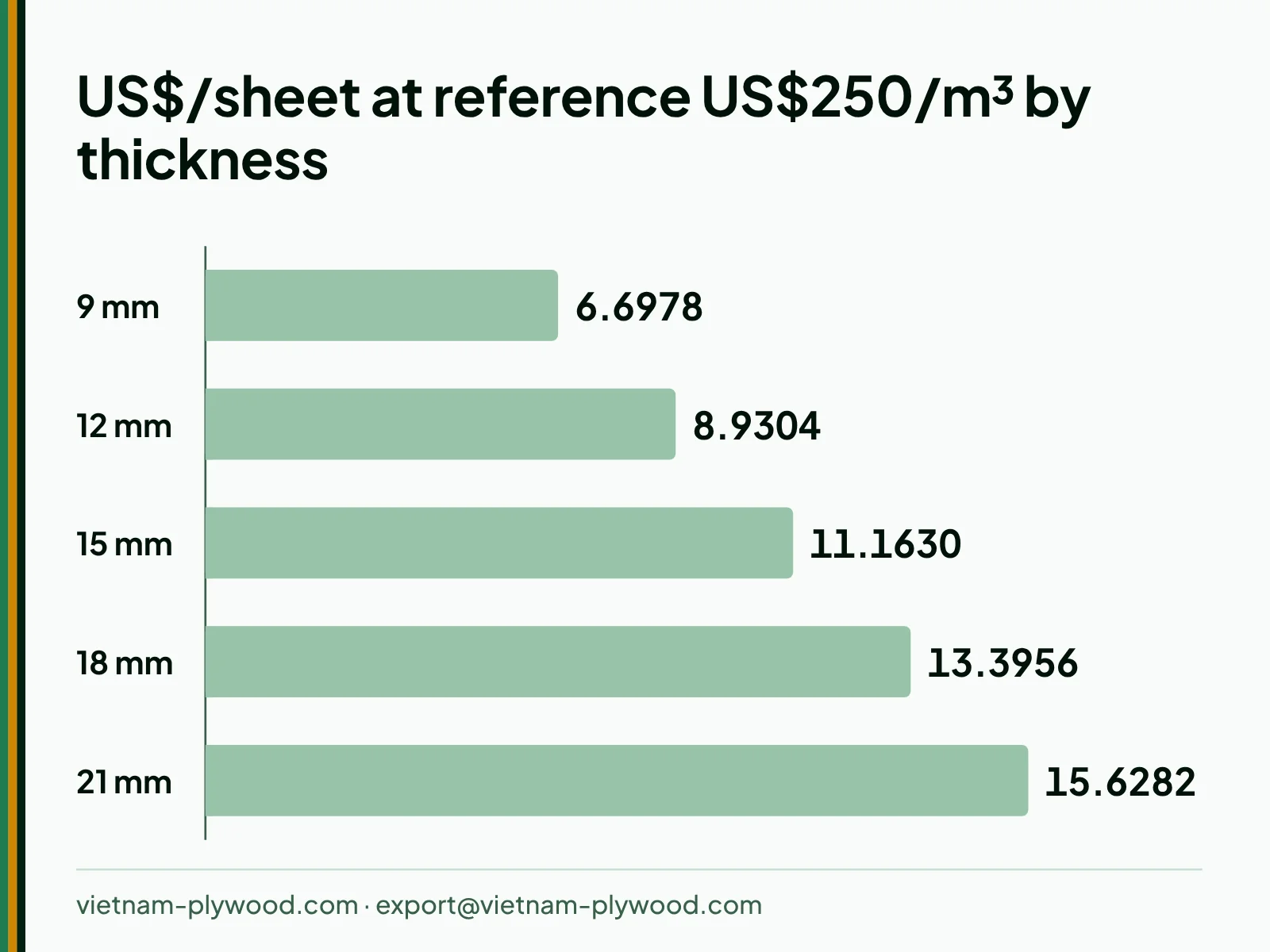
| Thickness | m³ per 1220 × 2440 sheet | m² per sheet | US$/m² at reference US$250/m³ | US$/sheet at reference US$250/m³ |
|---|---|---|---|---|
| 9 mm | 0.0267912 | 2.9768 | 2.25 | 6.6978 |
| 12 mm | 0.0357216 | 2.9768 | 3.00 | 8.9304 |
| 15 mm | 0.0446520 | 2.9768 | 3.75 | 11.1630 |
| 18 mm | 0.0535824 | 2.9768 | 4.50 | 13.3956 |
| 21 mm | 0.0625128 | 2.9768 | 5.25 | 15.6282 |
Illustration only: every row above applies the October 2026 commercial starting reference to show unit arithmetic. It does not assign a commercial quote to every thickness or grade. A real mixed-container comparison replaces that reference with each line’s separately quoted rate.
For example, an order with 12 mm cabinet panels and 18 mm commercial panels needs two specification IDs and two actual rates. Multiply each line’s sheet volume by its count, then by its own rate; add the resulting line totals. Do not average the two per-sheet values before accounting for quantities. The price by thickness page covers the product-level thickness differences.
What does container weight change in the comparison?
Container capacity is constrained by core density, pallet arrangement and payload, not simply cubic meters. At 18 mm and 1220 × 2440 mm, a full 40HC lookup gives 990 styrax-core sheets, 880 acacia-core sheets or 795 eucalyptus-core sheets. Their corresponding loads are 53.05 m³ and 26.52 t, 47.15 m³ and 27.35 t, and 42.60 m³ and 27.69 t.
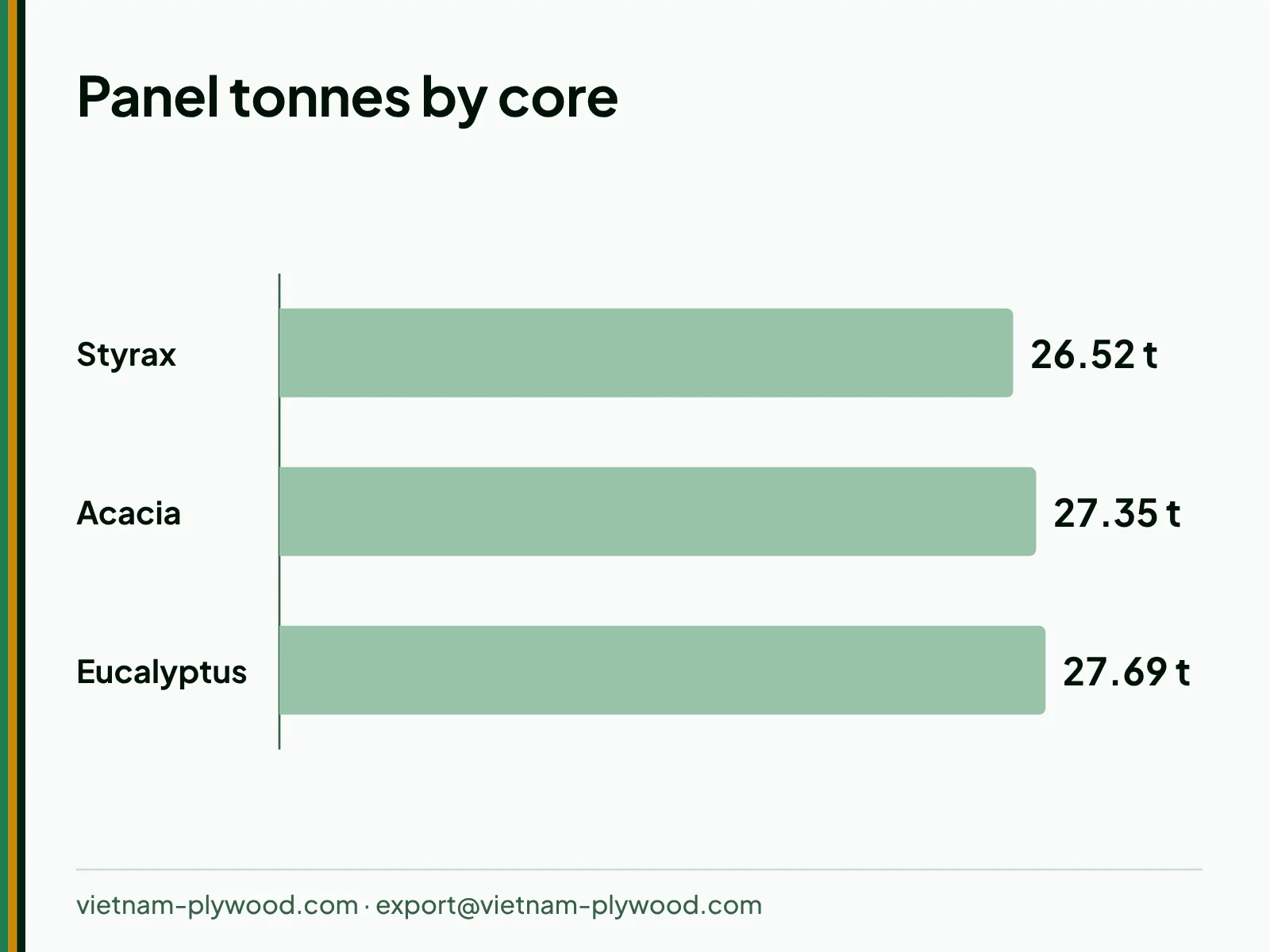
| Core | Density | 18 mm sheet weight | Full 40HC sheets | Volume | Panel tonnes |
|---|---|---|---|---|---|
| Styrax | 500 kg/m³ | 26.79 kg | 990 | 53.05 m³ | 26.52 t |
| Acacia | 580 kg/m³ | 31.08 kg | 880 | 47.15 m³ | 27.35 t |
| Eucalyptus | 650 kg/m³ | 34.83 kg | 795 | 42.60 m³ | 27.69 t |
The 40HC payload limit is 28.5 t. These lookup weights exclude film weight. For a mixed load, ask the producing factory for a pallet-by-pallet loading plan showing the sheet count, core and packaging weight for each specification. Check the resulting gross payload against the container limit before approving the loading plan.
This is a weight illustration, not a completed loading plan: pallet geometry and packaging also need checking. The detailed container loading calculator and rules own the pallet and sheet-count planning. A mixed order has a minimum of one 40HC and can combine specifications within the payload limit.
Why must a plywood quote state its unit and date?
A dated, unit-labelled quote prevents a volume rate from being mistaken for an area or sheet rate. The quote should also identify the currency, trade term, specification, size, quantity and destination. Otherwise a buyer can reproduce the arithmetic correctly yet compare two different commercial scopes.
HCPLY’s published starting indications are from US$250/m³ FOB Hai Phong (October 2026) for commercial plywood and from US$350/m³ FOB Hai Phong (October 2026) for furniture plywood. They are starting references for different builds, not a single current rate for all face grades and thicknesses. Film-faced, packing and other grades require a quotation against the written specification.
Write the quotation date next to each quoted unit price and retain it when creating comparison columns. An older figure can remain useful for testing formulas but should not be presented as a new offer. For market context, see Vietnam plywood pricing analysis 2026. A sheet price without its size and thickness is incomplete; a per-m² price without thickness is equally incomplete.
What should inspection verify before shipment?
The producing factory can show whether the measured dimensions, core lay-up and face match the purchase specification. An inspector can select panels from the prepared lot, measure thickness and length and width, examine accessible edges for core gaps and review the agreed surface grade. HCPLY coordinates on-site quality control and the export process.
Furniture sanded thickness tolerance is ±0.2 or ±0.3 mm as ordered. Commercial and film-faced thickness tolerance is ±0.5 mm; packing is ±0.5–1.0 mm. Length and width tolerance is ±2 mm. At 18 mm, the ply count is 11–13, depending on core veneer thickness of 1.4–2.0 mm. A dimension check therefore connects directly to the volume calculation used on the invoice.
The buyer can visit the factory office and inspect goods at the producing factory. For orders needing certificate evidence, member-factory FSC, CARB P2, ISO 9001 or CE documents are shown with factory details masked, on request. Glue and emission are separate specification fields: MR or WBP describes the bond system, while E0, E1 and E2 are emission classes. CARB P2 and TSCA Title VI concern a U.S. emissions limit and third-party certification.
Which export documents carry the quantity and value?
The commercial invoice records the invoiced goods and value, while the packing list identifies packed quantities and shipment details. A bill of lading (B/L) records the carriage shipment. Compare the invoice unit and line quantities against the packing list before approving the drafts after loading.
The shipment documents include a commercial invoice, packing list, B/L, certificate of origin, phytosanitary and fumigation papers, and the order’s agreed certificate documents. EU lots include EUR.1 and the EUTR/EUDR file set; CIF shipments include insurance. An FSC claim on sales documents, emission certificate or test report appears when it belongs to the agreed build.
The delivery terms available are FOB Hai Phong, CFR (CNF) or CIF. These terms change which transport and insurance elements are included in the quoted scope, so never compare their numeric rates as though the basis were identical. The production period is 15–45 days from the 30% deposit, set by order size, line loading and the contract; the 70% balance is against the scanned B/L, by T/T or irrevocable L/C at sight.
What mistakes distort plywood sheet rates?
The most common error is applying an 18 mm conversion factor to a 12 mm panel. A second is treating a 1220 × 2440 mm sheet as equal in area to a 1250 × 2500 mm sheet. Both errors distort the sheet total before differences in grade or transport enter the comparison.
A third mistake is converting a starting rate into an apparent firm offer for another build. The conversion table above illustrates arithmetic; it cannot price a different face, film, core assembly or emission requirement. A fourth is comparing a delivered rate with an FOB rate without separating freight and insurance.
Finally, distinguish a face species from the core species. An okoume or bintangor face can sit on a different core, and the core drives the panel density. When buyers ask how much is a sheet of plywood, the answer must identify the build and dimensions before giving a figure. The same discipline applies to ply sheet cost, plywood sheet rates and cost of plywood per square metre.
What should you send for a comparable quotation?
Send a separate specification line for every build and thickness, with the required number of sheets and destination port. Ask for the quoted unit to be shown as US$/m³, together with the date and delivery term. Request the calculated m² and sheet equivalents as comparison fields, while keeping the agreed invoicing unit explicit.
HCPLY produces orders at the appropriate member factory in Phu Tho or Hai Phong and ships directly from that producing location, FOB Hai Phong. Our furniture and commercial plywood capacity is up to 100 containers a month; construction plywood capacity is up to 140. Samples cost nothing: a first-time buyer pays the courier, and that charge comes off the first confirmed order.
Use the following lines for a quotation request. They make the unit calculation reproducible and give the producing team a specification against which to check the finished lot.
Application: furniture / cabinets / packing / formwork
Line or core: furniture styrax or eucalyptus / commercial acacia / construction acacia or eucalyptus
Glue: MR melamine or WBP phenolic
Emission: E0 / E1 / E2; additional agreed documentation if needed
Face and grade: species or film type and weight; specified grade
Thickness and tolerance: ___ mm; ___ mm
Size: length ___ mm × width ___ mm
Quantity: ___ sheets by specification; total ___ 40HC
Destination port: ___
Quotation basis: US$/m³; quote date ___; FOB Hai Phong / CFR / CIF
Next step: plan a trial container using the agreed specification lines, converted sheet totals and checked payload.