





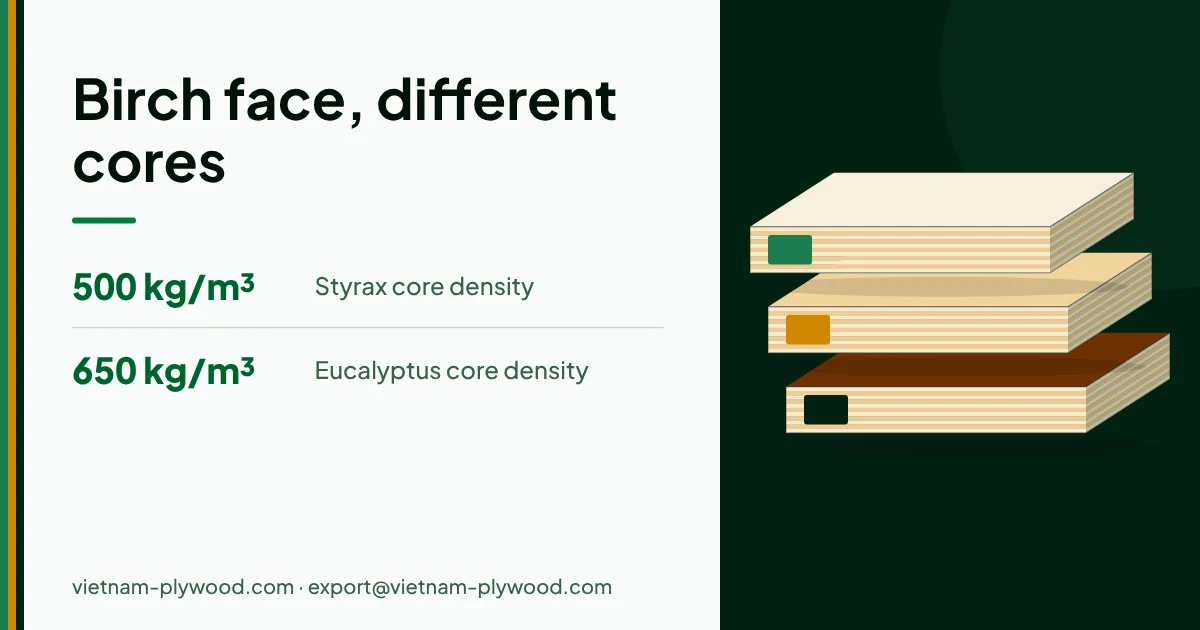
Birch vs Baltic birch plywood comes down to the veneers beneath the surface: Baltic birch is an all-birch construction, while birch-faced plywood can use another wood core. Confusing them can mean paying for the wrong material, remaking cabinet parts or rejecting a shipment. HCPLY makes birch-faced furniture plywood with named Vietnamese cores; buyers should compare the complete build rather than the face alone.
What is the difference in birch vs Baltic birch plywood?
Baltic birch plywood uses birch veneers throughout its layered construction, while ordinary birch-faced plywood can have birch only on its outer surfaces. The core changes weight, exposed-edge appearance, machining behaviour and the basis for a quotation. A birch face by itself says nothing conclusive about the internal species or the panel’s screw withdrawal strength.
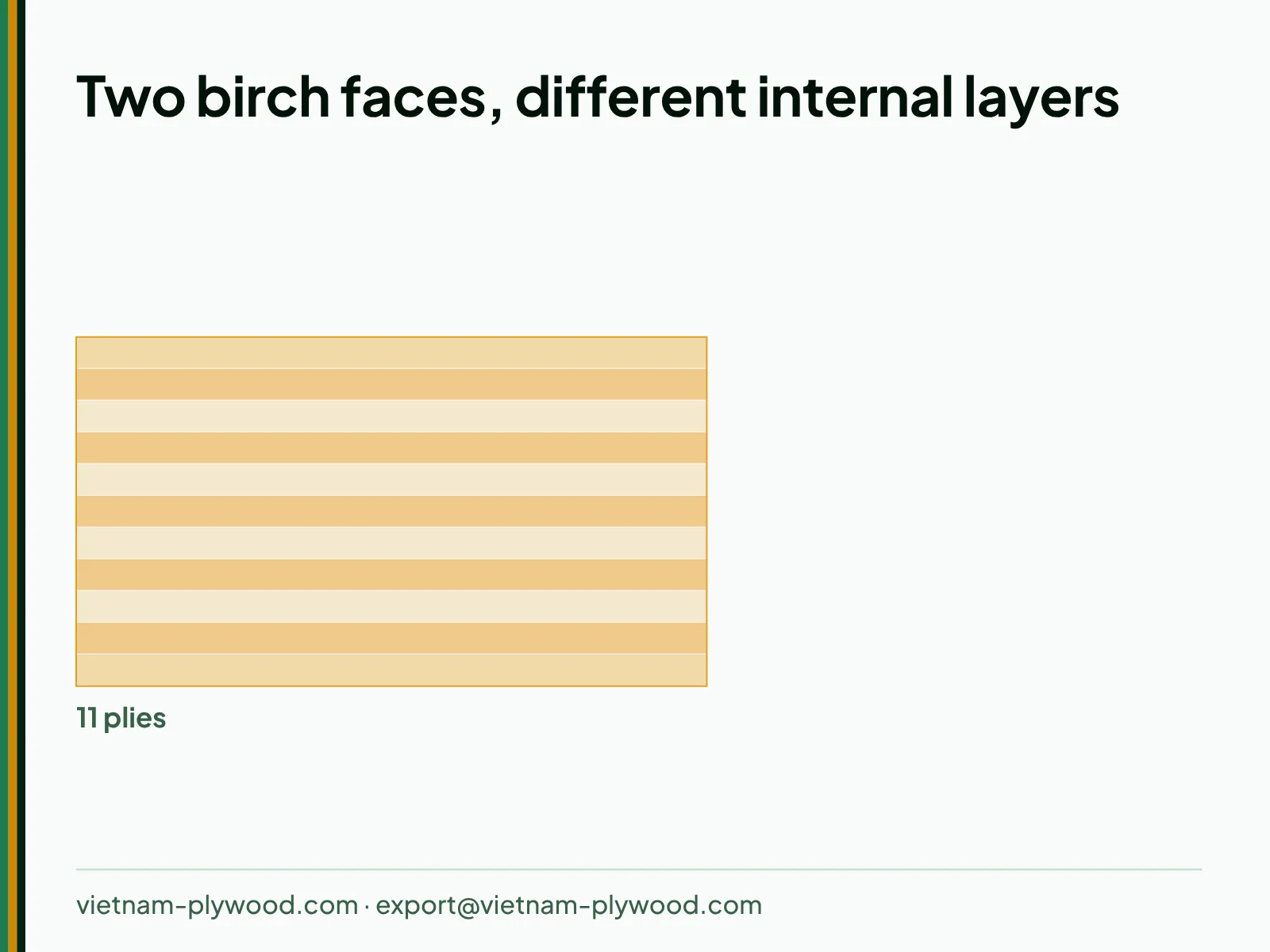
The term Baltic birch describes a recognized product construction and regional trade description, rather than a universal certification mark. A supplier’s country, grade terminology, veneer schedule and documented construction still deserve examination. For background on the all-birch product, see Baltic birch plywood explained.
A thin decorative birch face and a multi-ply birch core can look nearly identical before cutting. That is why a written core species and an approved cross-section sample belong beside the face description in a purchase specification. A label saying simply “birch plywood” leaves a material ambiguity that surface photographs cannot resolve.
Which build fits each cabinet application?
The right panel follows the edge treatment, hardware load and finishing schedule of the finished component. The table compares measurable specifications and gives a purchasing verdict by use, rather than treating every birch-faced sheet as interchangeable.
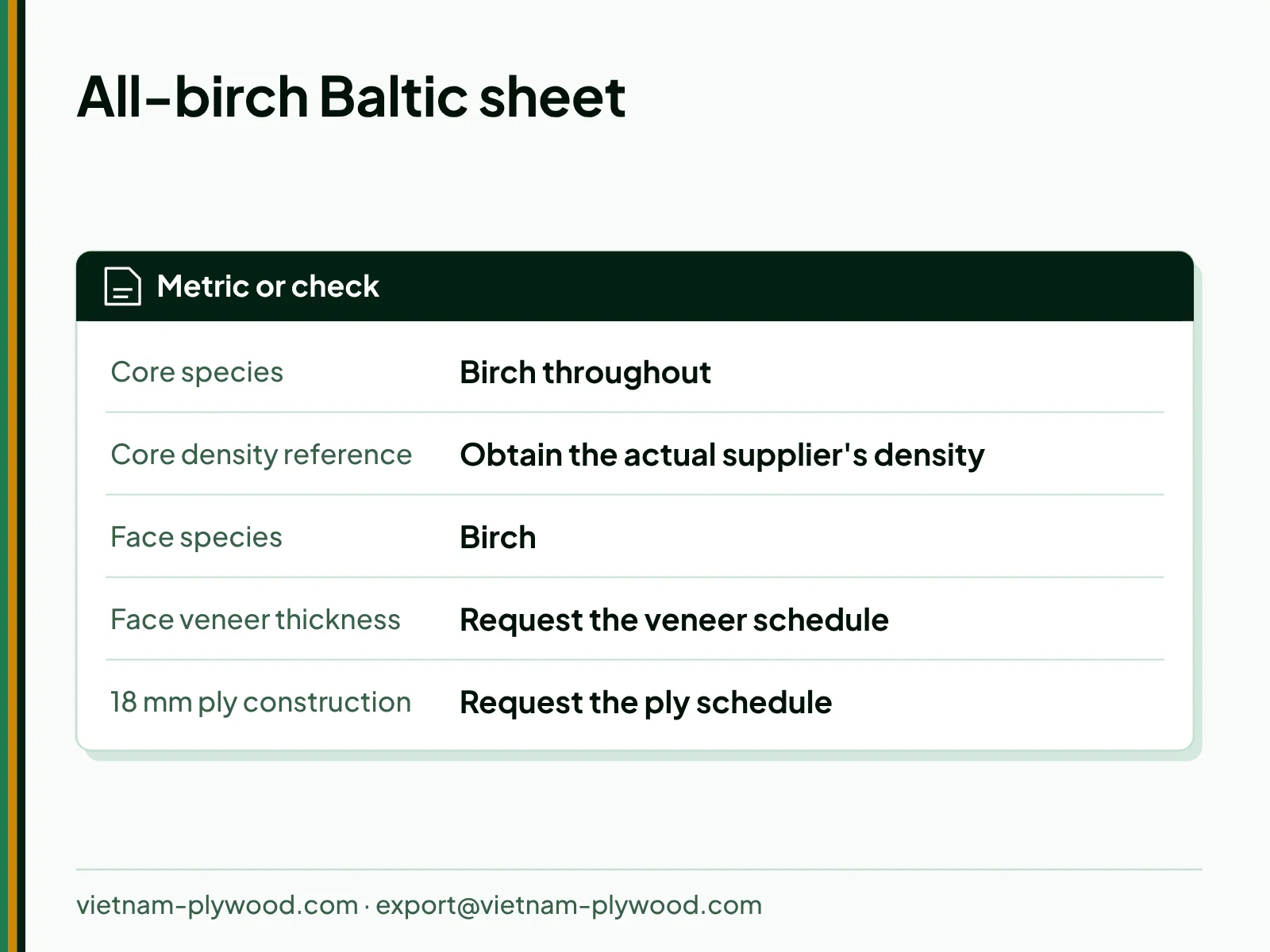
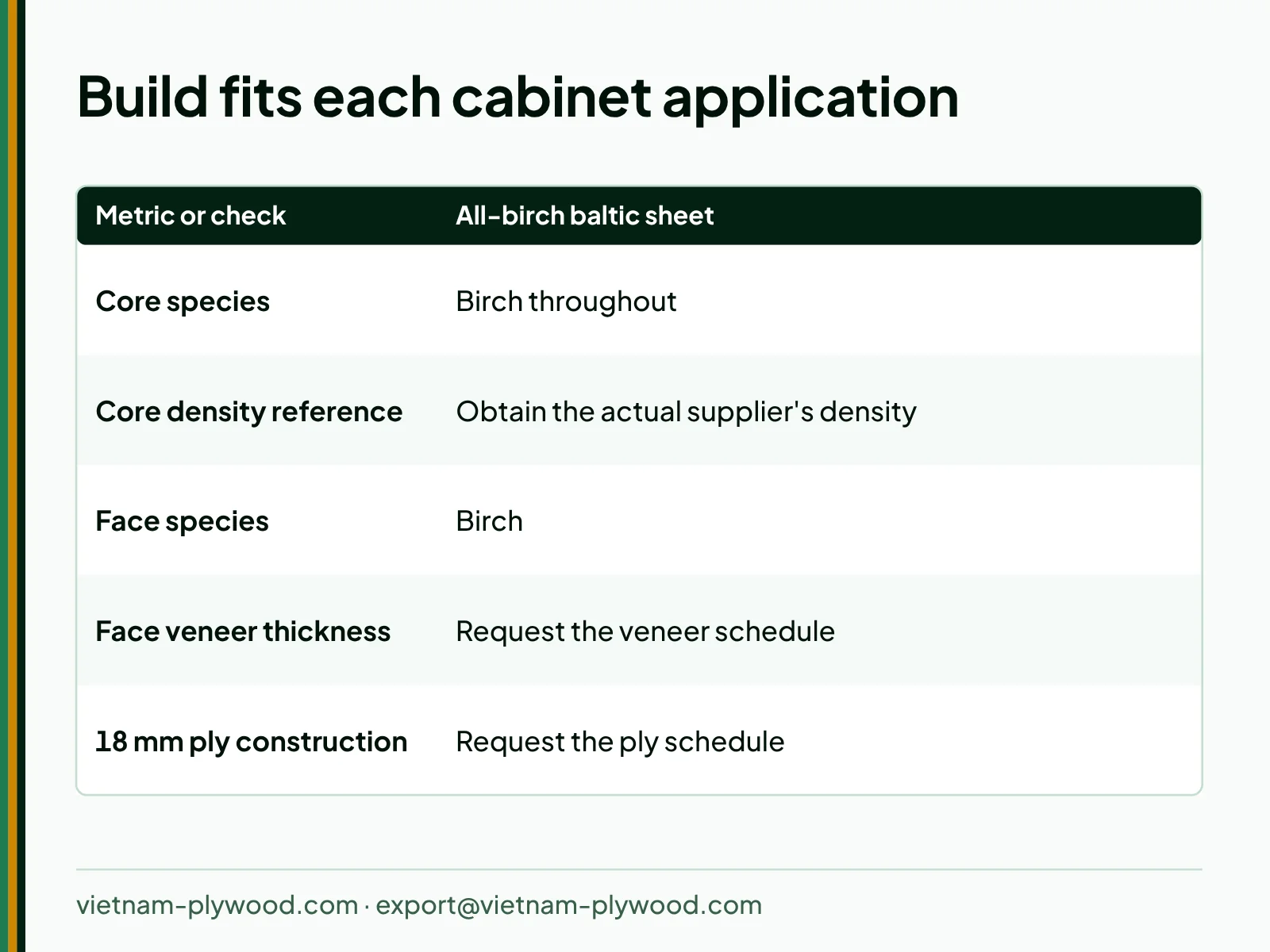
| Metric or check | All-birch Baltic sheet | HCPLY birch-faced furniture sheet | Verdict by use |
|---|---|---|---|
| Core species | Birch throughout | Styrax or eucalyptus on our furniture line | All-birch for a uniform exposed edge; named-core panel for covered edges |
| Core density reference | Obtain the actual supplier’s density | Styrax 500 kg/m³; eucalyptus 650 kg/m³ | Styrax for lower handling weight; evaluate eucalyptus where a denser core is wanted |
| Face species | Birch | Birch veneer | Both can present a birch face; specify finish acceptance separately |
| Face veneer thickness | Request the veneer schedule | Common face veneer 0.2–0.4 mm | Allow adequate finishing stock for the actual veneer |
| 18 mm ply construction | Request the ply schedule | 11–13 plies, depending on veneer thickness | Compare real sections before routing or edge profiling |
| 18 mm sanded tolerance | Request a signed tolerance | ±0.2 or ±0.3 mm as ordered | Select by CNC fit and hardware tolerances |
| Exposed edge | Repeated birch layers | Core species visible beneath birch faces | All-birch for deliberately visible laminated edges |
| Edge screw withdrawal | Require a representative test | Require a representative test | Select against tested joint performance, not appearance |
| Price basis | Birch throughout and the specified grade | Face, core, construction and finishing choices | Compare written builds at equal dimensions and acceptance criteria |
What core does Vietnamese birch-faced plywood contain?
Our furniture line presses birch faces over styrax or eucalyptus cores, with full-stitched construction and sanded surfaces. HCPLY does not press birch-core plywood. The core is therefore stated explicitly on the quotation, inspection sheet and agreed sample.
Our commercial and packing line instead presses acacia-core panels with moisture-resistant (MR) glue and unsanded or light-sanded finishes. Our construction line presses acacia- or eucalyptus-core panels with phenolic, melamine or anti-slip film faces. These other lines serve different applications; they do not turn a birch-faced furniture panel into Baltic birch.
The distinction also matters when comparing the birch face with styrax core combination and plywood grades across factory lines. Ask for the producing line and actual core species rather than inferring them from the face name. The same birch appearance can conceal a different weight and edge structure.
How much does each core weigh?
At 18 mm and 1220 × 2440 mm, the core-density calculation gives 26.79 kg per styrax sheet, 31.08 kg per acacia sheet and 34.83 kg per eucalyptus sheet. These are core-based reference weights, not measured Baltic birch weights. Density follows the core rather than the birch face.
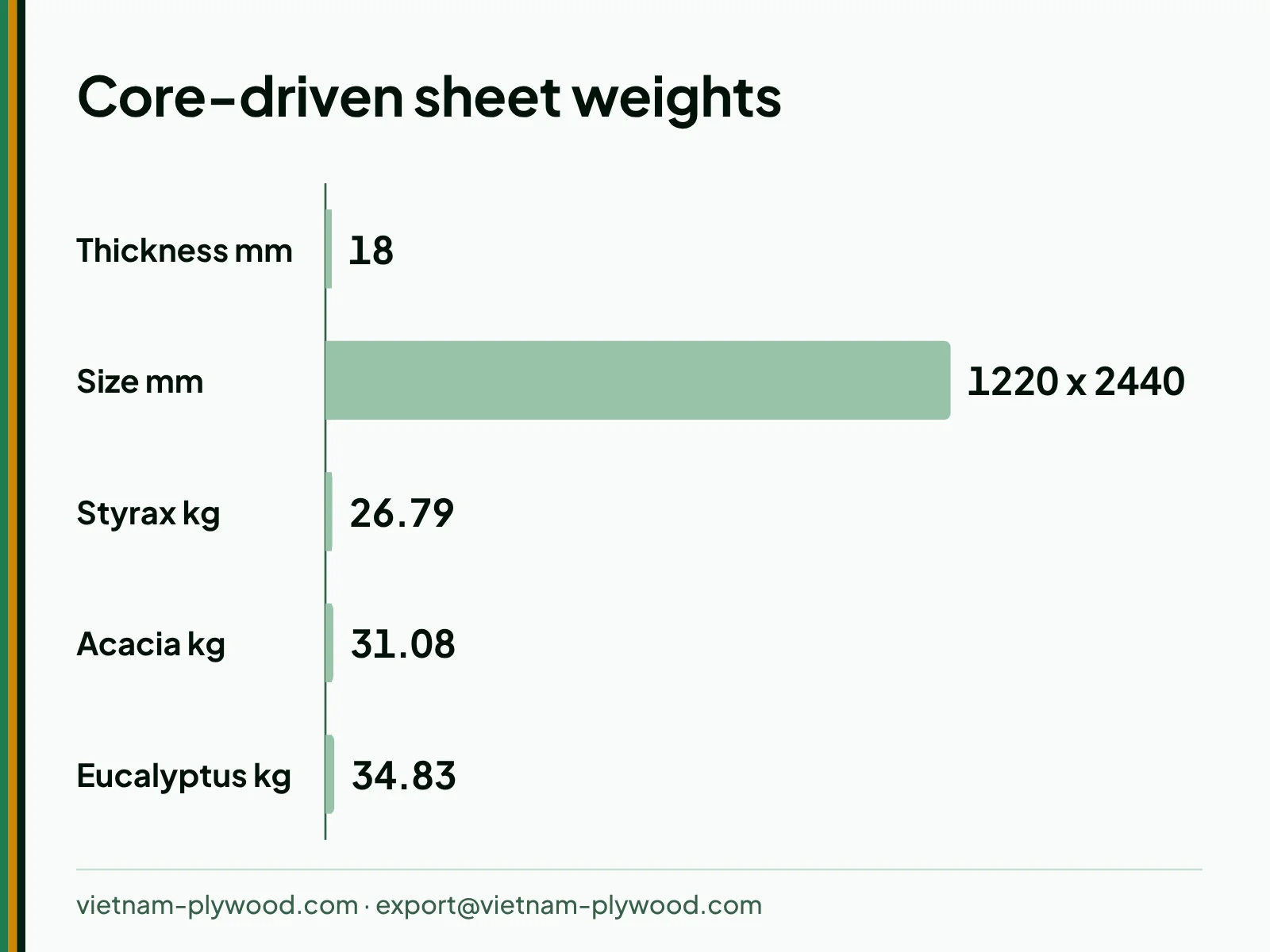
| 18 mm, 1220 × 2440 mm metric | Styrax | Acacia | Eucalyptus |
|---|---|---|---|
| Core density | 500 kg/m³ | 580 kg/m³ | 650 kg/m³ |
| Reference sheet weight | 26.79 kg | 31.08 kg | 34.83 kg |
| Full 40HC sheets by pallet pattern | 990 | 880 | 795 |
| Full 40HC core-based mass | 26.52 t | 27.35 t | 27.69 t |
Acacia is included to show how the commercial line compares, even though the furniture line’s named birch-faced cores are styrax and eucalyptus. An all-birch Baltic sheet needs its own supplier’s declared density and actual sample weight; assigning it one of these Vietnamese core figures would misstate the comparison.
How do screw holding and machining compare?
Screw holding must be evaluated on the actual core, fastener and joint geometry. An all-birch construction often appeals to buyers routing visible edges or placing fasteners close to them, but a numerical advantage cannot be assigned without matched tests. Species, core gaps, screw diameter, pilot hole and insertion direction all affect the result.
For cabinet production, test face withdrawal and edge withdrawal separately. Edge screws load the exposed veneers and glue lines differently from screws driven through the face. Use the same fastener, embedment depth and conditioning for both candidate panels, then record failure modes as well as peak force.
A routed groove can reveal local voids, veneer overlaps or edge breakout that a smooth face hides. Compare a trial cabinet joint, hinge mounting and shelf-support hole on samples from the intended lots. Where edges will be banded, appearance matters less, but machining consistency still affects rework and assembly time.
What does the cut edge reveal?
A cut edge reveals the veneer species pattern, ply alignment, visible gaps and the quality of the core assembly. All-birch sheets present repeated birch-colored layers, while birch-faced styrax or eucalyptus sheets show the contrasting core beneath their birch outer veneers.
Inspect a clean crosscut and a routed edge from each proposed build. Count plies, look for open core joints and compare the cross-section with the approved sample. On our furniture line, full-stitched core construction is the specified starting point; a cut sample lets the buyer see how the core is assembled.
Edge appearance is a design decision as well as a quality check. A visible layered edge may justify an all-birch purchase. An edge that will receive banding can make a birch-faced named-core build more economical while keeping the required face appearance.
Finishing requires similar care. The common 0.2–0.4 mm birch face on our furniture panels should be protected against sanding-through. If a clear-coated face is specified, approve a finished sample and agree the permitted repairs, grain and color range before pressing the order.
Which thickness, face grade and glue should be specified?
Specify thickness, tolerance, face grade, core species, adhesive and emission class as separate fields. HCPLY furniture panels cover 3–40 mm thickness, with common choices of 3, 5, 9, 12, 15, 18, 21 and 25 mm. Available sizes include 1220 × 2440 and 1250 × 2500 mm, with custom cutting available.
For birch faces, our available face grades are D, E and F. These labels must be assessed against an approved appearance sample; they should not be silently translated into another supplier’s Baltic birch grading system. Face grade does not identify the core.
Glue and formaldehyde emission are different fields. Melamine adhesive is MR with a 12-hour boil designation, while phenolic adhesive is WBP with a 72-hour boil designation. E0, E1 and E2 refer to emission classes; CARB Phase 2 and TSCA Title VI concern US emission limits and third-party certification, not an adhesive recipe.
Our furniture line is specified with E0 or E1 emission classes. Order-specific emission evidence and any relevant member-factory certificates are shown with factory details masked, on request. The finishing option birch UV-coated plywood is a separate topic, rather than a substitute for naming the core and glue.
Why does Baltic birch cost more?
An all-birch Baltic construction normally carries a higher material-cost basis than a birch-faced styrax-core panel because birch runs through the sheet rather than appearing only on the faces. Core species is the first price driver, followed by core assembly quality, veneer grade, adhesive specification, sanding tolerance and ordered dimensions.
A eucalyptus-core birch-faced build will have a different material and handling profile from styrax-core furniture plywood. The difference should be quoted against the same size, thickness, face acceptance and quantity, rather than assigned an unsupported percentage premium. No published price for either specific birch build is used here.
What can an inspector check at the producing factory?
The buyer can witness a sample crosscut, veneer count, caliper measurement, edge inspection and package-label check at the producing factory. Our three factories are in Phu Tho and Hai Phong, and buyers inspect goods where the specified order is made.
Begin with the approved sample and order sheet. Compare the birch face against the accepted D/E/F appearance reference, then inspect the exposed core species and stitched construction. Measure thickness across representative positions against the ordered ±0.2 or ±0.3 mm furniture tolerance; check length and width against ±2 mm.
HCPLY coordinates specification, on-site quality control, export documents and loading. Buyers may visit the factory office and inspect at the producing factory. The inspection record can follow the same item-level core description used on the quotation and packing list.
Which shipment documents identify the build?
The commercial invoice and packing list should carry the agreed birch-face and core description so the received goods can be matched to the order. The bill of lading (B/L) records shipment movement; it does not replace a technical specification or a cross-section inspection.
For an export shipment, documents include the commercial invoice, packing list, B/L, certificate of origin, phytosanitary and fumigation papers, and the agreed certificate or test documents. Insurance is included under cost, insurance and freight (CIF) terms. After loading, the draft shipping documents come to you for approval.
For European Union lots, the file set also includes EUTR/EUDR documentation and EUR.1 where applicable. The European Parliament and Council’s 2023 Regulation (EU) 2023/1115 lists “4412 Plywood, veneered panels and similar laminated wood” among wood products in its Annex I; see the official EUR-Lex regulation. This classification does not identify the species within an individual panel, which remains an order and traceability question.
Read importing birch plywood documents and duties for the separate customs and documentation workflow. A certificate of origin establishes the declared origin under the applicable rules; it should not be treated as a laboratory measurement of veneer composition.
Can different specifications travel in one container?
Specifications can be mixed in a 40HC container within the 28.5 t payload limit. The minimum order is one 40HC, and the pallet plan must account for the actual cores, thicknesses and sizes. A mixed styrax and eucalyptus order needs a line-by-line mass check rather than the full-load count of either core alone.
For illustration, the 18 mm reference patterns above are 990 styrax sheets at 26.52 t or 795 eucalyptus sheets at 27.69 t when each occupies its full planned container pattern. They are alternative full loads, not quantities to add together. Use the container loading reference for the complete sheet-count method.
Orders ship FOB Hai Phong, CFR (CNF) or CIF. Factory lead time runs 15–45 days from receipt of the 30% deposit; the exact figure depends on order size, line loading and what the contract fixes. The remaining 70% is paid on the scan of the bill of lading, by T/T, or by irrevocable sight L/C. For timing context, see plywood production lead time.
How should a quotation describe the panel?
A quotation should name the birch face and the exact core species in separate fields, followed by construction, glue, emission class and acceptance measurements. Write “birch-faced plywood, styrax core” or “birch-faced plywood, eucalyptus core” rather than the ambiguous label “Baltic birch.”
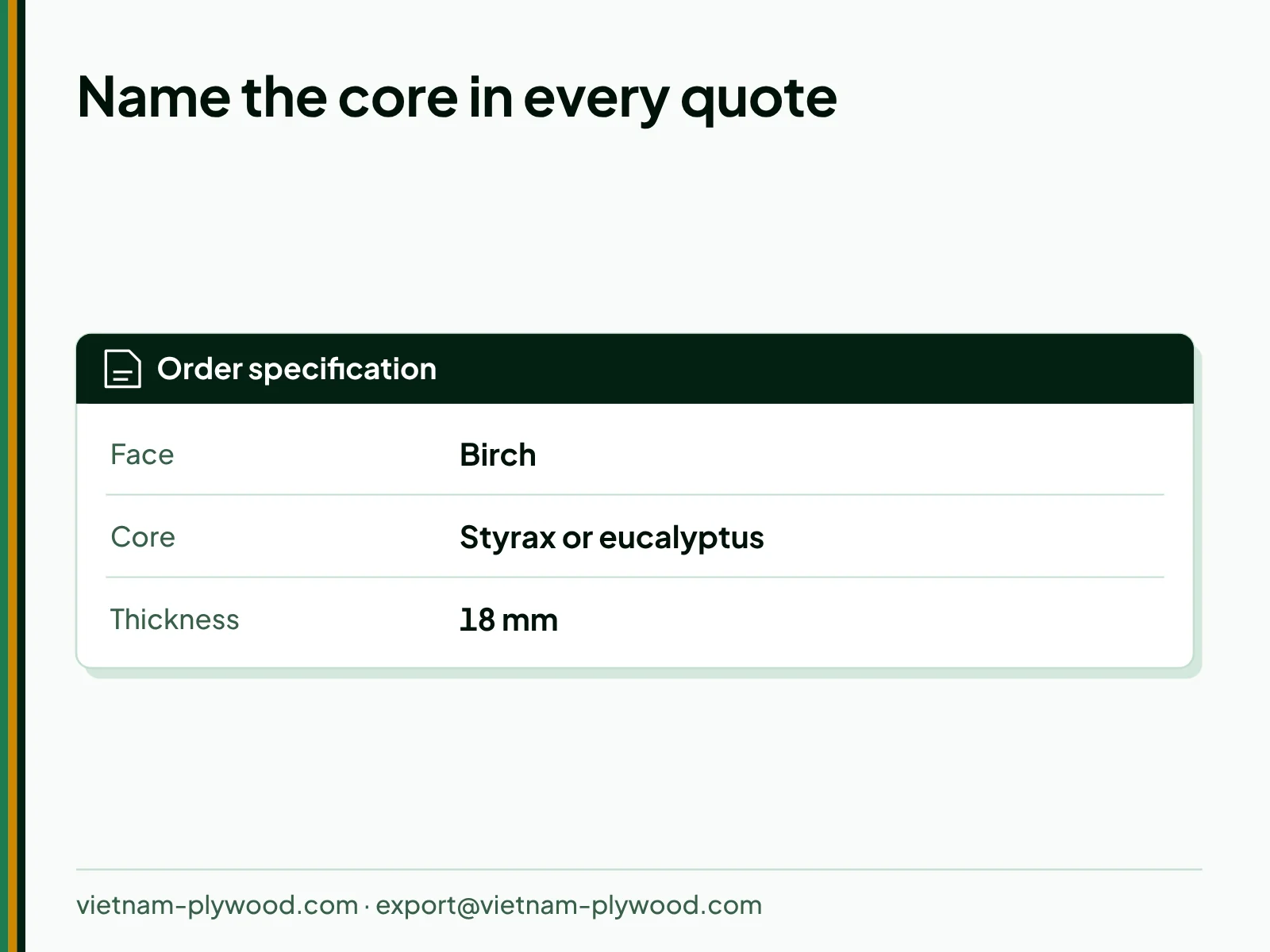
Send the following specification to Lucy at export@vietnam-plywood.com for an HCPLY furniture-line quotation. Samples cost nothing: a first-time buyer pays the courier, and that charge comes off the first confirmed order.
Application: Cabinet carcasses; edges banded; edge-screw trial required
Line or core: Furniture line; styrax core (alternative: eucalyptus core)
Glue: Melamine MR; state any requested phenolic WBP alternative
Emission: E1 (order-specific evidence requested)
Face and grade: Birch face/back; D grade; approved appearance sample
Thickness and tolerance: 18 mm; sanded ±0.2 mm
Size: 1220 × 2440 mm
Quantity: One 40HC; specify allocation by core
Destination port: [buyer to insert]
Next step: book a factory visit to inspect the producing line and approve the cross-section sample before ordering.