





How do you bend plywood without damaging the face?
HCPLY buyers can bend plywood using kerf cuts, controlled heat and moisture, or thin-layer lamination according to radius, visible face and finished stiffness. A trial bend on the actual sheet establishes the workable radius. For repeated cabinet curves, a formed laminate usually offers better shape retention than forcing a thick flat panel around a former.
We supply flat plywood for buyers who cut, form or laminate it in their own production. A wrong sheet can split its face, spring back after release or leave a visible groove, costing replacement panels and fabrication time.
For the broader choice of face and core, see our hardwood plywood guide and furniture plywood.
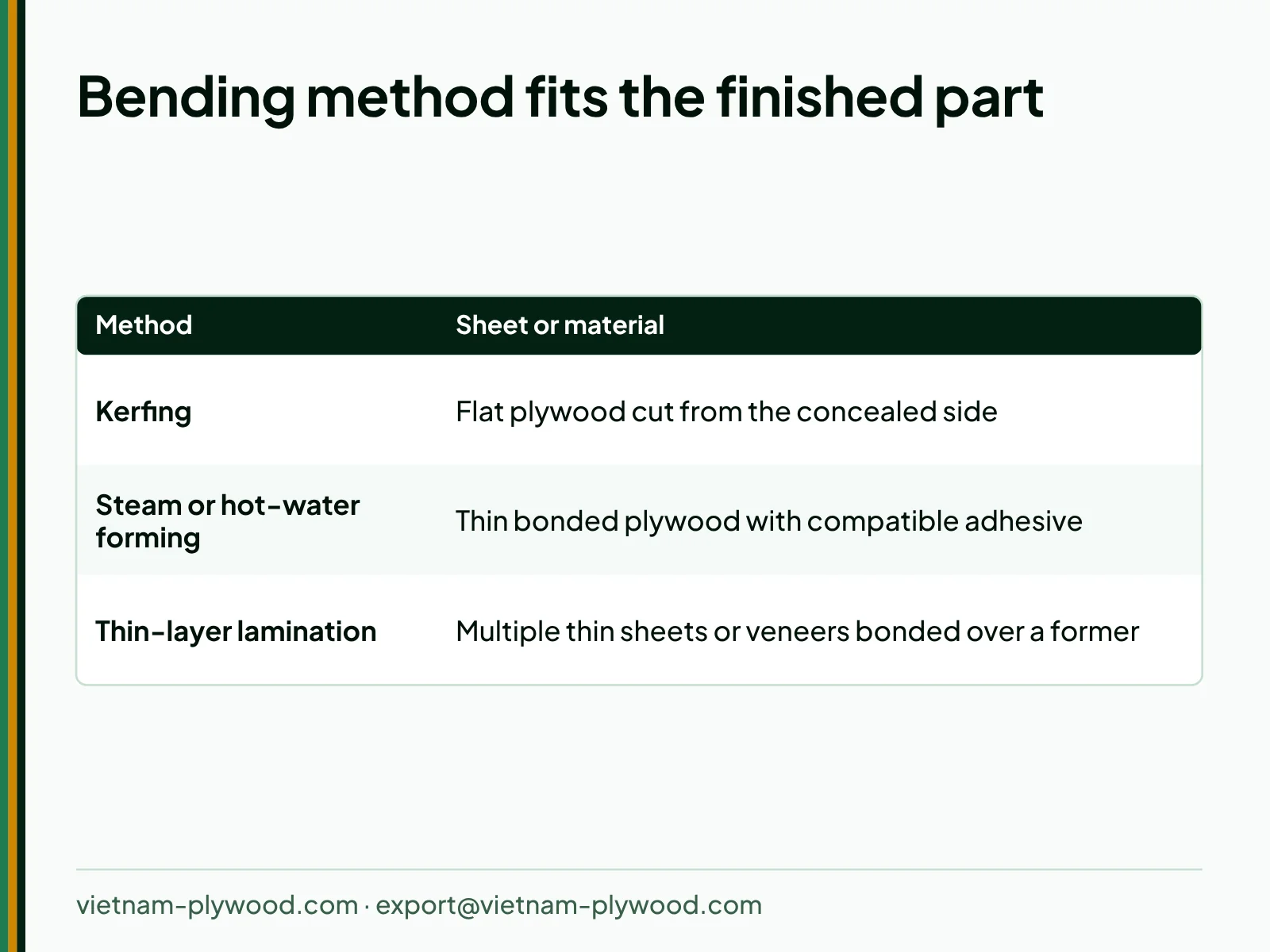
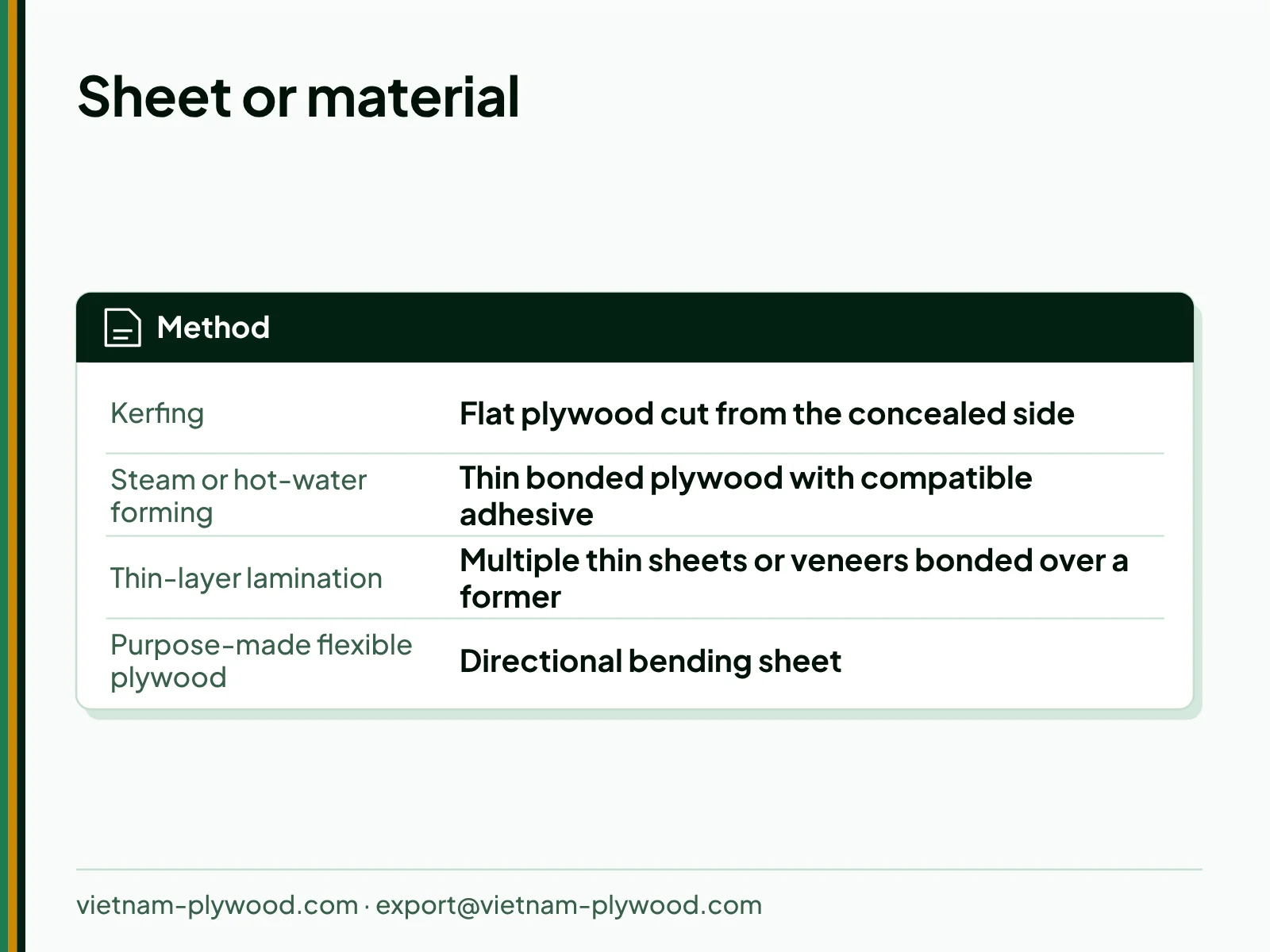
Which bending method fits the finished part?
| Method | Sheet or material | Visible face | Finished part and verdict |
|---|---|---|---|
| Kerfing | Flat plywood cut from the concealed side | Intact outside if cuts stop short | Good for a covered radius or fixed cabinet substrate; test remaining skin |
| Steam or hot-water forming | Thin bonded plywood with compatible adhesive | Continuous, but checks are possible | Trial only for gentle curves; water and heat can affect glue lines |
| Thin-layer lamination | Multiple thin sheets or veneers bonded over a former | Continuous after pressing | Preferred for repeatable exposed curves and shape retention |
| Purpose-made flexible plywood | Directional bending sheet | Continuous after facing | Suitable for tight curves where an independently specified flexible product is available |
The U.S. Forest Service’s 1999 Wood Handbook chapter on specialty treatments describes permanent shape changes in wood products. Its treatment of curved plywood distinguishes bending bonded sheets from bonding veneers while forming. That distinction matters more than a generic ‘bendable’ label on a purchase order.
How should kerf cuts be planned?
Kerfing removes material from the inside of a bend so the remaining outer skin can follow the former. It works when the kerfed side will be concealed or subsequently reinforced.
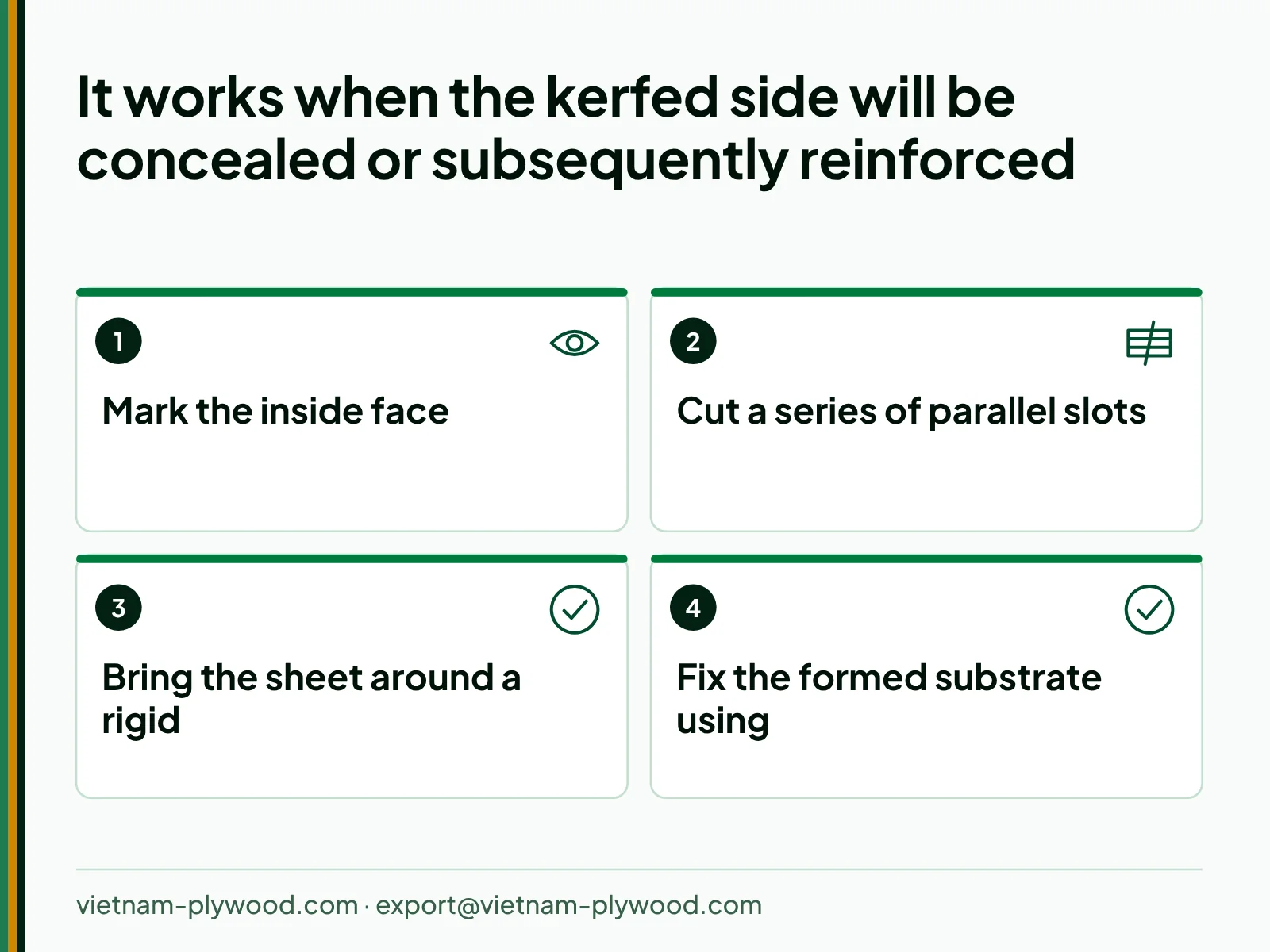
- Mark the inside face, curve direction and target radius on a sample from the production batch.
- Cut a series of parallel slots across the bend zone, stopping before the visible face veneer.
- Bring the sheet around a rigid former gradually and inspect the outside for checking or telegraphing.
- Fix the formed substrate using the fabricator’s engineered support or backing system; inspect the curve after release.
Cut depth and spacing must be established on a sample because core joints, thickness and tool kerf change the result.
Can steam or hot water bend a bonded sheet?
Heat and moisture can help some flat plywood follow a gentle former, but adhesive durability and veneer quality limit the result.
Start with a small coupon, record the bend direction and heat exposure, then check for delamination, face checks and springback after drying. Do not prescribe a universal steaming time or minimum radius across different adhesives and core constructions.
The Forest Service’s 2021 Wood Handbook identifies specialty treatments and wood adhesives as separate technical topics. That is a useful purchasing distinction: glue specification and emissions classification must be written separately.
Why does lamination hold a curve better?
Lamination bonds thin layers while they are restrained against the final former, reducing the strain demanded of any one layer. It is the stronger starting point for a production run of matching furniture fronts, curved cabinet ends or fit-out details.
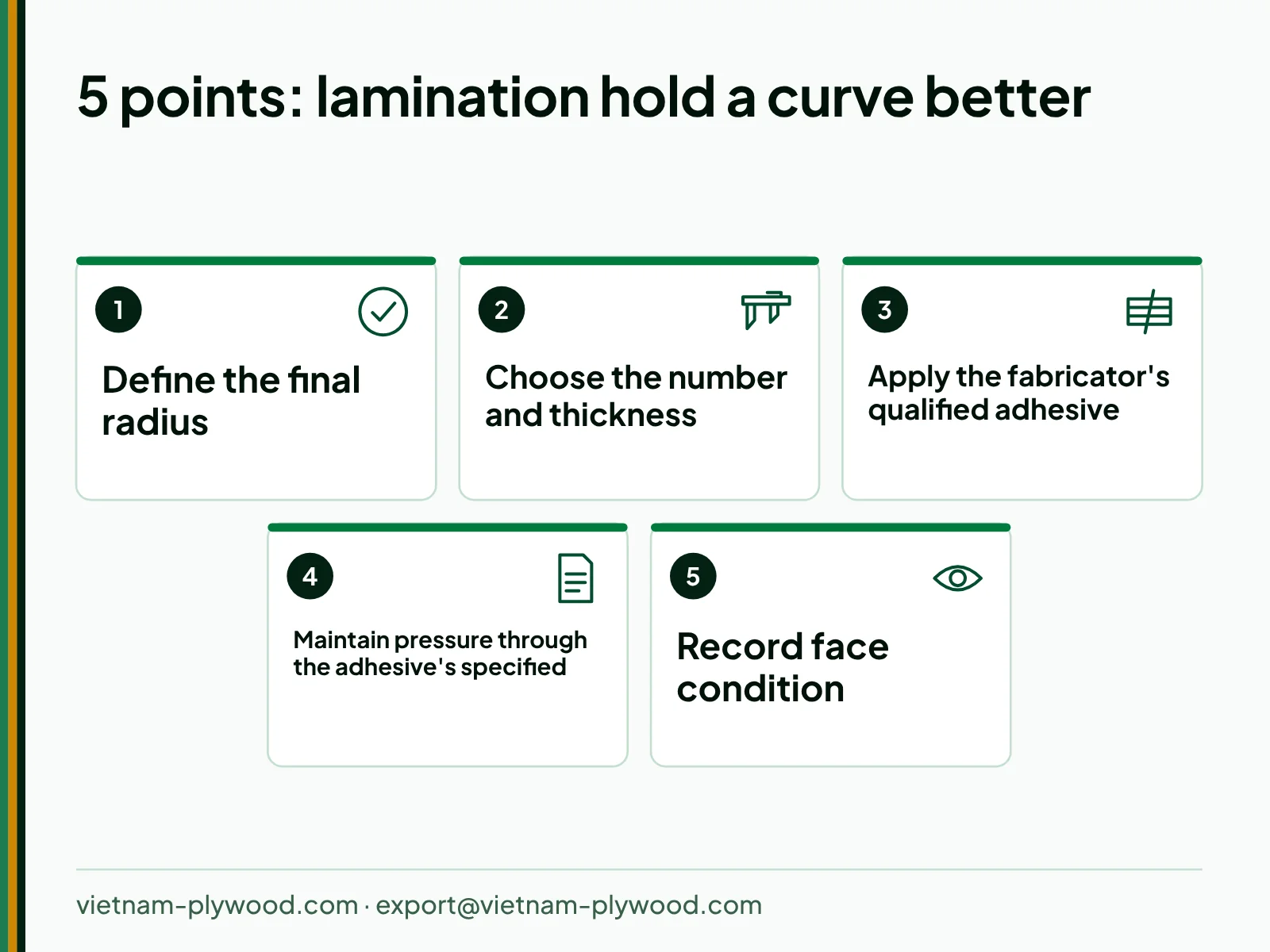
- Define the final radius, orientation, finished thickness and acceptable springback.
- Choose the number and thickness of layers through a forming trial and adhesive specification.
- Apply the fabricator’s qualified adhesive, align layers and press them against a dimensionally stable former.
- Maintain pressure through the adhesive’s specified cure, then release, condition and inspect the part.
- Record face condition, radius and bond quality against the approved sample.
Flat 3 mm or 5 mm panels are possible starting stock for trials, not automatic equivalents of purpose-made flexible plywood.
Which HCPLY line should make the starting sheet?
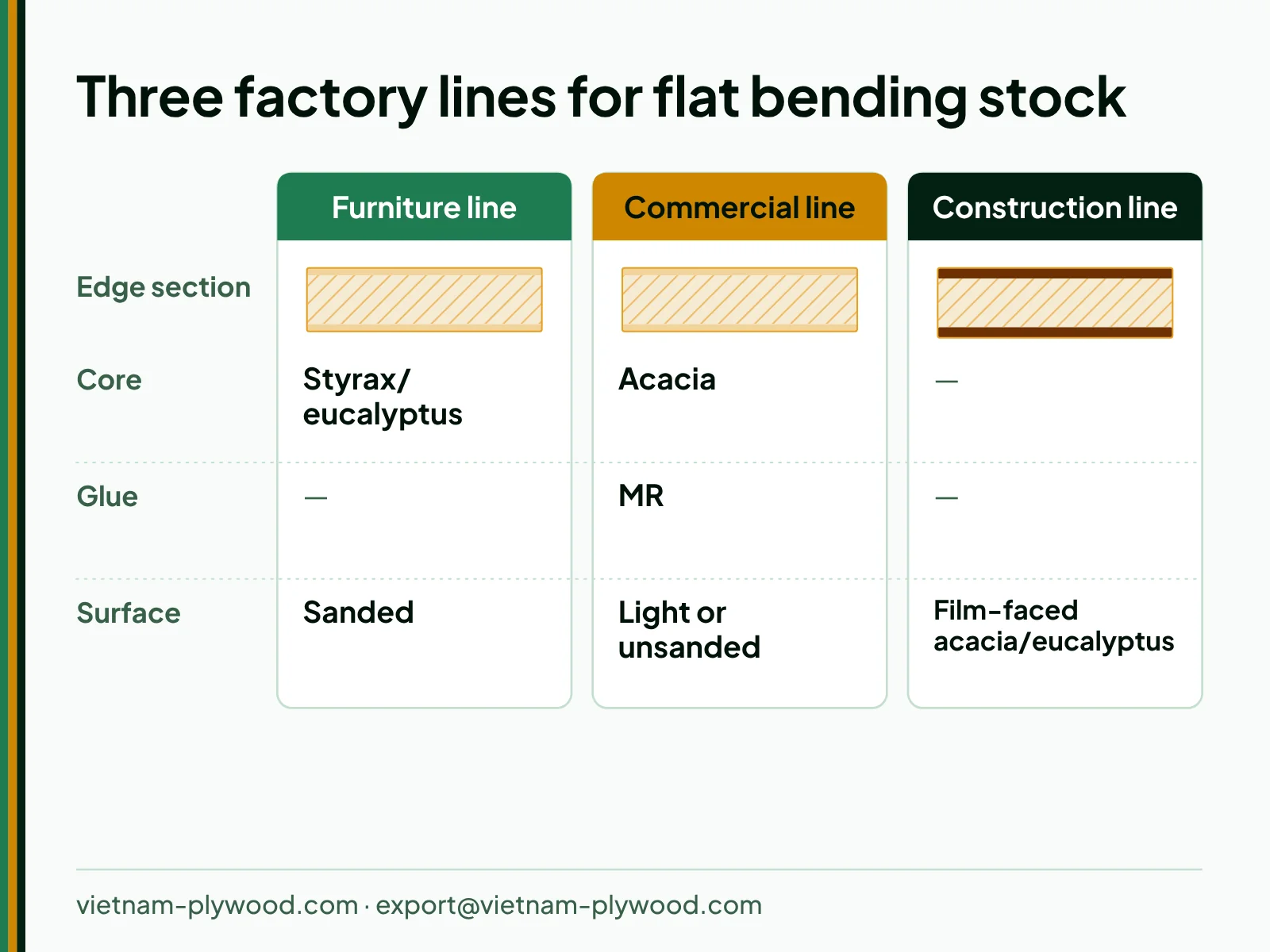
Our furniture line is the first choice for sanded, visible-face flat stock used in cabinet and fit-out forming trials. Our commercial and packing line makes acacia-core stock for concealed substrates; our construction line makes film-faced panels intended for formwork rather than decorative curves.
| Specification field | Furniture line | Commercial and packing line | Construction line |
|---|---|---|---|
| Core | Styrax or eucalyptus | Acacia | Acacia or eucalyptus |
| Surface | Sanded veneer face | Unsanded or light-sanded | Phenolic, melamine or anti-slip film |
| Glue/emission | Specify separately; E0 or E1 | MR glue; emission field separately | Specify bond and film |
| 5 mm or 9 mm flat stock | Trial layers for exposed curved parts | Concealed kerfed substrate trial | Formwork-facing use, not preferred for visible cabinet bends |
| Thickness tolerance | ±0.2 or ±0.3 mm as ordered | ±0.5 mm commercial; ±0.5–1.0 mm packing | ±0.5 mm |
The producing factory presses the ordered flat panel. HCPLY does not describe these standard panels as pre-bent, radius-rated or specially flexible.
What thickness, face and size should the buyer specify?
Begin with the finished radius and visible surface, then select flat-sheet thickness for a trial rather than guessing flexibility from nominal thickness. Our panel range is 3–40 mm, with common thicknesses of 3, 5, 9, 12, 15, 18, 21 and 25 mm.
Available sheet sizes include 1220 × 2440, 1250 × 2500, 1220 × 2135, 1220 × 1830, 915 × 2440, 915 × 2135 and 915 × 1830 mm; custom cutting is available. Length and width tolerance is ±2 mm. Specify the grain direction on the visible face relative to the bend axis, especially for long cabinet fronts.
Compare meranti and luan faces when choosing appearance. Faces include bintangor, okoume, engineered veneer, gurjan, pine, poplar, eucalyptus, birch and sapele; matt means an unfaced raw core. Common face veneer thickness is 0.2–0.4 mm. Face grades are A/B, while birch uses D/E/F.
What can an inspector check before loading?
An inspector can compare a flat-sheet sample with the purchase specification and witness thickness, face, core and edge checks at the producing factory. A bend test requires the buyer’s agreed radius, forming procedure and acceptance criteria; ordinary sheet inspection alone cannot establish a minimum bend radius.
Check the face for splits and repairs, the edge for open joints, the thickness at agreed points and the sheet dimensions. For furniture stock, inspect sanding and the requested stitched-core construction. Full stitched cores are the highest core-construction option in our range, followed by stitched outer layers with edge-trimmed inner layers, finger-jointed and loose-laid construction.
Record whether the sample cracks during forming, whether the adhesive line opens, and how much the part springs back after release. If the intended service has structural requirements, specify the buyer-accepted test report and performance criteria independently.
Can curved-part stock share a container with other plywood?
A mixed-specification 40HC can combine thin furniture stock and commercial substrate stock within the 28.5 t payload limit. The load plan must use each core’s density and pallet configuration, rather than assuming equal sheet weights.
For 1220 × 2440 × 5 mm sheets, styrax-core stock weighs 7.44 kg per sheet and acacia-core stock weighs 8.63 kg. A full styrax 40HC is 3,600 sheets, 53.58 m³ and 26.79 t; a full acacia 40HC is 3,200 sheets, 47.63 m³ and 27.62 t. These are separate full-load references, not a proposed combined load.
For a mixed shipment, the buyer lists the quantity of each specification and HCPLY calculates the combined volume and mass against the payload and pallet arrangement. The container loading reference owns detailed load counts; see distributor supply programmes for mixed orders.
How should glue, emission and finish be written?
Specify adhesive and emission as separate fields, then describe the exposed face and intended forming process. Melamine MR glue is associated with a 12-hour boil specification; phenolic WBP means weather and boil proof and has a 72-hour boil specification. These descriptions do not establish bend performance.
Emission classes E0, E1 and E2 are classifications; CARB P2 and TSCA Title VI concern U.S. formaldehyde limits with third-party certification. Do not substitute an emission class for a bond-performance requirement.
If the formed component will receive an applied laminate or high-pressure laminate face, treat that finishing material as a separate buyer operation. We do not offer melamine, HPL or laminate faces as a product line.
What belongs in the export order and quotation?
A furniture-grade sanded sheet costs more than a basic commercial substrate when its face selection, core stitching and sanding require more processing. More demanding thickness tolerance and face selection also increase processing requirements.
Indicative starting prices are from US$350/m³ FOB Hai Phong (October 2026) for furniture plywood and from US$250/m³ FOB Hai Phong (October 2026) for commercial plywood. Ask for a quotation against the actual written specification.
The minimum order is one 40HC, with mixed specifications allowed within payload. Production takes 15–45 days from the 30% deposit, set by order size, line loading and the contract. The 70% balance is against the scanned bill of lading, by telegraphic transfer or irrevocable letter of credit at sight. We ship FOB Hai Phong, or CFR (CNF) or CIF to your port. Free samples are available; new buyers book their courier, and its cost can be credited against a real order.
Which shipment papers cover the ordered build?
The invoice and packing list identify the shipped specifications and quantities; agreed test reports document the performance checks requested for that build. Shipment paperwork includes the bill of lading, certificate of origin, phytosanitary and fumigation papers, and insurance under CIF.
EU lots include EUR.1 where applicable and the EUTR/EUDR file set; order-specific certificate documents can include an FSC claim on sales documents and an emission certificate. Member-factory FSC, CARB P2, ISO 9001 and CE certificates, and EUDR/EUTR documents, are shown with factory details masked, on request. After loading, the draft shipping documents come to you for approval.
For a curved fit-out programme, the shipping papers identify the flat panels.
What should go on the bending plywood enquiry?
Send the finished geometry and the flat-sheet specification together, with a request for a trial sample and the spec sheet.
Application: curved cabinet end / fit-out panel; finished radius and bend axis: [drawing]
Line or core: furniture line / styrax or eucalyptus core
Glue: [MR melamine or phenolic WBP as agreed]
Emission: [E0 or E1 as agreed]
Face and grade: [species / A or B; birch D/E/F]
Thickness and tolerance: [mm / ±0.2 or ±0.3 mm as ordered]
Size: [mm × mm]
Quantity: [sheets and total m³]
Destination port: [port, country]
Forming method and acceptance: [kerf / heat trial / lamination; radius, springback, face checks]
Request the bending-stock spec sheet from Lucy at export@vietnam-plywood.com through our contact page.