





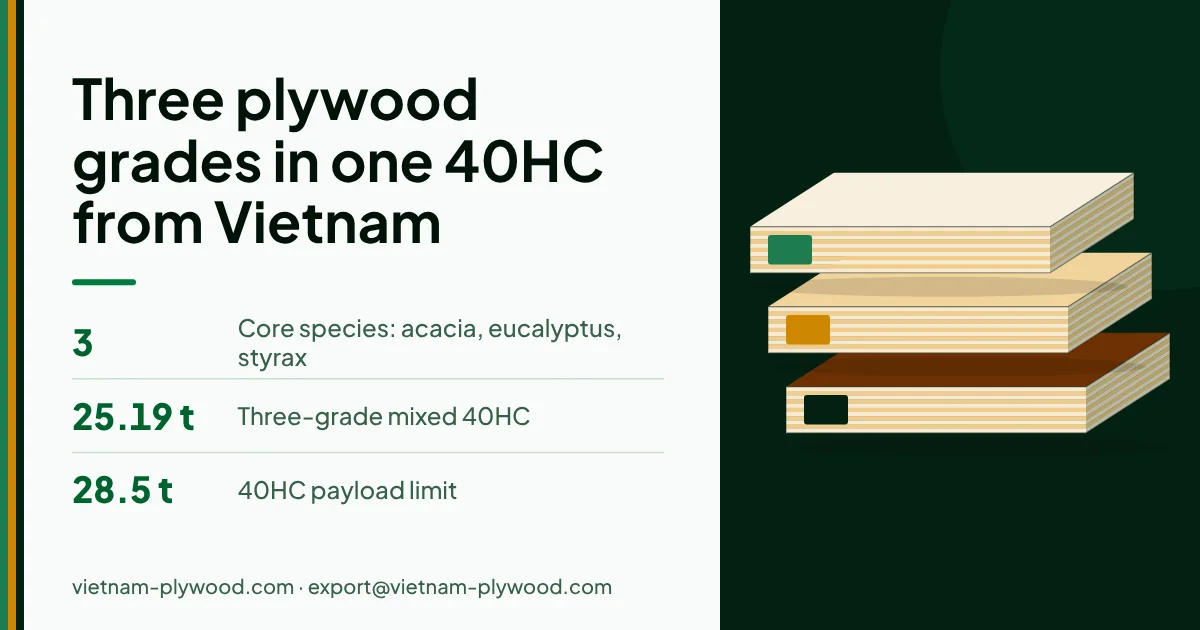
An importer who stocks furniture panels, packing grade and formwork can fill one 40HC from Vietnam with all three, and HCPLY ships exactly that kind of load from Hai Phong. Buying each grade from a different country means separate minimums, separate freight and separate paperwork, and a gap in the range when one source runs late. That cost lands on the distributor’s shelf before it shows on any price list.
Why buy plywood from Vietnam?
Buy plywood from Vietnam for plantation hardwood cores in three densities, factories organised by product group, and the freedom to mix grades in one 40HC. Furniture, commercial, packing and film-faced panels share an export port, a document set and a payment schedule, which matters most to a buyer who needs several grades at once.
Plenty of origins can sell one good panel. The case for Vietnam is the range under one shipment. Acacia, eucalyptus and styrax cores cover light, medium and heavy builds. Faces run from bintangor, okoume, EV (engineered veneer), gurjan, pine, poplar, eucalyptus and sapele to birch graded D, E or F, plus matt (unfaced raw core). Thickness runs 3–40 mm, in sizes from 1220×2440 to 915×1830 mm and custom cuts.
This page sits with our other plywood buying guides. It answers the questions importers and distributors ask when they are ready to order: what Vietnam does well, where it is weaker, which beliefs about it are wrong, and how a mixed first container works.
What does a buyer who needs several grades gain from Vietnam?
A buyer who needs several grades gains one origin that presses each of them on a line built for that product. Our furniture line, our commercial and packing line, and our construction line each keep their own press settings, cores and tolerances, so an order for three grades becomes three builds, each pressed where its settings already run.
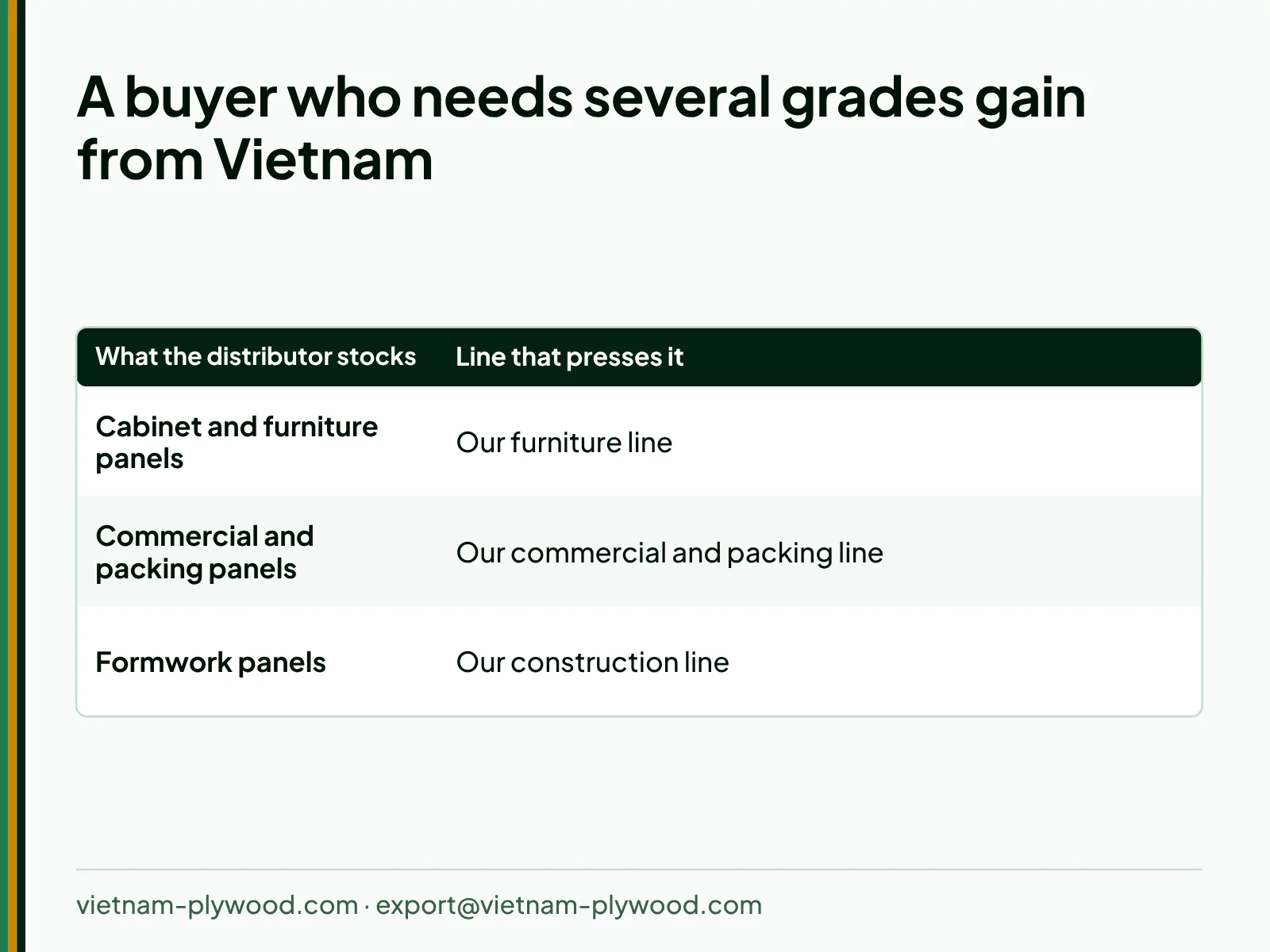
The table shows what a distributor’s typical range looks like when each grade is pressed on the line made for it.
| What the distributor stocks | Line that presses it | Core and glue | Surface and tolerance | Who buys it from the distributor |
|---|---|---|---|---|
| Cabinet and furniture panels | Our furniture line | Styrax or eucalyptus, full stitched; MR or WBP | Sanded, face A or B, E0/E1, ±0.2 or ±0.3 mm | Furniture, cabinet and fit-out makers |
| Commercial and packing panels | Our commercial and packing line | Acacia; MR | Unsanded or light-sanded; ±0.5 mm, packing ±0.5–1.0 mm | Packing companies, pallet and crate makers |
| Formwork panels | Our construction line | Acacia or eucalyptus; phenolic or melamine film | Film 120, 135 or 220 g/m² (anti-slip); ±0.5 mm | Contractors and formwork yards |
Capacity covers repeat programmes: our furniture and commercial plywood runs up to 100 containers a month, and construction plywood up to 140. Buyers who hold stock for resale can read how plywood supply programmes for distributors are planned month to month.
What the other lines would build instead matters when a buyer is unsure which grade a customer needs. A cabinet maker who asks for “18 mm okoume” gets a sanded, full stitched styrax or eucalyptus core from our furniture line. The same request on our commercial line becomes an acacia-core, MR, unsanded panel. On our construction line it would be film over the core. The furniture plywood page lists what the first of these builds covers.
Why do plantation cores matter for plywood buyers?
Plantation cores matter because they fix two things a buyer pays for: sheet weight and origin paperwork. Acacia at 580 kg/m³, eucalyptus at 650 kg/m³ and styrax at 500 kg/m³ are the only core species pressed here, and density follows the core, not the face.
Known density turns into known freight. An 18 mm sheet at 1220×2440 mm weighs 26.8 kg on styrax, 31.1 kg on acacia and 34.8 kg on eucalyptus, so the buyer can price handling and payload before the quote arrives. It also tells the machining shop what to expect: the lightest core for furniture parts handled by hand, the heaviest for panels that take load and wear.
Origin is the second gain. Plantation acacia, eucalyptus and styrax are Vietnamese species, so the core of the panel and its legality file point to the same country. For UK buyers, the retained EU Timber Regulation on legislation.gov.uk (Regulation 995/2010, Article 4) states that operators shall exercise due diligence when placing timber products on the market. Our EU lots ship with the EUTR/EUDR file set, which is what an importer’s due diligence system draws on.
What are the pros and cons of Vietnamese plywood?
The pros of Vietnamese plywood are its cores, its glue and emission options and its mixed loads; the cons are that it rewards a complete specification and punishes a vague one. The table puts each point against the buyer it affects, with a verdict.
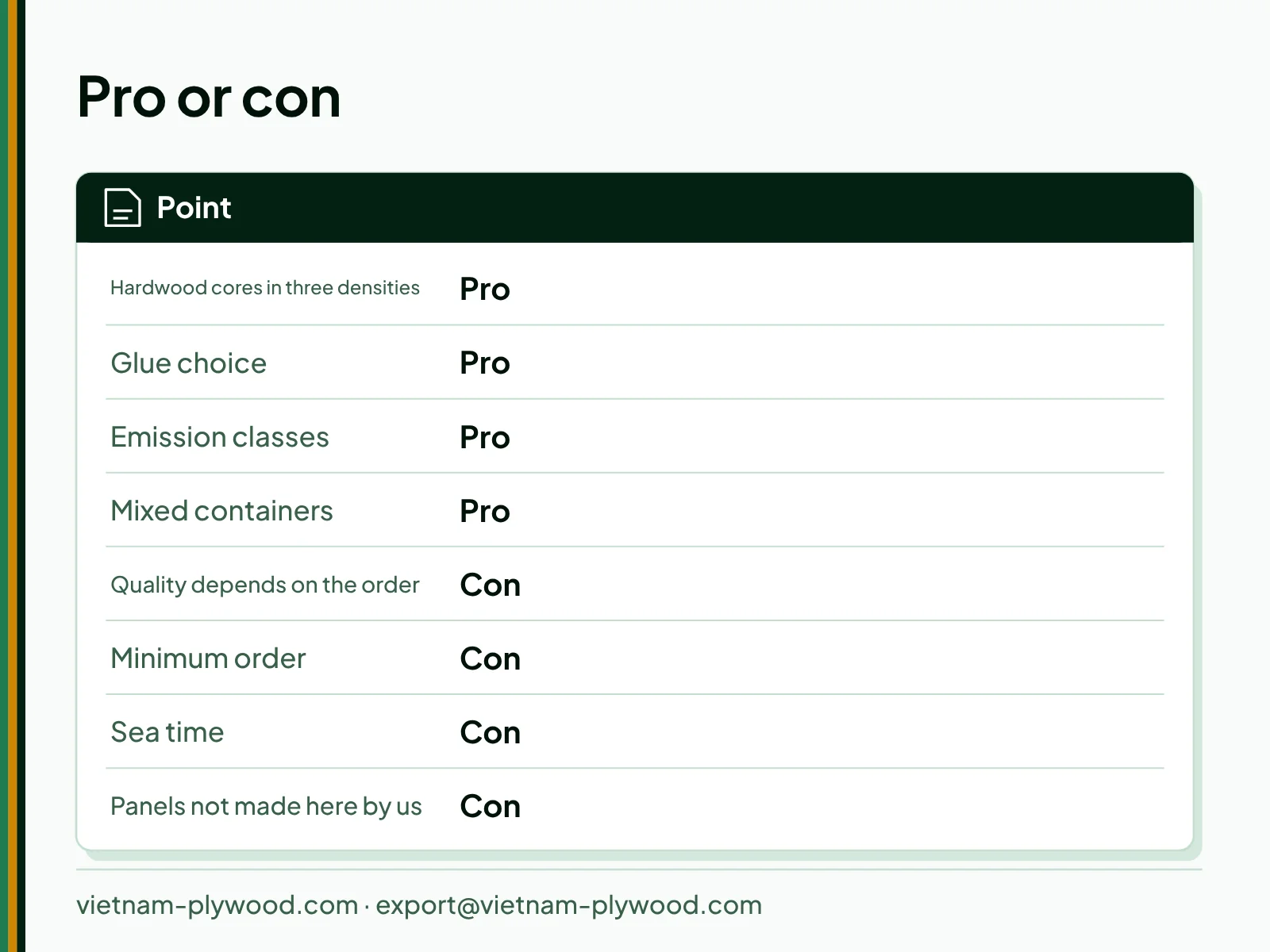
| Point | Pro or con | What it means in numbers or terms | Verdict by buyer |
|---|---|---|---|
| Hardwood cores in three densities | Pro | 500, 580, 650 kg/m³ | Furniture makers pick styrax for weight; formwork yards pick eucalyptus for wear |
| Glue choice | Pro | MR 12-hour boil, WBP 72-hour boil | Interior and packing on MR; wet sites on WBP |
| Emission classes | Pro | E0, E1, E2; CARB P2 / TSCA Title VI for the US | Cabinet makers order E0 or E1; US importers order CARB P2 / TSCA Title VI |
| Mixed containers | Pro | Minimum one 40HC, mixed within 28.5 t | Distributors test several grades in one load |
| Quality depends on the order | Con | Open fields get the cheapest build | Every buyer: write core, glue, class, tolerance |
| Minimum order | Con | One 40HC | Small yards may need a partner to share a load |
| Sea time | Con | 30–40 days at sea to Northern Europe, 35–45 to the US East Coast | Plan stock cover for the voyage |
| Panels not made here by us | Con | No MDF, OSB, chipboard, blockboard, bamboo, MDO, HDO, 3-ply spruce or birch-core | Buy those from other origins |
Read the cons as planning items. None of them is a defect in the panel; each one is a decision the buyer makes on the order or on the stock plan.
What are the advantages and disadvantages for European buyers?
For European buyers, the advantages are dense hardwood cores, EUR.1 certificates of origin and an EUTR/EUDR file set with each EU lot; the disadvantage is distance. Sea time from Hai Phong runs 25–35 days at sea to the Mediterranean and 30–40 days to Northern Europe, by carrier and route.
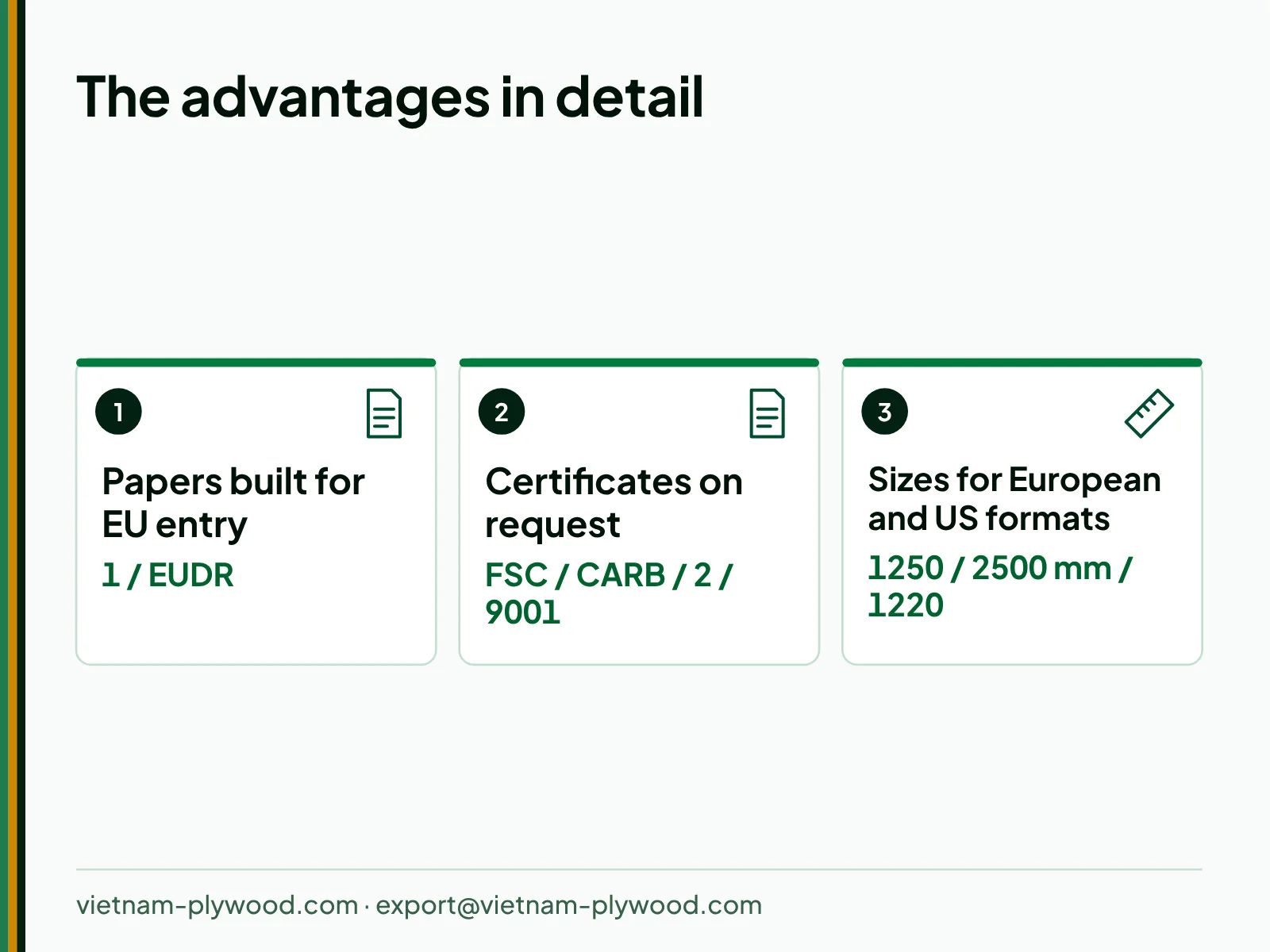
The advantages in detail:
- Papers built for EU entry. The certificate of origin is issued as EUR.1 for EU lots, and the shipment carries the EUTR/EUDR file set alongside the commercial invoice, packing list and B/L.
- Certificates on request. FSC, CARB P2, ISO 9001 and CE belong to the member factories and are shown with factory details masked, on request.
- Sizes for European and US formats. Both 1250×2500 mm and 1220×2440 mm are standard.
The disadvantages, stated plainly:
- Stock cover. A buyer reordering when shelves are empty will run out; order against a forecast that covers production plus the voyage.
- Panels we do not press. European buyers who also need spruce, OSB or birch-core panels must source those elsewhere.
- Specification discipline. EN-style expectations do not travel by default. Name glue, emission class and tolerance on each line of the order.
Buyers setting up their first import account can start with our guide to becoming a plywood importer, which covers the registration side this page skips.
What are the common Vietnam plywood misconceptions?
Five Vietnam plywood misconceptions come up in first conversations with importers, and each has a factual answer. The answers rest on the build and the papers, so a buyer can test every one of them at the producing factory.
“Vietnamese plywood is one low grade”
Vietnam presses furniture panels sanded to ±0.2 mm and packing panels at ±0.5–1.0 mm, and both are correct for their use. Low-grade complaints usually come from a packing-grade build bought for a visible part. The grade is chosen on the order; the country does not choose it.
“Local hardwoods are soft”
Acacia and eucalyptus are dense hardwood cores at 580 and 650 kg/m³. Styrax, at 500 kg/m³, is the light core and is chosen on purpose for furniture where sheet weight matters. Softness is a choice of core, and the buyer makes it.
“It is Chinese plywood with a Vietnamese label”
This belief has a real source. The US Department of Commerce ruled in its July 2023 notice in the Federal Register (govinfo.gov) that an exporter claiming no Chinese inputs must prepare and maintain an exporter certification with supporting documents. The answer is origin evidence: Vietnamese core species, a certificate of origin and, for EU lots, the EUTR/EUDR file set.
“The papers are thin”
The shipment file is complete when the order asks for it: commercial invoice, packing list, B/L, certificate of origin, phytosanitary and fumigation papers, insurance under CIF, and the order’s certificate documents. After loading, the draft shipping documents come to you for approval.
“Price is the only argument”
Price is one argument among several. Commercial plywood starts from US$250/m³ FOB Hai Phong (October 2026), and the buyer who needs three grades also saves a second minimum order, a second freight booking and a second file. Our comparison of the best plywood producing countries sets Vietnam beside other origins.
How does a mixed container of several grades work?
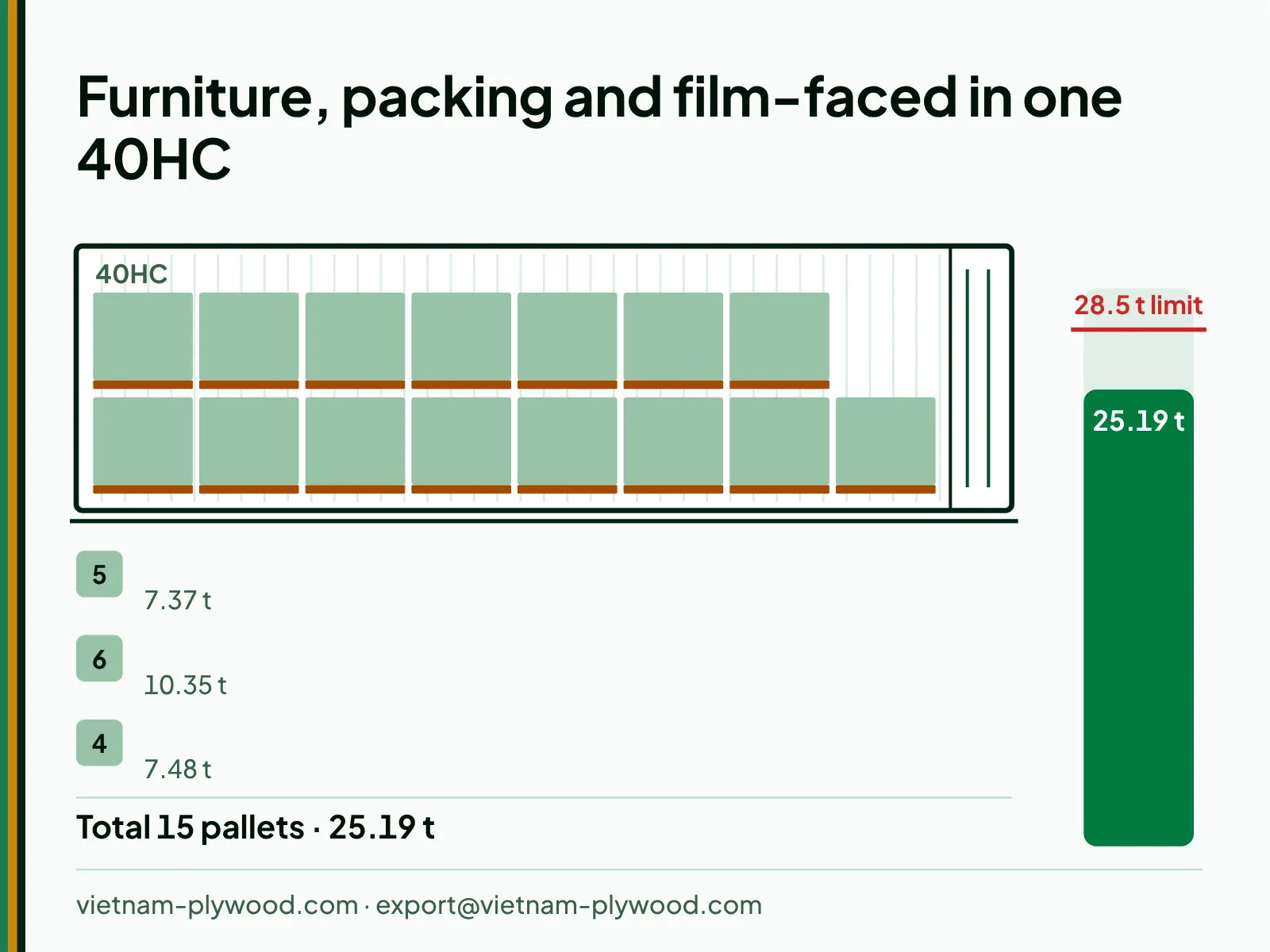
A mixed 40HC works by blocks of pallets, one block per specification, with the combined weight kept under the 28.5 t payload limit. The minimum order is one 40HC, and specifications can be mixed in it. Here is a load a distributor might plan to cover furniture, packing and formwork customers, all at 1220×2440 mm:
| Block | Grade and core | Thickness | Pallets | Sheets per pallet | Sheets | m³ | Tonnes |
|---|---|---|---|---|---|---|---|
| 1 | Furniture, styrax | 18 mm | 5 | 55 | 275 | 14.74 | 7.37 |
| 2 | Packing, acacia | 9 mm | 6 | 111 | 666 | 17.84 | 10.35 |
| 3 | Film-faced, eucalyptus | 21 mm | 4 | 46 | 184 | 11.50 | 7.48 |
| Load | 15 | 1,125 | 44.08 | 25.19 |
The arithmetic uses our loading formula. Sheets per pallet = floor(stack height ÷ thickness): 1000 ÷ 18 = 55 for styrax, 1000 ÷ 9 = 111 for acacia, 970 ÷ 21 = 46 for eucalyptus. Volume = sheets × 1.22 × 2.44 × thickness in metres, and tonnes = m³ × core density ÷ 1000.
At 25.19 t, the load leaves 3.31 t of headroom under the payload limit. A single-grade load of 18 mm runs 990 styrax, 880 acacia or 795 eucalyptus sheets; other thicknesses are on our container load tool. Each block is pressed in the factory that fits its specification and shipped directly from it, FOB Hai Phong.
Which papers travel with a mixed-grade shipment?
A mixed-grade shipment travels with one set of export documents that lists every block. The buyer does not assemble three files from three sources, and customs sees one invoice and one packing list. The table maps each paper to what it covers on a three-grade load.
| Paper | What it covers on a mixed load |
|---|---|
| Commercial invoice | Each block as its own line: grade, core, thickness, m³, price basis |
| Packing list | Pallets per block, sheets per pallet, weights |
| B/L | The container and its total weight |
| Certificate of origin | Vietnamese origin of all blocks; EUR.1 for EU lots |
| Phytosanitary and fumigation papers | Pallets and packing wood |
| Insurance | Under CIF terms |
| Certificate documents | FSC claim on sales documents, emission certificate, test reports for the agreed build, per block |
| EUTR/EUDR file set | Legality and origin for EU lots |
The balance is paid against the scanned B/L, and the drafts reach the buyer after loading for approval. A distributor’s customs broker receives a file that already matches the goods, block by block.
What drives the price of a mixed Vietnamese order?
The price of a mixed order is the sum of its blocks, and each block is priced by its build. Commercial plywood starts from US$250/m³ FOB Hai Phong (October 2026) and furniture plywood from US$350/m³ FOB Hai Phong (October 2026). Film-faced and other grades are quoted against the written specification.
The drivers inside each block, from largest effect to smallest:
- Core construction: full stitched over finger-jointed over loose-laid.
- Glue: WBP costs more than MR, and its press runs hotter, at 130–145 °C against 110–120 °C.
- Surface: sanded to ±0.2 mm costs more than unsanded at ±0.5 mm; film-faced adds the film weight chosen.
- Emission class: E0 and CARB P2 / TSCA Title VI above E1 and E2.
- Face species and grade: A above B; matt least.
We ship FOB Hai Phong, or CFR (CNF) or CIF to your port. Quotes are dated because veneer and glue costs move; our page on quote validity and price changes explains how a dated quote is held and when it is reissued.
Can you see the factories before the first order?
Yes. Buyers visit the factory office and inspect goods at the producing factory, which is in Phu Tho or Hai Phong depending on the line. A buyer with a three-grade order can see each block on the line that pressed it before the balance is paid.
HCPLY runs the export end to end: specification, on-site QC at the producing factory, documents and loading. For a buyer with several grades, that means one contact for three builds. Lucy at export@vietnam-plywood.com takes the specification, and the same team that checks block 1 on our furniture line checks block 3 on our construction line before the doors close.
The visit also shows what a buyer cannot see in a photo. Core veneers at 1.4–2.0 mm are laid up into 11–13 plies for an 18 mm panel, and the core construction step, from full stitched to loose-laid, shows at the edge of a cut sheet. MR panels press at 110–120 °C and WBP panels at 130–145 °C, and the press settings for each line are visible on the floor.
A visit is the fastest way to settle the misconceptions above in person. Ask to watch a caliper check, a sheet weighed against its core density, an edge cut and a boil test. Our page on visiting a plywood factory in Vietnam covers how to arrange it.
How do you place a first mixed-grade order?
Place it in five steps, and each one closes a question before money moves.
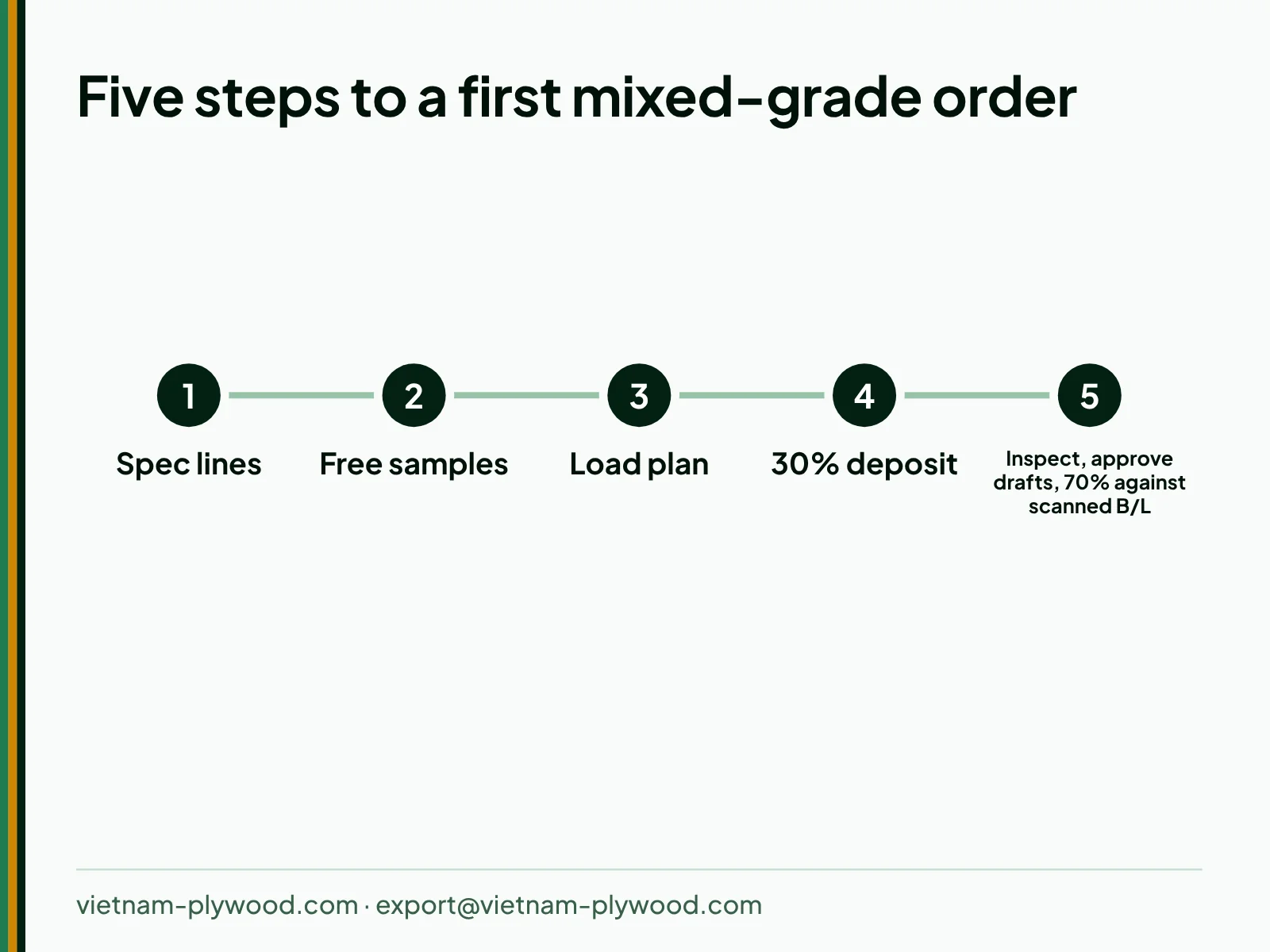
- Write each block as a specification line: application, line and core, glue, emission class, face and grade, thickness and tolerance, size.
- Request free samples of each block; a first-time buyer pays the courier, and that charge comes off the first confirmed order.
- Check the load plan against the 28.5 t payload limit, block by block.
- Pay the 30% deposit. Production runs 15–45 days from the 30% deposit, set by order size, line loading and the contract.
- Inspect at the producing factory, approve the draft documents, and pay the balance: 70% on the scanned bill of lading, by T/T or irrevocable sight L/C.
A buyer who sends the following lines gets one quote with a price per block:
Block 1  Application: cabinet carcass   | furniture line, styrax core, full stitched
         Glue: MR | Emission: E1 | Face: okoume A/B | 18 mm sanded ±0.3 mm | 1220×2440 | 5 pallets
Block 2  Application: export crates     | commercial and packing line, acacia core
         Glue: MR | Emission: E2 | Face: matt (unfaced) | 9 mm unsanded ±0.5–1.0 mm | 1220×2440 | 6 pallets
Block 3  Application: wall formwork     | construction line, eucalyptus core
         Glue: WBP | Film: 135 g/m² premium | 21 mm ±0.5 mm | 1220×2440 | 4 pallets
Container: one 40HC, 25.19 t planned | Terms: CIF [destination port]
Buyers who want one source for all of this can read how one supplier covers several plywood types. When your blocks are written, request the spec sheet for each grade and we will return a block-by-block quote.