






How does a new plywood importer start buying from Vietnam?
A new plywood importer should start with identified buyers, written specifications and a mixed trial container from HCPLY. A wrong first selection ties up cash, delays replenishment or produces a rejected load. Our furniture, commercial and packing, and construction lines operate at member factories in Phu Tho and Hai Phong. We assign each build to its producing factory and handle export inspection and documents. The importer arranges destination entry. Start with customers who already buy plywood by application, thickness and face. Record the competing stock specifications in your market before requesting a quotation.
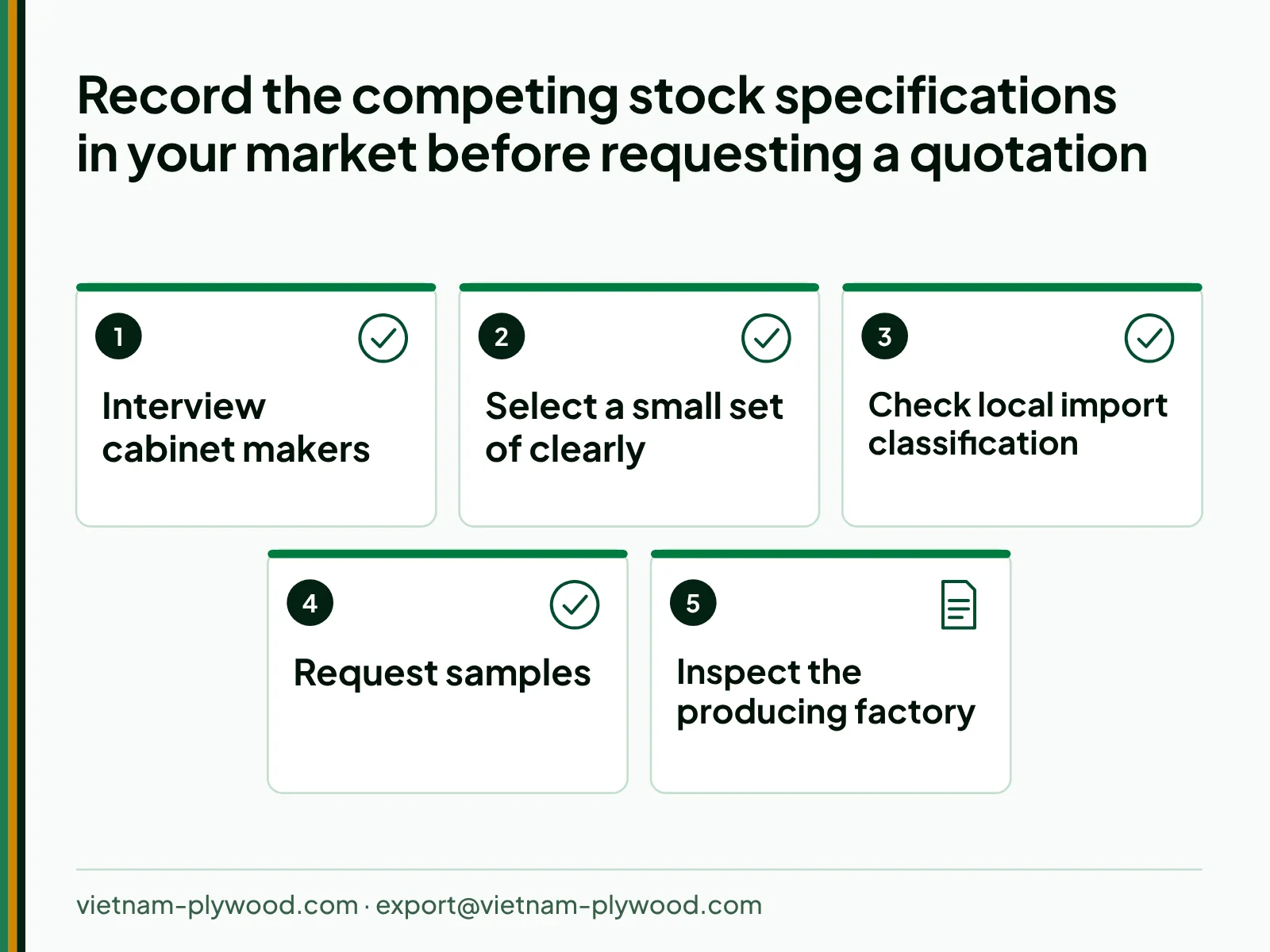
- Interview cabinet makers, packaging buyers and formwork yards about their actual repeat sizes and tolerances.
- Select a small set of clearly different specifications, with one application assigned to each.
- Check local import classification, taxes, product requirements and clearance arrangements before paying a deposit.
- Request samples, compare the written build with the physical panels and approve the trial order.
- Inspect the producing factory, approve the shipping-document drafts and record sales by product after arrival.
The Buying Guides collection covers adjacent purchasing decisions. Our supplier evaluation guide helps organize the factory questions before an order is placed.
Can a first-time importer test several plywood types in one container?
Yes. The minimum order is one 40HC container, and specifications can be mixed within its 28.5 t payload limit. The trial should compare applications rather than combine near-identical sheets that buyers cannot distinguish. Write each line item separately on the purchase specification and packing list.
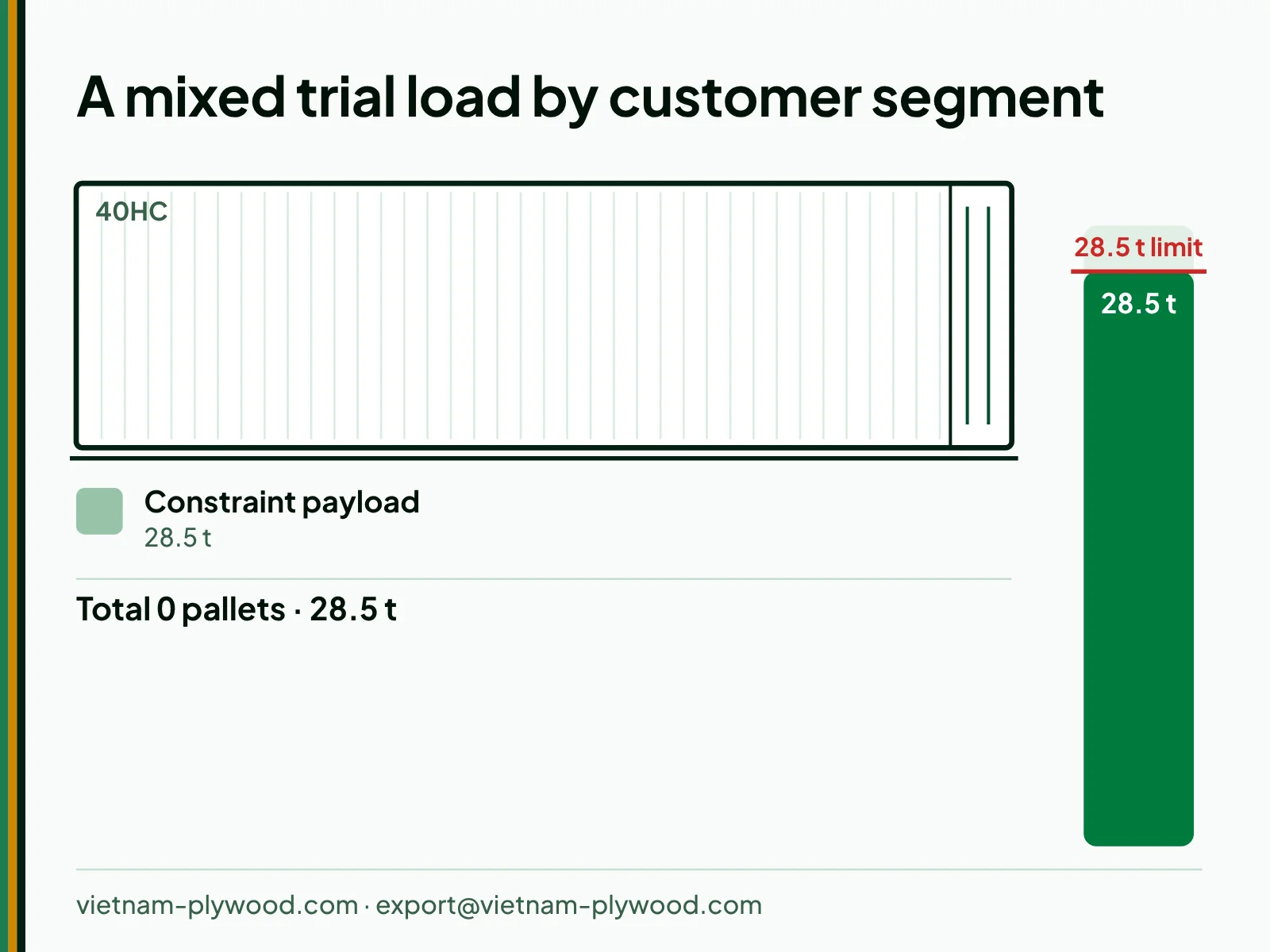
For example, a distributor might test sanded furniture panels for cabinet makers, acacia-core commercial sheets for packaging accounts and film-faced panels for formwork yards. These products originate on their respective lines. Coordinate the trial mix before production because different factories make the individual specifications; the final loading plan must identify the actual producing and loading arrangements.
Weight matters. At 18 mm and 1220×2440 mm, a styrax-core load is 990 sheets, 53.05 m³ and 26.52 t; an acacia-core load is 880 sheets, 47.15 m³ and 27.35 t; a eucalyptus-core load is 795 sheets, 42.60 m³ and 27.69 t. These are separate full-load references. Film weight is excluded from the calculation.
For a mixed load, sum the planned quantity times each sheet weight and include the packaging and any film weight in the actual loading check. At 18 mm, sheets weigh 26.79 kg in styrax, 31.08 kg in acacia and 34.83 kg in eucalyptus. Review pallet arrangement and loading weight with our export team. The container-loading guide owns the complete loading calculations.
Which plywood product line should a new importer start with?
Start with the line that has identifiable repeat buyers and a written acceptance standard in your destination market. Furniture panels are appropriate when cabinet makers need a sanded face and tighter thickness control. Commercial sheets suit buyers who accept a less finished surface. Film-faced panels fit construction accounts that evaluate overlay, edges and concrete-release performance.
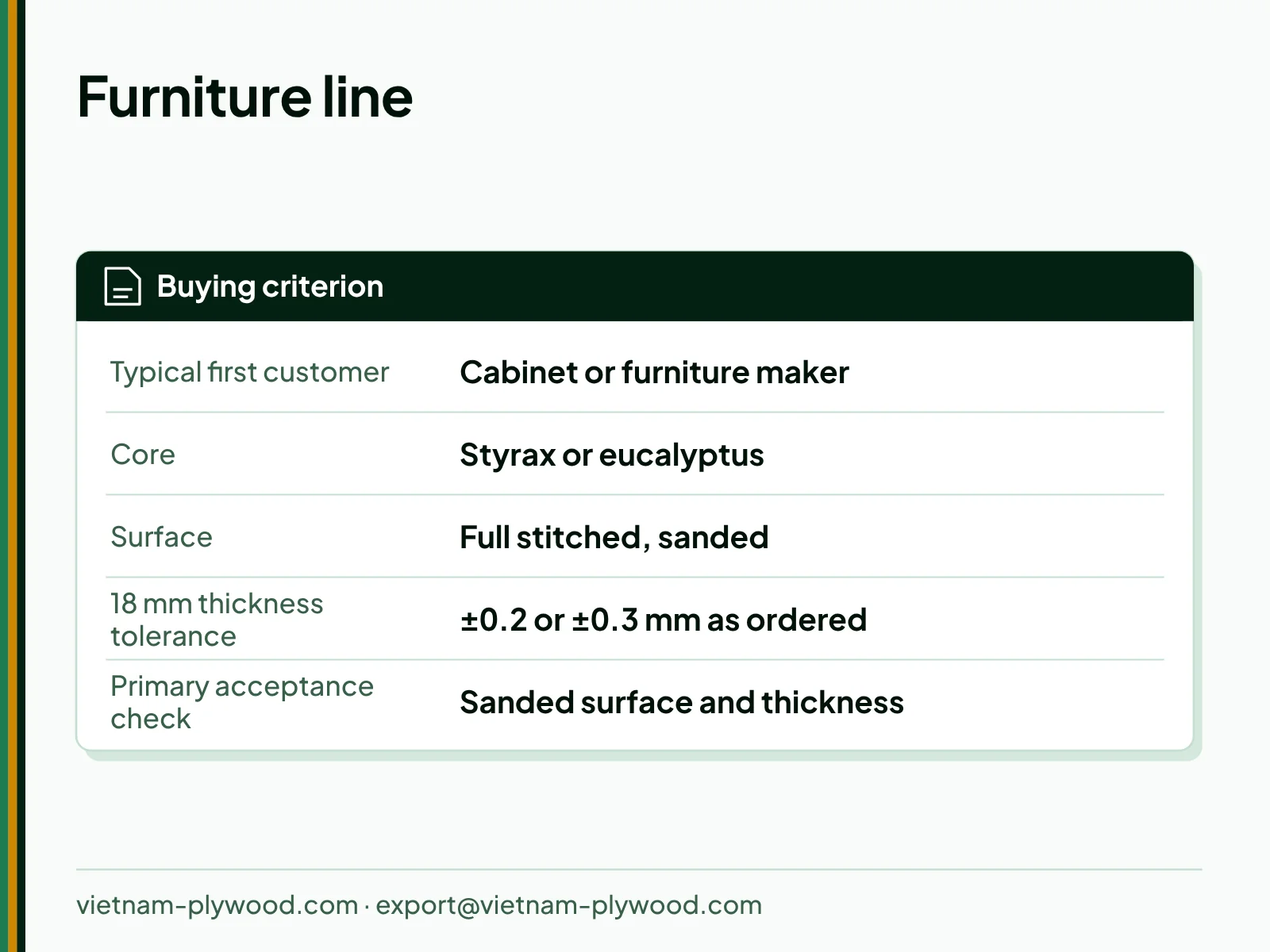
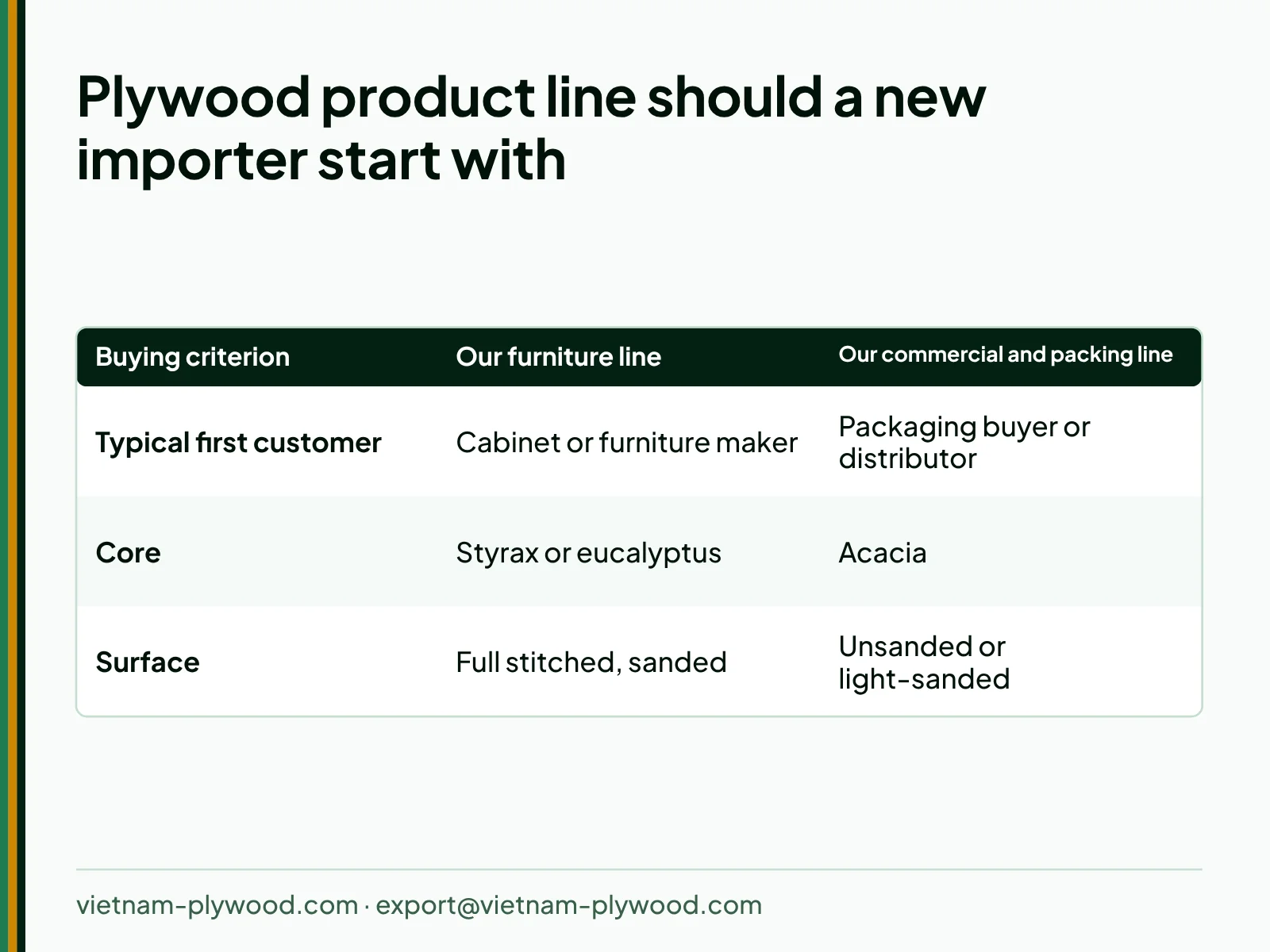
| Buying criterion | Our furniture line | Our commercial and packing line | Our construction line |
|---|---|---|---|
| Typical first customer | Cabinet or furniture maker | Packaging buyer or distributor | Formwork contractor or yard |
| Core | Styrax or eucalyptus | Acacia | Acacia or eucalyptus |
| Surface | Full stitched, sanded | Unsanded or light-sanded | Phenolic or melamine film, including anti-slip film |
| 18 mm thickness tolerance | ±0.2 or ±0.3 mm as ordered | Commercial ±0.5 mm; packing ±0.5–1.0 mm | ±0.5 mm |
| Primary acceptance check | Sanded surface and thickness | Core, bond and packing fitness | Film, sealed edges and thickness |
| First-trial verdict | Choose for cabinet accounts | Choose for general trade and packing | Choose for identified formwork accounts |
These are three distinct manufacturing builds, even when the nominal thickness matches. The furniture plywood page details the cabinet-facing build, while one supplier for several plywood types explains the wider range.
What specification should each trial line carry?
Give each trial product an unambiguous face, core, bond and tolerance. Product names follow the face, while density follows the core. A bintangor-faced furniture sheet with a styrax core remains a styrax-density load. Face veneer commonly measures 0.2–0.4 mm; the order should still state the required face and grade.
For furniture, choose a listed face such as bintangor, okoume, engineered veneer (EV), gurjan, pine, poplar, eucalyptus or sapele and specify A/B face grading. Birch faces use D/E/F grades. Our furniture line uses a full-stitched, sanded styrax or eucalyptus core and E0/E1 emission classes. Specify the glue field separately from the emission field.
Our commercial and packing line uses acacia core and moisture-resistant (MR) glue, with an unsanded or light-sanded finish. Our construction line applies 120 g/m² standard film, 135 g/m² premium film or 220 g/m² anti-slip film. State whether melamine or phenolic glue is ordered and identify the required film finish.
The available thickness range is 3–40 mm, with common orders at 3, 5, 9, 12, 15, 18, 21 and 25 mm. Available sizes include 1220×2440 and 1250×2500 mm, plus specified smaller formats. Length and width tolerance is ±2 mm. Custom cutting is available.
What should the importer inspect at the producing factory?
The buyer or appointed inspector should witness checks on the actual ordered build at the producing factory. Buyers visit the factory office and inspect goods where the order is produced. Begin with the written specification, then select sheets from the trial lot and compare measurements, surfaces and construction.
Check thickness at several points, record length and width, and inspect faces for defects against the agreed grade. Examine panel edges for gaps and core construction. The core-construction order from higher to lower quality is full stitched, stitched outer layers with edge-trimmed inner layers, finger-jointed and loose-laid.
On furniture sheets, examine sanding and face appearance. On packing sheets, inspect edge integrity and suitability for the intended packaging design. On film-faced sheets, check overlay condition, cut-edge sealing and the glue specification.
A test report can support a specific agreed build, but a surface appearance alone cannot establish a structural grade. Any request for marine or BS 1088 designation needs a test report the buyer accepts. Ask for the member factory’s relevant certificate material with factory details masked, on request, and match it to the product and shipment.
How should a trial importer compare glue, emissions and face quality?
Compare glue, emission class and face grade as separate fields on every line item. Melamine glue is the MR option with a 12-hour boil description; phenolic glue is the water-boil-proof (WBP) option with a 72-hour boil description. These describe the supplied glue categories and do not replace a test report for a buyer’s required performance.
Emission classes are E0, E1 and E2. For US-bound products, CARB Phase 2 and TSCA Title VI concern an emission limit with third-party certification, so obtain the applicable certificate documentation for the ordered factory build. Do not treat a glue description as an emission certificate.
For construction panels, film type and weight are different from the bond. With proper handling, a release agent on every pour and sealed edges, including cut edges, melamine-glue film-faced plywood gives about 12–15 pours; phenolic-glue film-faced plywood gives up to about 25 pours. Use those conditions in the buyer’s comparison, and do not turn them into an unconditional yield target.
Ask customers which measurable field drives acceptance and record it.
Which import and export documents need checking?
Check the export set against the exact product lines and the destination country’s import requirements. HCPLY prepares the commercial invoice, packing list, bill of lading (B/L), certificate of origin, phytosanitary and fumigation papers, and the order’s agreed certificate documents. Insurance is included under cost, insurance and freight (CIF) terms.
For European Union lots, the certificate of origin is EUR.1 and the EUTR/EUDR file set is included. An agreed Forest Stewardship Council (FSC) claim appears on sales documents when applicable; emission certificates and test reports accompany the agreed build. Member-factory FSC, CARB P2, ISO 9001 and CE material is shown with factory details masked, on request. After loading, the draft shipping documents come to you for approval.
For US imports, the US Government Publishing Office’s 2023 edition of 19 U.S.C. §1484 says the importer of record must use reasonable care when filing entry information, including classification and declared value. Arrange destination-specific customs advice before shipment.
Review the letter-of-credit documents guide before agreeing document wording, particularly where a bank examines the shipment documents.
How do pricing, payment and shipment timing work?
Request quotations against the written specification for each product and the agreed container mix. The indicative commercial plywood starting point is from US$250/m³ FOB Hai Phong (October 2026). The indicative furniture plywood starting point is from US$350/m³ FOB Hai Phong (October 2026). Film-faced and other grades need a specification-based quotation.
For film-faced panels, phenolic glue and heavier film generally add material requirements compared with melamine glue and standard film; the final quotation must also reflect core, size, tolerance, order mix and packing. For furniture sheets, a tighter sanded tolerance and a more demanding face grade require more processing than an unsanded commercial build. Compare quotations by line item and unit rather than the container total alone.
Factory lead time runs 15–45 days from receipt of the 30% deposit; the exact figure depends on order size, line loading and what the contract fixes. The remaining 70% is paid on the scan of the bill of lading, by T/T, or by irrevocable sight L/C. We ship FOB Hai Phong, or CFR (CNF) or CIF to your port. Free samples are available; a first-time buyer pays the courier, and that charge comes off the first confirmed order.
Sea transit from Hai Phong is 20–30 days to the US West Coast, 30–40 to Northern Europe and 15–25 to the Middle East, depending on carrier and route. For order sequencing, use the production lead-time guide and review quotation validity and price changes.
How does an importer move from a trial container to repeat orders?
Repeat the product line that earns actual customer reorders, then revise the specification only when the sales and inspection records justify it. Record the quantity sold, customer application, rejection reasons and requested replacement date for each trial line.
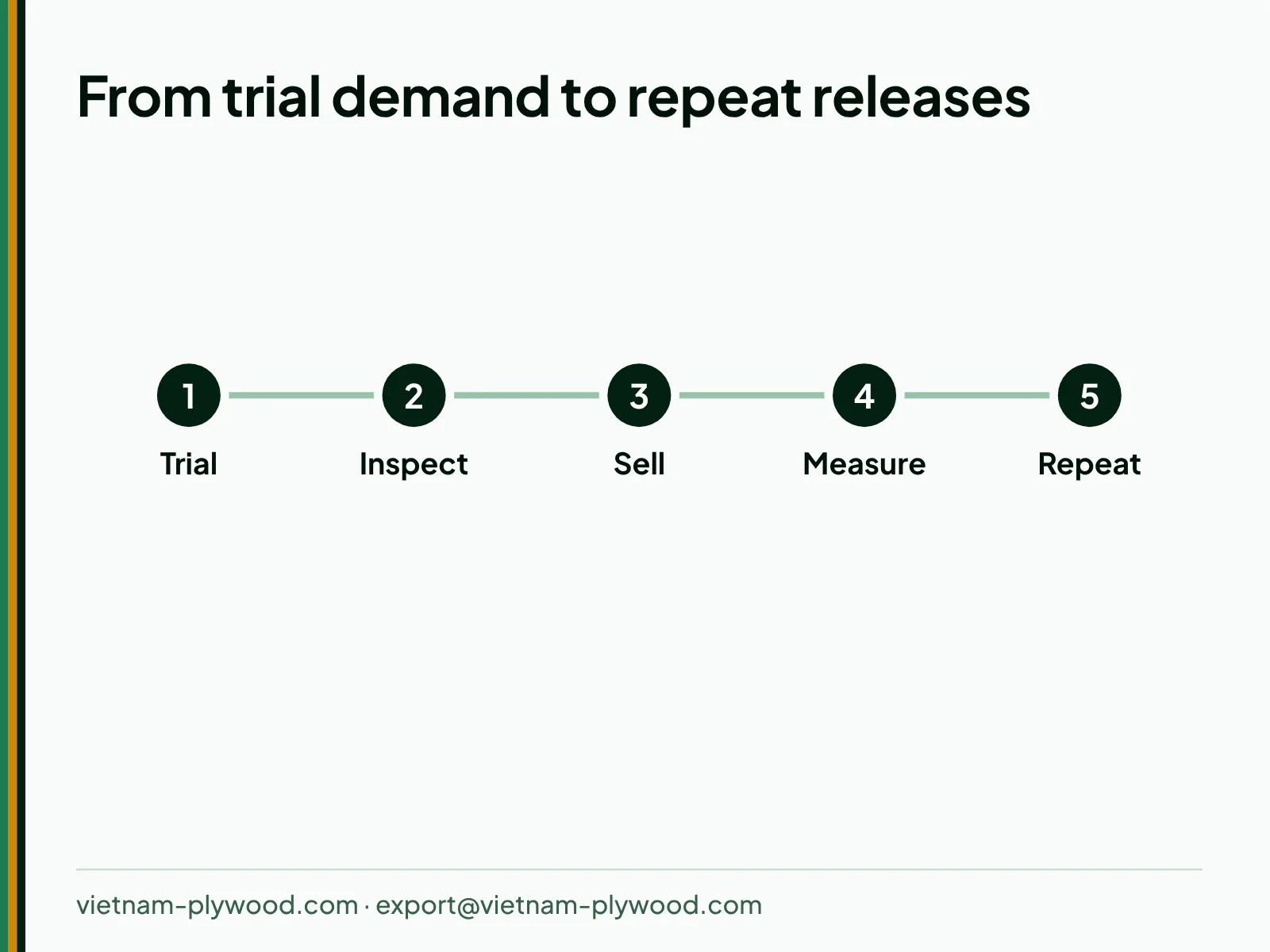
If cabinet makers reorder the sanded styrax build, hold the face grade, emission field and thickness tolerance steady. If packing buyers need a different core layout, amend that commercial line item explicitly. If formwork customers prefer the phenolic build, record their handling conditions and the film specification before repeating it.
Send the next purchase request with the prior specification reference, the proposed quantity and any approved corrections. Our export team can then compare it with the producing factory’s previous inspection record. A repeat order should have its own approved quantities, delivery timing and shipping papers, even when the commercial relationship continues.
The distributor supply-programme guide explains how to organize replenishment by account and product family.
Do repeat orders by line stay under the same contract and document set?
A continuing purchasing arrangement can cover repeated orders by line under one contract, while each shipment still needs its own accurate export paperwork. Keep the agreed product specification attached to each release or purchase order.
An invoice or packing list for a previous container cannot serve as the current shipment’s evidence.
What should be ready before the first deposit?
Before the deposit, the importer should have an accepted sample, a written product specification, a destination clearance plan and an agreed container mix. Confirm the invoice description and inspection method with the producing factory.
Use this final check: product application, core, glue, emission, face grade, dimensions, tolerance, packing, delivery term, destination and agreed supporting documents.
Send Lucy at export@vietnam-plywood.com the specification below. The next step is to request the spec sheet for the proposed trial container.
Application: cabinet / packaging / formwork customer segment
Line or core: furniture styrax or eucalyptus / commercial acacia / construction acacia or eucalyptus
Glue: melamine MR or phenolic WBP, as ordered
Emission: E0 / E1 / E2 or applicable agreed certificate requirement
Face and grade: named veneer and A/B (birch D/E/F), or film type and g/m²
Thickness and tolerance: ___ mm; ___ mm tolerance
Size: ___ × ___ mm
Quantity: ___ sheets per line; proposed mixed 40HC
Destination port: ___