





What does Vietnamese wood mean on a plywood quote?
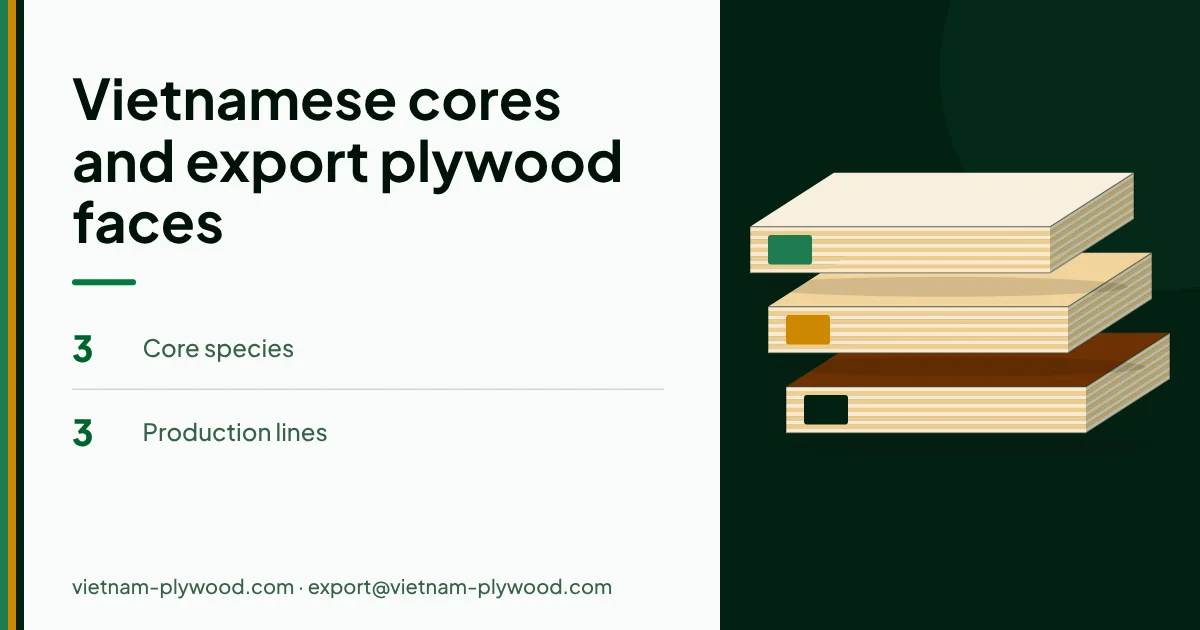
Vietnamese wood on a plywood quotation can describe the origin of the core, the place of panel manufacture, or both. It does not automatically identify the visible veneer. For export plywood, the useful distinction is between plantation-grown core species and the face selected for the finished panel. HCPLY builds with acacia, eucalyptus and styrax cores in Vietnam, while the finished panel can carry a different face name.
A quote reading “birch plywood” might identify birch face veneer over a eucalyptus core. A buyer who assumes the entire panel is birch can specify the wrong density, weight or machining requirement. The resulting mismatch can cost a rejected load, extra handling or days spent rewriting specifications. Record the core and face as separate fields before comparing quotations.
The core types reference groups related constructions. The manufacturer core guide explains how core arrangements change the panel beneath the surface.
What kinds of wood come from Vietnam?
Acacia, eucalyptus and styrax are the three Vietnamese core woods used in our plywood production. Vietnam also grows other timber species, but their presence in national forestry data does not make them HCPLY core options. The Vietnam Safeguards Information System reports that acacia occupied 60.1% and eucalyptus 9.08% of production forest area at the end of 2021 (government plantation data).
These are national area shares, not shares of plywood production or our purchasing. A tree species can enter the market as logs, chips, veneer or sawn timber. Panel selection starts with the actual veneer build and the application rather than a national species ranking.
| Vietnamese core | HCPLY reference density | Where we use it | Buying implication |
|---|---|---|---|
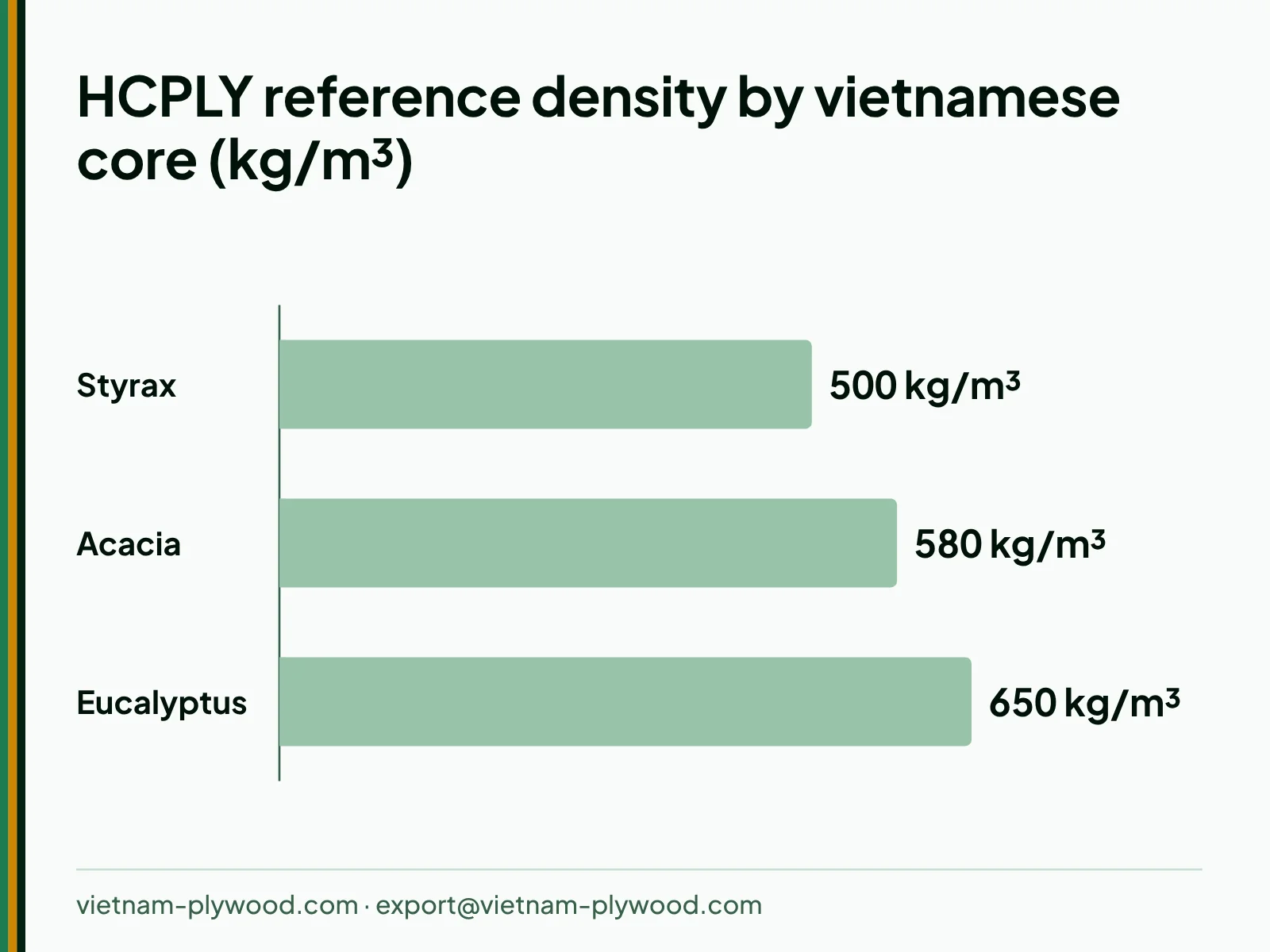
| Styrax | 500 kg/m³ | Our furniture line | Lighter reference load and a sanded, stitched core |
| Acacia | 580 kg/m³ | Our commercial and packing line; our construction line | Packing and general-purpose builds or film-faced formwork |
| Eucalyptus | 650 kg/m³ | Our furniture line; our construction line | Heavier reference load for the same dimensions |
Density follows the core, rather than the decorative face. These figures are the reference densities used to calculate our shipment weights, not species-wide grading rules. An order for a face veneer should therefore state its core separately.
Which factory line uses each timber?
Our furniture line presses styrax- or eucalyptus-core panels with full-stitched construction and sanded faces. Our commercial and packing line presses acacia-core panels with moisture-resistant (MR) glue and unsanded or light-sanded surfaces. Our construction line presses acacia- or eucalyptus-core panels under phenolic, melamine or anti-slip film.
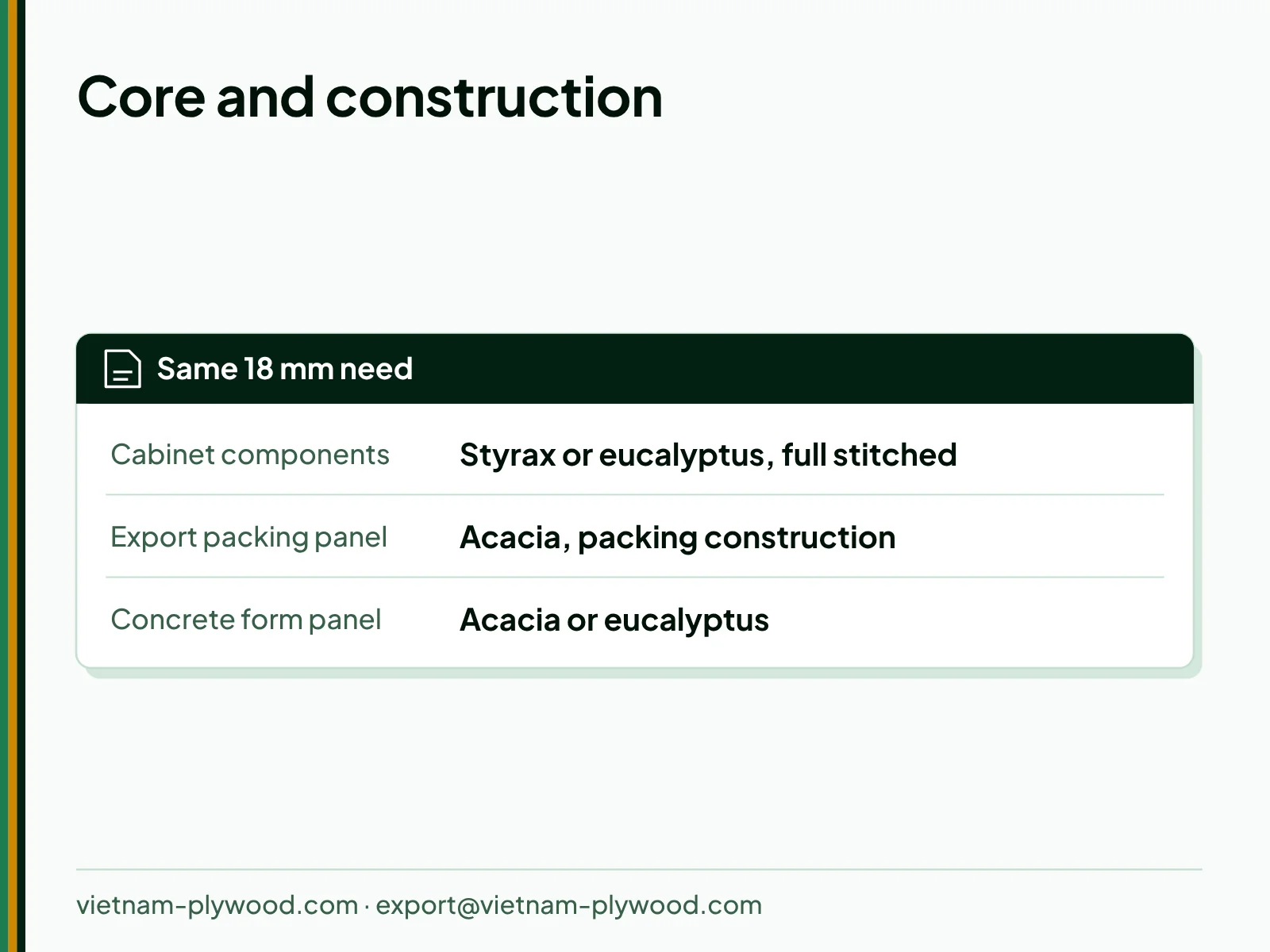
| Same 18 mm need | Core and construction | Surface and finish | Suitable buying use |
|---|---|---|---|
| Cabinet components | Styrax or eucalyptus, full stitched | Sanded veneer face | Visible furniture or cabinet work |
| Export packing panel | Acacia, packing construction | Unsanded or light-sanded | Crates and industrial packing |
| Concrete form panel | Acacia or eucalyptus | Film-faced, unsanded core | Formwork and shuttering |
An 18 mm request alone cannot select the line. A cabinet producer might require a uniform sanded panel with a named decorative face; a packing company may prioritize the specified core construction and edge condition. A formwork yard instead needs film and bond requirements recorded in the purchase order. The furniture plywood range provides the relevant starting point for cabinet buyers.
Which Vietnamese woods are plantation-grown and legal?
Acacia and eucalyptus have documented plantation presence in Vietnam; legal origin must still be established for the specific timber lot. The government forestry system identifies both species in production forest statistics, but a species name alone is not a chain-of-custody record. Styrax core origin also requires the relevant lot documentation rather than an assumption based on its name.
For a procurement file, request the species identification, harvest and purchase records, and the traceability information relevant to the destination market. Compare those records with the core species and quantities on the order. A legal-source claim is a document question as well as a botanical question.
For EU lots, the export documentation includes an EUTR/EUDR file set and the applicable certificate of origin. Factory-held FSC, CARB P2, ISO 9001 and CE documents can be shown with factory details masked, on request. A certificate attached to one producing factory should be evaluated for its own scope; it does not identify every timber lot or face species automatically.
Which wood products does Vietnam export?
Vietnam exports wood and wooden products including furniture, boards and other processed timber goods. The Ministry of Agriculture and Environment reported in 2025 that the country’s 2024 wood and forest-product exports exceeded US$17.2 billion (official ministry report). This is a sector-wide export value, rather than plywood sales alone.
For plywood buyers, product categories have distinct specifications: decorative furniture panels, commercial sheets, packing sheets and film-faced construction panels. Other Vietnamese wood exports include furniture and wood-processing products outside our plywood lines. Avoid treating a country’s overall export total as evidence of the output of an individual factory.
Our three factories in Phu Tho and Hai Phong produce orders at the facility matched to the specification. HCPLY manages specification, on-site quality control, loading and export documentation, with shipments dispatched from the producing factory under the agreed delivery term.
What does a species name actually identify?
A species name on a plywood offer can refer to the face, the core, or an entire construction only when the quotation explicitly defines it. Our products are named by their faces: bintangor, okoume, engineered veneer (EV), gurjan, pine, poplar, eucalyptus, birch or sapele. A matt panel has an unfaced raw core.
Common face veneers are 0.2–0.4 mm thick. The surface can establish colour and appearance without determining the density of the panel. A birch-faced panel with eucalyptus core therefore uses the eucalyptus core reference density for load planning.
Ask the quotation to identify both face and core, face grade, sanding and core construction. Face grades A/B are used for the relevant veneers; birch face grades are D/E/F. Compare a full poplar versus mixed core discussion as a market terminology example, while keeping our offered core list limited to acacia, eucalyptus and styrax.
How does core construction change the decision?
Core construction changes internal gaps, edge appearance and the predictability of machining. Our construction hierarchy runs from full stitched, to stitched outer layers with edge-trimmed inner layers, to finger-jointed, then loose-laid cores. A higher construction category addresses different buying needs than a lower-cost packing build.
Cabinet manufacturers often need predictable cut edges, consistent panel surfaces and repeatable machining. Packing buyers can accept a different internal arrangement when the agreed use allows it. The finger-joint core risks page explains the defects an inspector should look for.
At the producing factory, a buyer can witness a cut-edge inspection and compare the exposed core with the approved sample. Check for gaps, overlaps, joint alignment and whether the actual core matches the written construction. A face veneer alone cannot reveal these internal differences.
How should glue, emissions and thickness be specified?
Glue type and emission class belong in separate quotation fields. Our melamine MR adhesive is described by a 12-hour boil condition, while phenolic weather-and-boil-proof (WBP) adhesive is described by a 72-hour boil condition. Emission classes are E0, E1 and E2; CARB P2 and TSCA Title VI refer to US emission limits and third-party certification.
Available thicknesses run from 3 to 40 mm, including common 3, 5, 9, 12, 15, 18, 21 and 25 mm. Furniture sanded thickness tolerance is ±0.2 or ±0.3 mm as ordered; commercial and film-faced tolerance is ±0.5 mm, and packing tolerance is ±0.5–1.0 mm. Length and width tolerance is ±2 mm.
An 18 mm panel typically contains 11–13 plies because core veneer thickness is 1.4–2.0 mm. For cabinet cutting, specify the sanded tolerance in the order; for packing or formwork, write the relevant tolerance for that line. The MR MDF versus plywood comparison addresses an alternative material, but MDF is not pressed on our lines.
What changes in a container when the core changes?
At 18 mm and 1220 × 2440 mm, our reference full 40HC loads are 990 styrax-core sheets, 880 acacia-core sheets or 795 eucalyptus-core sheets. Their calculated loads weigh 26.52 t, 27.35 t and 27.69 t respectively, excluding film weight. The payload limit is 28.5 t.
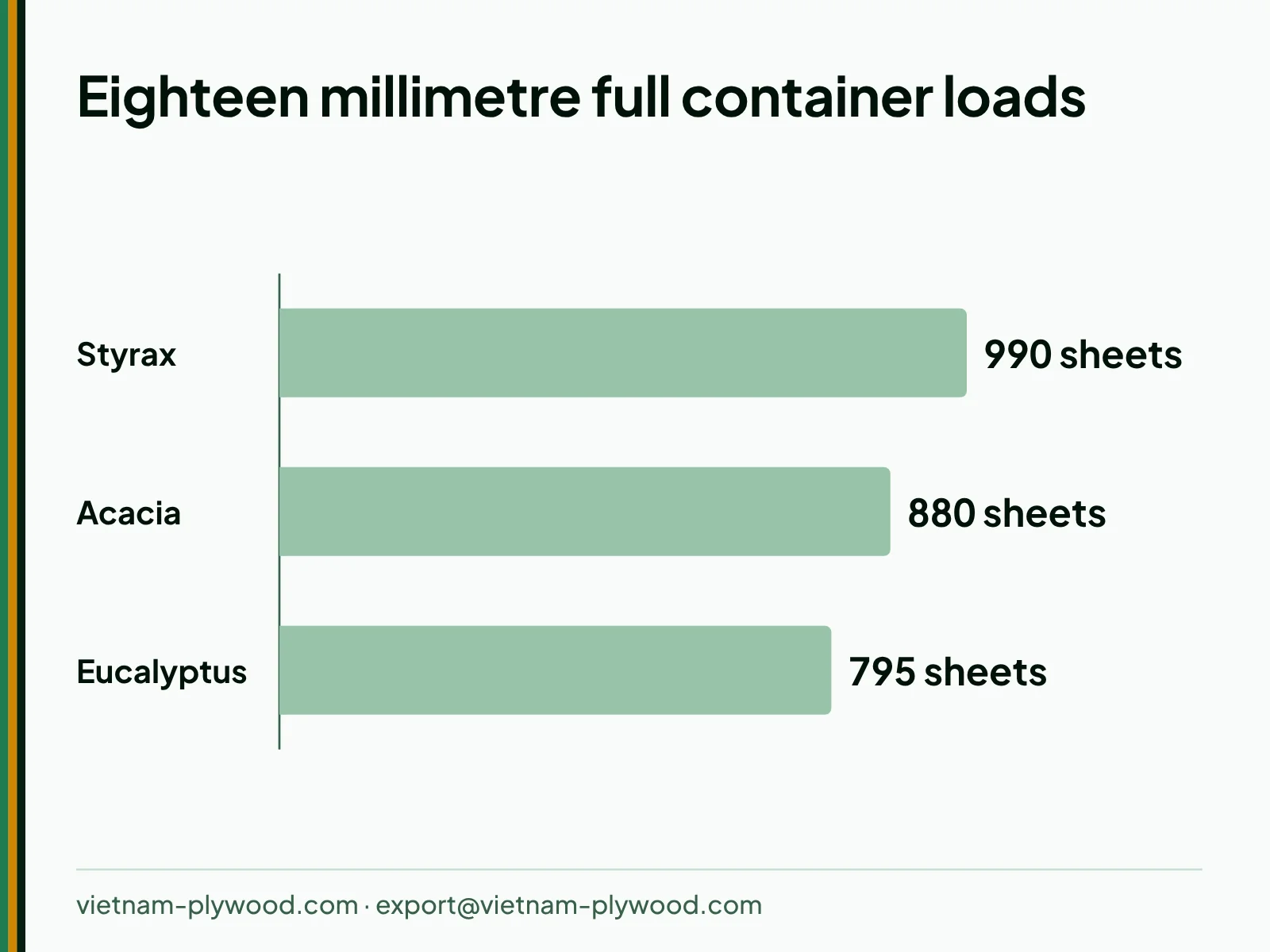
| Core | Weight per sheet | Full 40HC sheets | Reference total |
|---|---|---|---|
| Styrax | 26.79 kg | 990 | 26.52 t |
| Acacia | 31.08 kg | 880 | 27.35 t |
| Eucalyptus | 34.83 kg | 795 | 27.69 t |
Different specifications can share a 40HC within the payload limit. For example, a planned mix of 400 acacia sheets and 300 eucalyptus sheets at these dimensions has a panel-weight calculation of 400 × 31.08 + 300 × 34.83 = 22,881 kg, before pallet and other loading allowances. This is a planning example, rather than a full-load sheet count.
Use the container loading reference for complete load configurations and the mixed-container order guide for combining specifications. A decorative face name alone cannot establish the load weight.
What should the buyer inspect before shipment?
The producing factory should show the ordered core species, face, construction and dimensions in the finished goods. A buyer visiting the factory office can inspect goods at the facility making the order. The most revealing checks combine a cut-edge sample with measured thickness and a review of the lot identification.
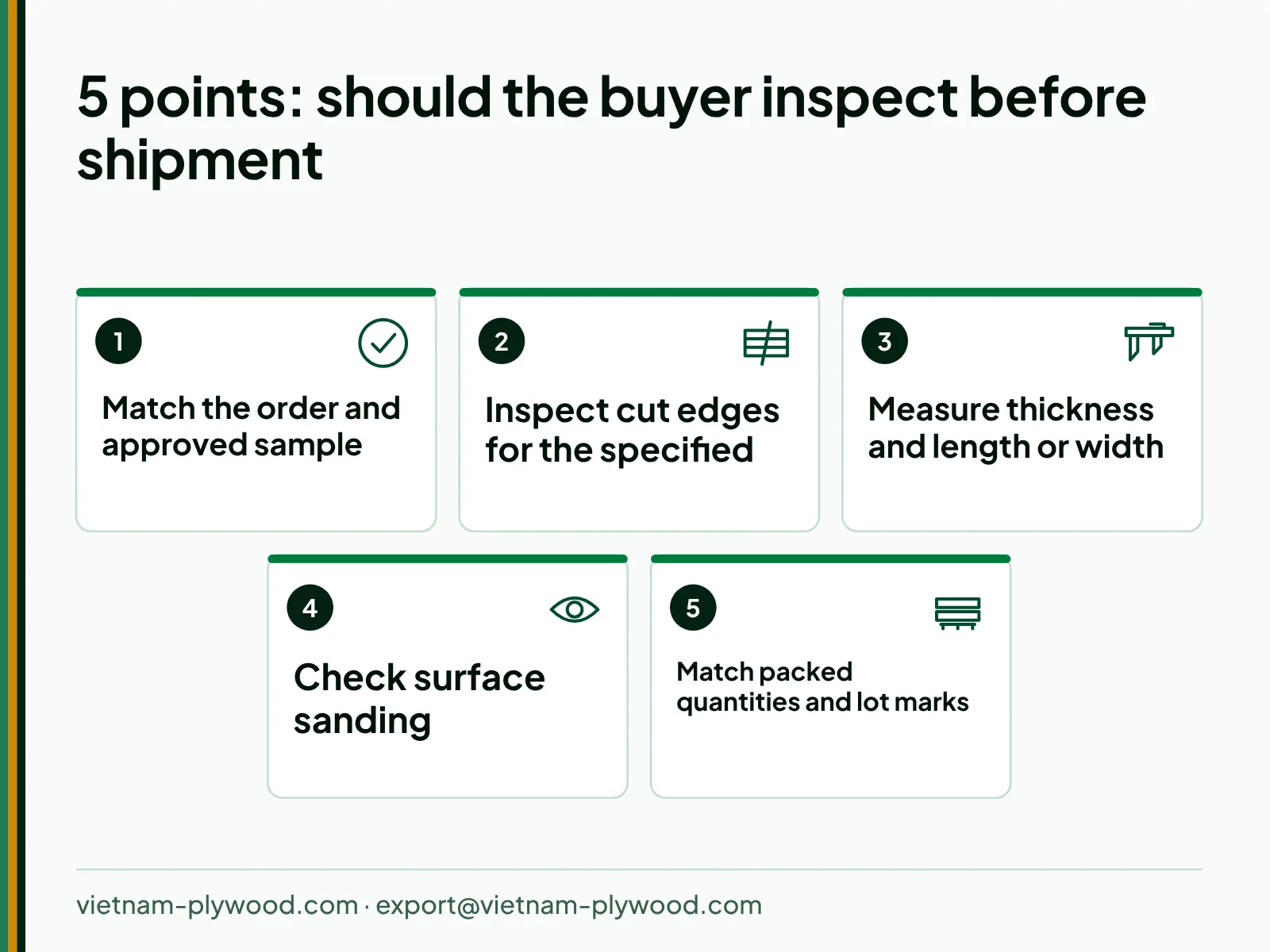
- Match the order and approved sample to the core species and named face.
- Inspect cut edges for the specified stitched, jointed or loose-laid construction.
- Measure thickness and length or width against the agreed tolerance.
- Check surface sanding, face grade and visible veneer defects against the sample.
- Match packed quantities and lot marks to the packing list before loading.
These checks identify observable conformity. Where an order requires a particular test report, review that report against the agreed build rather than inferring performance from a species label. Our on-site quality-control team coordinates the inspection with the producing factory.
Which documents connect the wood to the shipment?
The packing list connects the shipped panel quantities and descriptions to the physical load. The commercial invoice and bill of lading (B/L) identify the transaction and transport, while the certificate of origin addresses the shipment’s declared origin. EU lots use EUR.1 where applicable and the EUTR/EUDR file set.
Shipment papers also include phytosanitary and fumigation documents, insurance under cost, insurance and freight (CIF), and the order’s agreed certificate documents or test reports. Draft shipping documents are sent to the buyer for approval after loading. The species and core description in the contract should remain consistent across the relevant paperwork.
A certificate of origin is distinct from evidence of legal harvest for an individual timber lot. Request the lot-level sourcing file where your import compliance process requires it. This separation makes the document review more precise than treating a country-of-origin statement as a complete species record.
How do you request a comparable quotation?
A comparable quotation identifies the same core, face, construction, glue, emissions and dimensions across every offer. For commercial plywood, the indicative starting price is from US$250/m³ FOB Hai Phong (October 2026); for furniture plywood it is from US$350/m³ FOB Hai Phong (October 2026). Film-faced and other specific builds are quoted against the written specification.
Face veneer, core construction, glue and finishing drive the quotation. A full-stitched sanded furniture build costs more than a simpler unsanded packing build because it adds core preparation and surface processing. Film specification and bonding requirements change construction-panel costs; there is no single interchangeable price for every face and core combination.
The minimum order is one 40HC. Factory lead time runs 15–45 days from receipt of the 30% deposit; the exact figure depends on order size, line loading and what the contract fixes. The remaining 70% is paid on the scan of the bill of lading, by T/T, or by irrevocable sight L/C. We ship FOB Hai Phong, or CFR (CNF) or CIF to your port; the production lead-time guide explains the ordering sequence.
What specification should go to the factory?
A written specification should separate Vietnamese core wood from the decorative face and the intended application. This gives the producing line a clear basis for building and inspecting the panel. State the destination port so the shipment and documents can be prepared against the same order.
Application: [cabinet / fit-out / packing / formwork]
Line or core: [furniture / commercial and packing / construction]; [styrax / acacia / eucalyptus]
Glue: [melamine MR / phenolic WBP]
Emission: [E0 / E1 / E2 / applicable US requirement]
Face and grade: [species or film]; [specified grade]
Thickness and tolerance: [mm]; [allowed deviation]
Size: [length × width in mm]
Quantity: [sheets / m³ / 40HC mix]
Destination port: [port, country]
Ask Lucy at export@vietnam-plywood.com for a sample set against this specification. Samples cost nothing: a first-time buyer pays the courier, and that charge comes off the first confirmed order. The contact page is the next step.