





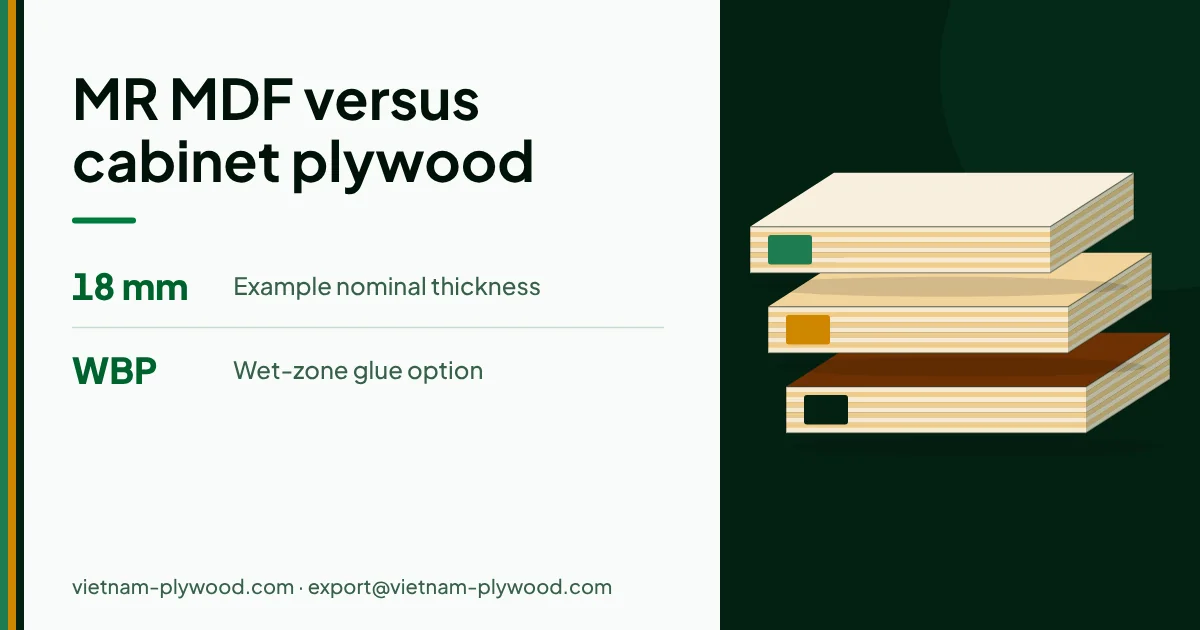
Moisture resistant MDF works for protected indoor cabinetry, but WBP-glued plywood is the safer specification starting point for sink bases, leak-prone vanities and exposed parts. Choosing the wrong substrate can mean swollen edges, replacement labour and a rejected cabinet batch. HCPLY manufactures plywood rather than MDF, so the comparison starts with the exposure of each component and the plywood build that our furniture line can press.
Where does moisture resistant MDF stop being suitable?
Moisture resistant MDF is suitable for controlled indoor humidity when edges, joints and drilled holes remain protected; it is a poor default for repeated wetting, trapped water or exterior exposure. The green core often used to identify this board is a product identifier rather than a waterproof barrier. For sink bases and vanities, specify the actual water exposure before choosing the substrate. For rain-exposed parts, start with a suitable plywood build and a separate finish and detailing plan.
Medium-density fiberboard (MDF) is manufactured from wood fibres bonded into a smooth panel. Moisture-resistant (MR) variants are designed to resist humidity better than ordinary MDF, but they still need controlled installation conditions. HCPLY does not press MDF. Our furniture line presses veneer-core plywood with defined glue, face and thickness requirements.
A buyer should separate occasional airborne humidity from splashes, plumbing leaks, cleaning water and standing water. A sealed vanity door faces a different risk from a cabinet bottom below pipe joints. For wider material choices, see the core types category.
Which panel belongs in each cabinet position?
Choose the panel by exposure at the weakest edge and joint, then by finish and machining requirements. The comparison below uses an 18 mm nominal thickness to make purchasing discussions concrete; it does not assign a universal performance rating to every MDF or plywood formulation.
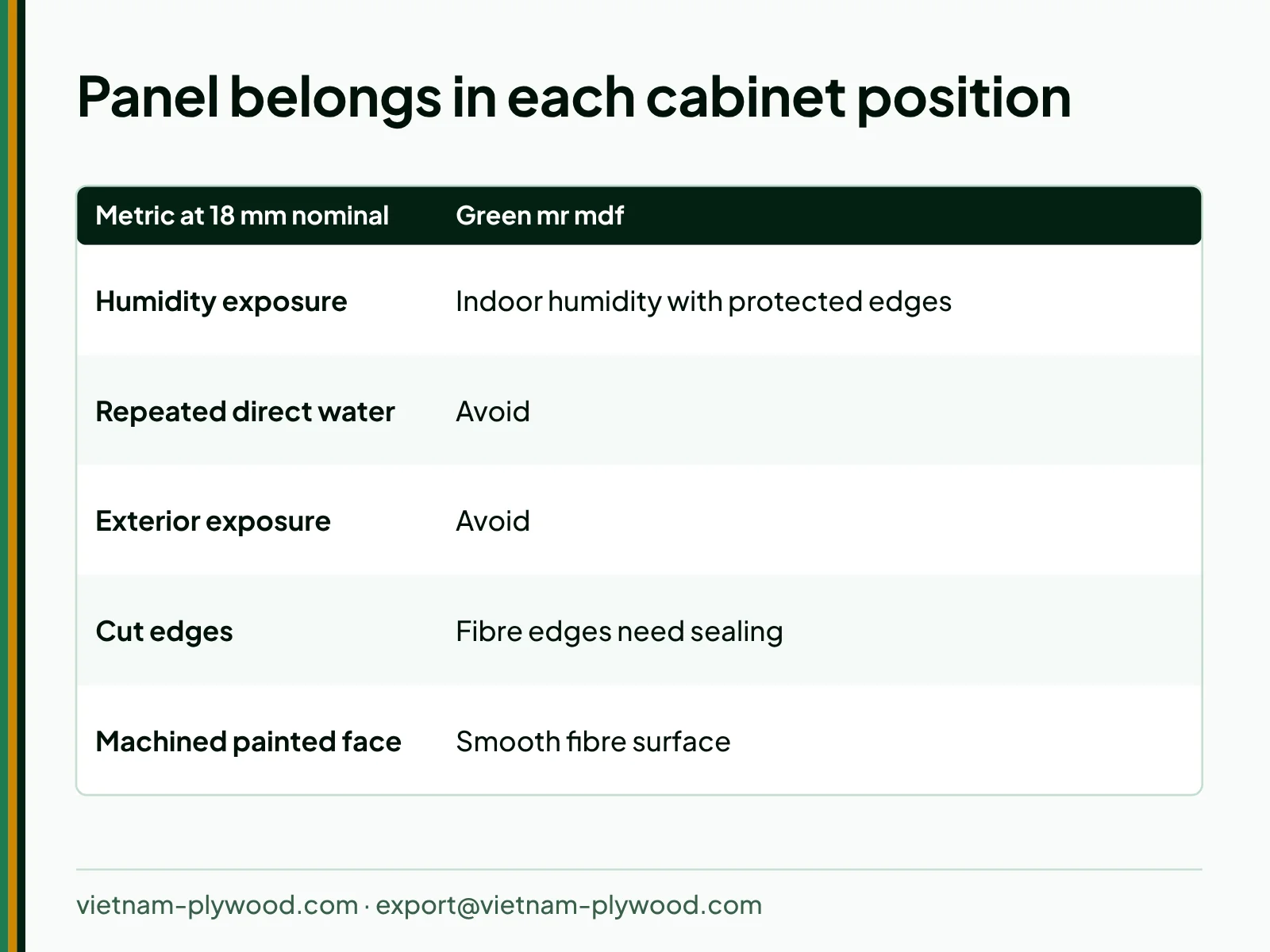
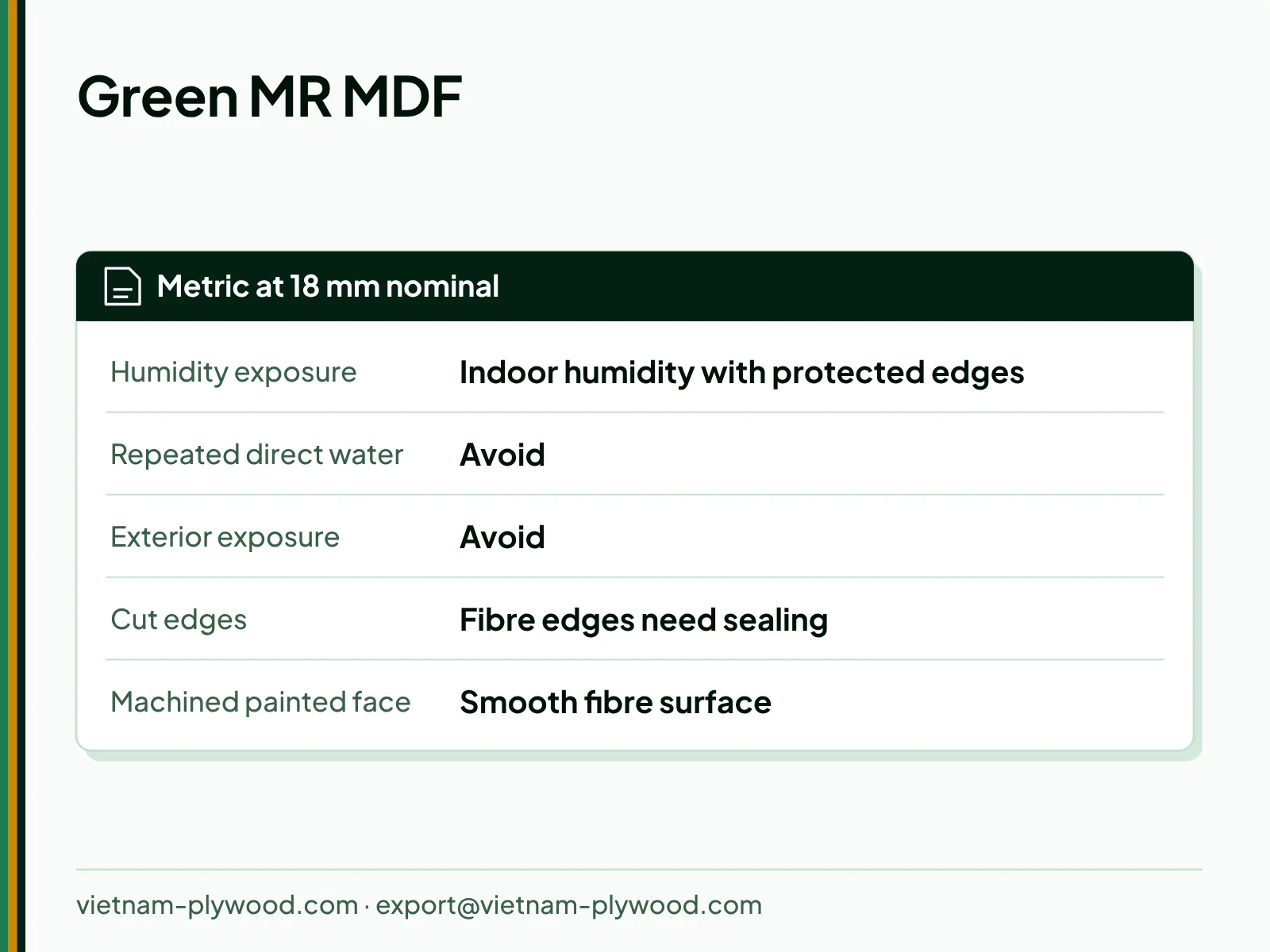
| Metric at 18 mm nominal | Green MR MDF | MR-glued furniture plywood | WBP-glued furniture plywood | Buyer verdict |
|---|---|---|---|---|
| Humidity exposure | Indoor humidity with protected edges | Interior humidity and occasional splash, with sealed edges | More demanding wetting exposure with sealed edges | MR MDF for dry-side doors; plywood for vulnerable carcasses |
| Repeated direct water | Avoid | Avoid prolonged wetting | Better glue specification, but protect the assembly | WBP plywood for sink-base bottoms exposed to leaks |
| Exterior exposure | Avoid | Avoid | Consider only with appropriate face, coating and joint design | Specify WBP plywood and exterior detailing |
| Cut edges | Fibre edges need sealing | Veneer edges need sealing | Veneer edges need sealing | No panel eliminates edge treatment |
| Machined painted face | Smooth fibre surface | Sanded veneer face needs preparation | Sanded veneer face needs preparation | MR MDF for intricate painted indoor fronts |
| Fastener position | Check design and edge fastening | Check ply quality and edge distance | Check ply quality and edge distance | Trial the actual hinge and screw pattern |
| Emission requirement | Separate product certificate | E0/E1 as ordered | E0/E1 as ordered | Request evidence for the specified batch |
The plywood choice must also specify the core and finish. The comparison across factory lines explains why nominal thickness alone cannot define an interchangeable product.
Why do edges and holes matter more than a green face?
Cut edges, screw holes and pipe penetrations are the entry points to control first. A factory-applied face finish cannot protect a hole drilled during cabinet installation unless that opening receives its own treatment.
For painted MDF, fabricators commonly use a compatible primer and topcoat system across all faces and edges, allowing the coating manufacturer’s specified cure time. A finishing schedule should include the back, underside, hardware holes and later machining. A sealant bead at the sink junction is an additional joint detail rather than a substitute for panel protection.
For plywood, seal every cut edge and penetration, including those concealed behind plinths. Check the finish against cleaning chemicals and expected service moisture. Specify ventilation and a leak-management detail where a cabinet encloses supply or waste connections. Neither a green colour nor a WBP glue designation makes an assembled cabinet waterproof.
What does our furniture line actually press?
Our furniture line presses full-stitched, sanded plywood using styrax or eucalyptus cores, with E0 or E1 emission classes specified separately from glue. For moisture-exposed furniture parts, buyers can request a melamine MR glue build or a phenolic weather-and-boil-proof (WBP) glue build against the agreed specification.
MR glue is described by a 12-hour boil condition and WBP glue by a 72-hour boil condition in our product specifications. These describe adhesive build categories; they do not certify an installed vanity against water ingress. The MR hot-press range is 110–120 °C, compared with 130–145 °C for WBP.
The furniture line can produce a sanded face for subsequent finishing. Common face veneers include bintangor, okoume and engineered veneer, with A/B face grades where applicable. Face veneer is commonly 0.2–0.4 mm. The veneer species names the product; density follows the core. See Vietnam timber species for plywood for the distinction.
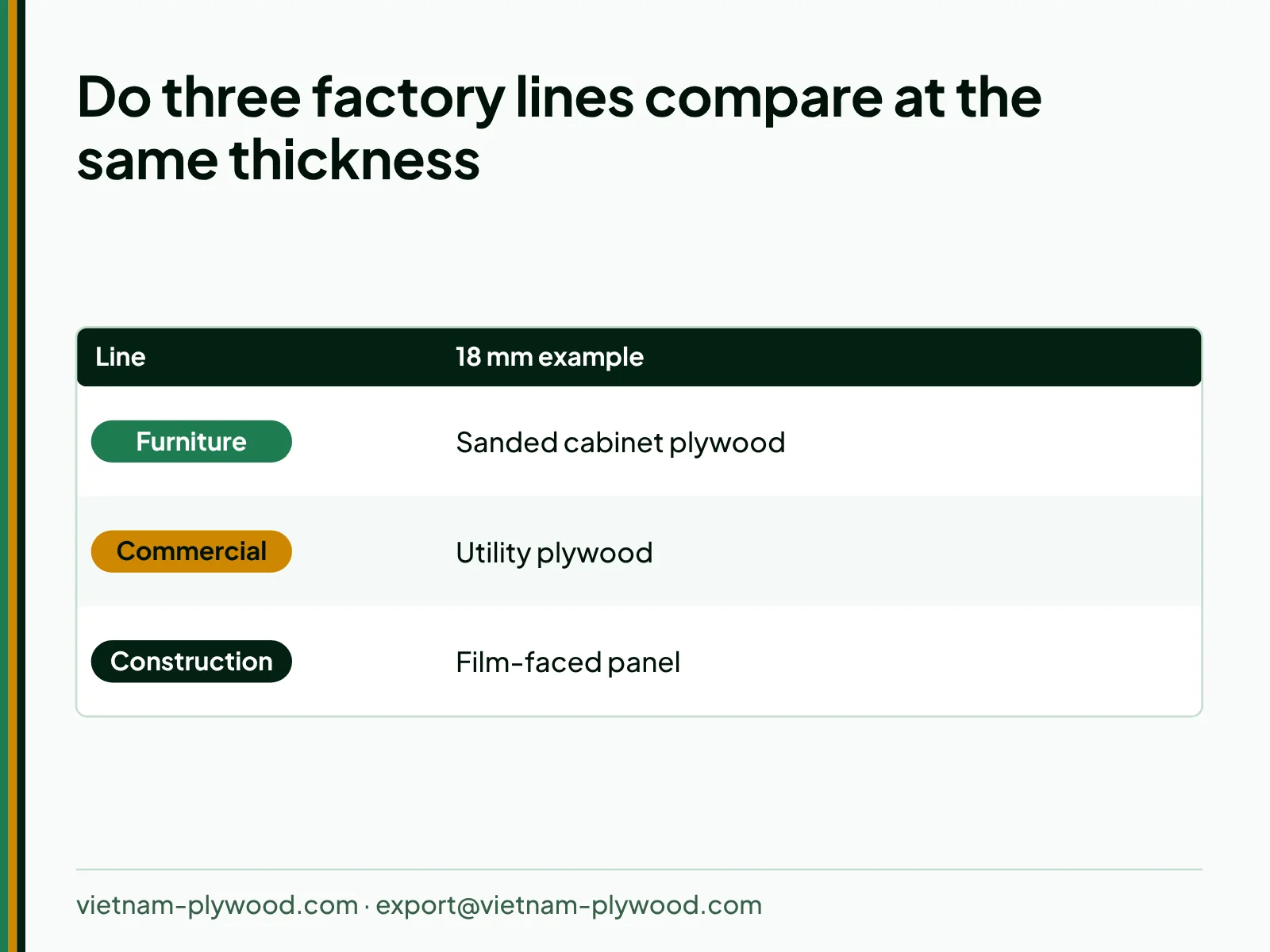
How do three factory lines compare at the same thickness?
At 18 mm, the intended use changes the build even when the nominal thickness is identical. HCPLY assigns the order to the producing factory according to its specification, with export coordination from specification through loading.
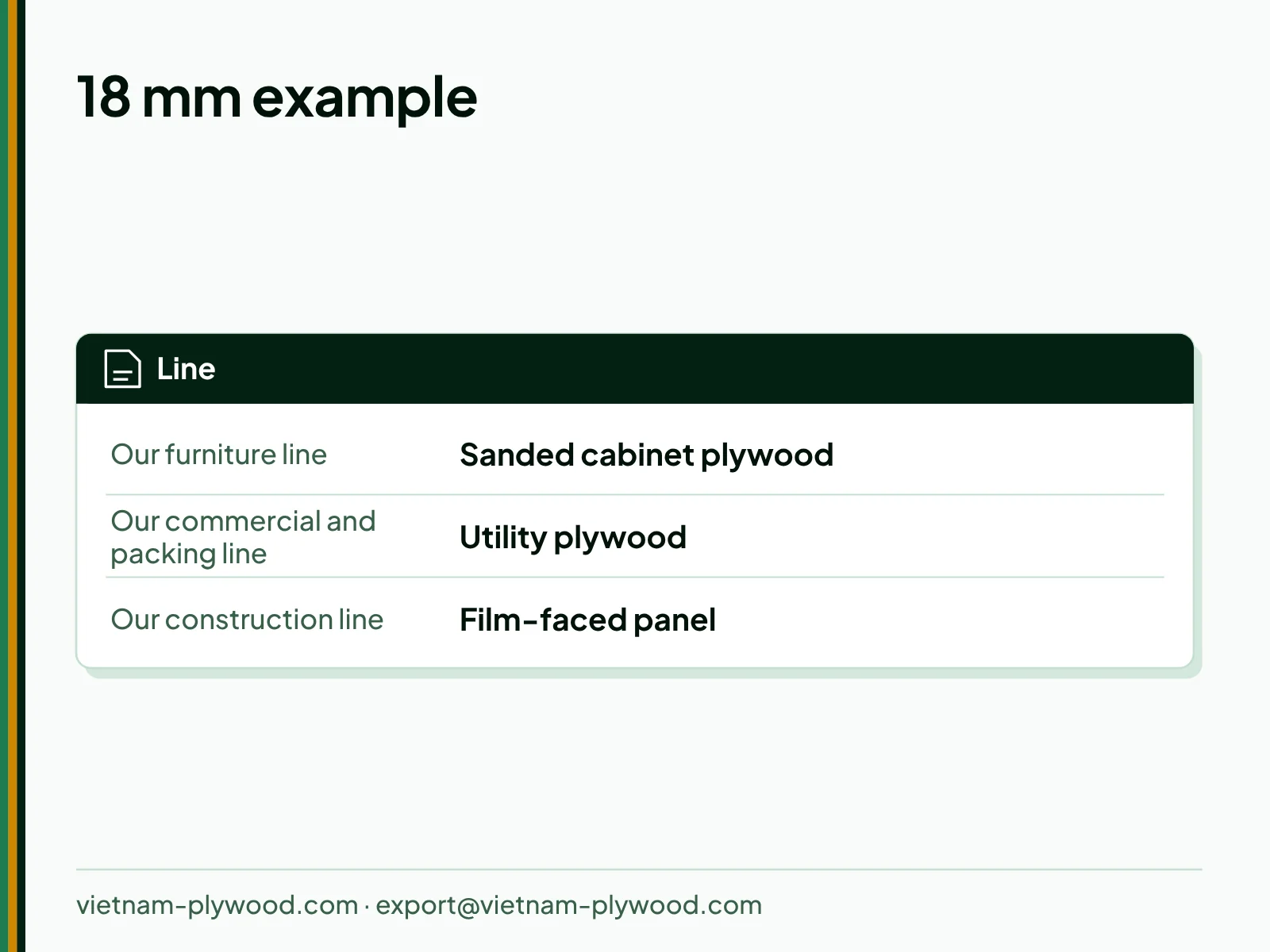
| Line | 18 mm example | Core and surface | Thickness tolerance | Appropriate order |
|---|---|---|---|---|
| Our furniture line | Sanded cabinet plywood | Full-stitched styrax or eucalyptus; veneer face | ±0.2 or ±0.3 mm as ordered | Vanity sides and cabinet components |
| Our commercial and packing line | Utility plywood | Acacia, MR glue; unsanded or light-sanded | ±0.5 mm commercial; ±0.5–1.0 mm packing | Packing and utility components |
| Our construction line | Film-faced panel | Acacia or eucalyptus, phenolic or melamine film; unsanded | ±0.5 mm | Formwork, rather than decorative cabinet interiors |
The construction line offers 120 g/m² standard film, 135 g/m² premium film and 220 g/m² anti-slip film. These films serve a different surface requirement from decorative furniture veneer. For a detailed core comparison, read the plywood core types guide.
Which plywood should replace MDF under a sink?
For a sink-base bottom or pipe enclosure, request WBP-glued, full-stitched furniture plywood with sealed edges and a finish matched to the installation. The higher-resistance glue build is especially relevant where a small leak can remain unnoticed.
Specify the cabinet’s real exposure: occasional condensation, splash during cleaning, or possible standing water from a failed connection. A removable tray, accessible plumbing and a documented sealing procedure can reduce damage beyond the choice of substrate.
For a vanity door away from direct water, MR MDF can remain a practical choice when the coating system covers all surfaces and machining. For a vanity carcass near plumbing or a floor junction, plywood is a stronger specification starting point. Do not substitute a plywood face grade for a glue requirement; both belong in the purchase order.
What changes for exterior parts?
Exterior parts require a WBP-glued plywood specification plus exterior-rated surface protection, protected edges and drainage-aware detailing. An indoor MR MDF board should not be moved into an exterior assembly merely because its core is coloured green.
Rain, sun, thermal movement and repeated wetting affect the finished component as a system. Ask the project designer for the service exposure and accepted performance test before specifying a structural or marine designation. We describe marine or BS 1088 performance only against a test report the buyer accepts.
A film-faced construction panel is designed for formwork use and is not an automatic replacement for exterior furniture cladding. Contractors evaluating temporary site applications can consult plywood supply for construction projects.
Can wet-zone plywood travel with ordinary furniture panels?
Specifications can be mixed within one 40HC container while remaining within its 28.5 t payload limit. This allows WBP-glued sink-base parts to ship with the rest of a furniture plywood order, with the load checked by core density and pallet plan.
At 18 mm and 1220 × 2440 mm, a styrax-core sheet weighs 26.79 kg; a full styrax load is 990 sheets, 53.05 m³ and 26.52 t. The corresponding eucalyptus-core sheet weighs 34.83 kg; its full load is 795 sheets, 42.60 m³ and 27.69 t. These core-based figures exclude film weight.
A mixed specification therefore needs a pallet-by-pallet mass check rather than adding two full-load sheet counts. For the calculation method and other sizes, use the container loading guide.
What can an inspector witness before loading?
An inspector can check panel construction, thickness, face condition and packing against the approved order at the producing factory. Buyers visit the factory office and inspect goods where their panels are made.
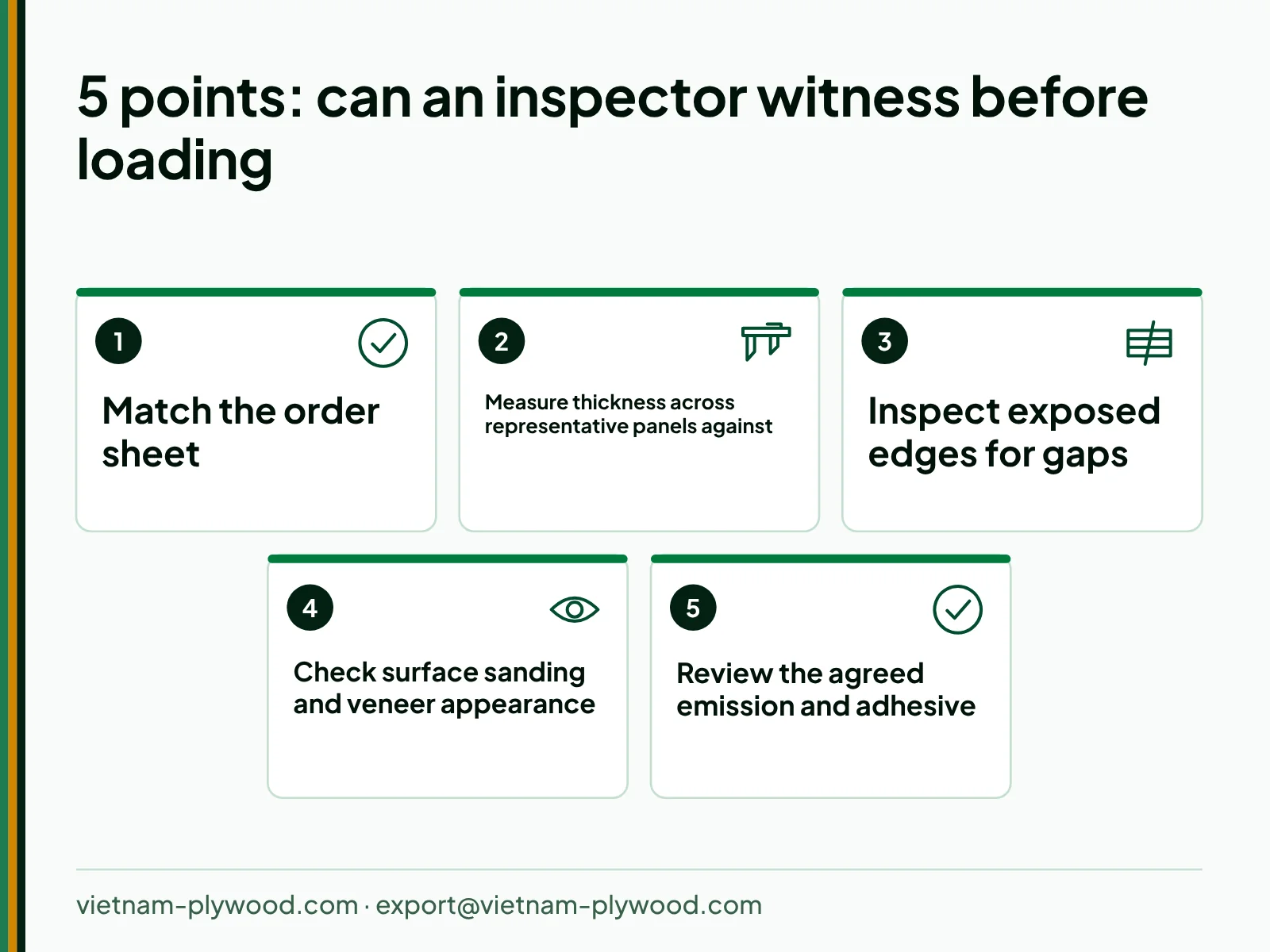
- Match the order sheet to the production lot: core, glue category, face grade, thickness and dimensions.
- Measure thickness across representative panels against the ordered furniture tolerance of ±0.2 or ±0.3 mm.
- Inspect exposed edges for gaps, overlaps and the requested full-stitched core construction.
- Check surface sanding and veneer appearance before the buyer’s finishing operation.
- Review the agreed emission and adhesive test documentation and match packing marks to the loading list.
The nominal thickness range is 3–40 mm, with common orders at 3, 5, 9, 12, 15, 18, 21 and 25 mm. Length and width tolerance is ±2 mm. A 1220 × 2440 mm sheet is one standard size; custom cutting is available. The manufacturer overview describes our production scope.
Which emission and export documents belong with the order?
Glue durability and formaldehyde emission class are separate purchasing fields. An E0 or E1 furniture panel description does not, by itself, establish compliance with a US certification rule.
The US Environmental Protection Agency’s 2025 Code of Federal Regulations, 40 CFR Part 770, sets formaldehyde controls for hardwood plywood and MDF, including testing and third-party certification requirements. See the official 2025 regulation and the EPA rule summary. For US-bound regulated panels, specify the applicable Toxic Substances Control Act (TSCA) Title VI evidence separately.
The shipment document set includes commercial invoice, packing list, bill of lading, certificate of origin, phytosanitary and fumigation papers, plus the order’s agreed certificate and test documents. EU lots include EUR.1 and the EUTR/EUDR file set; CIF shipments include insurance. After loading, the draft shipping documents come to you for approval. Member-factory FSC, CARB P2, ISO 9001 and CE certificates, and EUDR/EUTR documents, are shown with factory details masked, on request.
How should buyers compare cost and order terms?
A WBP-glued, full-stitched furniture build should be budgeted above a basic MR-glued commercial build because the glue specification, core assembly and sanding requirements differ. Within furniture plywood, face selection, thickness tolerance and emission documentation also change the quotation.
Furniture plywood starts from US$350/m³ FOB Hai Phong (October 2026). Commercial plywood starts from US$250/m³ FOB Hai Phong (October 2026). These starting points do not quote a particular WBP wet-zone cabinet specification; request a written quotation for that build. No MDF price is offered because we do not manufacture MDF.
Minimum order is one 40HC. Factory lead time runs 15–45 days from receipt of the 30% deposit; the exact figure depends on order size, line loading and what the contract fixes. The remaining 70% is paid on the scan of the bill of lading, by T/T, or by irrevocable sight L/C. We ship FOB Hai Phong, or CFR (CNF) or CIF to your port. Samples cost nothing: a first-time buyer pays the courier, and that charge comes off the first confirmed order.
What specification should the cabinet maker send?
Send a component-based specification that separates dry-side decorative panels from leak-exposed parts. State the actual moisture exposure and finishing sequence alongside the board dimensions, rather than ordering by the words “green board” alone.
For sink bases, identify whether the exposed edge will be cut after factory delivery. For painted fronts, describe the surface preparation and the coating approval process. If different panels share a shipment, identify each build and its quantity as a separate line item.
HCPLY can review the specification with Lucy at export@vietnam-plywood.com and arrange inspection at the relevant producing factory. The contact page is the route for drawings and the purchase schedule.
Application: sink-base bottom and vanity carcass; expected splash/leak exposure
Line or core: furniture line; full-stitched styrax or eucalyptus core
Glue: phenolic WBP for exposed parts; MR for designated dry-side parts
Emission: E0 or E1 as ordered; destination-specific evidence requested
Face and grade: specify veneer species and A/B grade
Thickness and tolerance: 18 mm; ±0.2 or ±0.3 mm as ordered
Size: 1220 × 2440 mm or approved cut sizes
Quantity: sheets by build; combined 40HC payload plan
Destination port: [buyer to complete]
Next step: book a factory visit to review the intended cabinet parts and inspection points.