





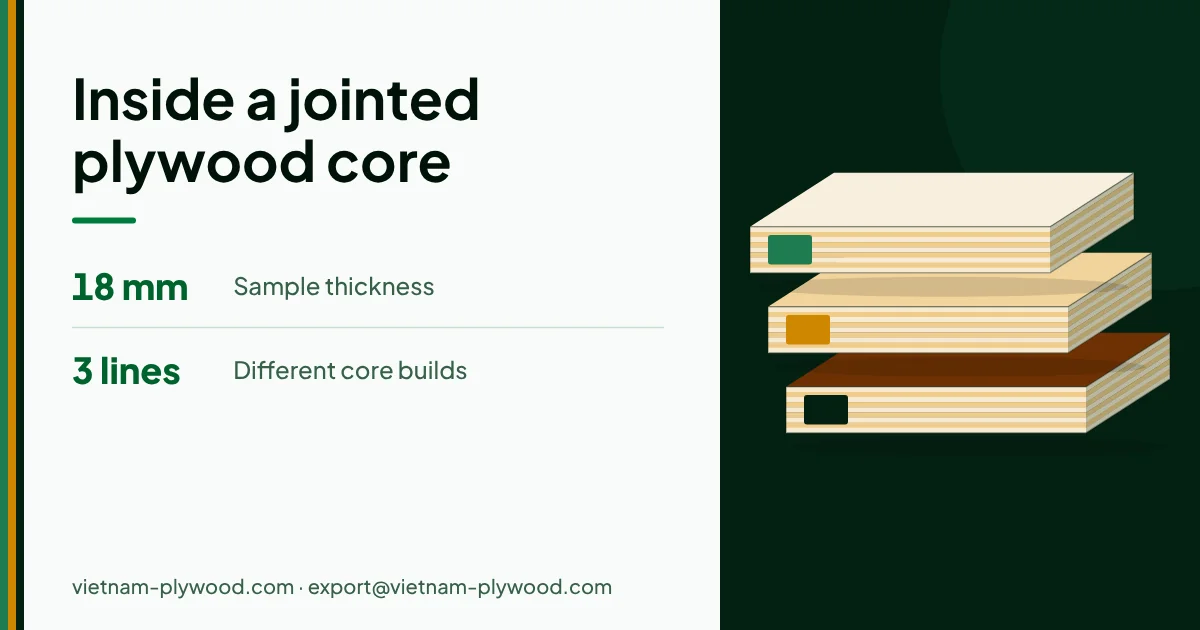
Finger joint plywood belongs only in an order whose core construction and inspection rules expressly allow joined material. A hidden joint in furniture or repeated-use formwork can cost replacement sheets, lost production days and a rejected load. HCPLY separates the core requirement from the visible face, then checks the agreed build at the producing factory.
What is finger joint plywood?
Finger joint plywood is a panel whose inner material includes shorter wood pieces joined end to end, often with interlocking fingers, before being covered by veneer faces. In some traded panels, the pieces come from recovered plywood offcuts or used boards. The face can look continuous while the middle contains multiple joints. The construction must be named explicitly because an attractive surface does not identify the core.
A finger-jointed solid board is a different product: it joins solid-wood strips, whereas plywood uses cross-oriented veneer layers. Finger joint board vs plywood is therefore a comparison of constructions, rather than two grades of the same panel. A finger-jointed core plywood combines elements of both: jointed material inside a plywood layup. See the core types overview.
The 2026 APA – The Engineered Wood Association plywood overview describes conventional plywood as thin, cross-laminated veneer bonded with heat and pressure. That construction is the reference point for assessing a substitute jointed middle, rather than evidence that a jointed product has a particular strength rating.
Why do jointed and recycled cores create risk?
The main risk is discontinuity inside the sheet: joints, old bond lines and mixed pieces introduce more interfaces than a specified continuous veneer layup. Under bending, repeated wetting or concentrated fasteners, those interfaces can become the first location to open or deform. The exact construction requires testing.
Recycled core plywood is also an ambiguous purchase description. It can refer to recovered plywood blocks, short veneer pieces or another reclaimed feedstock. Buyers should demand a cross-section drawing and a prohibition or allowance written against the core, rather than treating the word recycled as a measurable grade. Recovered blocks may retain older glue lines.
For comparable decisions, see plywood core types from a Vietnam manufacturer and the full poplar versus mixed-core discussion. These comparisons concern core composition; they do not replace cut-sample inspection.
Which of our production lines fits the order?
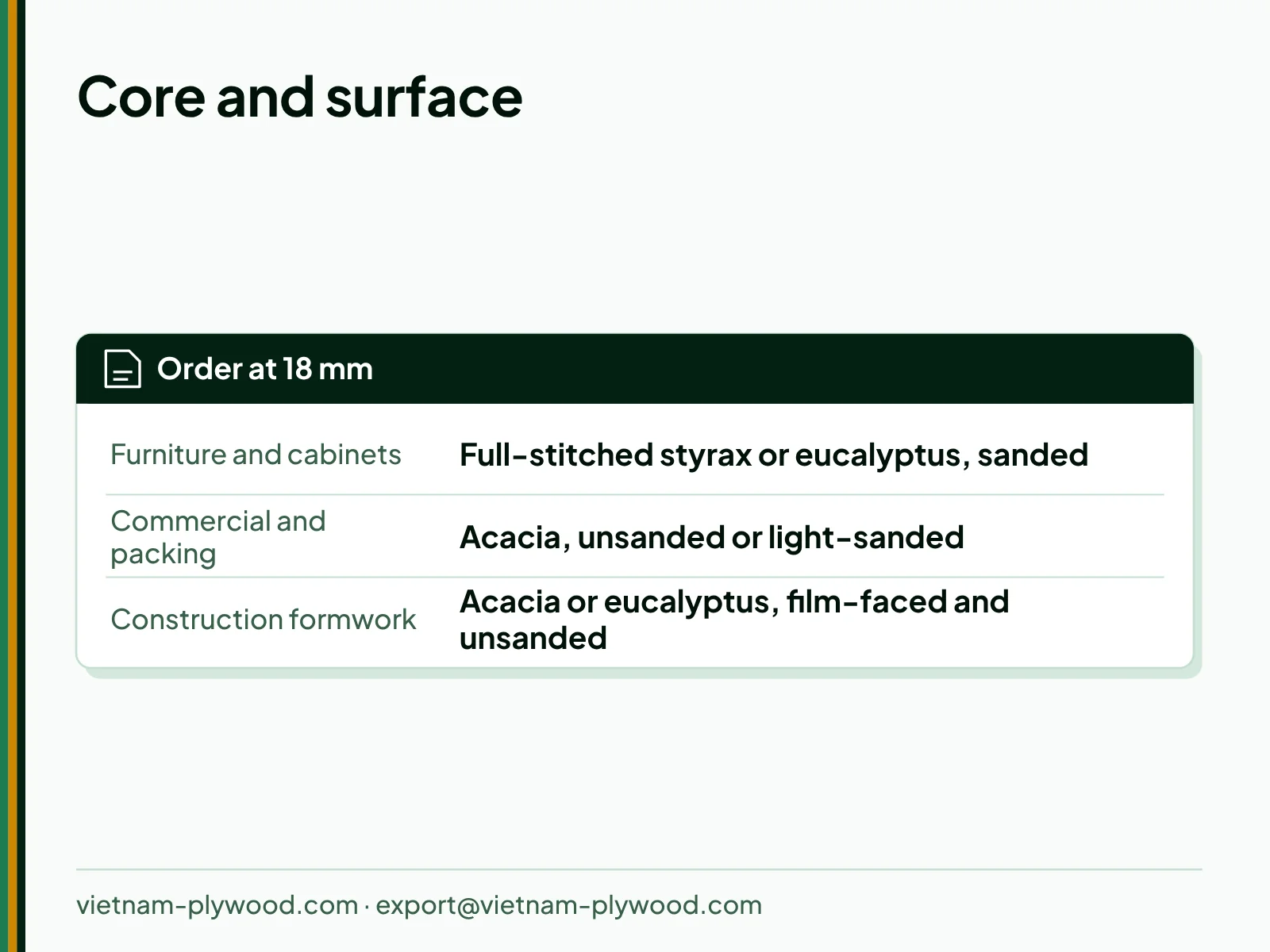
HCPLY directs the specification to the producing factory. Our furniture line uses full-stitched, sanded styrax or eucalyptus cores; our commercial and packing line uses acacia with moisture-resistant glue; our construction line presses film-faced panels with acacia or eucalyptus cores. A jointed-core substitution should therefore be discussed against the actual end use before production.
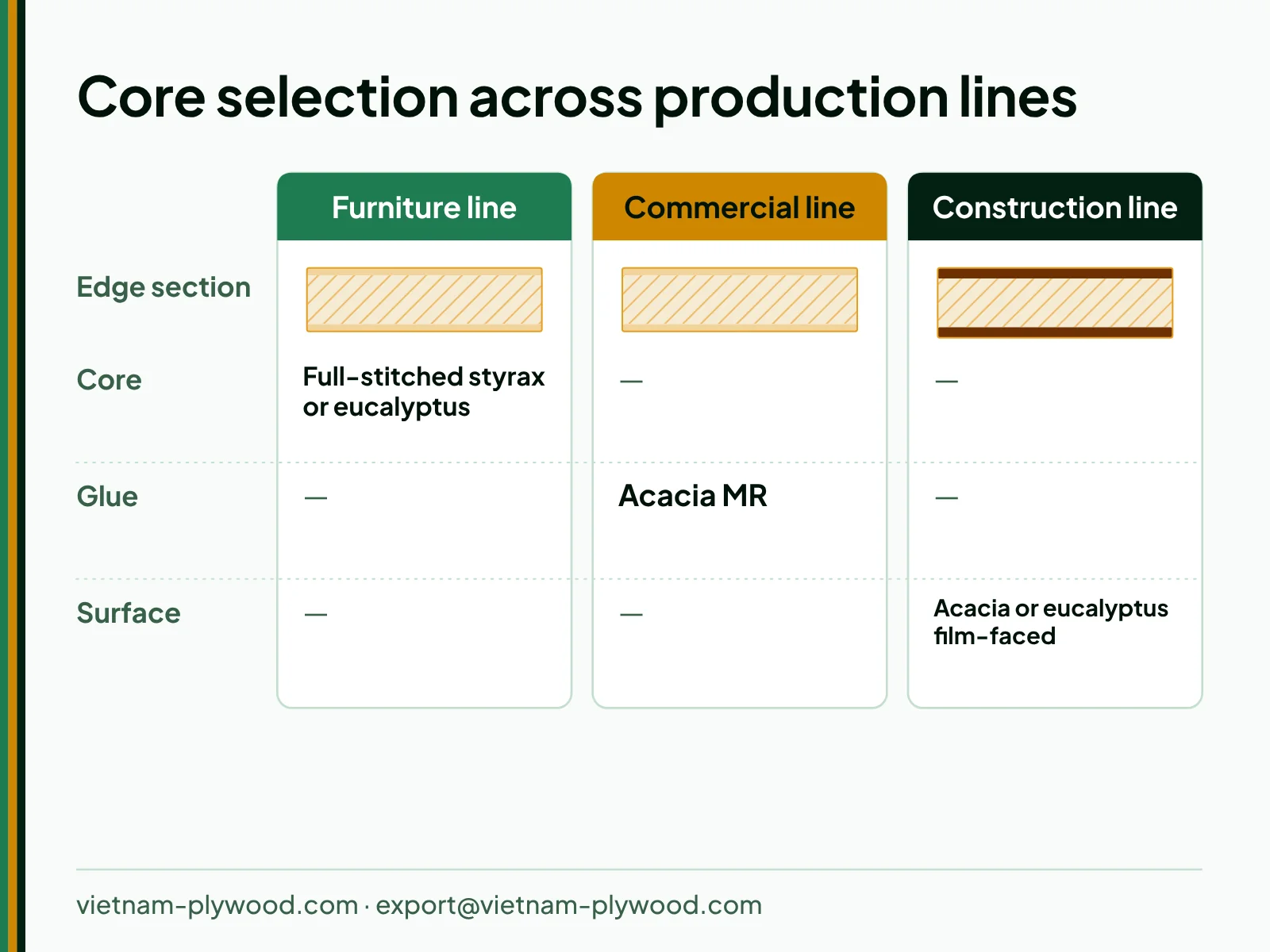
| Order at 18 mm | Core and surface | Thickness tolerance | Verdict for use |
|---|---|---|---|
| Furniture and cabinets | Full-stitched styrax or eucalyptus, sanded | ±0.2 or ±0.3 mm as ordered | Choose for visible furniture and machined cabinet parts; reject jointed substitution |
| Commercial and packing | Acacia, unsanded or light-sanded | ±0.5 mm commercial; ±0.5–1.0 mm packing | Consider economical protected packing, with core acceptance written down |
| Construction formwork | Acacia or eucalyptus, film-faced and unsanded | ±0.5 mm | Specify continuous accepted core construction; reject unapproved finger-jointed blocks |
The table compares applications, without equating performance. Our three factories in Phu Tho and Hai Phong each produce orders assigned to their specification. A buyer can inspect the goods at that producing factory and meet the team at its factory office.
What happens in film-faced formwork?
Finger joint core film faced plywood can conceal a discontinuous middle behind an intact film. Formwork panels face bending between supports, wet concrete contact and repeated stripping. A joint or recovered block that separates can leave a local depression, edge opening or uneven concrete surface, leading to rejected panels and site replacement.
Film weight describes the facing, rather than the internal core: our construction line uses 120 g/m² standard film, 135 g/m² premium film or 220 g/m² anti-slip film. Neither a heavier film nor a phenolic outer bond repairs a weak internal joint. Specify core and adhesive separately.
For our film-faced panels, melamine glue is moisture-resistant (MR) with a 12-hour boil description, while phenolic glue is weather-and-boil-proof (WBP) with a 72-hour boil description. These are glue fields, separate from emission classes. With proper handling, a release agent on every pour and sealed edges including cuts, melamine-glue film-faced panels yield about 12–15 pours; phenolic-glue panels reach up to about 25. Those figures apply to the specified panels and handling, rather than to jointed substitutes.
A formwork buyer should also distinguish a supplier’s reuse suggestion from an independently accepted test result. Specify the supported span, loading and acceptance evidence for the project instead of assuming every film-faced sheet is interchangeable.
Why does the furniture application reject it?
Furniture and cabinet components need predictable machining, edge quality and face flatness. A hidden block joint can intersect a routed groove or fixing position and reveal mixed internal layers at an exposed edge. A face veneer can hide the defect until a cabinet shop cuts the sheet, when the affected pieces may become scrap.
Our furniture plywood is built on full-stitched styrax or eucalyptus cores and sanded faces. Furniture emission choices are E0 or E1, stated separately from glue. A buyer should write the emission class, face species, face grade and cut-edge expectation in the order; appearance alone cannot demonstrate the core.
A decorative birch face is not a birch core. HCPLY names a product by its face, while density follows its core. This distinction also matters when comparing combi-core constructions and checking a supplier’s sample label.
Where can a jointed core be acceptable?
A jointed core can be considered for protected, noncritical packing where the purchaser accepts its construction and tests the intended load. It should not silently replace a continuous-core requirement in furniture, repeated-use formwork or any engineered load-bearing application. Even for packing, the buyer must specify whether nails, screws, edge cuts or stacking loads are expected.
A dry separator has different demands from a load-bearing crate wall. A written inspection plan should state which of these uses is being purchased and what cut-section defects trigger rejection.
Our commercial and packing line builds acacia-core panels with MR glue. It can serve the protected-packing specification without treating recovered finger-jointed blocks as an automatic equivalent. For structural claims or a marine designation, use only a test report the buyer accepts; a sales label alone cannot establish performance.
How can an inspector find a finger-jointed core?
The most direct check is to cut a representative panel at the producing factory and inspect its full thickness. An edge alone can miss hidden joints; cut another position. Record the sampled pallet and sheet identifiers so the finding connects to the shipment.
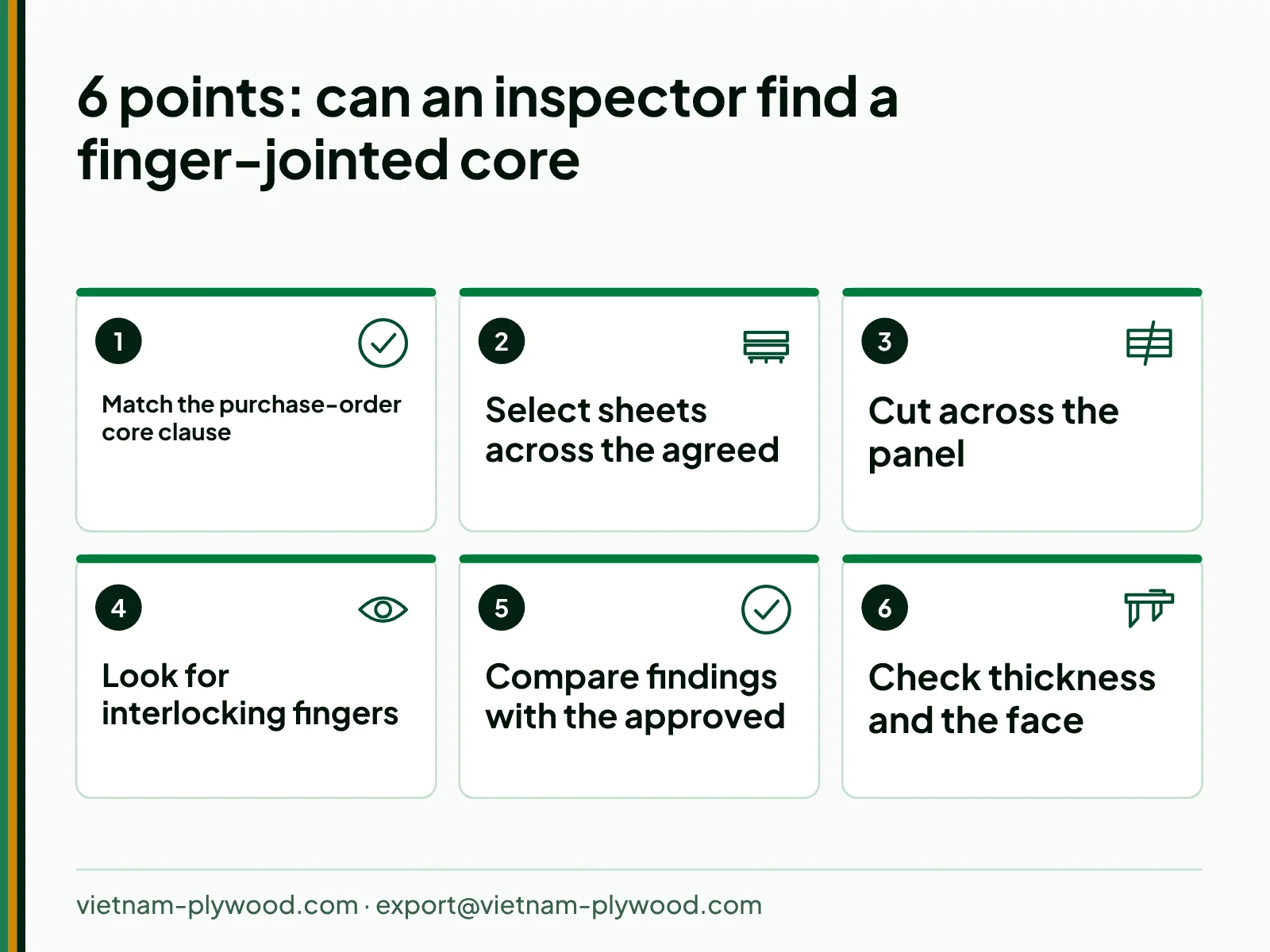
- Match the purchase-order core clause to the factory production sheet and approved reference sample.
- Select sheets across the agreed lot rather than accepting only pre-cut display samples.
- Cut across the panel, expose the central layers and photograph both cut faces with a scale.
- Look for interlocking fingers, block boundaries, old glue lines, large gaps and abrupt species changes.
- Compare findings with the approved core drawing, log acceptance or rejection, and retain the labelled cut pieces.
- Check thickness and the face specification separately; neither test substitutes for the core inspection.
This is a visible inspection, not a laboratory strength result. If a dispute concerns bending, bond durability or emissions, agree the test method and independent laboratory before shipment. The acacia-core discussion provides further context for core selection without assigning a structural rating to this cut test.
How should the core clause read?
The purchase order should name the core species, permitted construction, forbidden substitutions and the witness check. “Hardwood core” is too broad to exclude finger-jointed recovered blocks. Likewise, “full core” without an agreed drawing can invite different interpretations between a buyer and a factory.
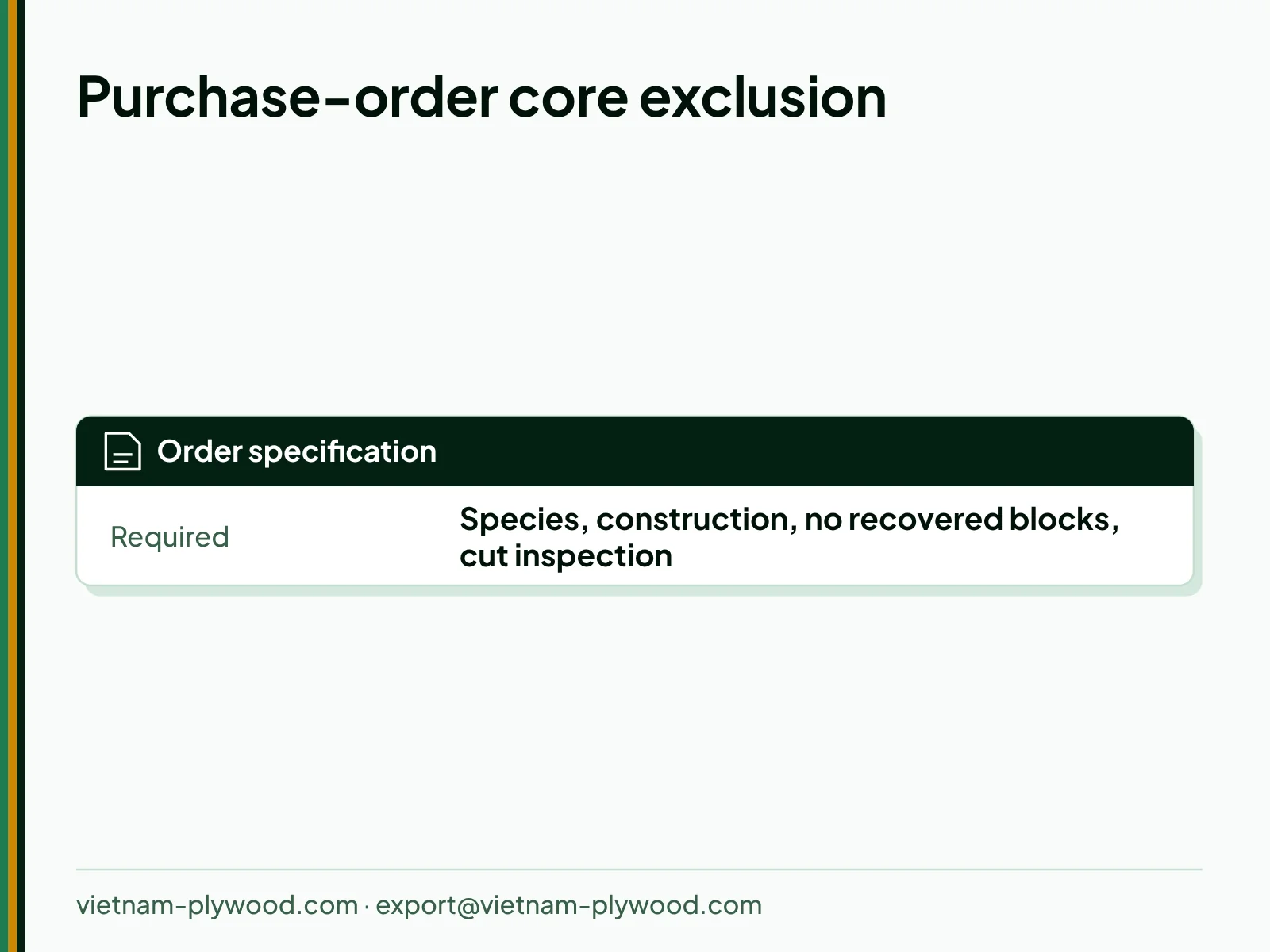
For furniture, specify full-stitched styrax or eucalyptus veneer core, with no finger-jointed or recovered plywood blocks. For formwork, specify acacia or eucalyptus core and the agreed continuous veneer arrangement, again excluding finger-jointed blocks unless a separately approved trial specification allows them. For packing, state whether edge-trimmed inner veneers are permitted and identify any explicit allowance for jointed material.
Record lot, cut locations, photographs and acceptance criteria. State who pays for destructive sampling and how the opened sheets are handled. HCPLY can arrange this witness check at the producing factory before loading, so the clause has a practical verification step.
Why is finger joint core plywood priced lower?
The largest potential saving comes from substituting shorter recovered blocks for selected continuous veneer, followed by less demanding core assembly and surface preparation. That material saving is offset by additional joining, sorting and rejection risk. Price differences cannot be quantified without a like-for-like written quotation and the intended application.
In construction quality order, full-stitched core comes before stitched outer layers with edge-trimmed inner layers, then finger-jointed core, then loose-laid core. A full-stitched furniture build costs more than a recovered jointed-core proposal because it requires selected, assembled veneer and tighter finishing. A jointed-core offer can look attractive per sheet while increasing the cost of cut-piece losses or replacement formwork.
Finger joint plywood price alone omits the build. Ask for separate quotations against the same dimensions and clearly different core clauses; do not compare an unspecified low-price panel with a fully described order.
What does the container comparison show?
Core choice changes shipment mass as well as product duty. At 18 mm and 1220 × 2440 mm, the reference styrax sheet weighs 26.79 kg, acacia 31.08 kg and eucalyptus 34.83 kg. Those figures describe core-density calculations and exclude film weight; they are not measurements of recovered jointed-core panels.
For a full 40HC of that size and thickness, styrax is 990 sheets and 26.52 t, acacia 880 sheets and 27.35 t, and eucalyptus 795 sheets and 27.69 t. Payload limit: 28.5 t. Mixed specifications require pallet and loading checks.
For example, 10 styrax pallets at 55 sheets each and 6 acacia pallets at 55 sheets each give 550 styrax plus 330 acacia sheets. Using the stated sheet weights gives 14,734.50 kg plus 10,256.40 kg, or 24,990.90 kg before pallets and packing. This illustrative combination is below the payload ceiling; pallet geometry and other load allowances still require checking. The mixed-container ordering guide covers the commercial arrangement, while container loading calculations own full packing counts.
Which documents carry the core agreement?
The core specification belongs in the signed order and inspection attachment, while the packing list identifies the loaded goods. The commercial invoice, packing list and bill of lading form part of the shipment record; approved inspection photographs should be traceable to the production lot. Witness the cut-section check separately.
For exports, HCPLY coordinates the specification, on-site quality control, documents and loading. Shipment paperwork includes the certificate of origin, phytosanitary and fumigation papers, plus order-specific certificates and agreed test reports. European Union lots also carry the EUTR/EUDR file set and EUR.1 where applicable; CIF shipments include insurance documents. After loading, the draft shipping documents come to you for approval.
Certificates including FSC, CARB P2, ISO 9001 and CE belong to member factories and are shown with factory details masked, on request. The exact certificate documentation is matched to the agreed producing factory and product.
What should buyers settle before placing the order?
Settle the application, core construction and destructive-inspection acceptance criteria before agreeing a price. Use a signed build schedule. The buyer should also decide whether a test report is needed for the expected mechanical or moisture exposure.
Our minimum order is one 40HC, with specifications mixed within the payload limit. Factory lead time runs 15–45 days from receipt of the 30% deposit; the exact figure depends on order size, line loading and what the contract fixes. The remaining 70% is paid on the scan of the bill of lading, by T/T, or by irrevocable sight L/C. We ship FOB Hai Phong, or CFR (CNF) or CIF to your port.
Samples cost nothing: a first-time buyer pays the courier, and that charge comes off the first confirmed order. Send the application and core clause to Lucy at export@vietnam-plywood.com. The several plywood types ordering page explains how separate line specifications can be coordinated.
What specification should be sent for review?
Send a build sheet that treats the core as an inspectable feature. The example describes furniture; adapt it for packing or formwork. Keep the exclusion and cut-section check visible in every revision.
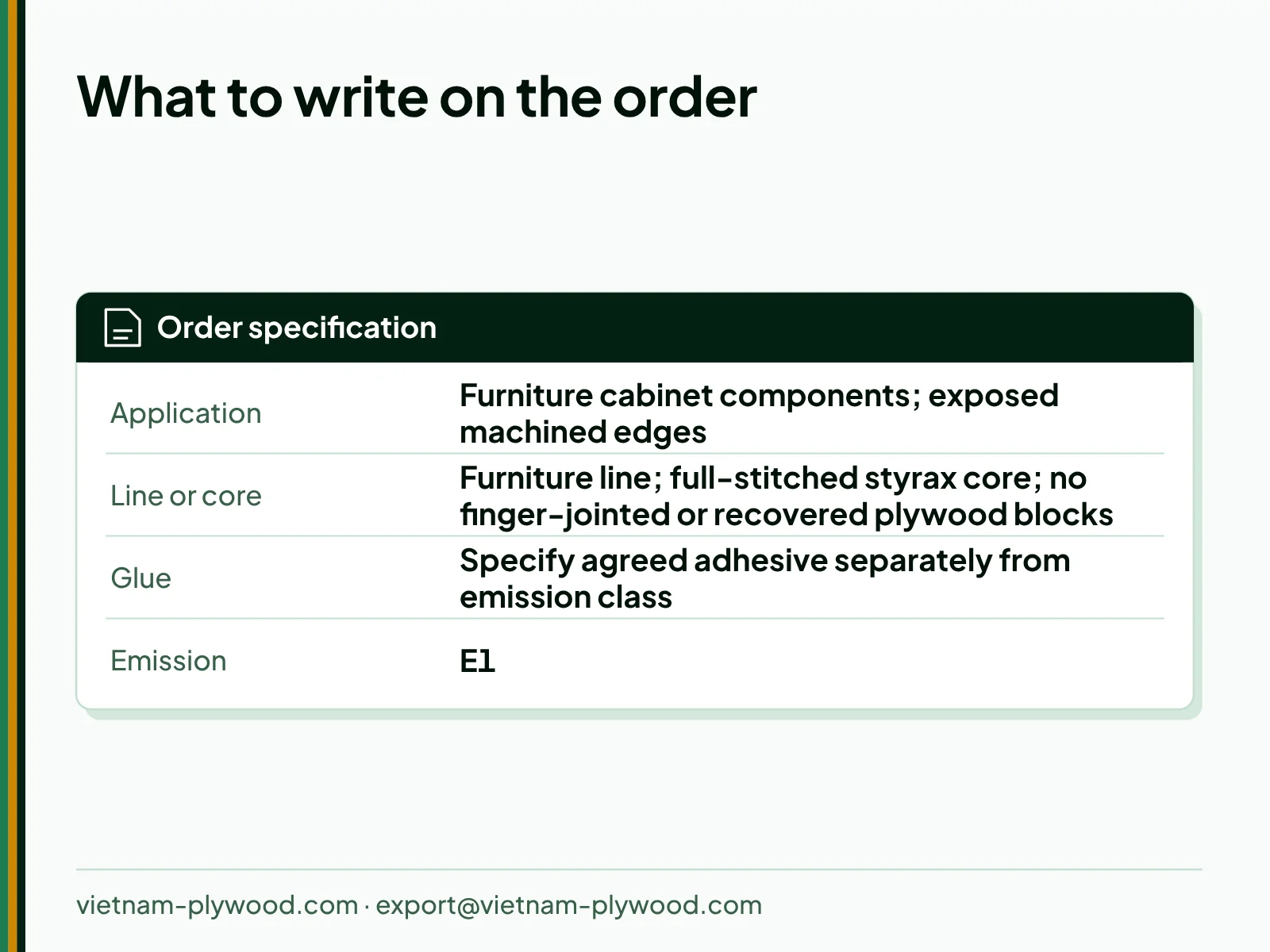
Application: Furniture cabinet components; exposed machined edges
Line or core: Furniture line; full-stitched styrax core; no finger-jointed or recovered plywood blocks
Glue: Specify agreed adhesive separately from emission class
Emission: E1
Face and grade: Bintangor, A/B
Thickness and tolerance: 18 mm; sanded ±0.2 mm as ordered
Size: 1220 × 2440 mm
Quantity: One 40HC; confirm pallet plan
Destination port: [buyer to insert]
Inspection: Witness cross-section cuts at producing factory against approved core drawing
Next step: book a factory visit to witness the core-section inspection before loading.