





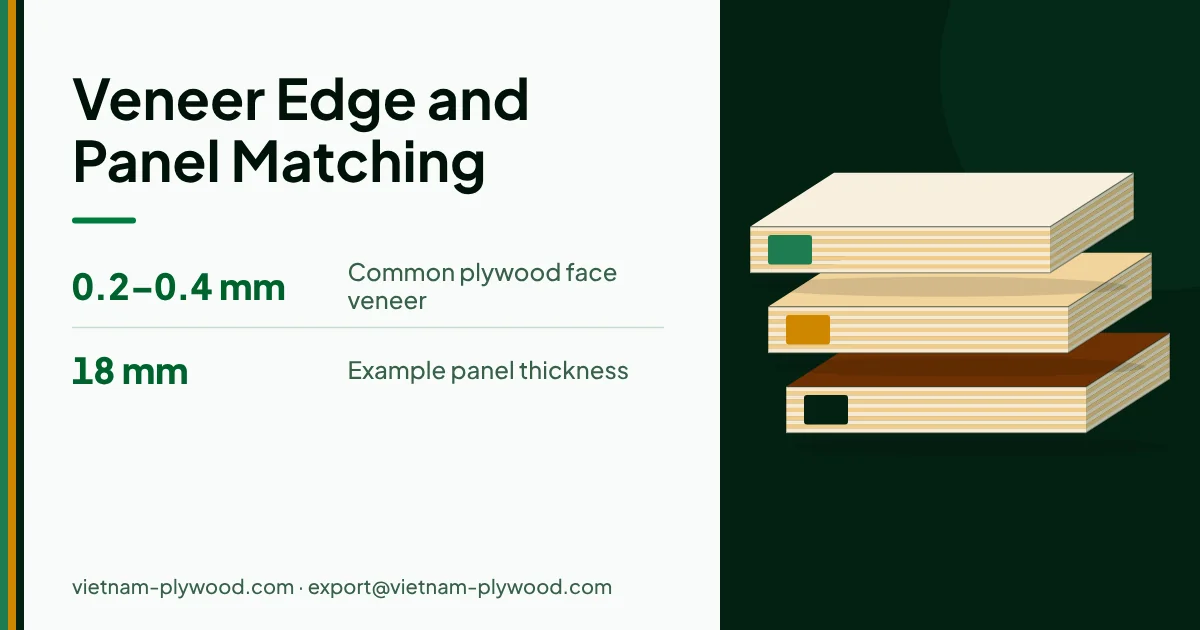
Veneer edgebanding comes in natural and engineered wood varieties, with backing and thickness chosen for the finished panel edge. A mismatched strip can add rework cost, delay cabinet production or cause a rejected load. HCPLY supplies the plywood substrate; buyers specify and procure matching edge strips separately. The decision starts with the face veneer, the edge profile and the production trial.
What is veneer edgebanding and which types matter?
Veneer edgebanding is a narrow wood-veneer strip that finishes the exposed edge of a furniture panel. Buyers commonly compare natural wood veneer, engineered veneer, backed strips and unbacked strips. The choice starts with the visible face and the finishing process rather than the strip label alone. For cabinet production, ask for a physical match between the panel face and the edge after finishing.
Natural veneer preserves wood variation; engineered veneer offers a designed appearance pattern. Paper-backed and fleece-backed strips can behave differently in handling and bonding from raw veneer. Pre-glued and unglued versions require different application equipment. These are categories to specify with a dedicated edging supplier, not HCPLY plywood product lines.
Which veneer edgebanding thickness should you specify?
Thickness is a machining decision. Thin strips follow straight edges and gentle curves with less material to remove; thicker strips offer more stock for rounding and subsequent sanding. The correct choice is the thickness that survives trimming and finishing while meeting the edge profile drawing.
Record nominal strip thickness, minimum acceptable thickness, width, roll length, backing and adhesive type on the edging purchase order. Measure samples after conditioning in the intended workshop. A strip can look suitable on a sample board yet expose the substrate after a heavy radius cut. Test the actual router, trimmer and finishing sequence before approving a bulk order.
HCPLY face veneer is commonly 0.2–0.4 mm. That describes the broad face of our plywood and must never be read as a specification for separately purchased edgebanding. Face thickness and edge-strip thickness perform different jobs.
When does plywood win over separate edge treatment?
Plywood works well where the buyer needs a stable sheet substrate, a specified face and repeatable panel machining. Separate edgebanding remains useful when the cut edge must resemble the broad face or hide the ply layers. An exposed laminated edge can also be an intentional design choice where the client approves its appearance.
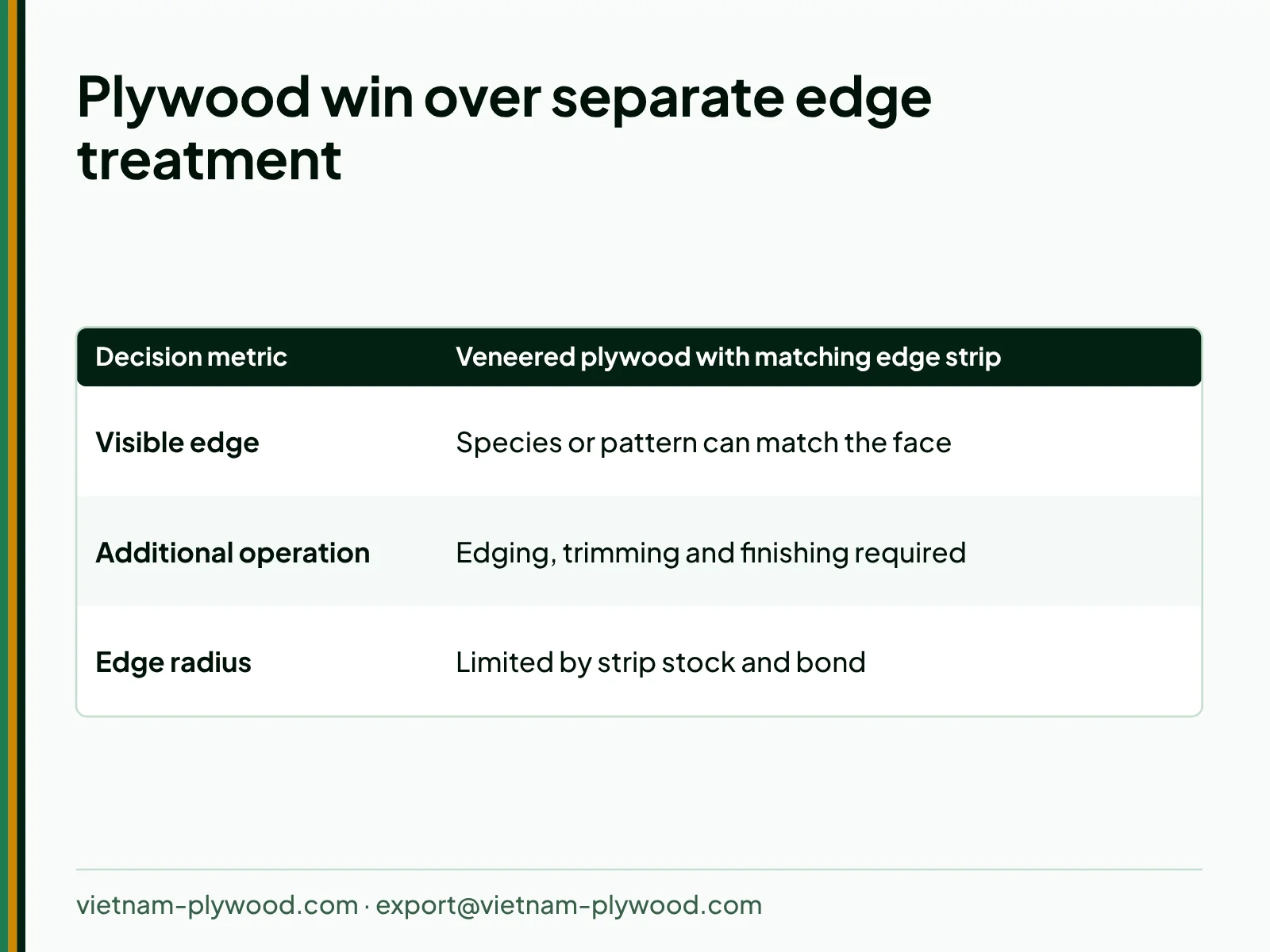
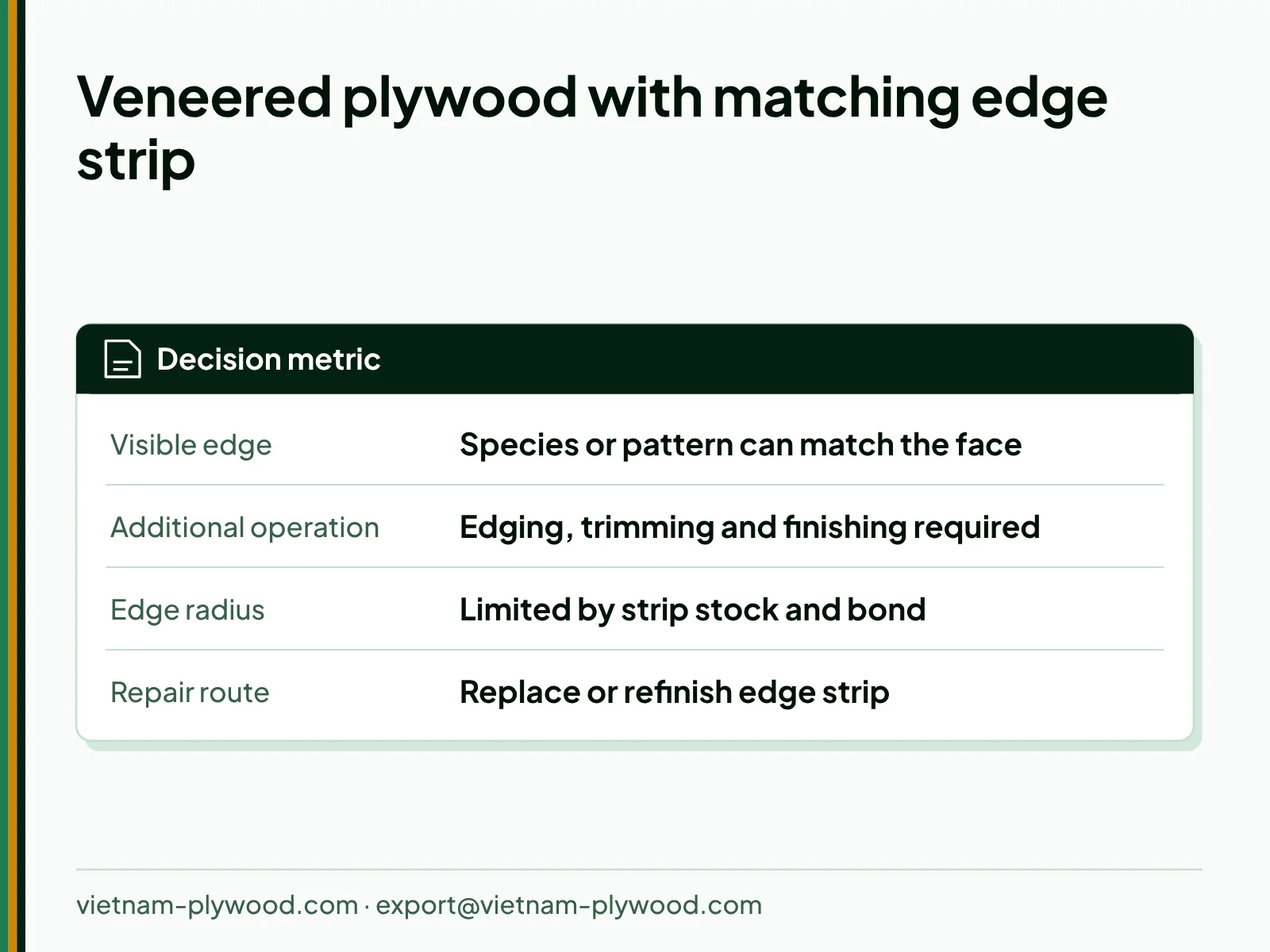
| Decision metric | Veneered plywood with matching edge strip | Plywood with exposed ply edge | Buying verdict |
|---|---|---|---|
| Visible edge | Species or pattern can match the face | Core layers remain visible | Match strip for uniform cabinet fronts |
| Additional operation | Edging, trimming and finishing required | Sanding and finishing only | Exposed edge for approved layered appearance |
| Edge radius | Limited by strip stock and bond | Limited by panel build and machining | Prototype the required radius |
| Repair route | Replace or refinish edge strip | Rework the plywood edge | Choose by service expectations |
| Purchase scope | Panel and edging specifications | Panel specification | Separate the edging procurement clearly |
The comparison belongs in the applications library because the finished cabinet edge is a design and process decision. For face selection, see engineered veneer plywood.
Which HCPLY line makes the matching panel?
Our furniture line presses the plywood panel for visible cabinetry, using styrax or eucalyptus cores, full-stitched construction and sanded faces. Its emission options are E0 and E1. Edgebanding rolls must be ordered from an edging specialist and checked against the finished plywood face.
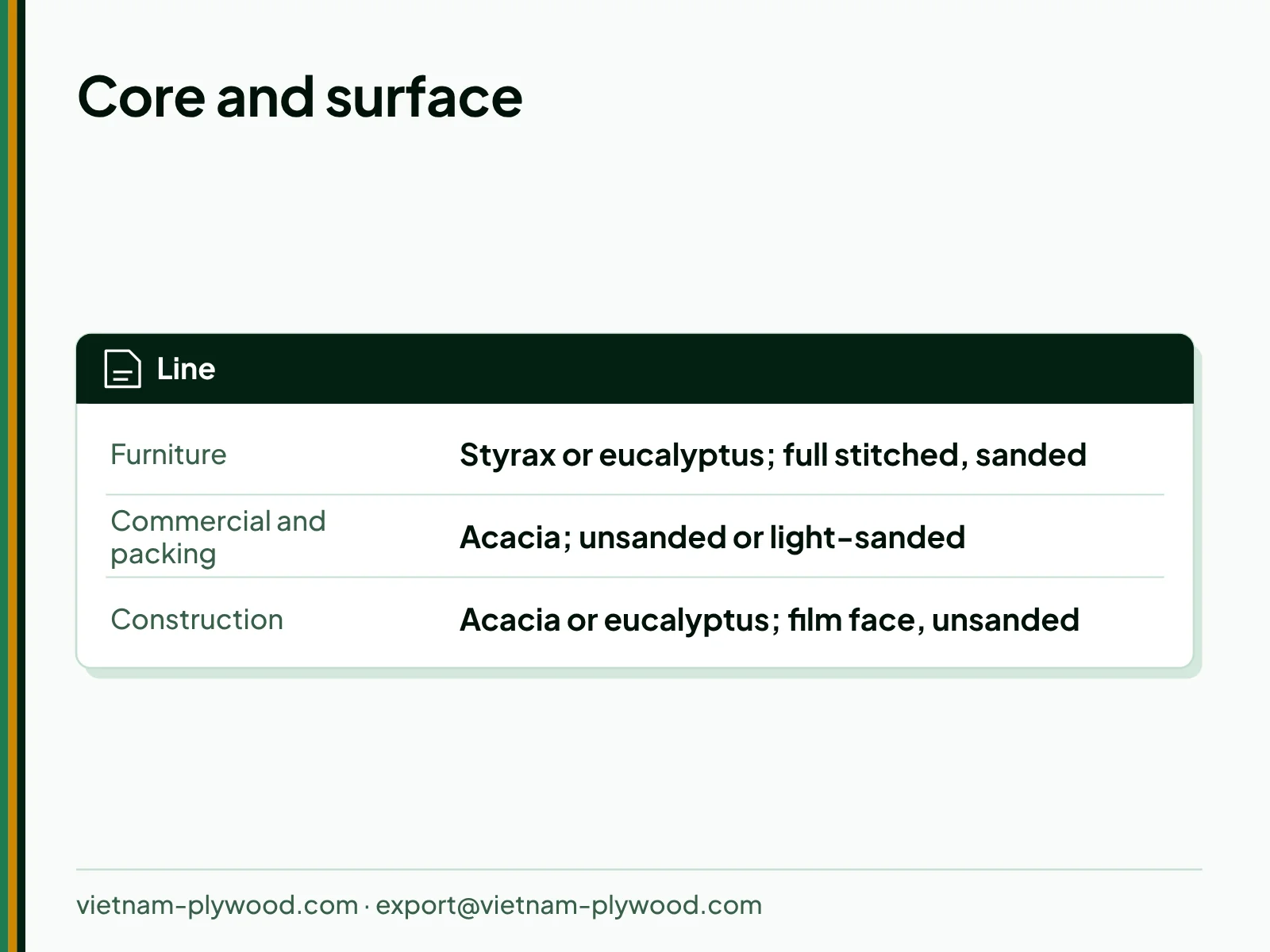
| Line | Core and surface | Relevant build at 18 mm | Edge decision |
|---|---|---|---|
| Furniture | Styrax or eucalyptus; full stitched, sanded | Decorative cabinet substrate | Match veneer strip to face and finish |
| Commercial and packing | Acacia; unsanded or light-sanded | Utility or packing panel | Visible decorative match is usually secondary |
| Construction | Acacia or eucalyptus; film face, unsanded | Formwork panel | Protect cut edges for formwork use |
HCPLY operates three member factories in Phu Tho and Hai Phong. Each order is made at the producing factory suited to its specification, with export coordination and on-site quality control. We do not press medium-density fibreboard, oriented strand board, chipboard, blockboard or bamboo panels.
How should face species and edge grain be matched?
Match a finished sample rather than relying on a species name alone. Light, grain direction, veneer slicing and coating can make two nominally similar products look different. Compare edge strips against the actual plywood production face under the intended coating and lighting.
Our face options include bintangor, okoume, engineered veneer (EV), gurjan, pine, poplar, eucalyptus, birch and sapele. Birch face grades are D, E and F; other face grades are A and B. A panel is named for its face, while its density follows the core. A birch-faced panel therefore does not imply a birch core.
For repeat cabinet orders, approve a reference sample showing face, edge, corner and finish. Specify grain direction on both the panel cutting schedule and the edging purchase order. Record whether the edge is meant to disappear visually or act as a deliberate accent.
What machining and sanding checks prevent rejects?
A production trial should demonstrate the finished corner after edging, trimming and sanding. The inspector can witness plywood thickness measurement, face inspection and the panel’s cut-edge construction at the producing factory. The edging applicator must separately demonstrate its bonding and machining settings.
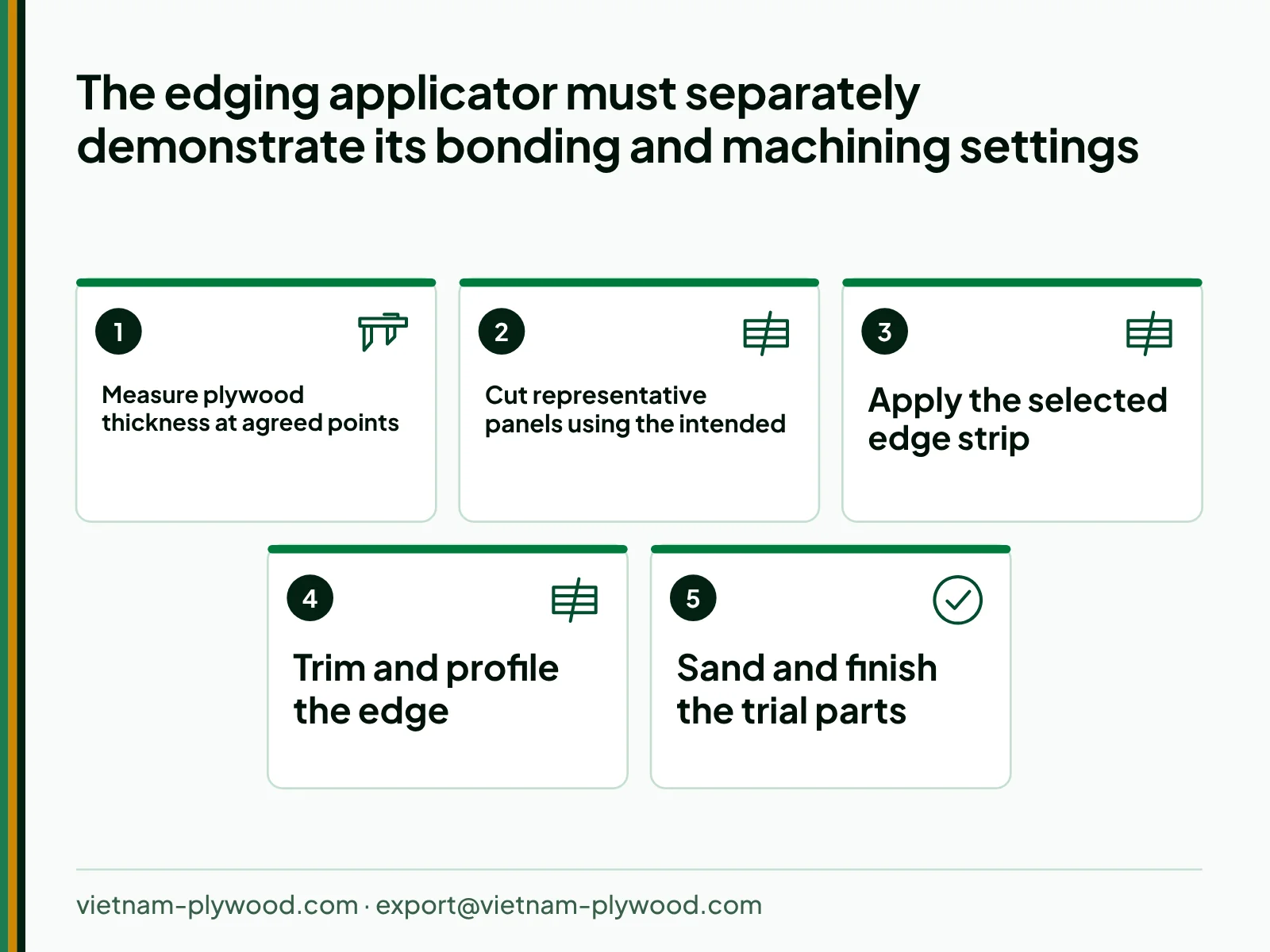
- Measure plywood thickness at agreed points before cutting; furniture sanded tolerance is ±0.2 or ±0.3 mm as ordered.
- Cut representative panels using the intended blade and feed setup; inspect tear-out at the face and core.
- Apply the selected edge strip to trial parts with the intended adhesive and machine settings.
- Trim and profile the edge, then check for exposed substrate, gaps and lifting at corners.
- Sand and finish the trial parts; compare colour and sheen against the approved reference.
The plywood sanding sequence and laser-cutting plywood settings cover related machining choices. Where printed decoration is planned, consult printing on plywood panels.
Can matching plywood specifications share a container?
Yes. Mixed plywood specifications can share one 40HC, with a 28.5 t payload limit. For 18 mm, 1220 × 2440 mm sheets, a full styrax-core load is 990 sheets at 26.52 t; an acacia-core load is 880 sheets at 27.35 t. The corresponding eucalyptus-core load is 795 sheets at 27.69 t.
Those are separate full-load reference cases, not quantities to add together. Mixed-load planning must recalculate total volume and weight from the actual selected quantities. The plywood loading figures exclude edging-strip weight, so separately purchased strips require their own transport assessment.
See container loading quantities for the owner calculation. If your operation also needs protective transport material, compare export wood packaging options.
What should the plywood specification say?
The written specification should identify the panel independently of the edge strip. State application, face, face grade, core, construction, glue, emission class, thickness, tolerance, size and quantity. A 1220 × 2440 mm cabinet panel with a sanded furniture build is a different purchase from an edging roll of matching appearance.
HCPLY offers plywood thicknesses from 3–40 mm, including common 3, 5, 9, 12, 15, 18, 21 and 25 mm. Standard panel formats include 1220 × 2440 and 1250 × 2500 mm, with custom cutting available. Length and width tolerance is ±2 mm. An 18 mm plywood sheet has 11–13 plies, depending on core veneer thickness.
Specify glue separately from emission: melamine moisture-resistant (MR) glue has a 12-hour boil description; phenolic weather and boil proof (WBP) glue has a 72-hour boil description. Neither glue name substitutes for an E0 or E1 emission requirement.
What paperwork matters for export buyers?
The shipping file links the ordered plywood build to the shipment. HCPLY coordinates the commercial invoice, packing list, bill of lading, certificate of origin and applicable phytosanitary and fumigation papers. For European Union lots, the file includes the EUTR/EUDR documents; agreed test reports and factory certificate documents accompany the relevant build.
The European Commission’s 2026 EU Deforestation Regulation overview identifies wood and certain wood products within the regulation’s scope. Importers should check their exact product classification and due-diligence role before placing an order. Member-factory FSC, CARB P2, ISO 9001 and CE documents are shown with factory details masked, on request.
Buyers inspect goods at the producing factory and can visit the factory office. After loading, the draft shipping documents come to you for approval.
What drives the price of a matched panel order?
Core construction and surface preparation are the first cost drivers, followed by face selection, panel dimensions and the agreed quality checks. Full-stitched, sanded furniture panels cost more to prepare than utility panels with a less demanding surface. Edge-strip backing, thickness and adhesive are separate pricing variables set by the edging supplier.
For furniture plywood, the indicative starting point is from US$350/m³ FOB Hai Phong (October 2026). Commercial plywood starts from US$250/m³ FOB Hai Phong (October 2026). These are category starting points; request a quotation for the written panel build and obtain a separate edging quotation.
The minimum order is one 40HC, with mixed plywood specifications allowed within its payload limit. Factory lead time runs 15–45 days from receipt of the 30% deposit; the exact figure depends on order size, line loading and what the contract fixes. The remaining 70% is paid on the scan of the bill of lading, by T/T, or by irrevocable sight L/C.
How should buyers approve a trial container?
Approve a plywood reference panel and a separately applied edge sample before committing to repeat production. The buyer’s inspection plan should compare face appearance, panel thickness, cut-edge quality and packing identification against the agreed specification. The edging trial should record adhesive, edge width, trim profile and finished corner acceptance.
HCPLY ships FOB Hai Phong, CFR (CNF) or CIF. Free samples are available; a first-time buyer pays the courier, and that charge comes off the first confirmed order. For distribution programmes, see plywood supply programmes for distributors.
Send Lucy at export@vietnam-plywood.com the panel schedule and a reference of the desired edge appearance through contact. The next step is to plan a trial container.
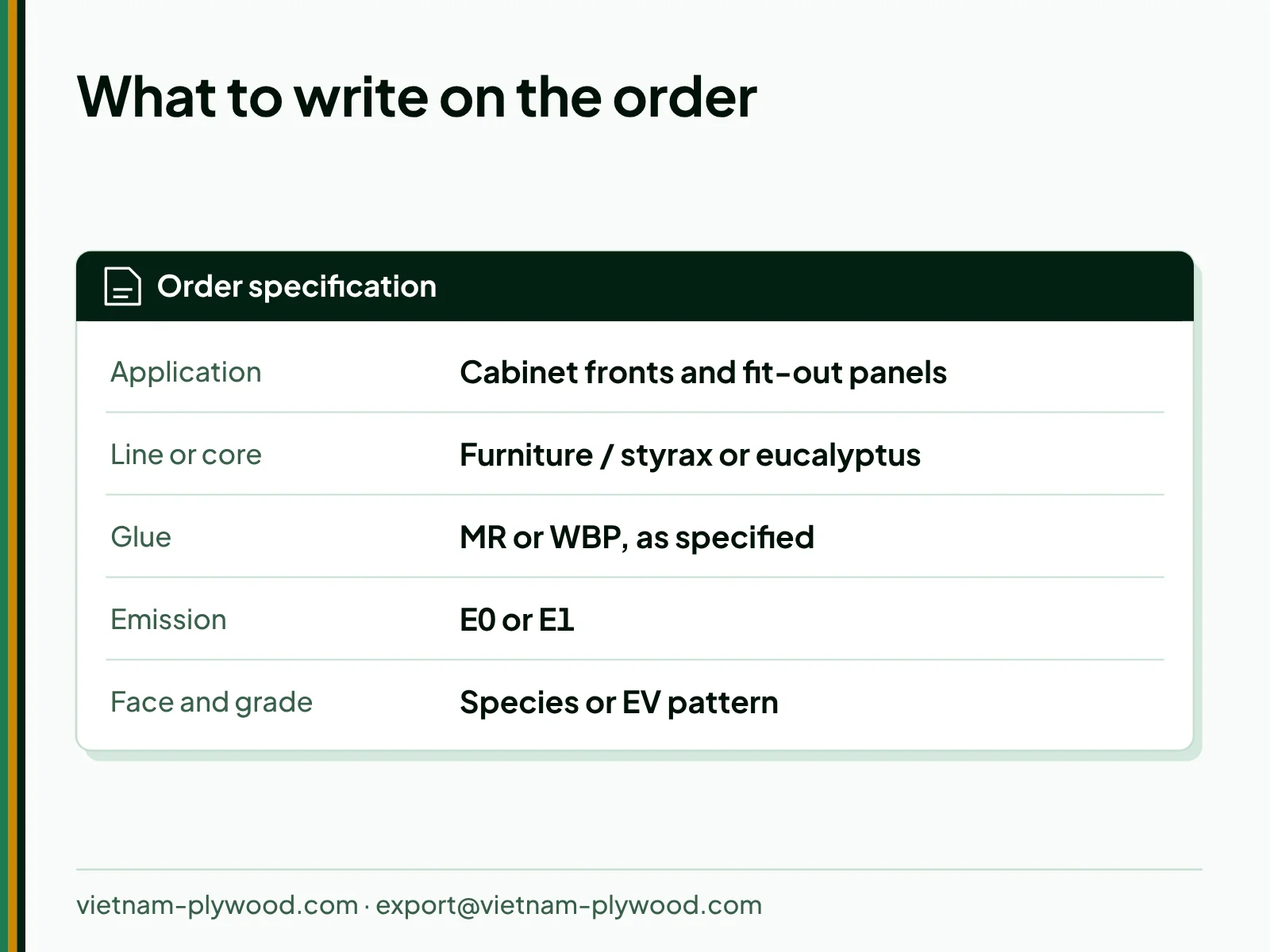
Application: cabinet fronts and fit-out panels
Line or core: furniture / styrax or eucalyptus
Glue: MR or WBP, as specified
Emission: E0 or E1
Face and grade: species or EV pattern; A/B (birch D/E/F)
Thickness and tolerance: 18 mm; ±0.2 or ±0.3 mm as ordered
Size: 1220 × 2440 mm
Quantity: one 40HC, mixed specifications if required
Destination port: [enter port]
Separate edging purchase: species/pattern, thickness, width, backing, adhesive
Plan a trial container with the approved panel and edge reference.