






The cheapest useful plywood is the lowest grade that still meets its assigned job: packing, concealed furniture or temporary formwork. Choosing the wrong HCPLY build can turn an invoice saving into rejected panels, replacement costs and production delays. Each line has a different entry specification, so buyers should compare the function lost at the next grade before ordering.
What is cheap plywood?
Cheap plywood is a lower-cost specification selected for a particular industrial job, rather than a universal grade stamped on every sheet. At HCPLY, the lowest-cost route usually begins with packing-grade commercial plywood, while furniture and construction each have their own entry build. Compare the face, core assembly, glue, tolerance and intended use before comparing quotations.
The phrase cheapest plywood sheets also hides a unit problem. A lower per-sheet invoice can reflect a thinner panel, smaller area or a different core. Compare like dimensions and delivery terms using the Vietnam plywood export cost breakdown before selecting the lower quotation. For an industrial buyer, a written build description is more useful than an undefined bargain label.
What is the lowest grade on each production line?
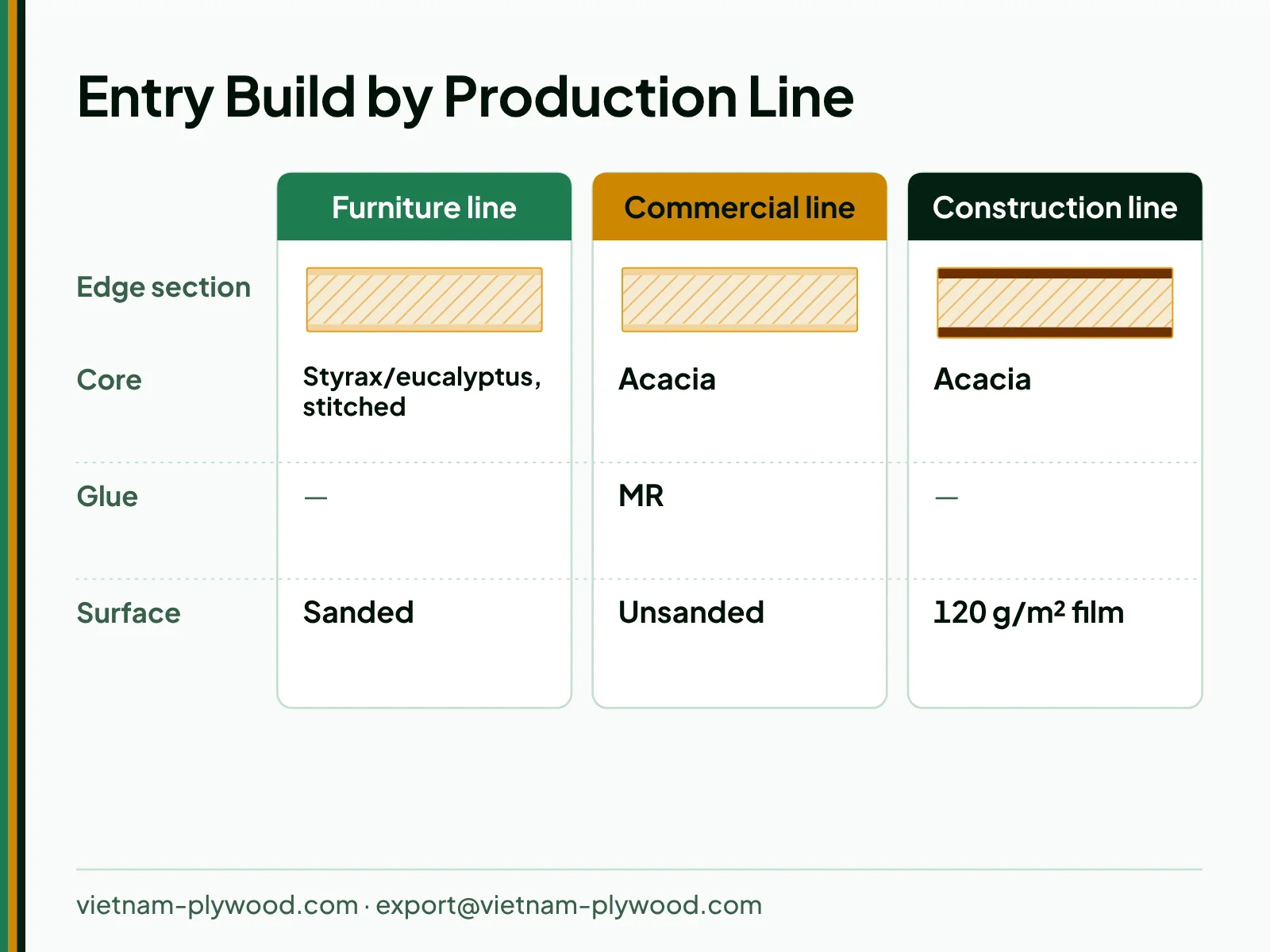
The lowest practical specification differs by application: packing-grade acacia for crates, a utility film-faced build for formwork, and a lower-appearance furniture face for concealed components. Our three factories in Phu Tho and Hai Phong press these different jobs on dedicated lines.
| Line and entry build | Next specification to compare | What the entry build gives up | Appropriate use |
|---|---|---|---|
| Commercial and packing: acacia core, moisture-resistant (MR) glue, unsanded packing finish | Light-sanded commercial face and more orderly core assembly | Surface smoothness and a tidier exposed edge | Crates, boxes and protected packing components |
| Construction: acacia core, standard 120 g/m² film, utility core assembly | Better-assembled core or 135 g/m² premium film | Face-film reserve and potentially more uniform edges | Temporary formwork where the approved pour plan fits the build |
| Furniture: styrax or eucalyptus core, full stitched and sanded, lower-appearance B face | A face selected for visible finishing | Cosmetic consistency and decorative yield | Concealed cabinet parts and furniture interiors |
Face names describe the outside veneer: bintangor, okoume, engineered veneer (EV), pine, poplar and others can be specified where appropriate. Core density follows the core species rather than the face label. A birch face therefore does not imply a birch core; we do not press birch-core plywood. See the furniture plywood specifications for a closer look at that line.
What does a lower grade give up?
A lower grade typically gives up appearance first, then core assembly consistency or surface treatment if the specification permits. The safe saving is the feature the finished job does not use. The expensive saving is the feature that makes a panel fail its intended duty.
Within the available core constructions, full stitched is the highest tier, followed by stitched outer layers with edge-trimmed inner veneers, finger-jointed, then loose-laid. That ordering matters more to a machined edge or stressed packing component than to a temporary protective cover. Specify the minimum acceptable assembly instead of buying solely from a face photograph; compare hardwood plywood prices by face separately.
A sanded furniture panel has a thickness tolerance of ±0.2 or ±0.3 mm as ordered. Commercial and film-faced panels use ±0.5 mm; packing panels use ±0.5–1.0 mm. A packing tolerance is reasonable for a crate wall designed around it, but a tight cabinet groove may require the furniture build. All listed length and width tolerances are ±2 mm.
Which jobs still suit entry-grade panels?
Entry-grade panels suit work where the omitted premium feature has little value to the finished product. The application must still define the required bond, dimensions and handling conditions; several plywood types in one order need distinct product codes.
Packaging: Crates, boxes and protective separators can use unsanded acacia panels when their load path, fastening pattern and handling conditions are agreed. A visibly rough face may be acceptable; an open edge gap at a fastening point may not be. A packing company should inspect representative cut edges before approving volume.
Furniture and fit-out: Concealed backs, interior partitions and covered components can use a lower-appearance face when the core is fully stitched and sanded for machining. A visible cabinet end or decorative door should be priced against its finishing yield. A lower-appearance panel does not automatically mean a lower emission requirement.
Construction: A utility film-faced panel belongs in a defined formwork method with an agreed support arrangement and surface expectation. Film selection alone cannot establish structural capacity. With proper handling, a release agent on every pour and sealed edges, including cut edges, melamine-glue film-faced plywood gives about 12–15 pours; phenolic-glue film-faced plywood reaches up to about 25 pours. These are handling-dependent reuse figures, not substitutes for project acceptance criteria.
Is packing-grade commercial plywood the cheapest container choice?
Packing-grade commercial plywood is the entry price category for HCPLY’s commercial range, starting from US$250/m³ FOB Hai Phong (October 2026). It is a strong first quotation for a container intended for packaging, but the lowest invoice total depends on the required thickness, quantity and accepted build.
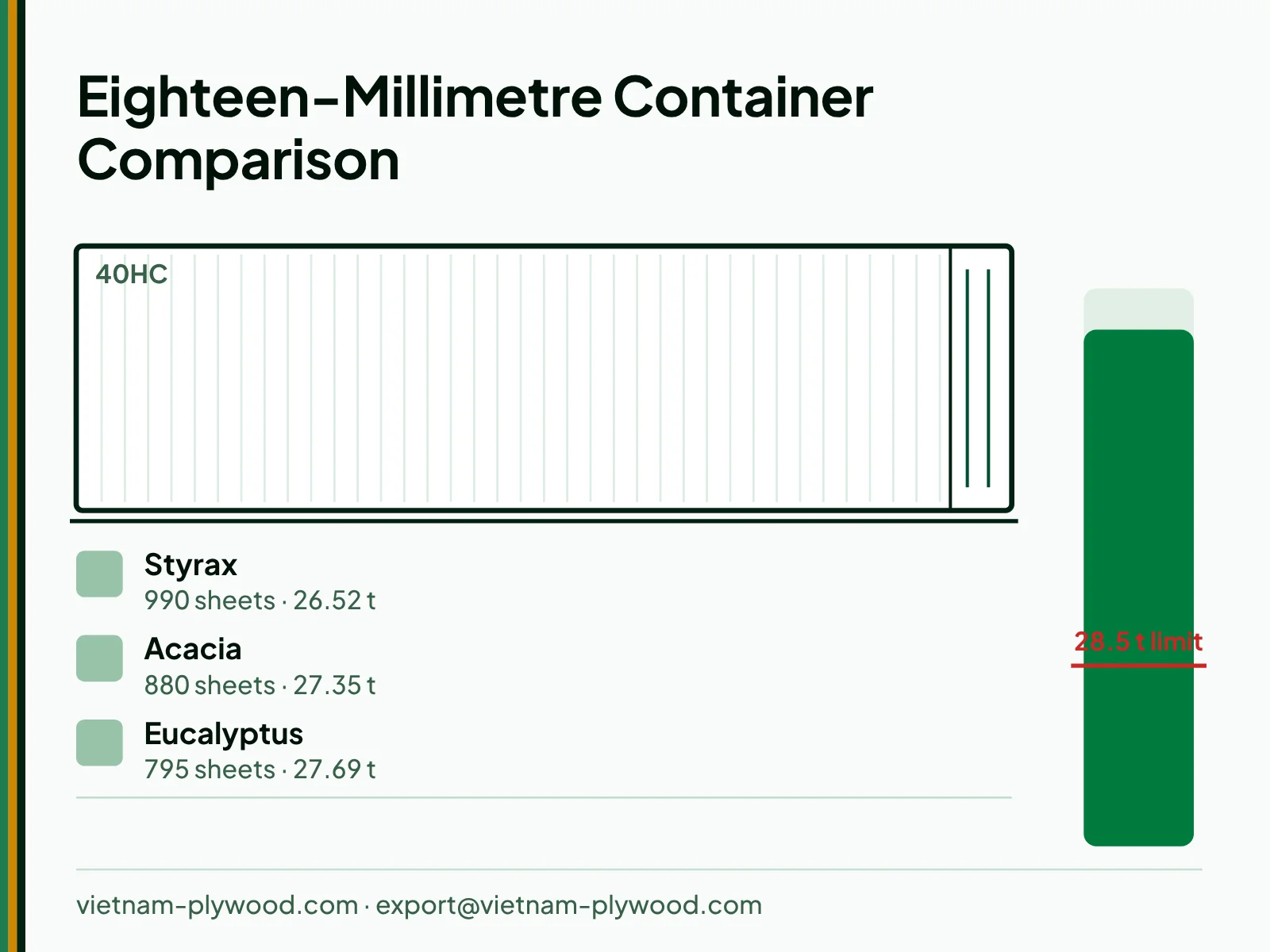
A standard 1220×2440 mm, 18 mm acacia sheet weighs 31.08 kg before any face-film allowance. At the stated pallet arrangement, 55 sheets fit each of 16 pallets: 880 sheets, 47.15 m³ and 27.35 t for a full 40HC acacia load. The container payload limit is 28.5 t. This makes weight a practical constraint when mixing specifications, even when floor space appears available.
For the same dimensions and thickness, the styrax lookup is 990 sheets, 53.05 m³ and 26.52 t; eucalyptus is 795 sheets, 42.60 m³ and 27.69 t. These figures describe core-density loading differences, not an assertion that one species is cheaper. See container loading by plywood specification for the dedicated loading question.
The minimum order is one 40HC, and specifications can be mixed within its payload limit.
Why do plywood prices differ between grades?
Core construction, face quality and finishing are the main grade decisions; glue, thickness and shipment composition then change the quoted build. Their effect should be examined in that order for a like-for-like panel, rather than assuming a fixed premium for every upgrade.
First, full-stitched construction uses a more orderly veneer assembly than loose-laid or finger-jointed alternatives. Second, a selected visible face and sanding require tighter cosmetic control than an unsanded packing face. Third, phenolic weather-and-boil-proof (WBP) glue and a specified film treatment serve a different exposure requirement from MR glue. Finally, thicker panels use more veneer volume per sheet, while unusual cutting patterns affect usable output.
The two glue descriptions should remain separate from formaldehyde emission classes. Melamine MR glue is described by a 12-hour boil condition; phenolic WBP by a 72-hour boil condition. E0, E1 and E2 describe emission classes. For a US-bound regulated hardwood plywood build, CARB Phase 2 and Toxic Substances Control Act (TSCA) Title VI are regulatory certification matters, not alternate names for glue.
The US Environmental Protection Agency’s 2016 final rule, summarized on its formaldehyde emission standards page, covers hardwood plywood and third-party certification. A low face grade cannot replace a required emission certificate. Buyers comparing quoted builds can also consult pine plywood cost drivers and the commercial plywood price discussion.
What dated from-price can a buyer use?
Commercial plywood starts from US$250/m³ FOB Hai Phong (October 2026). Furniture plywood starts from US$350/m³ FOB Hai Phong (October 2026). Those are indicative starting prices for their respective categories, rather than a sheet-by-sheet tariff or a quotation for every face and core combination.
For cheap plywood sheets 4x8, use the exact 1220×2440 mm specification rather than assuming every nominal 4×8 offer has identical dimensions. The available thickness range is 3–40 mm, with common choices including 3, 5, 9, 12, 15, 18, 21 and 25 mm. A quote should state the agreed tolerance alongside the nominal thickness.
FOB Hai Phong is one delivery option; CFR (CNF) and CIF are also available. Freight, insurance and destination handling change the buyer’s landed comparison. For dated context rather than an undifferentiated price list, read the Vietnam plywood price overview.
How should buyers inspect a low-cost build?
An inspector should compare the actual panel with a signed specification and acceptance sample at the producing factory. HCPLY coordinates on-site quality control, export documentation and loading; buyers can visit the factory office and inspect goods where the order is pressed.
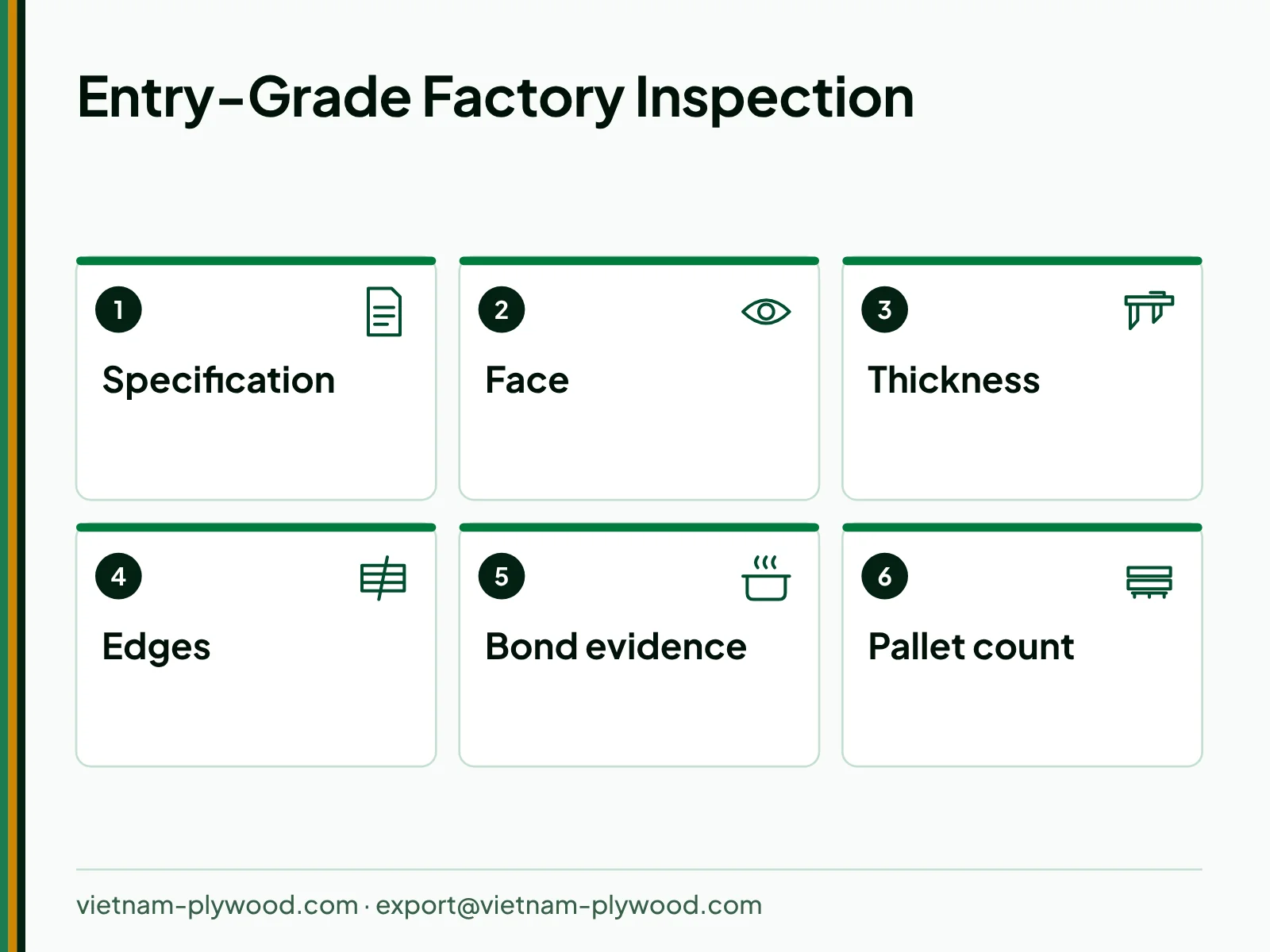
- Match the identification. Read the face, core, glue, emission class, nominal thickness, size and packing marks against the order.
- Check the surface. Inspect the agreed face grade under ordinary viewing conditions; separate permitted cosmetic variation from damage that interferes with use.
- Measure thickness. Sample across panels and compare measurements with the specified tolerance, including the wider packing allowance when applicable.
- Inspect cut edges. Look for core gaps, loose veneers and open glue lines at the places where fasteners or machining will act.
- Check flatness and bonding evidence. Compare representative sheets with the approved sample and review the agreed test reports rather than assuming a smooth face proves bond performance.
- Witness packing. Count sheets and pallets by specification, review marks and check that mixed weights fit the loading plan.
What documents protect a low-price import?
The shipment paperwork should identify the contracted build, quantity and origin clearly enough to reconcile the goods with the purchase specification. A low-grade face does not reduce customs or regulatory obligations.
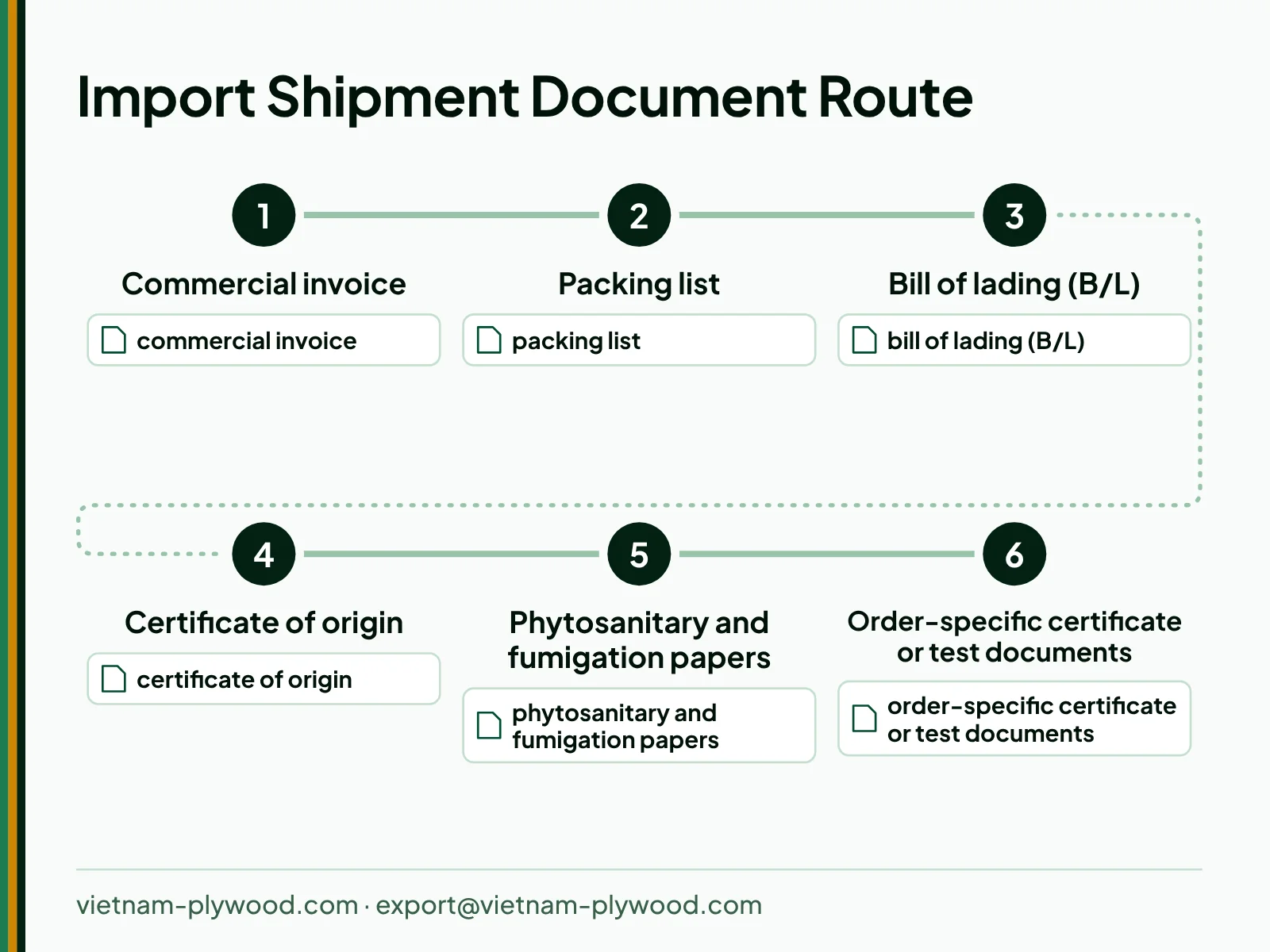
HCPLY prepares a commercial invoice, packing list, bill of lading (B/L), certificate of origin, phytosanitary and fumigation papers, and the order-specific certificate or test documents. EU lots include EUR.1 where applicable and the EUTR/EUDR file set; CIF includes insurance. After loading, the draft shipping documents come to you for approval.
For EU transactions, Regulation (EU) 2023/1115, adopted in 2023, addresses due-diligence information for covered wood products; see the Official Journal text on EUR-Lex. Buyers should match the species and shipment information to their own import obligations rather than treating a face grade as a compliance category.
FSC, CARB P2, ISO 9001 and CE certificates, along with EUDR/EUTR documents, belong to the member factories and are shown with factory details masked, on request. The specific certificate or test report required for the agreed order should be identified before production. This also helps prevent a lower-cost substitute from changing the compliance basis.
How can an importer keep the order economical?
An economical order locks down the few features that affect the end use, then avoids paying for cosmetic upgrades the buyer cannot recover. The purchasing team should separate performance requirements from optional appearance preferences.
Start with the application and decide whether the sheet will be visible, machined, exposed to moisture or loaded through fasteners. Choose a line and core accordingly. Then specify the lowest acceptable face and core construction, a glue category, an emission class and measurable dimensional limits. Ask for a reference sample before final approval.
Compare quotations in the same units and delivery term. A cheap plyboard quote with no thickness tolerance or core assembly description cannot be compared fairly with a defined panel. An importer should also distinguish unit price from unusable-sheet losses, rework, storage and possible replacement costs.
Production takes 15–45 days from the 30% deposit, set by order size, line loading and the contract. The remaining 70% is paid on the scan of the bill of lading, by T/T, or by irrevocable sight L/C. The production lead-time explanation helps purchasing teams align the grade decision with their shipment schedule.
Which specification should you send for a sample?
Send a specification that names the intended use and the lowest acceptable build, then compare the sample against that written acceptance standard. Lucy can coordinate samples for the relevant line and the producing factory’s inspection arrangement.
Free samples are available. New buyers book their own courier, and the courier cost can be credited against a real order. For a mixed purchase, label each sample by line, face and core so the approved appearance does not become confused across products.
A practical request for cheap ply sheets should also name the destination port. That lets the quotation separate FOB manufacturing value from the chosen shipping term and destination costs. The following template gives the factory the fields needed to price and sample a defined entry-grade build.
Application: Industrial packing crates / concealed cabinet component / temporary formwork
Line or core: Commercial and packing / acacia (or specified alternative)
Glue: MR melamine / WBP phenolic
Emission: E0 / E1 / E2 / applicable certified requirement
Face and grade: Unfaced matt / named veneer and agreed A or B / specified film
Thickness and tolerance: ___ mm; ___ mm
Size: ___ × ___ mm
Quantity: ___ sheets; pallet mix; minimum one 40HC
Destination port: ___
Ask Lucy at export@vietnam-plywood.com for a sample set using this specification through the contact page.