





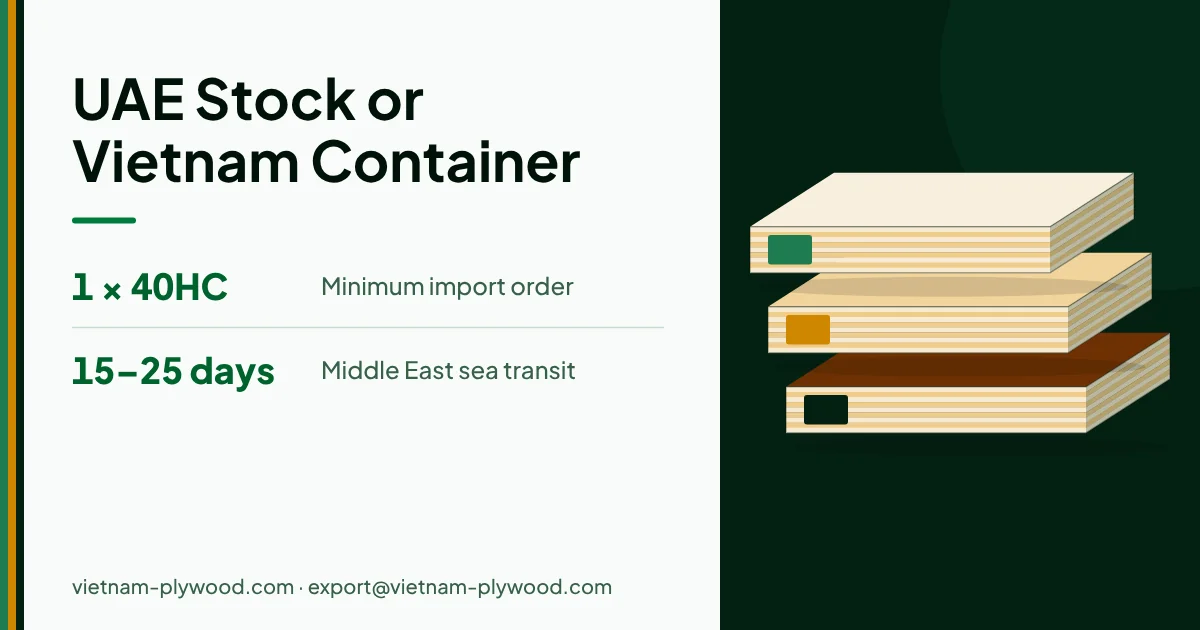
Should plywood Dubai buyers use local stock or import?
For plywood Dubai procurement, local stock suits urgent small releases, while a direct container order suits planned volume with a written panel specification. The wrong route can leave an importer paying for unused stock, waiting through a production cycle, or rejecting panels that do not match the end user’s build. Compare the landed cost and the actual inspection evidence before placing either order.
A UAE distributor may need immediate replacement sheets for an existing customer. A planned furniture programme or recurring formwork order offers more time to specify the panel at production. HCPLY manufactures in Vietnam and ships from the producing factory, FOB Hai Phong. The decision starts with the customer’s delivery window and acceptance criteria, rather than a broad supplier directory.
For the broader purchasing framework, see our plywood buying guides and second-source supplier checklist.
Which purchasing route fits each UAE order?
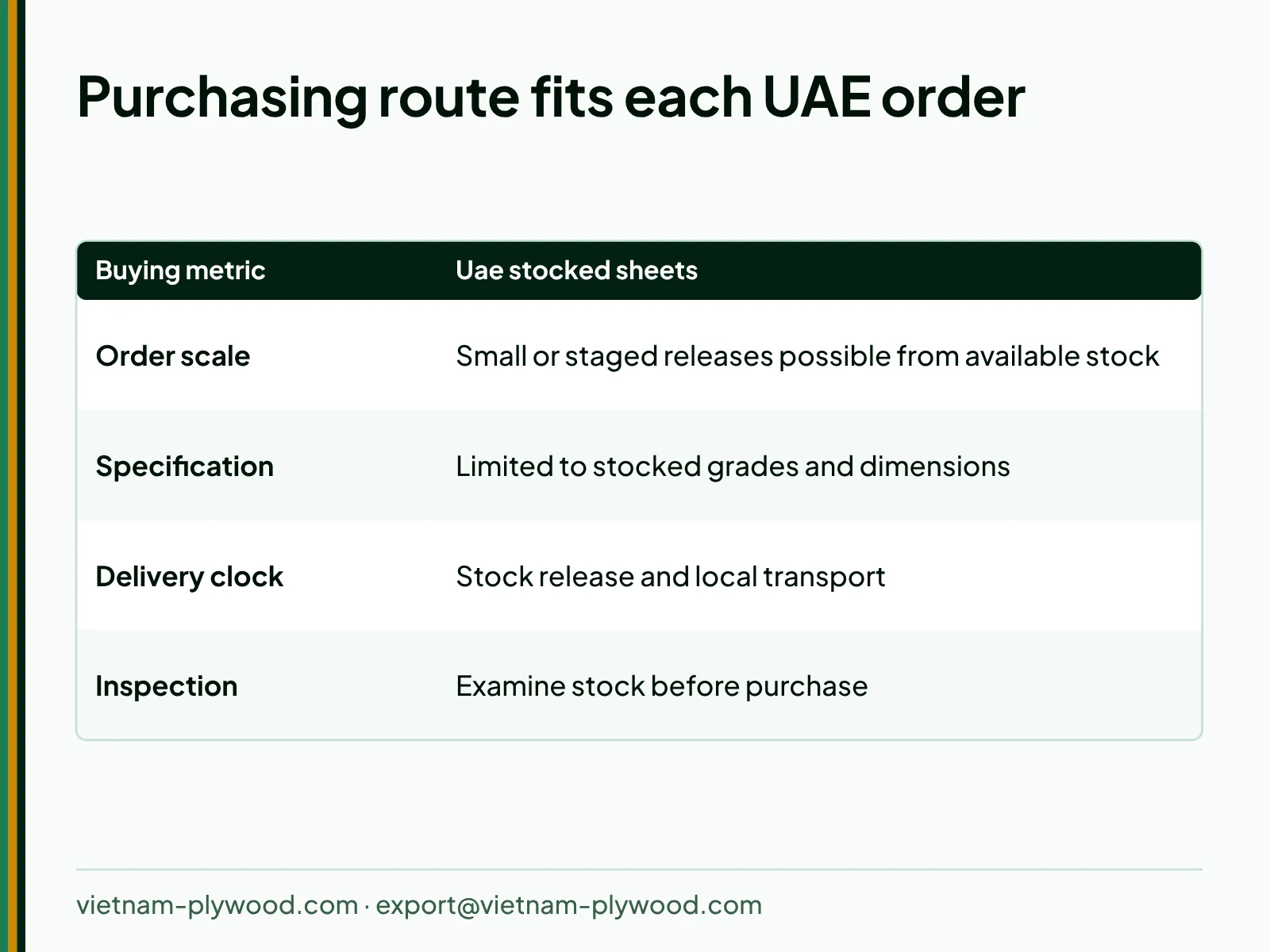
Use the following comparison to separate immediate availability from specification control. Neither route wins every purchase: the useful metric is the cost of meeting the required grade at the required delivery point.
| Buying metric | UAE stocked sheets | Factory container from Vietnam | Verdict by use |
|---|---|---|---|
| Order scale | Small or staged releases possible from available stock | Minimum one 40HC | Local for small replenishment; import for planned volume |
| Specification | Limited to stocked grades and dimensions | Build written around core, face, glue and tolerance | Import for repeatable private specifications |
| Delivery clock | Stock release and local transport | Production 15–45 days from the 30% deposit, set by order size, line loading and the contract; then sea transit | Local for urgent site gaps |
| Inspection | Examine stock before purchase | Witness production and loading at the producing factory | Choose by the evidence your customer requires |
| Price comparison | Local delivered sheet price | Factory quote plus freight, insurance when applicable, clearance and inland delivery | Compare landed cost for identical panels |
A distributor carrying many sizes may combine local replenishment with scheduled imports. A contractor buying against a fixed pour programme should also compare the cost of delayed formwork against any apparent saving per cubic metre.
What does a container order actually buy?
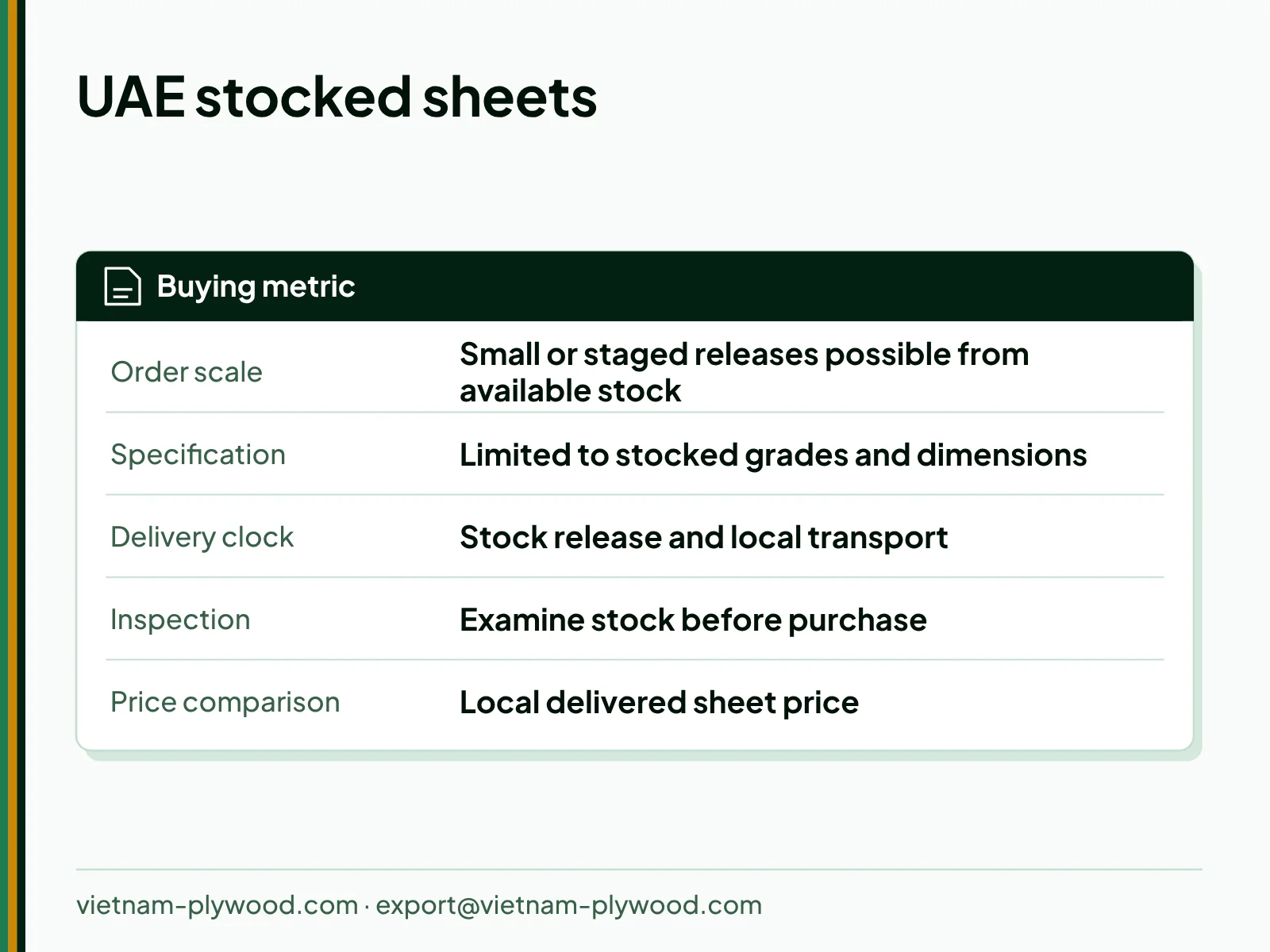
One 40HC is the minimum order, and specifications can be mixed within the 28.5 t payload limit. For 18 mm, 1220×2440 mm panels, the full-container lookup is 990 styrax-core sheets at 26.52 t, 880 acacia-core sheets at 27.35 t, or 795 eucalyptus-core sheets at 27.69 t. These figures exclude film weight.
That difference matters when a distributor wants both cabinet faces and general-purpose sheets. A mixed load needs a pallet-by-pallet weight plan, not a simple addition of full-container quantities. See the mixed-container ordering method and the detailed container loading reference.
HCPLY’s furniture and commercial plywood capacity is up to 100 containers a month; construction plywood capacity is up to 140. Those are line capacities, while an actual order follows its agreed production schedule.
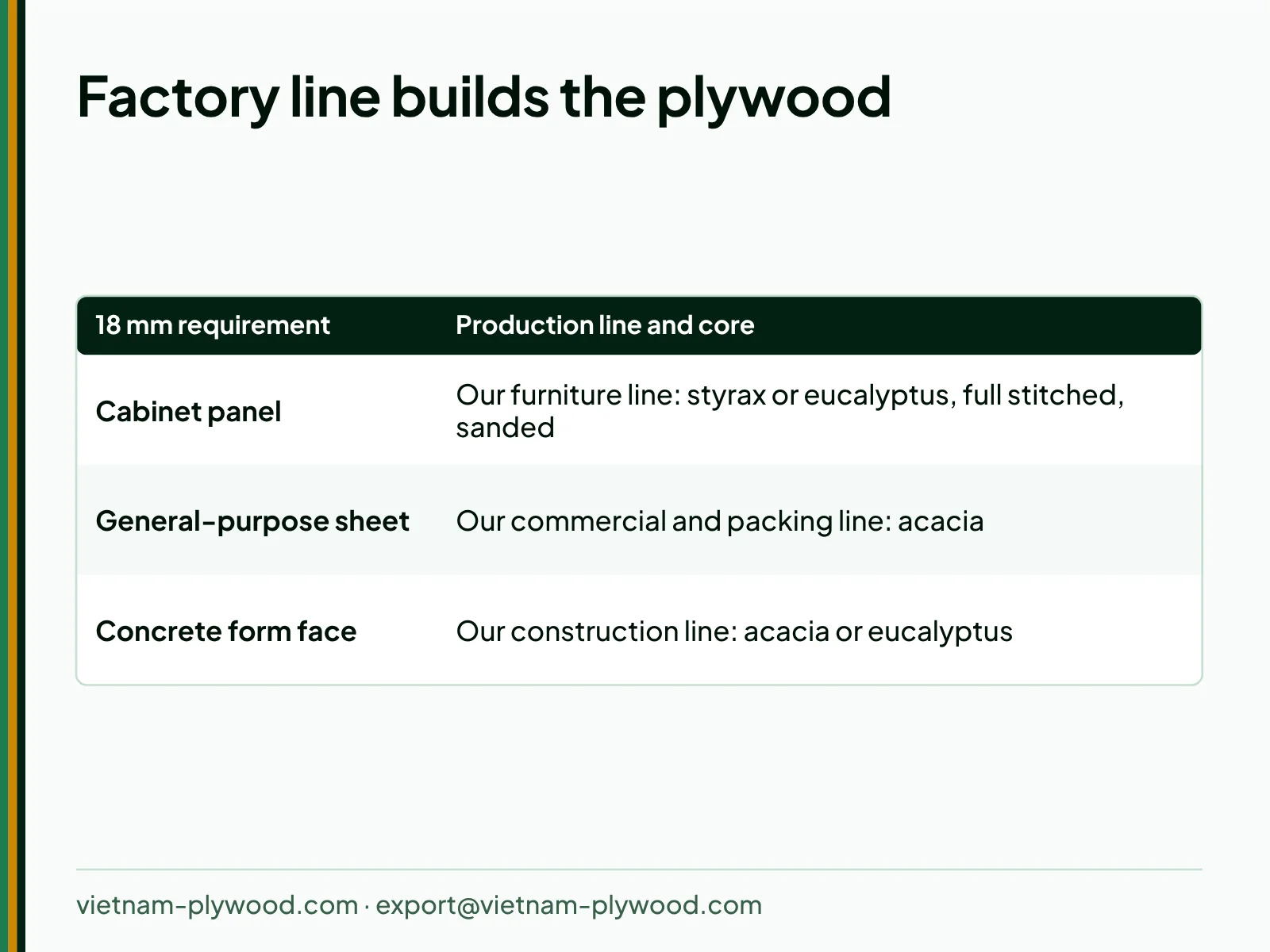
Which factory line builds the plywood?
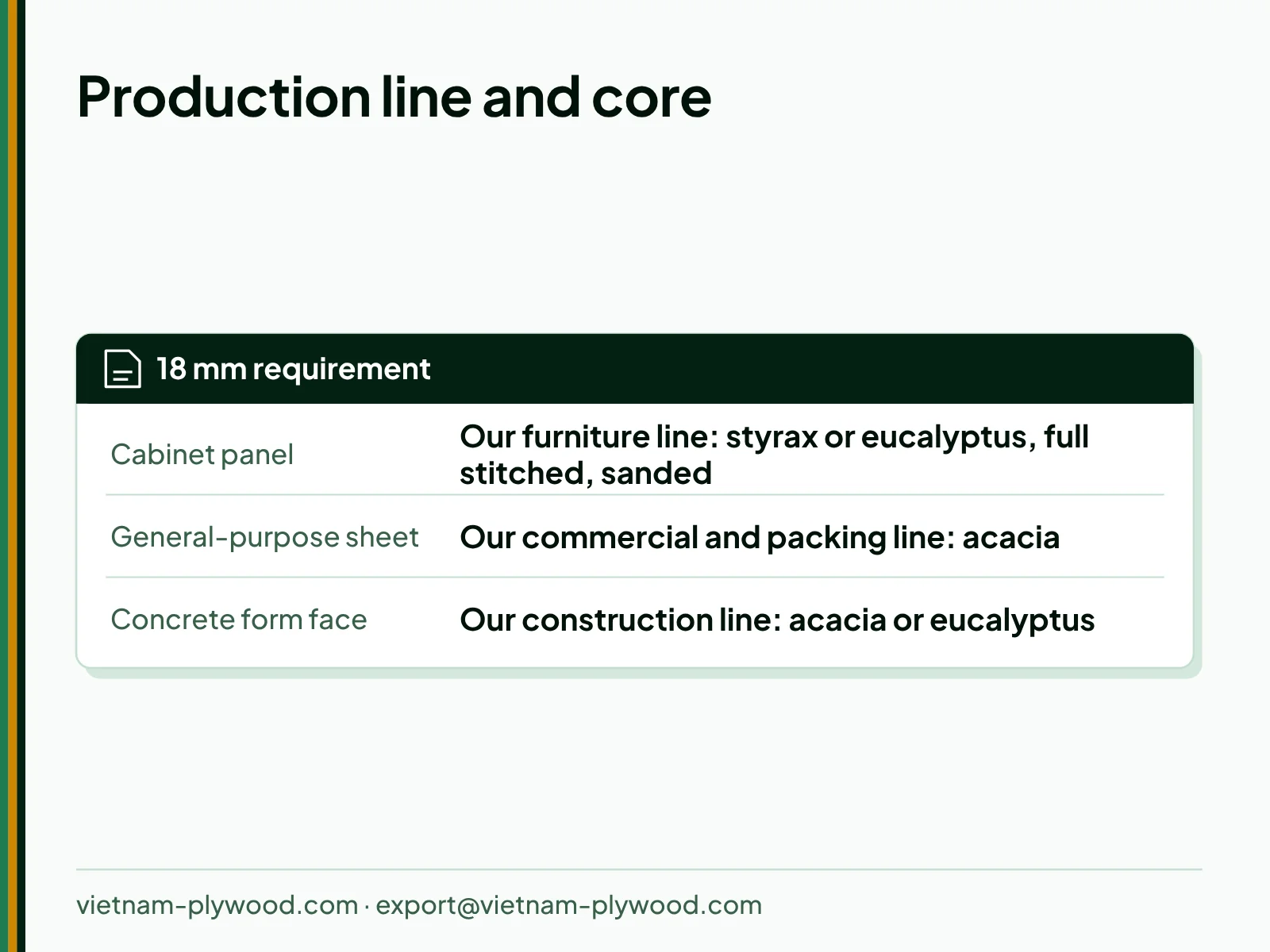
The intended application determines the pressing line and the inspection points. Our three factories are in Phu Tho and Hai Phong, with separate furniture, commercial and packing, and construction operations.
| 18 mm requirement | Production line and core | Surface and bond choice | Buyer use |
|---|---|---|---|
| Cabinet panel | Our furniture line: styrax or eucalyptus, full stitched, sanded | Veneer face, E0 or E1 emission class | Visible furniture and cabinets |
| General-purpose sheet | Our commercial and packing line: acacia | MR glue, unsanded or light-sanded | Distribution and packaging |
| Concrete form face | Our construction line: acacia or eucalyptus | Phenolic or melamine film; unsanded core | Formwork yards and contractors |
An 18 mm callout alone cannot make these builds interchangeable. For cabinets, face grade and sanding tolerance matter; for packing, handling and core construction matter; for formwork, film, glue and edge protection matter. The furniture plywood specification and construction project supply overview cover those distinct applications.
What specifications should a UAE distributor lock?
Write the product description as a measurable acceptance schedule. HCPLY’s common thicknesses include 3, 5, 9, 12, 15, 18, 21 and 25 mm within a 3–40 mm range. Common formats include 1220×2440 and 1250×2500 mm, with other listed formats and custom cutting available.
For furniture, specify a sanded thickness tolerance of ±0.2 or ±0.3 mm as ordered. Commercial and film-faced tolerances are ±0.5 mm; packing tolerances are ±0.5–1.0 mm, with length and width ±2 mm. Face options include bintangor, okoume, engineered veneer, gurjan, pine, poplar, eucalyptus, birch and sapele; birch face grades are D/E/F, while other veneer faces use A/B.
Glue and emissions need separate entries. Melamine MR is a 12-hour boil designation, while phenolic weather-and-boil-proof (WBP) is a 72-hour boil designation. E0, E1 and E2 are emission classes; CARB Phase 2 and TSCA Title VI concern US emission limits and third-party certification. A ‘marine’ or structural requirement must be assessed against a test report the buyer accepts.
How should plywood Dubai prices be compared?
Commercial plywood starts from US$250/m³ FOB Hai Phong (October 2026); furniture plywood starts from US$350/m³ FOB Hai Phong (October 2026). These are different builds and different starting points, so compare matched specifications rather than treating either as a Dubai delivered price.
For film-faced formwork, request a quotation against the written build. Core construction, glue, film weight, thickness, size and volume shape the factory price. A full-stitched furniture core requires more core preparation than loose-laid construction; heavier film adds facing material. Local quotes should be converted to the same sheet dimensions, thickness and delivered location before comparing.
The import calculation then adds freight, insurance where purchased, port and clearance charges, applicable duties and taxes, inland transport and stock carrying costs. A local quote may already include some of those items. Keep them visible as separate lines in the comparison sheet.
What should buyers check on film-faced shuttering?
Film-faced plywood for concrete formwork is specified by face weight, bond and handling conditions. Our construction line uses 120 g/m² standard film, 135 g/m² premium film, or 220 g/m² anti-slip film only. Anti-slip is a surface choice for the relevant application, not a substitute for a formwork design check.
With proper handling, a release agent on every pour and sealed edges including cut edges, melamine-glue film-faced panels achieve about 12–15 pours; phenolic-glue panels reach up to about 25 pours. These counts are tied to that handling regime. Buyers should match the target finish, reuse plan and panel support system before approving a shipment.
Inspect film continuity, edges and the stated bond build on sample panels. Face colour by itself does not establish adhesive type or panel performance.
How can an importer inspect before loading?
A buyer or appointed inspector can visit the producing factory to check the ordered build before shipment. For a furniture lot, measure thickness at agreed positions, inspect sanding and face grade, and check core gaps at accessible edges. For a construction lot, inspect film, edge sealing and the agreed panel dimensions.
The factory office hosts buyer visits, while goods are inspected where they are produced. Compare pallet marks, panel counts and the inspection record with the order specification. Photographs of a sample face cannot replace checks across the production lot.
Request the relevant member-factory FSC, CARB P2, ISO 9001 or CE documents only where the order calls for them; documents are shown with factory details masked, on request. The certificate scope and the particular product build should be checked together. See how to assess a Vietnam plywood supplier.
Which UAE import papers and trade terms apply?
The U.S. International Trade Administration’s 2025 UAE import guide states that importers need an appropriate trade licence and identifies the commercial invoice, certificate of origin and detailed packing list among standard documents. Its UAE import documentation guidance also identifies import permits for restricted or duty-exempt goods. Dubai Customs’ declaration service lists invoice, packing list, certificate of origin and permits from restriction entities.
HCPLY provides the commercial invoice, packing list, bill of lading, certificate of origin, phytosanitary and fumigation papers, insurance under CIF, and the order’s agreed certificate or test documents. After loading, the draft shipping documents come to you for approval. UAE clearance arrangements remain with the importing entity and its appointed customs service provider.
Delivery can be FOB Hai Phong, CFR (CNF) or CIF. The production period is 15–45 days from the 30% deposit, set by order size, line loading and the contract. The 70% balance is against the scanned bill of lading, by telegraphic transfer or irrevocable letter of credit at sight.
How should UAE arrival timing be planned?
The stated Middle East sea-transit range from Hai Phong is 15–25 days, by carrier and route. It follows production and precedes local clearance and delivery. A buyer scheduling site supply should put these stages on separate lines instead of quoting sea time as door-to-door delivery.
Begin with the last acceptable warehouse arrival date, then work backward through clearance, sailing and production. Allow time for approving the panel specification, samples and shipping document drafts. For orders tied to a construction programme, keep a local buffer for unexpected demand rather than scheduling every sheet to arrive on the next vessel.
The Vietnam plywood order calendar provides a framework for placing recurring orders. A buyer working across languages can also use the plywood naming crosswalk to reduce misunderstandings in purchase orders.
What should the first quotation request include?
A useful quotation starts with the intended application and a panel description that both parties can inspect. State the destination port in the UAE and whether the comparison needs FOB, CFR or CIF. Separate any requirement for a test report from the surface name used in local trade.
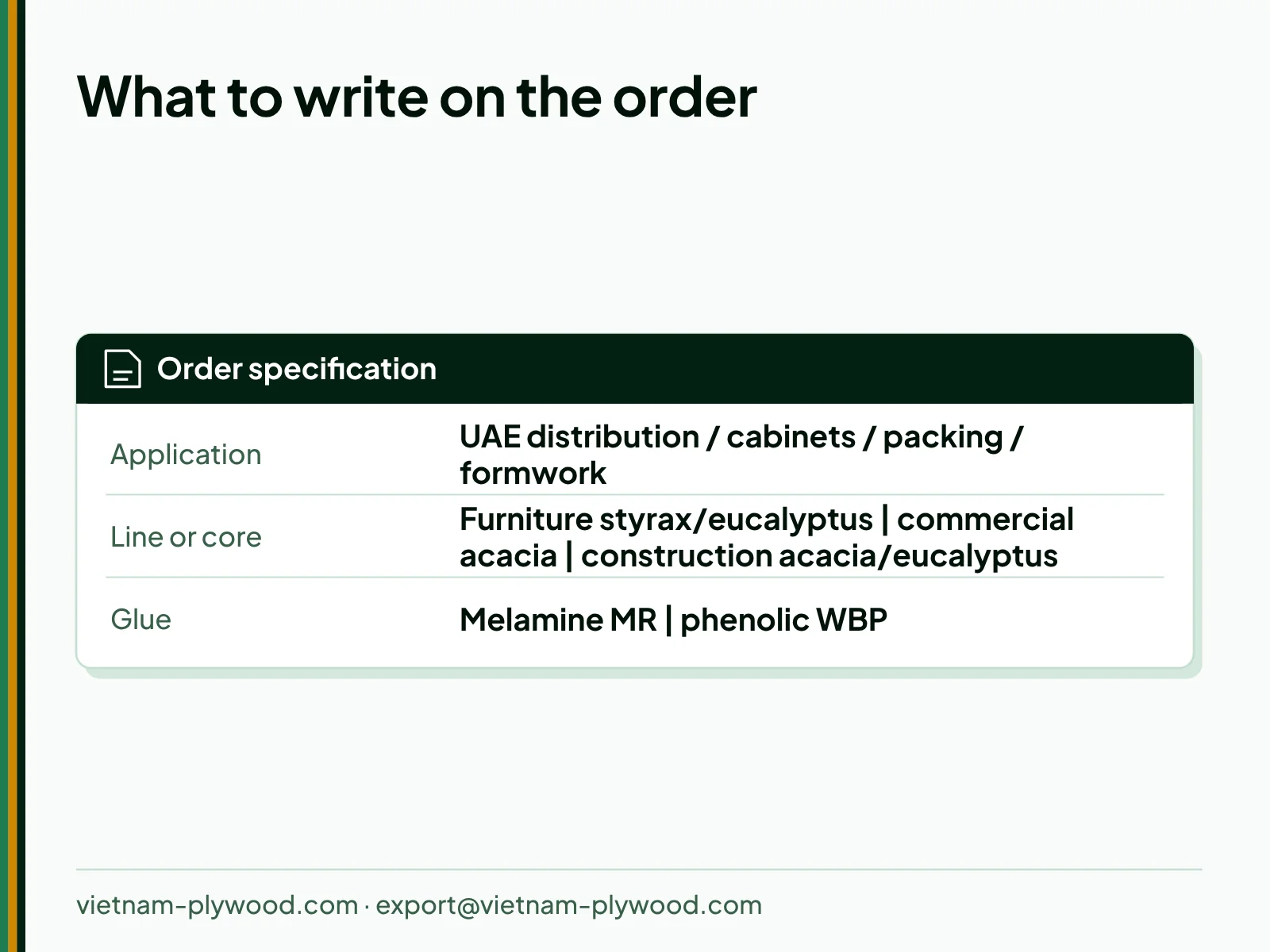
Free samples are available; a first-time buyer pays the courier, and that charge comes off the first confirmed order. Send the specification below to Lucy at export@vietnam-plywood.com or through the contact form.
Application: UAE distribution / cabinets / packing / formwork
Line or core: furniture styrax/eucalyptus | commercial acacia | construction acacia/eucalyptus
Glue: melamine MR | phenolic WBP
Emission: E0 | E1 | E2 (as applicable)
Face and grade: veneer species + A/B or birch D/E/F | film weight
Thickness and tolerance: ___ mm; ___ mm
Size: ___ x ___ mm
Quantity: ___ sheets / pallets / 40HC
Destination port: ___, United Arab Emirates
Ask for a sample set against this written specification before committing the container order.