





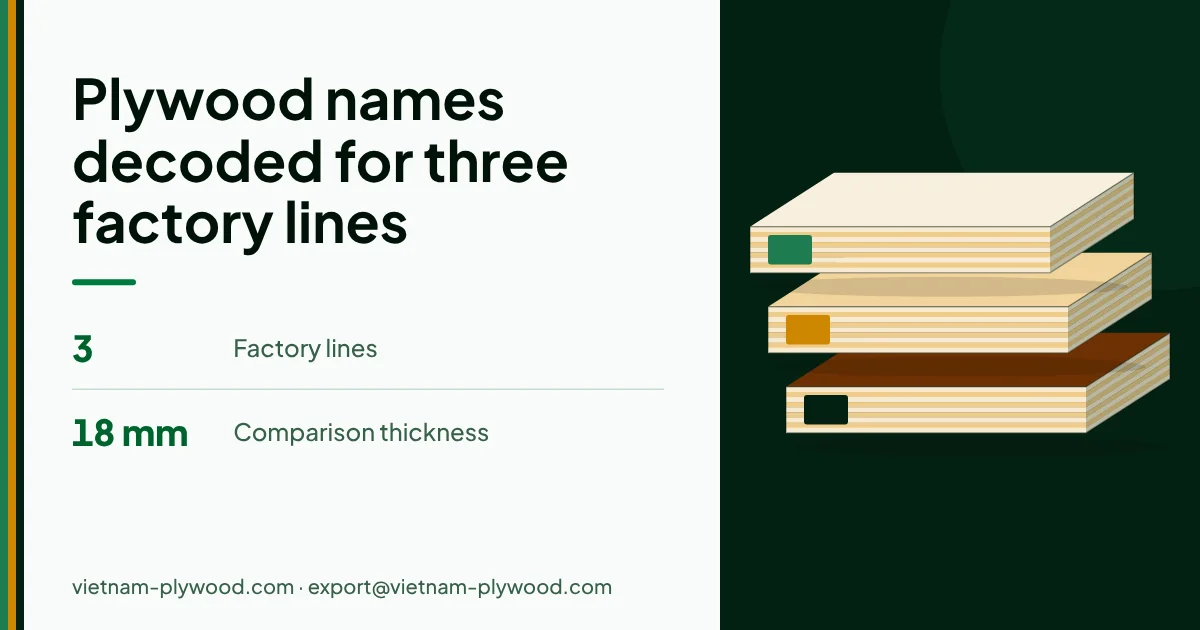
Plywood deutsch usually means Sperrholz, while Multiplex describes a more specific layered-panel expectation in German purchasing language. A wrong translation can send a furniture RFQ to a formwork specification, wasting sampling costs and delaying acceptance. At HCPLY, the local name starts a specification discussion; the application and build decide which producing factory presses the order.
A translated name alone cannot establish core construction, bonding, face grade or emission class. This buying-guides reference connects common multilingual terms with the details a plywood importer should write into an RFQ.
What does plywood deutsch mean on a German RFQ?
Plywood deutsch is usually Sperrholz; Multiplexplatte commonly signals a multi-ply panel with a visible layered edge. Neither word alone specifies veneer species, bonding or an accepted grade. A German cabinet maker requesting Multiplex may expect a different edge appearance from a buyer asking for generic Sperrholz for concealed packing parts.
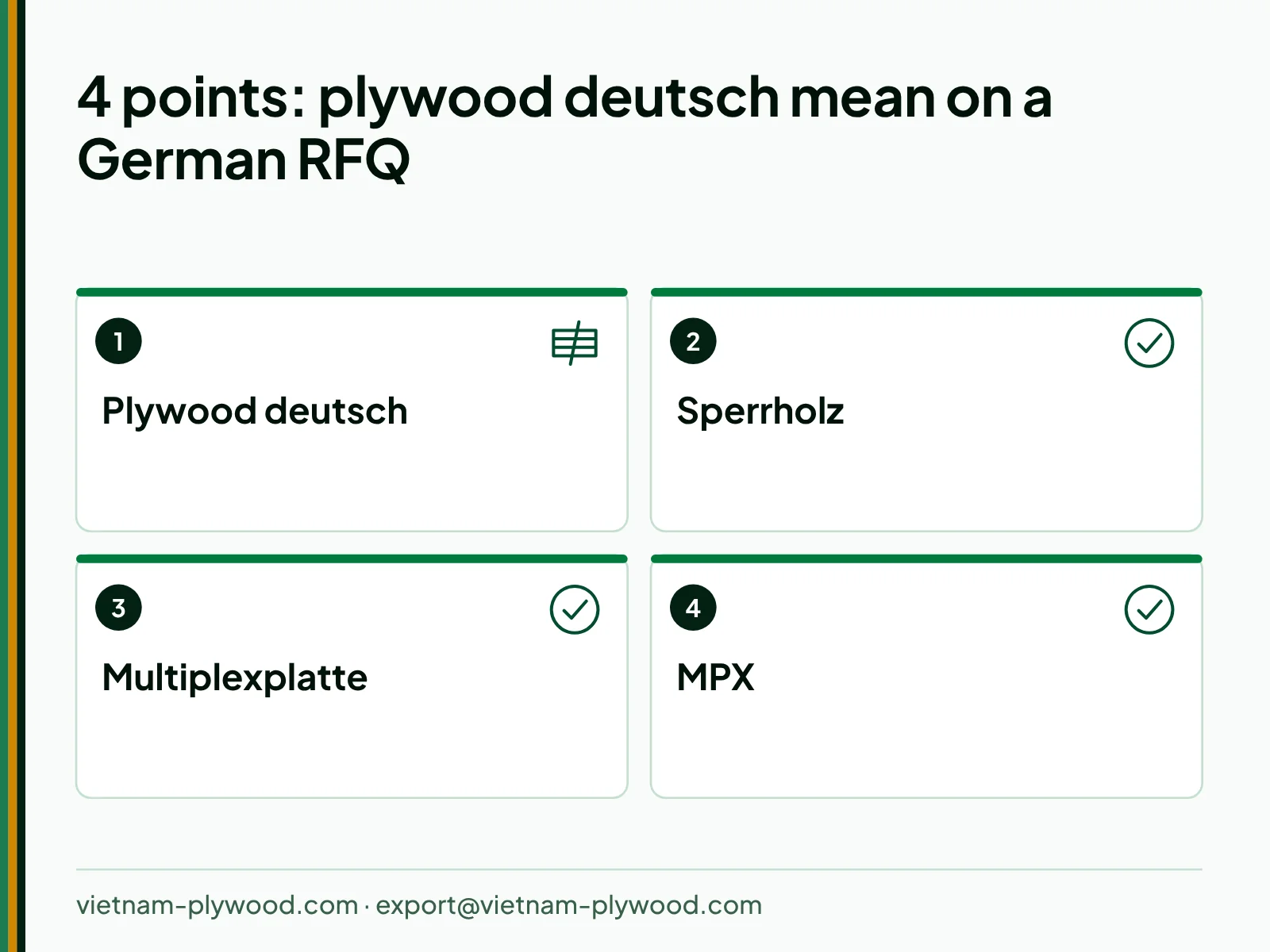
The distinction matters when a drawing shows exposed edges. A full-stitched, sanded furniture build fits a cabinet-facing request; a rougher commercial build fits concealed uses. A term such as Siebdruckplatte usually points toward film-faced construction panels, often with a textured face. Schalungsplatte points to formwork by application, although its surface still needs specification.
In German purchasing conversations, MPX is shorthand associated with Multiplex. It is not an independent certification or a fixed ply-count requirement. For comparison, the three-line grade comparison shows why the core construction must accompany the local name.
What is plywood in Spanish and French?
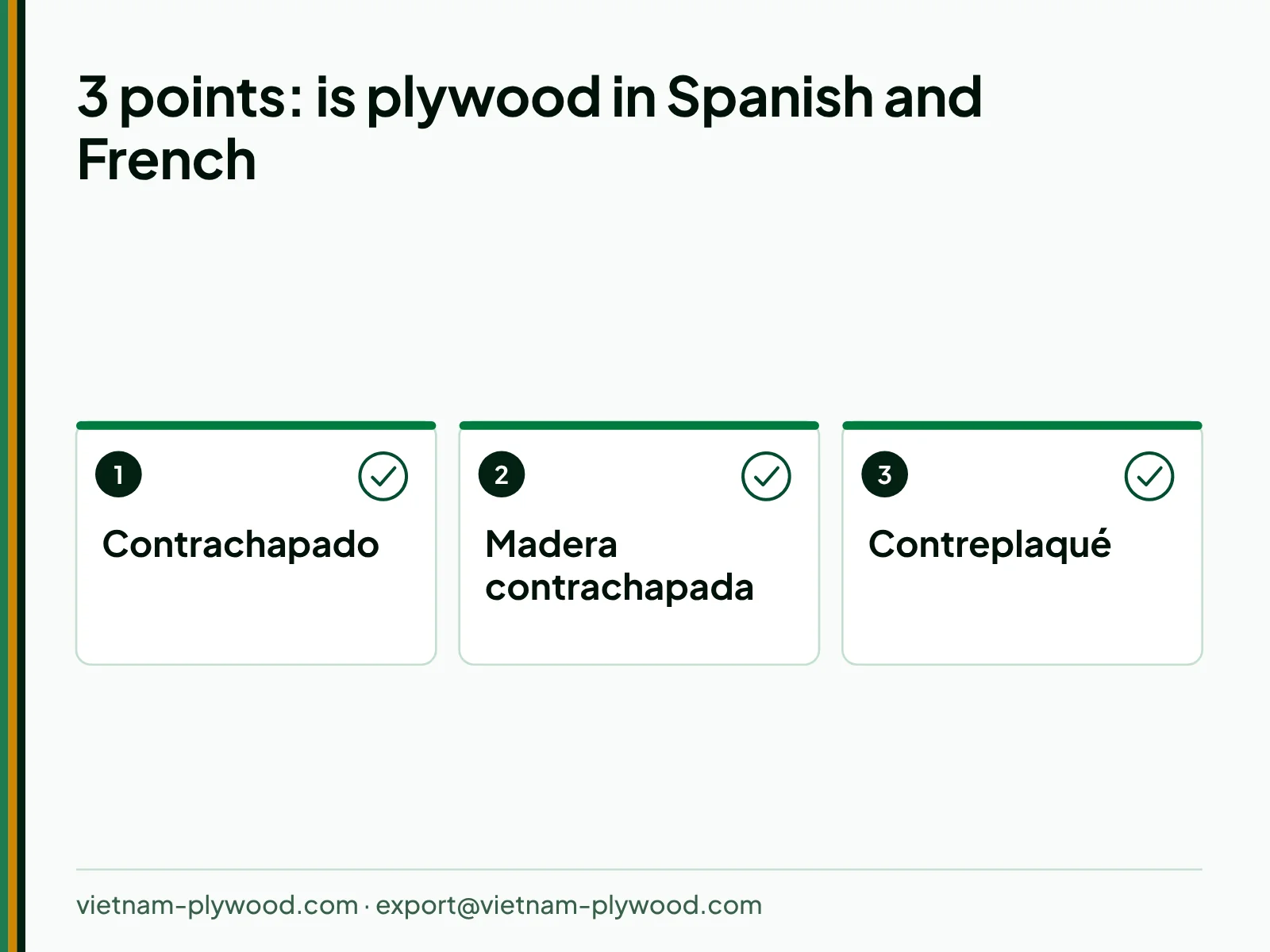
In Spanish, plywood is contrachapado or madera contrachapada; triplay is another regional commercial term. In French, it is contreplaqué, commonly written panneau contreplaqué on a specification. These names identify a panel family, while contrachapado fenólico or contreplaqué filmé adds a clue about bonding or facing.
A Spanish plywood RFQ for cabinetry should name the visible veneer, face grade and finish requirement. An RFQ for concrete shuttering should instead state film surface, glue system and edge treatment. The same translation can therefore lead to quite different bills of materials.
The French expression contreplaqué marine also requires care. The word marine describes an intended performance category in market language; for an HCPLY order it is used only against a test report the buyer accepts. It does not follow automatically from an okoume face or a phenolic adhesive.
What are plywood names in Greek, Dutch, Bulgarian and Arabic?
These translations help an export team recognize the RFQ before reviewing the drawings. The right-hand column gives a likely conversation starter, rather than a binding product specification.
| Language or search wording | Common local term | Initial RFQ interpretation | Detail to request |
|---|---|---|---|
| German, plywood german | Sperrholz; Multiplex | General panel; often furniture for Multiplex | Edge, face and core |
| Spanish, plywood en español | Contrachapado; triplay | Furniture or general panel | Application and bonding |
| French, plywood en francais | Contreplaqué | General plywood | Face grade and use |
| Greek, plywood greek | Κόντρα πλακέ (kontra plaké) | General plywood | Surface and use |
| Dutch, plywood in dutch | Multiplex; triplex | Joinery or general plywood | Ply construction and face |
| Bulgarian, plywood in bulgarian | Шперплат (shperplat) | General plywood | Glue and application |
| Arabic, plywood in arabic | خشب أبلكاش (khashab ablakash); خشب رقائقي | General plywood | Core, face and use |
| Portuguese, plywood em português | Contraplacado; compensado | General plywood | Market usage and specification |
| Chinese, plywood in chinese | 胶合板 (jiāohébǎn) | Generic plywood terminology | Full technical specification |
The Chinese entry is a translation reference, not an HCPLY sales-market invitation. Arabic spellings and transliterations differ across purchasing documents, so retain the buyer’s original script alongside the English build description. Greek and Bulgarian characters should also remain intact on internal RFQ records.
What does plywood fenolico mean in an RFQ?
Plywood fenolico usually refers to phenolic-bonded plywood, but in some buying contexts it means phenolic-film-faced formwork board. Ask whether fenólico describes the adhesive, the overlay, or both. The distinction changes surface appearance, press conditions and inspection points.
Our construction line makes phenolic or melamine film-faced plywood with acacia or eucalyptus core. Phenolic glue is described as weather and boil proof (WBP), with a 72-hour boil classification; melamine glue is moisture resistant (MR), with a 12-hour boil classification. These glue terms are separate from emission classes E0, E1 and E2.
For a formwork RFQ, specify smooth film or anti-slip film, required film weight, edge sealing and intended release-agent practice. Standard film is 120 g/m², premium film 135 g/m², and anti-slip film 220 g/m² only. An RFQ saying fenolico without these fields leaves too much room for a wrong face to be pressed.
What does triplek mean?
Triplek is an Indonesian and regional trade word for plywood, frequently used without a precise core or face grade. It does not necessarily mean a panel with exactly three plies. Treat it as the product family, then request the actual thickness, core assembly and intended use.
For cabinet carcasses, a triplek inquiry can point to our furniture line when the buyer specifies sanded faces and a stitched core. For crate parts, the commercial and packing line is a more fitting starting point. If the buyer means reusable concrete formwork, the construction line needs film and glue details instead.
The word also resembles a company or website name in English. Search results for a matching spelling can be unrelated to plywood; the surrounding words in the RFQ matter more than the isolated term.
Which names point to furniture, packing or formwork?
Furniture-panel words such as cabinet Multiplex and decorative contreplaqué suggest our furniture line; shuttering words such as shperplat za kofrazh point toward our construction line. Generic Sperrholz, triplek and contrachapado require the application before a line is chosen.
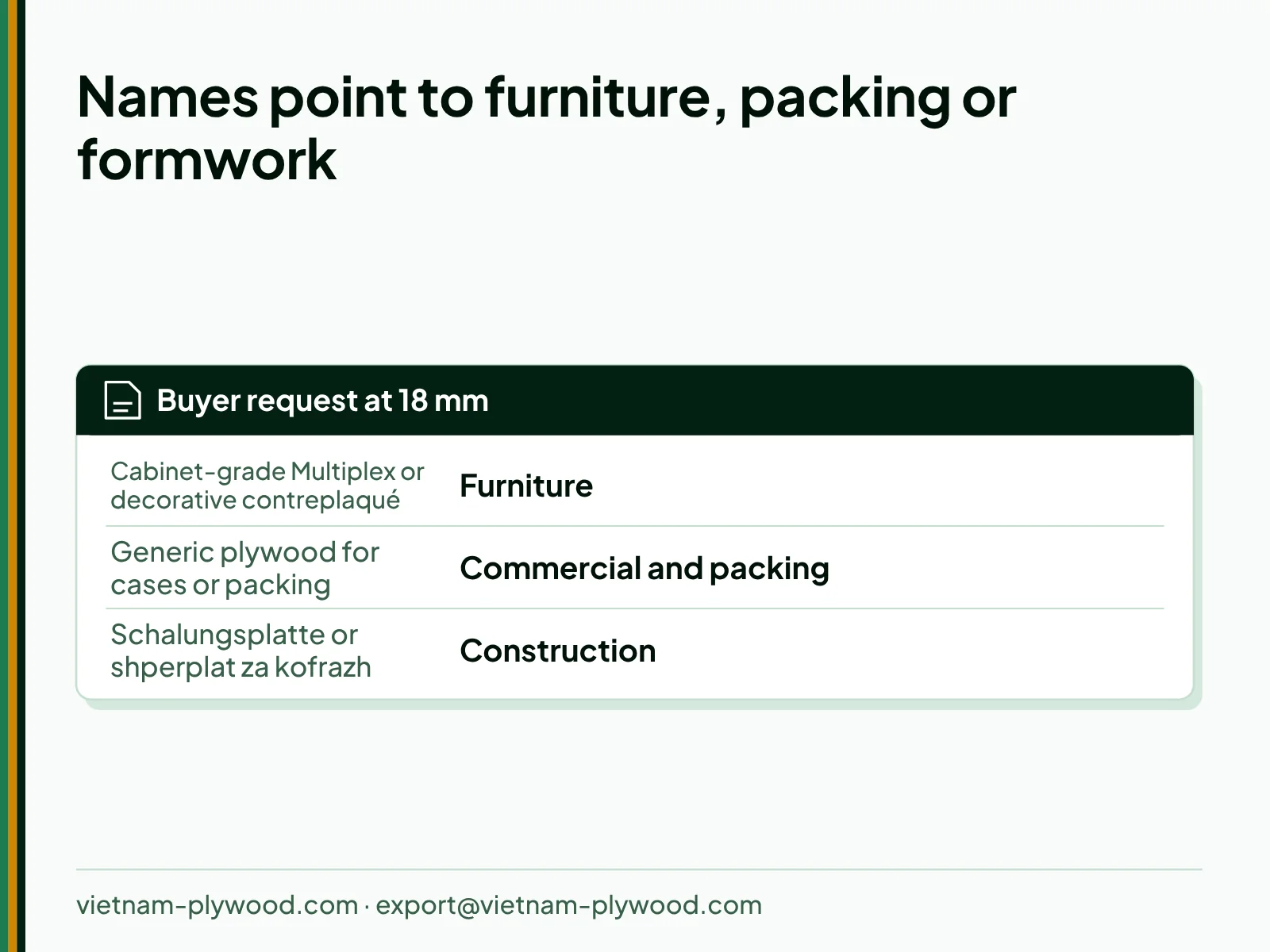
| Buyer request at 18 mm | Producing line | Core and surface build | Inspection emphasis |
|---|---|---|---|
| Cabinet-grade Multiplex or decorative contreplaqué | Furniture | Styrax or eucalyptus, full stitched, sanded, E0/E1 | Face, edge and thickness |
| Generic plywood for cases or packing | Commercial and packing | Acacia, MR glue, unsanded or light-sanded | Core gaps, cut size and stacking |
| Schalungsplatte or shperplat za kofrazh | Construction | Acacia or eucalyptus, film-faced, unsanded | Film, edges and bonding |
At the same nominal thickness, those are different products. Furniture sanding tolerance is ±0.2 or ±0.3 mm as ordered; commercial and film-faced tolerance is ±0.5 mm, while packing tolerance is ±0.5–1.0 mm. Length and width tolerance is ±2 mm. For a more detailed furniture plywood specification, identify the face and emission class separately.
How should a buyer translate a local name into a build?
A usable multilingual RFQ starts with the local term and ends with an English manufacturing specification. Follow these steps before comparing quotations.
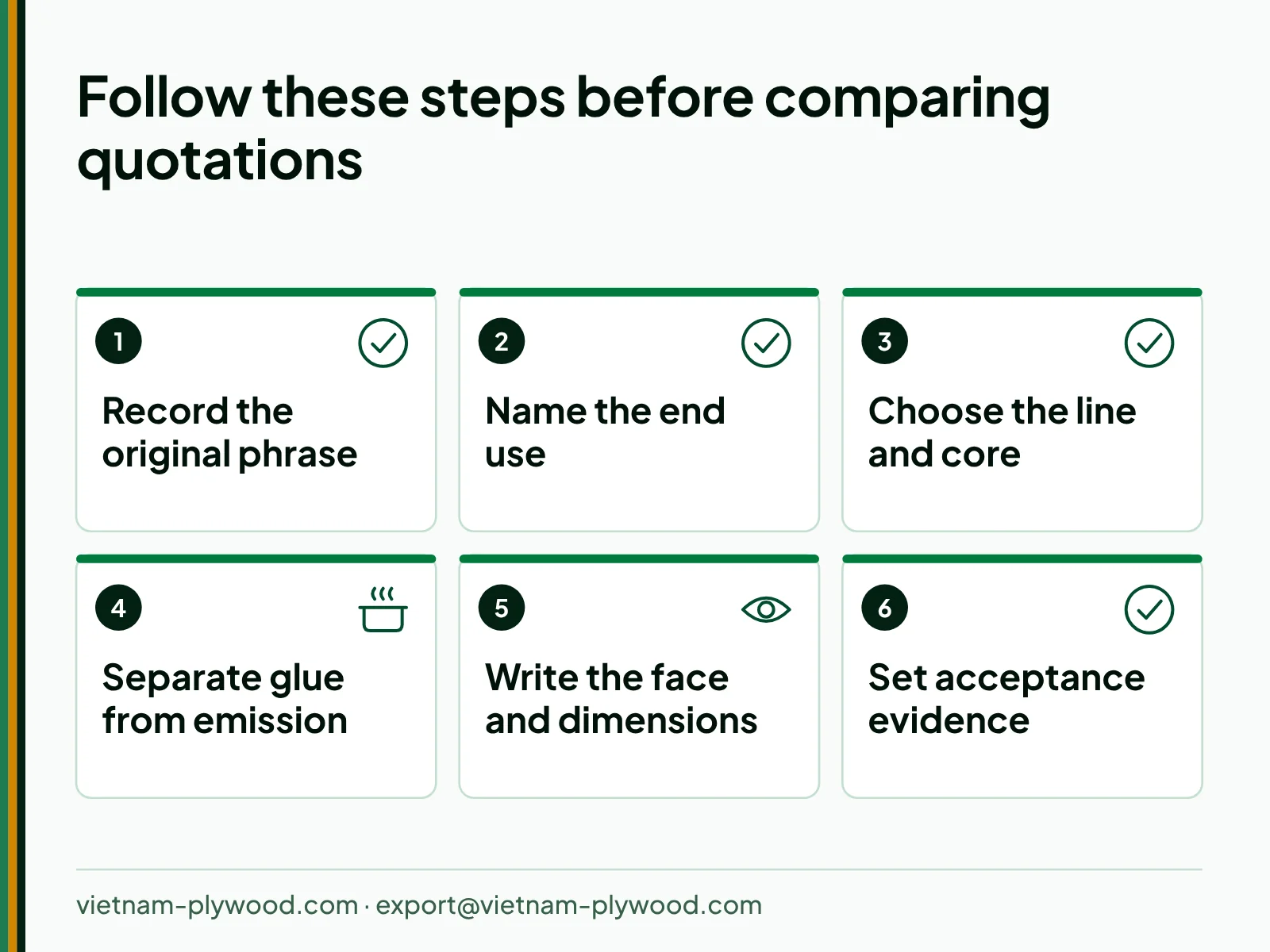
- Record the original phrase. Keep accents and non-Latin characters, including shperplat za kofrazh (Bulgarian for formwork plywood) and plywood en español.
- Name the end use. Cabinet, packing, shuttering and anti-slip platforms require different surfaces and core assembly.
- Choose the line and core. Furniture uses styrax or eucalyptus; commercial and packing uses acacia; construction uses acacia or eucalyptus.
- Separate glue from emission. Specify MR or WBP independently of E0, E1 or E2; a US emissions requirement calls for the applicable CARB P2 / TSCA Title VI evidence.
- Write the face and dimensions. State veneer or film, grade, thickness, tolerance and sheet size rather than relying on the translated noun.
- Set acceptance evidence. Agree which sample, test report and producing-factory inspection checks govern the order.
HCPLY uses the English build specification to allocate production. The multi-product ordering overview explains how separate applications can be handled within an export programme.
Why does the face name differ from the core name?
Plywood is commonly named by its face veneer, while density follows the core species. A request for birch-faced plywood therefore does not automatically mean birch-core plywood. Our available Vietnamese cores are styrax at 500 kg/m³, acacia at 580 kg/m³ and eucalyptus at 650 kg/m³.
Face options include bintangor, okoume, engineered veneer (EV), gurjan, pine, poplar, eucalyptus, birch and sapele. Matt denotes an unfaced raw core. Common face veneer thickness is 0.2–0.4 mm. A/B is the stated face-grade convention for the listed faces other than birch, which uses D/E/F.
This is especially relevant when a buyer translates a timber species alongside contrachapado or Sperrholz. The species word might describe only the outer veneer. We do not press birch-core plywood, so an RFQ requiring that core needs a different product source.
How do mixed specifications affect a container order?
A mixed shipment is possible when the individual builds and total payload are stated. The minimum order is one 40HC, with specifications mixed within its 28.5 t payload limit. The container packing reference owns detailed loading calculations.
For a common 1220 × 2440 × 18 mm sheet, the lookup weights are 26.79 kg with styrax core, 31.08 kg with acacia and 34.83 kg with eucalyptus. A buyer who switches the RFQ from furniture styrax to construction eucalyptus changes the load calculation even when the translated name and thickness stay unchanged.
As an illustrative mixed-load arithmetic check, 400 styrax sheets weigh 10,716 kg, 300 acacia sheets weigh 9,324 kg and 200 eucalyptus sheets weigh 6,966 kg. Their combined panel weight is 27,006 kg, before pallets, film and other loading materials. This is an arithmetic illustration rather than a proposed pallet layout; loading must also fit the applicable stack heights and pallet configuration.
What can an inspector check at the producing factory?
The inspector can compare the approved English specification with the actual panels, labels and packing. At the producing factory, the buyer can witness thickness checks, face grading, edge and core inspection, and a count against the packing list.
For a furniture translation such as Multiplex, inspect the sanded surface, veneer grade and visible edge assembly. For a formwork translation such as shperplat za kofrazh, inspect film type, face condition and sealed edges, including cut edges. A word on an invoice cannot substitute for these physical checks.
Buyers visit the factory office and inspect goods where the order is produced. Our factory-visit information sets out that practical route. Samples cost nothing: a first-time buyer pays the courier, and that charge comes off the first confirmed order.
Which export document should carry the agreed name?
The commercial invoice and packing list should identify the agreed product description, quantity and package breakdown consistently. The bill of lading (B/L), certificate of origin, phytosanitary and fumigation papers form part of the shipment records. EU lots use EUR.1 where applicable and an EUTR/EUDR file set; insurance applies under CIF.
Order-specific certificate documents can include an FSC claim on sales documents, an emission certificate or test reports for the agreed build. Certificates held by member factories, including FSC, CARB P2, ISO 9001 and CE, are shown with factory details masked, on request. After loading, the draft shipping documents come to you for approval.
The English specification should remain consistent even if a local trade term is retained as a reference. For destination-side cost components, use the export cost breakdown and the European buyer guide.
How should the final RFQ be sent?
Send the original local name together with the complete build, so the quote compares the same panel. A distributor can use the plywood supply programme when several downstream customers use different local terms.
For a commercial acacia build, the indicative starting point is from US$250/m³ FOB Hai Phong (October 2026); for a furniture build it is from US$350/m³ FOB Hai Phong (October 2026). Film-faced and other grades need a written-build quotation. Core assembly, face selection, bonding, tolerance and quantity drive the comparison.
The European Union’s 2025 consolidated timber-product listing identifies heading 4412 as “Plywood, veneered panels and similar laminated wood” (EUR-Lex, 2025). That heading is broader than any one local sales name; product classification and order specifications serve different purposes.
Application: cabinet components / packing / concrete formwork
Original RFQ term and language: [write local wording]
Producing line or core: furniture—styrax / commercial—acacia / construction—eucalyptus
Glue: MR melamine / WBP phenolic
Emission: E0 / E1 / E2 or agreed market requirement
Face and grade: [veneer species and grade / film type and weight]
Thickness and tolerance: [mm and permitted deviation]
Size: [length × width in mm]
Quantity: [sheets or m³; mixed items listed separately]
Destination port: [port, country]
Next step: book a factory visit with Lucy at export@vietnam-plywood.com to inspect the proposed build at the producing factory.