






Adding a second plywood source without changing your specification starts with a matched reference panel and a controlled trial. A wrong core, adhesive or tolerance can cost freight, production days and a rejected load. HCPLY assigns the existing build to the appropriate factory line, compares samples against the current panel and supports inspection before the first container leaves Hai Phong.
How do I add an alternative plywood supplier without changing my specification?
An alternative plywood supplier should receive the existing written panel specification before discussing a substitute build. HCPLY maps that specification to the producing factory, compares a sample with the current panel, and prepares a factory-inspected trial container. Keep the acceptance criteria identical across both sources so the purchasing decision measures comparable goods.
Start with the latest approved purchase specification, not an old quotation or a product nickname. Include the end use, face and back grade, core species, core construction, adhesive, emission class, finished thickness, tolerance, sheet size, packing and documentation. A rejected load can cost freight, storage and production time even when its nominal thickness matches.
The buyer should retain a reference panel from the current supply and record which features are mandatory. For example, an 18 mm furniture panel with a stitched core and sanded face cannot be compared fairly with an unsanded packing panel simply because both are called plywood. Use the Buying Guides index for related purchasing checks.
The acceptance record should identify the reference panel, approved sample, agreed measurement method and inspection stage. Put exceptions in writing before production. If the existing build uses a material outside our range, we identify that gap rather than silently replacing it.
Which factory line would make the matching panel?
The application and build determine which of our three factories presses the trial order. Our furniture line uses styrax or eucalyptus core, full stitched construction and sanded faces for furniture and cabinets. Our commercial and packing line uses acacia core, moisture-resistant (MR) glue and unsanded or light-sanded finishes. Our construction line uses film-faced or anti-slip film panels on acacia or eucalyptus cores.
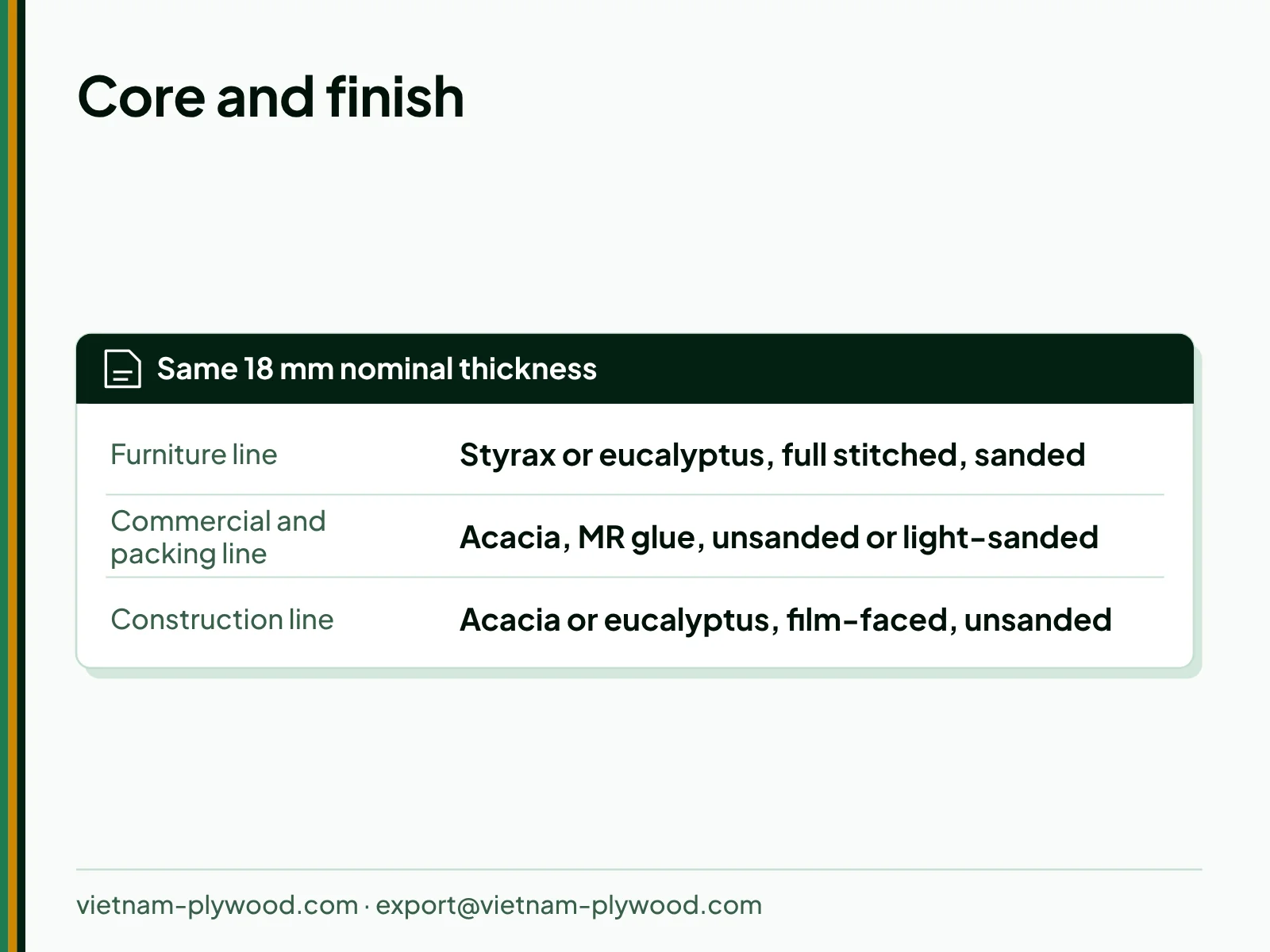
| Same 18 mm nominal thickness | Core and finish | Tolerance | Suitable trial use |
|---|---|---|---|
| Furniture line | Styrax or eucalyptus, full stitched, sanded | ±0.2 or ±0.3 mm as ordered | Cabinet and furniture components |
| Commercial and packing line | Acacia, MR glue, unsanded or light-sanded | ±0.5 mm commercial; ±0.5–1.0 mm packing | Distribution and industrial packing |
| Construction line | Acacia or eucalyptus, film-faced, unsanded | ±0.5 mm | Formwork and site panels |
The same thickness therefore describes three different purchasing decisions. A cabinet buyer should compare face quality, stitched-core integrity and thickness after sanding. A packing buyer should inspect usable strength and dimensional acceptance against the agreed packing build. A formwork buyer should examine film, edges and the adhesive specification.
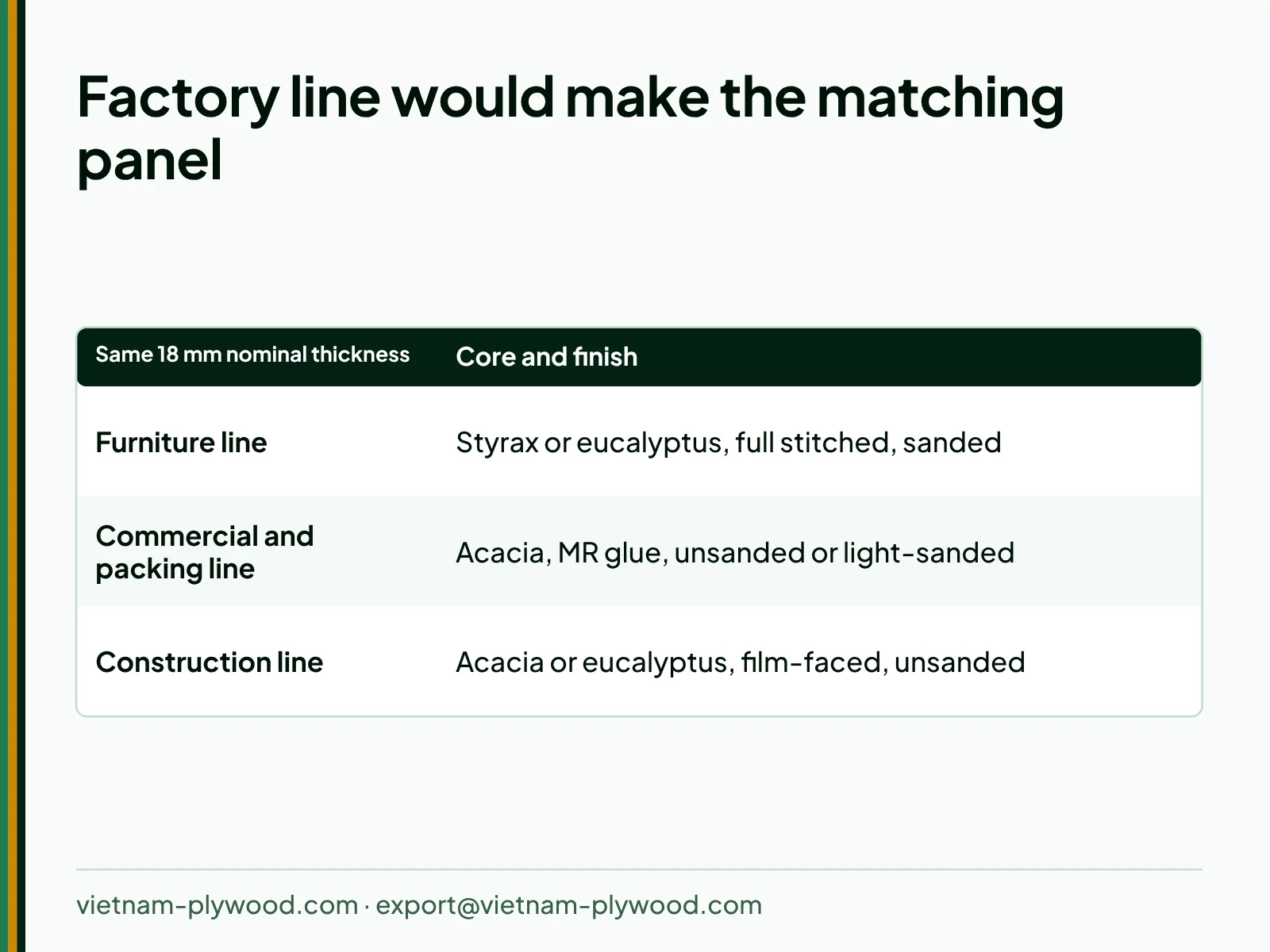
Our furniture line would press a matched cabinet panel; the other lines would instead build packing or film-faced material. The factory-line grade comparison explains why a grade name alone does not select the right press. Our manufacturer overview describes the product range.
Can you match the panel I buy now?
We can compare an existing panel with builds available on the matching line and document any differences before approving a sample. Matching means agreeing measurable attributes, including the face appearance and internal construction, rather than claiming that two natural veneers look identical.
Record the existing panel’s face species and face/back grades. The face names the product; core density follows the core species. Available faces include bintangor, okoume, engineered veneer (EV), gurjan, pine, poplar, eucalyptus, birch and sapele. Birch face grades use D/E/F; other listed faces use A/B. A matt panel is an unfaced raw core.
For the core, identify styrax, acacia or eucalyptus and inspect a cut edge. Core constructions range from full stitched to stitched outer layers with edge-trimmed inner layers, finger-jointed and loose-laid. A supplier’s description of ‘hardwood core’ does not specify these distinctions. If the current panel is birch-core plywood, we do not press that core and cannot offer a like-for-like birch-core match.
Our production range covers 3–40 mm thickness. Common sizes include 1220 × 2440 and 1250 × 2500 mm, with other listed formats and custom cutting. Length and width tolerance is ±2 mm. Record whether thickness is measured at the edge, at several interior points, or after conditioning, and agree the inspection method before the trial.
How is a sample matched against my existing plywood?
A sample match compares the current panel and the proposed panel under one written inspection sheet. Both should be identified by date, nominal specification and intended application. The buyer can then approve an observable reference rather than a description alone.
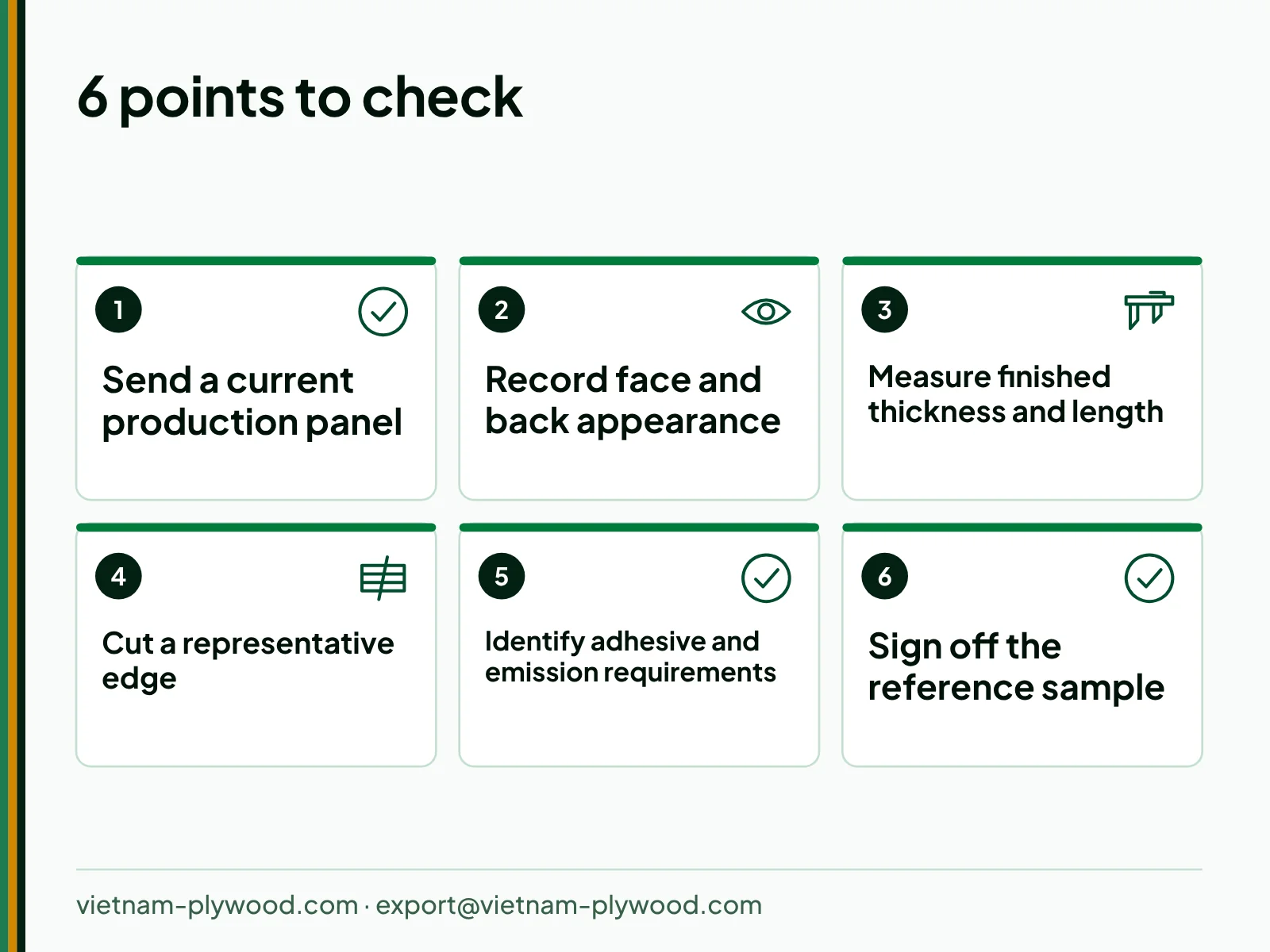
- Send a current production panel or representative offcut with the original purchase specification and acceptance history.
- Record face and back appearance, veneer grade, surface sanding, visible repairs and edge construction side by side.
- Measure finished thickness and length and width against the same agreed method; inspect several points rather than selecting a favourable corner.
- Cut a representative edge to compare ply arrangement, gaps, joints and the full stitched requirement where applicable.
- Identify adhesive and emission requirements separately, then attach the accepted test or certificate evidence to the sample record.
- Sign off the reference sample and list any approved deviation explicitly before trial production.
For 18 mm material, the typical construction has 11–13 plies because core veneers run approximately 1.4–2.0 mm thick. Ply count alone does not replace a check for gaps or the agreed core construction. Face veneer commonly measures 0.2–0.4 mm; the appearance standard must still come from the approved reference.
Samples are free. New buyers book their own courier, and the courier cost can be credited against a real order. Keep an approved sample available for the factory visit and inspection rather than relying on photographs alone.
Which glue and emission requirements must remain unchanged?
Glue performance and formaldehyde emission class must be recorded as separate fields. Our melamine glue is MR with a 12-hour boil specification; phenolic glue is weather-and-boil-proof (WBP) with a 72-hour boil specification. E0, E1 and E2 describe emission classes, not glue chemistry.
A matching request should therefore state the adhesive system and emission requirement independently. For furniture panels, our line uses E0 or E1 emission classes. For regulated US hardwood plywood, the relevant requirement is third-party certification under Toxic Substances Control Act (TSCA) Title VI, rather than an informal E0 label.
The US Environmental Protection Agency’s 2016 formaldehyde rule, explained in its regulated-stakeholder questions, covers veneer-core hardwood plywood and requires certification by an EPA-recognized third party for regulated panels. That is a market-access check distinct from a factory’s adhesive designation. The member-factory FSC, CARB P2, ISO 9001 and CE certificates, along with EUTR/EUDR documents, are shown with factory details masked, on request.
If a buyer specifies marine or BS 1088 performance, acceptance must be against a test report the buyer accepts. We do not supply a structural grade on a label alone; that too requires a test report the buyer accepts. A matching exercise must distinguish a requested standard from a documented result.
Should the second source begin with a trial container?
A trial container gives the buyer a production-scale comparison after the sample has been accepted. The minimum order is one 40HC, and specifications can be mixed within its 28.5 t payload limit. Select the trial mix around the items that matter most to repeat purchasing.
For a standard 1220 × 2440 mm, 18 mm panel, the planning lookup gives 990 styrax-core sheets at 26.52 t, 880 acacia-core sheets at 27.35 t, or 795 eucalyptus-core sheets at 27.69 t for a full 40HC. These are distinct full-load examples, not quantities to add together. Film weight is excluded from those panel-weight figures.
For mixed trials, ask for a pallet-by-pallet load plan showing the furniture and commercial specifications separately. The 18 mm reference weights are 26.79 kg per styrax-core sheet and 31.08 kg per acacia-core sheet, excluding film weight. Check the proposed sheet counts, pallet tare, packing weight and container weight distribution against the 28.5 t payload limit before approving the mix.
For mixed orders, identify each pallet by specification and keep sample acceptance records separate. See mixed-container planning and the container loading reference for full-load figures by core and thickness. A trial should measure repeatability across the shipped batch, not merely the appearance of its top sheets.
What should the trial container acceptance plan measure?
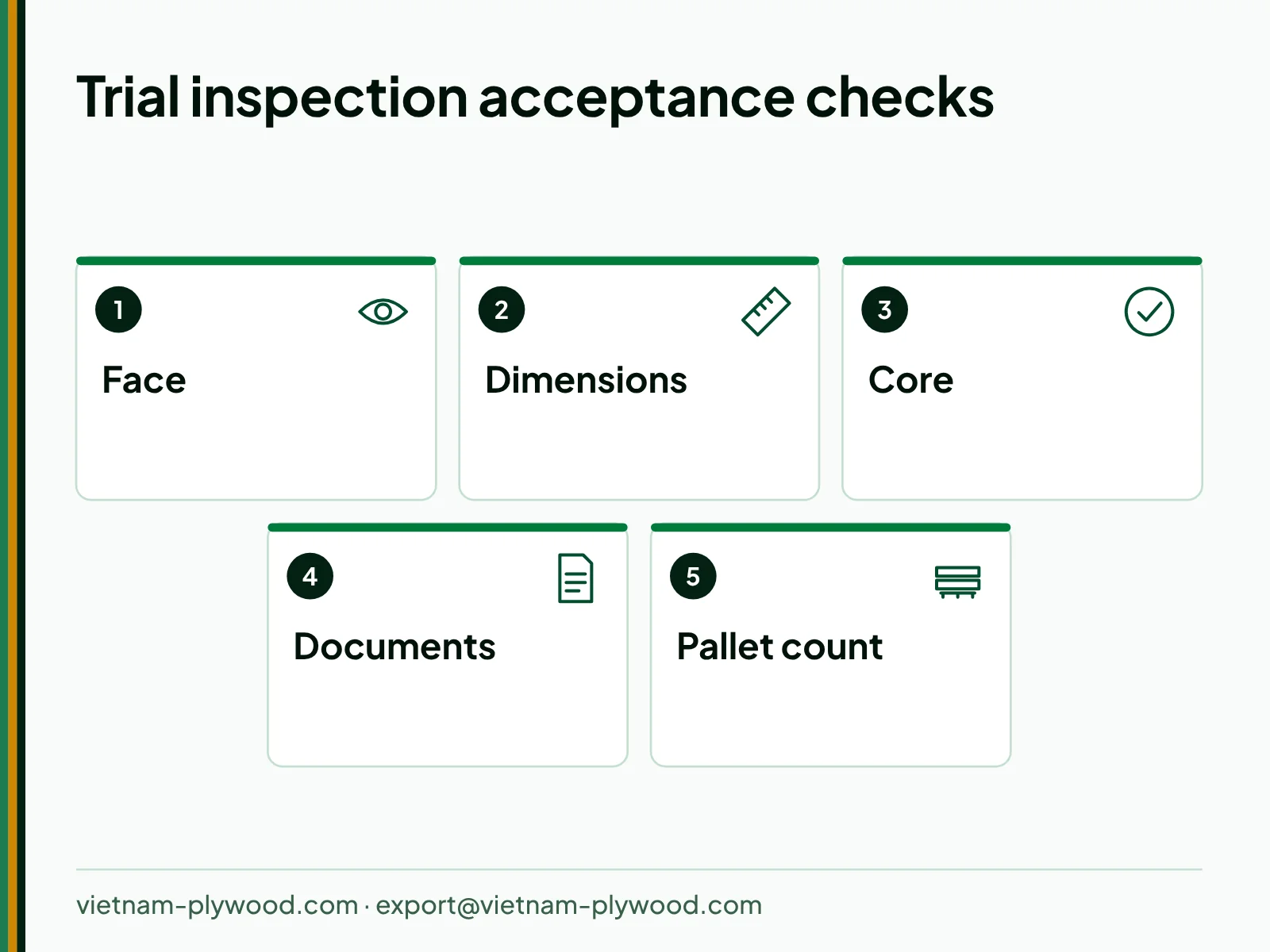
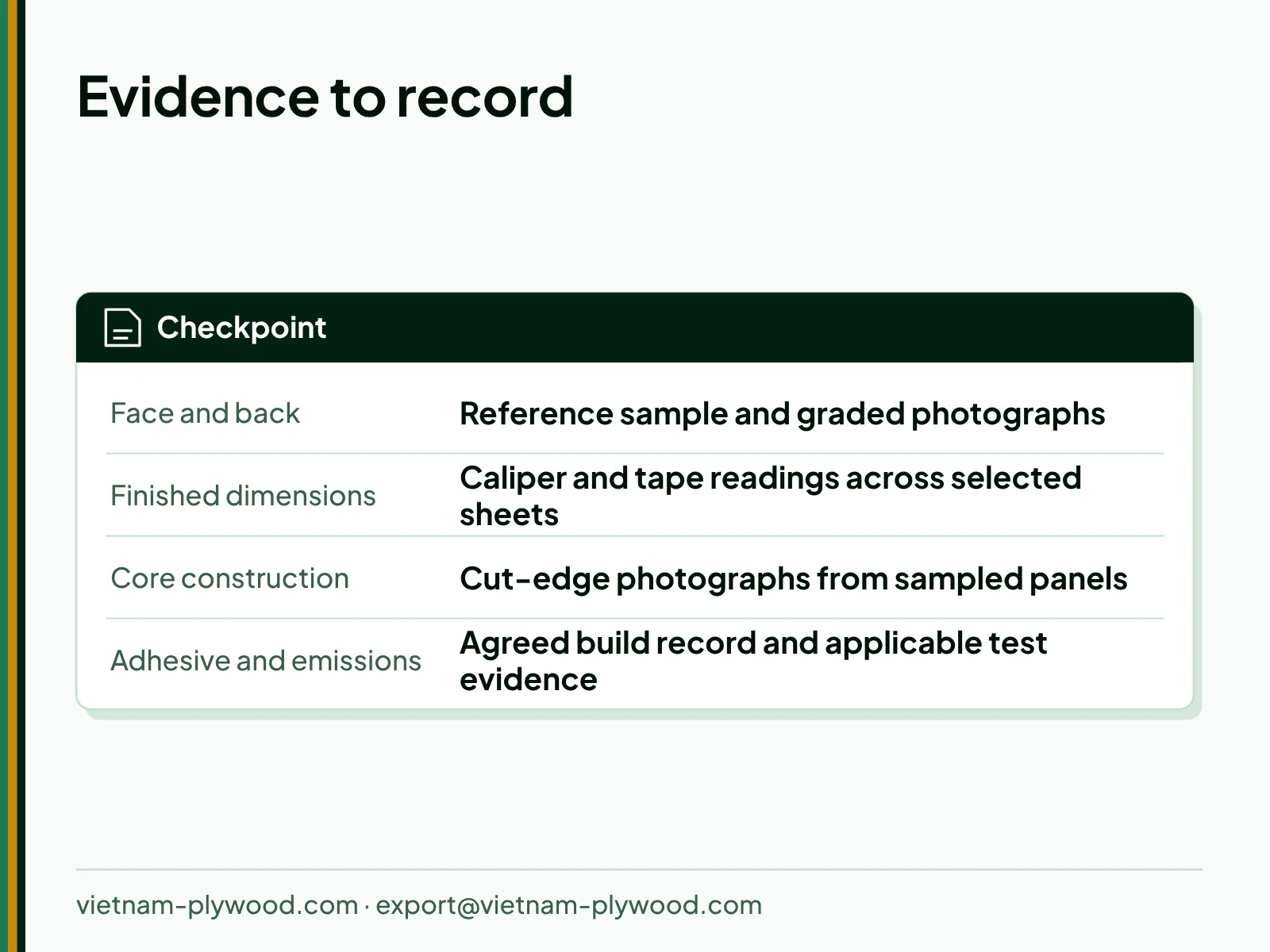
The trial acceptance plan should measure the same criteria used to accept the current supplier’s goods. Set the sample size, sampling locations, rejection thresholds and evidence format in the purchase specification before the press run.
| Checkpoint | Evidence to record | Decision for the trial |
|---|---|---|
| Face and back | Reference sample and graded photographs | Accept only the agreed grade and visual limits |
| Finished dimensions | Caliper and tape readings across selected sheets | Apply ordered tolerance and ±2 mm length/width |
| Core construction | Cut-edge photographs from sampled panels | Match the specified stitching and joint pattern |
| Adhesive and emissions | Agreed build record and applicable test evidence | Meet the written glue and market requirement |
| Packing and loading | Pallet IDs, sheet counts and loading photographs | Reconcile with packing list and load plan |
For an initial order, keep inspection results traceable to pallet IDs. If the current supplier’s acceptance system includes additional factory tests, name the method and report required before treating the two supplies as equivalent. A visual check cannot replace an emission test or a bond-performance report.
A trial can also reveal differences that are acceptable for one application but unacceptable for another. A small face colour shift may be tolerable for concealed packing panels, while a visible cabinet component may require a closer reference match. Record that distinction by product code rather than changing the common specification after delivery.
Can I inspect the trial container at the producing factory?
Yes. Buyers visit the factory office and inspect their own goods at the producing factory before loading. HCPLY coordinates the specification, on-site quality control, documents and loading so the inspector can follow the same product code from approved sample to packed pallets.
At the visit, ask to see the approved reference beside the production batch. Inspect faces in suitable light, measure selected panels and examine cut edges. Check that pallet labels match the product code, grade, dimensions and count in the packing record. For film-faced material, check the specified film weight and edge sealing, including cut edges.
The inspector should witness the loading count and note any substituted pallet or damaged wrap before the container closes. Photographs should show identifiable pallets and their position in the container. A signed report should separate observations, measurements, accepted deviations and corrective work.
The producing factory is also where a disputed result can be checked against the approved sample. Arrange the visit through Lucy before the production slot reaches loading. The factory visit information gives the practical next step.
Which export documents support the second-source trial?
The shipment document set should connect the approved product description to the quantity that actually leaves the factory. The commercial invoice identifies the sale; the packing list records the pallet and panel quantities; the bill of lading (B/L) records carriage. The certificate of origin supports origin declarations, with EUR.1 for EU lots where applicable.
Phytosanitary and fumigation papers accompany the shipment. Insurance documentation is included under CIF. Where agreed, add the member factory’s certificate documents, FSC claim on sales documents, emission certificate and test reports for the ordered build. EU lots also include the EUTR/EUDR file set.
After loading, the draft shipping documents come to you for approval. Compare product codes, thickness, face, quantity and destination across the invoice and packing list. A mismatch in description can make a physically acceptable trial difficult to receive or enter into inventory.
Certificate scope deserves separate attention. The name and scope on a factory certificate should correspond to the producing factory and product type. For US-bound regulated hardwood plywood, the EPA’s official stakeholder guidance explains labeling and recordkeeping obligations. A certificate for one product category should not be assumed to cover another.
How should I compare landed cost without changing the build?
Compare quotations against an identical specification and the same delivery term. A lower nominal rate can disappear when a different core density, pallet count, rejection rate or destination charge changes the usable cost per accepted sheet.
For commercial plywood, the indicative starting price is from US$250/m³ FOB Hai Phong (October 2026). For furniture plywood, it is from US$350/m³ FOB Hai Phong (October 2026). These are starting points for different builds; request the price for the written matching specification rather than treating either figure as the price of the trial.
The principal quote drivers are core construction, face and back veneer grade, adhesive system, sanding and thickness tolerance, followed by sheet size and packing requirements. Full stitched, sanded furniture construction costs more to make than a loose-laid, unsanded packing build because it requires more core preparation and finishing. Phenolic bonding and a specified film also change the construction cost relative to basic MR commercial panels.
FOB Hai Phong, cost and freight (CFR/CNF), and cost, insurance and freight (CIF) are available delivery terms. Compare each offer on the same basis and calculate freight and import charges separately. The export cost breakdown provides the cost categories to request.
When should the trial be scheduled and reordered?
Schedule the trial around sample approval, the factory production slot and the buyer’s receiving inspection. Production takes 15–45 days from the 30% deposit, set by order size, line loading and the contract. The 70% balance is against the scanned B/L, by telegraphic transfer (T/T) or irrevocable letter of credit (L/C) at sight.
Do not assume the sea passage is part of production time. From Hai Phong, indicative sailing times vary by carrier and route: Northern Europe 30–40 days, US West Coast 20–30 days and Middle East 15–25 days. The arrival plan must also allow for customs, onward transport and the buyer’s trial inspection.
Use the Vietnam plywood order calendar to sequence specification approval, deposit, production, loading and delivery. When the first container arrives, record acceptance by product code and identify any change needed before the next purchase order. Preserve the approved sample and inspection record as the baseline for subsequent batches.
For a repeat programme, ask for the same face, core construction, glue, emission requirement, thickness tolerance and packaging codes. A second source becomes useful when its delivered panels can enter the same purchasing and quality workflow without an undocumented substitution.
What should I send to request the matching sample set?
Send the current panel specification and a reference sample, then request a matched sample set from the appropriate line. Include the intended market and any required test evidence so the sample review covers the finished panel and its documentation.
Use this specification as a starting point and replace the bracketed fields with the existing approved values:
Application: [cabinet / commercial distribution / packing / formwork]
Line or core: [furniture: styrax/eucalyptus | commercial: acacia | construction: acacia/eucalyptus]
Glue: [melamine MR / phenolic WBP]
Emission: [E0 / E1 / E2 / market-specific documented requirement]
Face and grade: [face species, face/back grade, approved reference]
Thickness and tolerance: [mm; ±0.2 / ±0.3 / ±0.5 / ±0.5–1.0 as applicable]
Size: [length × width in mm]
Quantity: [one 40HC; product mix and pallet allocation]
Destination port: [port and country]
Ask Lucy at export@vietnam-plywood.com for a sample set matched against the current panel, or use the contact page.