





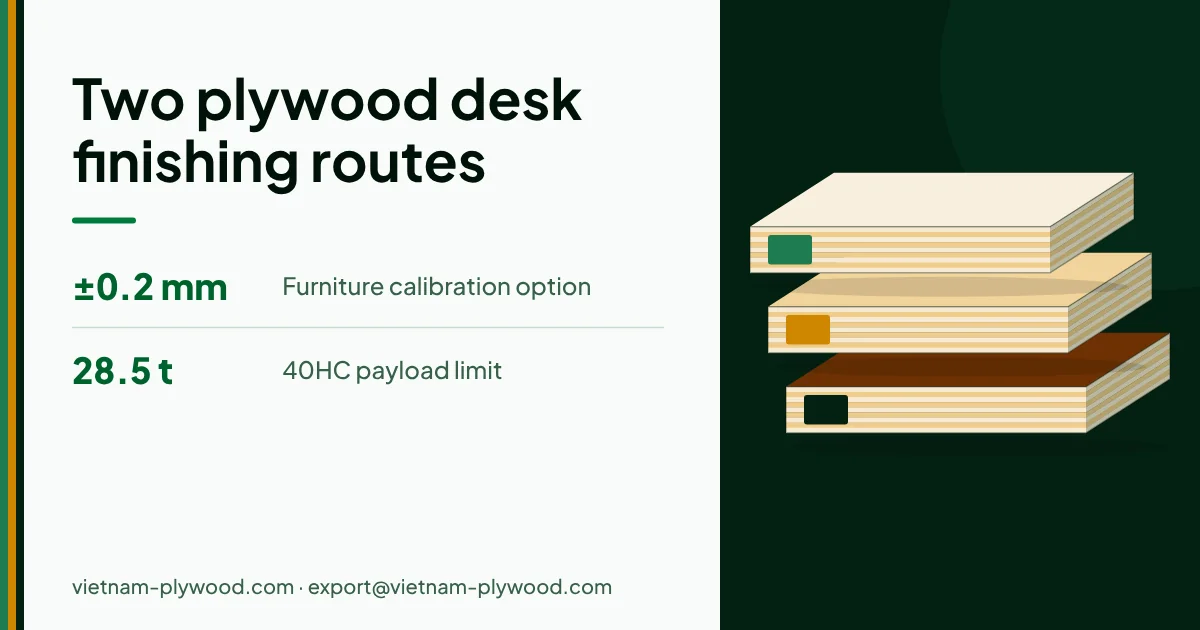
A plywood desk top should be specified either for a visible veneer finish or as a substrate for a separate laminate. Choosing the wrong surface can add rework, delay furniture assembly or lead to rejected panels. HCPLY builds these routes with different face and calibration requirements, allowing furniture manufacturers to order each finish as a distinct lot.
What plywood desk build works for commercial tops?
A plywood desk top works best when its face and core are specified for the intended finish. A visible wood surface calls for sanded, full-stitched furniture plywood with an agreed veneer grade. A top receiving a separate decorative laminate needs a sound, flat substrate, with its surface preparation agreed before pressing the covering. These are different purchase specifications even when the nominal thickness matches.
At HCPLY, the distinction begins with the finishing route. For exposed-grain desks and meeting tables, our furniture line presses stitched, sanded panels using styrax or eucalyptus cores. For covered tops, buyers can consider a matt raw-core build or an acacia-core commercial panel, after checking whether the selected covering process accepts that surface. Laminate can reveal raised joints and gaps.
The starting point is the finished product drawing: top dimensions, edge treatment, support positions, visible faces and finish system. Long unsupported spans need a separate deflection assessment. The furniture plywood range is the starting point for visible-faced furniture builds.
What separates veneer-ready and laminate-ready plywood?
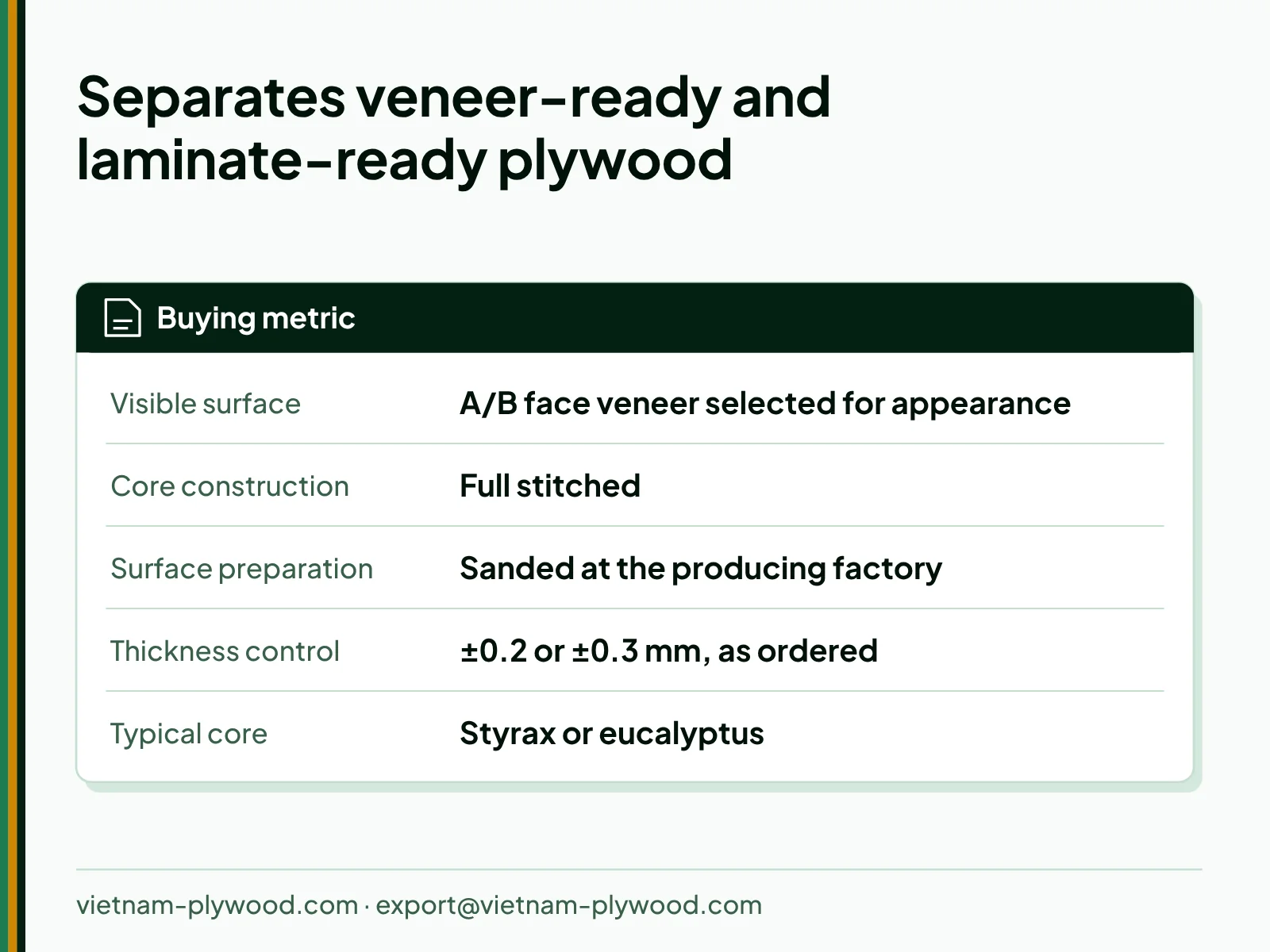
Veneer-ready plywood presents a selected wood face that remains part of the finished appearance. Laminate-ready plywood is a substrate that receives a separate surface layer in the furniture maker’s process. Both need flatness and sound bonding, but face appearance and the finishing checks are different.
| Buying metric | Veneer-ready top | Laminate-ready substrate | Verdict by use |
|---|---|---|---|
| Visible surface | A/B face veneer selected for appearance | Matt or specified commercial surface hidden by covering | Veneer-ready for exposed grain; substrate for covered tops |
| Core construction | Full stitched | Specify core quality and allowable gaps | Full stitched for exposed, precision-finished edges |
| Surface preparation | Sanded at the producing factory | Substrate preparation agreed with the laminator | Match to the actual finishing process |
| Thickness control | ±0.2 or ±0.3 mm, as ordered | Commercial ±0.5 mm | Furniture calibration for tighter top matching |
| Typical core | Styrax or eucalyptus | Acacia for commercial build | Select on weight and finishing needs |
| Incoming inspection | Veneer appearance, sanding and calibration | Flatness, voids, bond and covering trial | Inspect the failure mode of each finish |
A decorative high-pressure laminate (HPL) or melamine-faced board is a different finished material from the plywood substrate. We explain those coverings as specification options for the buyer’s downstream process; HCPLY does not press HPL, melamine-faced or other laminate-faced product lines. See the HPL-faced plywood explanation for the covering terminology.
Which face grade and calibration should a veneered table top use?
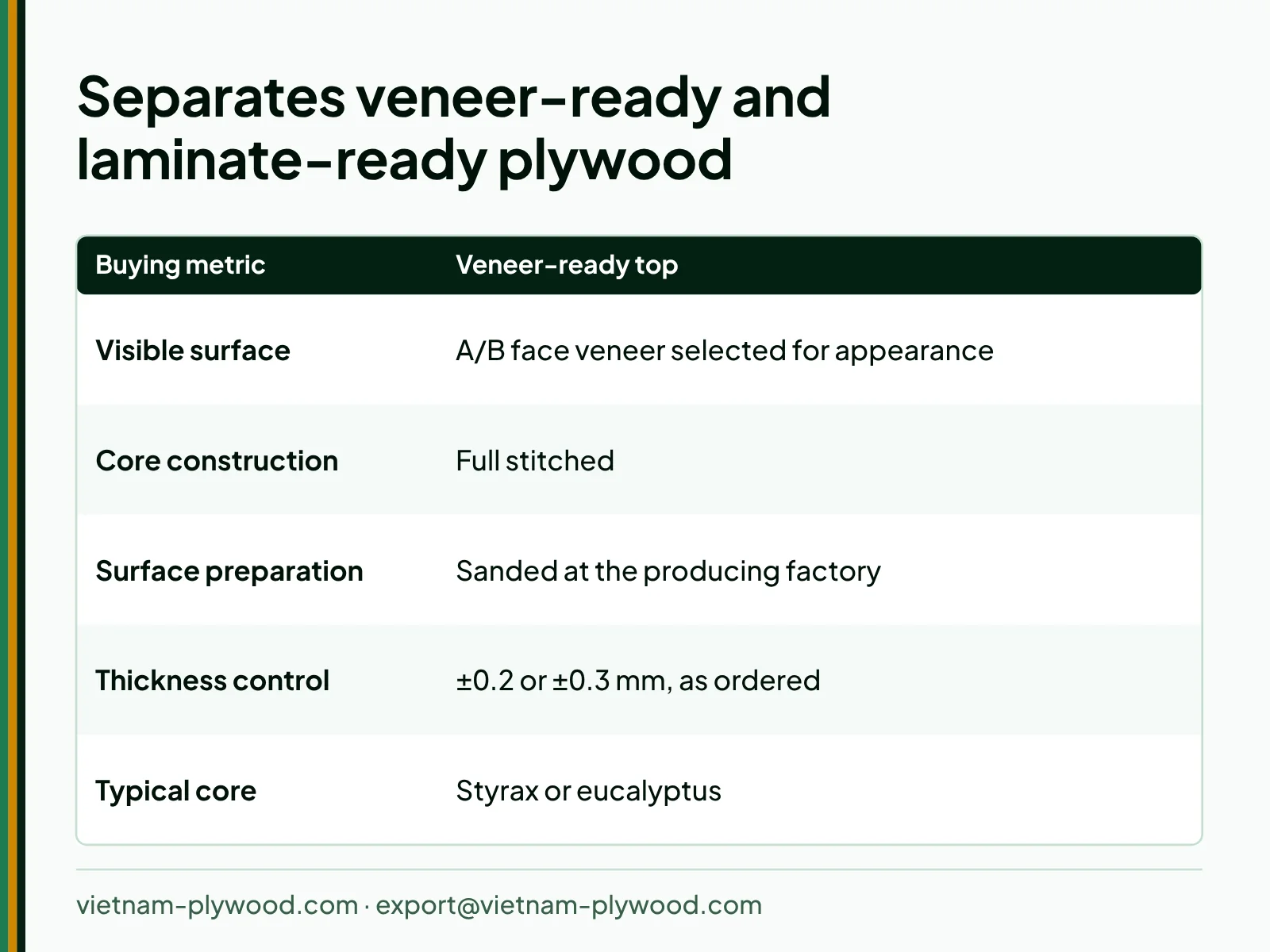
Specify an A/B face with the visible side, acceptable colour variation and veneer species stated in writing. The buyer’s appearance sample should establish which knots, repairs and grain changes are acceptable. Agree a visual reference for the desk program.
Bintangor, okoume, engineered veneer (EV), gurjan, pine, poplar, eucalyptus and sapele are face choices. Birch faces use D/E/F grades instead of A/B. Common face veneer thickness is 0.2–0.4 mm, so aggressive finishing can expose the layer below. A veneered desk program should state its sanding allowance and finishing method before the panels are made.
Our furniture line makes full-stitched, sanded panels with E0 or E1 emission-class options. Specify furniture thickness tolerance as ±0.2 mm or ±0.3 mm; length and width tolerance is ±2 mm. For two panels joined in a long table, the agreed thickness band matters because a step at the joint remains visible under clear finish.
Core density follows species, not face: styrax is 500 kg/m³ and eucalyptus 650 kg/m³. See pine plywood for face naming.
Can matt or commercial plywood sit under a laminate?
Yes, matt or commercial plywood can be considered as a laminate substrate when the covering process accepts the board’s flatness, bond and surface condition. Matt describes an unfaced raw core; it is not a finished decorative face. Our commercial and packing line presses acacia-core panels with moisture-resistant (MR) glue, normally unsanded or light-sanded.
A laminator should test the actual covering adhesive, pressing schedule and edge treatment on a production-representative panel. A coarse surface can telegraph defects through a thin covering, while a loose core can affect machining and edge-banding. If the covering requires a finer substrate, order the surface preparation explicitly or choose the sanded furniture build.
Commercial and packing plywood has ±0.5 mm thickness tolerance, while packing-grade orders can use ±0.5–1.0 mm. Those bands can matter for flush desk joints and machined hardware seats. An acacia core has a density of 580 kg/m³, placing its weight between the styrax and eucalyptus alternatives at the same dimensions.
For buyers comparing material categories, our lines do not press medium-density fibreboard (MDF), oriented strand board (OSB), chipboard or blockboard. A substrate substitution therefore needs a new machining and bonding trial rather than a name-only change. The commercial plywood specification describes that line’s intended construction.
Which producing line handles each desk specification?
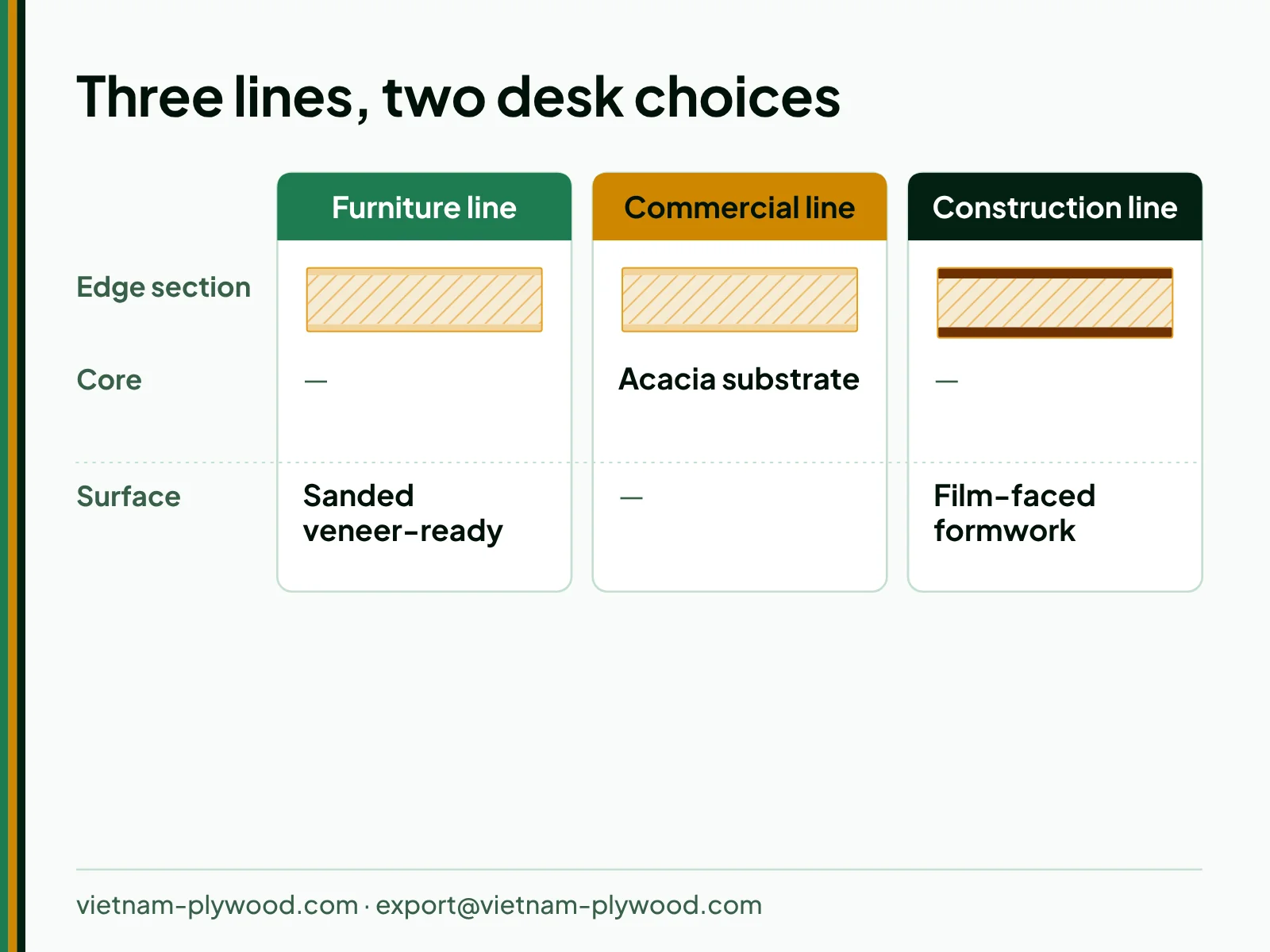
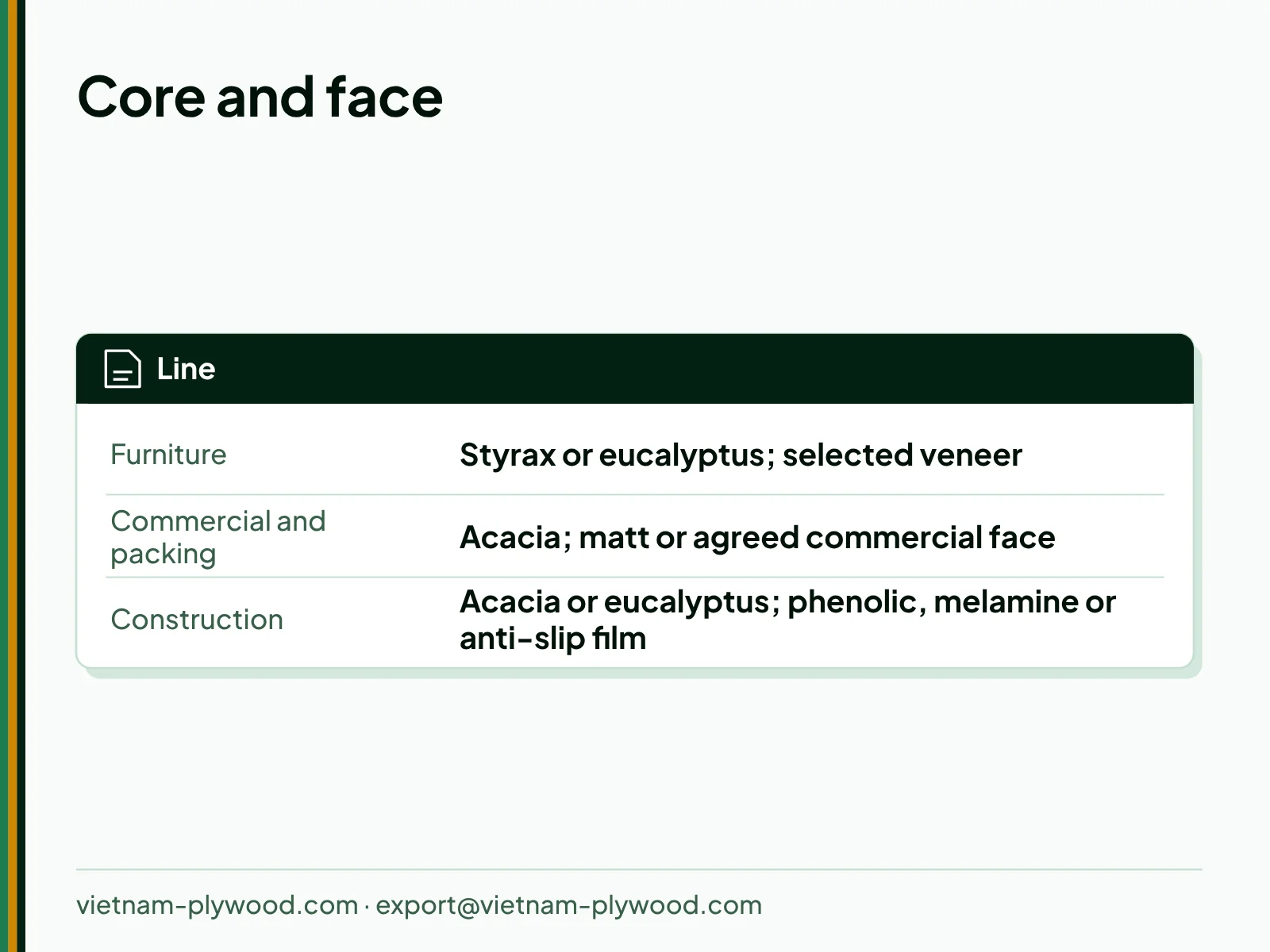
Our furniture line is the first choice for exposed veneer and close calibration. Our commercial and packing line builds the acacia-core alternative for covered components. Our construction line instead presses film-faced panels for formwork and related applications; its surface is not the decorative face of a desk.
| Line | Core and face | Surface and tolerance | Appropriate decision |
|---|---|---|---|
| Furniture | Styrax or eucalyptus; selected veneer | Sanded; ±0.2 or ±0.3 mm | Visible veneer desk and table top |
| Commercial and packing | Acacia; matt or agreed commercial face | Unsanded or light-sanded; ±0.5 mm | Covered substrate after lamination trial |
| Construction | Acacia or eucalyptus; phenolic, melamine or anti-slip film | Unsanded; ±0.5 mm | Formwork use, rather than decorative desk finish |
HCPLY has three member factories in Phu Tho and Hai Phong. Each order is made at the producing factory suited to the written build and shipped directly from that location. Buyers can visit the factory office and inspect the actual goods where they are produced. This lets a desk buyer witness the veneer and calibration checks instead of judging the product from a catalogue image.
Can veneered and laminate-ready panels share a container?
Yes. Veneer-ready and laminate-ready panels can be ordered as two separately identified lots within one 40-foot high-cube container, within its 28.5-tonne payload limit. Keep each lot’s line, core, face, tolerance and pallet identification distinct on the order and packing list.
For a 1220 × 2440 × 18 mm sheet, styrax-core furniture plywood weighs 26.79 kg; acacia-core commercial plywood weighs 31.08 kg. A worked mixed-lot example of 400 styrax sheets and 400 acacia sheets gives 10,716 kg plus 12,432 kg, or 23,148 kg of panel mass. The example illustrates the panel arithmetic only; pallet and other shipment weights still enter the load plan.
For comparison, a full single-core 40HC lookup at that size and thickness is 990 styrax sheets or 880 acacia sheets. A mixed load is planned by its actual lots, pallet arrangement and total weight, rather than adding those full-container counts. See container loading calculations for the loading topic.
The minimum order is one 40HC, and specifications can be mixed within its payload limit. The packing list should show separate quantities and pallet marks for the two desk builds. That separation makes receiving inspection and downstream production scheduling easier.
How should thickness, edges and support affect the drawing?
Write the nominal panel thickness alongside the finished top thickness and edge construction. HCPLY’s panel range is 3–40 mm, with common choices including 12, 15, 18, 21 and 25 mm. These are panel thickness options, not engineering span ratings for a desk.
For exposed edges, inspect veneer continuity and voids after cutting. For wrapped edges, test the covering bond and corner detail.
Standard sheet dimensions include 1220 × 2440 mm and 1250 × 2500 mm, with custom cutting available. Other listed formats include 1220 × 2135, 1220 × 1830, 915 × 2440, 915 × 2135 and 915 × 1830 mm. Nest the actual desk components against the sheet before selecting a size; yield is driven by the cutting layout and grain direction.
Panel thickness is only one part of the support decision. Desk spans, concentrated monitor loads, cable cut-outs and metal underframes should be assessed by the furniture designer. For related load questions, see plywood shelf span considerations.
What can the buyer inspect at the producing factory?
The buyer can witness the checks that match the finish route: visible face selection for veneer-ready panels and surface readiness for the laminate substrate. Start with the approved sample, written tolerance and pallet lot identification. Then inspect representative panels from the actual order.
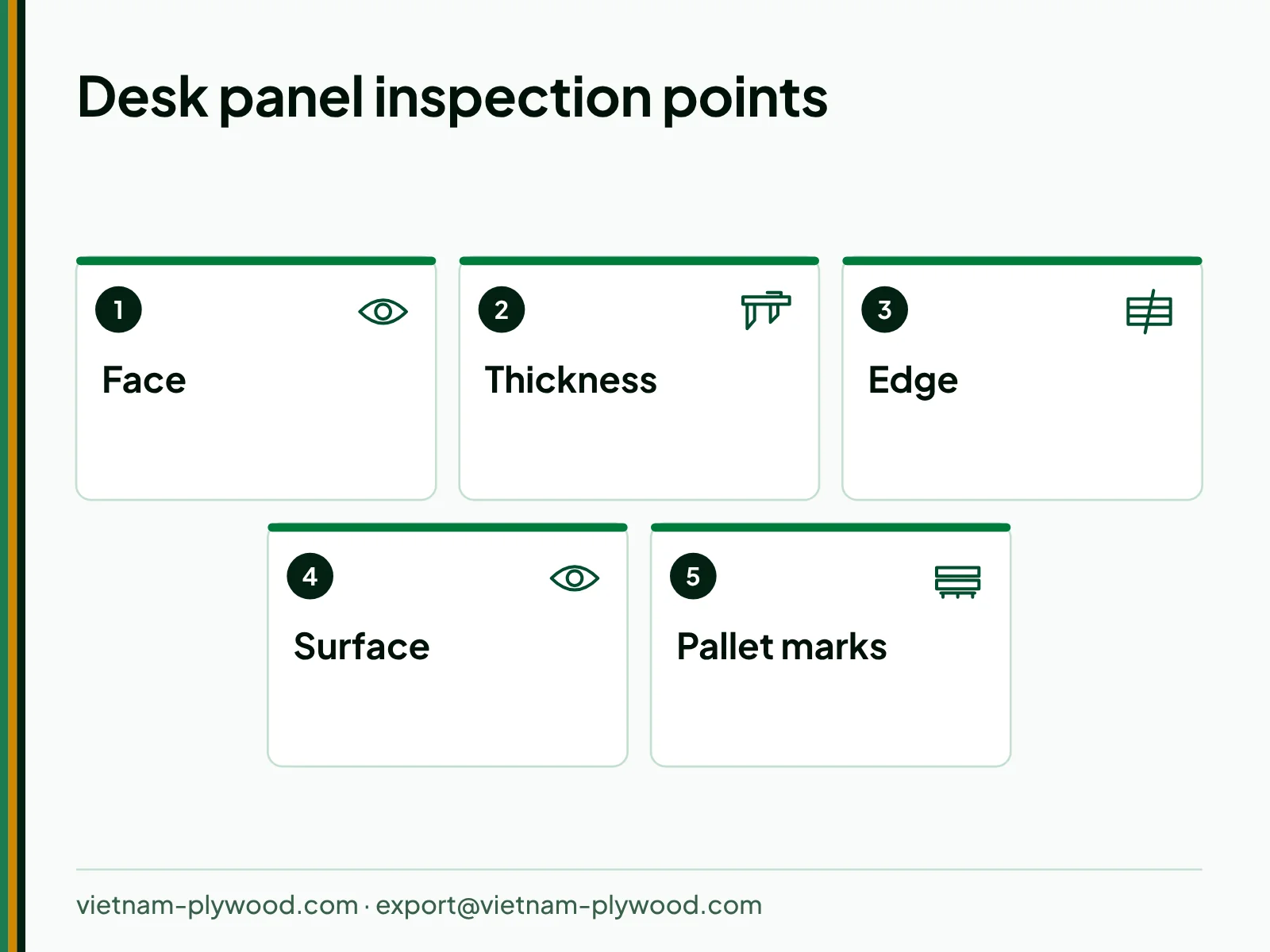
- Compare the visible veneer against the agreed face sample under consistent lighting, including colour, repairs and grain direction.
- Measure thickness at agreed points and record the observed range against the order’s ±0.2 or ±0.3 mm furniture tolerance, or ±0.5 mm commercial tolerance.
- Inspect cut edges for core gaps and check that the specified full-stitched construction appears in the furniture lot.
- Check surface flatness and sanding consistency; run a covering trial on the commercial substrate before accepting it for the furniture press.
- Match pallet labels, sheet dimensions and quantities to the draft packing list before loading.
Glue and emission are separate fields: MR melamine has a 12-hour boil description, phenolic WBP a 72-hour boil description; E0/E1 are emission classes.
Which emission and export documents belong with the desk order?
For US-bound interior plywood, the relevant emission paperwork must match the regulated product and the actual producer. The US Environmental Protection Agency’s 2016 formaldehyde rule, summarized on its official rule page, covers hardwood plywood and certain laminated products. The 2025 Code of Federal Regulations, 40 CFR Part 770, sets a 0.05 parts-per-million emission limit for regulated hardwood plywood with veneer or composite core.
CARB Phase 2 and Toxic Substances Control Act (TSCA) Title VI are US compliance references involving third-party certification. A factory’s emission certificate should be checked against the ordered panel, producer and shipment documentation. Member-factory FSC, CARB P2, ISO 9001 and CE certificates, plus EU timber documentation, are shown with factory details masked, on request.
For a shipment, the document set includes commercial invoice, packing list, bill of lading (B/L), certificate of origin, phytosanitary and fumigation papers, and the agreed order-specific certificate or test documents. EU lots include EUR.1 where applicable and the European Union Timber Regulation / Deforestation Regulation file set; CIF shipments include insurance. After loading, the draft shipping documents come to you for approval.
The packing list is the document that distinguishes the veneer-ready lot from the laminate-ready lot. It should reflect the pallet marks and quantities checked at the producing factory.
What drives the cost of the two desk builds?
The visible veneer-ready furniture build normally costs more than a basic commercial substrate because it requires selected faces, full stitching, sanding and closer calibration. Within the furniture build, veneer species, visual sorting, tight tolerance and custom cutting add cost. Within a covered-top build, core quality and required surface preparation matter more than decorative veneer appearance.
Indicative furniture plywood starts from US$350/m³ FOB Hai Phong (October 2026). Indicative commercial plywood starts from US$250/m³ FOB Hai Phong (October 2026). These are starting figures for their respective categories, rather than prices for a specified finished desk top.
Ask for two separate quotations against the same drawing and destination. One should show the veneer-ready build and its face acceptance criteria; the other should show the substrate build and the lamination trial requirement. The comparison should include downstream sanding, covering losses, edge work and rejection risk rather than panel price alone.
How do the order and delivery terms work?
HCPLY handles specification, on-site quality control, export documents and loading for each producing factory. The order can carry both desk-panel lots, with separate descriptions and pallet marks. We ship FOB Hai Phong, or CFR (CNF) or CIF to your port.
Factory lead time runs 15–45 days from receipt of the 30% deposit; the exact figure depends on order size, line loading and what the contract fixes. The 70% balance is against the scanned B/L, by telegraphic transfer (T/T) or irrevocable letter of credit (L/C) at sight. Free samples are available; new buyers book their courier, and that courier cost can be credited against a real order.
Align approved samples with the production lead-time plan and release both lot descriptions together.
What specification should a desk-panel buyer send?
Send one written specification for each finish route, even when the top dimensions are identical. State the intended covering process and the visible-edge treatment, so the producing line can build and inspect against the right acceptance criteria.
Use the following lines as a request template. Replace the example options with the actual approved drawing and destination; keep veneer-ready and laminate-ready quantities separate.
Application: commercial desk / meeting-table tops; finish route per lot
Line or core: furniture / styrax or eucalyptus; commercial / acacia
Glue: MR melamine or agreed phenolic WBP
Emission: E0 or E1; destination-market documents specified
Face and grade: selected veneer A/B (birch D/E/F) OR matt substrate
Thickness and tolerance: 18 mm; furniture ±0.2 mm or commercial ±0.5 mm
Size: 1220 × 2440 mm or approved cutting drawing
Quantity: veneer-ready ___ sheets; laminate-ready ___ sheets
Destination port: ___; delivery term: FOB Hai Phong / CFR / CIF
Request the desk and table-top specification sheet from Lucy at HCPLY at export@vietnam-plywood.com.