





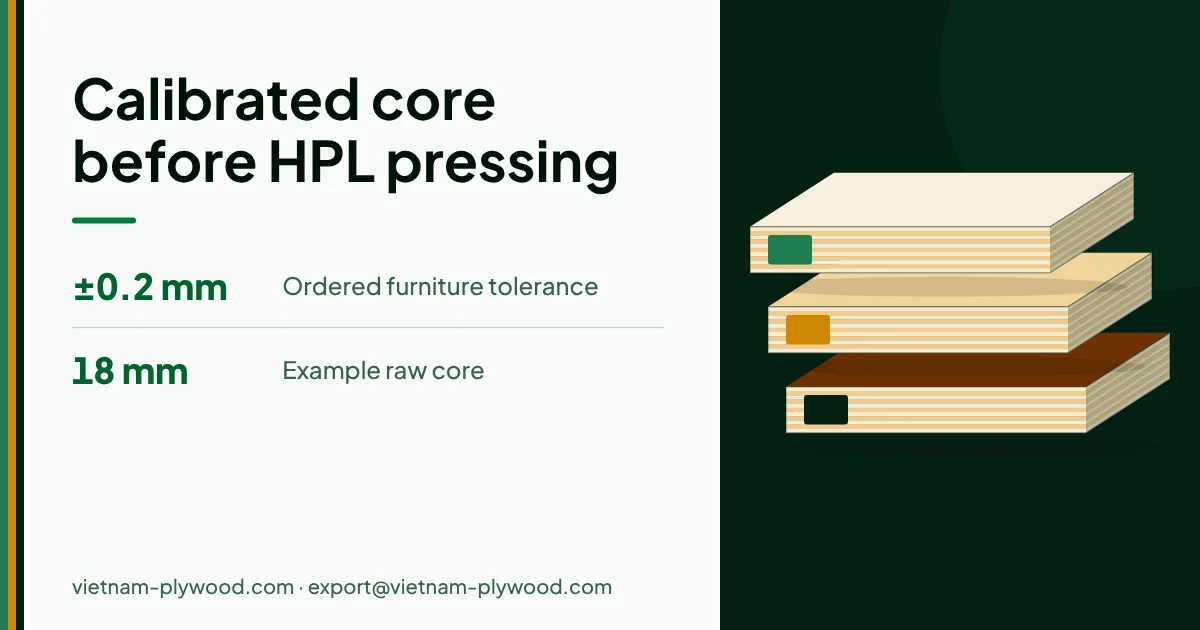
HPL plywood succeeds when its supporting core is flat, calibrated and tightly joined before the laminate is pressed. A poor core can waste laminate, press time and finished cabinet panels. HCPLY makes the plywood substrate on our furniture line; the buyer’s laminator supplies and bonds the decorative sheet. This guide identifies the build and checks to write into an import specification.
What is HPL plywood?
HPL plywood is a plywood substrate covered with high-pressure laminate on one or both faces. The laminate supplies the decorative, wear-facing surface; the plywood carries the panel and supports the bond. For buyers, the practical purchase is a calibrated plywood core that a separate laminator can press with its selected HPL sheet. That division determines who checks the substrate and who accepts the finished face.
HPL plywood appears in cabinet carcasses, counter fronts, shopfitting fixtures and interior joinery. A plywood with Formica laminate is one branded example of this general construction, provided the applied sheet is actually HPL. The word Formica alone does not specify a substrate, bond system or laminate grade. The furniture plywood range is the starting point for selecting the unfinished panel beneath the decorative sheet.
What does HPL stand for?
HPL stands for high-pressure laminate. It refers to a consolidated decorative surfacing sheet made under pressure, subsequently bonded to a substrate in a separate fabrication operation. The term does not describe the glue used inside plywood, its formaldehyde emission class or the thickness of the finished assembly.
A buyer asking “whats HPL” or “what is high pressure laminate” often needs to distinguish the surface sheet from the supporting board. HPL can have solid colours, printed wood effects and different textures. Yellow HPL plywood describes a chosen laminate colour; it is not a yellow-core plywood grade. Specify the laminate maker’s product and performance data separately from the plywood purchase.
Does HCPLY supply the HPL face or the plywood core?
HCPLY supplies the plywood core; the buyer’s laminator applies the HPL face. We do not press HPL, melamine decorative sheets or other laminate faces as a product line. The core order therefore covers veneer construction, flatness, sanding, bonding and dimensional tolerance, while the laminator owns the overlay specification and bonding process.
Our furniture line produces full-stitched, sanded styrax or eucalyptus plywood, with E0 or E1 emission classes as ordered. A matt, unfaced raw core can be specified for subsequent finishing. Our commercial and packing line builds acacia-core material with MR glue and an unsanded or light-sanded finish. Our construction line makes film-faced panels for formwork, which are a different surface system. These distinctions help prevent an order for HPL-ready substrate from being interpreted as an order for finished HPL laminated plywood.
Which factory-line core is suitable for HPL pressing?
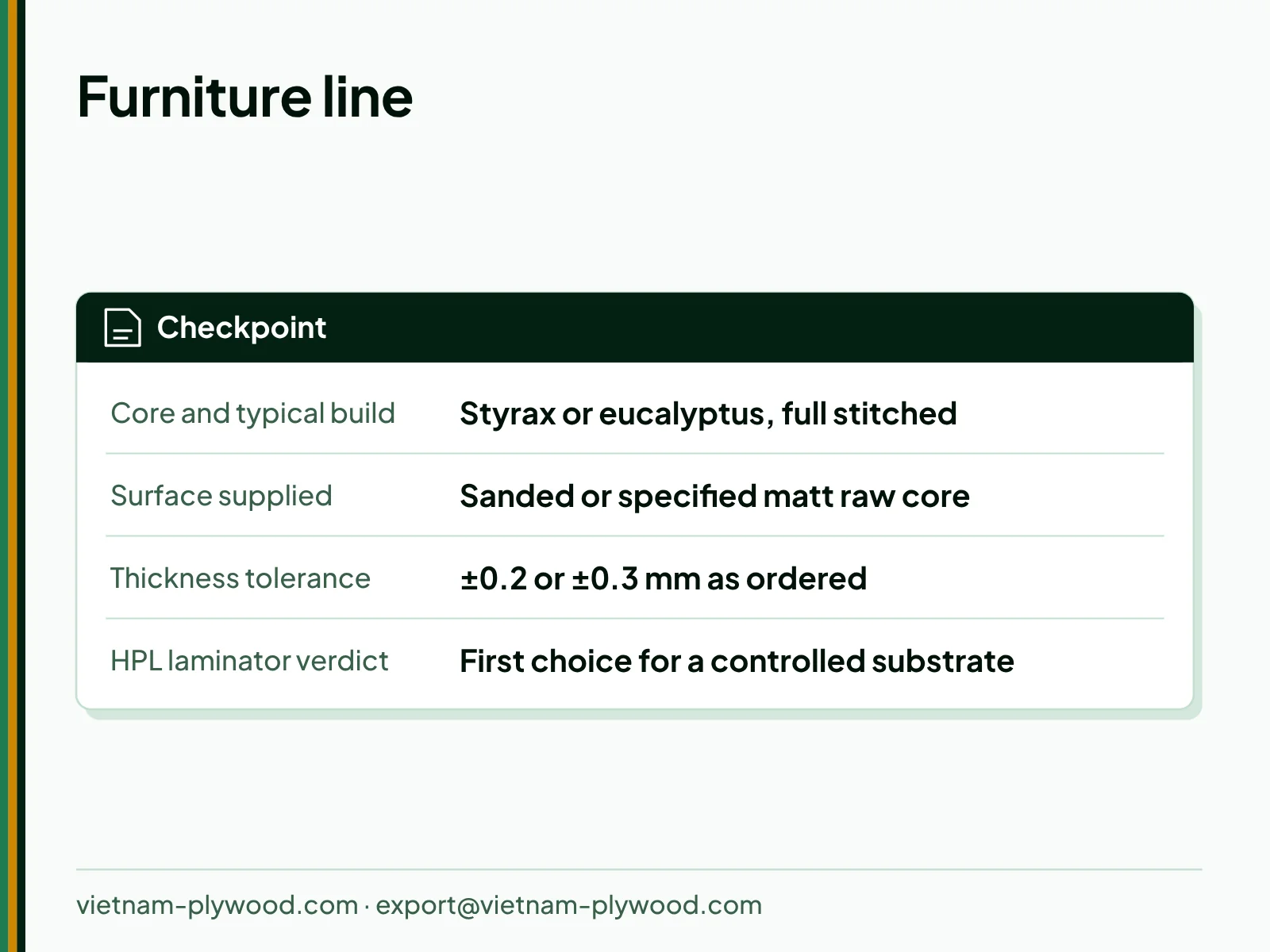
The furniture line is the preferred starting specification for HPL pressing because full stitching and calibrated sanding address the substrate’s most visible risks. The other lines answer different end uses and should be ordered on their own merits.
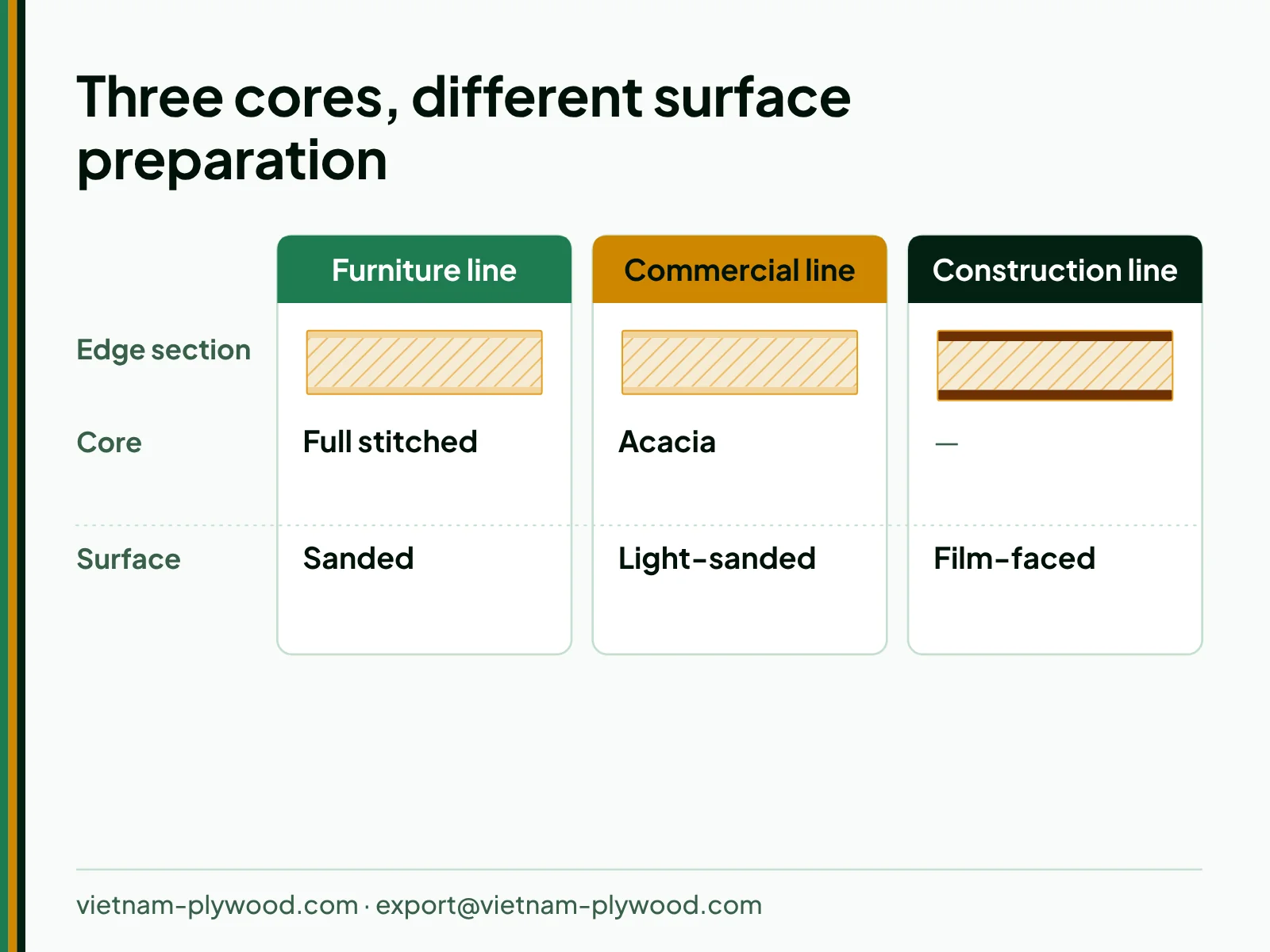
| Checkpoint | Furniture line | Commercial and packing line | Construction line |
|---|---|---|---|
| Core and typical build | Styrax or eucalyptus, full stitched | Acacia, MR glue | Acacia or eucalyptus, film-faced |
| Surface supplied | Sanded or specified matt raw core | Unsanded or light-sanded | Phenolic, melamine or anti-slip film |
| Thickness tolerance | ±0.2 or ±0.3 mm as ordered | ±0.5 mm; packing ±0.5–1.0 mm | ±0.5 mm |
| HPL laminator verdict | First choice for a controlled substrate | Only after additional substrate assessment and preparation | Not the requested raw substrate |
For a plywood core intended for a press, the extra sanding and more continuous veneer lay-up have a practical purpose. A low purchase price for an uneven core can become a rejected laminated batch after the face is bonded. Compare the underlying builds in plywood grades across factory lines, rather than relying on a shared nominal thickness.
Why does an HPL press need a calibrated, void-free core?
A calibrated core presents a consistent surface and thickness to the laminating press. Local high spots can concentrate pressure; low spots, open joints and buried gaps can leave areas without uniform backing. Those defects can show as telegraphing, poor contact or uneven finished surfaces after the laminate is bonded.
Full stitching brings adjacent veneers together before pressing, reducing open-joint risk. Sanding removes local high spots and makes the panel easier to feed through a controlled adhesive-spreading and pressing process. A flat-looking top face alone cannot reveal every internal gap, so inspect exposed edges and sampled cross-sections as well.
The laminator must still validate adhesive compatibility, moisture, pressure, temperature and cycle settings with its own HPL supplier. A plywood core cannot by itself determine laminate bond performance. The furniture suitability inspection guide explains the checks that matter before cutting and finishing.
What tolerance, sanding and glue belong in the order?
Write the substrate requirements as measurable fields, with the plywood thickness stated before the HPL is added. For furniture plywood, choose ±0.2 mm or ±0.3 mm thickness tolerance as ordered. State sanded faces, a full-stitched core, the selected species and the acceptance method for visible voids and flatness.
Specify glue separately from emission class. Our melamine glue is MR, with a 12-hour boil description; phenolic glue is WBP, with a 72-hour boil description. These are plywood bond descriptions, not instructions for applying an HPL sheet. E0 and E1 are emission classes; neither is a glue name. For the final laminated assembly, request the applicable evidence from the party responsible for the finished product.
The common 18 mm panel has 11–13 plies because core veneers are 1.4–2.0 mm thick. This count helps explain why the same nominal thickness can contain different veneer constructions. Also specify length and width tolerance of ±2 mm, edge condition and how many sample panels the laminator will trial before bulk conversion.
How should the laminator qualify a trial batch?
The laminator should approve a representative trial before converting the shipment into finished furniture panels. A controlled sequence keeps substrate faults distinct from laminate or adhesive faults.
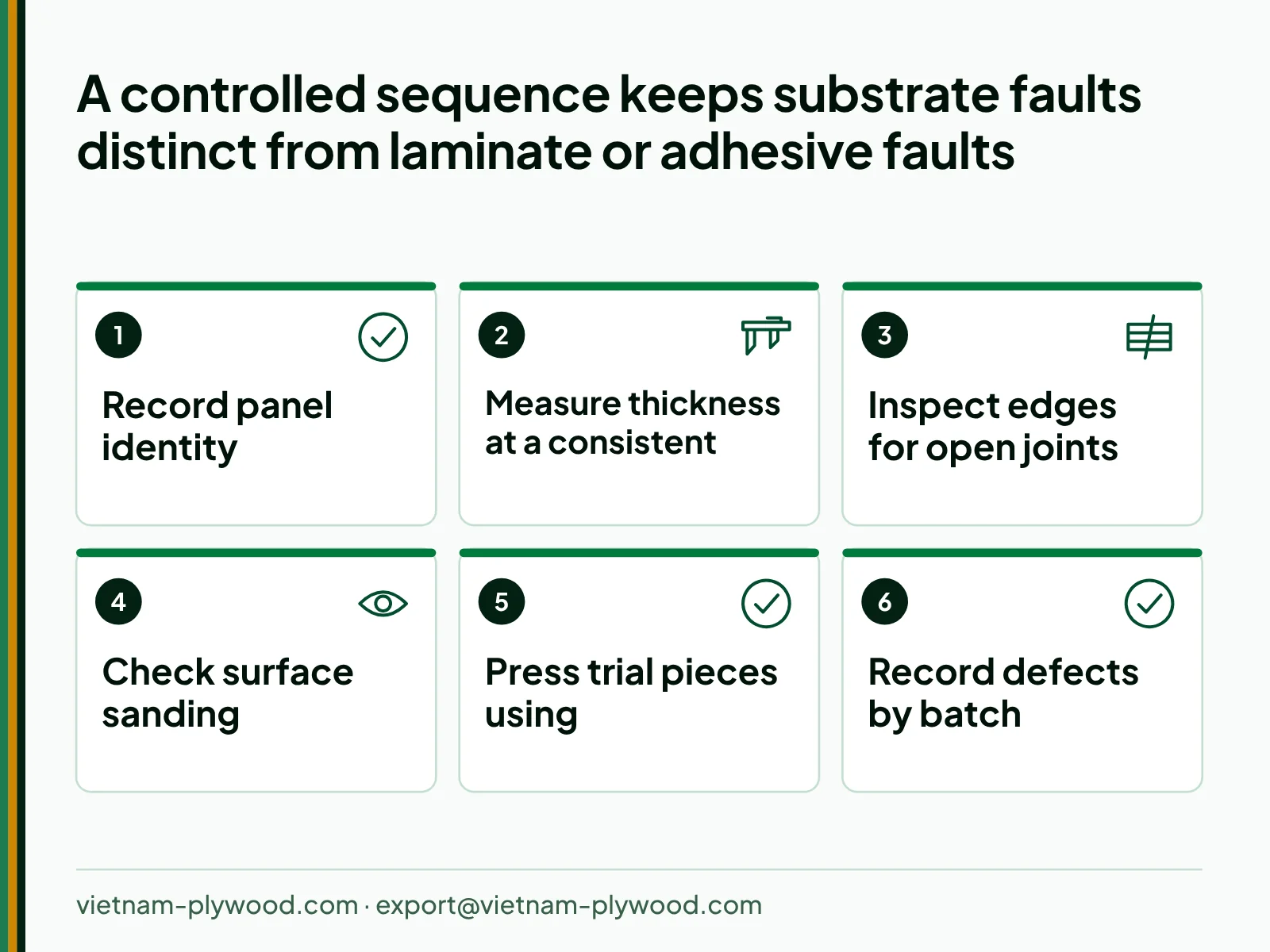
- Record panel identity, core species, nominal thickness and ordered tolerance on arrival.
- Measure thickness at a consistent set of locations and check the sheet for bow, twist and surface irregularities.
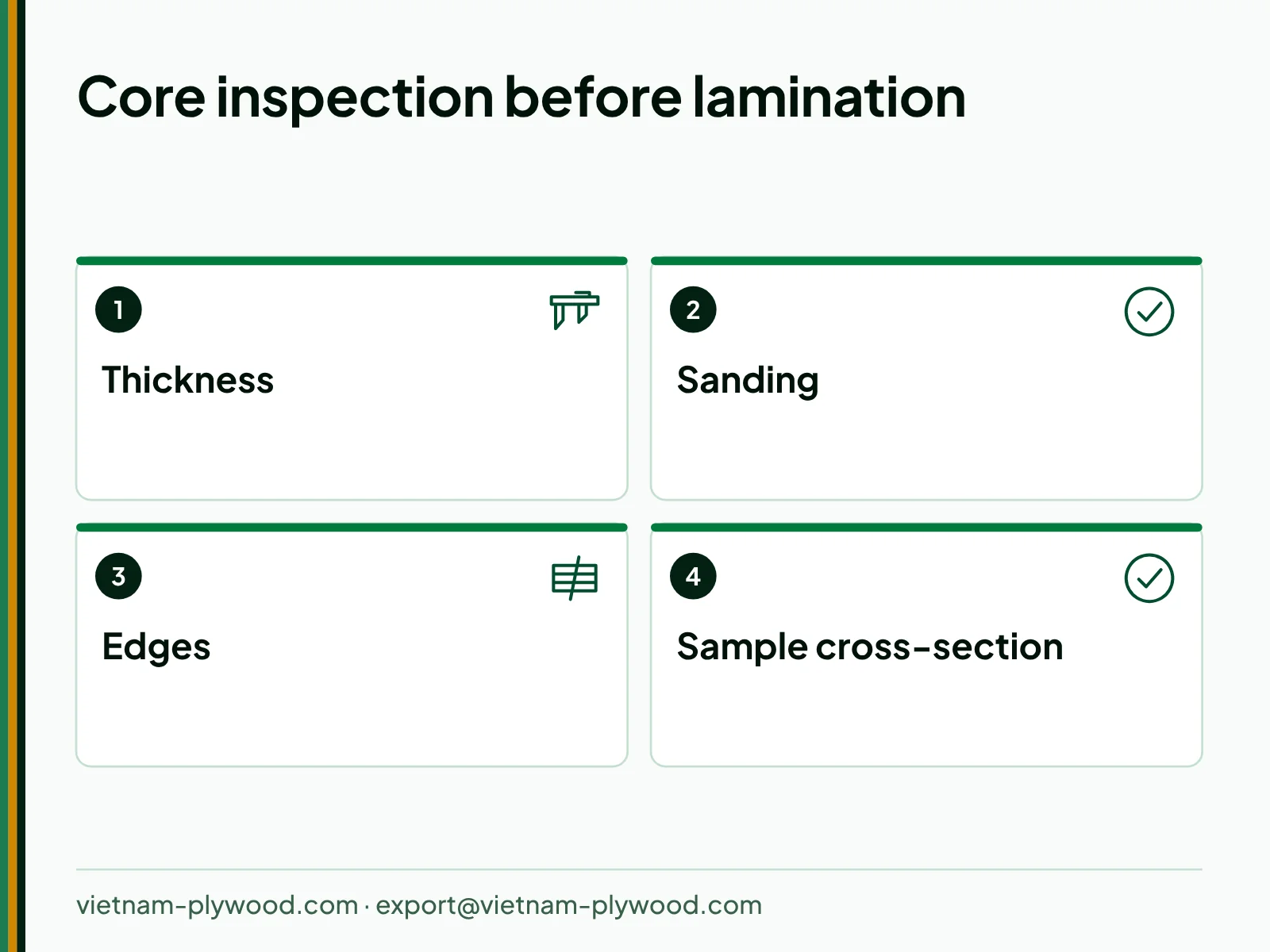
- Inspect edges for open joints, overlapping veneers and cavities; cut a sample cross-section where the acceptance plan calls for it.
- Check surface sanding, cleanliness and moisture against the laminator’s documented press requirements.
- Press trial pieces using the selected HPL and adhesive system; examine surface appearance and bond results under that system’s acceptance procedure.
- Record defects by batch and agree whether the cause is the substrate, the laminating process or the overlay itself.
A good-looking trial from a single board is not a substitute for lot sampling. Agree the sampling plan in the purchase specification, including how nonconforming boards will be identified and separated.
What can an inspector witness at the producing factory?
At the producing factory, the buyer can witness thickness readings, surface sanding checks and edge inspections on identified panels. The inspector can compare the actual build with the approved sample and photograph representative veneer joints. A sample cut from the selected batch can expose whether the stitched construction matches the order.
HCPLY runs specification, on-site QC, export documents and loading. Buyers visit the factory office and inspect goods at the producing factory in Phu Tho or Hai Phong. The Vietnam plywood manufacturing overview describes the production context, while the engineered veneer plywood page helps distinguish a decorative veneer face from a raw substrate awaiting HPL.
Write the inspection criteria before production starts. If flatness or void acceptance needs a numerical limit, provide the laminator’s approved method and threshold rather than relying on an undefined phrase such as “lamination grade.”
Which sizes, cores and loading quantities make sense?
The common 1220 × 2440 mm sheet is often described as HPL plywood 4x8. Other available plywood formats include 1250 × 2500, 1220 × 2135, 1220 × 1830, 915 × 2440, 915 × 2135 and 915 × 1830 mm; custom cutting is available. Thickness ranges from 3–40 mm, with 18 mm a common cabinet specification.
At 18 mm and 1220 × 2440 mm, a styrax core weighs 26.79 kg per sheet and an eucalyptus core 34.83 kg. Full 40HC calculations are 990 sheets, 53.05 m³ and 26.52 t for styrax; eucalyptus is 795 sheets, 42.60 m³ and 27.69 t. These figures describe plywood without an HPL overlay. The 40HC payload limit is 28.5 t.
A minimum order is one 40HC, and one container can carry several specifications as long as the payload limit holds. For example, an HPL-ready styrax furniture core and a separate eucalyptus furniture specification can share the shipment after pallet and weight planning. Do not add the two full-container figures together: each is an alternative complete load. The container loading reference covers load planning in more detail.
Which emission and export documents should buyers request?
For an EU furniture application, separate plywood emission evidence from finished-article compliance. Commission Regulation (EU) 2023/1464 (2023) sets a formaldehyde release limit of 0.062 mg/m³ for furniture and wood-based articles under its specified test conditions after 6 August 2026, subject to the regulation’s exclusions. See the official EUR-Lex text. The laminator should assess the finished article against the destination rules.
Factory certificates such as FSC, CARB P2, ISO 9001 and CE, and EUTR/EUDR documents, are shown with factory details masked, on request. They belong to the member factories and must be matched to the specific producing factory and ordered build. For a US-bound cabinet substrate, ask for the relevant emission documentation and product scope rather than treating E0 or E1 as interchangeable with CARB P2 or TSCA Title VI.
The shipment document set includes a commercial invoice, packing list, bill of lading, certificate of origin, phytosanitary and fumigation papers, plus agreed certificate documents. EU lots include EUR.1 and the EUTR/EUDR file set; CIF shipments include insurance. After loading, the draft shipping documents come to you for approval.
Is Formica-faced plywood different from HPL plywood?
Formica-faced plywood can be HPL plywood when the applied Formica product is a high-pressure laminate. Formica is a brand reference, while HPL describes a laminate category. A plywood Formica worktop also needs the intended surface grade, edge detail, adhesive and substrate specification; the name alone does not settle those fields.
A shopfitting order may call for a colour, texture, abrasion requirement or cleaning resistance. Those properties belong to the selected overlay and its supplier’s technical sheet. A yellow or wood-grain face does not identify core species or emission class. Finished HPL plywood from other manufacturers can also have overlays on one or both faces, with different total thicknesses. Ask whether the quoted dimension is the substrate thickness or the finished laminated thickness.
How should a buyer compare offers and request a quote?
Compare quotations on the same substrate build and inspection method. First rank full-stitched construction and calibrated sanding against less prepared cores; the former takes more preparation and is the appropriate comparison for a visible HPL finish. Next compare core species, ordered tolerance, glue system, emission documentation, dimensions and volume. These factors change the production work and quotation.
Request a written quote for the selected raw core rather than using a finished-laminate price as a proxy. Our furniture line can be quoted against the specified build; distributor supply programmes explain how repeated specifications can be organised.
Factory lead time runs 15–45 days from receipt of the 30% deposit; the exact figure depends on order size, line loading and what the contract fixes. The remaining 70% is paid on the scan of the bill of lading, by T/T, or by irrevocable sight L/C. We ship FOB Hai Phong, or CFR (CNF) or CIF to your port. Samples cost nothing: a first-time buyer pays the courier, and that charge comes off the first confirmed order.
What should the purchase specification say?
The purchase specification should name the raw plywood substrate and the laminator’s acceptance checks, without treating the HPL overlay as part of our delivery. Include the destination port so the shipment can be quoted against the correct delivery term. For an 18 mm HPL plywood sheet, record 18 mm as the core thickness and have the laminator calculate the finished thickness separately.
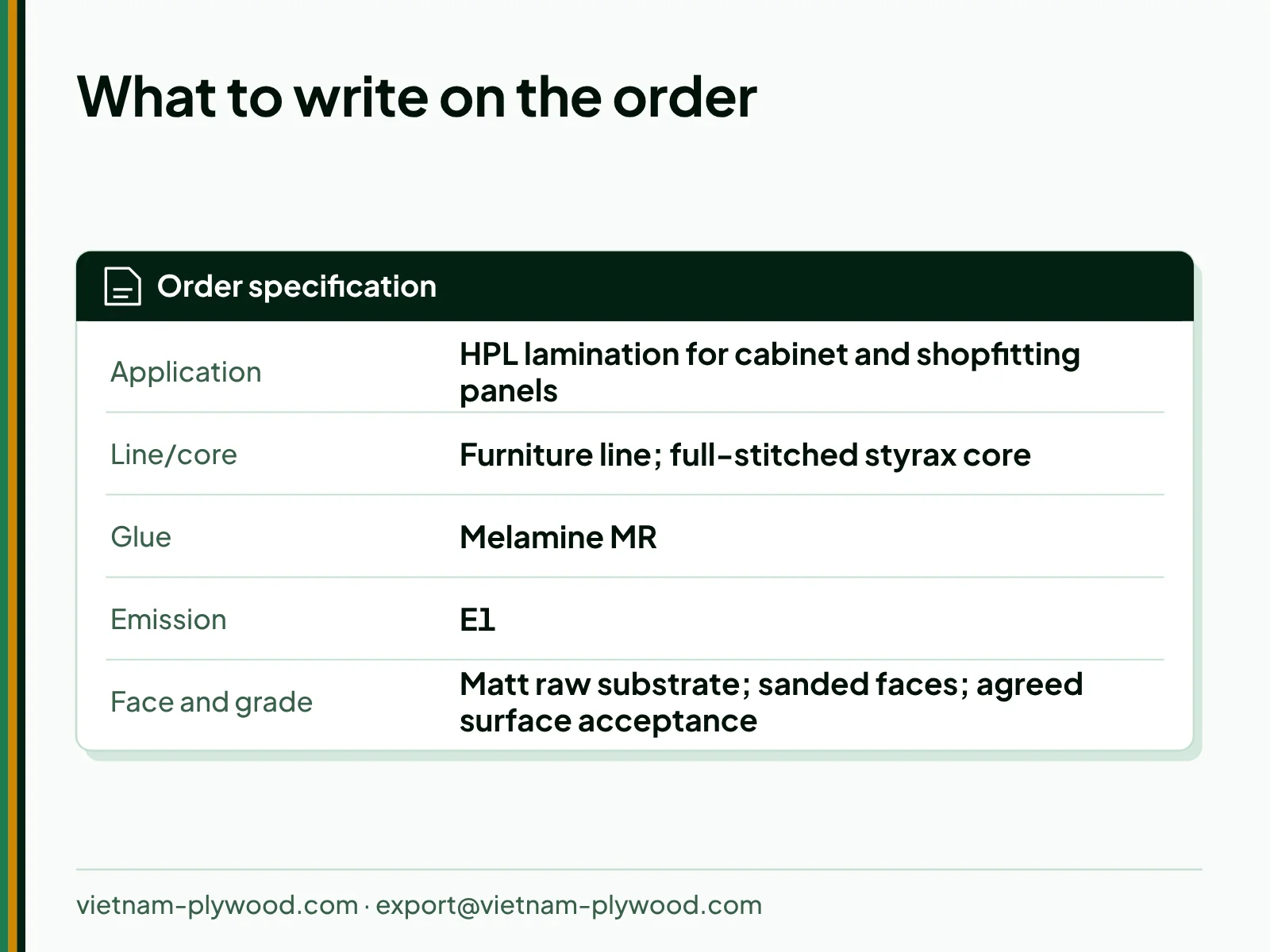
The following is a starting order message for an HPL-ready core. Replace the example choices with the actual approved trial requirements and destination.
Application: HPL lamination for cabinet and shopfitting panels
Line/core: Furniture line; full-stitched styrax core
Glue: Melamine MR
Emission: E1
Face and grade: Matt raw substrate; sanded faces; agreed surface acceptance
Thickness and tolerance: 18 mm core; ±0.2 mm
Size: 1220 × 2440 mm; length/width ±2 mm
Quantity: One 40HC, final specification mix by payload
Destination port: [buyer to insert]
Book a factory visit with Lucy at export@vietnam-plywood.com to inspect the producing factory and approve the HPL-ready core.