





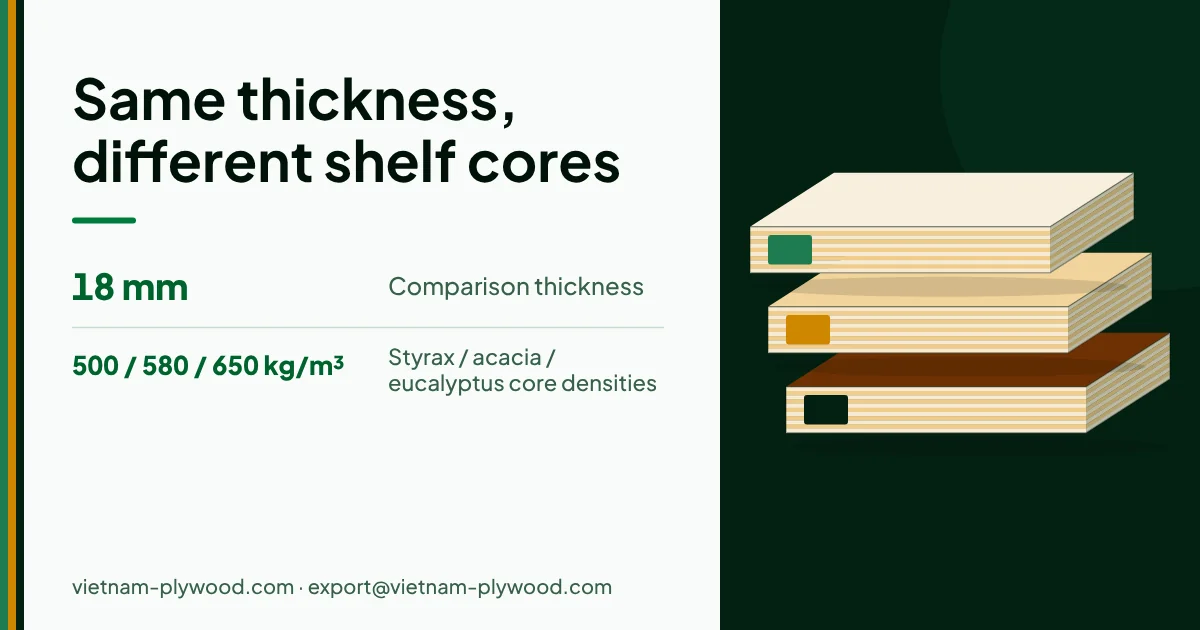
For plywood shelves at the same 18 mm thickness, core selection changes weight and can change bending performance, but density alone cannot predict sag. A wrong specification can mean rejected cabinet components, extra machining or a delayed shipment. HCPLY recommends matching the core and surface build to the shelf load, clear span and support arrangement before ordering.
Which plywood shelves specification works best?
For plywood shelves carrying books or display stock, start with an 18 mm sanded furniture panel, a full-stitched core and supports set by a documented load test. Choose eucalyptus core when higher density is desirable, or styrax when lower handling weight matters. A face veneer determines appearance; the core and complete panel construction govern the bending response.
HCPLY makes furniture plywood with styrax or eucalyptus cores on our furniture line. For cabinet runs, the buyer should specify shelf depth, clear span, anticipated distributed load, front-edge reinforcement and acceptable deflection before selecting the face. A clean face cannot compensate for an inadequate span design.
The furniture plywood range provides the relevant build choices. Birch is available as a face, but we do not press birch-core plywood. For visible cabinets, bintangor, okoume, engineered veneer (EV) and sapele are among the face options; face veneer is commonly 0.2–0.4 mm.
What thickness of plywood should be used for shelves?
18 mm is a practical starting specification for furniture shelves, while 12 or 15 mm can suit short, lightly loaded runs and 21 or 25 mm can be evaluated for greater stiffness. These are specification candidates rather than certified span ratings. A shelf maker should qualify each combination of depth, support spacing, load and edge detail.
Our thickness range is 3–40 mm, including common 9, 12, 15, 18, 21 and 25 mm builds. Sanded furniture thickness tolerance is ±0.2 or ±0.3 mm as ordered. Thickness matters strongly because bending stiffness rises rapidly as the section becomes deeper, provided the panel construction and orientation are comparable.
At 18 mm, the core contains 11–13 plies, depending on individual veneer thickness of 1.4–2.0 mm. Inspect ply continuity and internal gaps alongside thickness: nominal dimensions alone cannot describe the bending performance of a shelf.
How far can an 18 mm plywood shelf span before it sags?
There is no single defensible maximum unsupported span for an 18 mm shelf without a specified load, depth, support condition and measured bending stiffness. Every loaded shelf deflects to some extent. A manufacturer or cabinet engineer should set an allowable deflection and verify the chosen panel against it.
For a simply supported shelf under a uniform line load, the classical beam model gives deflection proportional to load multiplied by span to the fourth power, divided by flexural rigidity. That means even a modest increase in unsupported length can markedly increase sag. Front-edge lipping, a rear cleat or an intermediate divider can change the result by changing the support or section.
A full bookcase, a light retail display and a narrow cabinet shelf therefore cannot share one universal span number. Request a sample and test it at the actual clear span with the expected long-duration load. Record immediate deflection and subsequent movement over time; also check fasteners and support deformation.
Which core sags least: eucalyptus, acacia or styrax?
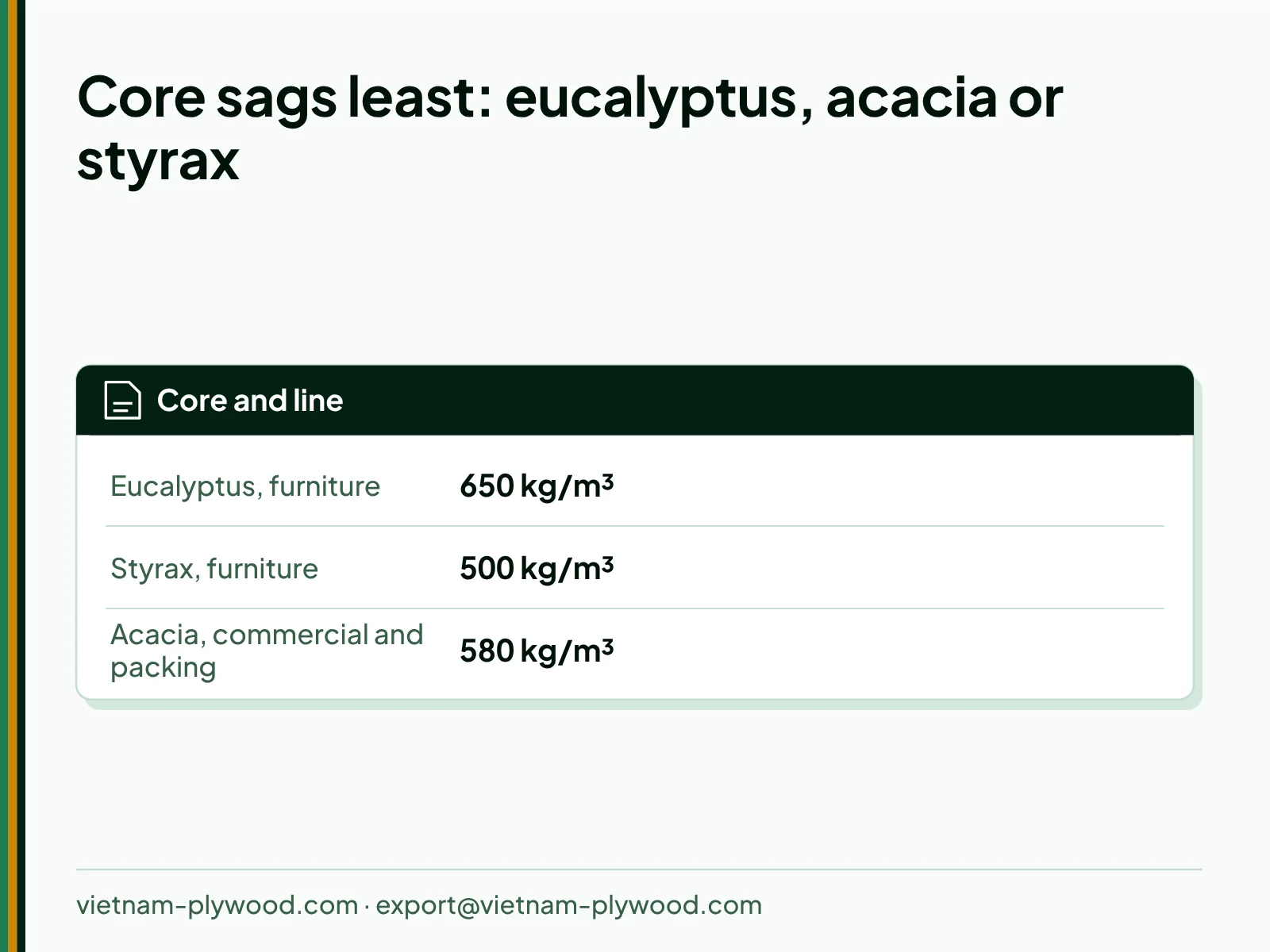
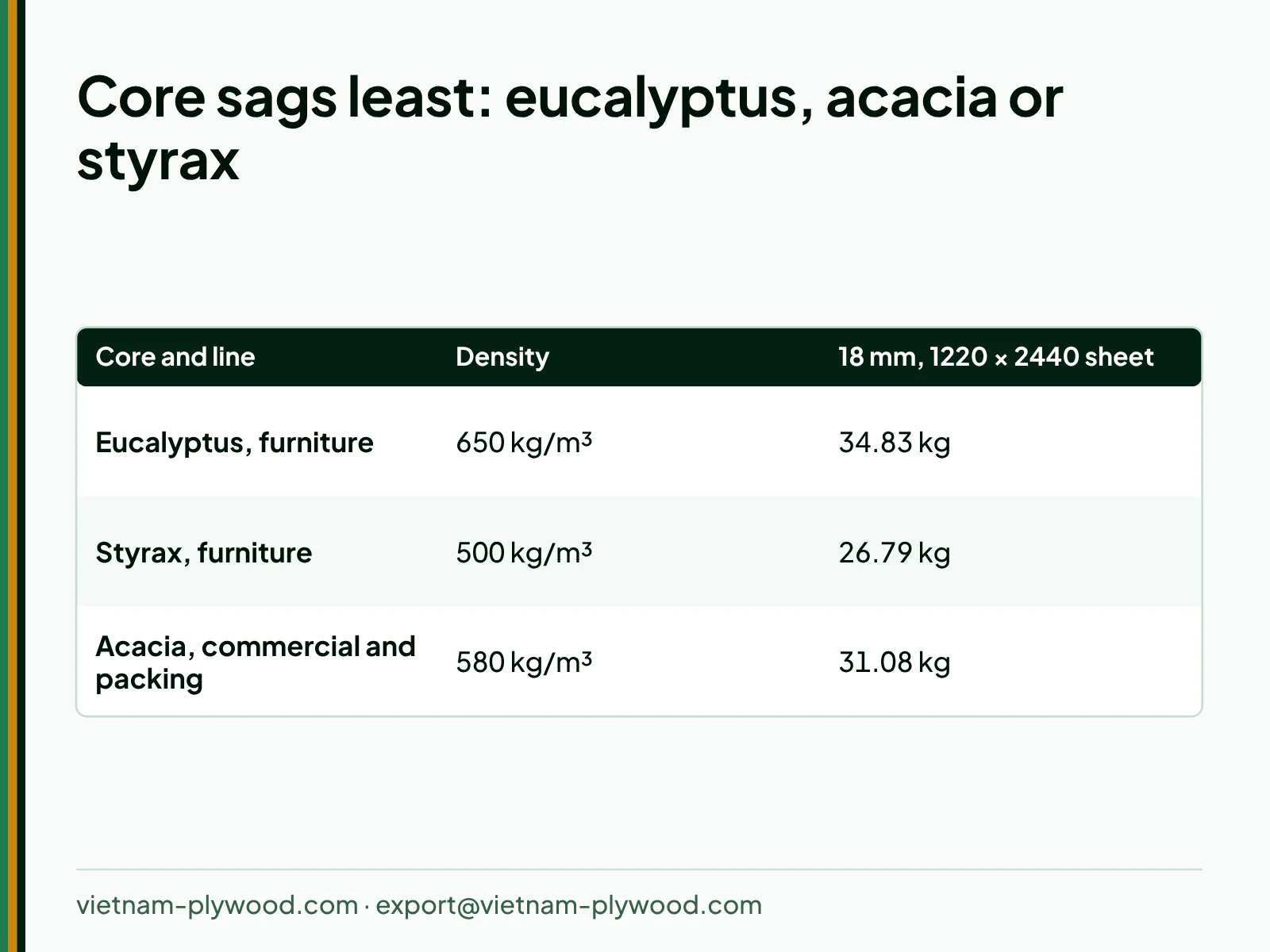
Density alone cannot rank shelf sag: eucalyptus is densest in our range, but actual bending stiffness depends on veneer quality, grain direction, bond and panel construction. Eucalyptus at 650 kg/m³, acacia at 580 kg/m³ and styrax at 500 kg/m³ are the core-density inputs. None is a measured modulus of elasticity or a certified shelf span.
| Core and line | Density | 18 mm, 1220 × 2440 sheet | Typical shelf decision |
|---|---|---|---|
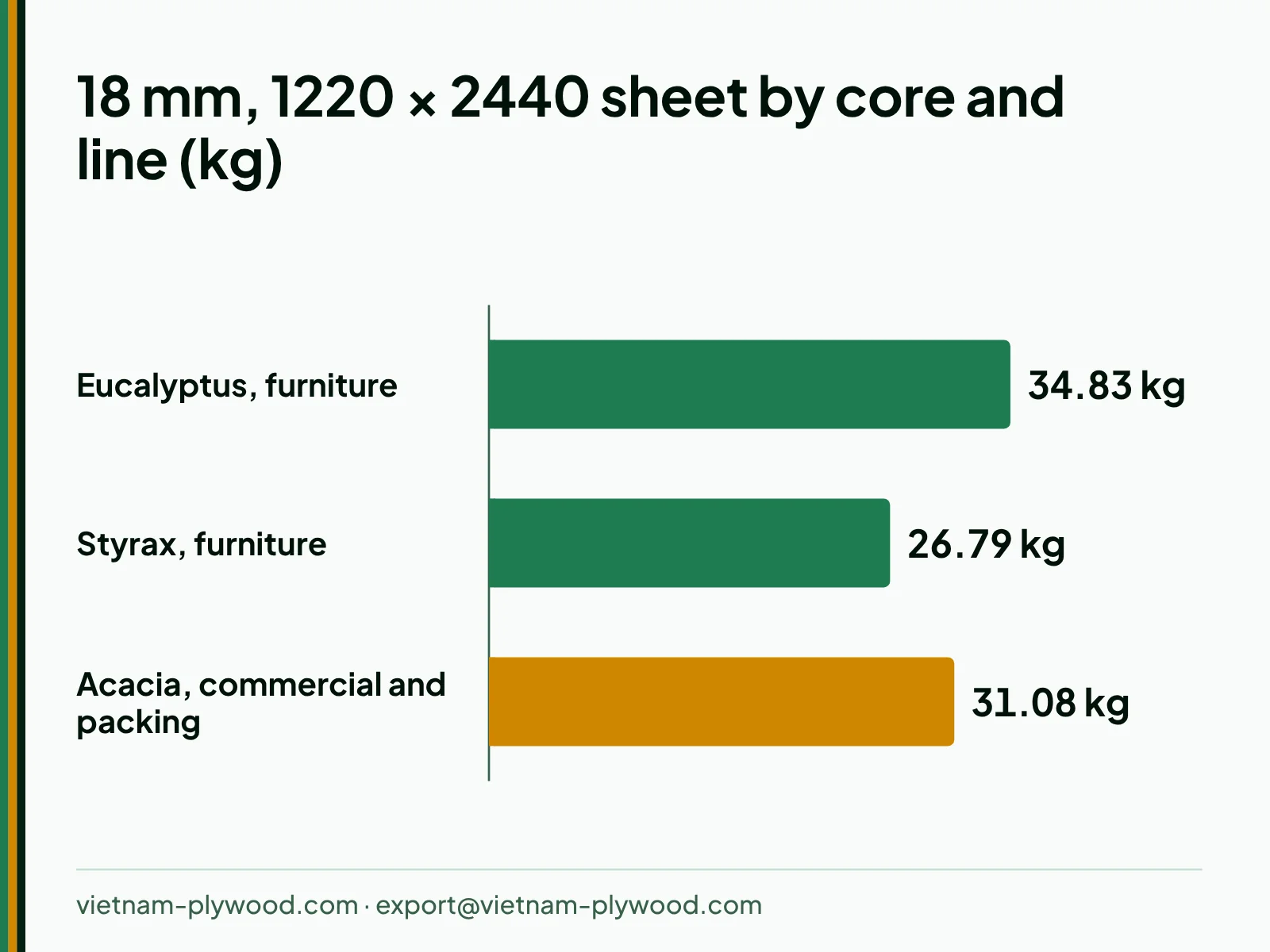
| Eucalyptus, furniture | 650 kg/m³ | 34.83 kg | Evaluate for long, loaded visible shelves after deflection testing |
| Styrax, furniture | 500 kg/m³ | 26.79 kg | Lighter visible cabinets where span and load permit |
| Acacia, commercial and packing | 580 kg/m³ | 31.08 kg | Hidden or short runs after checking surface and load needs |
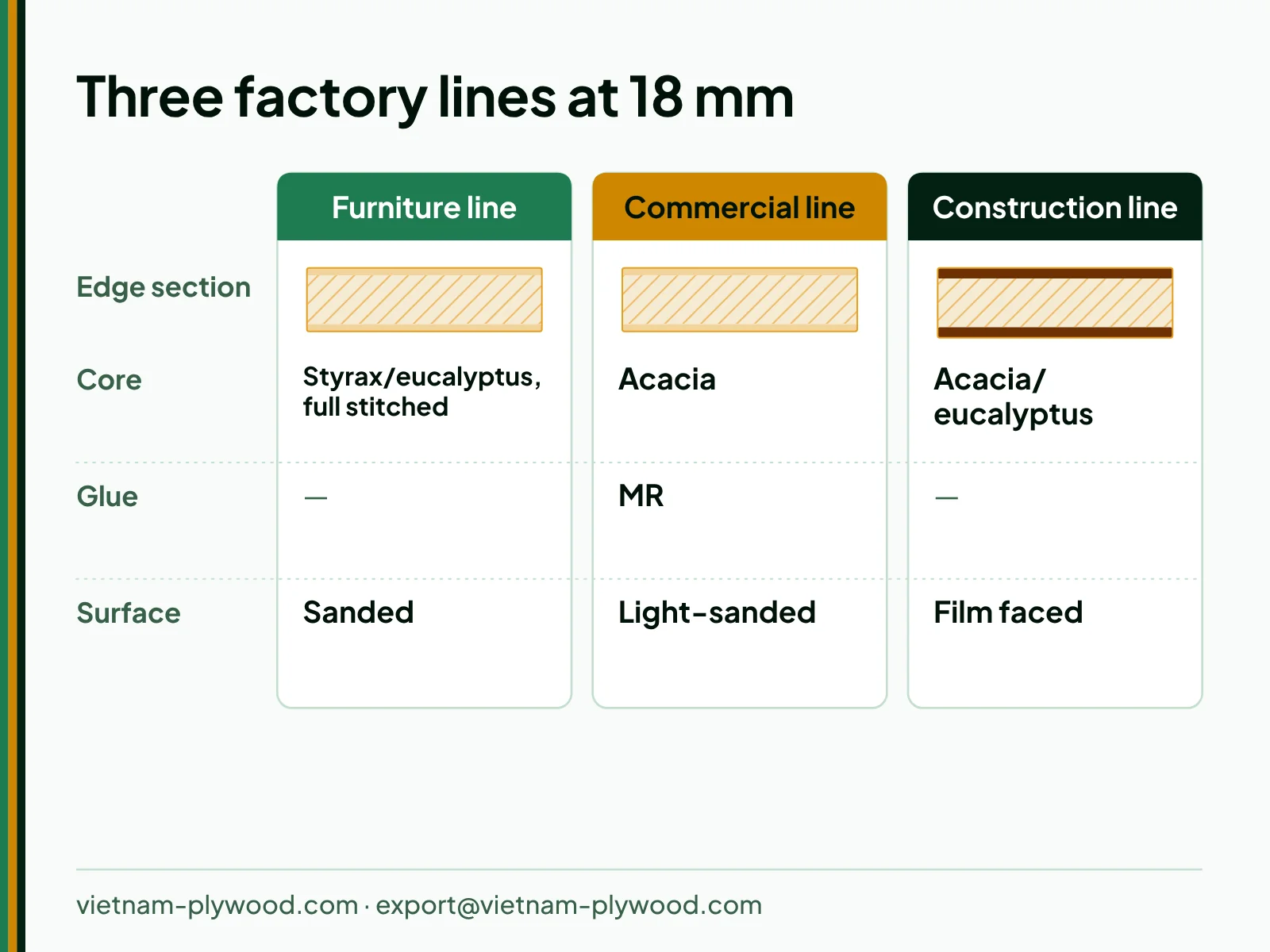
Our commercial and packing line uses acacia with moisture-resistant (MR) glue and unsanded or light-sanded surfaces. Our construction line presses film-faced acacia or eucalyptus for formwork, rather than a decorative shelf face. The comparison of plywood grades across factory lines helps purchasing teams separate these builds.
For a valid comparison, test matched 18 mm samples at identical shelf depth, grain orientation, supports and loading. Density can guide handling and logistics, but only comparable bending tests establish which panel sags less.
Is 3/4-inch plywood suitable for shelves and bookcases?
Three-quarter-inch plywood is a common nominal purchasing description, close to 19 mm; an 18 mm order must be written as 18 mm rather than treated as identical. Bookcases need a load-and-span check even when the panel is described as three-quarter-inch. A heavy row of books can expose a weak shelf design over time.
For repeatable cabinet machining, put the ordered thickness and tolerance on the drawing. Confirm groove widths, shelf pins, edge banding and any reinforcing lip against the actual panel. A 0.2–0.4 mm decorative veneer is a face specification, not an allowance to change the core thickness.
Where the shelf sits beside a desk or counter, compare edge and finish expectations with table-top and desk plywood. For cabinets with narrow internal components, thin plywood supply addresses a different thickness decision.
When is a commercial-line panel enough?
An acacia commercial panel is a reasonable candidate for concealed shelving with short spans, moderate loading and no visible decorative-face requirement. It uses MR glue and an unsanded or light-sanded surface, so machining and finish trials matter. Specify a furniture-line face when the shelf edge and broad surface remain exposed.
At 18 mm and 1220 × 2440 mm, the acacia panel weighs 31.08 kg, compared with 26.79 kg for styrax and 34.83 kg for eucalyptus. Those figures help estimate handling and shipping mass, but they do not provide allowable shelf loads. A commercial-line purchase should still define void acceptance, edge quality, glue, thickness and an inspection method.
For a packing or utility use, a lower surface finish may be acceptable. For fitted cabinets with close-fitting joints, the sanded furniture build and tighter ordered tolerance are more appropriate. Ask for both constructions as samples when the price-versus-finish choice remains open.
What matters more than the face species?
Core assembly, ply alignment and support detail matter more to shelf performance than a decorative face name alone. Our furniture panels use full-stitched, sanded cores; lower-cost construction choices can include stitched outer layers with edge-trimmed inner layers, finger-jointed layers or loose-laid veneers. For a visible shelf, ask for continuous edges and a defined internal-void acceptance rule.
Choose face grade separately from mechanical requirements. A/B face grading applies to relevant decorative faces; birch faces use D/E/F grades. The face species identifies the product commercially, while the core density follows the internal species. A birch-faced eucalyptus-core panel remains an eucalyptus-core panel for density calculations.
For painted shelves, inspect grain visibility, sanding marks and the sample finish under the intended coating. For clear-finished shelving, approve veneer colour range, joins and surface repairs on an agreed reference sample. Melamine, high-pressure laminate and decorative laminate faces are separate finishing topics, not HCPLY product lines.
How should shelf loads and support details be tested?
A representative shelf test should reproduce the real clear span, depth, panel orientation, supports and expected load. Record the panel identification, starting flatness, applied load, deflection at midspan and any lasting change after unloading. Repeat after conditioning appropriate to the intended indoor environment.
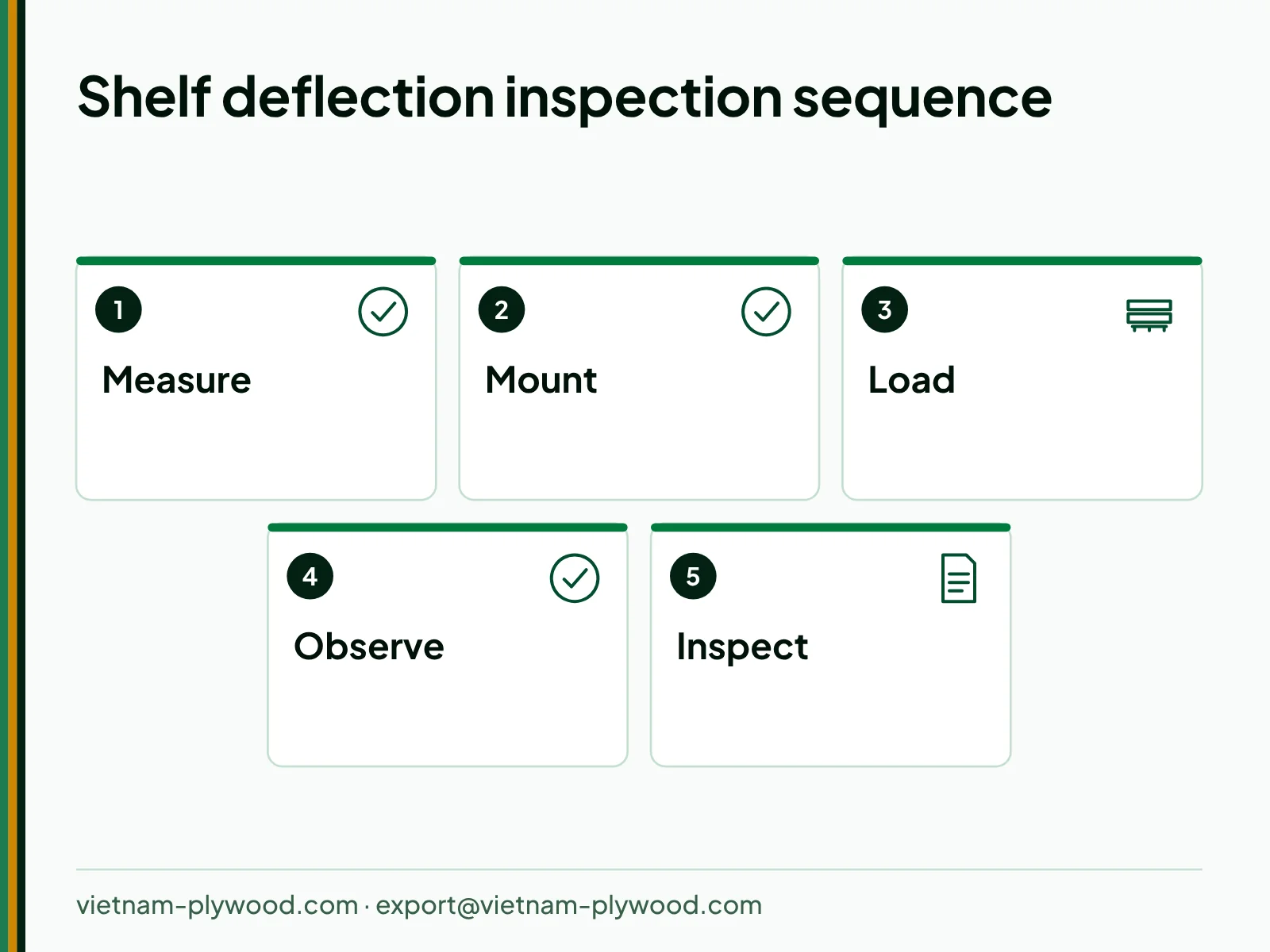
A practical acceptance sequence is:
- Measure the panel thickness and cut a shelf to the production drawing.
- Install it on the intended brackets, pins, cleats or cabinet sides.
- Apply the specified distributed load, then measure centre deflection against the agreed limit.
- Keep the load in place for the buyer’s specified observation period and record additional sag.
- Inspect edges, joints, supports and the panel after unloading.
The test must distinguish panel deflection from bracket rotation or cabinet-side movement. Keep the same loading method across all candidate cores. For wet or fluctuating conditions, moisture control and edge treatment also enter the acceptance criteria.
What about humidity, finishes and shelf edges?
Shelving in damp storage or fluctuating indoor humidity needs an explicit moisture exposure specification and sealed machined edges. MR describes the melamine glue system and its 12-hour boil condition; phenolic weather-and-boil-proof (WBP) glue has a 72-hour boil condition. These glue descriptors do not independently establish the stiffness of a shelf or make an exposed assembly waterproof.
APA – The Engineered Wood Association, in its 2024 technical note on panel buckling, explains that increased moisture can expand wood panels and produce waviness. The note concerns structural sheathing, so its edge-spacing detail is not a cabinet-shelf rule; the relevant lesson is to control moisture and allow for dimensional movement in the actual assembly. See the APA technical note.
For shelves, approve the coating system and edge treatment with the furniture maker. Seal drilled holes and cut edges where exposure requires it, and inspect samples after conditioning. A shelf that passes a dry-room trial should be evaluated separately for a humid installation.
What can the buyer inspect at the producing factory?
Buyers can inspect core construction, dimensions, sanding and packed goods at the producing factory before shipment. At HCPLY, our three factories are in Phu Tho and Hai Phong, and the order runs on the line matching its written specification. Buyers visit the factory office and inspect goods at that factory.
For a shelving lot, witness a calibrated thickness check across selected panels, inspect cut edges for gaps and compare the face to the approved sample. Record the glue and emission requirements as separate fields: E0 or E1 are emission classes on the furniture line, while the adhesive type describes bonding. For a US-bound order, CARB Phase 2 or TSCA Title VI requirements involve a separate compliance and certification question.
Member-factory FSC, CARB P2, ISO 9001, CE and EUDR/EUTR documents can be shown with factory details masked, on request. Agree on the actual documents needed for the destination and the specific build before production.
How does a shelving order fit into a container?
The minimum order is one 40HC, and specifications can be mixed within its 28.5 t payload limit. For 18 mm, 1220 × 2440 mm panels, the full-container reference is 990 styrax sheets at 26.52 t, 880 acacia sheets at 27.35 t or 795 eucalyptus sheets at 27.69 t. Those totals exclude any additional film weight.
A mixed shipment could combine visible furniture shelves with hidden commercial panels, provided the pallet allocation and total mass stay within the limit. For example, 10 styrax pallets at 55 sheets each weigh about 14.73 t using 26.79 kg per sheet; eight acacia pallets at 55 sheets each weigh about 13.68 t using 31.08 kg per sheet. Together that is about 28.41 t before packaging and other load allowances, so the loading plan must account for those additional weights.
Use the mixed-container specification process for combining builds and the container loading reference for pallet planning. Shipping documents include the commercial invoice, packing list and bill of lading; the packing list identifies quantities and packages in the shipment.
What should go into the purchasing specification?
A shelf-plywood request should state the shelf geometry and test condition before naming the face. The buyer’s drawing should distinguish the decorative surface from the core, and define thickness, tolerance, support layout and intended load. This avoids purchasing a visually acceptable panel that fails the cabinet’s sag criterion.
For a visible shelf, request our furniture line with a full-stitched, sanded styrax or eucalyptus core and an approved decorative face. For hidden short runs, ask for an acacia commercial-line sample as a comparison. Request a quotation against the complete written specification; face grade, core assembly, machining tolerance and order mix all affect cost.
HCPLY coordinates specification, on-site quality control, loading and export documents. The order ships directly from its producing factory, with FOB Hai Phong available. Send Lucy the drawing and intended test load through contact or export@vietnam-plywood.com.
Application: cabinet/bookcase shelves; clear span, depth, support and load specified
Line or core: furniture / eucalyptus or styrax; alternate commercial / acacia
Glue: MR melamine or agreed phenolic WBP
Emission: E0 or E1 as ordered; destination compliance requirements
Face and grade: named veneer and applicable A/B or birch D/E/F grade
Thickness and tolerance: 18 mm, sanded ±0.2 or ±0.3 mm as ordered
Size: 1220 × 2440 mm sheets; shelf cutting schedule attached
Quantity: sheet count and mixed-load breakdown within one 40HC
Destination port: named discharge port; FOB Hai Phong or agreed CFR/CIF
Ask Lucy for a sample set covering the proposed visible and concealed shelf builds.