





Shuttering plywood price in India must be compared by sheet size, measured thickness, core, glue and landed cost rather than a kilogram label alone. A wrong comparison can consume the savings through early replacement, extra handling or a rejected load. HCPLY builds film-faced panels on our construction line in Vietnam and quotes against a written specification.
What decides shuttering plywood price in India?
The main price drivers are core construction, bonding system, film and thickness, followed by dimensional consistency and delivery terms. A heavier sheet can contain more wood, denser wood or a different nominal thickness. Its weight alone says little about bond performance or useful pours. Compare the full build before comparing rupees per square foot.
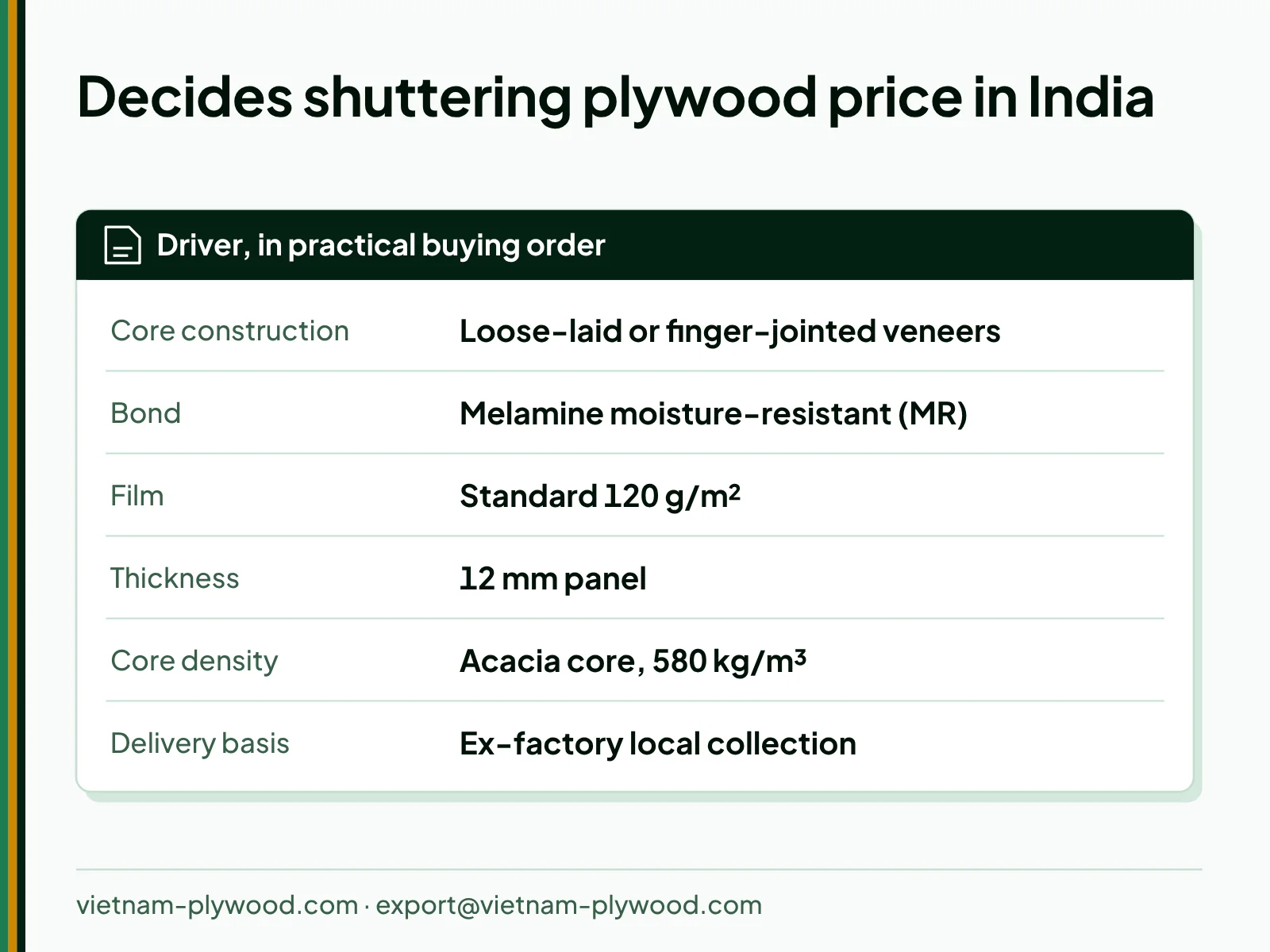
| Driver, in practical buying order | Lower-cost comparison | Higher-cost comparison | What to ask for |
|---|---|---|---|
| Core construction | Loose-laid or finger-jointed veneers | Full stitched core with controlled gaps | Edge photograph and core construction |
| Bond | Melamine moisture-resistant (MR) | Phenolic weather-and-boil-proof (WBP) | Glue specification and agreed test report |
| Film | Standard 120 g/m² | Premium 135 g/m²; 220 g/m² is anti-slip only | Face type and film weight |
| Thickness | 12 mm panel | 18 mm panel of matching build | Measured thickness and tolerance |
| Core density | Acacia core, 580 kg/m³ | Eucalyptus core, 650 kg/m³ | Species and actual sheet mass |
| Delivery basis | Ex-factory local collection | Delivered Indian jobsite or landed import | Taxes, freight and handling included |
The table ranks manufacturing features by their practical effect on a comparable build; actual price differences require quotations. Film weight describes a face specification, while core density follows the wood inside. A higher-grade face cannot substitute for a sound bond or closed core.
For a wider cost structure, see Vietnam plywood export cost components and the construction plywood range.
Why is shuttering plywood sold by sheet weight?
Sheet weight is an accessible receiving-yard check where 8x4 boards are traded in kilogram bands. Buyers can weigh a bundle and detect an unexpected difference from a purchase description. Yet two panels with identical mass can have different thicknesses, core voids, glue and surface coatings.
An 8x4 label normally points to a nominal 1220 × 2440 mm panel in an import comparison. Check whether the local listing uses exact dimensions or rounded feet. A sheet’s mass is length × width × thickness × density, plus any face coating and other finishing contribution.
A weight-based tender should therefore name both a target mass and measurable construction requirements. Do not treat 25 kg, 30 kg or 32 kg as a structural grade. For handling and shipping calculations, keep the core-only mass distinct from the finished panel’s scale reading.
What thickness is a 30 kg shuttering plywood sheet?
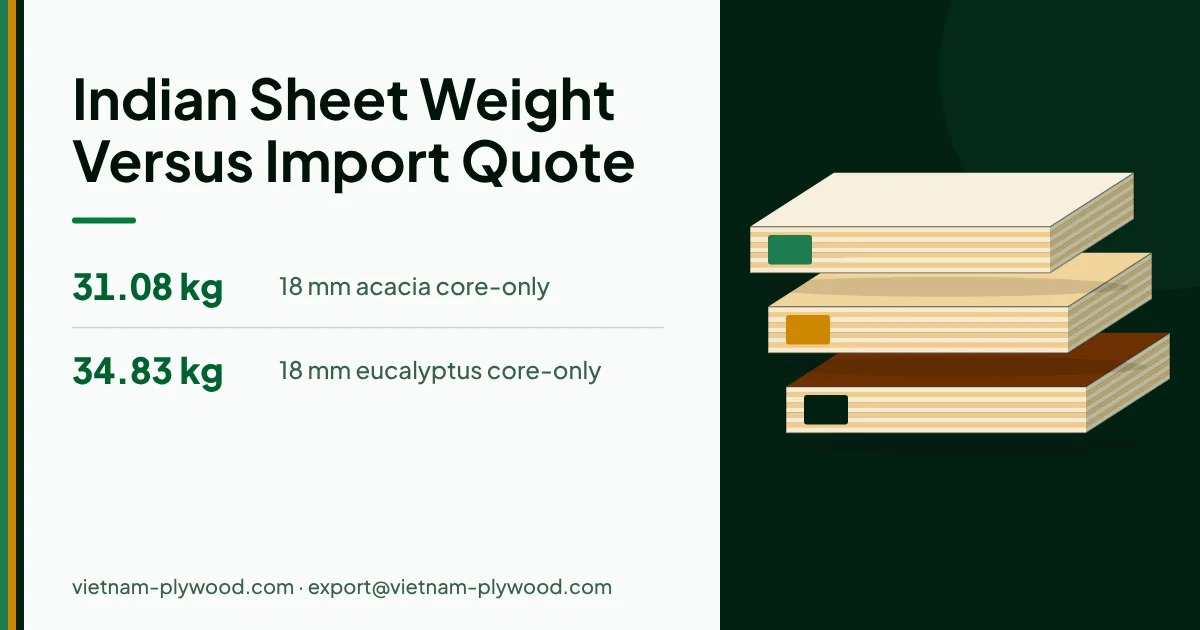
Thirty kilograms does not establish thickness without area and density. At the HCPLY 1220 × 2440 mm size, an 18 mm acacia-core sheet is 31.08 kg before film weight, whereas a 15 mm eucalyptus-core sheet is 29.02 kg before film. Both approach the market’s 30 kg shorthand through different builds.
| Nominal build at 1220 × 2440 mm | Core-only sheet weight | What the label misses |
|---|---|---|
| 12 mm acacia | 20.72 kg | Film, bonding and tolerances |
| 12 mm eucalyptus | 23.22 kg | Film, bonding and tolerances |
| 15 mm eucalyptus | 29.02 kg | Film and actual measured thickness |
| 18 mm acacia | 31.08 kg | Film and actual measured thickness |
| 18 mm eucalyptus | 34.83 kg | Film and actual measured thickness |
These are product-core calculations, not Indian retail weight grades. Our construction line uses acacia or eucalyptus core with phenolic or melamine film, including an anti-slip option. Commercial and film-faced thickness tolerance is ±0.5 mm; length and width tolerance is ±2 mm.
A supplier advertising 25 kg or 32 kg should identify thickness independently. Measure multiple sheets, check edges and weigh finished sheets from the same batch. Do not reverse-engineer glue quality from the scale.
How should a 34 kg 12 mm claim be read?
A 34 kg, 12 mm, 1220 × 2440 mm sheet implies about 952 kg/m³ if its entire mass is treated as core mass. That figure exceeds our listed acacia and eucalyptus core densities. Film and finishing contribute to a finished sheet’s mass, so the calculation is a diagnostic question rather than a material identification.
First check whether 12 mm is the measured thickness and whether the stated weight applies to the same 8x4 dimensions. Next inspect whether the listing combines different products or uses an approximate weight band. Finally request the core species, bond and test basis before comparing quotes.
A heavier 12 mm sheet is not automatically stronger than a properly specified 18 mm sheet. Formwork spacing, support design, panel bending properties and the concrete pour determine suitability. The designer or contractor should approve the panel against the actual support arrangement.
What does a 12 mm or 18 mm 8x4 sheet cost?
A 12 mm or 18 mm shuttering plywood sheet needs a grade-specific quotation; thickness alone cannot produce an honest Indian price. Within the same core and face construction, 18 mm consumes more veneer and weighs more than 12 mm. Phenolic bonding and premium film also add cost relative to the corresponding MR and standard-film build.
Local advertisements can show prices per square foot, per sheet or per kilogram. These units are not interchangeable without a measured panel and a defined transaction basis. Convert a square-foot quote to a sheet price using the seller’s actual invoiced area, then compare it with the landed sheet cost of an import.
Ask whether the local shuttering wood price includes goods and services tax, transport to the formwork yard, unloading and any returns. Record whether the quoted panel is plain, coated or film-faced. The value-grade plywood comparison helps separate low upfront cost from construction suitability; thin plywood costs address a different thickness intent.
Which factory line builds the comparison panel?
Our construction line presses film-faced formwork plywood with acacia or eucalyptus cores and unsanded construction. The same nominal thickness has different purposes across our three factories. A matching thickness does not make those builds interchangeable on a concrete pour.
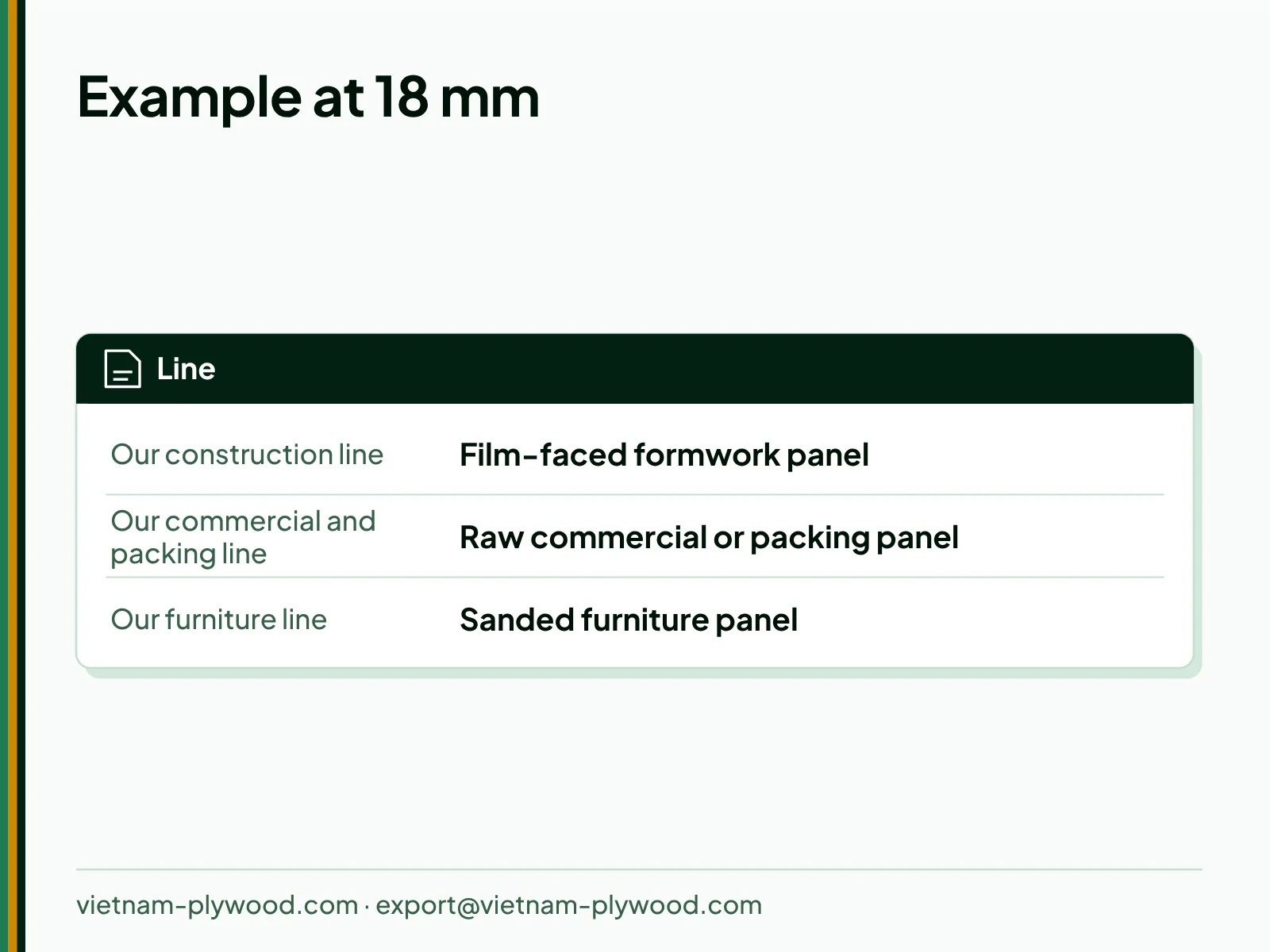
| Line | Example at 18 mm | Core and finish | Appropriate buying use |
|---|---|---|---|
| Our construction line | Film-faced formwork panel | Acacia or eucalyptus; phenolic or melamine film; unsanded | Concrete shuttering |
| Our commercial and packing line | Raw commercial or packing panel | Acacia; MR glue; unsanded or light-sanded | Packaging and commercial applications |
| Our furniture line | Sanded furniture panel | Styrax or eucalyptus; full stitched; E0/E1 | Furniture and cabinet manufacturing |
The producing factory handles the matching order. Buyers can visit the factory office and inspect goods at the producing factory. HCPLY coordinates specification, on-site quality control, export paperwork and loading, with shipment directly from that factory.
What can an inspector check before loading?
An inspector can check thickness, edge construction, film condition, sheet weight and package identity at the producing factory. Select panels from separate pallets rather than judging only the outer board. Record measurements against the signed purchase specification.
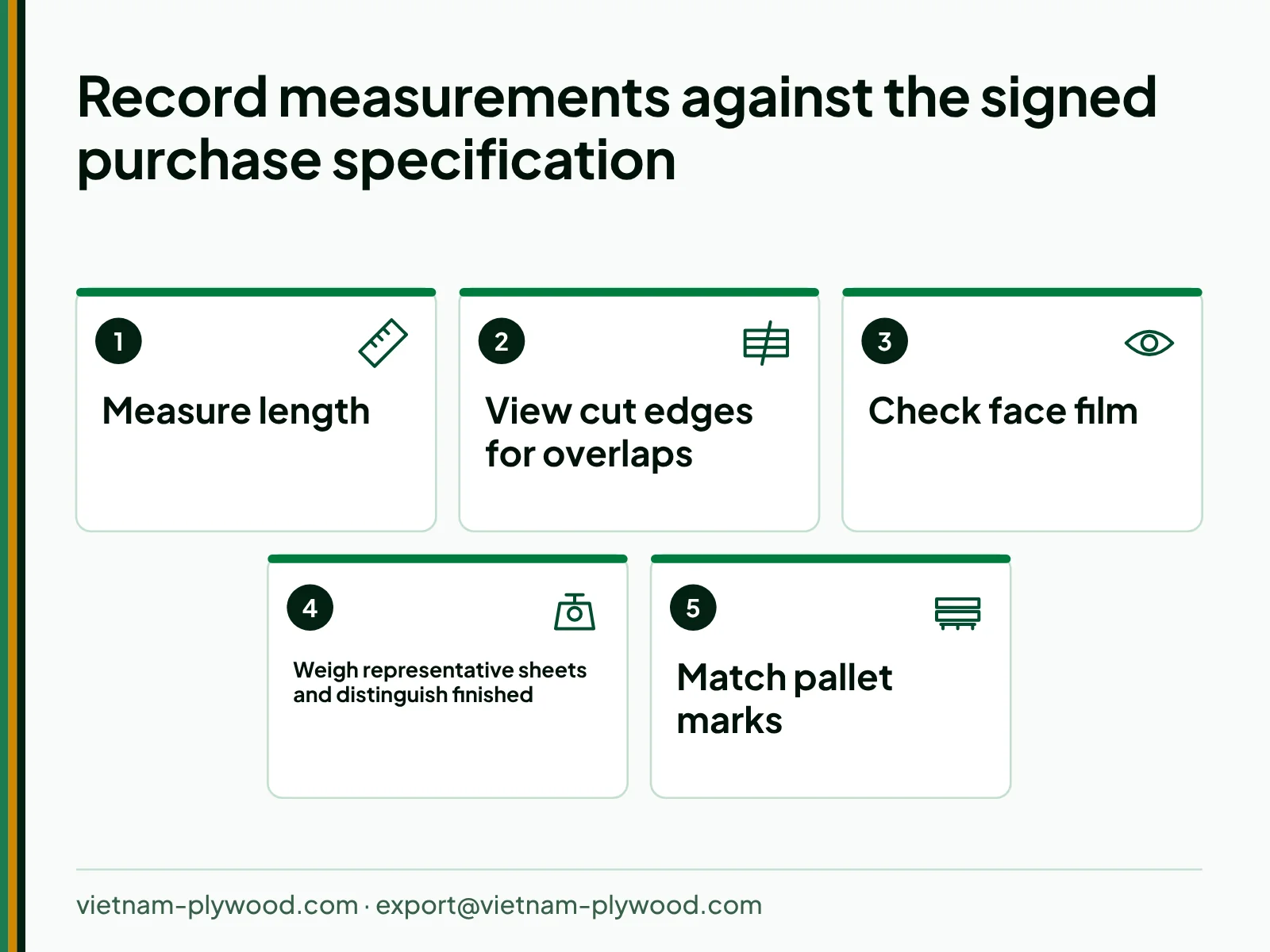
- Measure length, width and thickness on sampled panels and compare with the ordered tolerances.
- View cut edges for overlaps, gaps and core layup; document the core construction agreed in the order.
- Check face film, surface damage and edge sealing, including cut edges where present.
- Weigh representative sheets and distinguish finished weight from the core-only planning figures.
- Match pallet marks, counts and the packing list before loading.
For a technical reference, the Bureau of Indian Standards, IS 4990:2024, distinguishes plain shuttering plywood (CS), polymer-coated plywood (CSC) and film-faced plywood (CSFF). Its product guidance also treats dimensions, bonding, bending and formaldehyde as separate checks. See the BIS product-specific guidelines. Indian project acceptance and applicable import requirements must be resolved with the buyer’s compliance team; an imported film-faced description alone is not an Indian conformity mark.
How does a cubic-metre import quote become rupees per square foot?
Convert the quoted cubic-metre rate into a sheet cost using the ordered dimensions, then add the actual freight, clearance and inland charges. HCPLY does not publish a construction-line starting price; request its dated quotation for the specified film, core, thickness and order volume.
For a 1220 × 2440 × 18 mm panel, volume is approximately 0.05358 m³. The calculation is: FOB sheet value = quoted US$/m³ × 0.05358 m³. Convert that value at the exchange rate applicable to the transaction, then add shipment and Indian entry costs before comparing it with a local rupees-per-square-foot offer.
The FOB figure is only the origin-port component. A CFR or CIF quote covers different freight or insurance elements, and Indian clearance, applicable duties, taxes, terminal charges and inland transport still require separate line items. Check the 2026 plywood pricing analysis for broader market context, then use a dated freight and tax worksheet for the actual decision.
A nominal 8x4 sheet covers about 32 square feet in trade shorthand. Use the invoiced dimensions for the final calculation, since 1220 × 2440 mm is not precisely 4 × 8 international feet. Never compare an FOB cubic-metre number directly with a tax-paid Indian square-foot number.
Can mixed specifications fit one import container?
One 40HC can mix specifications within a 28.5-tonne payload limit, but pallet counts and mass constrain the blend. At 18 mm and 1220 × 2440 mm, the core-only planning lookup gives 880 acacia sheets at 27.35 tonnes, or 795 eucalyptus sheets at 27.69 tonnes for full single-core loads.
A mixed purchase should reserve weight for film, packaging and any other load components. Combining acacia and eucalyptus batches requires a pallet-level weight schedule rather than simply adding two full-container counts. See the container loading calculations for the load-planning method.
For distributors building repeat purchase schedules, plywood supply programmes can frame specification continuity across orders. HCPLY offers a minimum order of one 40HC, with specifications mixed inside the payload limit.
When does importing film-faced plywood pay?
Importing pays when a consistent full-container build delivers a lower landed cost per usable pour than the available local alternative. It is less attractive when the requirement is urgent, the volume is small or local handling and import charges erase the factory-price difference.
Compare like-for-like panels under the same release-agent practice, edge treatment and handling. With proper handling, a release agent on every pour and sealed edges including cut edges, melamine-glue film-faced panels reach about 12–15 pours; phenolic-glue panels reach up to about 25 pours. These figures describe conditional reuse, rather than a guaranteed project result.
Calculate landed sheet cost ÷ usable pours, then add cleaning, repair and labour differences where recorded. The formwork cost-per-pour method addresses that denominator. A higher invoice price can be commercially preferable if the approved build survives more site cycles; a lower-priced local sheet can win when availability or job duration dominates.
Our construction line ships FOB Hai Phong, with CFR (CNF) or CIF terms available. Factory lead time runs 15–45 days from receipt of the 30% deposit; the exact figure depends on order size, line loading and what the contract fixes; the 70% balance is against the scanned bill of lading, by T/T or irrevocable letter of credit at sight. Budget those timings alongside the Indian jobsite programme.
What should the buyer put into the quotation request?
A useful quotation request names the physical panel and the delivery endpoint so that sheet weight is only one checked field. Specify the required bond and any test report the buyer accepts, plus film, thickness tolerance and the intended concrete application.
The shipment document set includes commercial invoice, packing list, bill of lading, certificate of origin, phytosanitary and fumigation papers, and order-specific certificate documents or agreed test reports; CIF adds insurance. After loading, the draft shipping documents come to you for approval. Ask the importer to verify the current Indian customs classification and entry requirements before committing to a landed-cost calculation.
HCPLY’s export contact is Lucy at export@vietnam-plywood.com. A written specification gives the producing factory a concrete inspection target and gives the buyer comparable bids. The contact page is the place to submit the completed fields.
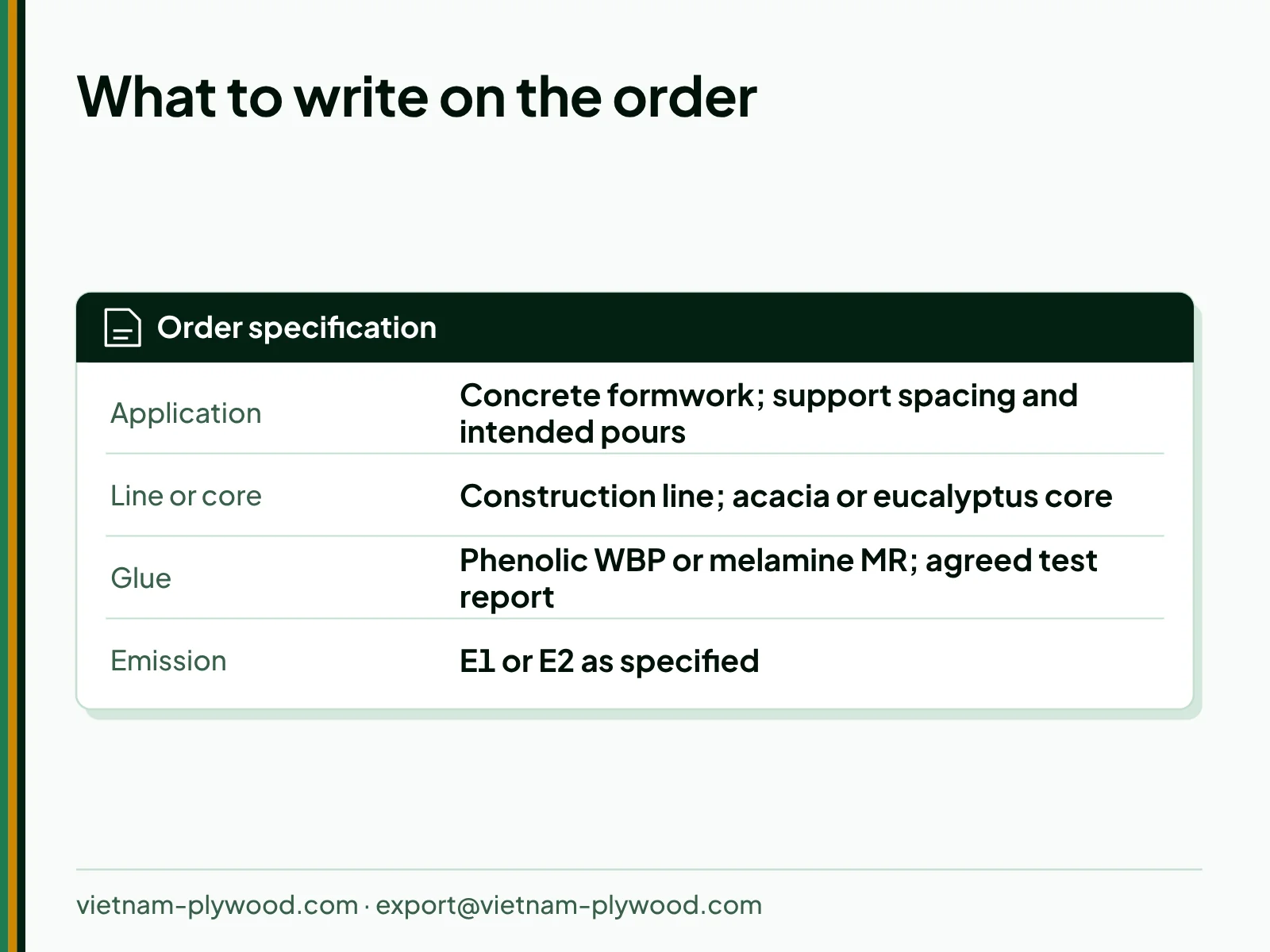
Application: concrete formwork; support spacing and intended pours
Line or core: construction line; acacia or eucalyptus core
Glue: phenolic WBP or melamine MR; agreed test report
Emission: E1 or E2 as specified
Face and grade: phenolic/melamine film; 120 or 135 g/m²; anti-slip 220 g/m² only if required
Thickness and tolerance: 12 or 18 mm; ±0.5 mm
Size: 1220 × 2440 mm or named cut size; ±2 mm length/width
Quantity: pallets and total sheets; minimum one 40HC
Destination port: named Indian port; request FOB/CFR/CIF comparison
Next step: book a factory visit to inspect the construction-line build before the order is released.