





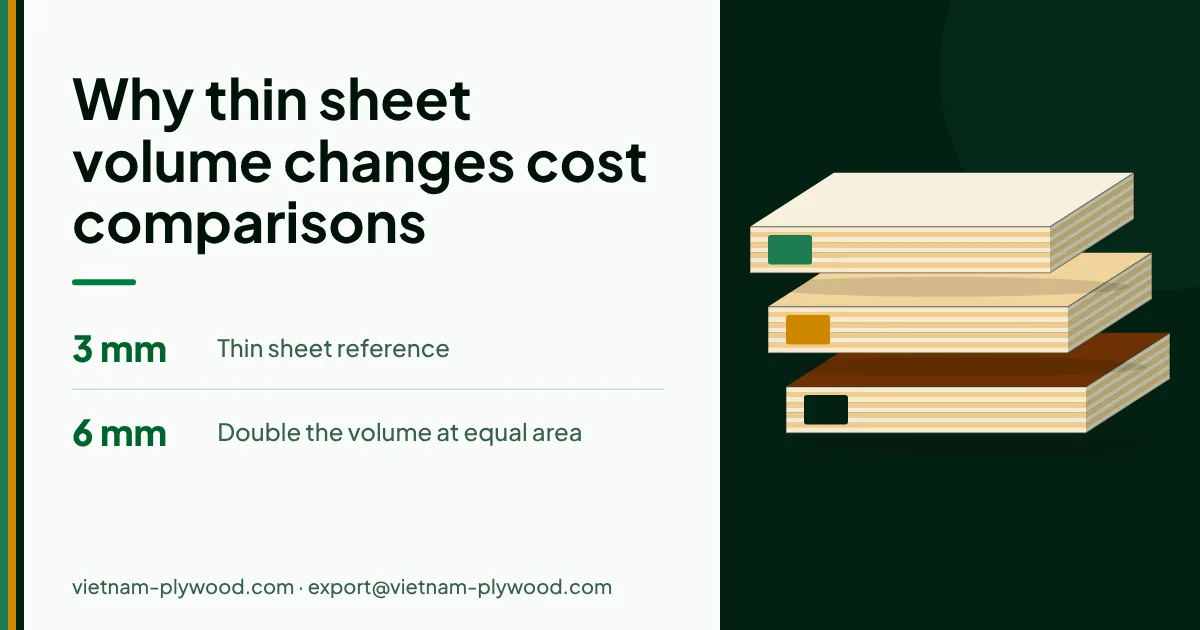
Thin plywood can cost more per cubic metre because each sheet carries processing and handling work across less wood volume. Choosing by sheet price alone can cause wasted material, delayed cabinet production or a rejected delivery. HCPLY compares the face, core and finish of each thin build before quoting.
Why does thin plywood price rise per cubic metre?
Thin plywood price per cubic metre rises because a thin sheet contains less saleable wood volume while still requiring veneer selection, bonding, pressing, trimming and inspection. A lower per-sheet quotation can therefore produce a higher cubic-metre cost. At HCPLY, our furniture line prices the specified face, core and finish together, rather than treating thickness as the sole cost driver.
Consider the production denominator. One 1220 × 2440 mm sheet at 3 mm contains 0.0089304 m³; at 6 mm it contains 0.0178608 m³. The thinner sheet offers half the wood volume, although it still needs handling and a face inspection. These volumes are dimensional calculations, not product quotations. Compare the same face grade, glue, emission class and delivery basis before attributing the difference to thickness.
For the broader cost structure, see Vietnam plywood export cost factors. That breakdown separates manufacturing specifications from shipment costs.
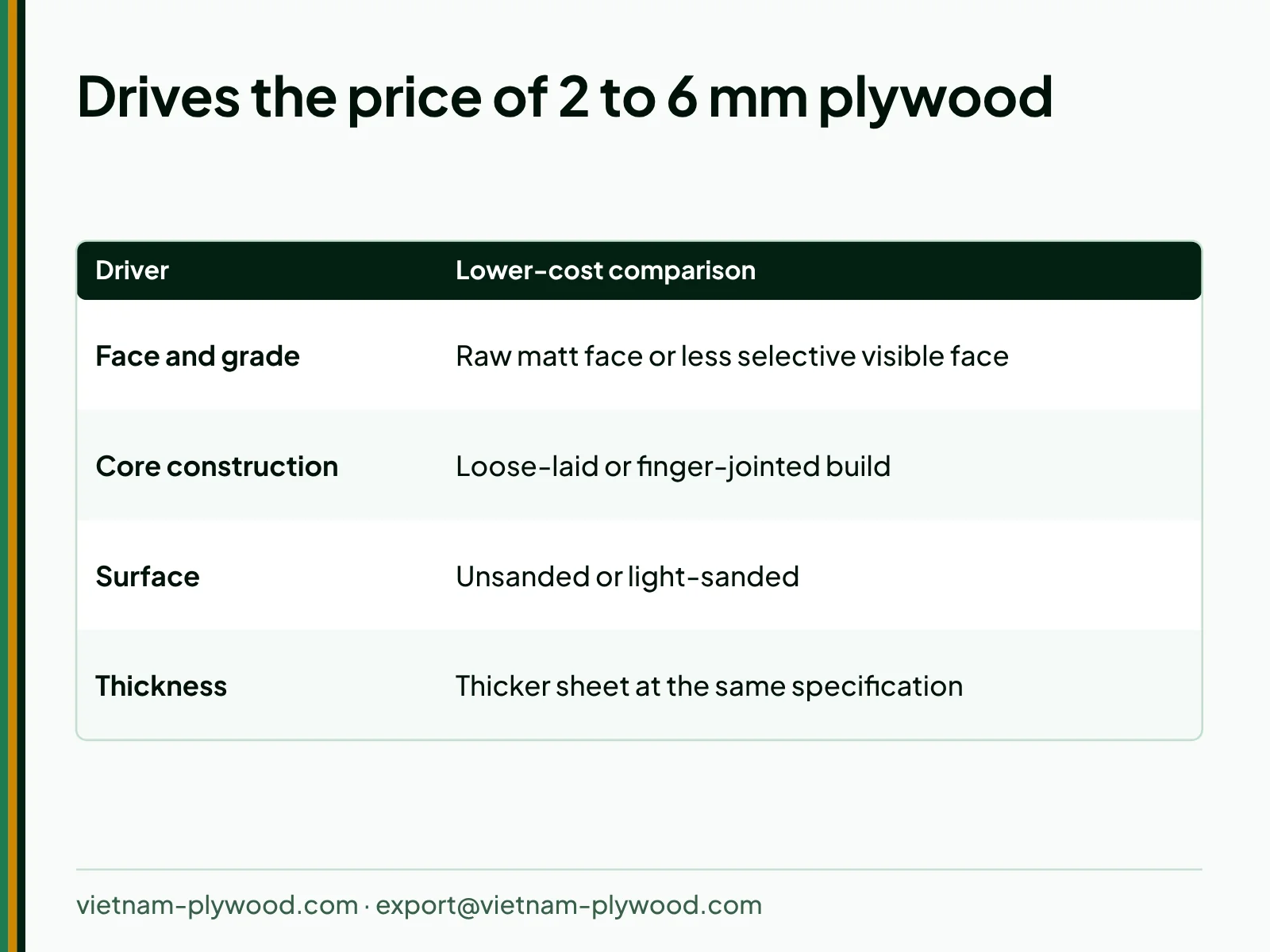
What drives the price of 2 to 6 mm plywood?
The strongest price drivers are face selection and usable veneer yield, followed by core construction, finish and thickness control; order configuration and delivery basis complete the comparison. The ranking is a practical quotation sequence, not a measured cost allocation.
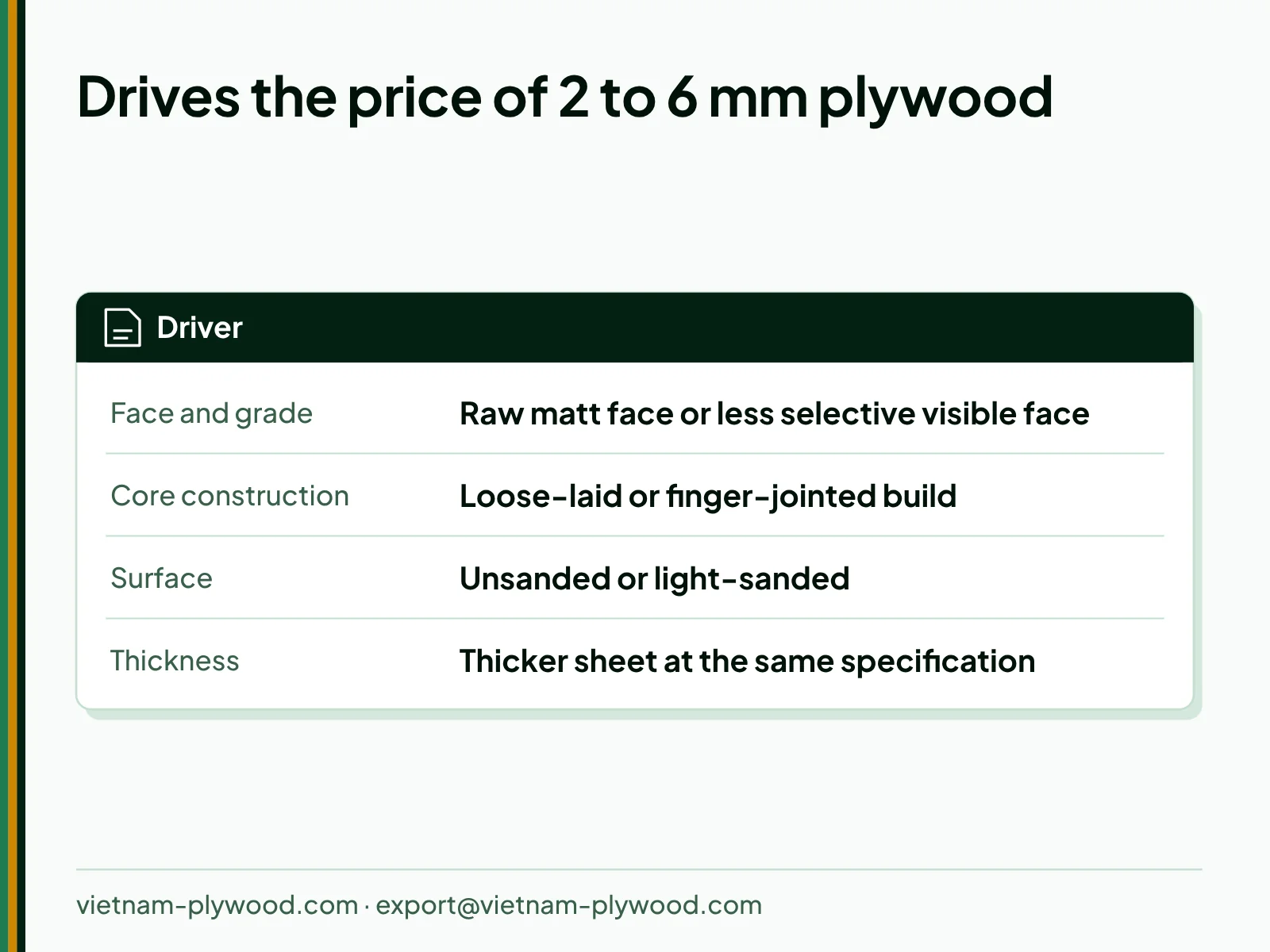
| Driver | Lower-cost comparison | Higher-cost comparison | Why the difference matters |
|---|---|---|---|
| Face and grade | Raw matt face or less selective visible face | Selected A/B decorative face | More face selection and rejected veneer |
| Core construction | Loose-laid or finger-jointed build | Full stitched core | More core preparation and continuity |
| Surface | Unsanded or light-sanded | Fully sanded furniture surface | Extra finishing and thickness control |
| Thickness | Thicker sheet at the same specification | Very thin sheet at the same specification | Handling cost spread over less volume |
| Glue and emission | MR specification appropriate to use | More demanding agreed bond or emission specification | Different materials and testing requirements |
| Order and route | Repeated specification, FOB | Multiple cuts, freight-inclusive terms | Setup, packing and freight differ |
The common range of our panels begins at 3 mm and extends to 40 mm. A 2 mm inquiry needs a separate feasibility discussion, rather than an assumption that every thin gauge is produced. Thickness should be written in millimetres, even when a market listing uses an inch fraction.
The 4mm plywood price and 5mm plywood price follow the same cost logic. A 4mm plywood 8x4 price or 5mm plywood 8x4 price cannot be compared directly with a different face, size or tolerance.
How do face and core change a thin panel quote?
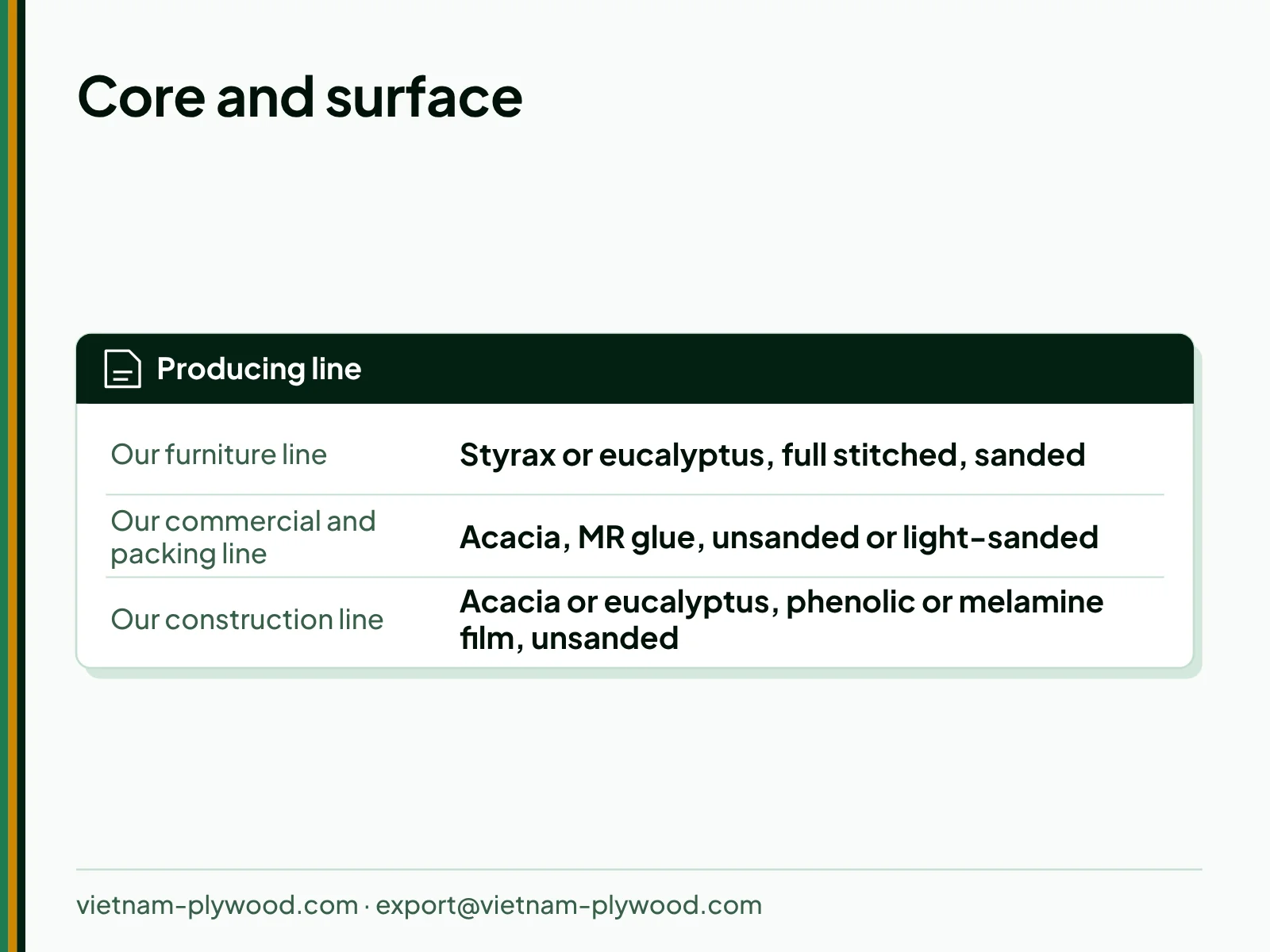
The face determines the product name and visible grade; the core determines density and much of the handling weight. Our furniture line uses styrax or eucalyptus cores with full stitching, sanding and E0/E1 emission classes. An okoume-faced panel can therefore have a styrax core rather than an okoume core.
Face options include bintangor, okoume, engineered veneer, gurjan, pine, poplar, eucalyptus, birch and sapele. Common face veneer thickness is 0.2–0.4 mm. Face grades are A/B, except birch faces, which use D/E/F. Ask for the face and back grade separately when appearance matters.
| Producing line | Core and surface | Thin-sheet comparison | Buyer verdict |
|---|---|---|---|
| Our furniture line | Styrax or eucalyptus, full stitched, sanded | Decorative thin panel for cabinets or fit-out | Select for a visible, controlled surface |
| Our commercial and packing line | Acacia, MR glue, unsanded or light-sanded | Functional thin packing or backing panel | Select where a decorative face is unnecessary |
| Our construction line | Acacia or eucalyptus, phenolic or melamine film, unsanded | Film-faced build for construction applications | Specify for the intended forming application, rather than cabinet appearance |
These are different builds, even at the same nominal thickness. See grade comparison across factory lines and the okoume-faced plywood specification for the appropriate discussion.
How do I convert per-sheet prices to per-m³ prices?
Multiply the finished sheet length, width and thickness in metres to obtain cubic metres per sheet. Divide the per-sheet quotation by that volume to obtain the implied per-m³ quotation, keeping currency and delivery terms unchanged.
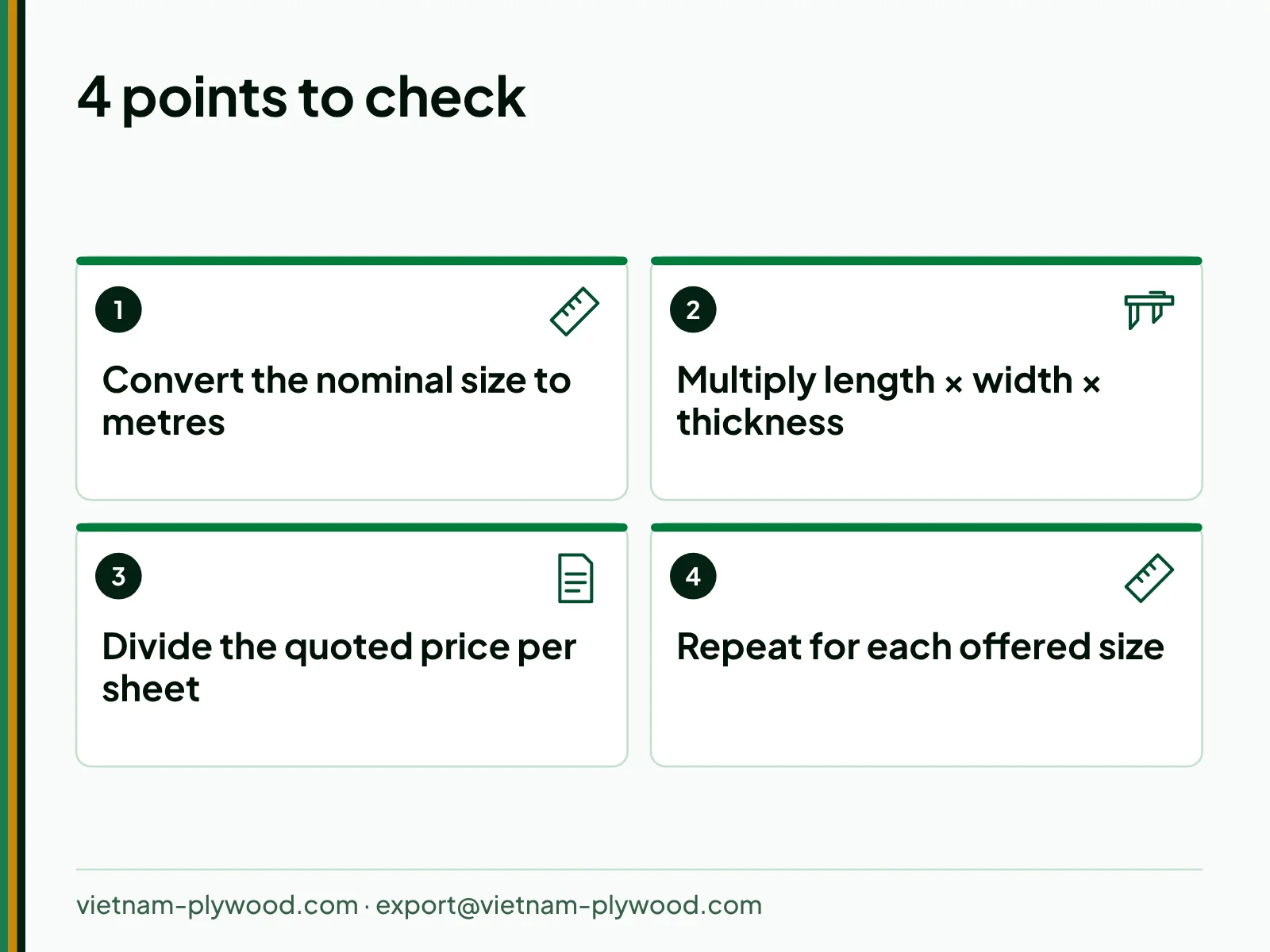
- Convert the nominal size to metres and thickness to metres.
- Multiply length × width × thickness for one sheet.
- Divide the quoted price per sheet by that result.
- Repeat for each offered size and compare identical specifications and Incoterms.
For a 1220 × 2440 mm sheet, the conversion volumes are 0.0089304 m³ at 3 mm, 0.0119072 m³ at 4 mm, 0.014884 m³ at 5 mm and 0.0178608 m³ at 6 mm. A hypothetical per-sheet amount should be entered from the actual seller quotation; there is no assumed market price in this calculation.
A 3mm plywood 8x4 price usually refers to a nominal imperial size. Check whether the actual offer is 1220 × 2440 mm or a literal 4 × 8 ft cut. That small dimension difference changes the conversion. For a quote covering multiple thicknesses, calculate each line independently before summing volumes.
What do sheet weight and container loading reveal?
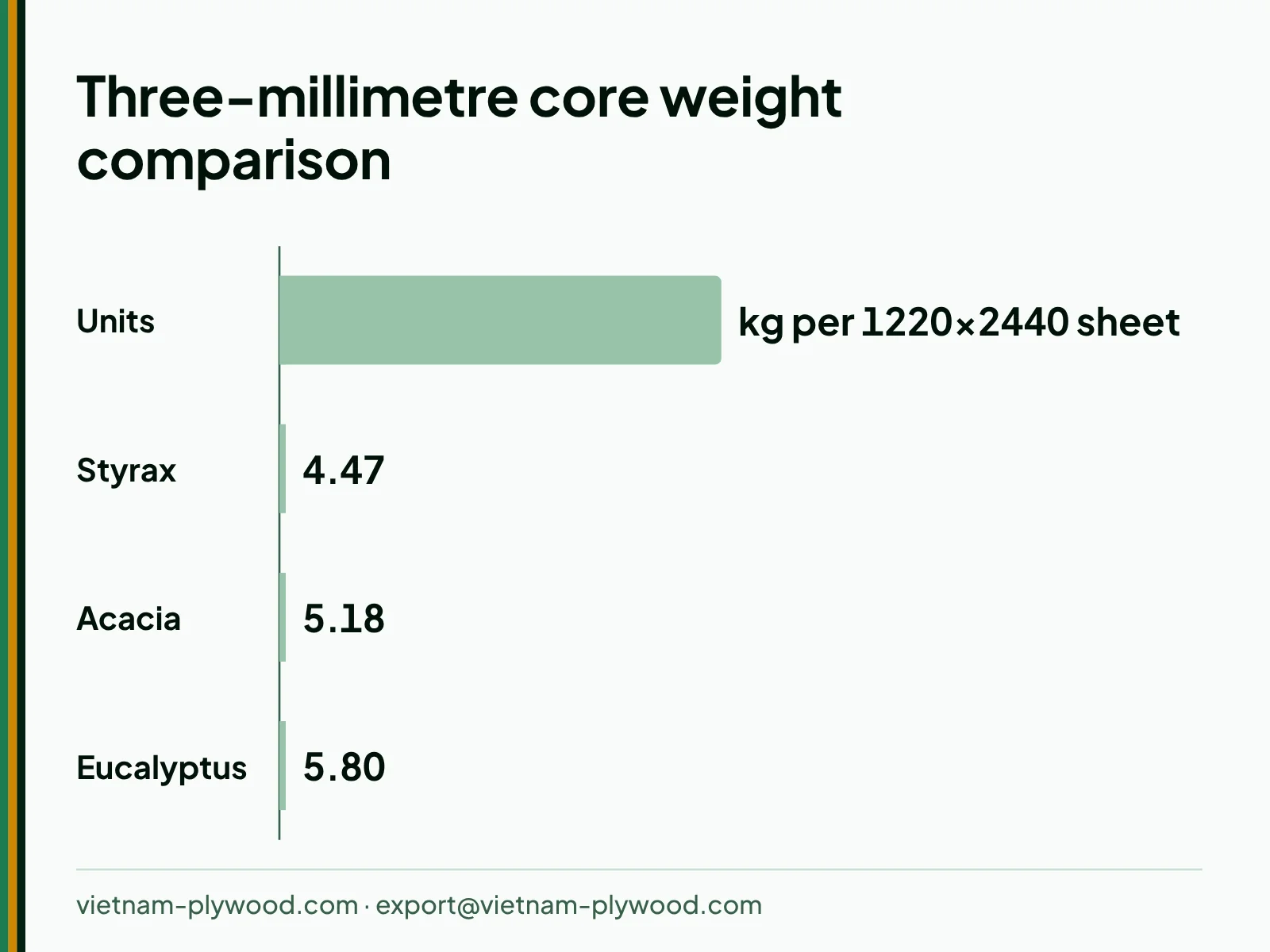
Sheet weight gives a second comparison alongside price because denser cores increase the payload used by each sheet. At 1220 × 2440 × 3 mm, styrax weighs 4.47 kg, acacia 5.18 kg and eucalyptus 5.80 kg per sheet. Those figures reflect core density, without added face-film weight.
For the same size at 3 mm, the computed full 40HC loads are 5,994 styrax sheets at 26.76 t, 5,328 acacia sheets at 27.60 t and 4,845 eucalyptus sheets at 28.12 t. The payload limit is 28.5 t. A mixed load must be planned against the combined weight, pallet arrangement and specification mix.
For example, a proposed allocation of 1,000 styrax sheets and 1,000 acacia sheets at 3 mm has a nominal sheet-weight subtotal of 4.47 t + 5.18 t = 9.65 t, before pallets and other goods. This arithmetic illustrates the weight check; it is not a finished loading plan. See mixed-container planning and the container loading reference for the loading question.
How does a US 1/8 inch lauan quote compare?
A US 1/8 inch lauan quotation must be converted to the same actual thickness, face, core, grade and delivery point as a Vietnamese thin panel. One eighth of an inch equals 3.175 mm; it is not identical to a 3 mm order. “Lauan” is a market name that does not, by itself, identify the core construction or finish.
For a 4 × 8 ft sheet, ask the US seller for measured dimensions, the stated species or trade description, face and back grades, thickness tolerance and whether freight or taxes are included. Ask the Vietnamese producer for the same fields and an FOB Hai Phong basis. Convert both prices to volume only after those specifications align.
A listing for 1 8 lauan plywood 4x8 price can refer to retail availability, a domestic distributor or a different grade. A luan plywood price or lauan plywood prices search label does not establish equivalence with an okoume-faced, full-stitched furniture panel. The comparison is useful only when the buyer defines the application and acceptable surface.
What dated from-price can a Vietnam buyer use?
HCPLY’s indicative furniture plywood starting point is from US$350/m³ FOB Hai Phong (October 2026). Its indicative commercial plywood starting point is from US$250/m³ FOB Hai Phong (October 2026). Neither is a dedicated 3 mm, 4 mm, 5 mm or 6 mm quotation.
For thin furniture panels, request a build-specific price by face grade, core, glue, emission class, sanding and tolerance. The furniture starting point is the relevant category reference, while a raw commercial build belongs to a different specification. A precise thin-gauge price requires the written order details.
For context on dated market commentary, see Vietnam plywood pricing analysis and the historical FOB rate discussion. Those pages are context rather than a substitute for a current specification-based offer.
Which glue, emission and tolerance fields belong in the quote?
Glue describes the bond system; emission describes the formaldehyde classification or regulatory requirement. Our furniture line offers E0/E1 emission classes. Melamine MR glue and phenolic WBP glue describe different bonding requirements, while CARB P2 and TSCA Title VI concern the US emissions regime and third-party certification.
For sanded furniture panels, specify a thickness tolerance of ±0.2 mm or ±0.3 mm as ordered. Commercial and film-faced panels use ±0.5 mm, while packing panels use ±0.5–1.0 mm. Length and width tolerance is ±2 mm. The tighter surface specification can affect material selection and rejection during production.
An inspector at the producing factory can witness thickness checks at multiple points on sampled sheets, inspect the sanded face against the agreed grade and examine the core at an exposed edge. Record the measured thickness range, sample count and any rejected pieces against the purchase specification. This turns a vague thin-panel request into an acceptance check.
What should the quotation and export papers show?
The commercial invoice should describe the actual product and quantity, while the packing list should match the pallet and sheet breakdown. For US entry, the 2025 US Code of Federal Regulations, 19 CFR §141.86, requires a detailed merchandise description, quantity and purchase-price information on the invoice: official HTML text.
HCPLY manages specification, on-site quality control, shipping documents and loading. Its export papers include the invoice, packing list, bill of lading, certificate of origin, phytosanitary and fumigation papers, plus applicable agreed certificate documents. EU lots include the relevant EUTR/EUDR file set; insurance applies under CIF. After loading, the draft shipping documents come to you for approval.
The member factories’ FSC, CARB P2, ISO 9001 and CE certificates, and EUDR/EUTR documents, are shown with factory details masked, on request. The buyer should identify which factory documents are relevant to the specific producing line and destination.
How should a buyer compare FOB, CFR and CIF?
A thin-panel price comparison should name the delivery term and destination before judging the amount. FOB Hai Phong covers a different cost boundary from CFR (CNF) or CIF, which include freight-related obligations. Destination customs duties, inland transport and taxes need their own treatment in a landed-cost worksheet.
Compare the same dimensions and volume first, then list freight, insurance and destination costs separately. A domestic US lauan shelf price and an FOB export price are different stages of the supply chain. For a film-faced construction comparison, the relevant economics are discussed in formwork cost per pour and the film-faced pricing guide, rather than transferring those assumptions to cabinet plywood.
One order can combine specifications within the payload limit. The minimum order is one 40HC; production is 15–45 days from the 30% deposit, set by order size, line loading and the contract. The remaining 70% is paid on the scan of the bill of lading, by T/T, or by irrevocable sight L/C.
What should be checked before approving a trial container?
Approve the sample and acceptance specification before using a thin-panel quotation for production purchasing. Request face and back identification, core construction, thickness readings and a finished-sheet count by grade. A price that omits those fields leaves the receiving inspection with no agreed basis.
Free samples are available; a first-time buyer pays the courier, and that charge comes off the first confirmed order. Buyers can visit the factory office and inspect goods at the producing factory. The relevant line presses the ordered build, and shipment leaves that factory under HCPLY’s export coordination.
For a cabinet or fit-out trial, ask Lucy at export@vietnam-plywood.com to align the face, core and thickness tolerance with the intended cutting process. Use the following specification as the starting request.
Application: cabinet / furniture / fit-out / packing
Producing line or core: furniture / commercial and packing; styrax / eucalyptus / acacia
Glue: MR melamine or agreed phenolic WBP
Emission: E0 / E1 / agreed destination requirement
Face and grade: species; face/back grade
Thickness and tolerance: __ mm; ±__ mm
Size: __ × __ mm
Quantity: __ sheets / __ m³
Destination port: __
Next step: plan a trial container with Lucy against this written specification.