





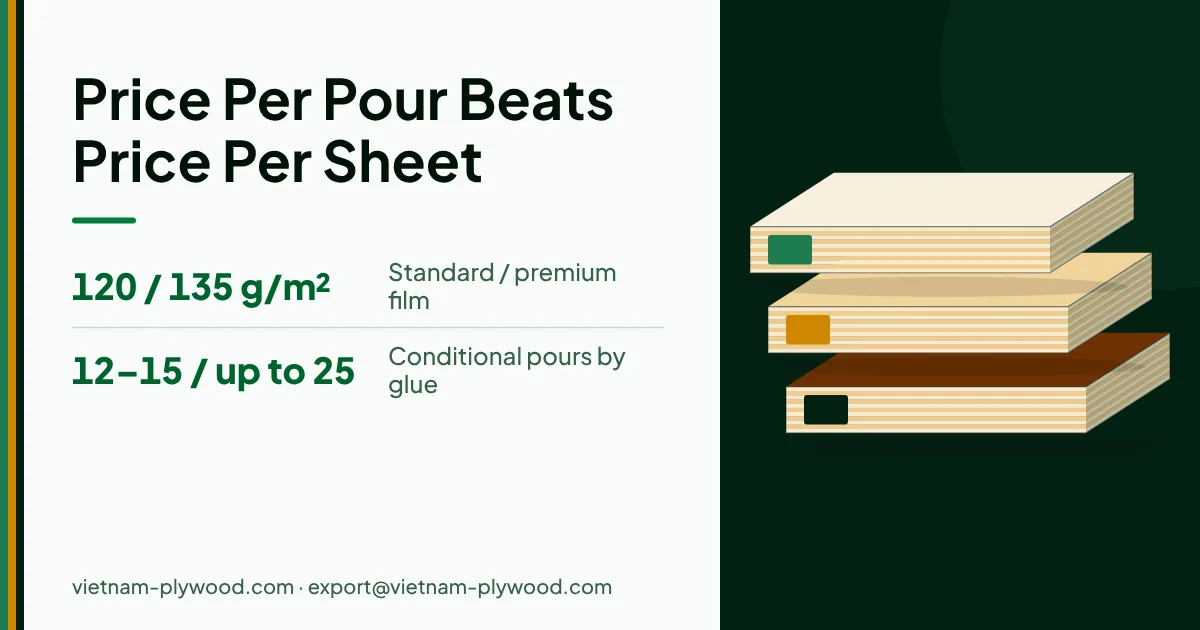
HCPLY compares formwork plywood price by the cost of each usable pour, not by the purchase price of one sheet. A poor match can raise stripping costs, waste panels and delay the next concrete placement. The correct comparison joins film weight, glue, core, usable area and actual reuse under the same site conditions.
What is the formwork plywood price from Vietnam?
HCPLY quotes construction panels against a written specification; no dated construction-panel starting price is published. A formwork plywood price therefore needs a written construction specification and a quotation, rather than a number borrowed from commercial or furniture plywood. Film weight, glue, core, thickness, size and delivery basis determine the offer. The relevant product is our film-faced plywood from Vietnam.
The available dated starting figure covers a different product: commercial plywood from US$250/m³ FOB Hai Phong (October 2026). It is not a starting price for shuttering panels. Using it to estimate film-faced construction material would confuse different face treatments and glue specifications.
Our construction line presses film-faced sheets with phenolic or melamine film, including anti-slip film, over acacia or eucalyptus cores. We quote the exact construction build. Buyers should state the number of planned pours, surface finish, handling method and destination port. Our export cost breakdown explains why an FOB figure is only one part of an importer’s budget.
Why is a sheet price the wrong comparison?
A sheet price misses how much usable concrete-facing area survives each pour. A lower purchase amount can become a higher project expense when panels are retired early, damaged during stripping or cut without resealing. Conversely, a premium film is wasted when the project has too few repeat pours to recover its higher purchase cost.
The comparison needs the same size, thickness, intended finish and work cycle. A contractor buying panels for repeated wall pours should calculate cost per usable square metre per pour. A yard buying for one short job should compare the actual planned cycles, rather than a catalogue’s maximum. This keeps the estimate tied to the work programme.
Separate the cost of acquiring the panels from site expenses. Freight, duties, local transport, release agent, edge sealing, cleaning, storage, repairs and retirement affect total cost. A quote for panels alone cannot stand in for the installed and operated formwork budget. For a broader unit-area budget, use the formwork cost per square metre breakdown.
How do you calculate formwork plywood cost per pour?
Divide the usable panel cost by the number of successful pours actually achieved. For a more complete comparison, add site preparation, cleaning and handling costs for the relevant cycles, then divide by the number of usable pours. Keep currency, area and labour scope identical between competing offers.
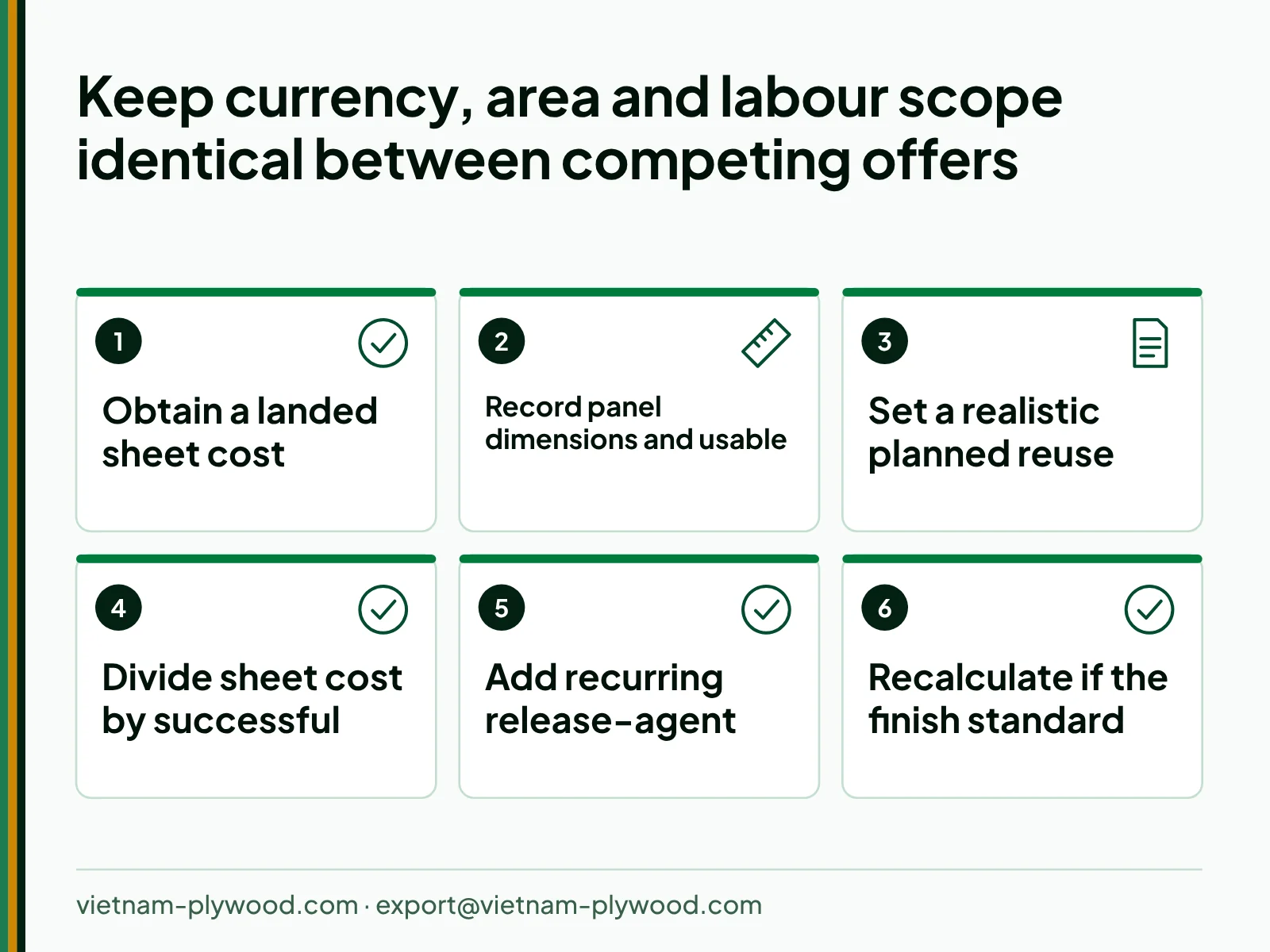
- Obtain a landed sheet cost on the same destination and delivery basis for both options.
- Record panel dimensions and usable face area after cuts, openings and edge losses.
- Set a realistic planned reuse count for the actual site handling regime.
- Divide sheet cost by successful pours, then by usable square metres if comparing different sizes.
- Add recurring release-agent, cleaning and repair costs per cycle, plus any disposal cost allocated to the panel.
- Recalculate if the finish standard rejects a face before the physical panel is exhausted.
Panel-only cost per pour per sheet = landed sheet cost ÷ successful pours. Panel-only cost per m² per pour = landed sheet cost ÷ (usable face area × successful pours). For total working cost, allocate one-time costs over successful pours and add recurring costs at their actual frequency. These are estimating formulas, not a claim about an achieved project.
A reusable sheet can lose value through edge damage even when the film still looks sound. Record actual cycles by bundle and identify the reason for retirement. That site record makes the next order more accurate than a supplier’s maximum reuse figure alone.
How do film weight and glue change reuse?
Film weight changes surface protection, while glue changes the bond system. Our standard film is 120 g/m², premium film 135 g/m², and 220 g/m² is reserved for anti-slip film. Anti-slip is a surface-use distinction; it is not automatically the right face for smooth concrete casting.
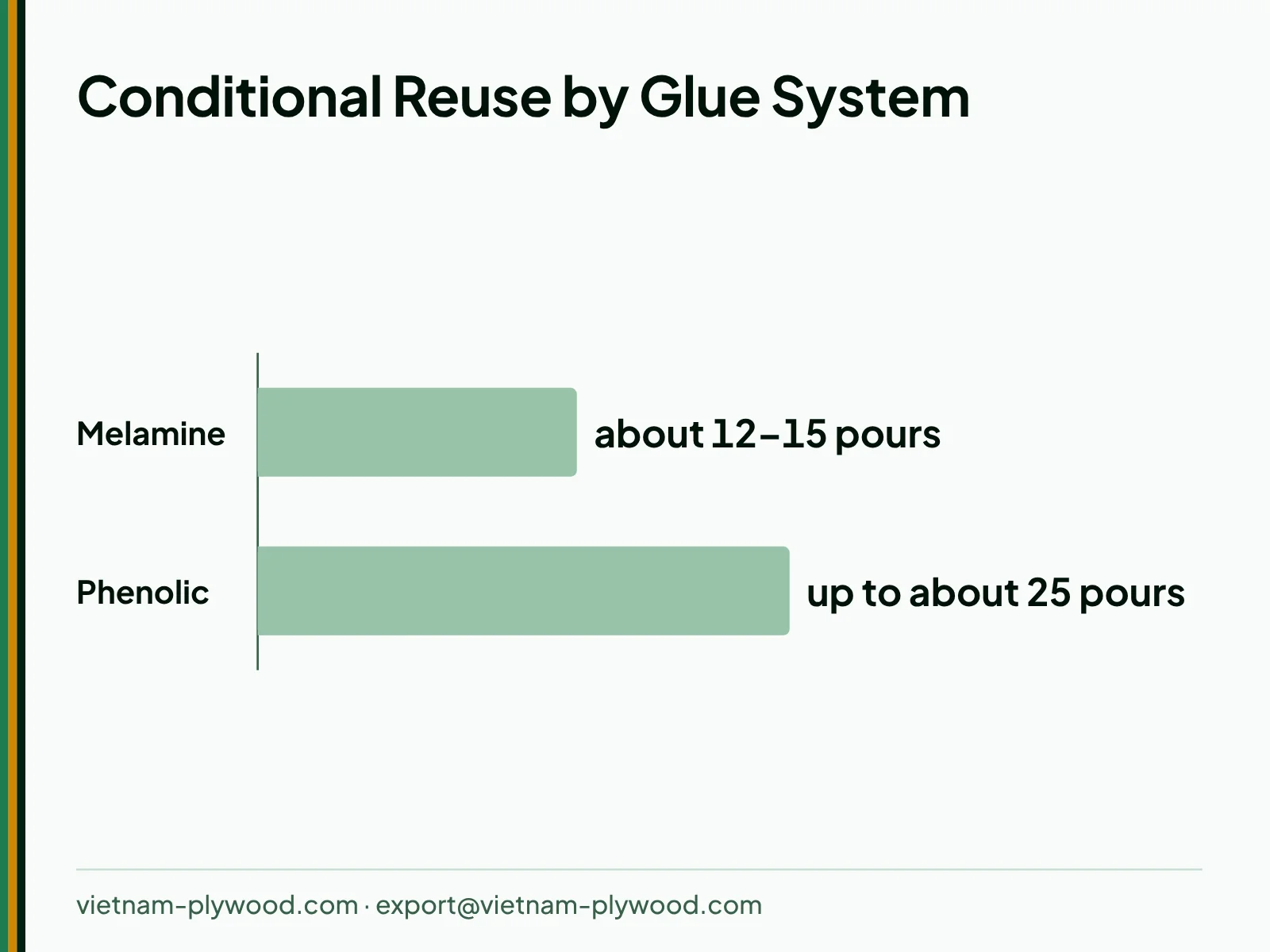
Our melamine-glue film-faced panels are described as about 12–15 pours with proper handling, a release agent on every pour and sealed edges, including cut edges. Our phenolic-glue film-faced panels reach up to about 25 pours under those same conditions. These are conditional reuse expectations, not a fixed count for every job.
Melamine glue is an MR system with a 12-hour boil specification for this glue system; phenolic is WBP with a 72-hour boil specification. The construction line hot-presses WBP builds at 130–145 °C. The stated boil descriptions are manufacturing specification labels, not a promise that a panel can remain continuously submerged on site.
A heavier film and phenolic bond normally call for a higher quotation than a lighter-film, melamine-glue build because material and processing inputs differ. The higher initial amount earns its place only when successful pours increase enough to offset it. Ask for the exact film weight and glue field on the quotation; the word “film-faced” alone cannot identify either.
Which price drivers should buyers compare first?
The strongest construction quote comparison starts with the surface and bond system, then checks the core build and dimensions. Price drivers should be evaluated against the work programme rather than ranked as universal price percentages. We do not publish percentage uplifts for these choices.
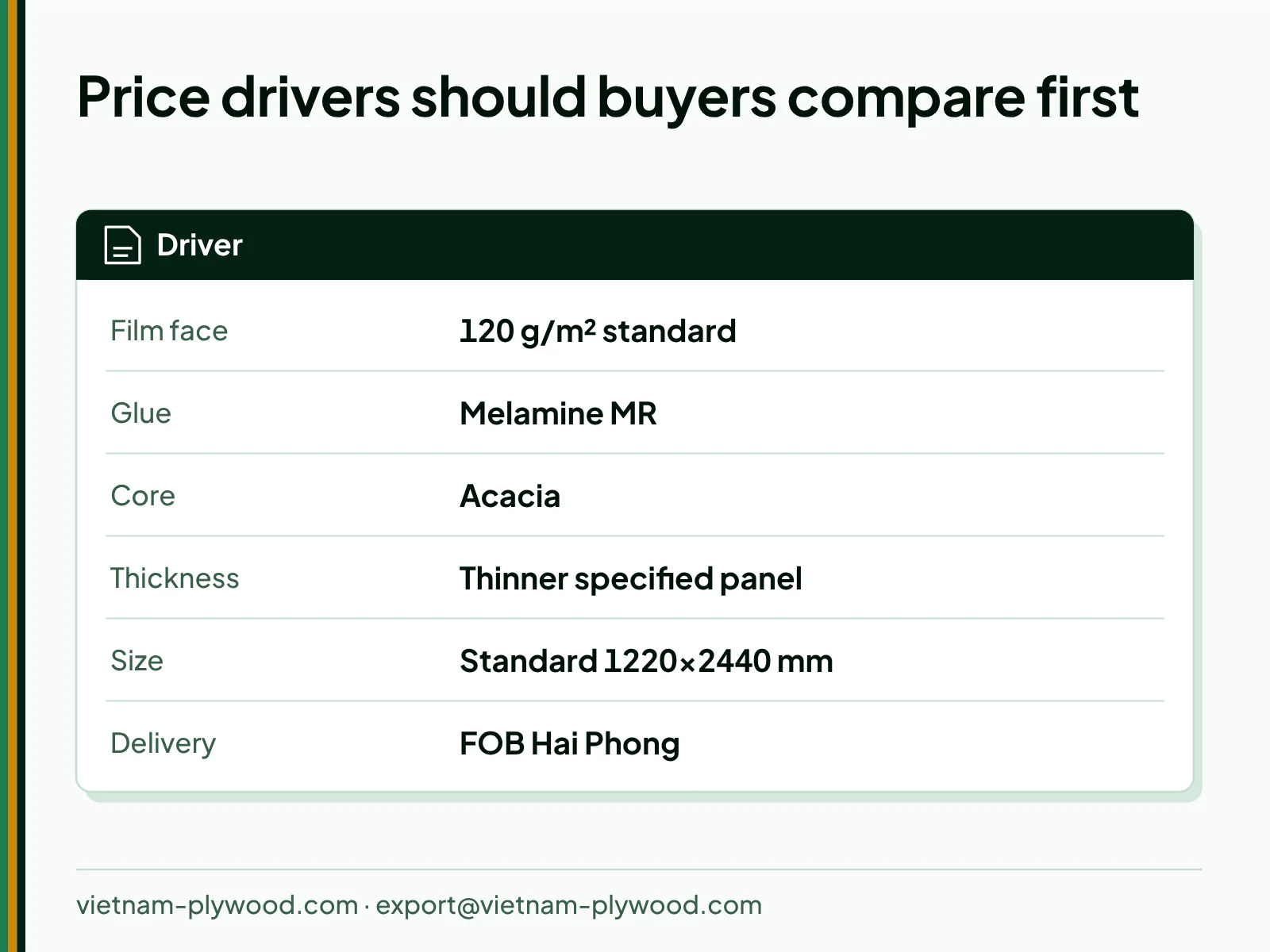
| Driver | Lower-input comparison | Higher-input comparison | Effect on the decision |
|---|---|---|---|
| Film face | 120 g/m² standard | 135 g/m² premium | Compare finish survival and successful pours; request separate quotes |
| Glue | Melamine MR | Phenolic WBP | Phenolic typically costs more to make; compare conditional reuse |
| Core | Acacia | Eucalyptus | Density and weight change handling and container planning; quote each |
| Thickness | Thinner specified panel | Thicker specified panel | More material changes sheet cost; design loads govern selection |
| Size | Standard 1220×2440 mm | 1250×2500 mm or custom cutting | Area, cutting waste and packing differ |
| Delivery | FOB Hai Phong | CFR (CNF) or CIF | Ocean freight and insurance scope change the quoted total |
Core density follows the core rather than the face: acacia is 580 kg/m³ and eucalyptus 650 kg/m³. Both are offered on the construction line. A denser panel is heavier at the same size and thickness; density alone does not establish allowable form pressure or span.
The quoted film weight is separate from glue and emission class. E0, E1 and E2 describe emission classes; they are not glue names. If an order calls for an emission class or supporting test report, write that as a separate field. For a broader view of export price drivers, see why Vietnam plywood prices differ.
How does price per sheet convert to price per m²?
Divide the price per sheet by the sheet’s face area in square metres. A 1220×2440 mm sheet covers 2.9768 m² before trimming, while 1250×2500 mm covers 3.125 m². Use the same currency and delivery basis in both calculations.
For example, if a supplier quotes an amount P per 1220×2440 mm sheet, the nominal area price is P ÷ 2.9768 per m². The amount is a variable, not a construction-panel price quotation. If the sheet is cut into narrow strips, divide by the usable area instead of the nominal full-sheet area.
A formwork plywood price per m2 should also specify whether the unit is one purchased square metre or one successfully reused square metre per pour. These are different measures. For repeated pours, the second denominator includes successful cycles and therefore better reflects the work delivered.
Panel thickness is not an area conversion factor, but it matters for stiffness and material quantity. Our available thickness range is 3–40 mm, with common choices including 12, 15, 18, 21 and 25 mm. Film-faced thickness tolerance is ±0.5 mm; length and width tolerance is ±2 mm. The project designer must set the required formwork support spacing and loads.
What do our three production lines build?
The construction line is the producing factory for film-faced formwork plywood. Our furniture line and our commercial and packing line build different products, even when the nominal thickness matches. This distinction matters when comparing quotes that share a thickness but do not share a face or glue specification.
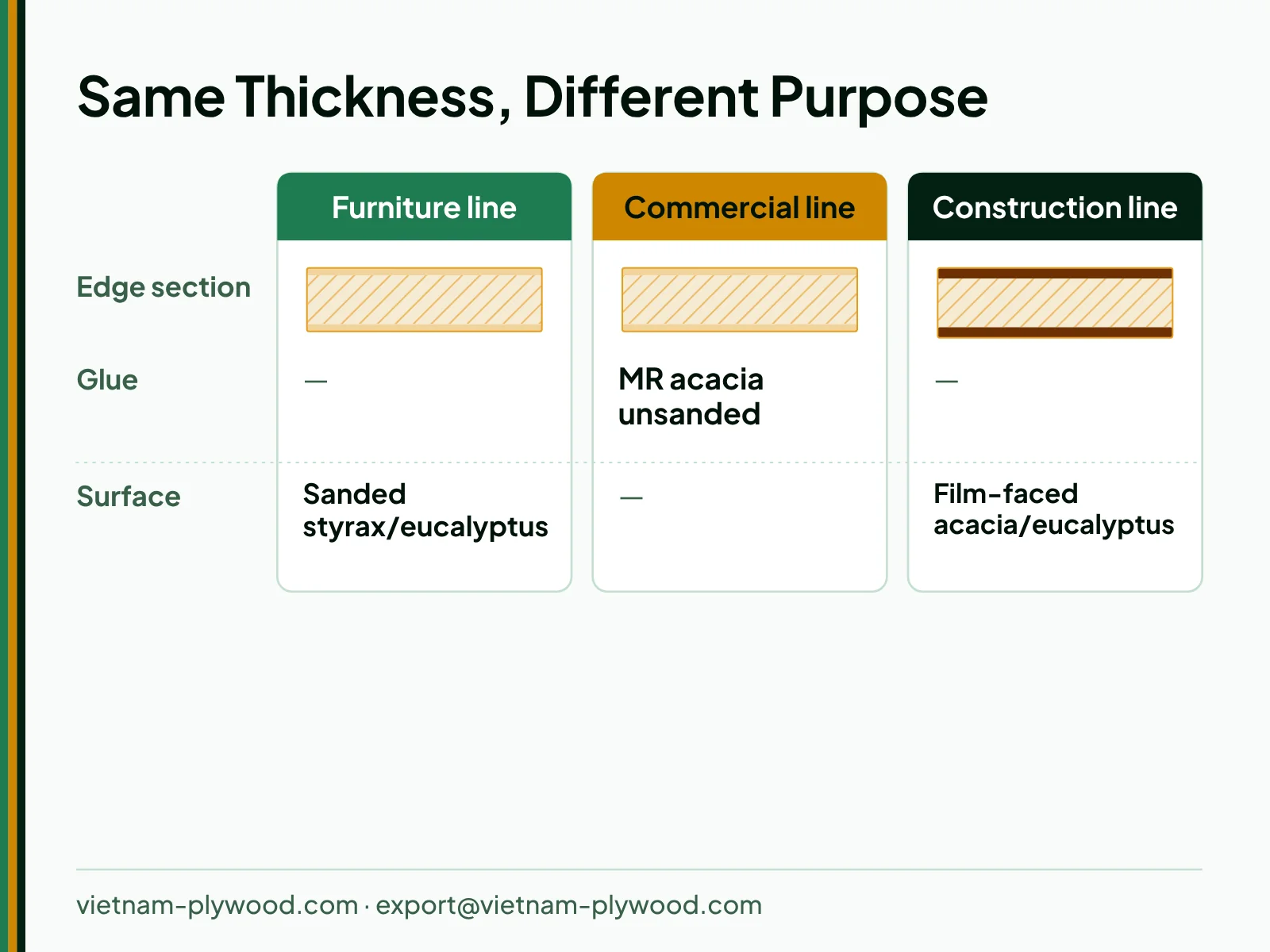
| Line | Example at 18 mm | Core and face | Tolerance | Fit for the intended use |
|---|---|---|---|---|
| Construction | Film-faced shuttering sheet | Acacia or eucalyptus; phenolic, melamine or anti-slip film | ±0.5 mm | Specify for concrete formwork |
| Commercial and packing | Unfaced packing or commercial sheet | Acacia, MR glue, unsanded or light-sanded | ±0.5 mm; packing ±0.5–1.0 mm | Specify for packing, not repeated concrete face work |
| Furniture | Sanded furniture panel | Styrax or eucalyptus, full stitched core, E0/E1 | ±0.2 or ±0.3 mm as ordered | Specify for furniture and cabinet work |
The 18 mm construction sheet has 11–13 plies according to the veneer build. Ply count follows core veneer thickness, which is 1.4–2.0 mm. Ask the producing factory to show core edges, gaps, bond quality and panel dimensions from the actual order batch.
The furniture line’s tighter sanding tolerance does not turn it into a concrete-facing panel. Likewise, our packing or commercial plywood should not be substituted merely because its unit price is lower. The intended face and wet-use cycle determine the line choice.
How does a container change the delivered calculation?
A container quote must be checked against payload and actual panel dimensions before converting a cubic-metre price to a sheet cost. The 40HC payload limit is 28.5 tonnes. Mixing specifications in one container is possible within that limit, but a packing plan needs the weights of each item.
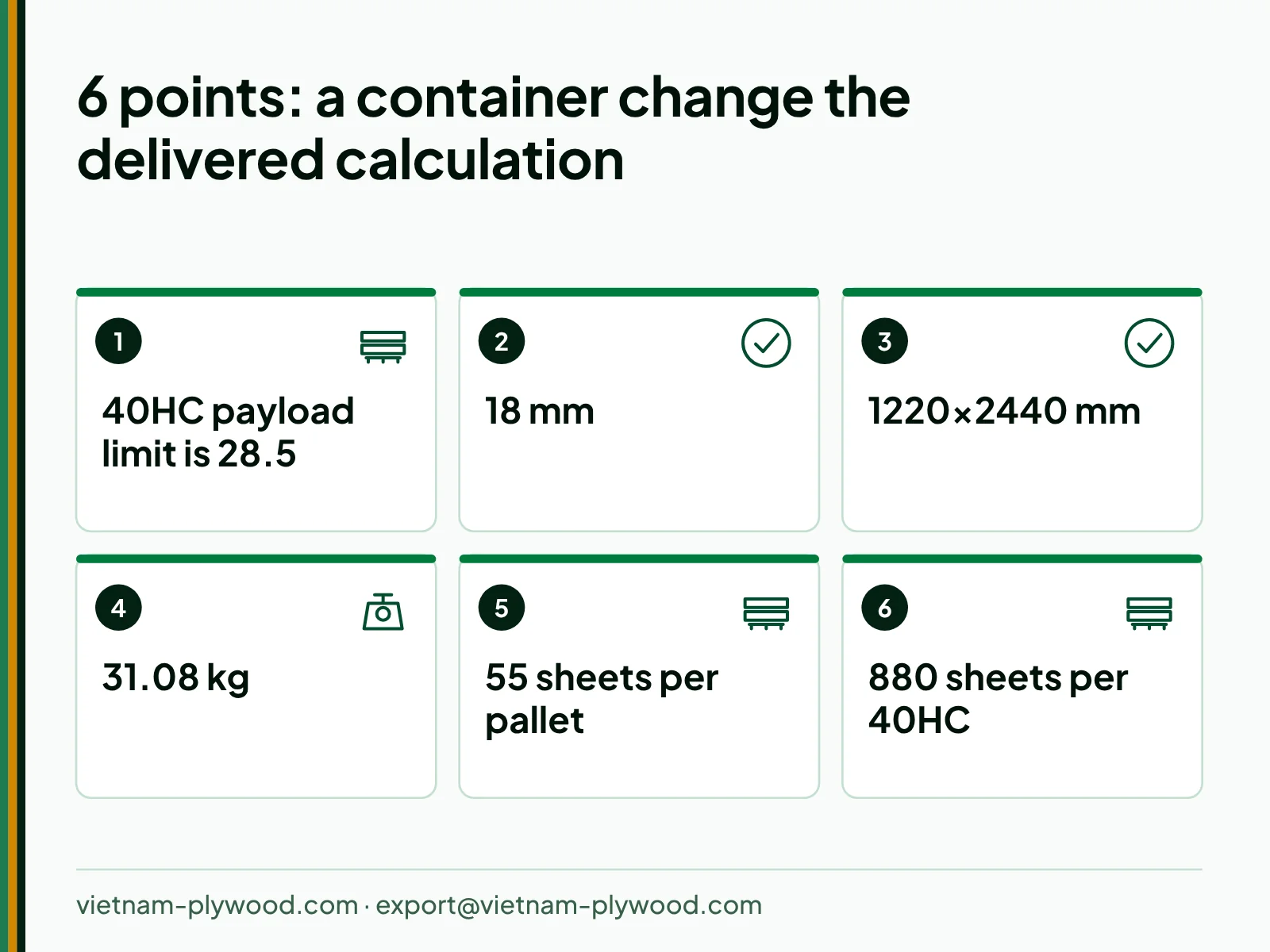
At 18 mm and 1220×2440 mm, an acacia-core sheet weighs 31.08 kg. The packing table lists 55 sheets per pallet, 880 sheets per 40HC and 27.35 tonnes of panels. Check pallet and packaging weight against the carrier’s loading requirements.
For eucalyptus core, the same sheet weighs 34.83 kg. The packing table lists 53 sheets per pallet, 795 sheets per 40HC and 27.69 tonnes of panels. Packaging, pallet mass and the carrier’s actual constraints still need checking. See container loads for the dedicated packing topic.
A contractor should compare the landed cost per usable square metre after considering breakage, cuts and shipment handling. An importer should also compare the weight of the same area across cores. More sheets in a container is not automatically more usable formwork area for a particular site layout.
What can an inspector verify before loading?
An inspector can check the quoted construction specification against physical panels at the producing factory. We handle specification, on-site quality control, export documents and loading, while the buyer can visit the factory office and inspect goods where the order is produced.
The witness check should start with identification of the ordered core, film type and declared film weight. Next, measure thickness at agreed locations against ±0.5 mm, and length and width against ±2 mm. Inspect film coverage, surface defects, corners, edges, cut-edge sealing requirements and visible core voids. Record samples and batch references against the approved specification.
A surface inspection cannot establish a laboratory bond result or a certified structural capacity. Request an agreed test report for the specified build where performance evidence is needed. For US orders, glue and emission requirements must be treated separately. The 2011 United States Code, Title 15, section 2697, defines hardwood plywood for these provisions by intended interior use and construction. That definition does not itself establish that temporary film-faced formwork meets a US emission requirement (official US Code).
Member-factory FSC, CARB P2, ISO 9001 and CE documents, and EUTR/EUDR documents, are shown with factory details masked, on request where relevant. A document must match the producing factory, product and shipment requirement. No marking or certificate should be assumed from a general product description.
When does a higher-priced panel win?
A higher-priced panel wins only when its usable life offsets the extra acquisition and operating cost. Compare the two quoted sheet prices as variables A and B, and their successful pours as rA and rB. The panel-only break-even condition is A ÷ rA < B ÷ rB for the first option to cost less per pour.
Consider two possible specifications: standard-film melamine glue with the conditional about 12–15 pours, and phenolic glue with up to about 25 pours under proper handling, release agent every pour and sealed edges. The second has a longer stated reuse envelope, but that does not establish the achieved number on a particular project. Nor does it establish its actual price premium.
For a short programme, use the pours that can physically occur before the job ends. For a longer programme, track whether the film retains the required concrete finish. If a panel is retired after an edge split, its remaining theoretical film life cannot be billed as usable work.
Add the extra labour of stripping a damaged face and the cost of rework only when there is project evidence for those amounts. Avoid treating the cost of one damaged pour as identical across walls, slabs and columns. The calculation is a purchasing decision tool, not a structural formwork design.
What documents and trade terms belong in the quote?
A formwork quote should identify the build and the delivery scope in writing. We offer FOB Hai Phong, CFR (CNF) or CIF. A CFR or CIF offer must be compared with FOB only after the freight and insurance responsibilities are aligned.
Minimum order is one 40HC; specifications can be mixed within the payload limit. Production is 15–45 days from the 30% deposit, set by order size, line loading and the contract. Balance is 70% on the scanned bill of lading, by T/T or irrevocable sight L/C. Samples cost nothing: a first-time buyer pays the courier, and that charge comes off the first confirmed order.
Shipment papers include the commercial invoice, packing list, bill of lading (B/L), certificate of origin, phytosanitary and fumigation papers, and insurance under CIF. EU lots include EUR.1 where applicable and the EUTR/EUDR file set. The order’s certificate documents can include an FSC claim on sales documents, an emission certificate and test reports for the agreed build. After loading, the draft shipping documents come to you for approval.
The commercial invoice identifies the charged goods and terms; the packing list identifies quantities and packing. Neither replaces the agreed technical specification or a test report. Buyers should connect the inspection record to the order description before approving shipping drafts.
What should a contractor request before ordering?
Request a written film-faced construction quote that identifies the actual application and target reuse programme. We can compare construction builds against a stated pour schedule, rather than attaching a generic price to an unspecified sheet.
Send the intended finish and the planned number of pours alongside the film weight and glue preference. State whether cut edges will be sealed and release agent used every pour. Include the support design’s thickness requirement, dimensions, tolerance and acceptable core. A quotation can then separate the cost of the build from freight and other delivered expenses.
For Saudi Arabian delivery, the Saudi Arabia plywood pricing page provides market-specific context, while the actual construction quote still requires a specification. For buyers considering different core weights, the eucalyptus plywood cost discussion offers another comparison; the construction-panel price must still be quoted separately.
Use the following lines as the purchase enquiry. The single next step is to plan a trial container with Lucy at contact or export@vietnam-plywood.com, then record actual pours and handling outcomes against the specification.
Application: concrete formwork; intended finish and planned pours: ___
Line or core: construction line; acacia / eucalyptus: ___
Glue: melamine MR / phenolic WBP: ___
Emission: E0 / E1 / E2 / agreed requirement: ___
Face and grade: film-faced; 120 / 135 g/m² (220 g/m² anti-slip only): ___
Thickness and tolerance: ___ mm; film-faced ±0.5 mm
Size: ___ mm × ___ mm
Quantity: ___ sheets / ___ 40HC
Destination port and delivery term: ___; FOB / CFR (CNF) / CIF