





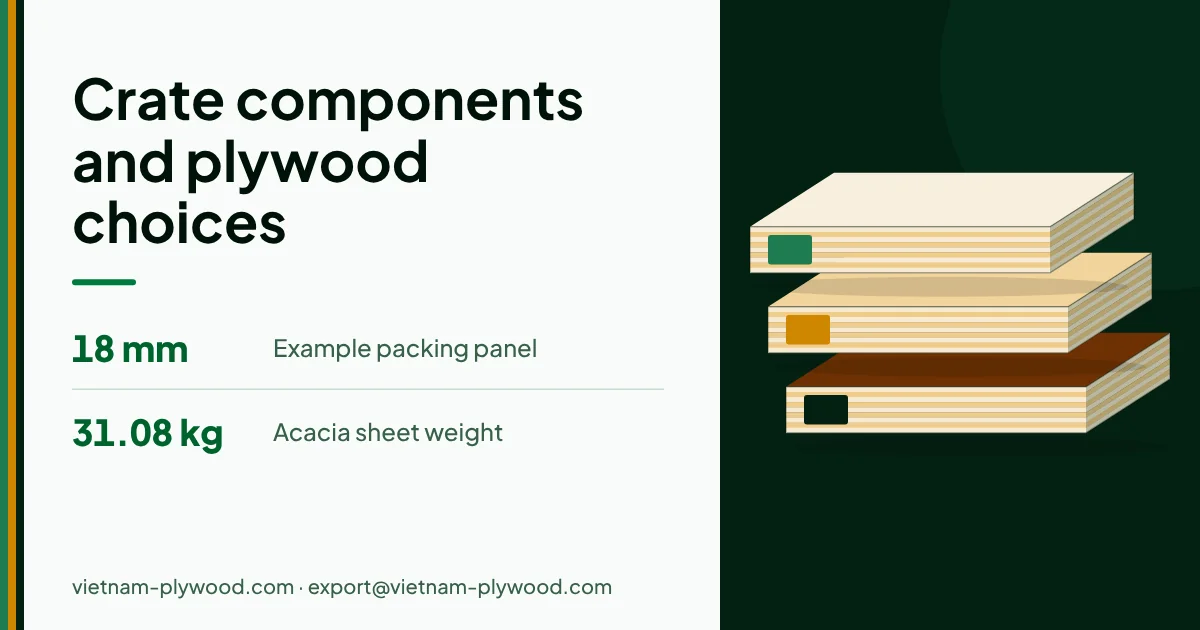
Plywood beats sawn boards on the broad sides and tops of wooden shipping crates, while designed members carry concentrated loads. Choosing the wrong part can mean damaged cargo, rework costs or a rejected import load. HCPLY makes acacia-core packing plywood for crate fabricators; the material list must separate panels from skids, bracing and regulated solid-wood packaging.
What separates a wooden crate from a wooden box?
A wooden crate carries its cargo through a supporting frame and base; a wooden box relies more directly on its enclosing panels and cleats. Both can have plywood walls, but the distinction is the load path rather than whether the sides are open. A fully sheathed crate remains a crate when its frame and skids carry the load.
For machinery, the buyer should start with the cargo mass, centre of gravity, lifting method and restraint points. A crate can leave ventilation gaps or use continuous sheathing. A closed wooden box suits smaller components when its panel connections and base are designed for the actual handling forces. See plywood export boxes for case-specific decisions.
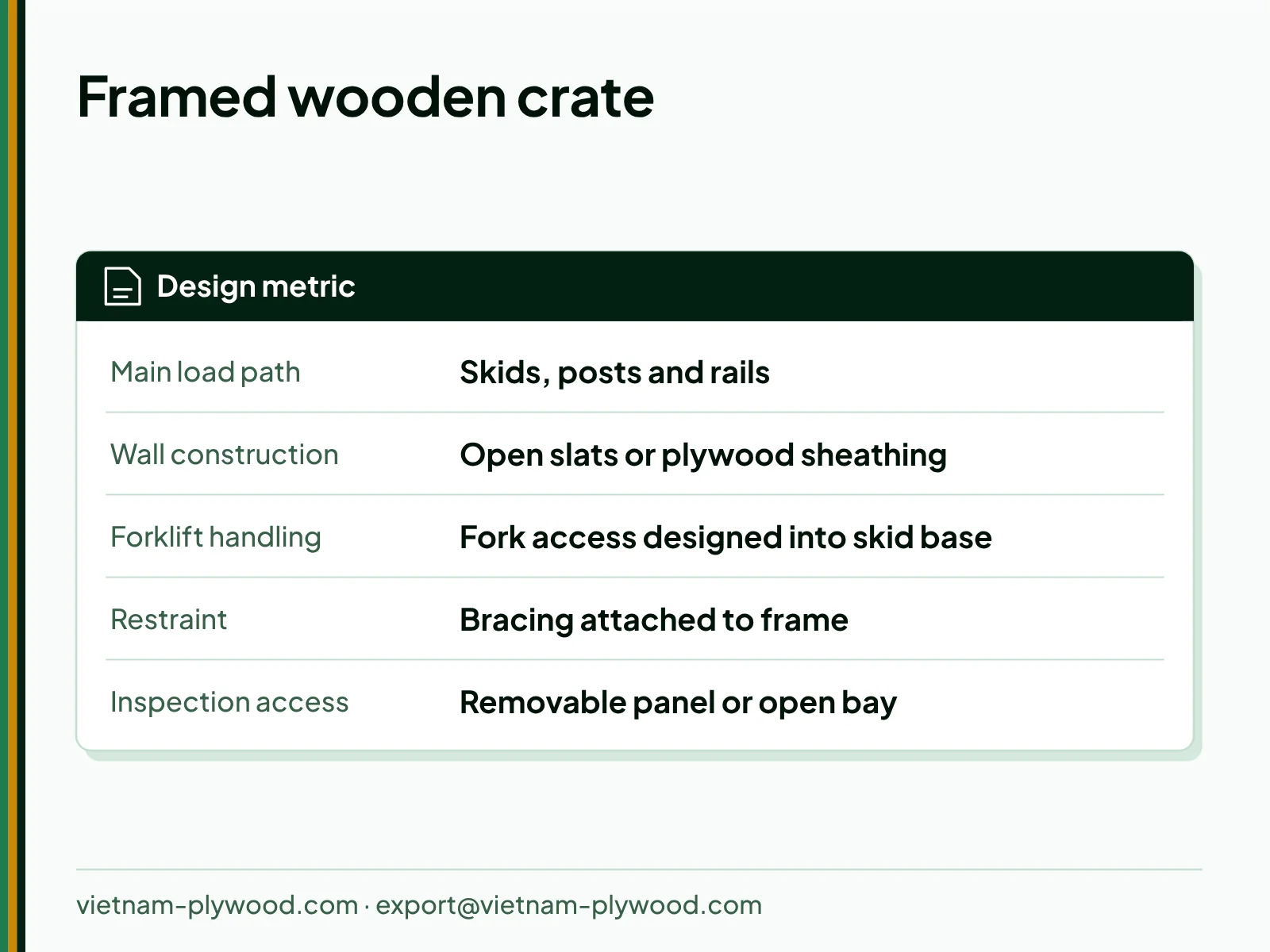
| Design metric | Framed wooden crate | Wooden box | Verdict by use |
|---|---|---|---|
| Main load path | Skids, posts and rails | Panels, cleats and base | Crate for concentrated machinery loads; box for distributed smaller cargo |
| Wall construction | Open slats or plywood sheathing | Usually continuous panels | Closed box for dust shielding; sheathed crate for protection with a separate frame |
| Forklift handling | Fork access designed into skid base | Requires a designed lifting base | Crate when forklift entry is central |
| Restraint | Bracing attached to frame | Blocking attached to reinforced base | Crate for high restraint forces |
| Inspection access | Removable panel or open bay | Lid or removable side | Choose the opening around customs and receiver access |
What are the parts of wooden shipping crates?
A shipping crate consists of skids, cross-members, uprights, rails, bracing, side sheathing, top sheathing and cargo restraints. The skid system receives forklift and floor reactions; panels close the envelope and distribute incidental contact across the frame. A top panel cannot replace a designed lifting or stacking member.
A material list should separate the base from the enclosure. Specify skid section and spacing from the packed mass and handling geometry; specify sheathing thickness from unsupported span, impact exposure and fastener layout. Include access panels, lifting clearance, tie-down locations, corrosion protection and moisture barriers as separate drawing notes.
HCPLY’s packaging plywood overview explains the sheet material, while the crating company designs and assembles the finished package. Our commercial and packing line makes acacia-core packing plywood with moisture-resistant (MR) glue and an unsanded or light-sanded finish. The fabricator cuts and fastens the panels to its engineered frame.
Where does plywood beat sawn boards, part by part?
Plywood is the practical choice for broad side and top surfaces because one sheet covers an area without multiple board joints. Sawn timber still serves where a solid member must take concentrated compression, fasteners or bracing reactions. The comparison changes by component rather than by a blanket claim that one wood is stronger.
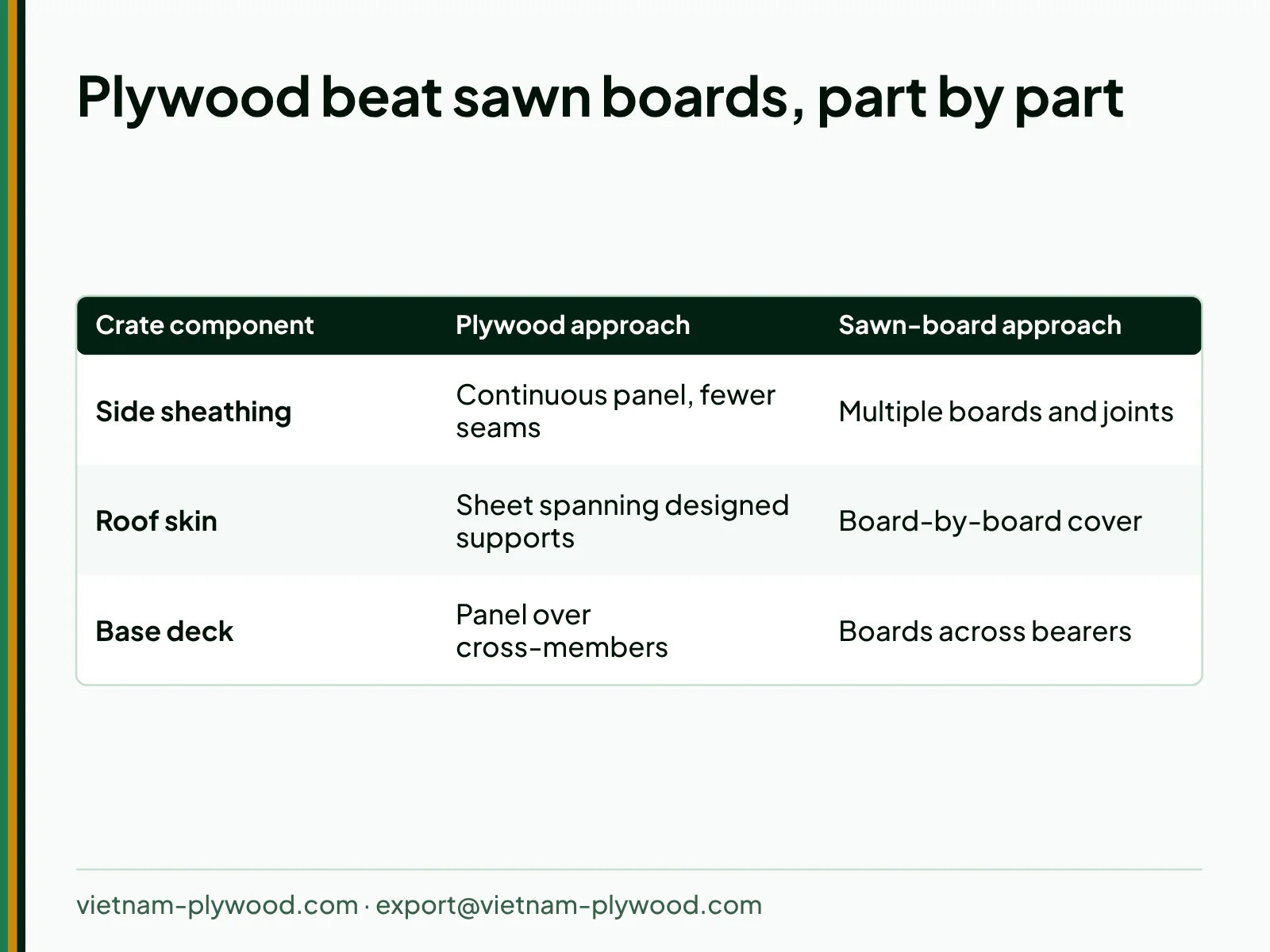
| Crate component | Plywood approach | Sawn-board approach | Preferred use |
|---|---|---|---|
| Side sheathing | Continuous panel, fewer seams | Multiple boards and joints | Plywood for enclosed walls |
| Roof skin | Sheet spanning designed supports | Board-by-board cover | Plywood for weather shielding with a separate roof frame |
| Base deck | Panel over cross-members | Boards across bearers | Select by contact pressure and fastening plan |
| Skid | Not a flat plywood sheet | Solid sawn bearer | Sawn timber or engineered LVL sized by designer |
| Corner post | Panel edge alone is unsuitable | Solid post transfers load | Framed member for concentrated loads |
| Diagonal brace | Sheathing can provide racking restraint if designed | Diagonal timber provides explicit bracing | Design and test the actual connection |
For a comparable packing panel, the packing plywood specification is a better purchasing reference than a generic request for ‘strong wood’. See also packing grades when deciding whether appearance or core assembly matters to the cut parts.
What wood is best for wooden shipping crates?
The appropriate wood is a combination: acacia-core packing plywood for sheet sheathing, with designed timber or engineered members for the skid and frame. A single species label cannot specify the whole package. HCPLY’s acacia-core packing panels have a core density of 580 kg/m³; density follows the core rather than the visible face.
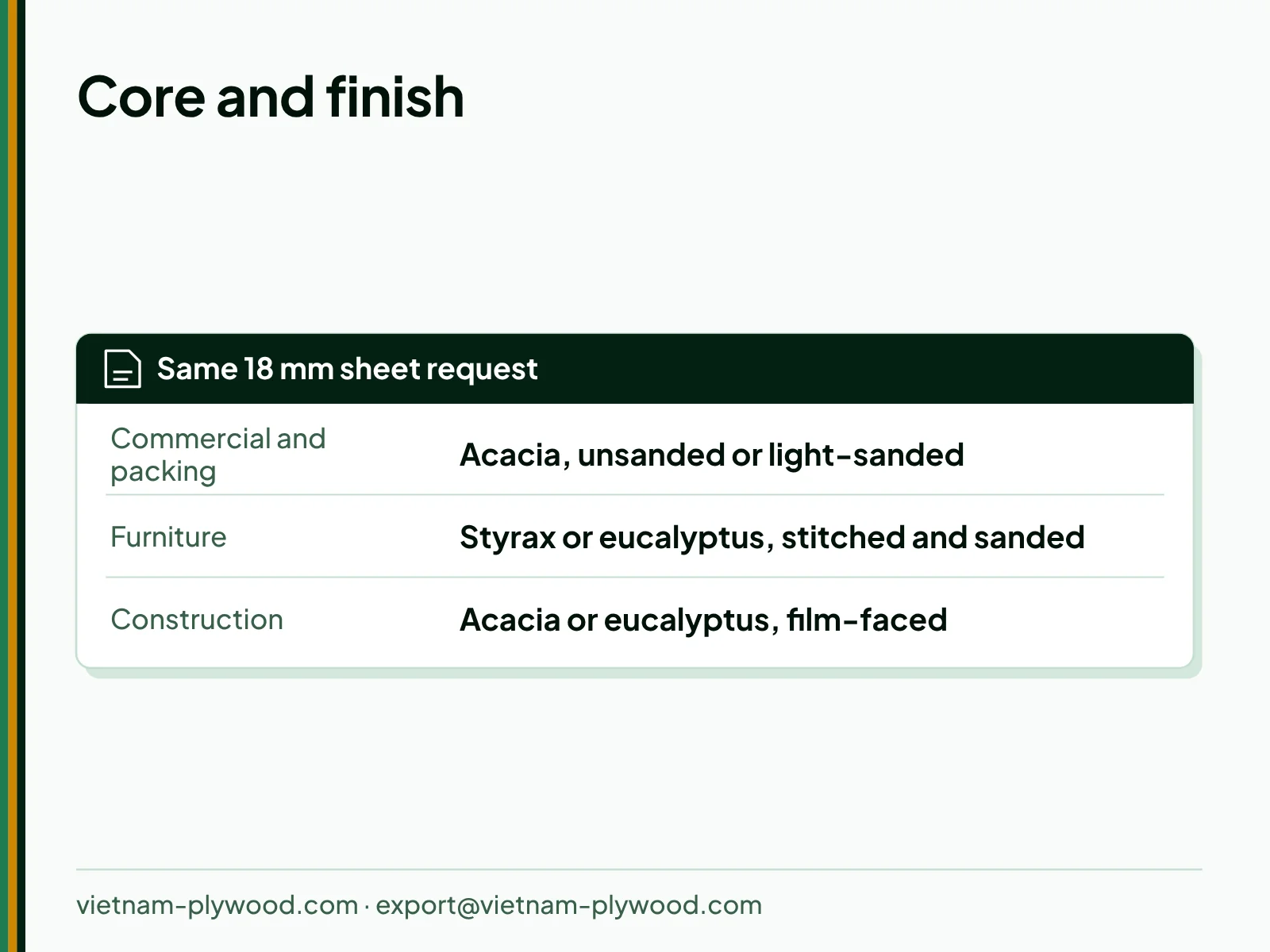
Our commercial and packing line builds MR-glued acacia panels with the surface finish chosen for packing. The furniture line instead uses stitched, sanded styrax or eucalyptus cores for visible interior components. Our construction line uses film-faced acacia or eucalyptus cores for formwork surfaces; its film is unnecessary for most disposable crate walls.
| Same 18 mm sheet request | Core and finish | Ordered thickness tolerance | Crate decision |
|---|---|---|---|
| Commercial and packing | Acacia, unsanded or light-sanded | Packing ±0.5–1.0 mm | Starting point for crate skins |
| Furniture | Styrax or eucalyptus, stitched and sanded | ±0.2 or ±0.3 mm | Use when surface finish matters |
| Construction | Acacia or eucalyptus, film-faced | ±0.5 mm | Use only if the film has a defined function |
Which crate parts need ISPM 15 treatment?
Plywood and laminated veneer lumber (LVL) made through glue, heat or pressure processing are exempt wood packaging materials under International Standards for Phytosanitary Measures No. 15 (ISPM 15). Untreated solid-wood skids, posts, braces, blocking and dunnage used as regulated packaging remain within the treatment-and-marking rules. A mixed-material crate does not become wholly exempt because its walls are plywood.
The International Plant Protection Convention’s 2021 ISPM 15 publication excludes pest-free processed wood packaging such as plywood; the U.S. regulation in 7 CFR § 319.40-1 also excludes manufactured wood materials from its definition of regulated wood packaging. See the IPPC standard overview and U.S. regulatory definitions.
A receiving inspector should distinguish processed panels from raw solid members on the bill of materials. Check the approved treatment and legible mark on regulated solid wood, and check for bark, insects or bore evidence. The mark belongs to the accredited treatment or packaging operation, not to a plywood sheet merely because it is installed in a crate.
For shipments entering the United States, 7 CFR § 319.40-3 authorizes immediate reexport of regulated wood packaging missing its required mark. See U.S. treatment and marking rules. Destination rules and the exact package construction must therefore be checked before the crating company closes the load. Treatment paperwork for regulated wood should be kept with the packing record.
Can LVL be used for crate skids?
LVL can be specified for crate skids when the crating engineer sizes it for the actual loads and handling conditions. Laminated veneer lumber is an engineered product, but an exemption from ISPM 15 treatment is not a structural capacity rating. The buyer still needs the member dimensions, grade evidence, connection details and load calculations.
The page’s material-list concept includes LVL skid members alongside plywood sheathing. The defined HCPLY panel specification, however, provides no LVL dimensions, grades, capacities or test results. A purchase request for LVL should therefore be evaluated as a separate engineered-member specification rather than assigned a plywood value.
How should heavy crates be reinforced?
Heavy crates need reinforcement at the load path: base, restraint anchors, corners and unsupported spans. Steel brackets or straps help only when their fasteners transfer force into sound framing. Adding more metal to thin sheathing does little for an overloaded skid.
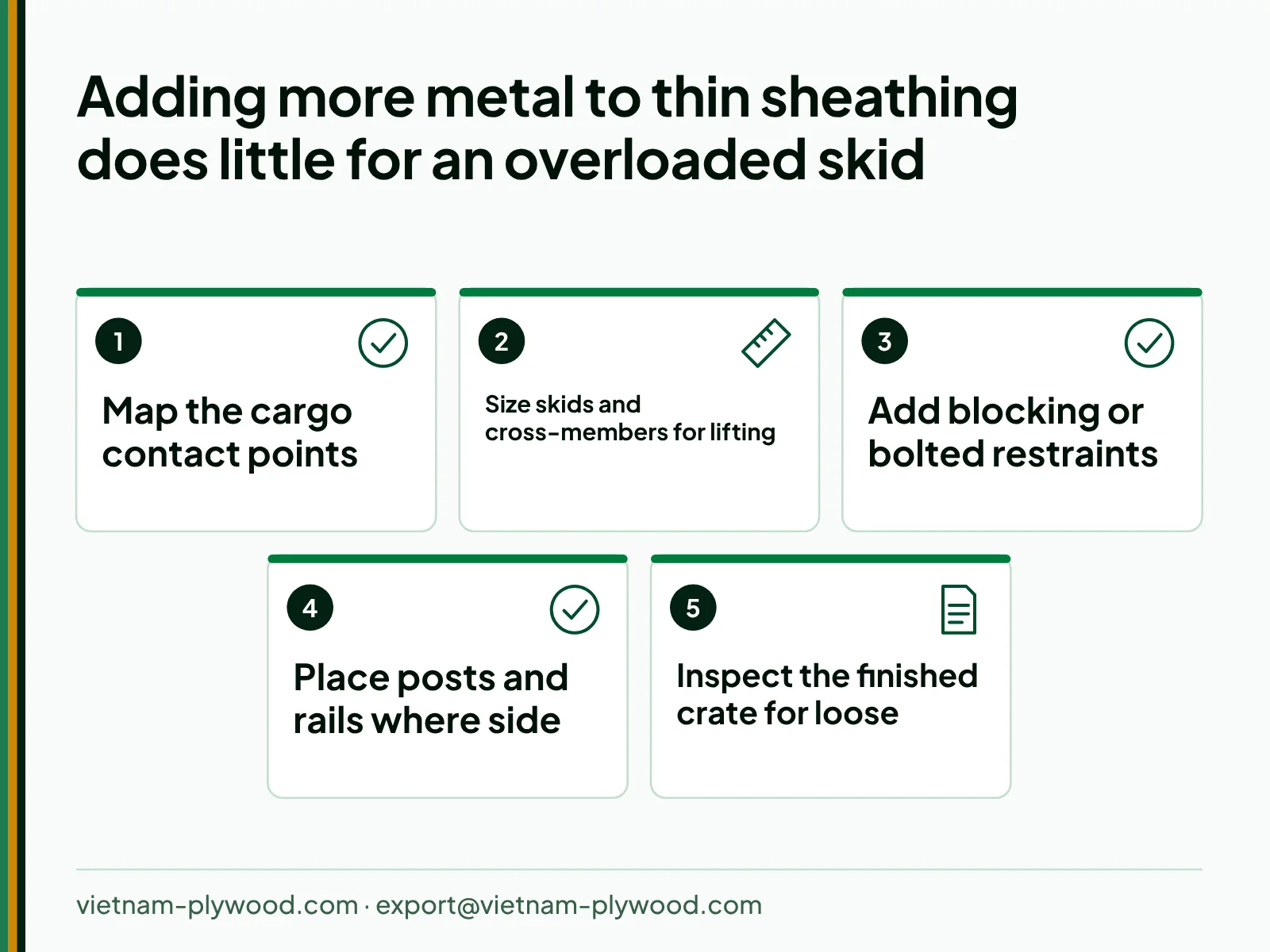
- Map the cargo contact points and centre of gravity onto the base drawing.
- Size skids and cross-members for lifting and floor reactions, including the actual fork positions.
- Add blocking or bolted restraints at approved cargo contact points; keep fragile housings free of direct restraint loads.
- Place posts and rails where side and roof panels need support, then specify fastener spacing and edge distances.
- Inspect the finished crate for loose connections, splits, moisture exposure and access to lifting points.
What can an inspector check at the producing factory?
An inspector can witness sheet dimensions, thickness, core assembly and pallet identification at the producing factory. For packing plywood, HCPLY can show the ordered acacia-core build and the agreed unsanded or light-sanded face. The finished crate’s restraint and lifting checks belong with the crating assembler.
For 18 mm panels, the commercial and packing line uses the ordered packing tolerance of ±0.5–1.0 mm; length and width tolerance is ±2 mm. A practical witness check samples panel edges for gaps, measures thickness at agreed locations and compares the packing labels with the written order. The inspector can also check that panels intended for exposed edges are identified for sealing by the assembler.
How do sheet weight and mixed loads affect buying?
Sheet mass affects how a packing company plans cutting, unloading and mixed container orders. At 1220 × 2440 × 18 mm, an acacia-core sheet weighs 31.08 kg before any crate hardware. The corresponding full 40HC lookup is 880 sheets, 47.15 m³ and 27.35 t, with a 28.5 t payload limit.
See container loads for full counts. That lookup describes a full container of the stated plywood, not the weight of assembled wood crates. For a mixed order, the commercial and packing panels can share a container with other agreed specifications within the payload limit. Subtract the actual loaded mass of every additional specification from the payload allowance; check the final loading plan against the stated 28.5 t ceiling before changing the mix.
How should buyers order crate plywood?
Order crate plywood by its job in the assembly, not by the words ‘wood crates’ alone. State whether each panel becomes a wall, roof, deck or removable inspection hatch, and include the support spacing and fastening approach. That lets the factory quote the requested build without treating every panel as a structural skid.
The normal packing starting point is acacia core with MR glue, in an unsanded or light-sanded finish. Thicknesses range from 3–40 mm; common options include 9, 12, 15, 18 and 21 mm. Standard formats include 1220 × 2440 mm and 1250 × 2500 mm, with custom cutting available. Order dimensions should identify cut-piece orientation as well as the original sheet size.
The minimum order is one 40HC, and specifications can be mixed within the payload limit. Factory lead time runs 15–45 days from receipt of the 30% deposit; the exact figure depends on order size, line loading and what the contract fixes. The 70% balance is against the scanned bill of lading, by telegraphic transfer or irrevocable letter of credit at sight. We ship FOB Hai Phong, or CFR (CNF) or CIF to your port.
Commercial plywood starts from US$250/m³ FOB Hai Phong (October 2026). Thickness, core construction, surface finish, cutting loss and the quantity split influence the quotation; a more fully stitched build costs more to assemble than a loose-laid packing core. Request a quotation against the written component list, rather than extrapolating the starting figure to every grade.
Which documents travel with the plywood order?
The packing list is the shipment document that identifies panel counts, dimensions and packages against the crate-material order. The export file also contains the commercial invoice, bill of lading, certificate of origin, phytosanitary and fumigation papers, plus insurance under CIF. European Union lots include EUR.1 and the EUTR/EUDR file set; agreed certificate or test documents accompany the relevant build.
After loading, the draft shipping documents come to you for approval. Where an order calls for a factory certificate, documents from the member factories can be shown with factory details masked, on request. A treatment mark on solid-wood packaging is a separate matter for the accredited wood-packaging provider.
For recurring crate programmes, plywood supply programmes can organize repeated specifications; production lead time explains scheduling considerations. Keep the plywood purchase order aligned with the assembler’s material list so the receiving team can trace each panel bundle.
What specification should the buyer send?
A useful crate-panel request identifies the finished package’s purpose and the sheet’s exact role. Include the receiving port and whether the assembly will contain regulated solid-wood members. The assembler should separately approve skid engineering, restraint drawings and any treatment obligations.
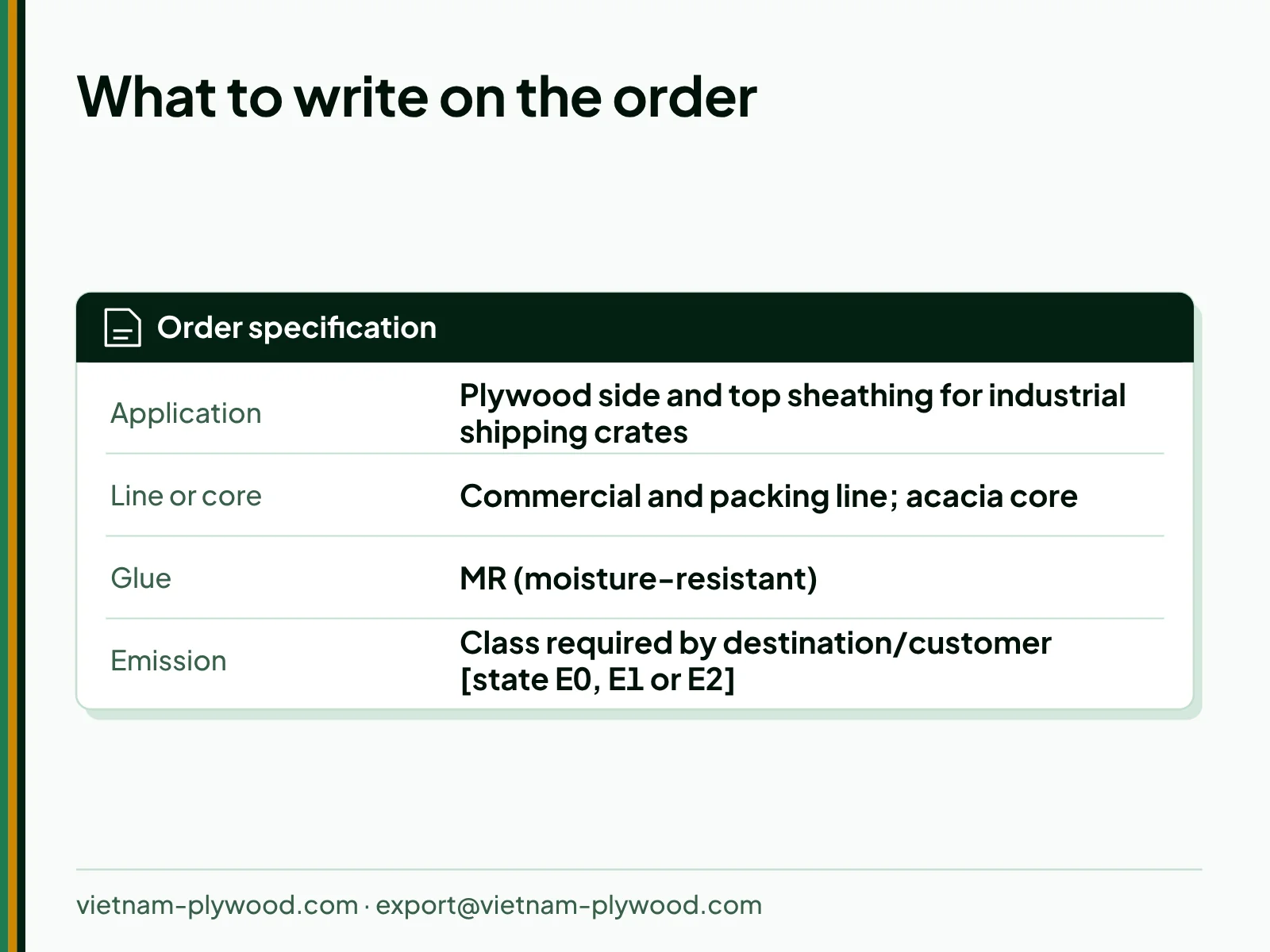
Application: plywood side and top sheathing for industrial shipping crates
Line or core: commercial and packing line; acacia core
Glue: MR (moisture-resistant)
Emission: class required by destination/customer [state E0, E1 or E2]
Face and grade: matt/unfaced packing surface; agreed appearance requirement
Thickness and tolerance: 18 mm; packing ±0.5–1.0 mm
Size: 1220 × 2440 mm; list any cut sizes
Quantity: [sheets and container mix]
Destination port: [port, country]
Crate assembly notes: skid material, solid-wood treatment responsibility, drawing reference
Request the crate-panel spec sheet from Lucy at export@vietnam-plywood.com through contact.