





What plywood box panels does HCPLY make?
A plywood box maker needs flat, dimensionally consistent panels cut for its approved case design. HCPLY presses acacia-core commercial and packing plywood on our commercial and packing line, then cuts panels to the box maker’s agreed parts list before loading. The wrong core construction, edge allowance or cut dimension can waste material, delay assembly or lead to a rejected load.
We supply the plywood components for box makers rather than claiming to approve their finished cases. A case drawing should identify the base, lid, side walls and any internal dividers separately. Our packaging plywood range explains the broader panel choices; this page concentrates on cut components for export boxes.
A useful order begins with the case style, cargo mass, handling route and a revision-controlled drawing. The maker then selects its joints, closures, reinforcement and test requirements. We translate the approved panel schedule into a production and inspection specification.
Which plywood grade suits each export box or case?
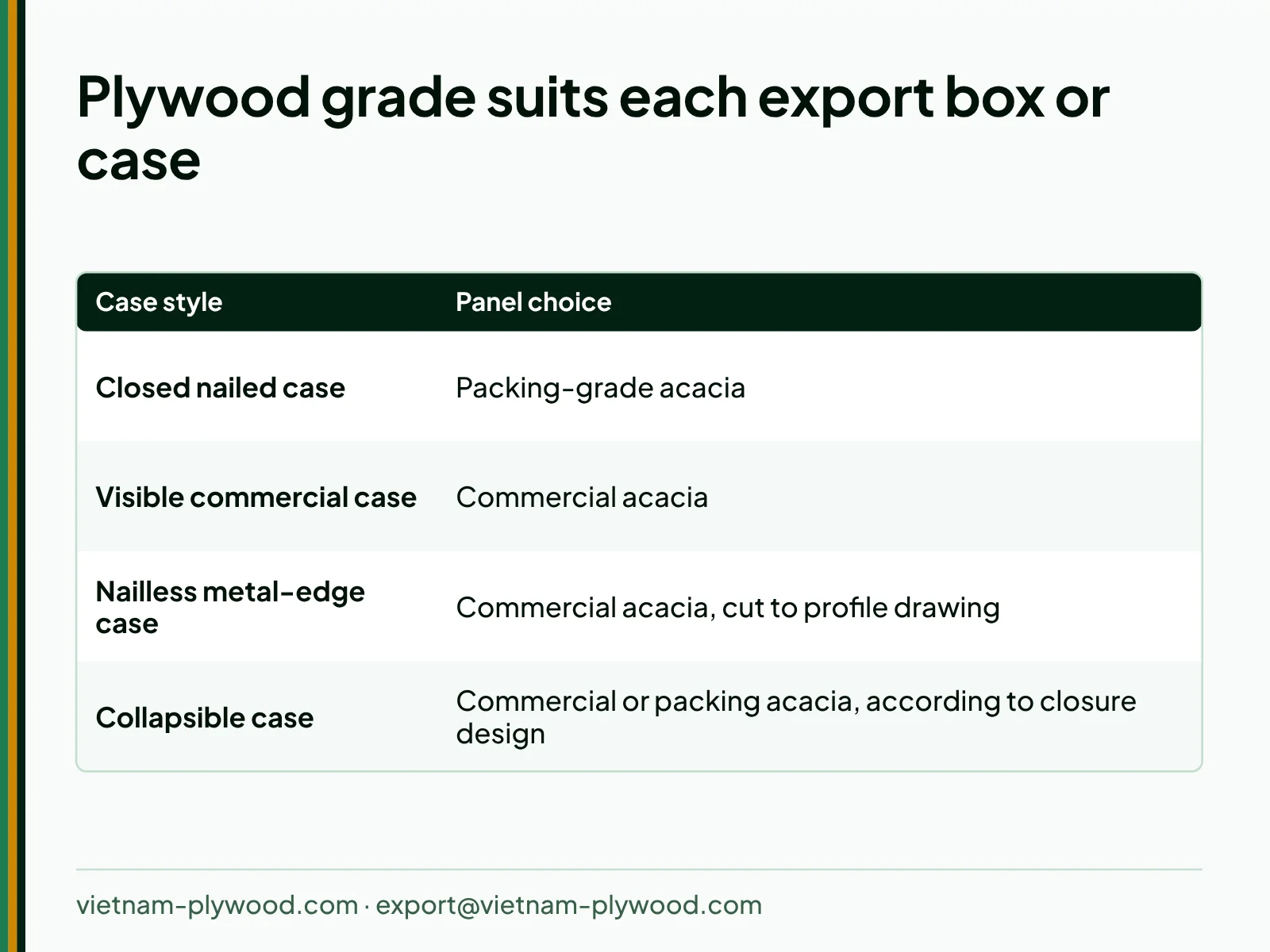
Packing-grade acacia plywood suits concealed or utility panels, while commercial acacia plywood suits cases needing a more consistent visible surface. Both come from our commercial and packing line with moisture-resistant (MR) glue and unsanded or light-sanded surfaces. The buyer’s drawings determine the necessary thickness and whether faces need a specified veneer.
| Case style | Panel choice | Practical inspection metric | Verdict by use |
|---|---|---|---|
| Closed nailed case | Packing-grade acacia | Thickness tolerance ±0.5–1.0 mm | Choose for utility walls with designed framing |
| Visible commercial case | Commercial acacia | Thickness tolerance ±0.5 mm | Choose for exposed walls and repeatable fit |
| Nailless metal-edge case | Commercial acacia, cut to profile drawing | Length/width tolerance ±2 mm | Choose where edge engagement is closely specified |
| Collapsible case | Commercial or packing acacia, according to closure design | Thickness and cut-panel dimensions | Choose by hinge, frame and repeated assembly requirements |
| Open plywood crate | Packing-grade acacia components | Cut dimensions and edge condition | Choose where enclosure is incomplete by design |
A/B is a face-grade description, not a box load rating. A box maker must calculate its own structural requirements and test the complete design when required. See packing plywood specifications and crate and pallet plywood grades for the related material decisions.
The box maker should state whether dimensions refer to a panel blank, the finished assembled case or its internal clear opening. Those measurements serve different purposes. An apparently small wall-thickness change can alter the clear opening and interfere with fitted cushioning.
What is a nailless plywood box?
A nailless plywood box is a case assembled with metal profiles, clamps or interlocking fittings instead of nails driven through its walls. Its plywood walls still need accurate cut dimensions, adequate edge quality and compatibility with the selected fittings. The finished case’s locking system is designed and validated by its box maker.
Nefab describes foldable boxes held together by steel profiles and a tab-and-slot locking system. UBEECO shows attached-frame, foldable-frame and loose-side arrangements. Those are useful design references, but their branded hardware and stated performance do not transfer automatically to another maker’s case.
For a nailless plywood box, send the profile section drawing, groove or edge-engagement dimensions, required clearances and assembly sequence. We can cut flat plywood blanks to the approved list; the case maker supplies or specifies the metal closures. A panel that passes a flat-sheet thickness check can still fail to engage a poorly matched profile.
What plywood is used for collapsible plywood boxes?
Collapsible plywood boxes use panels sized for a foldable frame or removable sides, with the closure hardware determining how the edges meet. Acacia-core commercial or packing panels are the relevant HCPLY options. The finished mechanism belongs to the case maker’s design, including hinges, clamps, latches and any protective edge treatment.
A one-piece folding arrangement joins the base, lid and frame; another separates the base, lid and folding frame. Larger knock-down designs use loose sides so a packing crew can reach the cargo from several directions. The appropriate style follows access, lifting equipment and warehouse handling.
Ask the maker to identify which panels fold, which remain rigid and where a hinge loads the edge. Specify the orientation of each blank in the cutting plan. Repeated opening requires an assembly trial with the actual hardware, rather than an assumption based on the plywood face grade.
Can a factory cut panels to a box maker’s parts list?
Yes. Our commercial and packing line can cut plywood panels to the approved box maker’s parts list before the producing factory loads the shipment. Standard sheets include 1220×2440 mm and 1250×2500 mm, and custom cutting is available. The order must distinguish nominal panel size from each finished cut part.
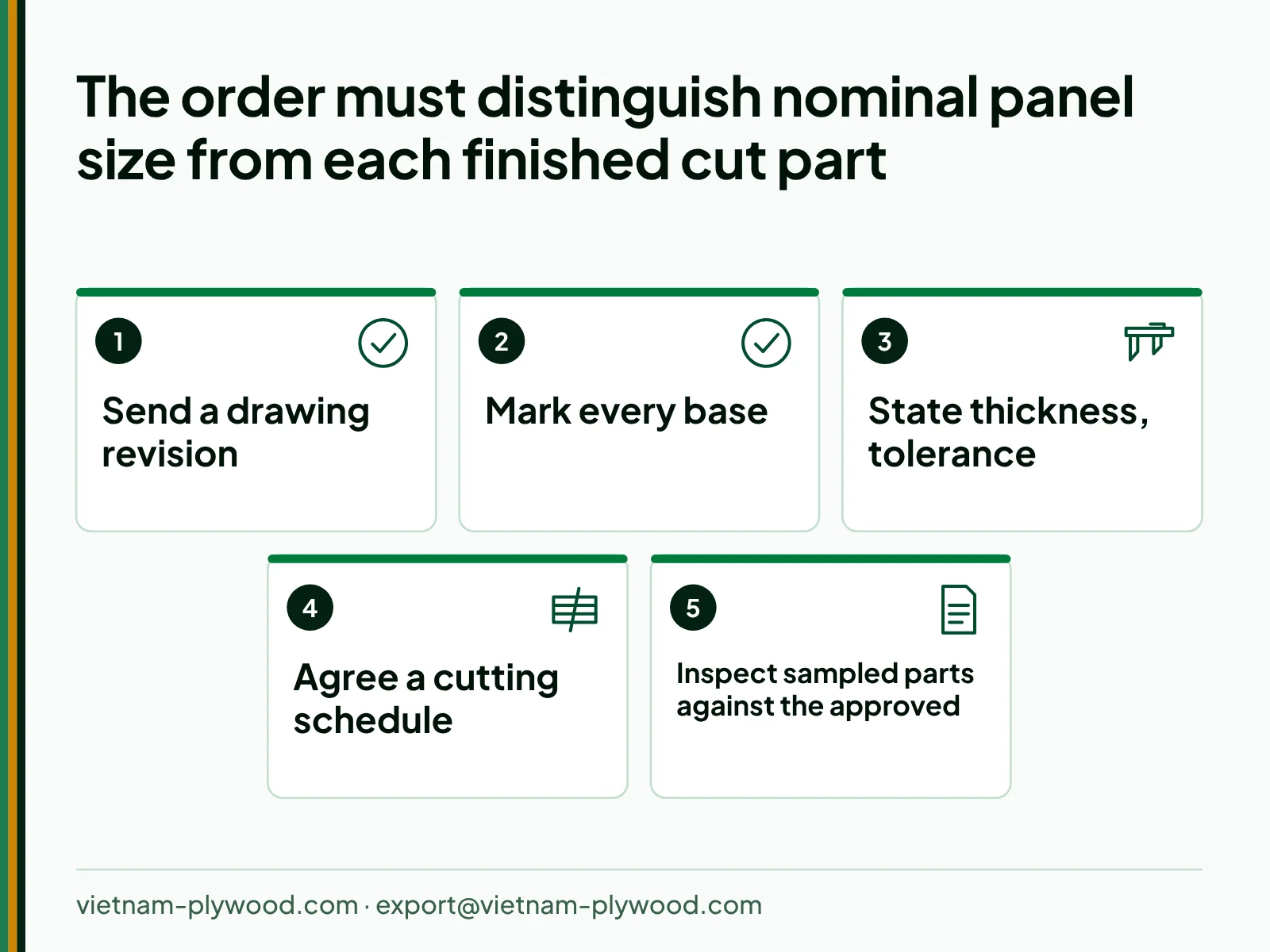
- Send a drawing revision and a numbered bill of parts for each case style.
- Mark every base, lid, side, divider and spare component with its required dimensions and quantity.
- State thickness, tolerance, grain or face direction and the required edge condition for each part.
- Agree a cutting schedule, bundle identification and acceptance checks before pressing and cutting.
- Inspect sampled parts against the approved drawing at the producing factory, then check bundle counts before loading.
For repeat orders, retain the drawing revision on the packing instructions. If a box maker changes a hinge or profile, update the affected cut lengths before the next production run. A change in box outside dimensions alone does not reveal the new cut sizes.
HCPLY manages specification, on-site quality control, export documents and loading. Buyers can visit the factory office and inspect goods where their order is produced.
Is commercial or packing-grade plywood better for export cases?
Commercial plywood is the better choice when the case maker needs a specified visible face and tighter thickness control; packing grade is the practical choice for concealed utility walls with a wider agreed tolerance. Both use acacia core on the same line. Neither grade, by its name alone, establishes a finished box’s stacking or impact performance.
Commercial and packing plywood share an acacia-core density reference of 580 kg/m³. Packing panels can use a simpler inner-core arrangement than a full-stitched construction. Specify the construction rather than treating a grade name as a complete acceptance criterion.
The cost drivers, in likely order of impact for a comparable order, are core construction and veneer yield, thickness and sheet consumption, face selection, then cutting complexity and waste. Full-stitched construction costs more than loose-laid construction because it requires more core preparation. Extra cutting and segregated part bundles add handling relative to uncut sheets. Request a quotation against the drawing rather than a generic plywood box price.
How do the three production lines compare for a box order?
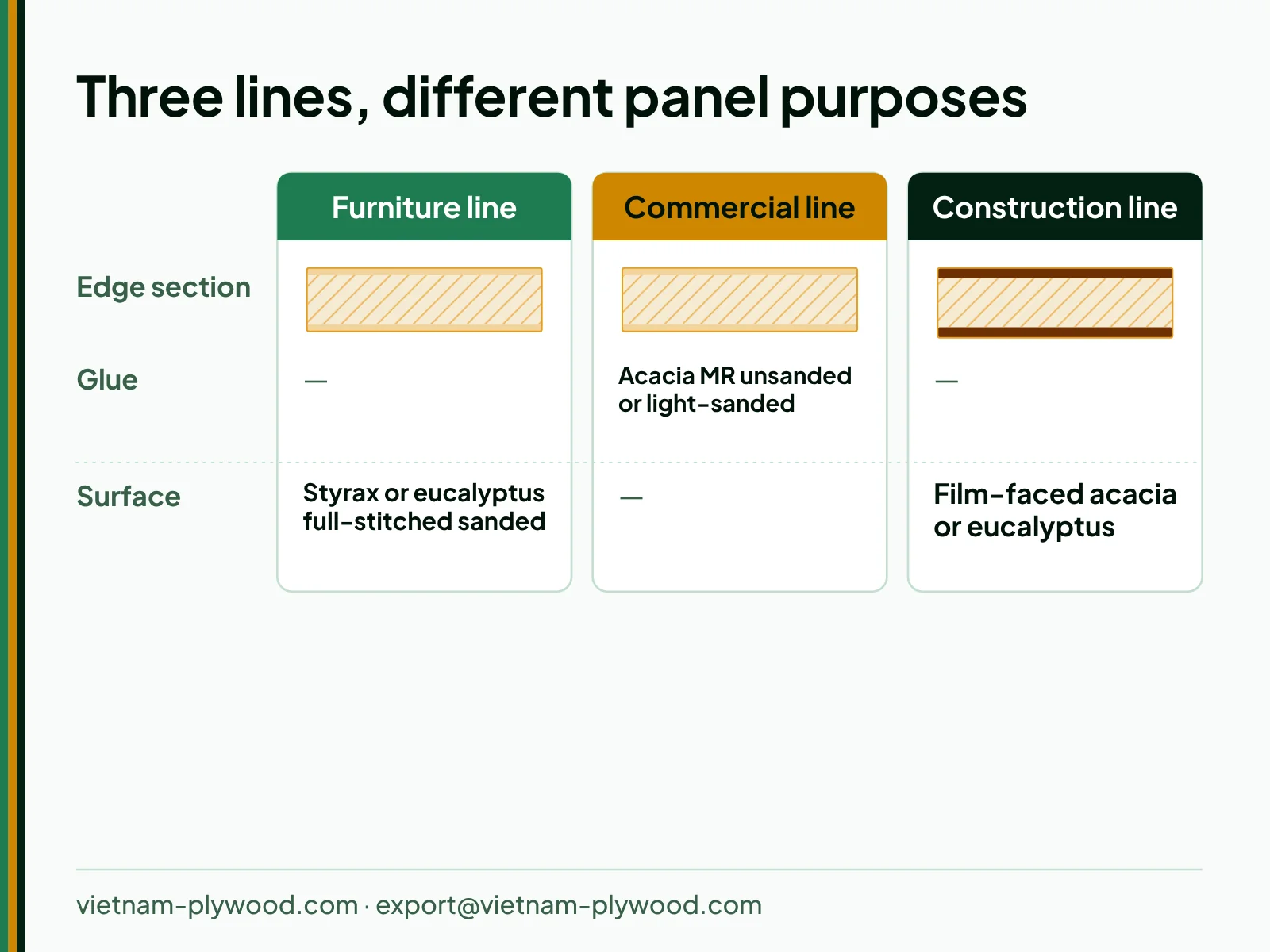
Our commercial and packing line presses the acacia-core plywood specified for box walls and cuts it to the case maker’s schedule. Our furniture line makes sanded styrax- or eucalyptus-core panels with full-stitched cores. Our construction line presses film-faced panels for formwork applications rather than ordinary box walls.
| Line | Example 18 mm build | Thickness tolerance | Box-maker decision |
|---|---|---|---|
| Commercial and packing | Acacia core, MR glue, unsanded or light-sanded | Commercial ±0.5 mm; packing ±0.5–1.0 mm | Normal source for cut case panels |
| Furniture | Styrax or eucalyptus, full-stitched, sanded, E0/E1 | ±0.2 or ±0.3 mm as ordered | Consider only where a furniture-type finish is separately specified |
| Construction | Acacia or eucalyptus, phenolic or melamine film | ±0.5 mm | Intended for film-faced construction work |
A film-faced sheet is described by its film weight, not by a box approval. The lines are assigned by the panel specification, and orders ship directly from the producing factory FOB Hai Phong. For buyers combining categories, see one supplier for several plywood types.
How do cut parts affect container planning?
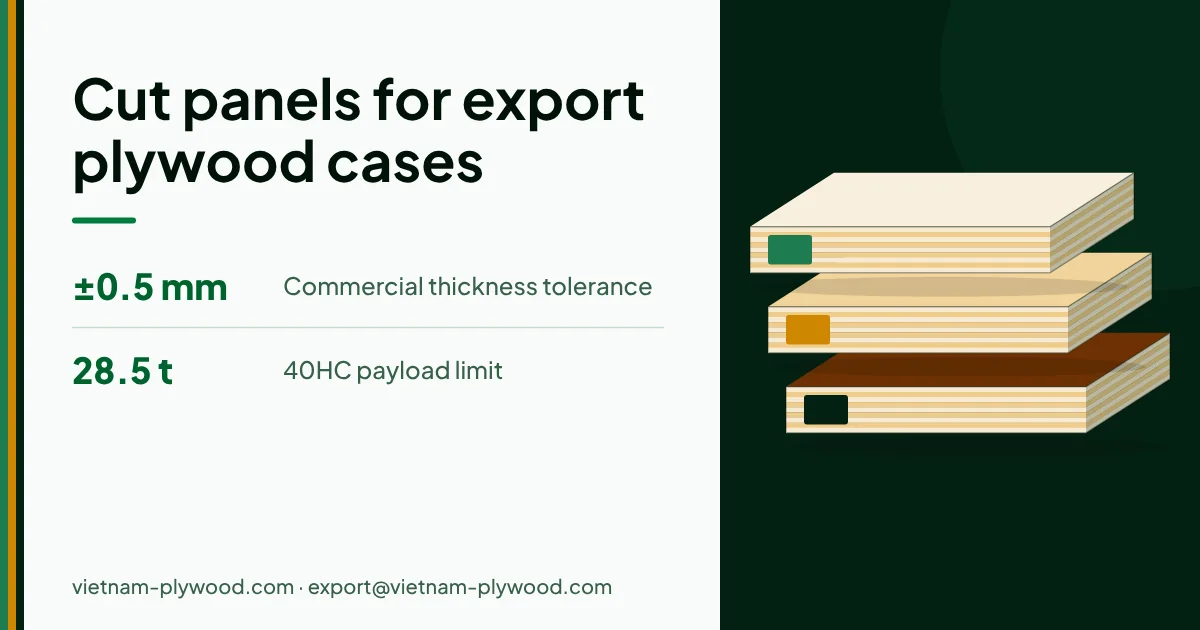
Cut parts need a bundle plan as well as a sheet-equivalent quantity, because cutting changes how panels occupy pallet space. For an uncut reference, 18 mm acacia sheets at 1220×2440 mm weigh 31.08 kg each. A full 40HC reference load is 880 sheets, 47.15 m³ and 27.35 t, below the 28.5 t payload limit.
Those figures describe full sheets, not a verified loading count for irregular cut components. The packing list should distinguish finished parts from sheet equivalents and record the actual pallet configuration. Our container loading reference covers the full-sheet calculation.
Specifications can be mixed in a container within the payload limit. The box maker should group parts by case model and revision, leaving an auditable count for each bundle. Distributors planning repeat replenishment can also review plywood supply programmes.
Who holds UN 4D approval for a plywood box?
UN 4D identifies a plywood box packaging design type for dangerous goods; the box maker or other named certificate holder is responsible for its approved design and conformity. A plywood panel supplier’s material specification does not grant approval to the assembled box. The applicable authority and transport mode determine the approval and testing process.
The UK Department for Transport’s 2020 guidance states that dangerous-goods packaging design types are tested and certified, and that an approval mark applies to packages matching the tested design. See the Department for Transport guidance.
A box maker seeking an un 4d plywood box should give the panel supplier the material and dimension requirements from the approved design. The certificate holder must control construction, closures, test evidence, markings and approved contents. A changed panel thickness, adhesive or assembly detail needs evaluation against that design’s approval documents.
For a dangerous-goods case, obtain the applicable certificate, test report and assembly instructions from the responsible packaging supplier or certificate holder. Do not substitute a plywood shipment’s quality papers for the finished packaging approval.
What can an inspector witness before shipment?
An inspector can compare cut plywood components against the drawing, check thickness and edge condition, and reconcile bundle quantities at the producing factory. This makes a case maker’s incoming inspection more predictable, although final case assembly and load testing remain downstream activities.
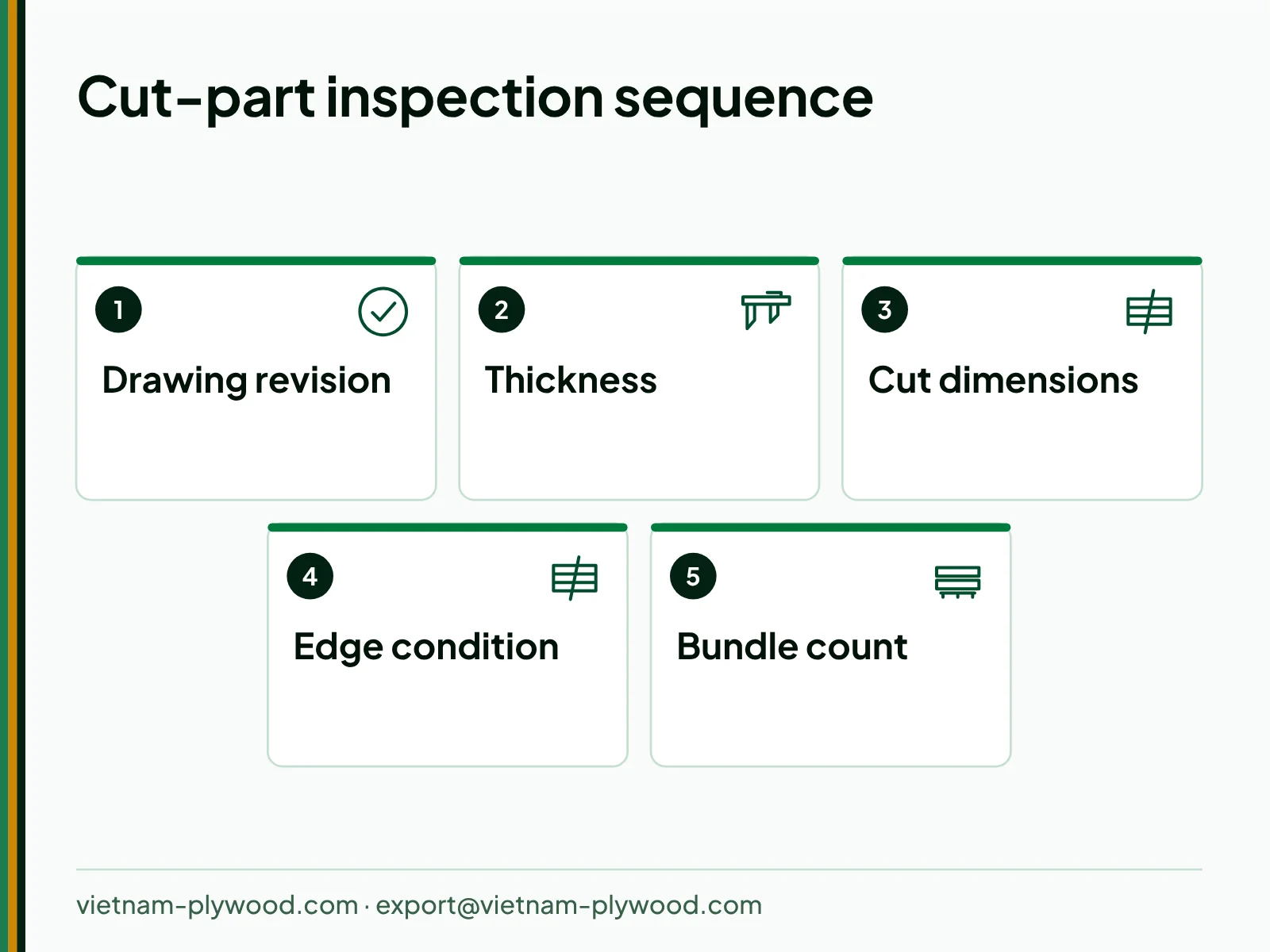
A practical witness check starts with the approved drawing revision and a selected bundle. Measure cut length and width against the specified ±2 mm sheet-size reference where applicable, then check the agreed part-level tolerances. Measure thickness at agreed locations, inspect faces and exposed edges, and record any chipped or incomplete cut.
The inspector should verify that the packing list identifies each case model, part number and quantity. A dry-fit of supplied components with the maker’s actual metal profile is especially useful for a nailless design when the hardware is available. Inspection records should state which parts were checked and what drawing revision governed acceptance.
Which export documents cover the panel shipment?
The commercial invoice and packing list describe the panel shipment, while the bill of lading (B/L) records carriage. A certificate of origin and applicable phytosanitary or fumigation papers accompany the shipment documentation. The order’s agreed certificates and test reports address the specified plywood build.
For European Union lots, the document package can include EUR.1 and the European Union Timber Regulation or Deforestation Regulation file set. Member-factory FSC, CARB P2, ISO 9001 and CE certificates, where relevant to the ordered build, are shown with factory details masked, on request. These are separate from a box maker’s UN design-type approval.
After loading, the draft shipping documents come to you for approval. We ship FOB Hai Phong, or CFR (CNF) or CIF to your port, with insurance under CIF. The shipment paperwork should use the same part and material descriptions as the approved order.
What should a box maker send for a quotation?
Send the finished case drawing and a separate plywood parts schedule, including revision, quantities and destination port. This lets our packing line quote the panel build and cutting work without guessing the box maker’s closure or load design.
The minimum order is one 40HC. Factory lead time runs 15–45 days from receipt of the 30% deposit; the exact figure depends on order size, line loading and what the contract fixes. The remaining 70% is paid on the scan of the bill of lading, by T/T, or by irrevocable sight L/C. Samples cost nothing: a first-time buyer pays the courier, and that charge comes off the first confirmed order.
For a plywood crate box, include whether the sides are fully enclosed or open, and whether the base takes forklift loads. For plywood boxes made to order, add the internal clear dimensions, cargo weight, cushioning allowance and hardware interface drawing. Buyers comparing plywood boxes suppliers and plywood boxes manufacturers should request a cut-part acceptance schedule alongside any price quotation.
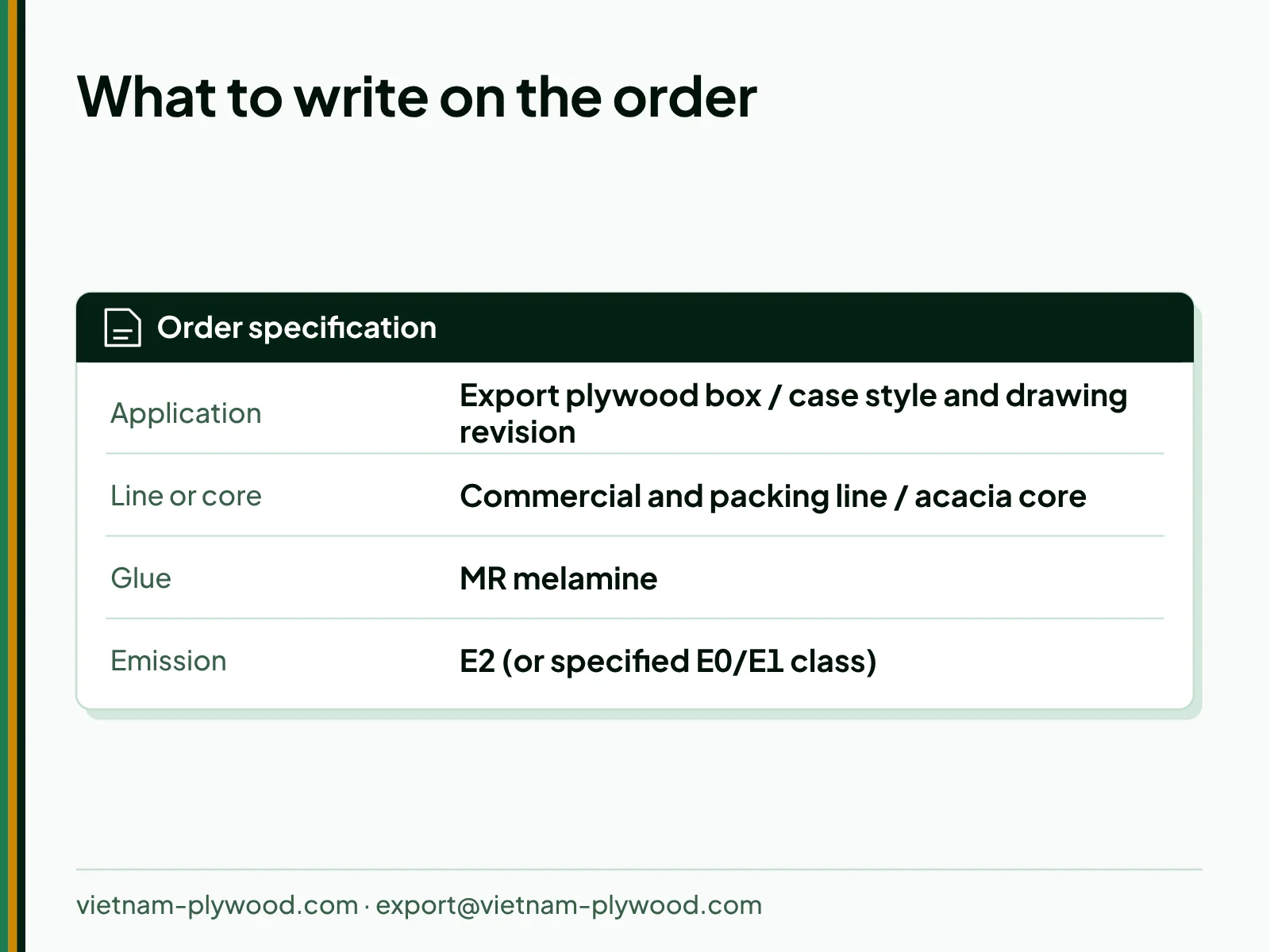
Application: Export plywood box / case style and drawing revision
Line or core: Commercial and packing line / acacia core
Glue: MR melamine
Emission: E2 (or specified E0/E1 class)
Face and grade: Matt/unfaced or specified veneer and A/B grade
Thickness and tolerance: [mm] / commercial ±0.5 mm or packing ±0.5–1.0 mm
Size: Sheet size and numbered cut-part dimensions [mm]
Quantity: Cases, pieces per case, total parts and bundles
Destination port: [port, country]
Request the plywood box panel specification sheet from Lucy at export@vietnam-plywood.com.