





PVC board vs plywood for commercial wall panels comes down to wet exposure, fixing strength, fire evidence and the required finish. A wrong choice can mean replaced panels, delayed handover or rejected installation details. HCPLY’s furniture line makes veneered and paint-grade plywood for fit-out manufacturers, while PVC and wood-plastic composite (WPC) serve different decorative lining jobs.
PVC board vs plywood: which wall-panel material wins?
PVC wall panels suit washable decorative skins; WPC suits profiled feature surfaces; plywood suits real-wood faces and walls requiring a continuous substrate for planned fixings. In damp rooms, a correctly detailed phenolic-bonded plywood panel can be more useful than a hollow decorative profile when cabinets or equipment must attach to the lining. None replaces a designed waterproofing system.
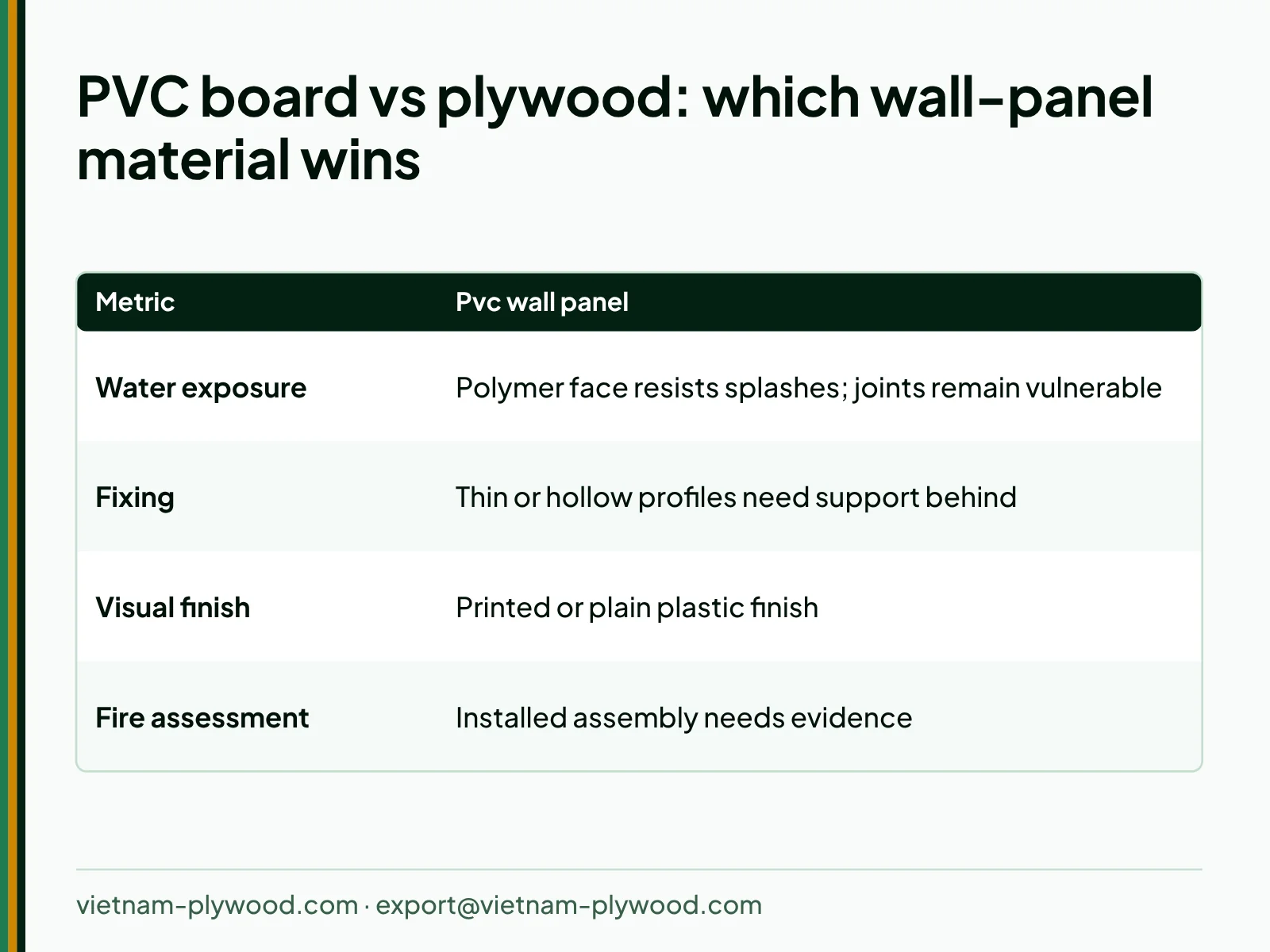
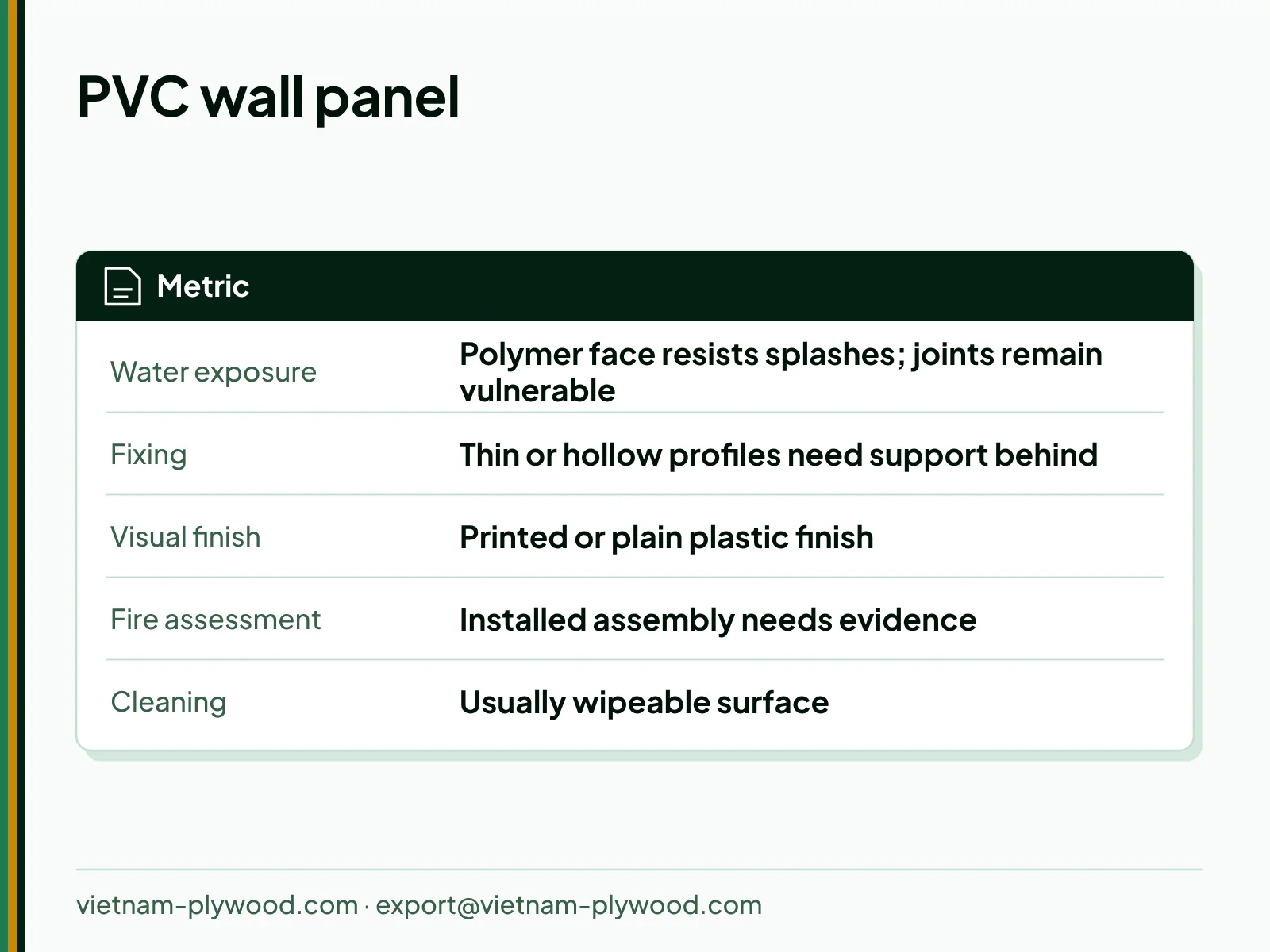
| Metric | PVC wall panel | WPC wall panel | Plywood wall panel | Verdict by use |
|---|---|---|---|---|
| Water exposure | Polymer face resists splashes; joints remain vulnerable | Composite surface resists routine moisture; profile and seams matter | Timber core needs sealed edges and suitable bond | PVC for washable skin; detailed WBP plywood for damp fixing wall |
| Fixing | Thin or hollow profiles need support behind | Hollow flutes need backing for heavy loads | Continuous sheet accepts designed fixing layout | Plywood for cabinet backing |
| Visual finish | Printed or plain plastic finish | Textured or wood-look film | Natural veneer, engineered veneer or paint-grade | Plywood for real veneer; WPC for fluted effect |
| Fire assessment | Installed assembly needs evidence | Installed assembly needs evidence | Installed assembly needs evidence | No material-name winner |
| Cleaning | Usually wipeable surface | Film and grooves need cleaning access | Finish system determines cleaning method | Smooth PVC for frequent wipe-down |
| Heat and movement | Thermal movement and heat sensitivity require detailing | Profile and polymer formulation affect movement | Wood moisture movement requires expansion allowance | Match environmental limits to supplier data |
| Damage repair | Interlocks can complicate access | Interlocks can complicate access | Individual sheet or finish can be repaired by design | Plywood for accessible flat panel replacement |
| Site labour | Clip or adhesive systems can reduce finishing | Profile systems can reduce finishing | Cutting, fixing and finishing take planning | PVC/WPC for fast decorative coverage |
The wider wood board types for importers comparison helps separate structural substrates from decorative skins. The decision above assumes an interior commercial fit-out with a competent wall design.
Are PVC wall panels waterproof?
PVC itself resists liquid water, but a PVC-lined wall is waterproof only when its joints, corners, penetrations and backing have a suitable waterproofing design. Water can enter behind a panel through a service opening or an unsealed edge. A washable face therefore cannot substitute for a waterproof membrane where one is specified.
WPC is also often described as water-resistant. Its wood-fibre fraction, protective skin, joint geometry and exposed cut ends make product construction relevant. Ask for a wall section showing joints, pipe penetrations and floor junctions.
WPC vs PVC wall panels: what changes on site?
WPC blends wood fibre with a polymer, while PVC wall panels are primarily polyvinyl chloride products. Both names cover solid boards, hollow profiles and decorative laminates, so section geometry matters more than a catalogue category. Ask for a cut sample showing wall thickness, clip engagement and the finished edge.
WPC fluted profiles can create pronounced shadows across a reception or retail feature wall. Smooth PVC panels can be simpler to wipe where repeated cleaning is expected. Neither appearance proves abrasion resistance; compare scratches, dents and replacement access using the actual ordered finish.
When does WBP plywood beat a decorative plastic panel?
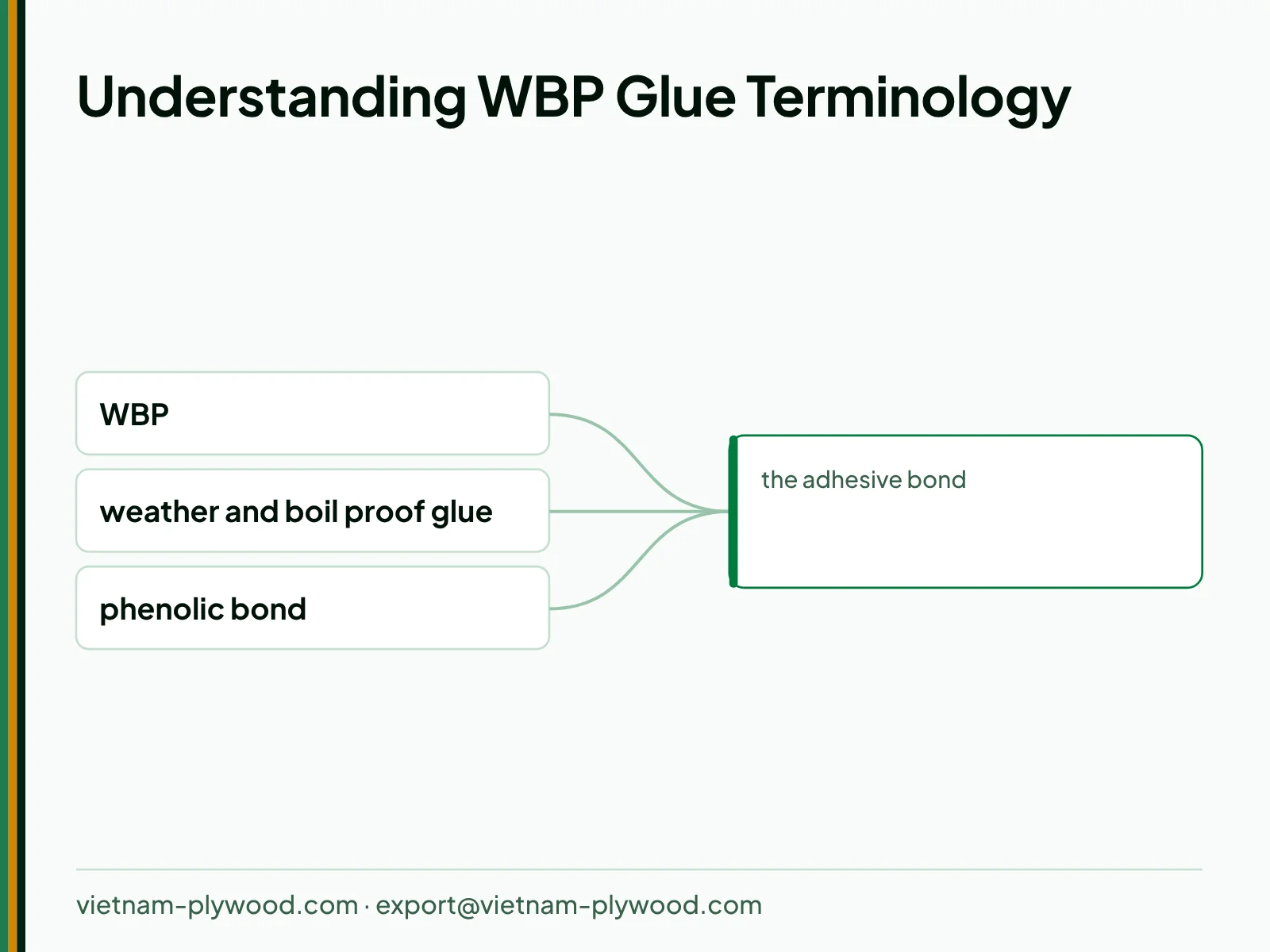
Phenolic-bonded plywood is useful where a damp-room wall also needs a continuous backing sheet for cabinets, access panels or trim. WBP means weather and boil proof glue; it describes the adhesive bond, while the timber core and cut edges still require protection. HCPLY can discuss a phenolic-glue build against the specified moisture exposure.
Our furniture line normally uses stitched, sanded styrax or eucalyptus cores for finish quality. The glue field and emission field are specified separately: a phenolic bond addresses wet exposure, while E0 or E1 identifies an emission class. Compare the actual plywood manufacturing options before approving a sample.
Which factory line builds the wall specification?
The same nominal thickness can describe very different products across our three factories. A visible cabinet wall needs face quality; a packing panel prioritises practical core construction; a formwork panel uses a film surface for concrete work. Matching the line to the application prevents a visually unsuitable substitute from reaching site.
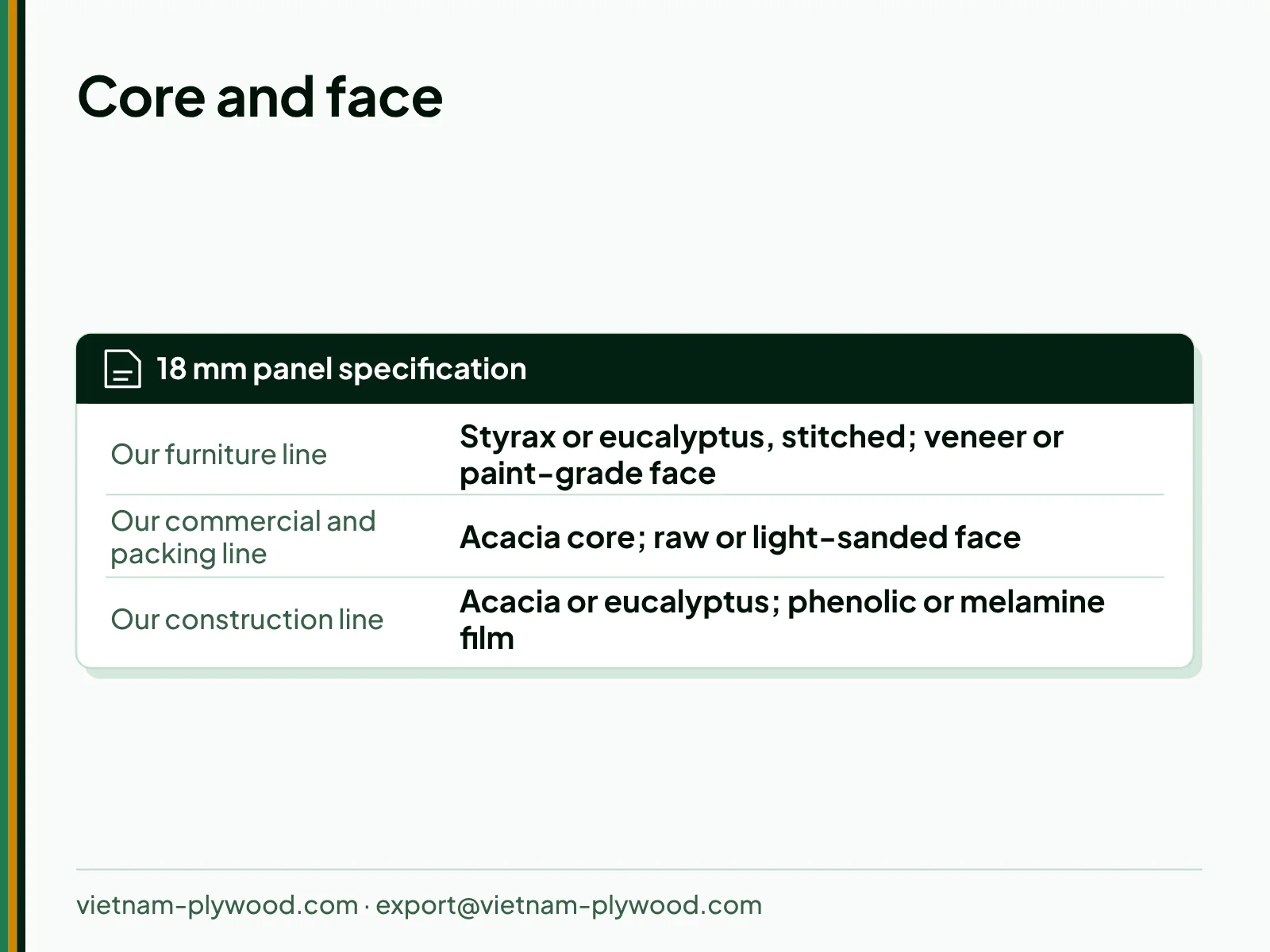
| 18 mm panel specification | Core and face | Surface preparation | Intended decision |
|---|---|---|---|
| Our furniture line | Styrax or eucalyptus, stitched; veneer or paint-grade face | Sanded, ±0.2 or ±0.3 mm as ordered | Interior visible wall and cabinet work |
| Our commercial and packing line | Acacia core; raw or light-sanded face | ±0.5 mm commercial tolerance | Concealed practical backing where approved |
| Our construction line | Acacia or eucalyptus; phenolic or melamine film | Unsanded, ±0.5 mm | Formwork rather than decorative fit-out |
Film-faced boards belong to construction plywood supply, where surface release and edge treatment serve another job. HCPLY does not press PVC, WPC, medium-density fibreboard (MDF), oriented strand board (OSB), chipboard or birch-core plywood. For related panel distinctions, see HDF plywood versus MDF and chipboard or plywood.
How do face, thickness and tolerance change the finish?
For visible plywood walls, the face selection and flatness requirement should precede the thickness order. Bintangor, okoume and engineered veneer (EV) give different grain and colour options; a paint-grade face needs a finish trial under the intended coating.
Common face veneer is 0.2–0.4 mm, with A/B face grades available for applicable species. The furniture line’s full-stitched core supports a uniform sanded surface, and a specified 18 mm panel typically contains 11–13 plies. Buyers should request matching samples for colour, joint pattern and coating absorption.
Which panel is safer where fire performance matters?
Choose a wall lining using the applicable fire classification and the exact installed assembly, never a generic claim that PVC, WPC or plywood is fireproof. The UK Ministry of Housing, Communities and Local Government’s 2025 Approved Document B guidance explains that reaction-to-fire classification can change with fixings, substrates and orientation.
For an England project, ask the design team which lining requirement applies to the room and circulation route. Then match the test report’s substrate, cavity, joints, fasteners and orientation to the proposed installation.
HCPLY does not assign a fire rating to its panels. Where a wall specification demands a particular reaction-to-fire class, obtain acceptable assembly evidence before ordering any material. This check is especially important where a decorative skin conceals a cavity or a combustible backing.
What can an inspector check at the producing factory?
An inspector can witness the plywood checks that affect fit-out appearance and installation: face selection, core construction, sanding, thickness and edge condition. Agree the sample and acceptance method before pressing, then compare production boards with the retained reference at the producing factory.
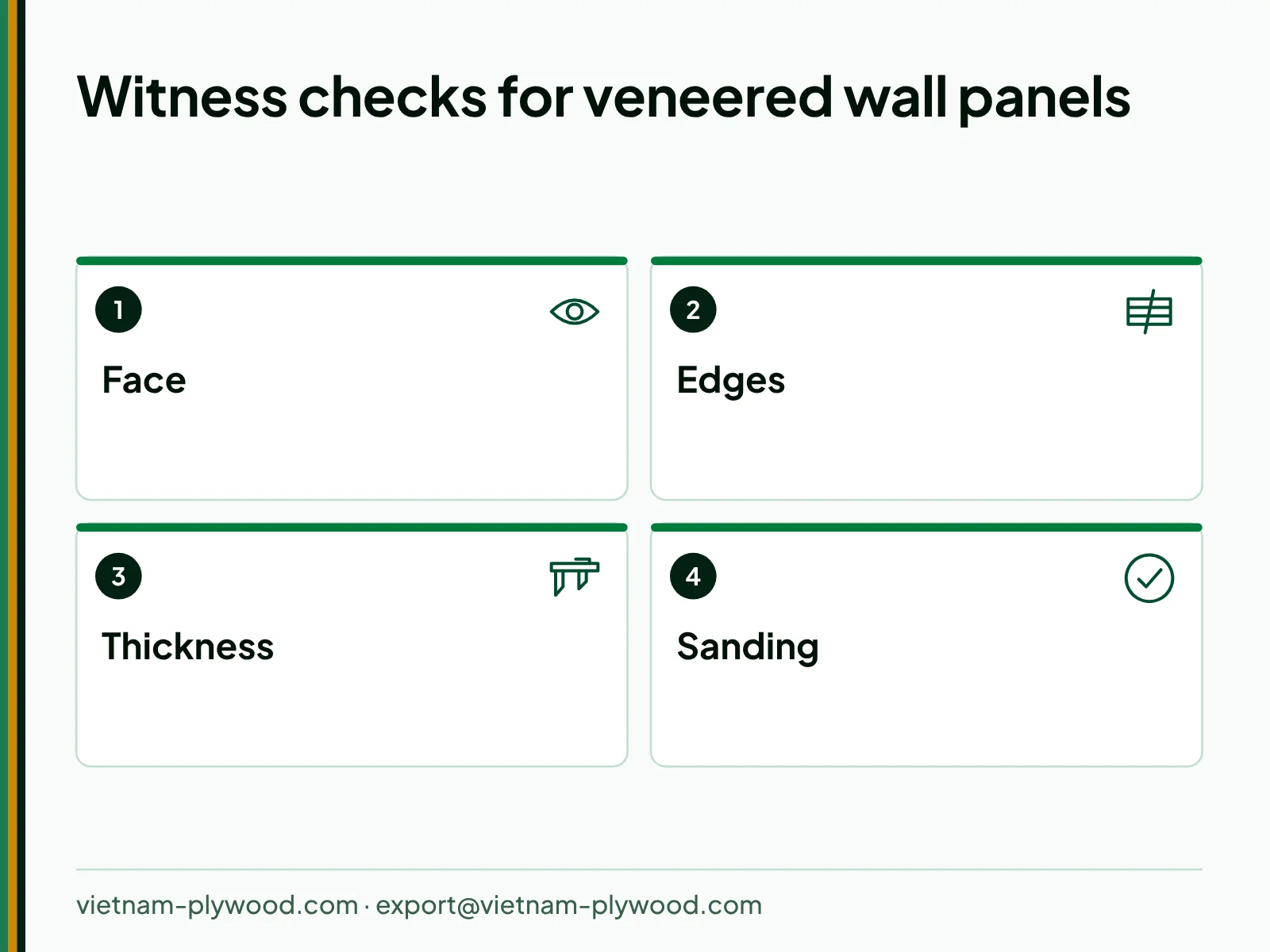
For a veneered wall order, examine face continuity under consistent light and look at exposed edges for gaps. Measure thickness across representative sheets against the ordered furniture tolerance. Inspect the sanded face before finishing, since a defect hidden by coating at dispatch may become visible under site lighting.
Buyers can visit the factory office and inspect goods where their order is produced. HCPLY handles on-site quality control and export loading. Factory-member FSC, CARB P2, ISO 9001 or CE documentation, when relevant to the agreed build, is shown with factory details masked, on request; none substitutes for project-specific fire evidence.
How does the panel choice affect a container order?
Plywood container planning is driven by core density and thickness, not the decorative face name. At 18 mm and 1220 × 2440 mm, the reference full 40HC loads are 990 styrax-core sheets, 880 acacia-core sheets or 795 eucalyptus-core sheets. The corresponding loads weigh 26.52 t, 27.35 t and 27.69 t, respectively, against a 28.5 t payload limit.
Specifications can be mixed within one 40HC, subject to that payload limit. Mixed core densities change the available sheet count, so the packing plan should use actual quantities and pallet positions. The dedicated container loading guide covers load calculations rather than treating every 18 mm board as identical.
The minimum order is one 40HC. For planning, production takes 15–45 days from the 30% deposit, set by order size, line loading and the contract. The production lead-time explanation shows why specification decisions should be settled before the production slot.
What should a buyer compare in the quotation?
Compare the cost of the installed wall system, including substrate preparation, fixings, finishing, edge sealing and replacement access. Compare matched specifications rather than unrelated price units.
For plywood, the furniture starting reference is from US$350/m³ FOB Hai Phong (October 2026). The commercial starting reference is from US$250/m³ FOB Hai Phong (October 2026). Furniture-grade stitched and sanded faces cost more than a basic commercial build because they require tighter preparation and face selection; phenolic bonding and selected veneer can add further cost.
Which export document records the agreed wall-panel build?
The commercial invoice and packing list identify the ordered plywood and quantities, while agreed test reports or emission certificates support the specified build. For EU lots, the EUTR/EUDR file set and applicable certificate-of-origin paperwork form part of the shipment records. Draft shipping documents are sent for buyer approval after loading.
Free samples are available; new buyers book their courier, and that courier cost can be credited against a real order. Send the following specification to Lucy at export@vietnam-plywood.com so the requested sample matches the wall build.
Application: Commercial interior wall panels; state dry or damp exposure
Line or core: Furniture line; styrax or eucalyptus core
Glue: MR melamine or WBP phenolic, selected for exposure
Emission: E0 or E1 class as required
Face and grade: Veneer species / EV / paint-grade; A/B where applicable
Thickness and tolerance: 18 mm; ±0.2 or ±0.3 mm as ordered
Size: 1220 × 2440 mm or specified cut size
Quantity: Sheets and number of 40HC containers
Destination port: [port and country]
Request the wall-panel plywood specification sheet with the intended wall section and finish sample requirements.