





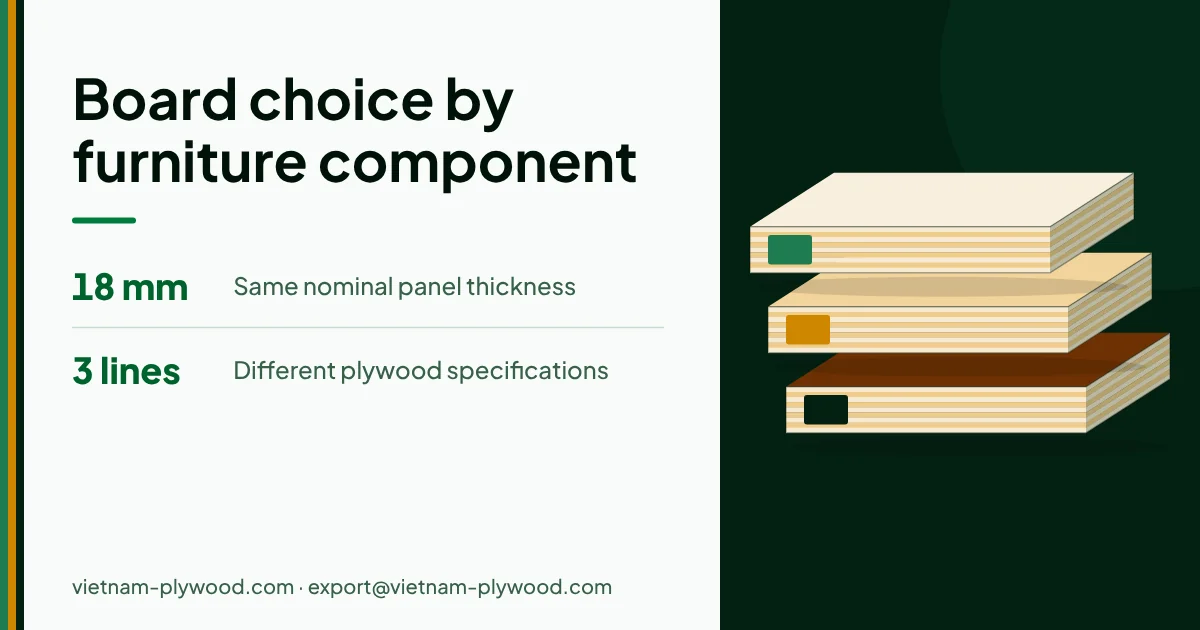
Plywood earns its higher price over chipboard in furniture parts that need strong joints, longer spans or repeated handling. Choosing the wrong board can turn an apparent saving into rejected components, repairs and delayed shipments. HCPLY compares plywood vs chipboard by carcass, shelf, floor deck and packing base, with specifications that importers and furniture makers can inspect before committing to a load.
What is the difference in plywood vs chipboard?
Plywood vs chipboard starts with construction: plywood bonds wood veneers in alternating grain directions, while chipboard presses particles and resin into a uniform panel. Veneer continuity gives plywood an advantage for repeated fasteners and demanding spans. Particleboard can be a sensible purchase for dry, supported, low-stress furniture components. The correct comparison is the specified assembly, rather than the panel name alone.
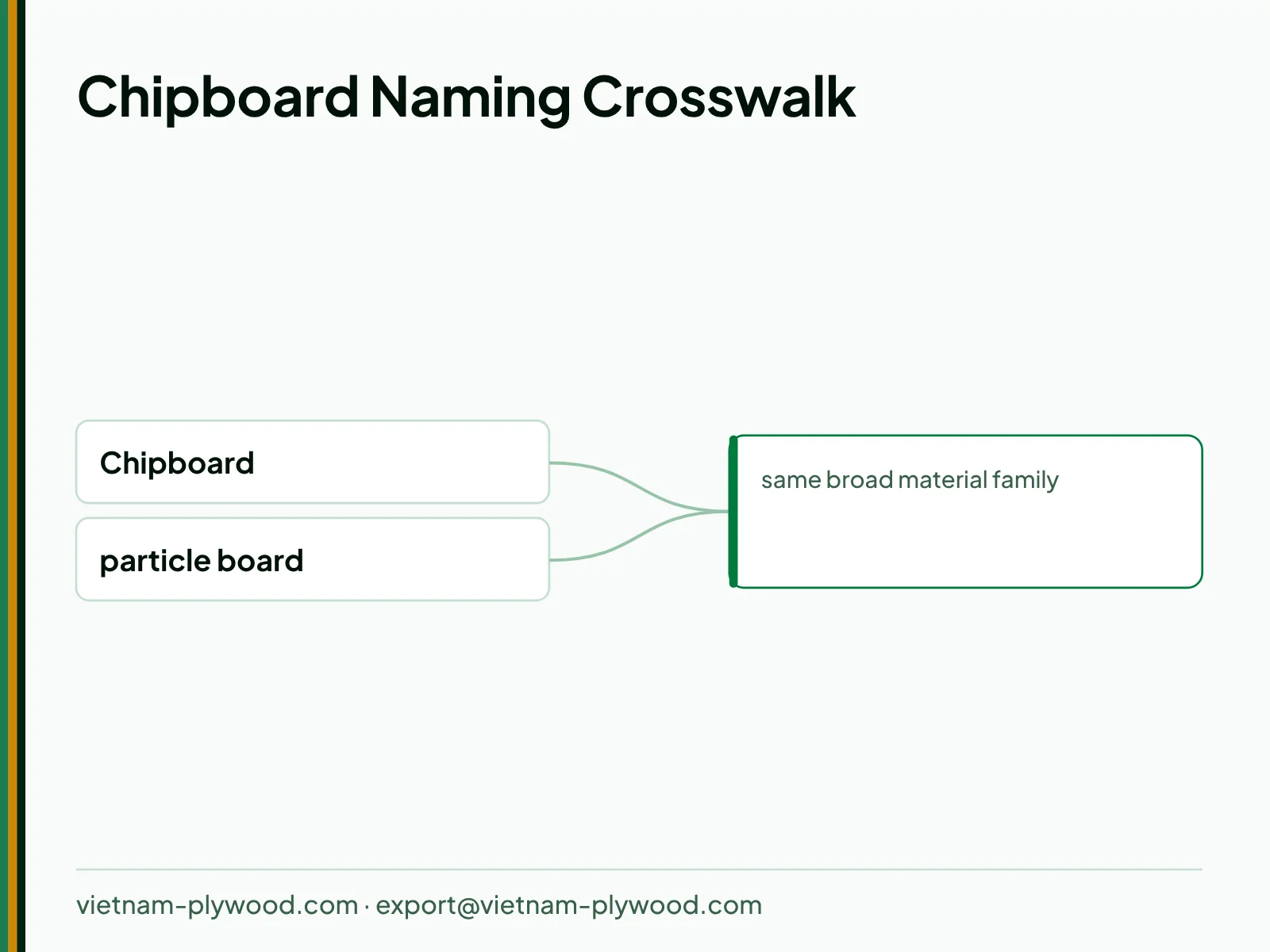
Chipboard and particle board are names for the same broad material family. Neither is medium-density fibreboard (MDF), which uses refined wood fibres. Melamine-faced chipboard (MFC) describes a surface finish over particleboard; a melamine surface does not turn the substrate into plywood. Our engineered wood terminology and MFC versus melamine plywood comparison separate substrate from finish.
HCPLY does not press chipboard, MDF, oriented strand board (OSB), or blockboard. We make veneer-core plywood on our furniture line, our commercial and packing line, and our construction line. A purchaser comparing particleboard with plywood should obtain a particleboard offer separately and evaluate both against the same drawing.
Which material wins each furniture application?
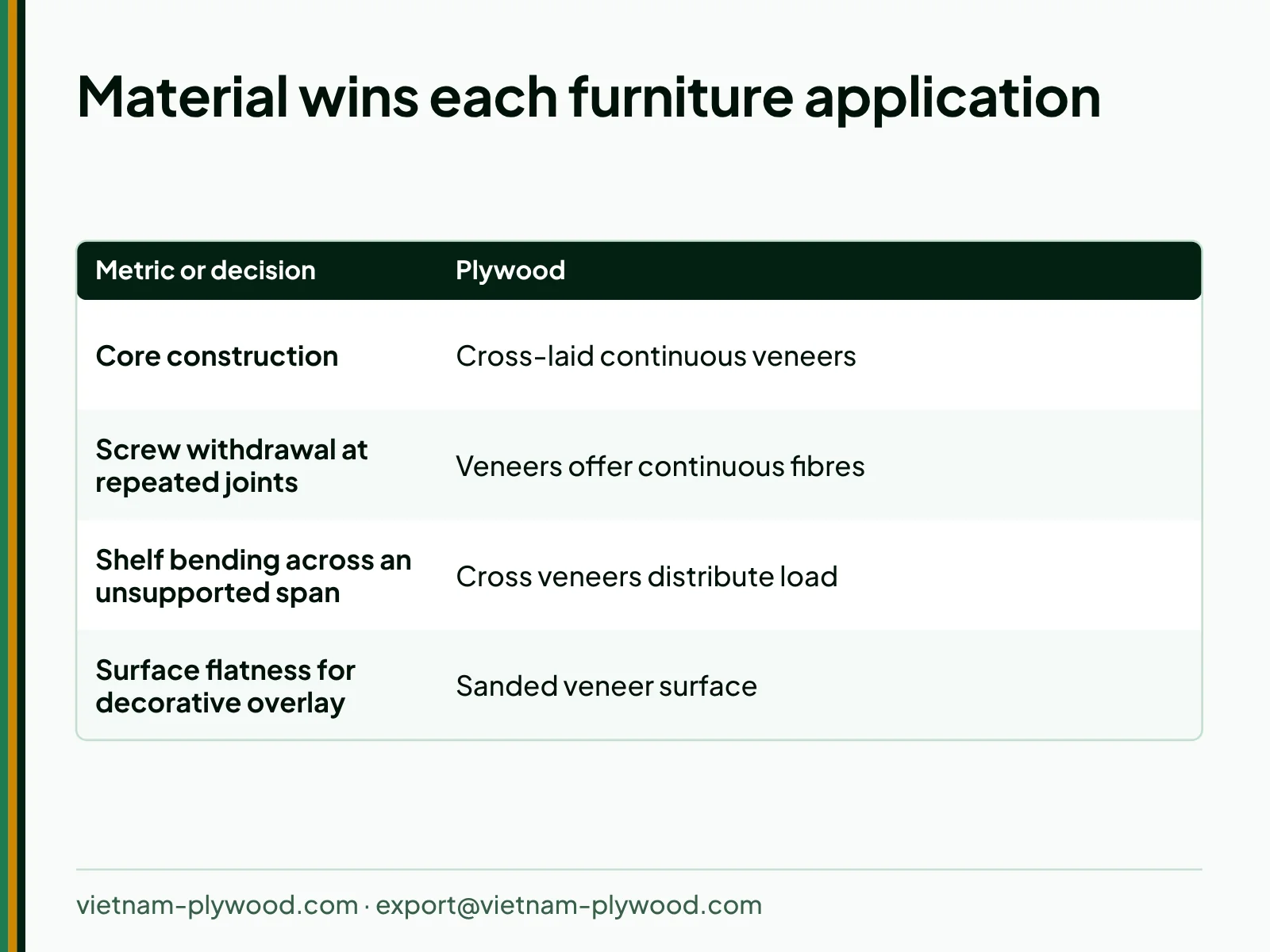
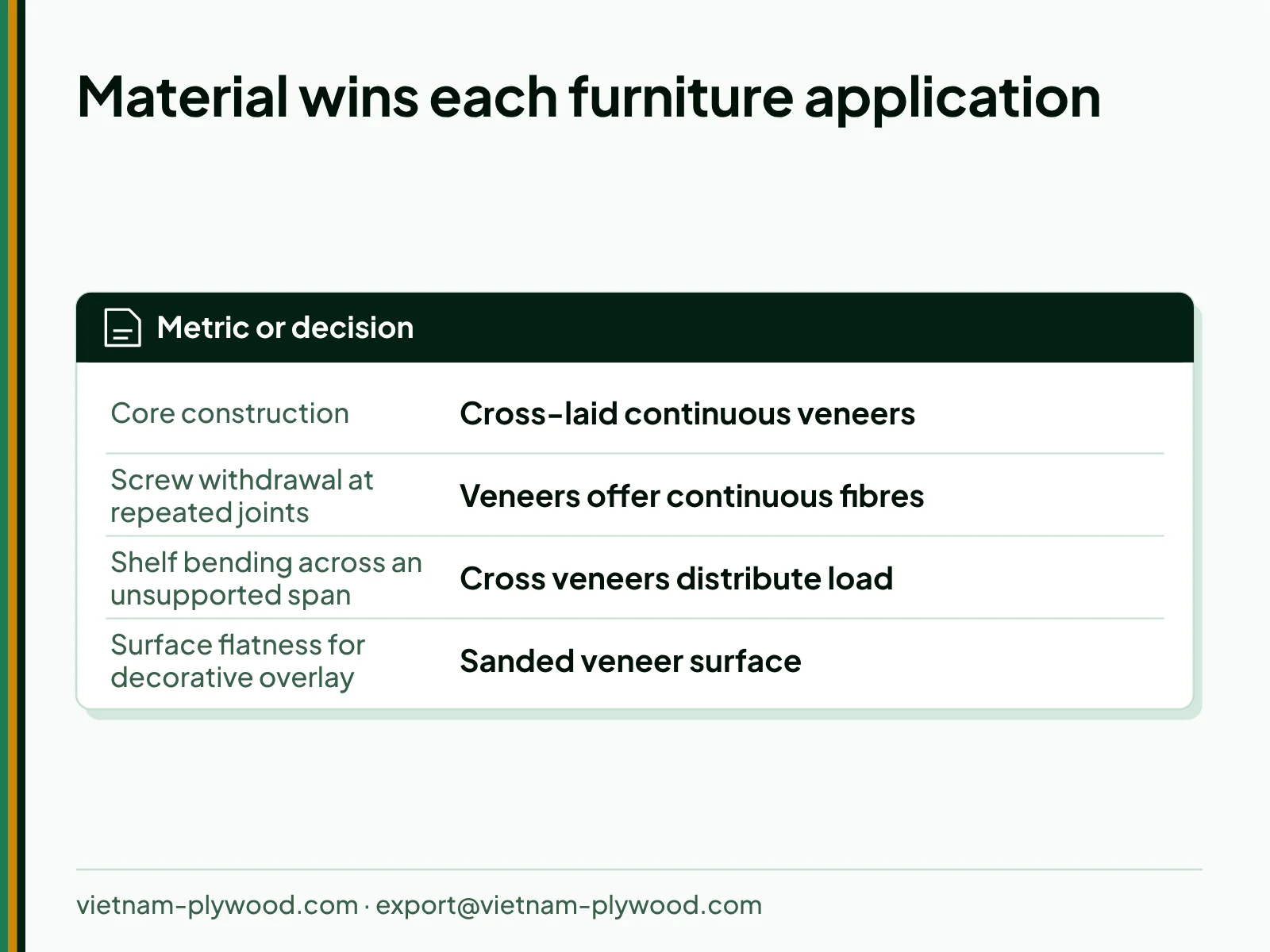
The table compares performance mechanisms and purchase decisions. A result is conditional on panel grade, support spacing, fastener layout and exposure; a single universal strength ranking cannot replace a design test.
| Metric or decision | Plywood | Chipboard / particleboard | Verdict by use |
|---|---|---|---|
| Core construction | Cross-laid continuous veneers | Bonded particles | Plywood for loaded edges and joints |
| Screw withdrawal at repeated joints | Veneers offer continuous fibres | Particle edges can crumble after refastening | Plywood for hinges and serviceable carcasses |
| Shelf bending across an unsupported span | Cross veneers distribute load | Deflection can become the limiting factor | Plywood for long or heavily loaded shelves; test both |
| Surface flatness for decorative overlay | Sanded veneer surface | Uniform particle surface | Chipboard for dry, fully supported covered panels |
| Moisture at exposed cut edges | Bond and veneer quality still matter | Edge swelling can be pronounced | Specified plywood for foreseeable damp handling |
| Panel purchase cost | More veneer preparation and layup | Often lower manufacturing cost | Chipboard for price-led dry components |
| Floor-deck duty | Requires a verified floor design | Requires a verified floor design | Neither without load, span and applicable grade evidence |
| Packing-base fasteners | Veneer layers accept mechanical joints | Edge damage can limit reuse | Packing plywood for fastened export bases |
| Shipment mass | Depends on core density and thickness | Depends on actual supplier density | Compare weighed panels, not names |
A furniture carcass with frequent hinge adjustments has a different duty from a fixed wardrobe back. For more detail on the plywood and MDF distinction, compare fibreboard separately rather than treating all composite panels as chipboard.
Is chipboard stronger than plywood?
For typical furniture fastening and bending applications, suitable plywood often has the advantage, but “stronger” needs a named test. Compare bending strength, stiffness, screw withdrawal and edge integrity separately. The tested thickness, span, loading direction and moisture conditioning must match the intended component.
A shelf can fail a serviceability requirement by sagging long before it breaks. A hinge rail can fail through screw withdrawal even when its panel remains flat. Cross-laid veneers help distribute these loads; particleboard can still work when brackets, inserts or short spans remove the limiting stress.
Ask suppliers for test methods and representative results for the actual grades being purchased. Do not substitute a generic strength number from an unrelated board for the specified production lot.
Which carcasses and shelves justify plywood?
Plywood earns its premium where the joint, span or repair cycle has a real cost. Specify it for heavily loaded shelving, narrow screw-bearing strips, frequently adjusted hinges and cabinets exposed to transport knocks. A fully supported dry divider, drawer bottom or non-load-bearing back can remain particleboard when the furniture design permits it.
For our furniture line, an 18 mm sanded styrax-core or eucalyptus-core panel can be specified with full stitched construction. Styrax core density is 500 kg/m³; eucalyptus core density is 650 kg/m³. The ordered sanded thickness tolerance is ±0.2 or ±0.3 mm. These are manufacturing specifications, not measured shelf-load ratings.
Compare the assembled cost of brackets, edge sealing, rejected components and service visits. A higher board invoice can still lower the cost of a cabinet whose joints must survive repeated handling. For a static, low-load dry panel, that premium can remain unnecessary.
How do screw holding and moisture change the decision?
Screw performance depends on thread engagement, edge distance, pilot hole, loading direction and the number of removal cycles. Plywood veneers offer a continuous-fibre path around many fasteners; chipboard edges can shed particles when a screw is repeatedly removed. For either board, a proper insert or redesigned joint can outperform a poorly placed direct screw.
Water exposure must be described as an event: condensation in a container, a wet cut edge, cleaning splash or prolonged saturation. A moisture-resistant adhesive does not make a panel waterproof. At our furniture line, melamine MR glue is described by a 12-hour boil condition; phenolic WBP glue is described by a 72-hour boil condition. Neither figure is a promise of unrestricted wet service.
Seal cut edges, record edge-swelling acceptance criteria and inspect after the intended conditioning. Keep glue performance separate from formaldehyde emissions: E0, E1 and E2 are emission classes, whereas MR and WBP describe adhesive systems.
What would our three production lines build?
Our three factories build different plywood specifications for the same nominal thickness. The producing factory follows the order drawing and is where buyers inspect the goods. HCPLY coordinates the specification, on-site quality control, export papers and loading.
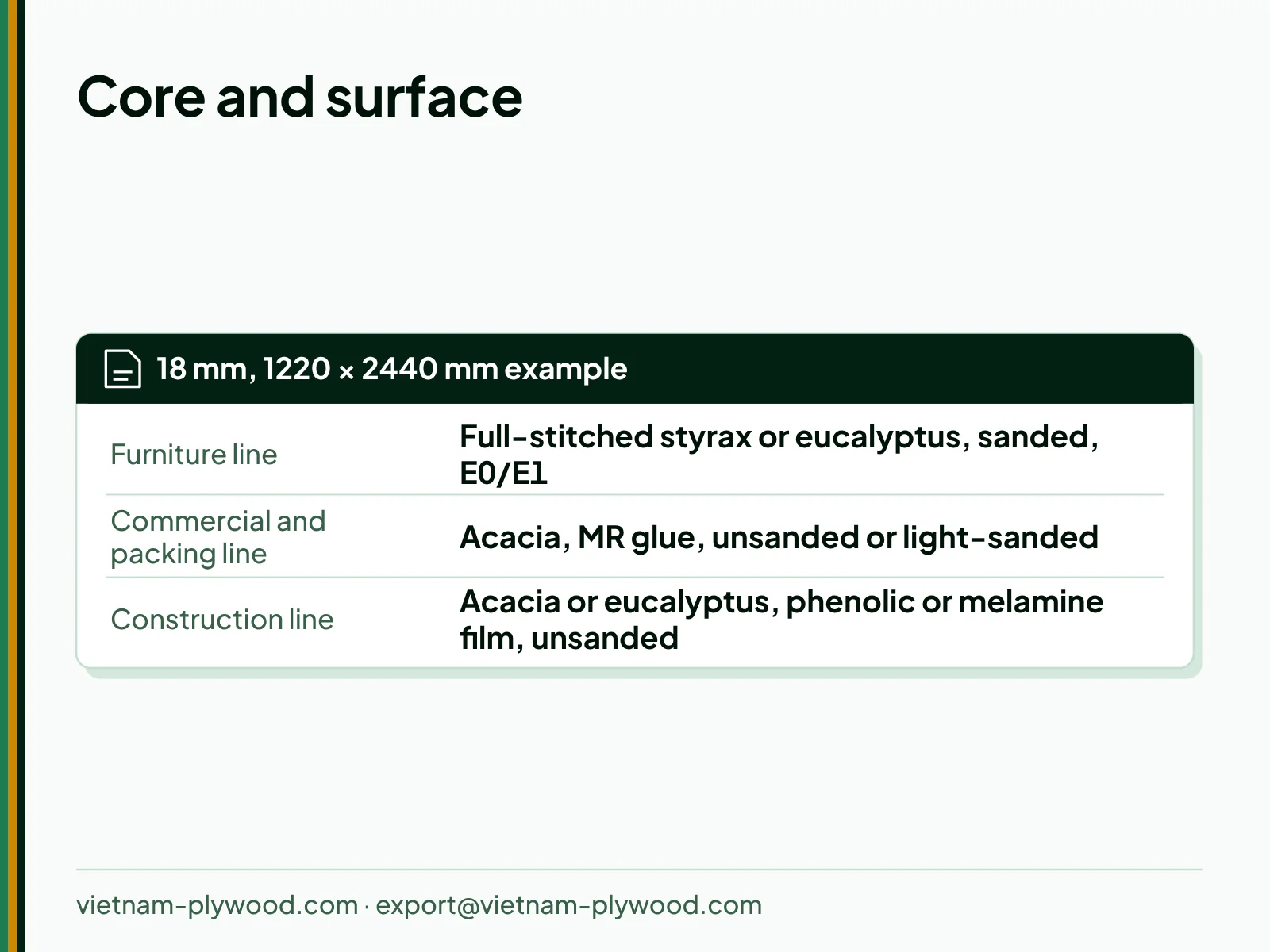
| 18 mm, 1220 × 2440 mm example | Core and surface | Thickness tolerance | Appropriate comparison |
|---|---|---|---|
| Furniture line | Full-stitched styrax or eucalyptus, sanded, E0/E1 | ±0.2 or ±0.3 mm as ordered | Cabinet carcass or visible furniture component |
| Commercial and packing line | Acacia, MR glue, unsanded or light-sanded | ±0.5 mm; packing ±0.5–1.0 mm | Packing base or concealed industrial panel |
| Construction line | Acacia or eucalyptus, phenolic or melamine film, unsanded | ±0.5 mm | Specified formwork or deck application |
The construction line can use 120 g/m² standard film, 135 g/m² premium film or 220 g/m² anti-slip film. Those film weights describe faces, not the strength of a structural floor. The manufacturer overview explains the available plywood categories; the multiple plywood types page covers coordinating different builds.
Is plywood or chipboard better for flooring?
For flooring, choose only after the designer defines the span, support system, loading, moisture class and applicable local requirements. Plywood can offer useful fastener retention and bending performance, while a correctly graded particleboard flooring panel can suit a protected, engineered floor system. Neither material name by itself establishes structural suitability.
A furniture plywood specification is not automatically a structural flooring grade. Ask for an accepted test report before describing any HCPLY build as structural. For industrial walkways or removable decks, specify surface slip resistance, edge protection and fastener details as separate acceptance items.
The installation team should check joist spacing, joint support, expansion allowance and the manufacturer’s fastening schedule. Squeaks arise from movement and connection details as well as panel selection; no panel can independently eliminate them.
How does chipboard vs plywood cost compare?
Chipboard usually starts with a lower panel manufacturing cost because particles can be pressed without peeling, grading and laying up multiple veneers. Within plywood, a full-stitched sanded furniture build costs more to prepare than a less-finished packing build; decorative face selection and tighter tolerances add processing. The largest price drivers are core construction and quality, adhesive and surface specification, then thickness, dimensions and order mix.
HCPLY’s indicative starting prices are from US$250/m³ FOB Hai Phong (October 2026) for commercial plywood and from US$350/m³ FOB Hai Phong (October 2026) for furniture plywood. These are starting points for different builds, not a matched chipboard-versus-plywood quotation. We do not publish a chipboard price because we do not manufacture it.
For a fair bid, request equal sheet dimensions, delivered terms, edge-treatment requirements and acceptable defects. Compare cost per usable component, including cutting yield, fastening hardware, replacement allowance and freight. A cheaper board per cubic metre can cost more per accepted cabinet when joint failures create rework.
What changes when panels ship by container?
Weight changes the commercial decision even when both bids quote identical nominal thickness. For 18 mm, 1220 × 2440 mm plywood, the specified styrax-core sheet weighs 26.79 kg; acacia-core weighs 31.08 kg; eucalyptus-core weighs 34.83 kg. These figures exclude film weight and do not describe chipboard.
At the listed full 40HC configurations, styrax takes 990 sheets and 26.52 t, acacia takes 880 sheets and 27.35 t, and eucalyptus takes 795 sheets and 27.69 t. The 40HC payload limit is 28.5 t. Pallet count and stack height also limit the sheet count, so density alone cannot predict the complete load.
Specifications can be mixed in a container within the payload limit, including furniture and commercial plywood builds. A buyer planning mixed carcass panels and packing bases should calculate each pallet’s mass and total mass before approving loading. The container-load calculations cover the full sheet-count question.
What can an inspector witness at the factory?
An inspector can verify the plywood build directly at the producing factory before loading. Agree a sampling plan and acceptance thresholds in the purchase specification, then witness the checks against that written agreement.
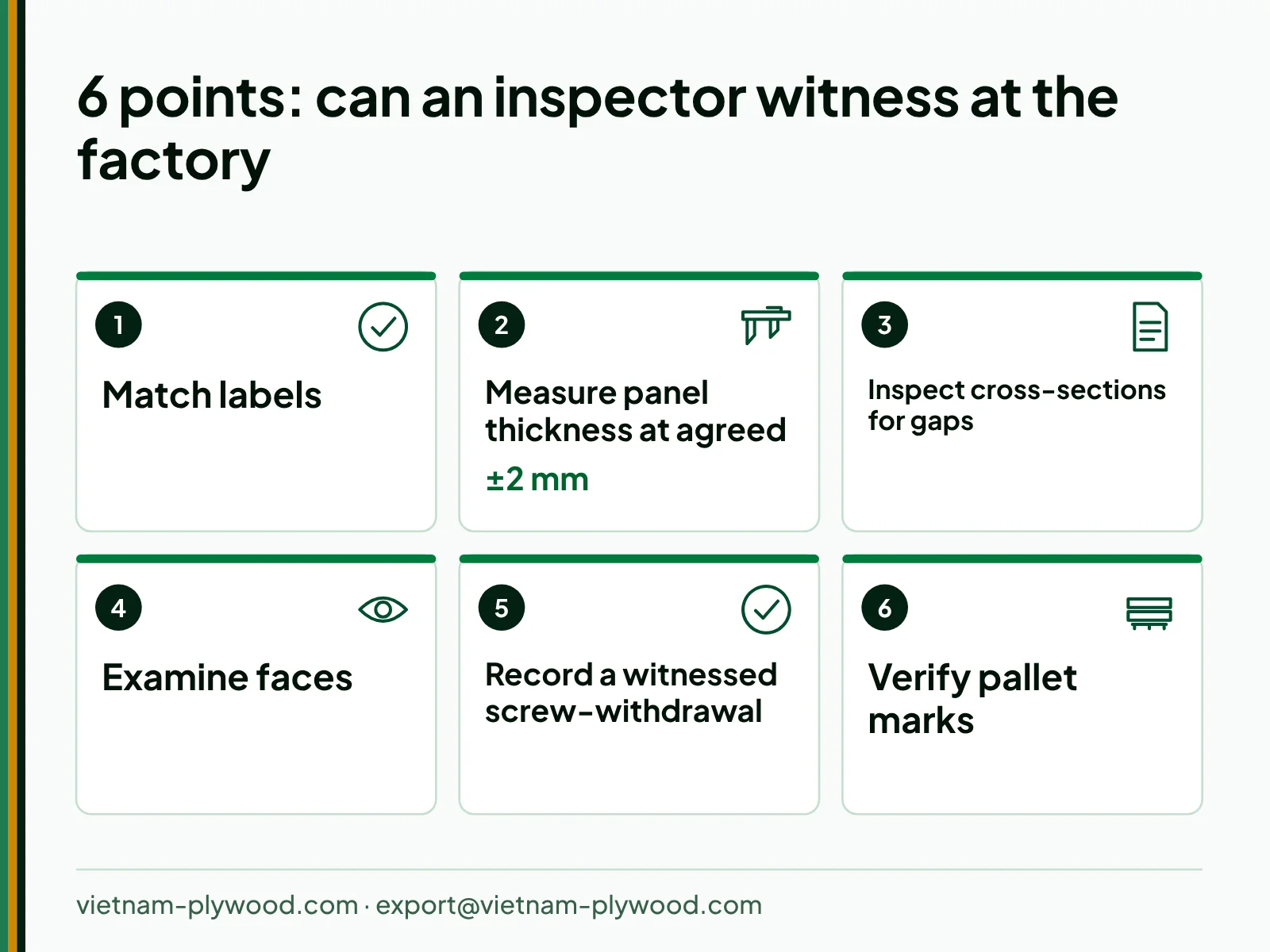
- Match labels, purchase specification and production batch to the intended line and core.
- Measure panel thickness at agreed positions and check length and width against the ±2 mm size tolerance.
- Inspect cross-sections for gaps, overlaps and the ordered stitched-core construction.
- Examine faces, edges and sanding quality against the agreed face grade and defect limits.
- Record a witnessed screw-withdrawal or conditioning test only when its method and acceptance value were agreed beforehand.
- Verify pallet marks, quantities and loading condition before shipment.
Our furniture line can use bintangor, okoume, engineered veneer or other listed faces, with A/B face grades; birch faces use D/E/F grades. Face veneer is commonly 0.2–0.4 mm. A face name does not identify the core species or establish a mechanical test result.
What emission paperwork belongs with the order?
The United States Environmental Protection Agency (EPA) explains in its 2016 final-rule summary that hardwood plywood, medium-density fibreboard and particleboard fall under the Toxic Substances Control Act (TSCA) Title VI composite-wood framework. The EPA states that the rule established third-party certification for formaldehyde-emission testing and oversight. A purchaser should therefore compare documented emission compliance for the actual regulated panel, rather than infer emissions from the words plywood or chipboard. See the EPA rule summary.
For an HCPLY order, request the producing member factory’s relevant certificate and test report; available FSC, CARB P2, ISO 9001 and CE documents are shown with factory details masked, on request. Any TSCA Title VI requirement must be assessed against the relevant product and accepted third-party evidence. An E0 or E1 designation by itself is not a substitute for that US compliance documentation.
The shipment’s document set includes commercial invoice, packing list, bill of lading (B/L), certificate of origin, phytosanitary and fumigation papers, and the agreed certificate or test documents. EU lots include EUR.1 and the EUTR/EUDR file set; insurance is included under CIF. After loading, the draft shipping documents come to you for approval.
Which specification should a buyer send?
Specify the component duty before choosing the substrate. For dry, supported furniture parts, compare a particleboard bid against the plywood build’s cost per accepted part. For loaded edges, repeated screw adjustment, packing bases and moisture-exposed handling, request plywood samples and inspect the actual joints.
Minimum order is one 40HC. Factory lead time runs 15–45 days from receipt of the 30% deposit; the exact figure depends on order size, line loading and what the contract fixes. The remaining 70% is paid on the scan of the bill of lading, by T/T, or by irrevocable sight L/C. We ship FOB Hai Phong, or CFR (CNF) or CIF to your port.
Send the following lines to Lucy at export@vietnam-plywood.com or through contact. Samples cost nothing: a first-time buyer pays the courier, and that charge comes off the first confirmed order.
Application: cabinet carcass / loaded shelf / floor deck / packing base
Line or core: furniture styrax or eucalyptus / commercial acacia / construction acacia or eucalyptus
Glue: melamine MR or phenolic WBP
Emission: E0 / E1 / E2; destination-specific evidence requested
Face and grade: [species or matt] / [A/B, or birch D/E/F]
Thickness and tolerance: [mm] / [ordered tolerance]
Size: [mm × mm]
Quantity: [sheets and proposed pallet mix]
Destination port: [port, country]
Ask Lucy for a sample set matching the actual carcass, shelf or packing-base specification.