





Plywood sales contract terms should turn each approved panel specification into a measurable delivery and acceptance obligation. A wrong tolerance, inspection trigger or document instruction can cost money, days or a rejected load. HCPLY writes the production schedule around the actual line, then connects factory inspection, packing records and shipping documents to that schedule.
What should a plywood sales contract include?
A plywood sales contract should identify the parties, approved panel specification, quantity, price basis, packing, inspection point, claim procedure, payment triggers and delivery rule. Attach a signed specification schedule and state which document controls when a purchase order conflicts with the accepted quotation. A shipment should be judged against that schedule.
For HCPLY, the cost of an ambiguous clause can be a rejected load, delayed document release or disputed replacement. A buyer ordering cabinet panels needs different acceptance criteria from a buyer ordering formwork panels. Put those criteria in the signed schedule before production starts.
Use this order of review: identify the goods; define acceptable variation; allocate inspection; record how defects are evidenced; settle payment and shipping; then agree remedies and governing rules. The Buying Guides collection covers related purchasing decisions, while the import process covers the wider shipment sequence.
A practical plywood contract template should have a separate product line for each build. Avoid treating a commercial panel and a sanded furniture panel as interchangeable merely because both are described as 18 mm plywood.
How should the product and grade schedule be written?
Write each line as a measurable build: application, producing line, core species, core construction, face species and grade, glue system, emission class, nominal thickness, tolerance, dimensions, finish and quantity. Include the accepted reference sample or approved photograph set, and state whether acceptance uses that sample or the written grade criteria if they differ.
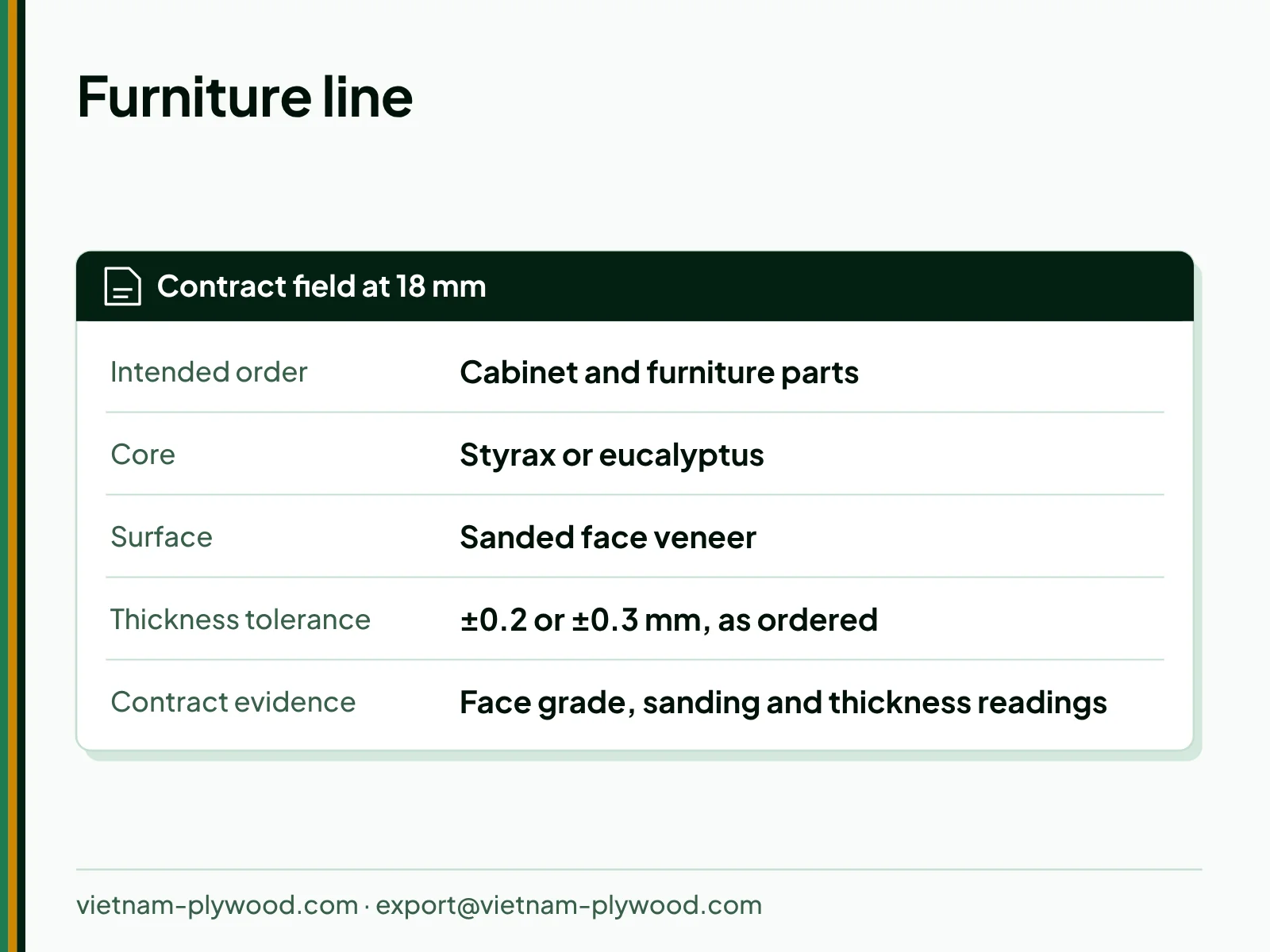
A product is named by its face. Thus a birch-faced panel can have a styrax or eucalyptus core; the face name alone does not establish density. For our furniture line, full-stitched, sanded panels use styrax or eucalyptus core and E0/E1 emission classes. Our commercial and packing line uses acacia core with moisture-resistant (MR) glue and an unsanded or light-sanded surface. Our construction line presses film-faced panels with acacia or eucalyptus core.
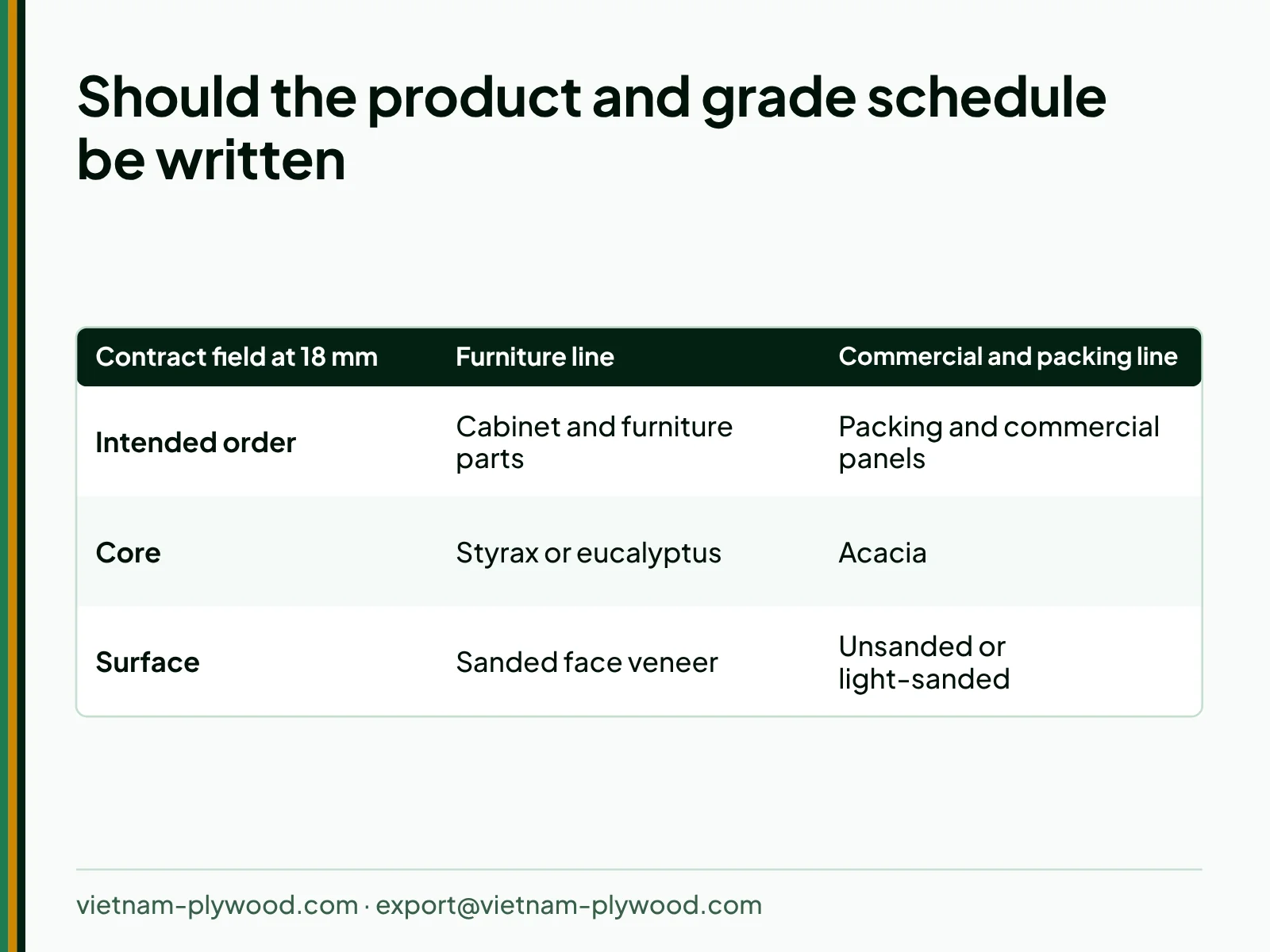
| Contract field at 18 mm | Furniture line | Commercial and packing line | Construction line |
|---|---|---|---|
| Intended order | Cabinet and furniture parts | Packing and commercial panels | Formwork panels |
| Core | Styrax or eucalyptus | Acacia | Acacia or eucalyptus |
| Surface | Sanded face veneer | Unsanded or light-sanded | Phenolic, melamine or anti-slip film |
| Thickness tolerance | ±0.2 or ±0.3 mm, as ordered | Commercial ±0.5 mm; packing ±0.5–1.0 mm | ±0.5 mm |
| Contract evidence | Face grade, sanding and thickness readings | Core and edge condition, packing count | Film weight, surface and thickness readings |
The table is a contract-choice comparison, not an invitation to substitute lines after signing. A cabinet buyer should select the furniture specification; a packing buyer should specify the commercial or packing build; a formwork buyer should specify film type and handling requirements. Compare grades across factory lines before writing the purchase order.
State face grade as A/B where applicable; birch faces use D/E/F. The commonly specified face veneer thickness is 0.2–0.4 mm. Film-faced orders should name 120 g/m² standard film, 135 g/m² premium film or 220 g/m² anti-slip film. Do not replace a film-weight clause with a vague description such as heavy-duty finish.
Specify glue and emission separately. Melamine glue is MR with a 12-hour boil designation; phenolic glue is water-and-boil-proof (WBP) with a 72-hour boil designation. E0, E1 and E2 are emission classes, whereas CARB P2 / TSCA Title VI concerns a US emission limit and third-party certification. For certificate-backed orders, list the exact certificate documents and accepted test report in the schedule. Member-factory FSC, CARB P2, ISO 9001, CE and EUTR/EUDR documents are shown with factory details masked, on request.
How should thickness tolerance be written into a plywood contract?
Write the nominal thickness and the allowed measured range together, then identify the inspection method and the point where measurements are taken. For a sanded 18 mm furniture order with ±0.2 mm tolerance, the agreed range is 17.8–18.2 mm. A commercial 18 mm order with ±0.5 mm tolerance uses 17.5–18.5 mm.
The thickness clause should state the measurement tool, panel condition, edge offsets, sample selection and treatment of individual out-of-range readings. Agree these procedural details in writing rather than assuming that every inspector follows the same sampling plan. Length and width tolerance is ±2 mm; list nominal sheet dimensions independently from thickness.
Available formats include 1220×2440, 1250×2500, 1220×2135, 1220×1830, 915×2440, 915×2135 and 915×1830 mm, with custom cutting available. The specified size belongs on the order line, pallet label and inspection sheet. A 1220×2440 mm order cannot be accepted against a 1250×2500 mm schedule merely because the nominal thickness matches.
Ply count should be recorded only where it is part of the agreed build. At 18 mm, the construction has 11–13 plies because core veneer thickness is 1.4–2.0 mm. A contract demanding an exact count should therefore make that count an express production requirement and connect it to an approved cross-section sample.
What packing and quantity terms belong in the purchase order?
State whether quantity is priced by sheets or cubic metres, the conversion basis, pallet count, pallet marks and the accepted quantity variance. Do not import a tolerance for short or excess delivery from another supplier’s conditions. Write the permitted variance expressly, or require the signed quantity.
Our minimum order is one 40HC, and one container can carry several specifications as long as the payload limit holds. The 40HC payload limit is 28.5 t. For 18 mm 1220×2440 panels, the full-container lookup is 990 styrax sheets at 26.52 t, 880 acacia sheets at 27.35 t, or 795 eucalyptus sheets at 27.69 t. These are different full-container examples, not additive quantities.
For a mixed order, calculate each proposed component’s sheet count, volume and weight, add the component weights and keep the combined total within 28.5 t. For instance, a buyer can specify styrax furniture sheets and acacia packing sheets in separate schedule rows, then approve a loading plan with a summed payload. Pallet configuration and loading sequence must also fit the container; weight arithmetic alone does not establish physical fit. See container loading calculations for the full-load reference.
Require pallet labels to show the contract line, thickness, size, face and grade, sheet count and pallet sequence. State how broken packaging, water exposure and damaged edges are photographed before unloading. The packing list should mirror the physical labels, with discrepancies corrected before the draft documents are approved.
Where should the inspection point be fixed in a plywood contract?
Fix the primary inspection at the producing factory before loading, and identify who may witness it and sign the record. HCPLY arranges on-site quality control; buyers can visit the factory office and inspect goods where the order is produced. Each order is made at the factory matched to its specification and shipped directly from that factory.
The contract should define inspection notice, sampling plan, instruments, lot identification, pass/fail thresholds, photographs and the sign-off authority. An inspection appointment is useful only when the contract also says what happens if the buyer or nominated inspector does not attend. Specify whether the seller proceeds with a documented inspection or waits for revised instructions.
A furniture inspection can witness face grading, sanding, caliper readings and the condition of stitched core at an agreed cut sample. A packing inspection can witness pallet count, edge construction and surface finish. A film-faced inspection can witness film description, face condition, thickness and edge treatment. All findings should refer back to the signed build schedule.
Record the pre-loading state separately from arrival damage. Photographs of closed pallets and the loading sequence establish the condition presented for shipment. Arrival photographs then help distinguish apparent transit damage from an alleged manufacturing defect. The buyer’s independent inspector should have access to the approved schedule before attending.
How are quality claims written into a plywood contract?
A claims clause needs a defined notice trigger, negotiated claim window, evidence checklist, inspection opportunity and agreed remedies. The claim window should distinguish visible arrival damage from defects found during normal processing. State when each clock begins and whether written notice preserves a claim while supporting evidence is gathered.
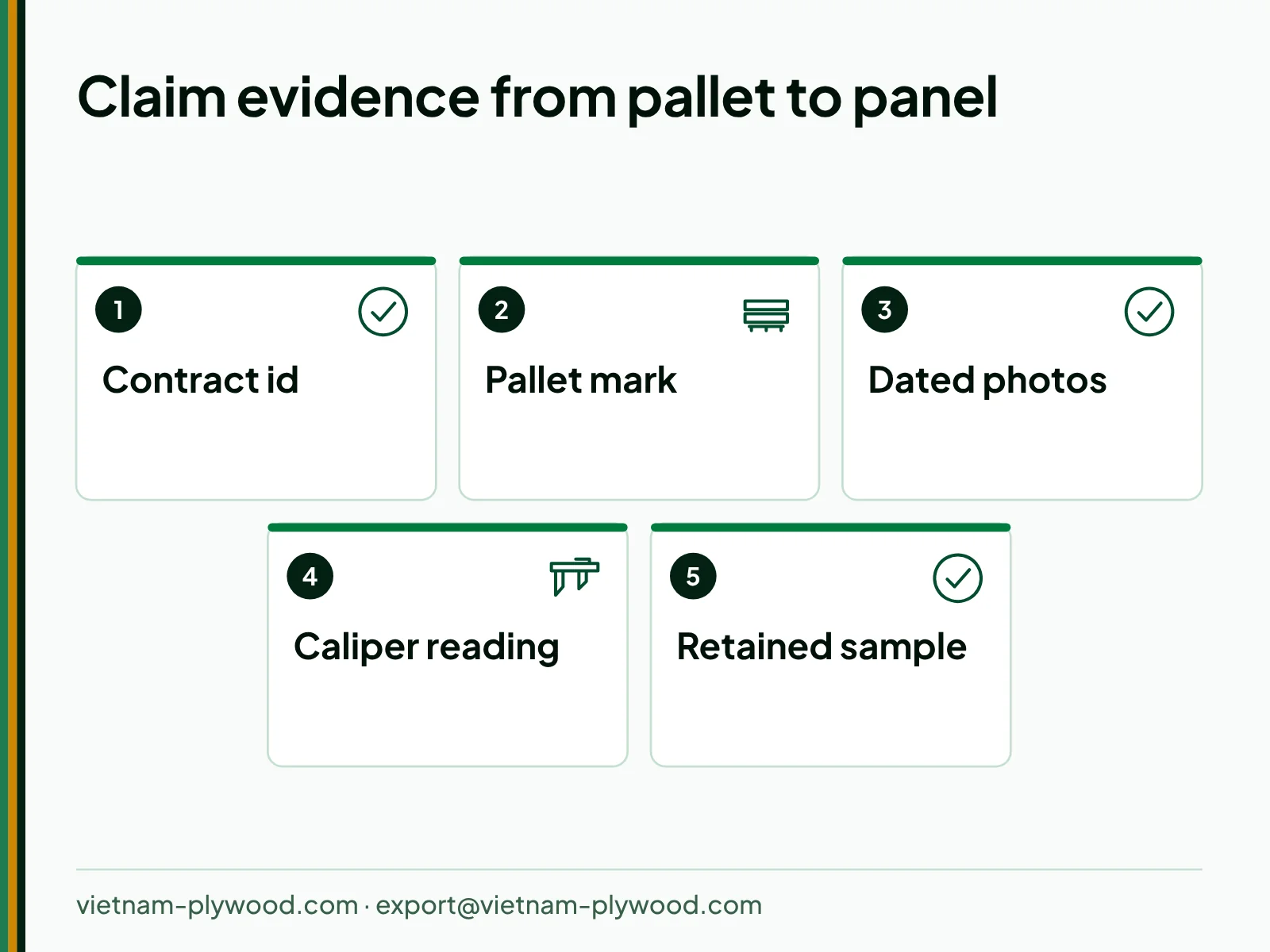
Do not copy another seller’s notice period as though it were a universal plywood rule. A signed plywood purchase contract can use an agreed window for apparent damage and a separate process for concealed defects. The exact periods, response time and final remedy should be negotiated and inserted into the executed agreement.
For grading disputes, compare the delivered faces with the agreed A/B or D/E/F criteria and reference sample. For thickness, compare actual readings with the stated range. For glue or emission disputes, identify the agreed test method, laboratory, sample custody and accepted test report before assigning responsibility.
A remedy schedule can specify sorting, replacement, credit or another mutually accepted resolution. It should also allocate testing expense when a claim is substantiated or rejected, describe salvage handling and state whether the buyer may process unaffected panels. Avoid automatic destruction or disposal before the parties have a documented chance to inspect.
Which payment milestones should the contract state?
Write the deposit trigger, production interval, balance trigger, accepted payment instrument and document-release sequence as explicit milestones. Our production period is 15–45 days from the 30% deposit, set by order size, line loading and the contract. The balance is 70% against the scanned bill of lading (B/L), by telegraphic transfer (T/T) or irrevocable letter of credit (L/C) at sight.
Describe the milestones in chronological order: signed specification and order; deposit received; production and inspection; loading and scanned B/L; balance payment or L/C document presentation; shipping-document release. For a documentary credit, the credit text and documentary requirements must match the agreed shipping schedule before production proceeds.
Write the consequence of a delayed deposit, a buyer-requested specification change or an unresolved inspection hold. Also identify who authorizes an amendment to the shipping date and how revised costs are agreed. A contract can address these contingencies without inserting invented penalty rates or fixed compensation amounts.
Samples cost nothing: a first-time buyer pays the courier, and that charge comes off the first confirmed order. Record the sample reference and approval outcome in the contract schedule, rather than treating receipt of a sample as acceptance of every later production lot.
Which Incoterm and destination details should be named?
State the selected delivery rule, named port and Incoterms 2020 edition on the same line. HCPLY offers FOB Hai Phong, cost and freight (CFR, also called CNF), or cost, insurance and freight (CIF). FOB names the loading port; CFR and CIF name the destination port.
The International Chamber of Commerce’s Incoterms and Commercial Contracts explanation of the 2020 rules says that these terms allocate obligations, risk and costs, while leaving product specifications, payment and remedies to the sale contract. Under CFR and CIF, paying freight to the destination does not mean risk transfers at destination. Under CIF, the seller also arranges the required insurance. Read the ICC explanation.
State port of loading, port of discharge, consignee instructions, notification party, shipment window, permitted transshipment and any agreed insurance particulars. A destination port should be written precisely enough for the freight booking and documentary credit. State who supplies import instructions and who approves changes to the shipping marks.
For route planning, sea transit from Hai Phong depends on carrier and route: South-East Asia 5–12 days, Middle East 15–25, US West Coast 20–30, Mediterranean 25–35, Northern Europe 30–40, US East Coast 35–45 and West Africa 35–50. These are sea-transit ranges; the production period and destination clearance are separate stages.
Which export documents should the contract list?
List every required document by name, issuer, recipient and approval stage, then make the invoice and packing list match the signed specification. The US International Trade Administration’s Common Export Documents guidance identifies the commercial invoice as a customs valuation document and the packing list as the record of package counts, weights and marks. See the official export-document explanation.
For HCPLY shipments, specify the commercial invoice, packing list, B/L, certificate of origin, phytosanitary and fumigation papers, and insurance under CIF. Add the order’s certificate documents: any FSC claim on sales documents, emission certificate and test reports for the agreed build. EU lots include EUR.1 and the EUTR/EUDR file set.
The contract should state the exact consignee and notify-party text, invoice description, quantity unit, origin details and document language. If a buyer needs additional original copies, legalization or a particular document presentation format, record that requirement before the goods are loaded.
After loading, the draft shipping documents come to you for approval. Make that review a named milestone, with one authorized buyer contact who returns consolidated corrections. An invoice showing one core species while the packing list describes another creates avoidable clearance questions even when the physical panels are acceptable.
Document accuracy is also a claim-control tool. The signed specification describes what was ordered; the inspection record shows what was examined; the packing list shows what was loaded; the B/L records carriage. These records should use consistent contract and shipment references.
What other legal clauses prevent an order dispute?
Add change control, cancellation, delay notification, force majeure, governing law, dispute forum, confidentiality and an agreed order of precedence. These clauses belong alongside the plywood-specific schedule because a technical pass does not settle every commercial disagreement.
For delay events, define notice content, evidence, mitigation, revised shipment discussions and any agreed termination mechanism. A force-majeure clause should identify the events covered and what happens to deposits, unfinished stock and documents if performance stops. Do not borrow a broad clause without checking its interaction with local law.
A dispute clause should name the governing law, venue or arbitration institution, language and method for serving notices. The parties should obtain legal review of the final wording, especially for cross-border enforcement, limitation of liability and title provisions. A commercial checklist helps structure negotiation; it does not substitute for an executed contract.
What should the buyer approve before signing?
Approve the specification schedule, inspection procedure, claim evidence rules, payment triggers, delivery rule and document list together. A signed price without these attachments leaves the buyer and seller with different ways to decide whether the shipment conforms.
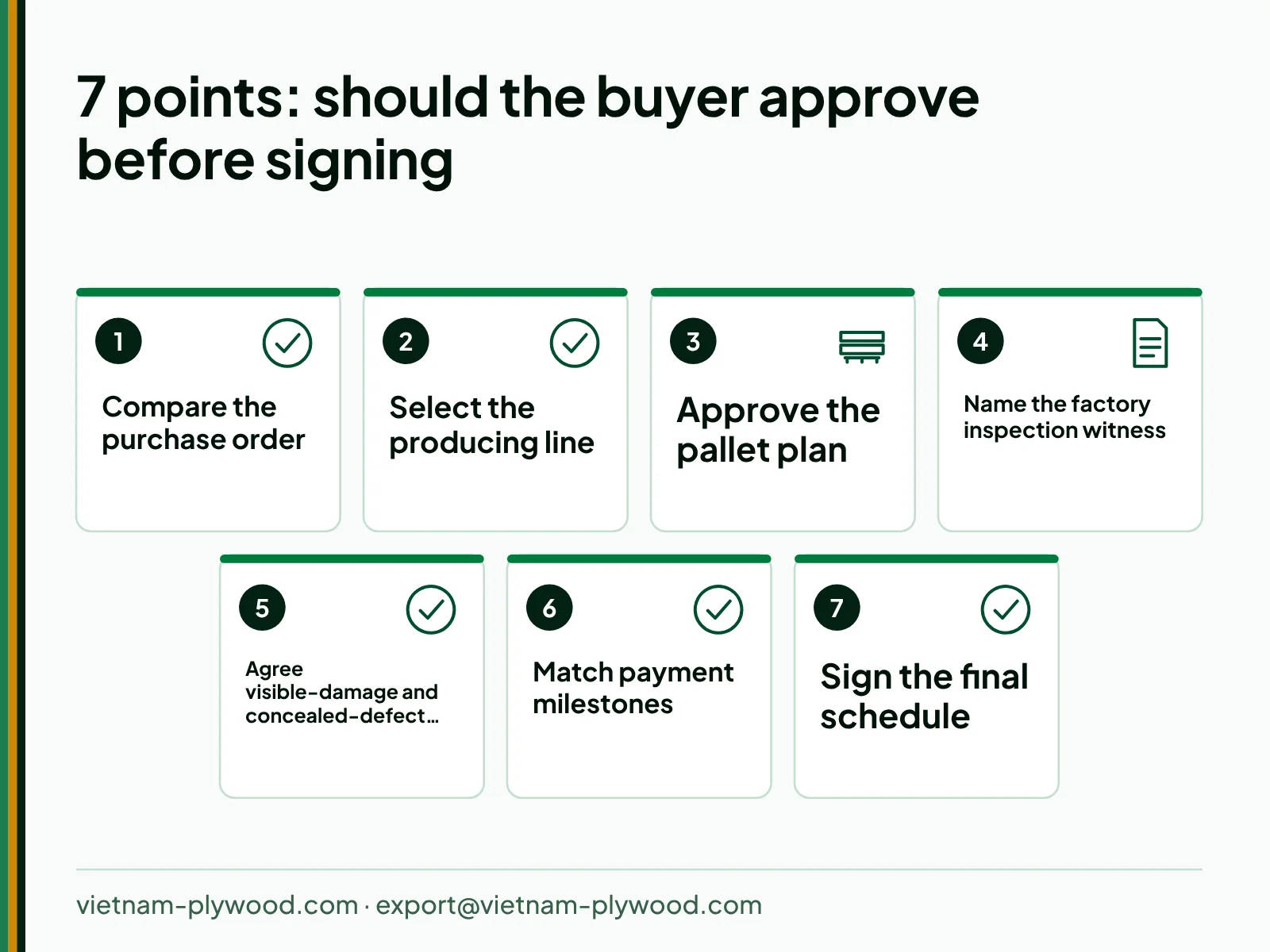
- Compare the purchase order with the quotation and correct every conflicting product field.
- Select the producing line and record core, face, glue, emission, finish and measurable tolerances.
- Approve the pallet plan, quantity unit and mixed-load instructions against the payload limit.
- Name the factory inspection witness, sampling method and pre-loading disposition process.
- Agree visible-damage and concealed-defect notice triggers, evidence and remedy handling.
- Match payment milestones with the selected Incoterm and document-release instructions.
- Sign the final schedule and assign an authorized contact for later amendments.
Our three factories serve different specifications; a furniture order belongs on the furniture line, a packing order on the commercial and packing line, and film-faced formwork on the construction line. The manufacturer overview explains these product families, while packing and commercial plywood gives additional context for that build.
A buyer arranging repeat orders can also review supply programmes for distributors and second-source supplier checks. These discussions help define approval controls without weakening the specific signed terms of the current shipment.
What contract details should go in the first inquiry?
Send a complete written specification with the intended use, shipment quantity and destination port. Lucy at export@vietnam-plywood.com can use it to arrange the relevant sample set and prepare the commercial discussion.
Application: cabinet components / packing / formwork [select one]
Line or core: furniture—styrax / commercial and packing—acacia / construction—acacia [select]
Glue: melamine MR / phenolic WBP [select agreed build]
Emission: E0 / E1 / E2 / agreed US compliance document [select]
Face and grade: species, A/B or birch D/E/F; film weight if applicable
Thickness and tolerance: nominal mm; agreed ± mm
Size: length × width in mm
Quantity: sheets and/or m³; pallet plan; one 40HC minimum
Destination port: named port and country; FOB/CFR/CIF term
Ask for a sample set through the contact page before finalizing the approved reference and signing the purchase schedule.