





A plywood letter of credit fails when its documentary fields conflict with the plywood specification, loading plan or carrier paperwork. A discrepancy can delay payment, trigger bank charges or leave a shipped load waiting for a buyer waiver. HCPLY reviews those fields against the producing factory’s actual order before loading.
What documents should a plywood letter of credit require?
Require only documents that the seller can issue or obtain for the agreed plywood shipment, with their issuers and content stated precisely. The normal working set includes a commercial invoice, packing list and bill of lading (B/L), with origin and regulatory papers added for the destination. A certificate requirement must describe an obtainable document rather than an undefined assurance.
For HCPLY shipments, the export set comprises the commercial invoice, packing list, B/L, certificate of origin, phytosanitary and fumigation papers, plus order-specific certificates or test reports. EU lots use EUR.1 where applicable and the EUTR/EUDR file set; CIF shipments include insurance. After loading, the draft shipping documents come to you for approval.
The credit’s document schedule should distinguish the papers needed for customs from those the bank must examine. A customs requirement does not automatically belong in field 46A. State the document title, issuing party, required copies or originals, signatures and any exact statement. For factory certificates, FSC, CARB P2, ISO 9001 and CE materials belong to member factories and are shown with factory details masked, on request.
The International Chamber of Commerce (ICC), in its 2007 Uniform Customs and Practice for Documentary Credits (UCP 600), Article 5, states that banks deal with documents rather than goods. This makes documentary wording a separate risk from product quality. The U.S. Department of Commerce International Trade Administration, in its 2022 Trade Finance Guide, also warns that discrepancies can defeat payment under a credit; see the official trade finance guide. See the buying guides and the sales contract checklist when preparing the contract before the bank application.
How should plywood be described in a letter of credit?
Describe the ordered plywood in terms that can be reproduced on the invoice without forcing every technical detail onto the B/L. Field 45A should identify the panel type, face and grade, core, glue, emission class, thickness, dimensions and agreed quantity unit. Put the detailed build in the contract and invoice schedule.
For example, a furniture item can read: “Eucalyptus-core plywood, bintangor face A/B, full-stitched core, sanded, 18 mm, 1220 × 2440 mm, E1 emission class, quantity as invoice schedule.” State glue separately from emissions: MR melamine glue and E1 are different characteristics. Do not write “E0 glue.”
For a construction item, identify the film and its weight rather than using an undefined premium label. Our construction line uses phenolic or melamine film, including anti-slip film; standard film is 120 g/m², premium 135 g/m² and anti-slip 220 g/m². An order’s face and core must not be silently interchanged.
The invoice should carry the detailed goods description. Other documents can use a shorter description that does not conflict with it: ICC UCP 600 Article 14(e) distinguishes the invoice from other documents. For more build distinctions, consult plywood manufacturer specifications.
Which factory line determines the document wording?
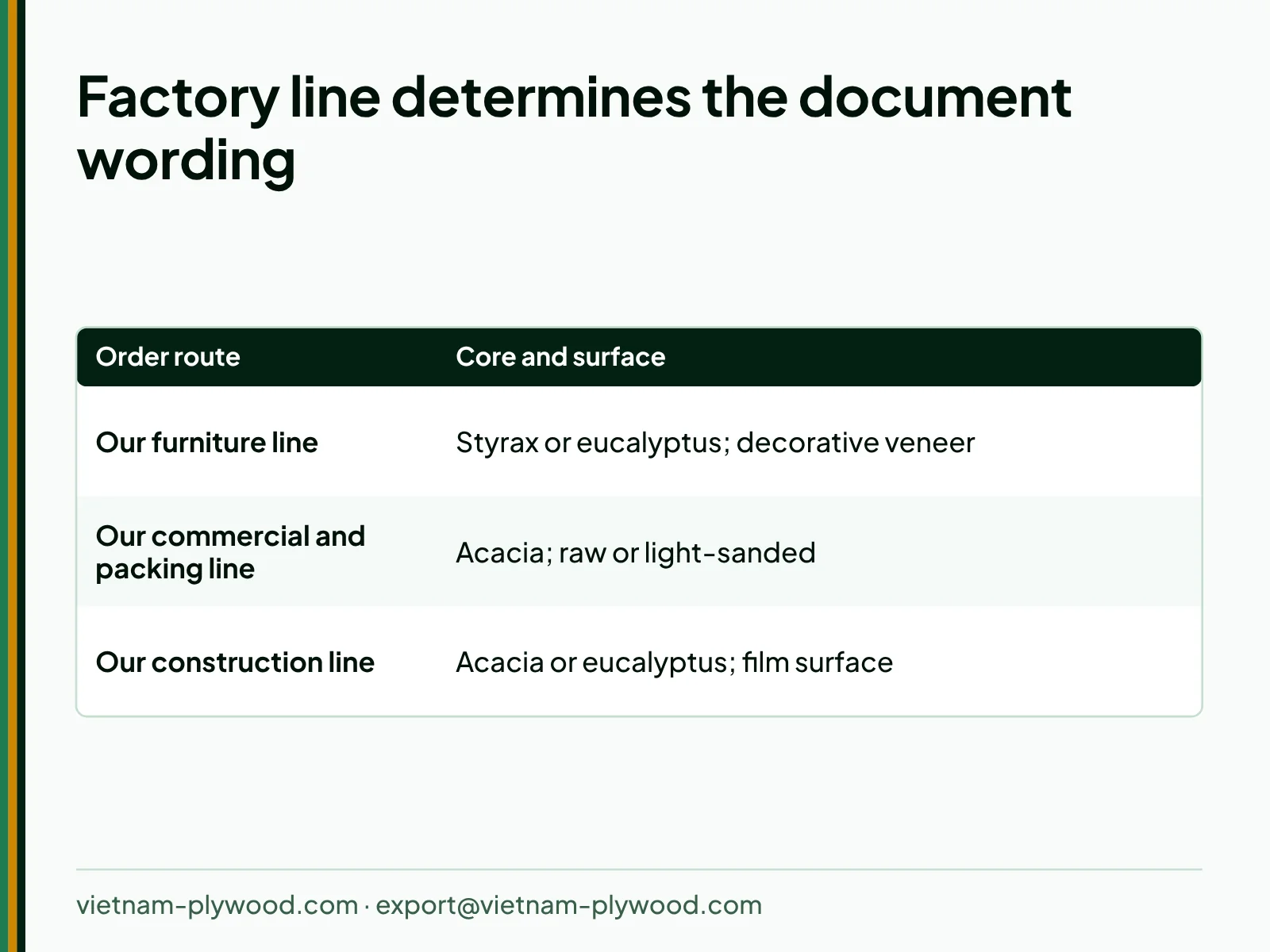
The producing line determines the build fields that appear in the commercial invoice and any inspection record. HCPLY has three factories in Phu Tho and Hai Phong, and each order is produced at the factory matched to its specification. The export team manages specification, on-site quality control, paperwork and loading.
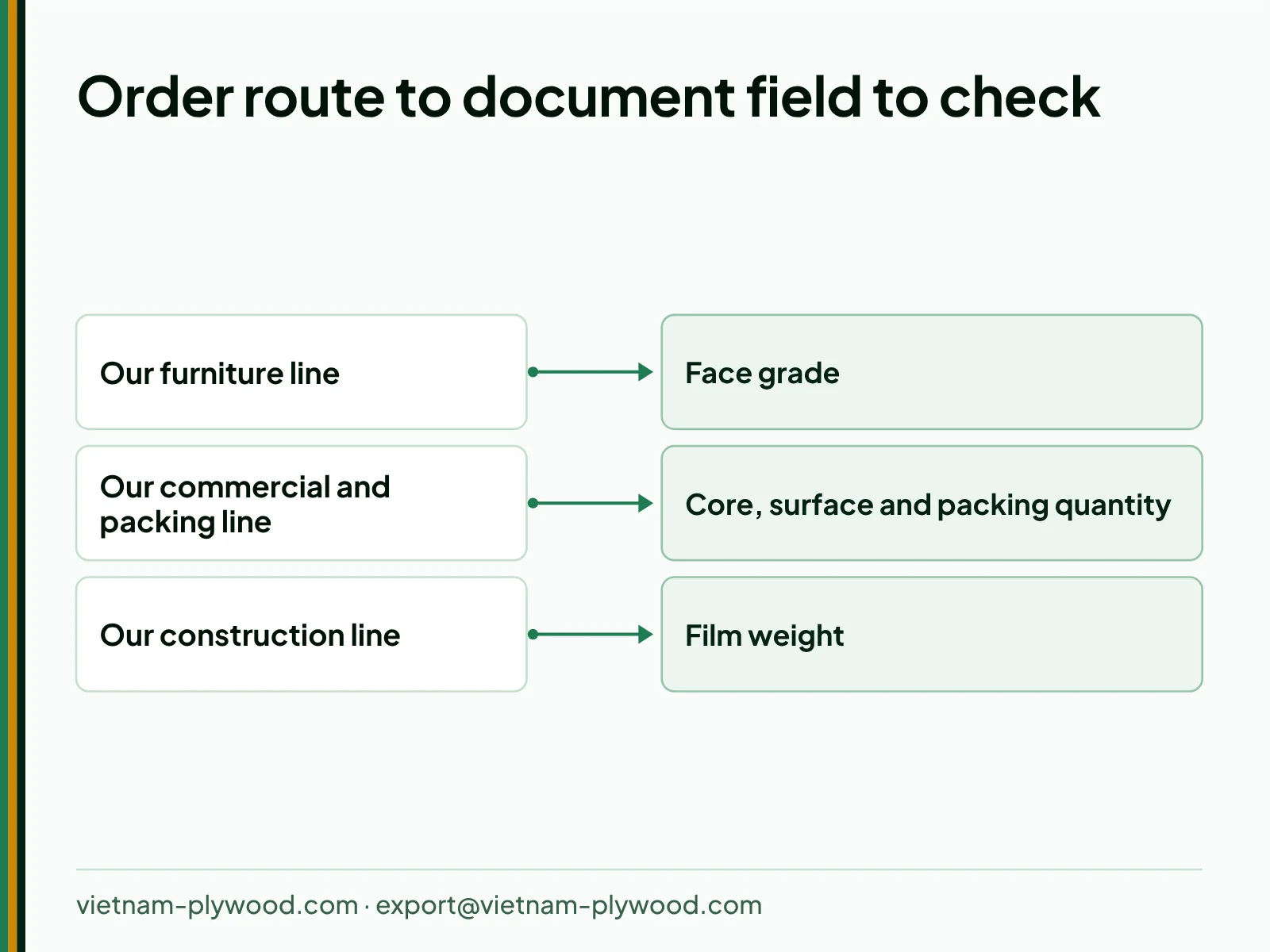
| Order route | Core and surface | Processing and glue | Document field to check |
|---|---|---|---|
| Our furniture line | Styrax or eucalyptus; decorative veneer | Full stitched, sanded; E0/E1 emission | Face grade, emission and ordered thickness tolerance |
| Our commercial and packing line | Acacia; raw or light-sanded | MR glue; unsanded or light-sanded | Core, surface and packing quantity |
| Our construction line | Acacia or eucalyptus; film surface | Phenolic or melamine film; unsanded | Film weight, glue type and film description |
An inspector can witness thickness measurements against the ordered tolerance and match pallet labels to the packing list at the producing factory. Furniture sanded panels use ±0.2 or ±0.3 mm as ordered; commercial and film-faced panels use ±0.5 mm, while packing uses ±0.5–1.0 mm. Length and width tolerance is ±2 mm. The factory-line comparison explains why the same nominal thickness needs different document wording.
What quantity tolerance belongs in m³ or sheets?
Choose the quantity unit that the invoice, packing list and credit can all reproduce. Cubic metres (m³) measure panel volume, while sheet counts identify individual panels. Write an express allowance for each unit if the bank must accept a shipment above or below the contracted quantity.
For 18 mm sheets at 1220 × 2440 mm, a full 40HC reference load is 990 styrax sheets, 880 acacia sheets or 795 eucalyptus sheets. Those reference loads weigh 26.52 t, 27.35 t and 27.69 t respectively; the payload ceiling is 28.5 t. The numbers describe different cores and pallet arrangements, not interchangeable quantity promises. See the container load calculator for the load context.
UCP 600 Article 30(a) interprets “about” or “approximately” as a tolerance up to 10% in the quantity, amount or unit price concerned. Article 30(b) provides a conditional 5% quantity tolerance, but excludes quantities stated as packing units or individual items. A credit saying “880 sheets” should therefore spell out any permitted sheet-count difference instead of assuming the 5% rule applies.
A practical wording pattern is “quantity: [agreed] m³, tolerance [agreed]%; corresponding sheets per attached size schedule.” Where exact sheets matter, state “sheet quantity exact” and reconcile the permitted m³ rounding method with the bank before issuance. Avoid an unqualified combination of exact sheets and a flexible cubic-metre figure.
How should the latest shipment date be set?
Set the latest shipment date against the actual production agreement and carrier loading plan, then leave a separate document presentation window. Our production period is 15–45 days from the 30% deposit, set by order size, line loading and the contract. The L/C must fit the agreed order timetable rather than assume the shortest production period.
Field 44C normally carries the latest shipment date, while field 31D specifies expiry and place. Field 48 can define the presentation period. Under ICC UCP 600 Article 14(c), a presentation with an original covered transport document is normally due within 21 calendar days after shipment and no later than credit expiry, unless the credit changes the applicable period.
Check carrier cut-off, loading, on-board date and the location where the documents will be presented. Article 29(c) says a bank-closure extension of the expiry or presentation deadline does not extend the latest shipment date. An amendment should be arranged before loading when the vessel schedule moves beyond the credit’s shipment limit.
Which B/L clauses create discrepancies?
B/L discrepancies arise when the credit demands transport wording the carrier’s document does not show. Match the named loading and discharge ports, consignee, notify party, freight indication and on-board evidence to the booking before issuing the credit.
For FOB Hai Phong, the shipping arrangement should support the agreed transport document and freight terms. We also offer CFR (CNF) or CIF, but the credit must use the selected term consistently. Under CIF, include the insurance document and agree its coverage wording with the bank.
Review whether the credit permits transshipment and partial shipments, and whether it requires a clean on-board B/L. UCP 600 Article 20 sets the examination rules for bills of lading, including carrier identification, signature and on-board evidence. A requirement for an impossible vessel certificate, unusual consignee statement or carrier-only declaration can block an otherwise completed shipment.
Keep the B/L description shorter than the invoice where appropriate, without conflicting data. Confirm whether the document is an original negotiable B/L or another transport document before writing the bank condition. The importer starting guide covers the commercial steps around shipping arrangements.
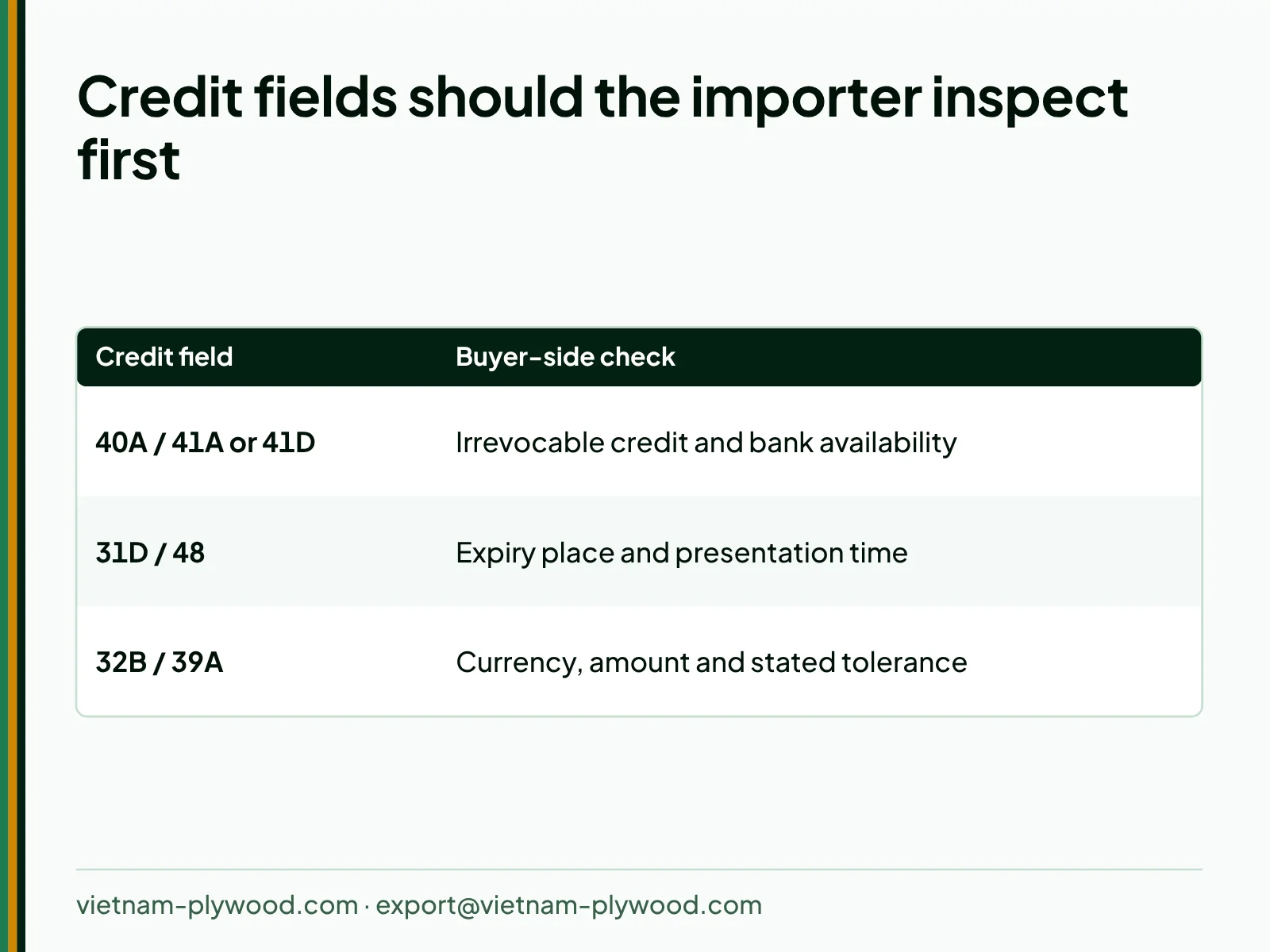
Which credit fields should the importer inspect first?
Read the payment and document fields together before authorising issuance. A credit can name the correct plywood yet contain an incompatible expiry date, beneficiary spelling or document requirement.
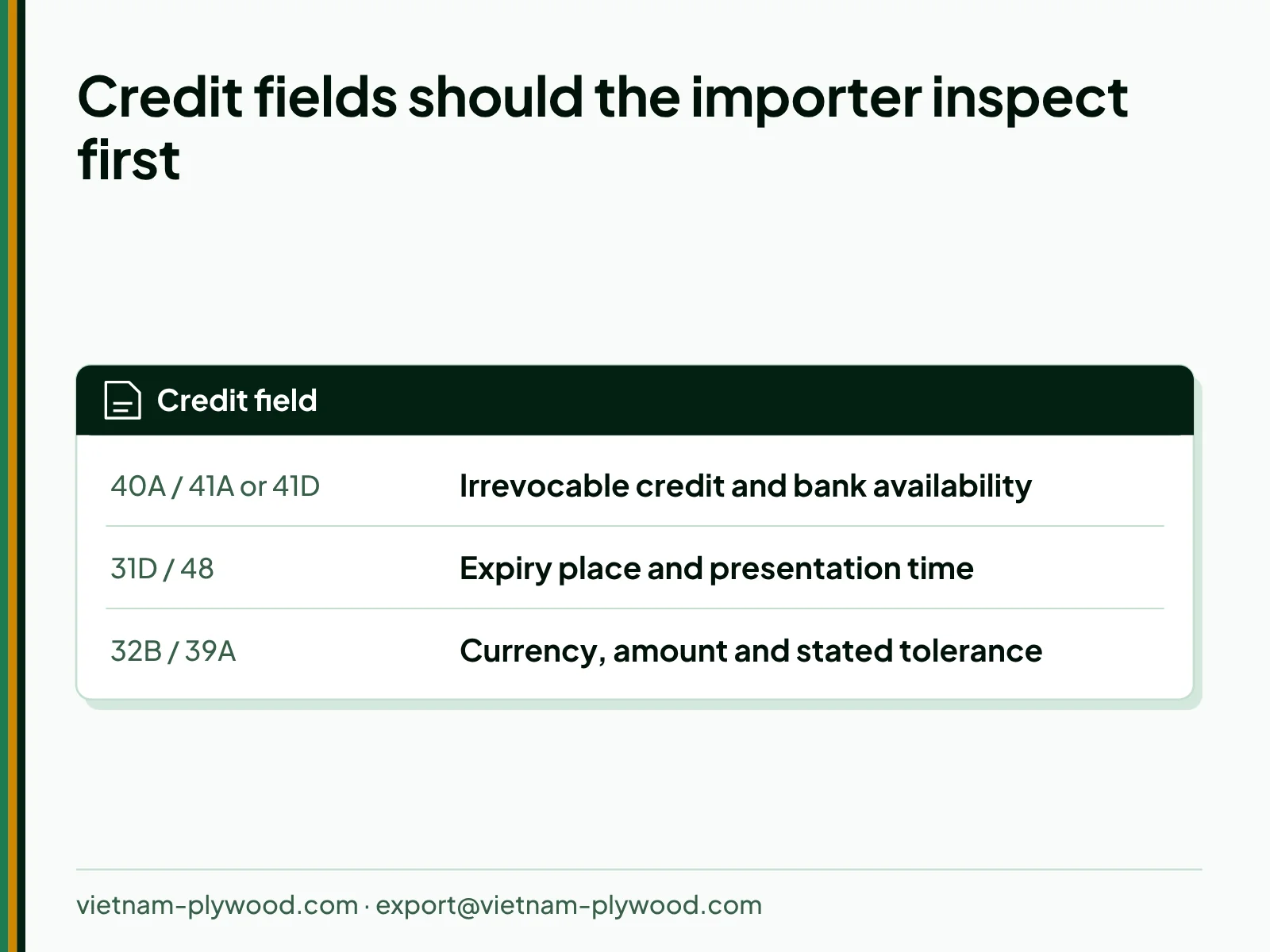
| Credit field | Buyer-side check | Frequent correction |
|---|---|---|
| 40A / 41A or 41D | Irrevocable credit and bank availability | Align sight payment instructions |
| 31D / 48 | Expiry place and presentation time | Allow document delivery after shipment |
| 32B / 39A | Currency, amount and stated tolerance | Match contract and permitted variation |
| 43P / 43T | Partial shipment and transshipment | Match actual carriage plan |
| 44C / 44D | Latest shipment date or shipment period | Reflect agreed loading window |
| 45A | Goods description | Use the approved specification |
| 46A / 47A | Documents and extra conditions | Remove undefined issuer or statements |
| 49 / 71D | Confirmation and charges | Agree banking responsibilities |
The several plywood types in one order page helps structure mixed specifications before they enter field 45A.
What are the common L/C discrepancies on plywood shipments?
The recurring risks are mismatched quantity units, inconsistent product descriptions, late on-board dates and certificates with an issuer or statement different from the credit. Each risk has a specific pre-loading check and a specific corrective action.
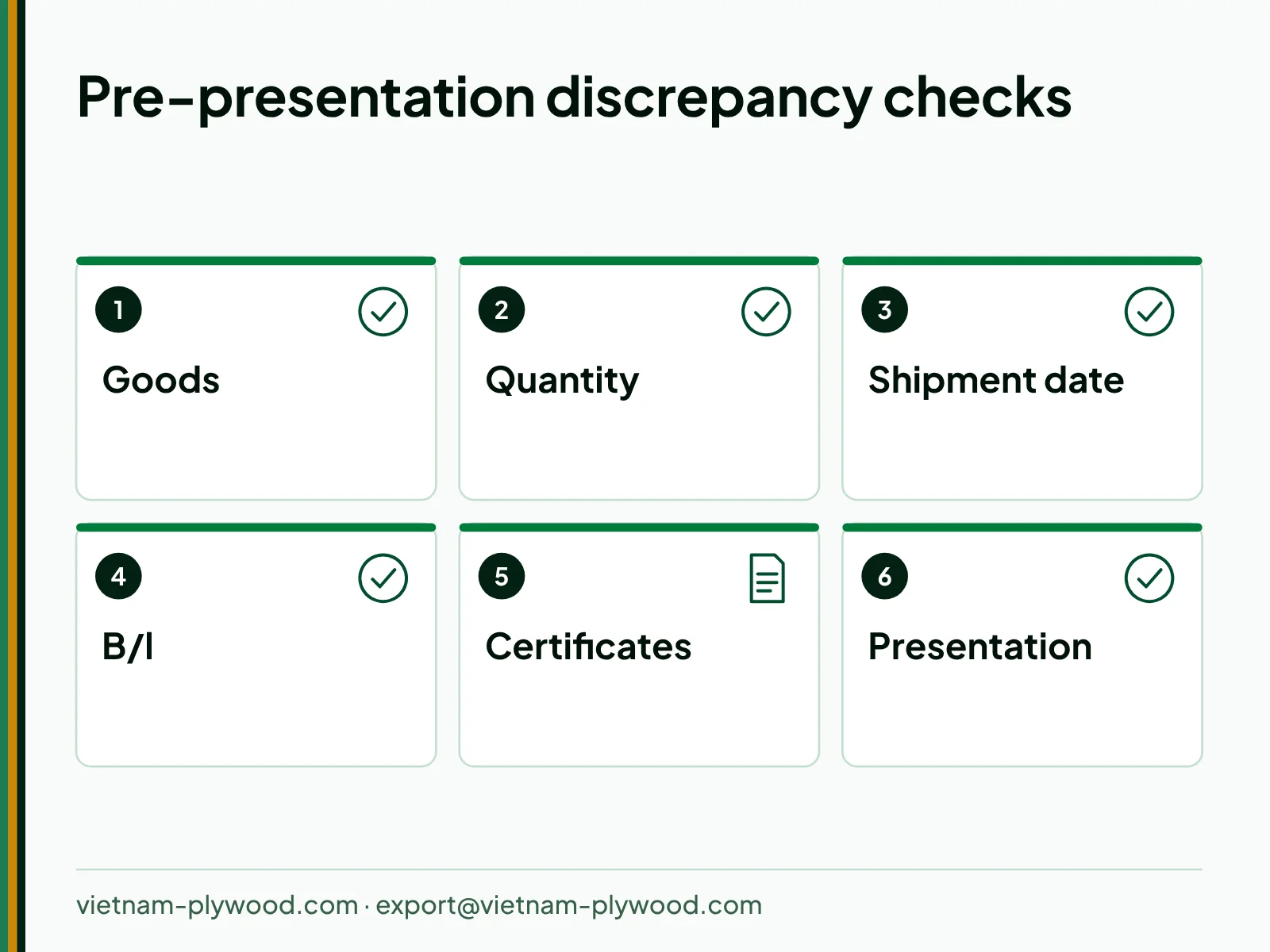
- Goods mismatch: compare field 45A with the final invoice line by line; amend a wrong face, grade or thickness description.
- Quantity mismatch: compare the invoice’s m³ and sheet totals with the packing list and credit tolerance; correct the unit basis before documents are issued.
- Date mismatch: compare field 44C with the intended on-board date; amend the credit before the carrier deadline if necessary.
- Transport mismatch: compare ports, consignee, freight wording and original requirements with the carrier’s draft B/L.
- Certificate mismatch: identify the issuer and exact required content before requesting the inspection, origin or emission paper.
- Presentation mismatch: allow time for obtaining originals and submitting them at the stated bank and place.
ICC UCP 600 Article 14 gives examining banks up to five banking days following presentation to determine compliance. Article 16 permits refusal of a discrepant presentation and sets the notice requirements. A buyer waiver is a possible bank process, not a substitute for issuing a workable credit at the outset.
How should inspection certificates be written?
Specify a measurable inspection event and a document issuer that can actually perform it. At the producing factory, a buyer or appointed inspector can witness panel thickness, surface grade, dimensions and pallet identification against the written specification.
An inspection clause can request a dated certificate identifying the order, inspected product, measurement basis and signatory. Do not demand a certificate from an unnamed “international authority” or insert an unsupported test value. If the order requires a laboratory report, agree the test method, laboratory and acceptance criteria before the credit is opened.
For a factory visit, the buyer can inspect goods where they are pressed and packed. Certificate documentation associated with the member factory is available with factory details masked, on request.
How do amendments and payment terms fit together?
Request a formal credit amendment whenever a required field conflicts with the accepted production or shipping plan. Under ICC UCP 600 Article 10, amendment acceptance involves the issuing bank, confirming bank if any, and beneficiary. An informal instruction between buyer and seller does not rewrite the issued credit.
Our payment terms are a 30% deposit and 70% balance against the scanned B/L, by T/T or irrevocable L/C at sight. The parties should agree how the selected payment method operates in the actual contract and credit. A sight L/C should identify the available bank, documents and payment mechanism clearly, rather than copying a T/T document-release instruction into the bank credit.
Use a pre-issuance review sequence: agree the sales contract checklist, approve the goods schedule, reconcile the transport terms, inspect field 46A, and only then authorise the issuing bank. Keep an amendment log when shipment dates, quantities or certificates change.
What should the buyer send for an L/C-ready specification?
Send a single line-by-line specification that can feed the contract, invoice and documentary credit. Include the core, surface, adhesive, emission class, thickness, tolerance, dimensions and quantity basis, together with destination and the proposed document schedule.
For a mixed load, separate each product line on the invoice and packing list. The minimum order is one 40HC, and specifications can be mixed within its payload limit.
Application: Import distribution / agreed end use
Line or core: Furniture / styrax or eucalyptus; commercial and packing / acacia; construction / acacia or eucalyptus
Glue: MR melamine or WBP phenolic, as agreed
Emission: E0 / E1 / E2 as ordered; certificate requirement if agreed
Face and grade: [veneer species and grade] or [film type and weight]
Thickness and tolerance: [mm] / [ordered +/- mm]
Size: [length x width, mm]
Quantity: [sheets and m3 per item; explicit tolerance and rounding rule]
Destination port: [named discharge port]
Next step: book a factory visit with Lucy to inspect the producing factory and agree the documentary fields before credit issuance.